Archive for the ‘Natural Phenomena’ Category

Mount Sinabung gets deadly as sightseers return

February 1, 2014

Mount Sinabung which has been erupting since September last year, has caused the first fatalities reported. It erupted again on Saturday ejecting rocks and ash and killing 14. The evacuation zone which extended upto 7km from the mountain has been relaxed to 5km, but the 14 people killed were all from the Suka Meriah village which is within 3km of the volcano. A group of sightseeing schoolchildren is reported to be among those killed. Another 3 people were severely injured when  apparently they had been visiting a family grave and their abandoned homes when the volcano spewed its ash.

On Friday the disaster management agency had allowed people living in villages more than 5km from the mountain to return home. Sixteen villages have been evacuated and residents are not supposed to visit for any reason.

The first eruption occurred at 10:30 a.m. and lasted for eight-and-a-half-minutes, spewing 2-kilometer ash and 4.5-km thick clouds to the south. The second eruption took place at 10:38 a.m. for just over four minutes, followed by another eruption at 11:27 a.m. for 84 seconds.

A villager run as Mount Sinabung erupt at Sigarang-Garang village in Karo district, Indonesia's North Sumatra province, February 1, 2014. REUTERS/Stringer

A villager run as Mount Sinabung erupt at Sigarang-Garang village in Karo district, Indonesia’s North Sumatra province, February 1, 2014.
CREDIT: REUTERS/STRINGER

Sources: Jakarta Post, BBC, Reuters

Related: 5 km radius around Mount Sinabung volcano evacuated as eruptions continue

The next VEI 5+ volcanic eruption is overdue

Herring fast frozen in the Norwegian Sea

January 15, 2014

Fast freezing at its natural best.

A shoal of herring was chased towards shore off the island of Lovund, Norway by cormorants. But the air temperature was – 7.8°C with a fresh Easterly wind and the sea froze so fast that the fish were trapped in “mid-swim” (or mid-flight)! Apparently the cormorants have not been able to get to them as yet. They will have to wait till the thaw — and that could be some time.

frozen herring lovund (image Norwegian Radio)

frozen herring lovund (image Norwegian Radio)

Norwegian Radio reports:

It was minus 7.8 degrees and the east wind made ​​the bay freeze in a short time. The shoal of herring had been chased to the shore by cormorants, and apparently had not been able to get out into the open sea again, says Ingolf Kristiansen.

He was on a Sunday outing with his miniature schnauzer Anton when he came across the unusual sight. “I’ve never seen anything like it. It has not happened before here as far as I know”, he said to NRK.no.

Aril Slotte, Head of Pelagic fish at the Sea Research Institute, says it was not uncommon for herring being chased ashore by predators. We know that whales scares herring at various locations in Tromso, so it is not inconceivable that this could happen with small herring and other fish being pushed up against the land”, he said to NRK.no.

In summer the bay is a popular swimming cove. A concrete wall has been built under water so that when the tide comes there is only seepage of seawater in from the open sea. …. 

Frossen sei på Lovund - Foto: Hermann Mindrum /

Frossen sei på Lovund – Foto: Hermann Mindrum

Lovund - Norway

Related: Moose frozen in the ice

5 km radius around Mount Sinabung volcano evacuated as eruptions continue

January 13, 2014

Mount Sinabung keeps rumbling on – and more than just rumbling as eruptions with material ejected upto 5,000m and lava flows are observed. Around 25,000 people have been evacuated for 5km surrounding the volcano and the authorities are urging those within a 7km radius to leave.

JakartaGlobe:More than 25,000 people have fled their homes following a series of eruptions and lava flows from Mount Sinabung volcano, an official said Sunday. Mount Sinabung in North Sumatra sent hot rocks and ash up to 5,000 meters (16,000 feet) in the air “several times” on Saturday, National Disaster Mitigation Agency emergency response director Tri Budiarto told AFP.

“So far, 25,516 people have been evacuated. There’s nobody now within a five-kilometer [three-mile] radius of the crater. We are urging those living within seven kilometers southeast of the crater to move too,” he added. Hot lava, which has been spewing from the volcano for the past two weeks, has flowed into a river and filled up valleys with pyroclastic material, he said.

“There were small secondary explosions when lava flows came into contact with the water, but there are no casualties so far. We are urging people not to carry out any activity in the rivers,” he added.

Mount Sinabung is one of 129 active volcanoes in Indonesia that straddle major tectonic fault lines, known as the Pacific Ring of Fire. It had been quiet for around 400 years until it rumbled back to life in 2010, and again in September last year.

During the 19th century there were volcano eruptions having a Volcanic Explosivity Index (VEI) of 5 or greater on average every 11 years. During the 20th century the average was 7 years with the greatest interval between VEI5 eruptions being 23 years. The last VEI5 eruption was in 1991 and now – 22 years on – a VEI5 eruption is overdue.

Mount Sinabung started its rumblings back in September 2013 and it may be that the continuing small eruptions relieve sufficient pressure to prevent a VEI5+ eruption. But the odds that the next VEI5 eruption occurs in or around Indonesia is still quite high – and it could be that Sinabung is just bubbling up to be a major eruption. However the eruptions are being monitored so closely that any such imminent eruption will probably be detected early enough to get most people out of harms way.

Mount Sinabung Indonesia - Google Maps

Mount Sinabung Indonesia – Google Maps

Supervolcanos can erupt sponataneously without an external trigger

January 7, 2014

New research suggests that supervolcanos do not need an external trigger to erupt. Bouyancy effects and the magma volume could be sufficient for spontaneous eruption.

Wim J. Malfait, Rita Seifert, Sylvain Petitgirard, Jean-Philippe Perrillat, Mohamed Mezouar, Tsutomu Ota, Eizo Nakamura, Philippe Lerch, Carmen Sanchez-Valle. Supervolcano eruptions driven by melt buoyancy in large silicic magma chambersNature Geoscience, 2014; DOI:10.1038/ngeo2042

From the Press Release:

Scientists have reproduced the conditions inside the magma chamber of a supervolcano to understand what it takes to trigger its explosion. These rare events represent the biggest natural catastrophes on Earth except for the impact of giant meteorites. Using synchrotron X-rays, the scientists established that supervolcano eruptions may occur spontaneously, driven only by magma pressure without the need for an external trigger. The results are published in Nature Geosciences.

A well-known supervolcano eruption occurred 600,000 years ago in Wyoming in the United States, creating a huge crater called a caldera, in the centre of what today is Yellowstone National Park. When the volcano exploded, it ejected more than 1000 km3 of ash and lava into the atmosphere, 100 times more than Mt Pinatubo in the Philippines did in 1992. Big volcanic eruptions have a major impact on the global climate. The Mt Pinatubo eruption decreased the global temperature by 0.4 degrees C for a few months. The predictions for a super volcano are a fall in temperatures by 10 degrees C for 10 years.

Abstract: Super-eruptions that dwarf all historical volcanic episodes in erupted volume and environmental impact are abundant in the geological record. Such eruptions of silica-rich magmas form large calderas. The mechanisms that trigger these super-eruptions are elusive because the processes occurring in conventional volcanic systems cannot simply be scaled up to the much larger magma chambers beneath supervolcanoes. Over-pressurization of the magma reservoir, caused by magma recharge, is a common trigger for smaller eruptions, but is insufficient to generate eruptions from large supervolcano magma chambers. Magma buoyancy can potentially create sufficient overpressure, but the efficiency of this trigger mechanism has not been tested. Here we use synchrotron measurements of X-ray absorption to determine the density of silica-rich magmas at pressures and temperatures of up to 3.6 GPa and 1,950 K, respectively. We combine our results with existing measurements of silica-rich magma density at ambient pressures to show that magma buoyancy can generate an overpressure on the roof of a large supervolcano magma chamber that exceeds the critical overpressure of 10–40 MPa required to induce dyke propagation, even when the magma is undersaturated in volatiles. We conclude that magma buoyancy alone is a viable mechanism to trigger a super-eruption, although magma recharge and mush rejuvenation, volatile saturation or tectonic stress may have been important during specific eruptions.

Supervolcanos do not occur all that often – perhaps one every 50,000 to 100,000 years. When they do occur they devastate a large geographical area and affect the climate for a decade or so. How much destruction of organic life occurs depends on the geographical area affected and the life that is extant there.

New Zealand’s Taupo Volcano was the most recent and erupted about 26,500 years ago. With a VEI of 8, just over 1,000 kmof ash were ejected. Though modern man had reached Australia by then, the effects of this eruption do not seem to have significantly delayed the march of humans. The Toba eruption 74,000 years ago occurred when the total population of all human species (Modern Humans, Neanderthals, Denisovans …..) was between 1 and 10 million. This eruption is also classified as a VEI of 8 and 2,800 km³ of material was ejected. Life was virtually extinguished from India to South East Asia. The effects were devastating not only in the fall out-zone but also – it seems – in hampering the expansion of modern humans out of AfricarabiaThis eruption may thus have caused one of the critical bottlenecks which has determined the subsequent evolution and expansion of humans. 

Image

Toba Fallout (Smithsonian Institute)

While a supervolcano could erupt at any time, it is much more probable to occur than a major asteroid collision with the earth (one in 100,000 years as opposed to once in tens of millions of years). But the volume of magma involved suggests that some early detection (perhaps 5 -10 years) may be possible. For the pressure to build up sufficiently in such a volume a significant bulging of the earth’s crust is likely and should be detectable. But while science fiction can imagine a battery of nuclear warheads to divert an oncoming asteroid in its trajectory, it is difficult to conceive of any way to prevent a supervolcano from erupting. Geo-engineering on a  scale massive enough to relieve some of the pressure in the magma is just conceivable at the edge of fantasy but even that could not prevent the eruption.

The next VEI 5+ volcanic eruption is overdue

November 26, 2013

As Indonesia raised the warning level for the Mount Sinabung eruption it is worth noting that the last volcanic eruptions of  5 or greater on the Volcanic Explosivity Index (VEI) scale were the 1991 eruptions of Mount Pinatubo (VEI of 6) and Mount Hudson (VEI of 5).

The currently ongoing Mount Sinabung eruption (pictures here) gives cause for concern, as all Indonesian volcanoes do, but there is no certainty as to what intensity it may finally reach:

Jakarta Post: The volcanic ash spewed by Mount Sinabung in Karo regency, North Sumatra, disrupted a number of flights from Kuala Namu International Airport in Deli Serdang regency on Sunday.
In Bandung, the Center for Volcanology and Geological Hazard Mitigation (PVMBG) increased the volcano’s status to “awas” (beware), the highest level of the four-level alert system.

During the 19th century VEI eruptions of 5 or greater ocurred every 11 years on average with the Krakatoa eruption being the greatest at VEI 6 in 1883. Through the 20th century, an eruption of intensity 5 or greater came at intervals varying from 1 year upto 23 years with an average interval of just under 7 years. The Novarupta (1912) and Mount Pinatubo (1991) eruptions were the two classified at VEI6. 

  • 1902 Santa Maria
  • 1907 Kudach
  • 1912 Novarupta
  • 1913 Colima
  • 1918 Katla
  • 1932 Cerro Azul
  • 1933 Kharimkotan
  • 1956 Bezymianny
  • 1963 Mount Agung
  • 1980 Mount St. Helens
  • 1982 El Chichón
  • 1991 Mount Pinatubo
  • 1991 Mount Hudson

So far in this century the 2010 Eyjafjallajökull eruption in Iceland “only” reached a VEI intensity of 4. The 2012 Mt. Etna eruption was rated a 3+. 

The last VEI 5 level eruption was in 1991 and a major eruption of intensity 5 or greater is now  overdue. The interval of 22 years is almost as long as the longest interval between major eruptions in the 20th century. Of course even VEI 6 is still a great deal less than the VEI 8 of Toba or Yellowstone.

The VEI is an index taking both the volume of tephra ejected as well as the height to which it is ejected into account. While there is no evidence that the impact of volcanic eruptions is more than a temporary perturbation of the underlying climate cycle, these perturbations may well last a year or two. The effect on climate is usually that of cooling.

The most significant climate impacts from volcanic injections into the stratosphere come from the conversion of sulfur dioxide to sulfuric acid, which condenses rapidly in the stratosphere to form fine sulfate aerosols. The aerosols increase the reflection of radiation from the Sun back into space, cooling the Earth’s lower atmosphere or troposphere. Several eruptions during the past century have caused a decline in the average temperature at the Earth’s surface of up to half a degree (Fahrenheit scale) for periods of one to three years. The climactic eruption of Mount Pinatubo on June 15, 1991, was one of the largest eruptions of the twentieth century and injected a 20-million ton (metric scale) sulfur dioxide cloud into the stratosphere at an altitude of more than 20 miles. The Pinatubo cloud was the largest sulfur dioxide cloud ever observed in the stratosphere since the beginning of such observations by satellites in 1978. It caused what is believed to be the largest aerosol disturbance of the stratosphere in the twentieth century, though probably smaller than the disturbances from eruptions of Krakatau in 1883 and Tambora in 1815. 

But an eruption of VEI 5 or greater within the next year or two could well accelerate the underlying global cooling cycle that may be underway (and caused primarily by solar effects – direct and indirect).

The diagram below comes from a guest post by Dan Pangburn at The Hockey Schtick.

Global temperature anomaly and major volcanic eruptions

Volcanic CO2 Levels Are Staggering

November 18, 2013

The carbon balance of the earth is far less understood – or quantified – than “climate scientists” would have us believe. The two largest sources and sinks (forests and the oceans) are generally assumed to be largely in balance. Volcanoes are estimated to produce a very small amount of carbon dioxide. Carbon in rocks brought up from the deep mantle by tectonic activities are assumed to be in balance with the return of sediments and rocks into the deep mantle by subduction. These assumed balances of the big numbers means that the relatively small numbers for emissions from fossil fuel combustion and changing land use then become dominant in explaining the observed increase of carbon dioxide concentration in the atmosphere. But these assumptions include many uncertainties:

Carbon dioxide emission sources (GT CO2/year)

  • Transpiration 440
  • Release from oceans 330
  • Fossil fuel combustion 26
  • Changing land use 6
  • Volcanoes and weathering 1

Carbon dioxide is accumulating in the atmosphere by about 15 GT CO2/ year. The accuracy of the amounts of carbon dioxide emitted by transpiration and by the oceans is no better than about 2 – 3% and that error band (+/- 20GT/year)  is itself almost as large as the total amount of emissions from fossil fuels.

But it now appears that even the carbon dioxide emissions from volcanoes have been grossly underestimated. Not only have the emissions from erupting volcanoes been underestimated but it also seems that many volcanoes emit carbon dioxide almost continuously and invisibly (a diffuse degassing).

Volcanic CO2 Levels Are Staggering 

Robin Wylie, University College London   |   October 15, 2013

…. Until the end of the 20th century, the academic consensus was that this volcanic output was tiny — a fiery speck against the colossal anthropogenic footprint. Recently, though, volcanologists have begun to reveal a hidden side to our leaking planet.

Exactly how much CO2 passes through the magmatic vents in our crust might be one of the most important questions that Earth science can answer. Volcanoes may have been overtaken in the carbon stakes, but in order to properly assess the consequences of human pollution, we need the reference point of the natural background. And we’re getting there; the last twenty years have seen huge steps in our understanding of how, and how much COleaves the deep Earth. But at the same time, a disturbing pattern has been emerging.

In 1992, it was thought that volcanic degassing released something like 100 million tons of COeach year. Around the turn of the millennium, this figure was getting closer to 200. The most recent estimate, released this February, comes from a team led by Mike Burton, of the Italian National Institute of Geophysics and Volcanology – and it’s just shy of 600 million tons. It caps a staggering trend: A six-fold increase in just two decades. ……

….. As scientific progress is widening our perspective, the daunting outline of how little we really know about volcanoes is beginning to loom large. ….

…. We now know that the CO2 released during volcanic eruptions is almost insignificant compared with what happens after the camera crews get bored. The emissions that really matter are concealed. The silent, silvery plumes which are currently winding their way skyward above the 150 or so active volcanoes on our planet also carry with them the bulk of its carbon dioxide. Their coughing fits might catch the eye — but in between tantrums, the steady breathing of volcanoes quietly sheds upwards of a quarter of a billion tons of CO2 every year. 

We think. Scientists’ best estimates, however, are based on an assumption. It might surprise you to learn that, well into the new century, of the 150 smokers I mentioned, almost 80 percent are still as mysterious, in terms of the quantity of CO2 they emit, as they were a generation ago: We’ve only actually measured 33.

If the 117 unsampled peaks follow a similar trend, then the research community’s current projection might stand. But looking through such a small window, there’s no way of knowing if what we have seen until now is typical or not. It’s like shining a light on a darkened globe: randomly, you might hit Australia, and think you’d seen it all – while on the edge of your beam, unnoticed, would be Asia. Our planet’s isolated volcanic frontiers could easily be hiding a monster or two; and with a bit of exploration, our estimate of volcanic CO2 output could rise even higher.

You’d think that would be enough. That might be my fault — I tend to save the weird stuff until the end. Recently, an enigmatic source of volcanic carbon has come to light that isn’t involved with lava — or even craters. It now seems that not only is there CO2 we can’t get to, there’s some we can’t even see.

Carbon dioxide is always invisible, but its presence can be inferred in volcanic plumes — betrayed by the billowing clouds of water vapour released alongside it. Without the water, though, it’s a different story. The new poster-child of planetary degassing is diffuse CO2 — invisible emanations which can occur across vast areas surrounding the main vents of a volcano, rising through the bulk of the mountains. This transparent haze is only just beginning to receive proper attention, and as such we have very little idea of how much it might contribute to the global output.

Even more incredibly, it even seems that some volcanoes which are considered inactive, in terms of their potential to ooze new land, can still make some serious additions to the atmosphere through diffuse COrelease. Residual magma beneath dormant craters, though it might never reach the surface, can still ‘erupt’ gases from a distance. Amazingly, from what little scientists have measured, it looks like this process might give off as much as half the CO2 put out by fully active volcanoes.

If these additional ‘carbon-active’ volcanoes are included, the number of degassing peaks skyrockets to more than 500. Of which we’ve measured a grand total of nine percent.

Related: Deep Carbon Emissions from Volcanoes


Power lines, the Army and arsonist kids helped ignite some NSW bushfires

October 29, 2013

The bushfires in New South Wales  seem – after great efforts by the fire services – to be under control. No doubt some rain has helped.

Of course some of the great unwashed immediately blamed “global warming”. The self proclaimed – and now self-employed – “Climate Council” was of course leading the charge. Tony Abbott called their claims “hogwash” but he was being rather polite. The bushfires are an annual event every spring and have occurred every year for at least the last 200 years. It may well be something that has ocurred annually for over 10,000 years.

It now transpires that in addition to natural causes, many of the fires were caused by accidents (the army’s exercises and power lines) and some were caused by juvenile delinquents – some as young as 8 years old! It could be that the power lines initiated this latest outbreak.

The Climate Council is drowning in its own self-importance and is indeed replete with hogwash –  and much of that is intentional.

  1. THE Department of Defence was last night found to have caused the State Mine Blaze near Lithgow, which has so far burnt out more than 46,000ha, led to one home being destroyed and three others damaged, and narrowly avoided turning into a “mega-fire”.

    The Rural Fire Service said an investigation had found a Department of Defence training exercise last week was responsible for the fire, west of the Blue Mountains, but the department said last night that there was still no definitive evidence that defence personnel had inadvertently started the blaze.

    “The investigation has concluded the fire started as a result of exploding ordnances on the range on (last) Wednesday,” a RFS spokesman said.

  2. POLICE detained two eight-year-old boys near East Maitland on the NSW North Coast last night after they were found trying to start a fire.Officers found the boys trying to use a lighter to set fire to dried leaves and grass on vacant land near Quarry St around 6:30pm AEST. A concerned resident called police to the scene and the lighter was later found to be “inoperable”, the law enforcement agency said in a statement.

    No charges were laid because of their age.

  3. AFTER one night in custody, the 11-year-old boy accused of lighting a 5000ha Hunter Valley bushfire walked free from court yesterday, flipping the bird to media waiting outside. …. The boy pleaded not guilty in Newcastle Children’s Court to two counts of starting a bushfire and recklessly causing its spread – a charge that carries a maximum sentence of two years’ detention for minors. But conviction records from the Bureau of Crime Statistics and Records show just one offender aged under 18 has ended up in detention for the offence in the past three years. The 11-year-old accused of lighting the October 13 Heatherbrae fire allegedly started another blaze earlier that day in the nearby suburb of Raymond Terrace.
  4. Bushfire risks posed by powerline failures are in the spotlight following last week’s crisis in New South Wales, …… In the wake of the NSW bushfire crisis, Four Corners has examined almost four decades worth of evidence into the cause and impact of major bushfires. Some of the most catastrophic bushfires in Australia’s history have been started by powerline failure. It is believed the most devastating fires in NSW last week began as a result of damaged powerlines.  In Victoria’s Murrindindi fire in 2009, which led to 40 deaths on Black Saturday, police initially focused their investigation on an alleged arsonist. However, after abandoning that line of inquiry, a case is now being made that a fallen powerline ignited the blaze. Law firm Maurice Blackburn is representing victims of the Murrindindi fire in a class action against power company SP Ausnet. The company rejects accusations its wire caused the fire. If proven, it means 93 per cent of the deaths on Black Saturday – Australia’s worst bushfire disaster – were caused by fires started by powerlines. ….. The issue of powerlines has not been at the centre of public debate. The program also found power companies have known since 1974 that their lines can cause fires. …… The Rural Fire Service, however, has said it believes fires in Salt Ash, Mount Victoria and Springwood were started by powerlines. Together, these fires destroyed 204 homes and damaged 110.

In India religion is more destructive than natural “disasters”

October 14, 2013

The headlines tell the tale.

Religion and caste and all that follows from them are more debilitating in Modern India than any “natural disaster”.

It is time to do away with the majority of temples and mosques and churches and shrines – and it would not be wrong to replace them with toilets!

1. 113 dead in Madhya Pradesh temple stampede, toll likely to rise

Hindustan Times  – ‎12 minutes ago‎
At least 113 people were killed and more than 100 injured in a stampede on a crowded bridge across Sindh river leading to Ratangarh temple in Datia district of northern Madhya Pradesh on Sunday.

2. Death toll rises to 21, floods affect thousands in Odisha

Firstpost  – ‎7 minutes ago‎
The death toll due to pre and post cyclone Phailin devastations has gone up to 21. One more death was reported late Sunday night, a senior government official told IANS. “The latest death took place in Balasore, where two people were drowning in flood …

3. Sexual assault case: Asaram to be taken to Ahmedabad today

IBNLive  – ‎1 hour ago‎
Jodhpur: Self-styled godman Asaram will be brought to Ahmedabad on Monday for questioning in another sexual assault case. The Jodhpur court has given permission to the Gujarat police to take him in custody for interrogation in the case filed by two sisters …

4. UP govt suspends senior IAS officer Mishra

indiatvnews.com  – ‎12 hours ago‎
Lucknow: A day after his transfer, senior IAS officer Sarvesh Chandra Mishra was today suspended and a departmental probe initiated against him over a controversial letter convening a meeting to discuss “reconstruction of Ram Temple in Ayodhya on lines …
 

5. No untouchability in politics, says Pawar

Indian Express  – ‎1 hour ago‎
NCP chief and Union Agriculture Minister Sharad Pawar, speaking at a programme organised by BJP leader Nitin Gadkari’s Purti Group here on Saturday, said “there should be no untouchability in social and political spheres of life”.

Phailin came and Phailin went: Alarmists and Warmists disappointed

October 13, 2013

Cyclone Phaelin came and it has now gone.

The Greens around the world are somewhat disappointed that many thousands have not died.

It was a very severe cyclone when it hit (windspeed 200km/h) but it did not reach the classification as a Super Cyclone (>220km/h windspeed).

It was a massive evacuation and that itself was somethiing of an achievement. More than 600,000 (and maybe as many as 1 million) moved or were moved out of harms way. 7 are known to have died in cyclone related events (falling trees in the main). Damage reports have yet to be assessed. Some fishermen are known to be stranded. The military is mobilised and stands ready for rescue and rehabilitation.

The Indian Meteorological community got it about right. But there were those who predicted that it would not only be a Super Cyclone at 220km/h but would be a Super Dooper Cyclone with winds up to 315km/h.

The US Navy’s Joint Typhoon Warning Center (JTWC) in Pearl Harbor, Hawaii, on Friday said Phailin is now expected to break the Indian Ocean intensity record set by the 1999 Cyclone in which at least 9,000 people were killed in Odisha.

Alarmists started criticising the preparations and the evacuations and suggested it would be worse than 1999 where at least 15,000 (unofficially 45,000) died. The Global Warmists at Huffington Post almost seemed to want the loss of life to be as high as possible so that they could blame Global warming (but note that they manage to blame any untoward weather event on Global Warming)

India should rename this meaningless obfuscation and call attention to global warming immediately. .. The anthropogenic global warming caused by accumulation of greenhouse gases is making the oceans warmer, which in turn is causing more frequent and more intense cyclones/hurricanes and floods.

Needless to say the Environ-Mentalists at Greenpeace were also hoping for a major disaster

Intense and destructive storms are likely to occur more frequently as global warming intensifies, Greenpeace said Saturday. “Such intense and destructive storms are likely to become more frequent in the future as global warming intensifies.  India member Biswajit Mohanty. According to the organisation, cyclone Phailin which is expected to hit the coastal areas of Odisha and Andhra Pradesh is likely to be the strongest such to affect India in 14 years, since the 1999 Odisha cyclone.

The Green Brigade conveniently forget that a Super Cyclone is generated in the Bay of Bengal every 10-20 years. It is a natural phenomenon known for at least the last 200 years. The super Cyclone of 1970 killed over 500,000 people. And the lessons learned since 1999, the major evacuation and the other preparations made seem to have achieved their objective and minimised the loss of life.

It was a severe storm and has surely caused some significant damage. But it is something which happens regularly and not anything unprecedented. It was not a Super Cyclone.

And it was nowhere near the major disaster that Alarmists, Greenpeace, Global Warmists and Environ-Mentalists were hoping for.

Cyclone Phaelin makes landfall – Severe storm but not a Super Cyclone

October 12, 2013

UPDATE!

Saturday: 11:30pm IST: It has been some 3 hours since Phaelin made landfall as a Severe Cyclone but without the wind-speed to be classified as a Super Cyclone. The full effects will now not be known till morning but it would seem that up to 1 million people may have moved – or been moved – out of harms way.

It is too early to give way to optimism. But fingers are crossed that the evacuations and advance preparations have been successful and that fatalities will be orders of magnitude lower than in 1999 or 1991.

==============================================

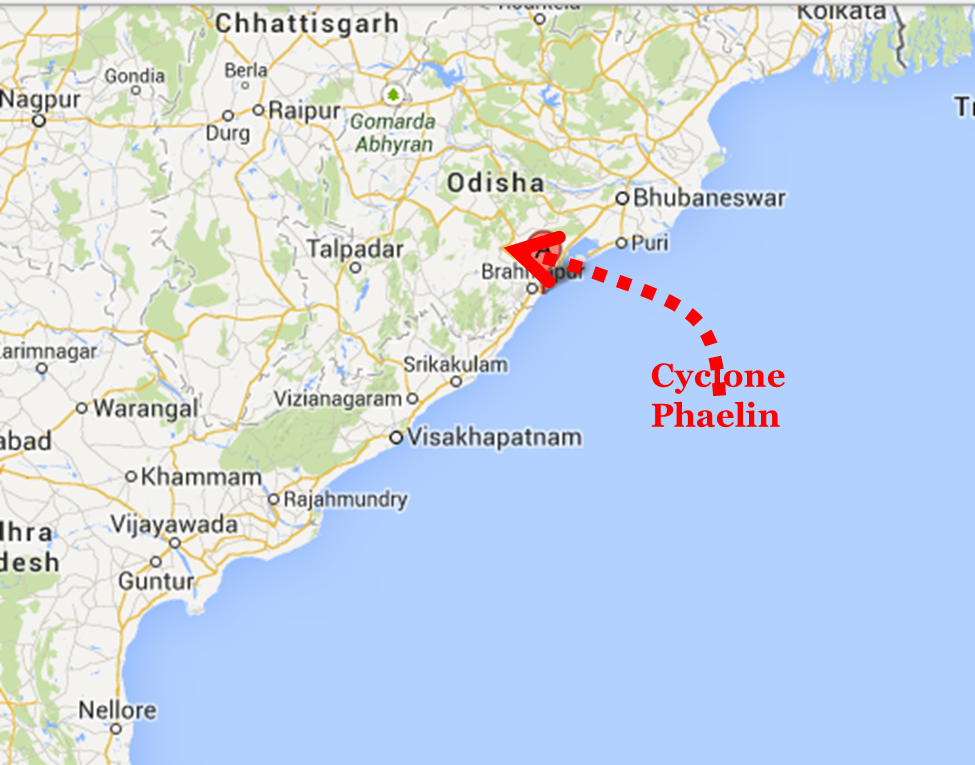
Phaelin made landfall at about 8:20pm local time just south of Gopalpur, Odisha. The cyclone has slowed down and has veered a little Westwards. Windspeeds at landfall were reported to be around 200km/h.

Apart from 7 reported killed due to falling trees in the high winds, damage reports are not yet available.

Phaelin Landfall Googlemaps

Phaelin Landfall Googlemaps