Archive for the ‘Science’ Category

Comet C/2013 A1 (Siding Spring) could impact Mars on 19th October 2014

March 21, 2013

Comet Shoemaker–Levy 9  broke apart and collided with Jupiter in July 1994, providing the first direct observation of an extraterrestrial collision of Solar System objects.

The collision provided new information about Jupiter and highlighted its role in reducing space debris in the inner Solar System.

But a much closer event could be in the offing for next year. A newly discovered comet has been found to have an orbit which takes it extraordinarily close to Mars in October 2014 and the possibility of an impact is 1 in 600. The size of the comet is still uncertain but some estimates are of the nucleus being 50 km in diameter. An impact crater on Mars – if an impact occurs – could then be about 500 km in diameter.

C/2013 A1 (Siding Spring) is a comet originating from the Oort cloud and was only discovered in January this year by Robert H. McNaught at Siding Spring Observatory in Australia,  using a 0.5-meter  Schmidt telescope. By looking at observations made before the comet was identified as a comet on 3rd January, NASA states “Pre-discovery observations located in the archives have extended the observation interval back to Oct. 4, 2012”.

NASA/JPL Near-Earth Object Program Office 
March 5, 2013

On Oct. 19, 2014, Comet 2013 A1 (Siding Spring) will pass extraordinarily close to Mars, almost certainly within 300,000 km of the planet and possibly much closer. Our current best estimate has it passing about 50,000 km from the surface of Mars. This is about 2.5 times the distance of Mars’ outermost satellite Deimos or less than twice the Earth close approach distance of 2012 DA14 on February 15, 2013. Since the observation span available for orbit determination is still relatively short, the current orbit is quite uncertain and the nominal close approach distance will change as additional observations are included in future orbit estimates. Currently, Mars lies directly within the range of possible paths for the comet and we can’t exclude the possibility that the comet might impact Mars. Our current estimate for the impact probability is less than one in six hundred and we expect that future observations will allow us to completely rule out a Mars impact.

This computer graphic depicts the orbit of comet 2013 A1 (Siding Spring) through the inner solar system. Image credit: NASA/JPL-Caltech

This computer graphic depicts the orbit of comet 2013 A1 (Siding Spring) through the inner solar system. Image credit: NASA/JPL-Caltech

Although the current heliocentric orbit is hyperbolic (i.e., eccentricity greater than one), the orbit is elliptic when expressed in the frame of the solar system’s barycenter. After more than a million year journey, this comet is arriving from our solar system’s distant Oort cloud. It could be complete with the volatile gases that short period comets often lack due to their frequent returns to the sun’s neighborhood.

During the close Mars approach, the comet will likely achieve a total visual magnitude of zero or brighter as seen from Mars-based assets. The attached illustration shows the comet’s approximate, apparent visual magnitude and its solar elongation angle as a function of time as seen from Mars. Because the comet’s apparent magnitude is so uncertain, the brightness curve was cut off at apparent visual magnitude zero. However, the comet may get brighter than magnitude zero as seen from Mars. From Earth, the comet will not likely reach naked eye brightness but it could brighten to visual magnitude 8 as seen from the southern hemisphere in mid-September 2014.

This illustration, prepared by Jon Giorgini, shows the apparent total visual magnitude and solar elongation angle as seen from the center of Mars

This illustration, prepared by Jon Giorgini, shows the apparent total visual magnitude and solar elongation angle as seen from the center of Mars image NASA

Life below the seabed which does not depend on photosynthesis

March 18, 2013

A new paper describes the finding of  live microbial communities in the earth’s crust deep below the seabed. Without recourse to sunlight and photosynthesis these bacteria seem to have found a different source of energy. “The bacteria feed on chemicals that are released when water seeps down through the rocks. The rocks contain iron ions that can react with sea water and produce hydrogen, which the bacteria can use as an energy source for producing their own organic matter,” says author Mark Lever. “This form of chemical synthesis, which is an alternative energy source to photosynthesis, also occurs elsewhere on Earth, for instance around warm springs in the seabed. But this is the first time that it has been found in the earth’s crust below the sea.”

M.A. Lever et al., “Evidence for microbial carbon and sulfur cycling in deeply buried ridge flank basalt,” Science, 339:1305-08, 2013DOI:10.1126/science.1229240

The Scientist: Tiny fissures in 3.5-million-year-old rock hundreds of meters below the seabed are home to microbes that gain their energy from the rock itself, according to a paper published in Science today (March 14). The study suggests that the largest ecosystem on the planet depends on energy, not from the sun, but from chemical reactions.

“The fact that you can get viable microbes out of those rock samples—and they’re clearly indigenous; they’re not contaminants—that’s just tremendously exciting,” said Andy Fisher, a professor of earth and planetary sciences at the University of California, Santa Cruz, who was the lead scientist on the drilling vessel.

The oceanic crust of volcanic-derived basalt rock lies below the sedimentary seabed, covers approximately two thirds of the Earth’s surface, and is on average 7 kilometers thick. Although scientists have found evidence of life within this vast expanse of rock, the samples obtained were of crustal fluids, rather than the basalt itself, explained Mark Lever, an ecologist at Aarhus University in Denmark, who led the study. “Ours was the first direct study that conclusively showed that there is life within these rocks,” he said. …..

….. The thick layer of sediment “acts like a blanket” to keep the relatively young crust warm, around 64°C, explained Damon Teagle, a professor of geochemistry at Southampton University in the UK, who was not part of the team. It also largely prevents seawater from entering the rock from above, he said. There is, however, horizontal flow of water through the rock from distant sediment-free entry points created by small seamounts. But, by the time that water has reached the site where Lever’s rock samples were collected, “it’s suggested to be over 10,000 years old,” said Lever. The water in the samples is also free of oxygen and chemically quite distinct from seawater due to the filtering effect of passing through rock. …..

…… Back in his land-based lab, Lever and colleagues extracted DNA from the fissure samples and identified genes for methane and sulfur metabolism, consistent with microbes living in an oxygen-free environment. He also observed that the chemical composition of the rock samples was in line with methane and sulfur metabolism by resident microbes.

The presence of microbial genes and characteristic rock chemistry was not sufficient to confirm the existence of life, however. “The sulfur and carbon isotopes that were analyzed could, in theory, have been produced thousands or millions of years ago,” said Lever, and the microbial DNA could have been from fossils. But, he added, “we didn’t just find DNA.”

The team also found that rocks incubated for several years under conditions resembling the crustal environment exhibited rising methane levels. “[It’s] evidence that [the microbes] are active and directly gaining energy from reactions with the rocks,” Lever said. ….

The McIntyre – The Bane of Climate Dogma and Mighty Slayer of Hockey Sticks

March 17, 2013

Steve McIntyre is

known in particular for his statistical critique, with economist Ross McKitrick, of the controversial hockey stick graph, which shows a sharp, and arguably unprecedented, increase in late 20th century global temperature.

He is at his sleuthing best again and Science will soon have to retract this new “hockey stick” paper

A Reconstruction of Regional and Global Temperature for the Past 11,300 Years, by Shaun A. Marcott, Jeremy D. Shakun, Peter U. Clark and Alan C. Mix, Science 8 March 2013: Vol. 339 no. 6124 pp. 1198-1201 DOI: 10.1126/science.1228026

This paper is apparently based on Marcott’s PhD thesis but the thesis contains no hockey stick!

By the time the paper was published a hockey stick had appeared.  In the most generous interpretation  the paper was “modified” to fit in with global warming dogma before being published in Science. A less generous – but more likely –  interpretation is that this is just fraud instigated probably by the global warming pundits who were the reviewers of the Science paper.

McIntyre’s latest post is a breathtaking indictment of the paper:

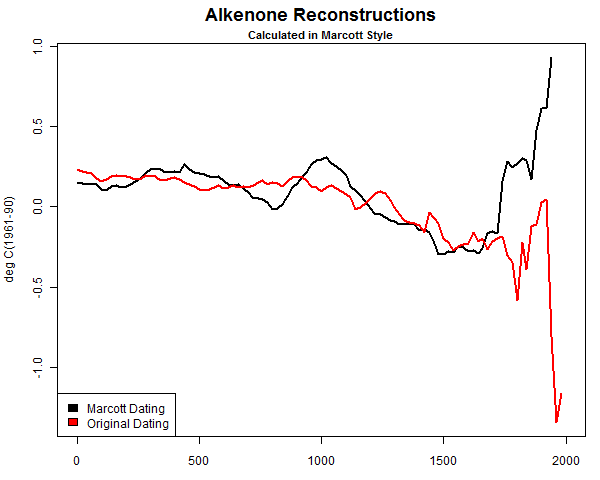
Marcott, Shakun, Clark and Mix did not use the published dates for ocean cores, instead substituting their own dates. The validity of Marcott-Shakun re-dating will be discussed below, but first, to show that the re-dating “matters” (TM-climate science), here is a graph showing reconstructions using alkenones (31 of 73 proxies) in Marcott style, comparing the results with published dates (red) to results with Marcott-Shakun dates (black). As you see, there is a persistent decline in the alkenone reconstruction in the 20th century using published dates, but a 20th century increase using Marcott-Shakun dates. (It is taking all my will power not to make an obvious comment at this point.)
alkenone-comparison
Figure 1. Reconstructions from alkenone proxies in Marcott style. Red– using published dates; black– using Marcott-Shakun dates.

Read More

The media went bonkers in reporting the Marcott paper  and this diagram will now go down in infamy:

marcott et al

This scandal is causing much attention ( here and here) but there is a deafening silence from the authors, from Science and from the – no doubt – anonymous reviewers.

I cannot draw but I have a clear image of a lone McIntyre battling against the Hockey Sticks. Perhaps a Josh can do justice to the image in my head.

The McIntyre slaying the Hockey Stick

The McIntyre slaying the Hockey Stick

Prof. Peter A. Ziegler: Solar effects drive climate change not CO2

March 14, 2013
Peter Ziegler

Peter Ziegler: image The Geological Society

Prof. Peter Ziegler (b. 1928) is a Swiss geologist  and Titular Professor of Global Geology at the Geological-Paleontological Institute, University of Basel. He is a member of the Royal Netherlands Academy of Sciences, the Polish Academy of Arts and Sciences, the Russian Academy of Natural Sciences and the Academia Europaea. His presentation on the “Mechanisms of Climate Change” from February this year is pretty self-contained and self explanatory and my comments would only be superfluous.

Climate Change Ziegler 2013 (pdf)

I reproduce his conclusions slide below:

  • Climate change during industrial times can be fully explained by natural processes
  • During the last 550 Million years major natural climate changes involved large fluctuations in temperature and atmospheric CO2 concentrations
  • Apart from orbital forcing and the distribution of continents and oceans, variations in solar activity and the galactic cosmic ray flux controlled climate changes during the geological past and probably still do so
  • Despite rising atmospheric CO2 concentrations we may experience during the coming decades a serious temperature decline akin to the Maunder Minimum due to decreasing solar activity
  • There is overwhelming evidence that Temperature forces the Carbon Cycle and not vice-versa, as postulated by IPCC
  • IPCC underestimates the effects of direct and indirect solar climate forcing but overestimates CO2 forcing by assuming unrealistic positive temperature feedbacks from a concomitant water vapor and cloud increase
  • The IPCC consensus on anthropogenic CO2 emissions causing Global Warming cannot be reconciled with basic data and is therefore challenged

Water in the Earth’s interior

March 14, 2013

Phase diagram for water substance. image – craigssenseofwonder.wordpress.com

Water at supercritical conditions is a strange beast and has some remarkable chemistry. It is a fluid with properties that are a blend of gas and liquid properties. Steam at supercritical conditions (around 220 – 250 bar and about 600 °C)  is in common use in large power plants since it can be expanded in steam turbines for power generation. It has gas-like properties such that – as an Oxygen carrier – it could even support combustion/oxidation processes. It has liquid like properties and can be used as a solvent.

It would seem that if water is contained in the interior of the earth’s crust it could be at pressures above 22 MPa (220 bar) and temperatures above 374°C, beyond the critical point, and its properties as a very aggressive solvent  could be controlling the behavior of magma. So perhaps plate tectonics is all down to water?

I am a little skeptical since I observe – in passing – that the behaviour of supercritical steam does not seem to dissolve away steam turbine blades or casings when used in power generation!

A new paper on the 

Microscopic structure of water at elevated pressures and temperatures  by C. J. Sahle, C. Sternemann, C. Schmidt, S. Lehtola, S. Jahn, L. Simonelli, S. Huotari, M. Hakala, T. Pylkkanen, A. Nyrow, K. Mende, M. Tolan, K. Hamalainen and M. Wilke.

 Proceedings of the National Academy of Sciences, 2013; DOI: 10.1073/pnas.1220301110

From the press release from the Helmholtz Centre, Potsdam

13.03.2013 | Potsdam: Earth is the only known planet that holds water in massive quantities and in all three phase states. But the earthly, omnipresent compound water has very unusual properties that become particularly evident when subjected to high pressure and high temperatures. In the latest issue of the Proceedings of the National Academy of Science (PNAS), a German-Finnish-French team published what happens when water is subjected to pressure and temperature conditions such as those found in the deep Earth. At pressures above 22 MPa and temperatures above 374°C, beyond the critical point, water turns into a very aggressive solvent, a fact that is crucial for the physical chemistry of Earth’s mantle and crust.

“Without water in Earth’s interior there would be no material cycles and no tectonics. But how the water affects processes in the upper mantle and crust is still subject of intense research”, said Dr. Max Wilke from the GFZ German Research Centre for Geosciences, who carried out the experiments along with his colleague Dr. Christian Schmidt and a team from the TU Dortmund. To this end, the research team brought the water to the laboratory. First, the microscopic structure of water as a function of pressure and temperature was studied by means of X-ray Raman scattering. For that purpose, diamond anvil cells of the GFZ were used at the European Synchrotron Radiation Facility ESRF in Grenoble. Inside the cell, a very small sample of water samples was enclosed, heated and brought to high temperatures and pressures. The data analysis was based on molecular dynamics simulations by the GFZ scientist Dr. Sandro Jahn.

“The study shows that the structure of water continuously develops from an ordered, polymerized structure to a disordered, marginally polymerized structure at supercritical conditions,” explains Max Wilke. “The knowledge of these structural properties of water in the deep earth is an important basis for the understanding of chemical distribution processes during metamorphic and magmatic processes.” This study provides an improved estimate of the behavior of water under extreme conditions during geochemical and geological processes. It is believed that the unique properties of supercritical water also control the behavior of magma.

Finale! Climategate 3.0 released and speculation about Mr. FOIA is rife

March 14, 2013

The anonymous disseminator of the Climategate emails (Climategate and Climategate 2.0) has been dubbed Mr. FOIA in the blogosphere. He still remains anonymous but he has now released the password for the large email dump he released under CG2.0. The password has been released to some selected bloggers  in the hope that they will have the time to sift through them, leave out any personal or irrelevant indiscretions and focus on the unprofessional and unethical manipulations of data by the “climate science” clique/hierarchy that was first revealed in Climategate.

We shall no doubt be hearing much over the next few weeks as this “crowd-sourced” analysis of the emails proceeds.

Mr. FOIA has probably achieved more than any other single individual in applying some brakes to the runaway train that was the global warming orthodoxy before Copenhagen. There is much speculation as to the identity of Mr. FOIA and my current speculative summary of his profile is:

    • not resident in the US or UK (>99%)
    • unlikely (<30%) to be usually resident in one of the old Commonwealth countries (Australia, Canada, S. Africa, India, N. Z., ….)
    • probably (>99%) not a native English speaker but with a formidable command of English
    • has possibly (>60%) been assigned to the University of East Anglia for some time (any faculty)
    • may have been (c. 30%) temporarily assigned to the CRE of the UEA
    • high probability of being resident in Europe (>70%)
    • could possibly (>30%) be originally from Scandinavia/Baltic States/N. Europe
    • has spent considerable time in the IT/programming fields (>99.9%)
    • IT experience perhaps only as support for his mainstream activities (>60%)
    • probably (>95%) male
    • probably (>75%) “white”
    • probably (>80%) aged under 50
    • probably (c. 80%) now agnostic/humanistic
    • probably (>50%) brought up as a Protestant/Lutheran
    • probably (> 50%) prefers wine to beer
    • probably (>50%) prefers beer to whiskey
    • probably (>60%) prefers soccer to baseball
    • probably (>80%) does not play golf

A photograph of Phil Jones – one of the Climategate stars – in his office from Tom Nelson’s blog.  I can see why FOIA requests are far too time consuming for him! A good thing that the science is settled. If only Phil had learnt to use Excel.

Phil Jones in his office with his data. Good thing the science is settled.

Neanderthals died out because they could see better than humans

March 13, 2013

Hot on the heels of the theory that Neanderthals died out because they couldn’t adapt from hunting big game to hunting rabbits comes this new theory that they died out because they developed bigger eyes than humans’ in the cold dark Northern latitudes!  The theory goes like this:

Their large eyes led to too much of their brain capacity being used for processing visual information and since more of their brain capacity was also needed to handle the motion of their larger, heavier bodies, this  resulted in less brain capacity being available for cognitive reasoning. They therefore had less brain to deal with other functions like social networking” and had “fewer friends to help them out in times of need”Obviously they then remained culturally trapped in the Stone Age and could not develop written language or Facebook or Agriculture as competing humans eventually did. Apart from a few intrepid and promiscuous Neanderthals who managed to participate in contributing their genes to the human gene pool, all the rest died out.

A novel theory but a little far-fetched!

Eiluned Pearce

This is the theory of  Eiluned Pearce a DPhil student at Oxford and is published in  a paper published today in the Proceedings of the Royal Society B (but where it is beyond a pay wall). A press release has been issued by the University of Oxford.

The only data are measurements of eye sockets in 13 Neanderthal skulls compared to those in 32 human skulls from the same time. All the rest is just conjecture – and then further conjecture based on the original speculation.  It would seem to be a little light on data and a little heavy on conjecture. It is still an interesting conjecture nevertheless.

… Looking at data from 27,000–75,000-year-old fossils, mostly from Europe and the Near East, they compared the skulls of 32 anatomically modern humans and 13 Neanderthals to examine brain size and organisation. In a subset of these fossils, they found that Neanderthals had significantly larger eye sockets, and therefore eyes, than modern humans. 

The researchers calculated the standard size of fossil brains for body mass and visual processing requirements. Once the differences in body and visual system size are taken into account, the researchers were able to compare how much of the brain was left over for other cognitive functions.

Previous research by the Oxford scientists shows that modern humans living at higher latitudes evolved bigger vision areas in the brain to cope with the low light levels. This latest study builds on that research, suggesting that Neanderthals probably had larger eyes than contemporary humans because they evolved in Europe, whereas contemporary humans had only recently emerged from lower latitude Africa.

‘Since Neanderthals evolved at higher latitudes and also have bigger bodies than modern humans, more of the Neanderthal brain would have been dedicated to vision and body control, leaving less brain to deal with other functions like social networking,’ explains lead author Eiluned Pearce from the  Institute of Cognitive and Evolutionary Anthropology at the University of Oxford.

‘Smaller social groups might have made Neanderthals less able to cope with the difficulties of their harsh Eurasian environments because they would have had fewer friends to help them out in times of need. Overall, differences in brain organisation and social cognition may go a long way towards explaining why Neanderthals went extinct whereas modern humans survived.’

‘The large brains of Neanderthals have been a source of debate from the time of the first fossil discoveries of this group, but getting any real idea of the “quality” of their brains has been very problematic,’ says Professor Chris Stringer, Research Leader in Human Origins at the Natural History Museum and co-author on the paper. ‘Hence discussion has centred on their material culture and supposed way of life as indirect signs of the level of complexity of their brains in comparison with ours.

‘Our study provides a more direct approach by estimating how much of their brain was allocated to cognitive functions, including the regulation of social group size; a smaller size for the latter would have had implications for their level of social complexity and their ability to create, conserve and build on innovations.’

Professor Robin Dunbar observes: ‘Having less brain available to manage the social world has profound implications for the Neanderthals’ ability to maintain extended trading networks, and are likely also to have resulted in less well developed material culture – which, between them, may have left them more exposed than modern humans when facing the ecological challenges of the Ice Ages.’

The relationship between absolute brain size and higher cognitive abilities has long been controversial, and this new study could explain why Neanderthal culture appears less developed than that of early modern humans, for example in relation to symbolism, ornamentation and art.

The Smithsonian blog writes:

One of the easiest differences to quantify, they found, was the size of the visual cortex—the part of the brain responsible for interpreting visual information. In primates, the volume of this area is roughly proportional to the size of the animal’s eyes, so by measuring the Neanderthals’ eye sockets, they could get a decent approximation of their the visual cortex as well. The Neanderthals, it turns out, had much larger eyes than ancient humans. The researchers speculate that this could be because they evolved exclusively in Europe, which is of higher latitude (and thus has poorer light conditions) than Africa, where H. sapiens evolved.

Along with eyes, Neanderthals had significantly larger bodies than humans, with wider shoulders, thicker bones and a more robust build overall. To account for this difference, the researchers drew upon previous research into the estimated body masses of the skeletons found with these skulls and of other Neanderthals. In primates, the amount of brain capacity devoted to body control is also proportionate to body size, so the scientists were able to calculate roughly how much of the Neanderthals’ brains were assigned to this task.

After correcting for these differences, the research team found that the amount of brain volume left over for other tasks—in other words, the mental capacity not devoted to seeing the world or moving the body—was significantly smaller for Neanderthals than for ancient H. sapiens. Although the average raw brain volumes of the two groups studied were practically identical (1473.84 cubic centimeters for humans versus 1473.46 for Neanderthals), the average “corrected” Neanderthal brain volume was just 1133.98 cubic centimeters, compared to 1332.41 for the humans.

This divergence in mental capacity for higher cognition and social networking, the researcher argue, could have led to the wildly different fates of H. sapiens and Neanderthals. “Having less brain available to manage the social world has profound implications for the Neanderthals’ ability to maintain extended trading networks,” Robin Dunbar, one of the co-authors, said in a press statement. “[They] are likely also to have resulted in less well developed material culture—which, between them, may have left them more exposed than modern humans when facing the ecological challenges of the Ice Ages.”

New insights into differences in brain organization between Neanderthals and anatomically modern humans by Eiluned Pearce, Chris Stringer and R. I. M. Dunbar

Published online March 13, 2013 doi:10.1098/rspb.2013.0168 Proc. R. Soc. B 7 May 2013 vol. 280 no. 1758 20130168 

Related articles

Rabbits (or a lack thereof) killed off the Neanderthals!

March 4, 2013

A new paper in the Journal of Human Evolution claims that the diet of the Neanderthals contained far fewer rabbits than that of Modern Humans. The paper then suggests that this was because Neanderthals could not shift from hunting large prey to hunting small animals. The data may well be valid but the interpretations of the data and the conclusions drawn are so lacking in common sense that the entire paper may well qualify as “idiot science”.

Rabbits and hominin survival in Iberia

by John E. Fa, John R. Stewart, Lluís Lloveras and J. Mario Vargas

Abstract

High dependence on the hunting and consumption of large mammals by some hominins may have limited their survival once their preferred quarry became scarce or disappeared. Adaptation to smaller residual prey would have been essential after the many large-bodied species decreased in numbers. We focus on the use of a superabundant species, the rabbit, to demonstrate the importance of this taxon in Iberia as fundamental to predators. We show that the use of the rabbit over time has increased, and that there could have been differential consumption by Neanderthals and Anatomically Modern Humans (AMH). Analysis of bone remains from excavations throughout Iberia show that this lagomorph was a crucial part of the diet of AMH but was relatively unutilised during the Mousterian, when Neanderthals were present. We first present changes in mammalian biomass and mean body mass of mammals over 50,000 years, to illustrate the dramatic loss of large mammalian fauna and to show how the rabbit may have contributed a consistently high proportion of the available game biomass throughout that period. Unlike the Italian Peninsula and other parts of Europe, in Iberia the rabbit has provided a food resource of great importance for predators including hominins. We suggest that hunters that could shift focus to rabbits and other smaller residual fauna, once larger-bodied species decreased in numbers, would have been able to persist. From the evidence presented here, we postulate that Neanderthals may have been less capable of prey-shifting and hence use the high-biomass prey resource provided by the rabbit, to the extent AMH did.

painting of prehistoric hunters

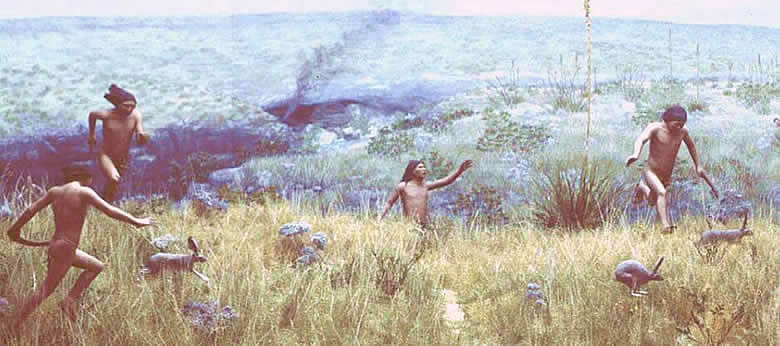
Prehistoric hunters prepare to unleash their throwing sticks at a group of jack rabbits on the run. Painting by Nola Davis, courtesy Texas Parks and Wildlife Department.

That Anatomically Modern Humans ate more rabbits than Neanderthals may well be true but to then leap to the amazing conclusion that Neanderthals were incapable of hunting small prey and then to the even more dubious suggestion that this may have something to do with the demise of Neanderthals as a species takes legitimate speculation into the fantasy worlds of the Land of Painted Caves. We could just as well assume that eating rabbits led to a virulent disease which AMH were immune to but which led to the eradication of the Neanderthal species (except of course for the offspring of those who had mated with AMH) !!

Chelyabinsk Meteoroid tracked back to the Apollo asteroid group

February 26, 2013

Astronomers at the University of Antioquia, Medellin in Colombia have back-tracked the trajectory of the Chelyabinsk meteoroid and have concluded that it was from the Apollo asteroid group which regularly intersect with Earth’s orbit. The Apollo group contains at least 5,000 asteroids and more than 240 of these are over 1 km in size. The largest known Apollo asteroid is 1866 Sisyphus, with a diameter of about 10 km.

The Chelyabinsk meteoroid crossed from northeast to southwest on February 15th at an angle of 20 degrees above the horizontal at a speed of about 18 km/s. It is estimated to have been about 17-m in size with an estimated mass of between 7,000 and 10,000 tonnes. It exploded at 03:20:26 GMT over 55° 10′ N, 61° 25′ E at an altitude of 15 to 20 kilometers (9.3 to 12.4 miles) with a force of 500 kilotons – the equivalent of 30 Hiroshima atomic bombs.

The astronomers have published their findings:

A preliminary reconstruction of the orbit of the Chelyabinsk Meteoroid

by Jorge I. Zuluaga, Ignacio Ferrin

http://arxiv.org/abs/1302.5377 (abstract)

complete paper (pdf)

Reconstructing the orbit

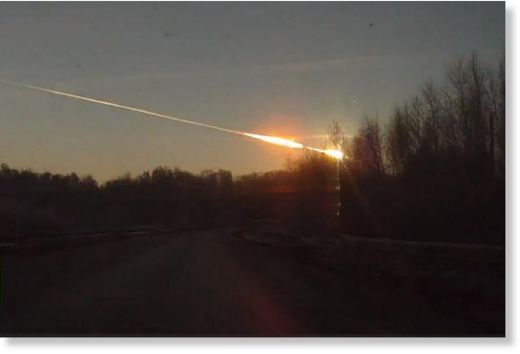
The Chelyabinsk Meteor Friday 15th Feb. 2013: image from http://www.sott.net

BBC:…. Astronomers have traced the origin of a meteor that injured about 1,000 people after breaking up over central Russia earlier this month.

Using amateur video footage, they were able to plot the meteor’s trajectory through Earth’s atmosphere and then reconstruct its orbit around the Sun. Using the footage and the location of an impact into Lake Chebarkul, Jorge Zuluaga and Ignacio Ferrin, from the University of Antioquia in Medellin were able to use simple trigonometry to calculate the height, speed and position of the rock as it fell to Earth.

To reconstruct the meteor’s original orbit around the Sun, they used six different properties of its trajectory through Earth’s atmosphere. Most of these are related to the point at which the meteor becomes bright enough to cast a noticeable shadow in the videos.

…. The results suggest the meteor belongs to a well known family of space rocks – known as the Apollo asteroids – that cross Earth’s orbit.

Of about 9,700 near-Earth asteroids discovered so far, about 5,200 are thought to be Apollos. Asteroids are divided into different groups such as Apollo, Aten, or Amor, based on the type of orbit they have.

MIT Technology Review: 

“According to our estimations, the Chelyabinski meteor started to brighten up when it was between 32 and 47 km up in the atmosphere,” say Zuluaga and Ferrin, who estimate the velocity at between 13 km/s and 19 km/s relative to Earth.

They then calculated the likely orbit by plugging these figures into a piece of software developed by the US Naval Observatory called NOVAS, the Naval Observatory Vector Astrometry. This allowed them to include the gravitational influence on the rock of the Moon and the 8 major gravitational bodies in the Solar System.


Junkies versus Non-junkies: Junk genes are not junk — or maybe they are

February 24, 2013

Myopic “scientists” bitching about each other is always interesting. Scientific theories have their own evolutionary life as some wither and die and some – gradually – become accepted and “proven”.  But it is the behaviour of the protagonists of rival theories which is entirely human. Rivalry, back-biting and childish insults in the world of evolutionary biology between junk-gene supporters and junk-gene debunkers are now getting entertaining.

Animation of the structure of a section of DNA...

from wikipedia

In September last year the ENCODE Project made a major splash when they published some 30 papers in front-line journals showing that most of the human genome dismissed earlier as as “junk genes”  did in fact show biological activity and probably had some as yet unknown function. They reported that they had transcribed some 76% of “junk” DNA and that more than 50% of all genes could be accessible to proteins which can control genetic behaviour and they concluded that over 80% of human DNA serves some purpose.

The term “non-coding” DNA, then popularised as”junk” genes, was coined in 1972. This idea  gradually gained favour and by 2003 the human genome was supposed to consist of some  26,000 protein-coding genes within a large amount of non-coding DNA where the non-coding or “junk” DNA represented some 98% of the whole genome. The results of the ENCODE project turned this idea on its head. The junk gene supporters were not amused. It has taken them a little while to circle the wagons and formulate a response to the flood of papers published in September. And the response resorts to unusually harsh language for scientific discourse. It would seem that the “junk” gene protagonists have been prodded in their vitals and feel their life-work and their livelihoods being threatened!

Junkies versus Non-junkies! The battle-lines have been drawn. They have now published an open-access diatribe: On the immortality of television sets: “function” in the human genome according to the evolution-free gospel of ENCODE

The Guardian: “Everything that Encode claims is wrong. Their statistics are horrible, for a start,” the lead author of the paper, Professor Dan Graur, of Houston University, Texas, told the Observer. “This is not the work of scientists. This is the work of a group of badly trained technicians.”

Scientists are being called technicians — no less!

The junkies write:

From an evolutionary viewpoint, a function can be assigned to a DNA sequence if and only if it is possible to destroy it. All functional entities in the universe can be rendered nonfunctional by the ravages of time, entropy, mutation, and what have you. Unless a genomic functionality is actively protected by selection, it will accumulate deleterious mutations and will cease to be functional. The absurd alternative, which unfortunately was adopted by ENCODE, is to assume that no deleterious mutations can ever occur in the regions they have deemed to be functional. Such an assumption is akin to claiming that a television set left on and unattended will still be in working condition after a million years because no natural events, such as rust, erosion, static electricity, and earthquakes can affect it. The convoluted rationale for the decision to discard evolutionary conservation and constraint as the arbiters of functionality put forward by a lead ENCODE author (Stamatoyannopoulos 2012) is groundless and self-serving.

Would the Junkies  – I wonder – allow 98% of their DNA – or that of their children – to be excised if it could be?