Archive for the ‘Science’ Category

Most detailed image of a sunspot ever by Big Bear

August 27, 2010

No wonder sunflowers are obsessed !!

Researchers at Big Bear Solar Observatory have tuned their adaptive optics array and achieved first light, capturing this image of a sunspot that is now the most detailed ever captured in visible light. The image was captured with Big Bear’s New Solar Telescope (NST), a brand new instrument (as the name implies) with a resolution of just 50 miles on the sun’s surface.
http://www.popsci.com/files/imagecache/article_image_large/articles/011-03410-01high.jpg

The NST is the precursor to an even-larger telescope, the Advanced Technology Solar Telescope (ATST), which will be constructed over the next decade, allowing Big Bear researchers to build a new kind of adaptive optics system known as multi-conjugate adaptive optics, that should provide them with a clear, distortion-free means of observing the sun from Earth in unrivaled detail.

Today is Volcano day – over 1900 years after Pompeii

August 24, 2010

Dr. Erik Klemetti is reporting from Pompeii.

The eruption of Vesuvius that buried Pompeii – and lead Pliny to write his Letters that birthed volcanology occurred (at least we think) on August 24, 79 A.D. So, eat some olives in memory of those who perished over 1,900 years ago – and hope that Naples is prepared the next time Vesuvius rumbles so that we don’t repeat “Volcano Day”.

Pompeii victim:http://www.nationalgeographic.com/history/ancient/images/sw/pompeii-victim-50657432-sw.jpg

Photo: Cast of Pompeii victim

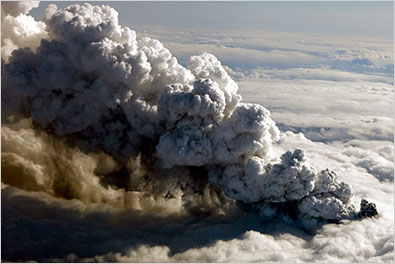
UK University parents emit twice as much CO2 as Ash Cloud Volcano

August 24, 2010

A new study by the UK’s low cost delivery service for students has found that the average fuel cost in the UK for transporting student belongings to and from university is £192 million per year. In total, parents taking their children’s belongings to and from uni emit 291k tonnes of CO2 every year – twice as much CO2 as Iceland’s Eyjafjallajökull volcano; which grounded flights across the world with a giant ash cloud, emitted every day.

http://topics.nytimes.com/top/news/international/countriesandterritories/iceland/eyjafjallajokull/index.html?inline=nyt-geo


The research, commissioned by low cost student baggage delivery service www.UniBaggage.com asked 1,196 parents if they helped their children move their belongings to and from student housing throughout their three years at university. In the academic year of 2008 – 2009 there were 2,396,050 university students in the UK.

The NYT reports that:

Seismic activity is petering out at the volcano that caused major European air-traffic disruption earlier this year, though the eruption has not yet been declared officially over, the authorities in Iceland said Monday. The most serious problem now is posed by mud flows created when heavy rains mix with ash settled along the top of glaciers close to the Eyjafjallajokull (pronounced EY-ya-fyat-lah-YO-kut) volcano, said Sigurlaug Hjaltadottir, a geophysicist with Iceland’s Meteorological Office.

But Eyjafjallajokull’s bigger sister Katla is still due to erupt at any time.

Solar Flares may dampen radioactive decay on Earth !

August 24, 2010

A detective story from Stanford University News. http://news.stanford.edu/news/2010/august/sun-082310.html

When researchers found an unusual linkage between solar flares and the inner life of radioactive elements on Earth, it touched off a scientific detective investigation that could end up protecting the lives of space-walking astronauts and maybe rewriting some of the assumptions of physics.

BY DAN STOBER

http://www.pcaire.com/images/solar_flares.png

(more…)

How can we – if we should – prepare for a new Little Ice Age?

August 22, 2010

It seems that we are in a Solar Cycle Minimum – a Landscheidt Minimum which will perhaps be comparable to the Maunder Minimum.

The last decade has seen flat or declining global temperatures.

The Ocean temperature oscillations could indicate 20 or 30 years cooling ahead of us.

If these are all indicators of a coming Little Ice Age, then it may be time to take some preparatory actions to help humans adapt. I think adaptation to Climate Change when it happens is the key not some mis-guided and futile attempt to prevent the Climate Change from happening (as being proposed by the IPCC and other global warming fanatics).

image: http://t2.gstatic.com/images?q=tbn:TtpOoja-ueuOLM:http://www.wilsonsalmanac.com/images3/frost_fair_C18.jpg

The question which is more for engineers rather than for scientists is “What are the actions that could be taken to prepare and help for such an adaptation?”

Applying Asimov’s Laws of Robotics

August 21, 2010

Isaac Asimov published his first short story about robotics in 1942 and his I Robot in 1950. The three laws of robotics he developed have now become the de facto basis for most science fiction dealing with robots and even in engineering:

First Law: A robot may not injure a human being, or, through inaction, allow a human being to come to harm, unless this would violate a higher order law.
Second Law: A robot must obey orders given it by human beings, except where such orders would conflict with a higher order law.
Third Law: A robot must protect its own existence as long as such protection does not conflict with a higher order law.
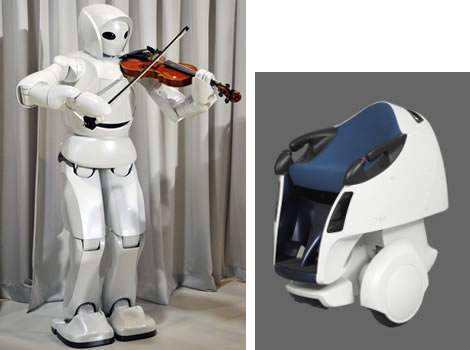
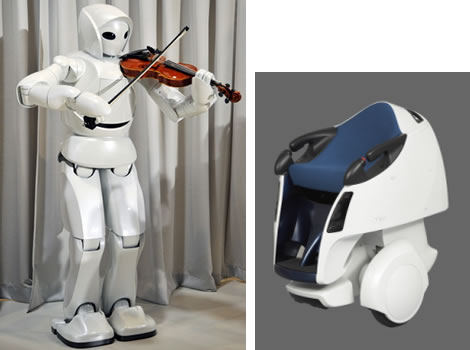
image: http://www.geekalerts.com/u/toyota-robots.jpg

Later as Asimov integrated his Robot series with his Foundation series he added a Zeroth Law:

Zeroth Law: A robot may not injure humanity, or, through inaction, allow humanity to come to harm.

A modern counterpart to Asimov’s fictional character is Eliza. Eliza was created in 1966 by Professor Joseph Weizenbaum of Massachusetts Institute of Technology who wrote Eliza — a computer program for the study of natural language communication between man and machine. She was initially programmed with 240 lines of code to simulate a psychotherapist by answering questions with questions.

Robotics and robot design has now advanced to the stage that engineers are now having to re-look at Asimov’s laws for practical implementation. David Woods, professor of integrated systems engineering at Ohio State University says “The philosophy has been, ‘sure, people make mistakes, but robots will be better — a perfect version of ourselves.’ We wanted to write three new laws to get people thinking about the human-robot relationship in more realistic, grounded ways.” He addresses the practical issues in his article: Beyond Asimov: The Three Laws of Responsible Robotics in IEEE Intelligent Systems by Robin Murphy , David D. Woods, July 2009, pp. 14-20. “Go back to the original context of the stories,” Woods says, referring to Asimov’s I Robot among others. “He’s using the three laws as a literary device. The plot is driven by the gaps in the laws — the situations in which the laws break down. For those laws to be meaningful, robots have to possess a degree of social intelligence and moral intelligence, and Asimov examines what would happen when that intelligence isn’t there.”

“His stories are so compelling because they focus on the gap between our aspirations about robots and our actual capabilities. And that’s the irony, isn’t it? When we envision our future with robots, we focus on our hopes and desires and aspirations about robots — not reality.”

In reality, engineers are still struggling to give robots basic vision and language skills. These efforts are hindered in part by our lack of understanding of how these skills are managed in the human brain. We are far from a time when humans can agree on a universal ethical or moral code and even further away from imbuing such a code into robots.

Woods and his coauthor, Robin Murphy of Texas A&M University, composed three laws that tries to put the responsibility back on humans.

The three new laws that Woods and Murphy propose are:

  • A human may not deploy a robot without the human-robot work system meeting the highest legal and professional standards of safety and ethics.
  • A robot must respond to humans as appropriate for their roles.
  • A robot must be endowed with sufficient situated autonomy to protect its own existence as long as such protection provides smooth transfer of control which does not conflict with the First and Second Laws.

Woods admits that one thing is missing from the new laws: the romance of Asimov’s fiction — the idea of a perfect, moral robot that sets engineers’ hearts fluttering.

Increasing whiskey production can save the environment

August 21, 2010

By-products from distilling whiskey produce a biofuel with 30% more power output than ethanol !

Using samples from the Glenkinchie Distillery in East Lothian, researchers at Edinburgh Napier University have developed a method of producing biofuel from two main by-products of the whisky distilling process – “pot ale”, the liquid from the copper stills, and “draff”, the spent grains. The new method developed by the team produces butanol, which gives 30% more power output than the traditional biofuel ethanol. It is based on a 100-year-old process that was originally developed to produce butanol and acetone by fermenting sugar. The team has adapted this to use whiskey by-products as a starting point and has filed for a patent to cover the new method. It plans to create a spin-out company to commercialise the invention. Butanol is superior to ethanol — with 25 – 30% t more energy per unit volume. The biofuel can also be introduced to unmodified engines with any gasoline blend, whereas ethanol can only be blended up to 85 percent and requires engine modification.

Read more:http://solveclimate.com/blog/20100817/scottish-scientists-develop-whisky-biofuel

Professor Martin Tangney, who directed the project said that using waste products was more environmentally sustainable than growing crops specifically to generate biofuel. “What people need to do is stop thinking ‘either or’; people need to stop thinking like for like substitution for oil. That’s not going to happen. Different things will be needed in different countries. Electric cars will play some role in the market, taking cars off the road could be one of the most important things we ever do.”

“The production of some biofuels can cause massive environmental damage to forests and wildlife. So whisky powered-cars could help Scotland avoid having to use those forest-trashing biofuels,” said Dr Richard Dixon, of WWF Scotland.

“DRINK IT and then DRIVE IT” has a nice ring to it and  is something I could enjoy supporting.

Hausergate: An utter lack of ethics

August 19, 2010

Fiction passed of as science

Further revelations in The Chronicle of Higher Education provides sordid details about the Hauser paper published in 2002 in Cognition and which is now being retracted. But the pattern of behaviour described is that of an accomplished liar well-versed in creating bogus data. To become such an accomplished inventor of data must have taken years of practice.

For how long has Hauser been passing off works of fiction as works of science?

Hauser’s hectoring tone towards his research assistants to try and force his false interpretations on them are also very revealing. The author of Moral Minds exhibits an utter lack of ethics.

Rather than getting a year off to write another work of fiction should he not be required to return all the salary and grant money he has enjoyed as the fruits of his inventiveness?

Where are all the peers who have recommended his being published?

Document Sheds Light on Investigation at Harvard 1

An internal document, however, sheds light on what was going on in Mr. Hauser’s lab. It tells the story of how research assistants became convinced that the professor was reporting bogus data and how he aggressively pushed back against those who questioned his findings or asked for verification.

(more…)

Climate models don’t need the sun – “Venus is similar to Earth” !!!

August 17, 2010

Japanese Spacecraft Approaches Venus

Venus Climate Orbiter “AKATSUKI”

This from NASA Science News:

[Global view of Venus]

Imamura is the project scientist for Akatsuki, a Japanese mission also called the Venus Climate Orbiter. The spacecraft is approaching Venus and will enter orbit on December 7, 2010. Imamura believes a close-up look at Venus could teach us a lot about our own planet.

“In so many ways, Venus is similar to Earth. It has about the same mass, is approximately the same distance from the sun, and is made of the same basic materials,” says Imamura. “Yet the two worlds ended up so different. We want to know why.”

Considering NASA’s own Venus fact sheet and the fact that Venus is about 41 million km closer to the sun it is – in the kindest interpretation – sloppy to permit a statement that “Venus is similar to earth.. approximately the same distance from the sun”.

“By comparing Venus’s unique meteorology to Earth’s, we’ll learn more about the universal principles of meteorology and improve the climate models we use to predict our planet’s future” says Imamura.

Of course the models will no doubt take into account that solar radiation on Venus is about  2688 J while the Earth receives 1365 J or perhaps the models don’t need the sun and will base everything on the heating effects of carbon dioxide.

I would have thought that it is the differences between Venus and Earth which can be revealing and to consider a distance of 41 million km closer to the sun as being negligible does not inspire confidence in any subsequent climate modelling.

Flattening the Mann hockey stick

August 15, 2010

The shape of Mann’ s hockey stick is morphing. The long horizontal handle (obtained by eliminating the MWP)  actually turns out to be sloping and the sharp upturn gets flattened.

WUWT reports a new and important study on temperature proxy reconstructions (McShane and Wyner 2010) submitted into the Annals of Applied Statistics and is listed to be published in the next issue.

A Statistical Analysis of Multiple Temperature Proxies: Are Reconstructions of Surface Temperatures Over the Last 1000 Years Reliable?

BY BLAKELEY B. MCSHANE∗ AND ABRAHAM J. WYNER†
Northwestern University∗ and the University of Pennsylvania†
This paper is a direct and serious rebuttal to the proxy reconstructions of Mann. It seems watertight on the surface, because instead of trying to attack the proxy data quality issues, they assumed the proxy data was accurate for their purpose, then created a bayesian backcast method. Then, using the proxy data, they demonstrate it fails to reproduce the sharp 20th century uptick

FIG 16. Backcast from Bayesian Model of Section 5. CRU Northern Hemisphere annual mean land temperature is given by the thin black line and a smoothed version is given by the thick black line. The forecast is given by the thin red line and a smoothed version is given by the thick red line. The model is fit on 1850-1998 AD and backcasts 998-1849 AD. The cyan region indicates uncertainty due to t, the green region indicates uncertainty due to β, and the gray region indicates total uncertainty.

The Mann Hockey Stick
Multiproxy reconstruction of Northern Hemisphere surface temperature variations over the past millennium (blue), along with 50-year average (black), a measure of the statistical uncertainty associated with the reconstruction (gray), and instrumental surface temperature data for the last 150 years (red), based on the work by Mann et al. (1999). This figure has sometimes been referred to as the hockey stick. Source: IPCC (2001).

The authors conclude that:

“…..we conclude unequivocally that the evidence for a ”long-handled” hockey stick (where the shaft of the hockey stick extends to the year 1000 AD) is lacking in the data.…..Climate scientists have greatly underestimated the uncertainty of proxy based reconstructions and hence have been overconfident in their models.”