Archive for the ‘Science’ Category

Culmination nears for India’s Mars Orbiter Mission

September 23, 2014

In 8 hours – if everything goes as planned – the MOM would have been inserted into Mars orbit of 423 km at periareion and 80,000 Kilometers at apoareion  at an inclination of 150 degrees and with an orbital period of a little more than three days. Though a number of experiments are planned, the most important objectives of the mission – to demonstrate technology and capability – will largely have been accomplished on getting into orbit.

Frugal engineering and with a cost of about 10% of that of NASA’s MAVEN will have taken ISRO’s MOM into Mars orbit – and at the first attempt.

But the next few hours will be tense and nervous not only for ISRO mission staff but for the many millions of Indians who will be following the live webcast at http://webcast.isro.gov.in/. The critical operations will take place while the MOM spacecraft is occluded on the far side of Mars and when signals will be taking over 12 minutes to reach earth.

Spaceflight101: 

The critical Mars Orbit Insertion Burn Sequence will begin three hours ahead of the planned maneuver time when the spacecraft automatically switches over to its Medium Gain Antenna for communications since the High Gain Antenna will be pointing away from Earth during the retrograde burn.
21 minutes ahead of ignition, the spacecraft will begin the re-orientation to the proper attitude for the burn, pointing LAM to the direction of travel. The re-orientation is accomplished using the vehicle’s Reaction Wheels. Five minutes and 13 seconds ahead of the burn, the spacecraft passes into darkness – for the first time since leaving Earth last year. In advance, MOM will fully charge its battery to be in a safe configuration for the eclipse.
Three minutes ahead of the burn, the vehicle’s eight 22-Newton thrusters are enabled to start providing attitude control which they will continue to do throughout the main engine burn, keeping MOM pointing forward. Ignition of the Liquid Apogee Motor is planned at 1:47:32 UTC on Wednesday, September 24, 7:17 Indian Standard Time. The Mars Orbit Insertion burn has a planned duration of 24 minutes and 14 seconds, slowing the spacecraft down by 1,098.7 meters per second to be captured in an elliptical orbit around Mars. During the burn, the engines will consume 249.5 Kilograms of propellant leaving only about 40 Kilograms of propellant for the rest of the mission.
Should something go wrong during the burn, MOM is programmed to react appropriately in order to achieve a stable orbit around Mars – even if that means to spend all the vehicle’s propellant to do so. In the event the Liquid Apogee Motor is not ignited or its burn is cut short, MOM would automatically switch to the 22-Newton thrusters to supply as much delta-v as possible. Due to their lower thrust, the 22N thrusters would need to fire much longer than LAM along a greater stretch around the periapsis pass which will increase propellant consumption and leave MOM in a higher orbit.
MOI timeline

Graphic ISRO (via spaceflight101)

MOM test fires liquid motor for orbit insertion on Wednesday

September 22, 2014

A sigh of relief today as the liquid fueled motor was successfully test fired for 4 seconds after having last been used 9 months ago.

The 440 Newton Liquid Apogee Motor (LAM) of India’s Mars Orbiter Spacecraft, last fired on December 01, 2013, was successfully fired for a duration of 3.968 seconds at 1430 hrs IST today (September 22, 2014). This operation of the spacecraft’s main liquid engine was also used for the spacecraft’s trajectory correction and changed its velocity by 2.18 metre/second. With this successful test firing, Mars Orbiter Insertion (MOI) operation of the spacecraft is scheduled to be performed on the morning of September 24, 2014 at 07:17:32 hrs IST by firing the LAM along with eight smaller liquid engines for a duration of about 24 minutes.

The MOM is now in (or just entering) Mars’ sphere of influence and is effectively falling freely towards Mars. The orbit insertion procedure is described here.

Mars Orbit Insertion for MAVEN and MOM

graphic: indiaspaceactivity

On 24th 0127 GMT, even as it is falling with speed of 4 kms/sec, the craft is reoriented so that the thrusters face forward  ( for the next orbit maneuver of retro thrust to reduce the speed and to direct it in the required orbit ). The re-orientation is completed @ 0147 GMT. MOM would by this time be falling with a speed of  4.48Km/sec.

After the disturbances due to reorientation have died, i.e. 5 seconds later,  the Retro action starts with the firing of  LAM using 8 thrusters ..  the fall speed by now is 4.68 km/s. Even as the thrusters start their effort to reduce the speed of MOM, the fallingspeed continues to increase due to the gathered momentum upto 5.89 km/s and thenspeed  starts falling. The LAM firing also directs the craft in the desired direction so that it achieves the required orbit around Mars. The LAM operation ends @0216GMT.

As shown in figure there the MOM speed would increase from 3.18 Kms/sec to 5.89Kms/sec @  0216GMT.

Now notice that MOM approached Mars parellel to  equator unlike MAVEN which approached over North pole.  The reason for these two approaches is that the final orbits of MAVEN and MOM are inclined @ 75 deg and @ 19 deg respectively. This is evident from the ‘ cross roads ‘ seen between MOM and MAVEN release in the combination diagram shown above.

In the above flow of sequence we did not have time to  mention a couple of more chilling facts: @ nearly the same time when LAM operation starts MOM would go behind Mars as seen from Earth. Secondly , even if it was visible, whatever happens at MOM will be known to Earth only after 12 minutes due to the distance between Earth and MOM. So all this (and next described operations ) are being done under the unsupervised pre-loaded command sequences. So the success indicates how well are we in anticipating the situation through modelling.

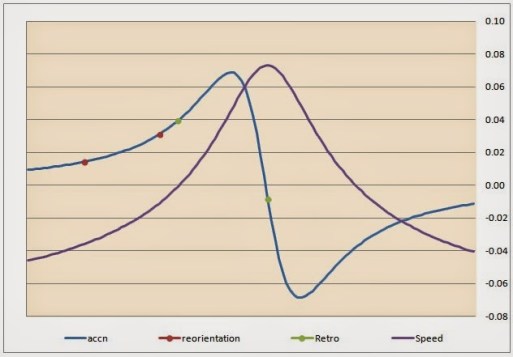
A detailed look at dynamics of acceleration during this critical operation is shown in this graphic. (numbers are in kms/sec/sec ) corrosponding to sky blue curve. (X axis is time axis from 0110GMT to 0310GMT of 24 Sep. )
Violet curve is the speed normalized to fit in this graph with that of acceleration. Actual speed variation shown corresponds to 3.88 km/sec at left to 5.89km/s at peak near center which falls to 4 km/s at lsft edge.

We have also marked the events of reorientation (between red dots) and retro rocket firing (between Green dots ) on acceleration curve.

Notice that the LAM retro action started at first green dot on left ( 0152 GMT ) ..  it has tried to reduce the speed but the fall is more powerful, so MOM speed continues to increase despite retro action. This continues and for sometime eventhough the acceleration has started reducing ( blue line coming down ), the gathered momentum  makes the craft to increase its speed for sometime. Finally however the thrusters succeed in reducing the speed ( reversal near center of violet line ) ..  the thrusters are also turned off at that moment.(green dot near the center of graph ). Now the total operation of MOI is over.

Incidentally, the point where speed reversal has taken space forms the lowest point near the surface of MOM prior to first perigee which would occur after the craft completes one revolution.

Maven to enter Mars orbit tonight and MOM on Wednesday

September 21, 2014

UPDATE:

NASA’s Mars Atmosphere and Volatile Evolution (MAVEN) spacecraft successfully entered Mars’ orbit at 10:24 p.m. EDT Sunday, Sept. 21, where it now will prepare to study the Red Planet’s upper atmosphere as never done before. MAVEN is the first spacecraft dedicated to exploring the tenuous upper atmosphere of Mars.

==============================================

NASA’s Maven will be inserted into Mars orbit later tonight at 2130 pm Eastern time and will be covered live by NASA TV.

India’s MOM should be inserted into Mars Orbit on Wednesday.

(Related: Alternate paths to Mars: NASA’s MAVEN compared to India’s MOM)

Maven planned Mars orbit insertion 20140921 - NASA

Maven planned Mars orbit insertion 20140921 – NASA

The orbit insertion factsheet from NASA is here: MAVEN Orbit Insertion Fact Sheet – NASA

The orbit-insertion maneuver will begin with the brief firing of six small thruster engines to steady the spacecraft. The engines will ignite and burn for 33 minutes to slow the craft, allowing it to be pulled into an elliptical orbit with a period of 35 hours.

Following orbit insertion, MAVEN will begin a six-week commissioning phase that includes maneuvering the spacecraft into its final orbit and testing its instruments and science-mapping commands. Thereafter, MAVEN will begin its one-Earth-year primary mission to take measurements of the composition, structure and escape of gases in Mars’ upper atmosphere and its interaction with the sun and solar wind….

MAVEN launched Nov. 18, 2013, from Cape Canaveral Air Force Station in Florida, carrying three instrument packages. It is the first spacecraft dedicated to exploring the upper atmosphere of Mars. The mission’s goal is to determine how the loss of atmospheric gas to space played a role in changing the Martian climate through time.

ISRO’s press briefing for the MOM Mars orbit insertion is here: MOM press briefing on Mars Orbit Insertion

MOM Mars Orbit insertion planned for 20140924  ISRO

MOM Mars Orbit insertion planned for 20140924 ISRO

Cloud Image wins National Geographic competition

August 26, 2014

See also the clouds at this post.

The Independence day by Marko Korošec 2014 NG Traveler winner

The Independence day by Marko Korošec 2014 NG Traveler winner

First Place Winner: The Independence Day

Photo and caption by Marko Korošec

While on storm chasing expeditions in Tornado Alley in the U.S. I have encountered many photogenic supercell storms. This photograph was taken while we were approaching a storm near Julesburg, Colorado, on May 28, 2013. The storm was tornado warned for more than one hour, but it stayed an LP [low precipitation] storm through all its cycles and never produced a tornado, just occasional brief funnels, large hail, and some rain.

National Geographic Traveler Director of Photography Dan Westergren, one of this year’s judges, shares his thoughts on the first-place winner:

“This winning photo of a supercell over the plains of eastern Colorado stopped the judges in our tracks. When we first saw the picture we guessed that the photographer probably had dedicated quite a bit of time chasing storms to capture such an amazing sight. But what makes the picture particularly strong is that except for the cloud, the rest of the scene is quite ordinary. The crazy UFO-looking shape gives the impression that it’s going to suck up the landscape like a tablecloth into a vacuum cleaner. The unresolved tension in the image makes me want to look at it over and over.”

Location: Julesburg, Colorado, USA

2014 Scientific Art Competition

June 10, 2014

The winner of the 2014 Competition was this image created by Dr. David A. Barrow

“Don’t forget your umbrella”

This digital artwork was created with a fractal software program called Apophysis, which can generate “IFS fractal flames”. IFS stands for Iterated Function System, a relatively new branch of mathematics. Fractal patterns often resemble structures in nature, and many viewers enjoy identifying familiar plants or animals, similar to “cloud watching”. The delicate lines in this image are similar to the vein patterns found in leaves, and are typical of the Apophysis styles “Breach” and “Elliptic Splits”. With skillful and practiced command of the software, the fractal/digital artist can shape and enhance these similarities to approach traditional, representational art.

Don't forget your umbrella by David Barrow

Don’t forget your umbrella by David Barrow

In last years competition David Barrow had an image placed second

Never Neverland

Never Neverland – David Barrow


Peer review as the erroneous comments of anonymous experts

May 28, 2014

There is a presumed halo around peer review which is quite unjustified. And when a publish or perish attitude prevails in academia it is inevitable that political correctness – as defined by the “peers” – colours whatever gets published. And “political correctness”  in science leads to a stamp of approval for what fits with the “consensus”. Nothing revolutionary can get through. Anything which smacks of being “heretical” has little chance of passing “peer review”.

 In 1936, Albert Einstein—who was used to people like Planck making decisions about his papers without outside opinions—was incensed when the American journal Physical Review sent his submission to another physicist for evaluation. In a terse note to the editor, Einstein wrote: “I see no reason to address the—in any case erroneous—comments of your anonymous expert. On the basis of this incident I prefer to publish the paper elsewhere.”

Melinda Baldwin considers the question “Did Isaac Newton need peer review

Peer review at scholarly journals involves recruiting experts to evaluate a paper before it is approved for publication. When a paper is submitted, the editors send it to two or three reviewers who are considered knowledgeable about the topic. The reviewers and the authors, in theory, do not know each others’ identities. If the reviewers raise objections to the methods or conclusions, the authors must revise the paper before it will be accepted for publication. If the objections are significant, the paper is rejected.

Most observers regard non-peer-reviewed results as, at best, preliminary. Instinctively, this makes sense. When a paper is printed in a scientific journal, it acquires the “imprimatur of scientific authenticity” (to quote the physicist John Ziman) and many observers consider its findings to be established scientific facts. It seems like a good idea to subject a paper to expert scrutiny before granting it that sort of status.

But it turns out that peer review is only the scientific community’s most recent method of providing this scrutiny—and it’s worth asking if science is, in fact, “real” only if it’s been approved by anonymous referees.

…. Nature published some papers without peer review up until 1973. In fact, many of the most influential texts in the history of science were never put through the peer review process, including Isaac Newton’s 1687 Principia Mathematica, Albert Einstein’s 1905 paper on relativity, and James Watson and Francis Crick’s 1953 Nature paper on the structure of DNA. ….

……… Peer review’s history is of particular interest now because there is an increasing sense in the scientific community that all is not well with the peer review process. In recent years, high-profile papers have passed peer review only to be heavily criticized after publication (such as the 2011 “arsenic DNA” paper in Science that claimed a particular bacterium could incorporate arsenic into its DNA—a finding most biologists have since rejected). Others have been retracted amid allegations of fraud (consider the now-infamous 1998 Lancet paper claiming a link between vaccines and autism). Many scientists worry that requiring approval from colleagues makes it less likely that new or controversial ideas will be published. Nature’s former editor John Maddox was fond of saying that the groundbreaking 1953 DNA paper would never have made it past modern peer review because it was too speculative. ….

“Peers” – and especially since they have to be knowledgeable in the field – always have some vested interest. It could be to defend their own work, or to publicise their own work, or to gain support for their own funding, to help young researchers get published, or to hinder others. Careers can be enhanced or destroyed by aiding or preventing publication. Anonymity also means that there is no accountability for the consequences of the reviewer’s views. Inevitably nothing revolutionary that may be attacked by an influential reviewer can even be submitted for publication. And therein lies the problem with “politically correct” science.

Now with the ease of on-line publication increasing, pre-publication, anonymous peer review is obsolete and has to give way to post-publication, attributable review.

Superhydrophobic and oleophobic

May 25, 2014

Nice video,


But,

From the coating distributor:

Ultra-Ever Dry is a superhydrophobic (water) and oleophobic (hydrocarbons) coating that will completely repel almost any liquid. Ultra-Ever Dry uses proprietary nanotechnology to coat an object and create a barrier of air on its surface. This barrier repels water, oil and other liquids unlike any coating seen before. The other breakthrough associated with Ultra-Ever Dry is the superior coating adherence and abrasion resistance allowing it to be used in all kinds of applications where durability is required.

See Wetting.

Wetting of different fluids. A shows a fluid with very little wetting, while C shows a fluid with more wetting. A has a large contact angle, and C has a small contact angle. – Wikimedia

However, detergents, soaps, Solvents or high pressure water must be kept away from the surfaces or the coating will fail. And it should not be touched with your bare hands  — to protect the coating and/or your hands?

Carbon Cycle: Emissions from forest clearance underestimated, land absorption underestimated

May 23, 2014

Two new papers just published show that the carbon cycle is far from being certain. We still have large uncertainties regarding the sources of carbon dioxide emissions and their magnitude and the sinks where, and mechanisms by which, carbon dioxide is absorbed. One in Global Change Biology. shows that emissions due to forest clearance have been underestimated by some 40% while the second in Nature suggests that there are large land sinks for carbon dioxide in the Southern Hemisphere (paywalled but reported here) which have largely been ignored by climate models.

  1. The amount of carbon lost from tropical forests is being significantly underestimated, a new study reports. In addition to loss of trees, the degradation of tropical forests by selective logging and fires causes large amounts of “hidden” emissions. 
  2. they find that land sinks for CO2 are keeping up with the increase in CO2 emissions, thus modeled projections of exponential increases of CO2 in the future are likely exaggerated. 

The “settled science of climate” is a an edifice tottering on two unproven hypotheses:

  1. That carbon dioxide concentration in the atmosphere is a key driver of global temperature, and
  2. That man-made emissions of carbon dioxide (primarily fossil fuel combustion) are the key contributor to concentration in the atmosphere.

If either of these two assumptions are incorrect, the entire edifice of climate science and climate policy comes tumbling down.

The first now looks decidedly weak. For almost 20 years now global temperatures have stagnated (and show a slight negative trend) while carbon dioxide emissions from combustion have increased sharply. Carbon dioxide concentration has also continued to increase but at a much lower rate than the rate of man-made emissions. No doubt carbon concentration has some impact but it is clearly far from being a key driver of global temperature.

The second assumes that “natural emissions” and absorption are roughly in balance and therefore it must be fossil fuel combustion which is responsible for the increase of carbon dioxide concentration. But the Carbon balance of the earth is far from certain. Volcanic de-gassng of CO2 has been grossly underestimated. The mass of CO2 absorbing bio-mass in the oceans has also been underestimated and remains still highly uncertain.

The error bands surrounding “natural” emissions are of the same magnitude as man-made emissions. Absorption of Carbon dioxide by the oceans and the biological life (algae) in the oceans are, at best, relatively uncertain estimations.

ktwop: Even though the combustion of fossil fuels only contributes less than 4% of total carbon dioxide production (about 26Gt/year of 800+GT/year), it is usually assumed that the sinks available balance the natural sources and that the carbon dioxide concentration – without the effects of man – would be largely in equilibrium. 

…… Carbon dioxide emission sources (GT CO2/year)

  • Transpiration 440
  • Release from oceans 330
  • Fossil fuel combustion 26
  • Changing land use 6
  • Volcanoes and weathering 1

Carbon dioxide is accumulating in the atmosphere by about 15 GT CO2/ year. The accuracy of the amounts of carbon dioxide emitted by transpiration and by the oceans is no better than about 2 – 3% and that error band (+/- 20GT/year)  is itself almost as large as the total amount of emissions from fossil fuels. ….. 

The demonisation of fossil fuel combustion is based on belief and not on evidence. The carbon dioxide assumptions which are the foundations of the climate orthodoxy are unsound.

Half of Newton’s papers were on religion, 10% on alchemy and only 30% on science and math

May 16, 2014

Unlike Alfred Nobel who I posted about recently, Isaac Newton left no will when he died in 1727. But he left behind him a mass of papers estimated to run to about 10 million words. But most of the notes he left behind dealt with religious subjects and alchemy and his views were not just politically incorrect but potentially embarrassing if not dangerous to his heirs.

Wired has interviewed Sarah Dry who has just published her book on The Newton Papers.

WiredHe wrote a forensic analysis of the Bible in an effort to decode divine prophecies. He held unorthodox religious views, rejecting the doctrine of the Holy Trinity. After his death, Newton’s heir, John Conduitt, the husband of his half-niece Catherine Barton, feared that one of the fathers of the Enlightenment would be revealed as an obsessive heretic. And so for hundreds of years few people saw his work. It was only in the 1960s that some of Newton’s papers were widely published.

Now of course The Newton Project is putting all of his papers online and they have so far transcribed about 6.4 million words:

The Newton Project is a non-profit organization dedicated to publishing in full an online edition of all of Sir Isaac Newton’s (1642–1727) writings — whether they were printed or not. The edition presents a full (diplomatic) rendition featuring all the amendments Newton made to his own texts or a more readable (normalised) version. We also make available translations of his most important Latin religious texts.

Although Newton is best known for his theory of universal gravitation and discovery of calculus, his interests were much broader than is usually appreciated. In addition to his celebrated scientific and mathematical writings, Newton also wrote many alchemical and religious texts.

Sarah Dry traces the history of the Newton papers and how they languished over the years. It was not perhaps by conspiracy but there was some clear apprehension that sorting and cataloguing them would be embarrassing because there was so much of a “heretical” nature:

Sarah Dry in WiredThere’s roughly 10 million words that Newton left. Around half of the writing is religious, and there are about 1 million words on alchemical material, most of which is copies of other people’s stuff. There are about 1 million words related to his work as Master of the Mint. And then roughly 3 million related to science and math.

…… one of the messages of the book is that getting too involved in the papers can be hazardous to your health. One of the first editors of the papers said an older man should take up the task, because he’d have less to lose than a younger man.

This is highly technical stuff. The alchemical stuff is technical, the scientific stuff is technical, the religious stuff is technical. I was more interested in the papers and the characters that worked on them. One person was David Brewster, who wrote a biography of Newton during the Victorian Era. He fought long and hard to resuscitate Newton’s reputation. But he was also one of these Victorians that had to tell the truth. So when he published his biography [in 1855], it included much of the heresy and alchemy, despite the fact that Brewster was a good orthodox Protestant.

…. When the papers came to Cambridge in the late 1800s, they were unsorted and chaotic. And the two men given to sorting them were John Couch Adams and George Stokes. Adams was the co-discoverer of Neptune. He famously never wrote anything down. And Stokes was just as great a physicist, but he wrote everything down. He in fact wrote 10,000 letters. So these two guys get the papers, and then they sit on them for 16 years; they basically procrastinate.

When actually confronted with Newton’s paper, they were horrified and dismayed. Here was this great scientific hero. But he also wrote about alchemy and even more about religious matters. Newton spent a long time writing a lot of unfinished treatises. Sometimes he would produce six or seven copies of the same thing. And I think it was disappointing to see your intellectual father copying this stuff over and over. So the way Adams and Stokes dealt with it was to say that, “His power of writing a beautiful hand was evidently a snare to him.” Basically, they said he didn’t like this stuff, he just liked his own writing.

There’s also Grace Babson, who created the largest collection of Newton objects and papers in America. She was married to a man who got rich predicting the crash of 1929. And Roger Babson [her husband] based his market research on Newtonian principles, using the idea that for every action there is an equal an opposite reaction. The market goes up so it must come down. Interestingly, he thought of gravity as an evil scourge.

Clearly people felt that tarnishing Newton’s image was a heresy in itself and they felt that publicising his stranger writings could do such damage to their icon. But the time since his death is critical here. Newton’s image  is now immune to such damage. I think that no matter how weird his views may have been about the Bible and prophecies and the occult and alchemy, they cannot – now – detract from his work on maths and physics and motion.

But his catalogers have a point. If one part of his work had been  debunked or ridiculed soon after his death, it could have damaged his reputation and even the credibility of his work in Physics and Maths. It is common practice now – as it was common practice then – for detractors to attack an opponent’s views on one subject obliquely, by denigrating his views or work in some other field. Wrong thinking in one field – by association – becomes wrong thinking in all fields.

It may have been different if they had TV in those days. For if Newton had lived in today’s world it could well be that his eminence in Physics and Maths  would have made him an instant TV pundit on all subjects. We would be suffering the pain of listening him to expound on his other weird and wonderful ideas. As we all must endure when we have to listen to actors pontificating about environmental science or psychiatrists excusing errant behaviour or politicians pretending they understand economics!!

How Sohlman and 3 white Russian stallions ensured the establishment of the Nobel prizes

May 15, 2014
Björkborn Manor (photo kkp)

Björkborn Manor (photo k2p)

Yesterday we visited the Nobel Museum at the Björkborn Manor and Estate in Karlskoga. Björkborn was Alfred Nobel’s last “residence” but he never really lived in it except as a sort of guest house. In fact he died at his villa in Italy. But Björkborn was critical in ensuring that the Nobel prizes even exist at all.  A visit I would now strongly recommend to any visitor to Sweden. For me personally it was memorable on many levels, but primarily for teaching me so much new and in such a dramatic fashion. Till this visit, I knew very little about Alfred Nobel’s last will and testament and what a close run thing it was that it was ever implemented.

This quite remarkable, but little known, story of Ragnar Sohlman and the 3 white Russian stallions which ensured that Nobel’s will could be followed and that the Nobel Foundation and its 5 prizes could be established was something quite new for me. Ragnar Sohlman who, at the age of 26 spent five years against formidable opposition in at least 3 countries to establish the Nobel prizes in accordance with Nobel’s wishes, is the real unsung hero of the creation of the brand equity which is today the hallmark of the Nobel prizes.

But more of Ragnar Sohlman later.

(more…)