Archive for the ‘scientific misconduct’ Category

Jatinder Ahluwalia tries to whitewash himself

July 8, 2011

Retraction Watch has an update on Jatinder Ahluwalia. Though reviews by Imperial College (where he scammed himself to a PhD) and the University of East London (where he is currently employed) have yet to be concluded, Ahluwalia is busy trying to whitewash himself.

RetractionWatch

If you’ve been wondering what’s happening in the case of Jatinder Ahluwalia, the University of East London researcher who has been found guilty of faking data as a graduate student at Cambridge and of misconduct at University College London, so have we.

We last reported, in February, that Imperial College London, where Ahluwalia earned his PhD, was repeating his key experiments “in light of new information received.” Today, an Imperial spokesperson tells Retraction Watch that those repeat experiments are complete, and “the results are currently being reviewed by the College.” We look forward to hearing the results of that review, of course.

A reminder that Ahluwalia’s current institution, the University of East London, is also reviewing his work. We’ve heard nothing from UEL, despite several requests. That’s consistent with the idea that the university has placed a gag order on its faculty and administration, although we haven’t confirmed that either.

In fact, we’re hearing a lot of rumors about this case, many of them left as anonymous comments, and while we appreciate any tips, we do our best to confirm verifiable facts before posting, even in comments. So if anyone has documentation of what’s going on, we’d welcome it.

We’ve also seen Ahluwalia apparently take a page out of the Anil Potti playbook, using social media and setting up a blog to extol his own virtues. Various sites discuss his papers and charitable donations, and he also has a Twitter feed that has a lot to say about the weather. Oddly, none of them mention the misconduct findings.

Continuing >> The strange and murky case of Silvia Bulfone-Paus

June 22, 2011

Professor Debora Weber-Wulff  has a comprehensive recapitulation of the twists and turns in the Silvia Bulfone-Paus / Borstel case. This is a strange story and at least 14 retractions, anonymous internet campaigns, Russian scientists being used as scapegoats, establishment scientists in denial, claims of nepotism and the destabilisation of science – no less (according to Nature)  have been some of the ingredients so far. The story continues ………. .

Copy, Shake and Paste:

Silvia Bulfone-Paus is an immunologist. She worked at the Forschungszentrum Borstel (FZB) outside of Hamburg in Germany, and is a professor at the Medical University in Lübeck.

Laborjournal.de reports that she published many papers together with the Russian couple Elena Bulanova and Vadim Budagian from Russia. Retraction Watch reported in March 2011 that 12 papers by the three authors have been retracted. The three have published 22 papers together, so there may be more.

In October 2009 the biologist Karin Wiebauer realized that the Western blots in some of the papers were very similar – sometimes just the labels were changed, in others a dose of Photoshop was used to mirror, move or distort the bands. This is the same method that Marion Brach used in the Hermann/Brach scandal end of the 90s [strangely enough, there is nothing in either Wikipedia about either them or the scandals].

In November 2009 Wiebauer informed the first author, Bulfone-Paus, of her discovery. Nothing happened. Finally, in April 2010 an investigation committee was convened. They determined that there was just sloppy publication, but the results were okay. There was a culprit found – the Russian couple. They were accused of deceit and the 12 papers retracted, although the Russians did not agree to the retractions. 

There ensued an anonymous Internet-based campaign. Colleagues then published an open letter supporting Bulfone-Paus,  saying the poor woman, who is a brilliant researcher and has published much, including work together with her husband, was deceived by her postdocs. The Borstel Board of Directors – sans Bulfone-Paus – published a good response to the open letter soon after forcing her off the board:

Severe failure in one area (as supervisor and responsible senior, corresponding and first author) can hardly be compensated by merits in other areas. […] For all scientists, one of the greatest goods in science is personal credibility and integrity, and that the most precious currency scientists have is the truthfulness of their data. The scientific community expects rigorous adherence to the rules of scientific research from principal investigators and, in particular, from heads of research divisions or departments. […] The scientific misconduct in Silvia Bulfone-Paus’s lab and her procrastination to go public despite being ultimately responsible has highly damaged the reputation of the Research Center. This is what cannot be tolerated.

But now the plot thickens: An additional paper by Bulfone-Paus (not including the Russian couple) in Blood  is currently under investigation. A co-author on this one is her husband, Ralf Paus, a dermatologist at the University of Lübeck. And the university has verified for Spiegel, a German news weekly, that they are currently investigating 6 papers of Paus. 

And now it bubbles up that Bulfone-Paus and Paus both have professorships in Manchester, in England, where they spend 20% of their time, according to the Times Higher Education. The couple also have three children, as reported by Spiegel in January

In other news about Borstel, another director, Peter Zabel, stepped down earlier this month amidst plagiarism charges. It seems he double published a paper (once in German and once in English), as well as in 2009 publishing a paper that included large portions of text and diagrams from a 2008 paper published in the US. The double publication is deemed not so severe, although it is not clear that the later publication makes clear that it is in fact a double publication – the abstract has been rewritten, but is still similar. Zabel has now also resigned from the editorial board of Der Internist.

The double publication was found by someone calling themselves Clare Francis, who informed Retraction Watch, Abnormal Science Blog, and me. It was found using the Déjà vu tool for searching for duplicate content in Medline. 

Joerg Zwirner, in a recent post to the Abnormal Science Blog, calls for setting up an Office for Research Integrity in Germany, as is to be found in the US. I heartily agree – this is far too complicated to understand for non-medical researcher, but it seems that there are deficiencies in the medical research complex in Germany that have existed for decades. And Hermann/Brach did not result in these being adequately addressed. Germany needs action, and it needs it now.


The shoes say it all!!

February 28, 2011

Shoes against zu Googleberg.

An impromptu protest at the German Defense Ministry demanding that Guttenberg step down. "Resignation = Progress" reads the sign.

An impromptu protest at the German Defense Ministry demanding that Guttenberg step down. "Resignation = Progress" reads the sign: photo DPA via Der Spiegel


Summa cum fraude: Now shoe waving to show contempt for Guttenberg

February 27, 2011

The German academic world is finally reacting to the Googleberg affaire. A demonstration was held in Berlin on Saturday and an open letter to Angela Merkel has been signed by more than 15,000 academics (as of Sunday noon).

Shoe waving as a means of showing contempt is spreading. It was very evident at the demonstration in Berlin on Saturday 26th February against Guttenberg and his fraudulent ways and against Angela Merkel for keeping him in his job.

Several hundred demonstrators protested in Berlin on 26th February 2011 against the fact that Defence Minister Karl-Theodor zu Guttenberg simply copied parts of his doctoral thesis and therefore lost his PhD but still remains in his job as Defence Minister. Summa cum fraude was the poster in reference to the very lax standards of University of Bayreuth in awarding him a PhD with  “Summa cum laude”  for his plagiarised thesis.

Tagesspiegel:

"Summa cum fraude": Photo: DAPD

Shoe waving showing contempt for Guttenberg: photo DAPD

Professor Debora Weber-Wulff writes on her blog:

German scientists and doctoral students are signing an open letter to the German Chancellor by the droves. There are some 7000 (over 15,153 on Sunday at noon -ed) signatures as of Feb. 26, 2011. Since I didn’t go to the demonstration in Berlin this afternoon, I will offer this translation:

Dear Chancellor Merkel,

As doctoral students we have been following the current discussion about the plagiarism accusations against the Minister of Defense, Mr. Karl-Theodor zu Guttenberg. We are shocked and do not understand what is happening. We have the impression that you are trying everything in your power to keep a minister in your cabinet who still insists that he did not knowingly deceive in his doctoral thesis, despite massive evidence to the contrary.

With this course of action, the German government and the members of parliament from the coalition [of CDU, CSU and FDP] damage not only themselves, but much more.

Zu Guttenberg has had to distance himself a number of times from statements he has made about his dissertation. The Internet community has with an unparalleled effort managed to demonstrate numerous incidents of clear plagiarism in Mr. zu Guttenberg’s dissertation. The evidence can be openly seen and checked by anyone. It should not surprise anyone that experts in plagiarism are united in the opinion that this is not just a few “embarassing errors”. This is massive, systematic deception.
Zu Guttenberg copied large portions of his dissertation from various sources – apparently with great ambition – and did not name those sources in order to obtain a doctoral title that he used for, among other things, election advertising. The University of Bayreuth did not address this issue of deception [when revoking the doctorate].

In the face of the extent and amount of plagiarism found, it should be as clear to you as it is to us that at the end of an exact investigation by the university, only one result will be possible with respect to the intent to deceive on the part of the minister. This cannot be done unknowingly.

Calling the deception a deception has nothing to do with the minister belonging to a particular political party. We would also demand that politicians from opposing parties step down, if they had given their word of honor that the work was only their own, except for sources as noted, and had plagiarized in the same manner.

On February 23, 2011 Mr. zu Guttenberg stated that he only wants to be judged by his performance as Minister of Defense. He alluded to a phrase you had used when you said that you did not hire him as a research assistant.

This makes a mockery of all the research assistants and doctoral students who honestly endeavor to contribute to the advancement of science. This makes it sound as if obtaining a doctoral title by fraud is just a trivial offense and that the academic word of honor is meaningless in everyday life.

When following the rules of good scientific practice it is not just a question of footnotes, trivialities that can safely be neglected in the face of the larger political problems of the day. This is the foundation of our work and our trustworthiness. We strive in our own work, according to the best of our knowledge and conscience, to reach this high goal at all times. When we fail, we run the risk – and rightly so – of being expelled from the university.
Most of us teach younger students. It is often our job to teach them the basics of good scientific practice. We insist that the students be exact at all times, correctly quoting and clearly noting all help that was used. We don’t do this because we are fanatics about footnotes or because we live in an ivory tower and know nothing about real life. It is our intention to pass on the understanding that scientific progress – and with it progress for society as a whole – is only possible when we can depend on the honesty of the scientific community.

When our students violate these precepts, we grade their efforts as unsatisfactory. On repeated violation, as a rule we try to expel them. Those who have been expelled are denied access to numerous career opportunities – and rightly so – even for jobs that are much less in need of personal integrity then the office of the Minister of Defense.

We may be old-fashioned and are spouting outdated conservative values when we are of the opinion that values such as veracity and a sense of responsibility should also be valid outside of the scientific community. Mr zu Guttenberg seemed to be of this same opinion until very recently.

Research contributes a valuable service to the development of society. Honest and innovative science is the foundation of the prosperity of our country. When it is no longer an important value to protect ideas in our society, then we have gambled away our future. We don’t expect thankfulness for our scientific work, but we expect respect, we expect that our work be taken seriously. By handling the case of zu Guttenberg as a trifle, Germany’s position in world science, its credibility as the “Land of Ideas”, suffers.

Maybe you consider our contributions to society as being negligible. In that case, we kindly request that in the future you refrain from referring to Germany as the “Republic of Education and Culture”, as you often proclaim.

Sincerely,

The Undersigned [at the time of translation]

3242 doctoral students
1817
persons with doctorates
2579
other supporters

(Updated ticker of Germans signing the open letter here)

I have no great faith in the level of integrity of European politicians. I cannot see that any principles of ethics or integrity will have any impact on Angela Merkel’s decisions. She will get rid of  Guttenberg if – and only if – she feels that he will be more of a liability rather than an asset in the March elections.

Plagiarism was standard practice for Guttenberg

February 27, 2011

Guttenberg has given up his PhD and the University of Bayreuth has now rescinded it after the Googleberg affaire. But it seems that for  Guttenberg plagiarism is a long standing and regular habit and not just an opportunistic effort for his PhD and certainly not the unwitting mistake he claims it was.

Photo: DPA

"zu Googleberg" the Copycat Minister: photo DPA

Der Spiegel carries an article about the moral bankruptcy in Germany and reports on the discovery by the Gutenplag Wiki that he had plagiarised also in 2004.

The GuttenPlag Wiki website also found a 29-page analysis from 2004 that Guttenberg, then a representative in the German parliament, wrote for the Hanns Seidel Foundation. According to the site, the document contains passages that have been taken from other sources with minimal changes and not attributed. A spokesperson from Guttenberg’s legislative office told SPIEGEL ONLINE that the case involved an “editorial text” and not an academic one, and pointed out that the sources were all listed in an attached literature review.

Meanwhile, Bild published a survey Thursday in which 87 percent of the respondents said they believed Guttenberg should stay in office. More than 260,000 people called and faxed in to the toll line. The headline on the newspaper’s front page Thursday was “Yes, we stand behind Guttenberg!” However, on Friday, an ongoing online poll on the newspaper’s website found that 57 percent of the more than 680,000 surveyed wanted Guttenberg to step down.

Jürgen Trittin, floor leader of the Green Party, on Thursday spoke of a “dirty deal” between Guttenberg and Axel Springer AG, which owns Bild. It was announced this week that the newspaper will be a major recipient of new advertising that the government is planning to help with recruitment for the German military, the Bundeswehr, which is soon to become a volunteer army. A spokesman for the media company told SPIEGEL ONLINE this week that the editorial offices only learned of the advertising campaign from the media on Thursday, after the telephone poll.

Critics also pointed out that the tabloid in the past also defended Guttenberg’s controversial trip to Afghanistan in December with his wife Stephanie, which was decried as a publicity stunt by his opponents.

Ther are other writings by Guttenberg that are being criticised. Even Angela Merkel may have to back away from the support she has been giving to her Defence Minister to exploit his popularity before the impending local elections.

Guttenberg’s star with Merkel could more likely be tarnished by what a report said she regarded as an “only very rudimentary and poorly-considered basis for decisions about reform of the Bundeswehr.”

Der Spiegel reported at the weekend that criticism of his work at the Defence Ministry from the Chancellery was much harsher than previously thought.


Gaddafi Jr.’s PhD thesis from LSE being examined for plagiarism

February 24, 2011

After the success of the on-line analysis of Guttenberg’s PhD thesis from Bayreuth University which proved that more than two-thirds of the pages had plagiarised content, the suspect thesis of Gadaffi Jr. from the LSE is also being examined on line here.

It would probably be a good idea for LSE to apply some plagiarism software and get ahead of the curve.

From Wikipedia:

Saif Al-Islam Gaddafi received his Ph.D. from the London School of Economics in 2008. Through the Gaddafi International Charity and Development Foundation, Saif subsequently pledged a donation of £1.5 million to support the work of the LSE’s Centre for the Study of Global Governance on civil society organizations in North Africa. Following the political uprising in Libya in February 2011, the LSE has issued a statement indicating that it will cut all financial ties with the country and will accept no further money from the Foundation, having already received and spent the first £300,000 installment of the donation.

Saif’s Ph.D. thesis has been made available online and commentators have already identified several passages which appear to have been copied from other sources without attribution. There is speculation that the thesis was plagiarized and/or ghostwritten by another individual.

Saif Al-Islam Gaddafi

Analysis of Saif Al-Islam Gaddafi’s LSE Thesis:

“THE ROLE OF CIVIL SOCIETY IN THE DEMOCRATISATION OF GLOBAL GOVERNANCE INSTITUTIONS”
(PDF)

In the Guttenberg case, Bayreuth University has now rescinded his PhD in an investigation which lasted less than a week. As Professor Debora Weber-Wulff points out this must be the fastest ever decision by a German University in over 400 years!!

Well, this has to be a record. I believe this is the shortest university decision process in the last 400 years or so. Last Tuesday evening the story broke, just over a week later the university commission for good scientific work at the University of Bayreuth reached a decision. They are rescinding his doctorate.

They didn’t go into details, and most important, didn’t decide if he plagiarized on purpose. He says he didn’t, the documentation found on the GuttenPlagWiki screams a different story. Since he has announced that he wanted to withdraw his doctorate anyway, he won’t contest it, so they don’t have to do the normal detailed analysis.

Price of a PhD in Germany: €10,000 – €30,000

February 23, 2011

Between 500 and 700 PhD degrees awarded in Germany every year are illegitimate. The days when Ph.D. degrees were mainly awarded to scientists and scholars in Germany are long gone. The title is in high demand among managers, lawyers and politicians – many with little time for the required research writes Deutsche Welle.

The zu Googleberg affaire has focused the spotlight on Germany’s new PhD consultantcy industry. New cases of corrupt practices are being found regularly.

One former law professor from Hanover, for example, is currently serving three years in prison after he was found guilty of issuing doctoral titles in exchange for bribes and sexual favors in 2009. It seems the prestige and the higher salary an academic title confers is a temptation some career-minded Germans find difficult to pass up.

Guttenberg is hardly alone when it comes to ambitious people with high goals battling time restraints. In German corporate circles, where a Ph.D. means more status and a higher salary, busy managers have little time to study. While the defense minister stands accused of failing to provide the proper attribution for certain passages of his thesis, others have been known to turn to a relatively small industry of so-called “doctorate consultants.”

The consultants demand anywhere from 10,000 to 30,000 euros to help aspiring doctorate holders with all the formalities and contacts needed to be accepted into a Ph.D. program – and more. It’s the “more” that can cause problems, however. Doctorate consultants specialize in providing assistance in labor-intensive areas such as research and writing – tasks Ph.D. aspirants are normally expected to master on their own.

“We’re aware of the criticism of our line of business but we aren’t doing anything criminal,” said Thomas Nemet from ACAD Write, a company that employs around 250 staff and serves a customer base of 1,500.

“Our clients are mostly managers, lawyers and others in the medical profession, who have little time. We help them optimize their time to earn a Ph.D. But let me make one point very clear, we don’t sell doctorate degrees.” Some of his rivals in the doctorate consulting branch, like the “Institut für Wissenschaftsberatung” in Bergisch Gladbach, have been accused of doing exactly that, however, by paying large bribes to corrupt professors. …..

Manuel Rene Theisen, an economics professor at the Ludwig-Maximillian University in Munich, estimates that between two and three percent of the Ph.D. degrees awarded in Germany are illegitimate. So that’s between 500 and 700 degrees annually.

Time Magazine reported in 2009:

…. German prosecutors revealed that they are investigating around 100 academics at some of the country’s top universities on the suspicion that they granted doctorates to dozens of unqualified students after taking bribes from a consultancy firm. The investigation follows a raid on an academic consultancy called the Institute for Scientific Counselling in the western town of Bergisch Gladbach in March 2008. .. Prosecutors in the city of Cologne say the institute helped doctoral candidates find a supervisor and paid lecturers to take on Ph.D. students. “Some Ph.D. students paid up to $30,000 to get their doctor titles,” Günther Feld, a senior prosecutor in Cologne tells TIME. “Many people had received mediocre results in exams and they weren’t eligible to do a Ph.D. in the first place.”

Leibnitz Universität Hannover

…. One former director of the Bergisch Gladbach consultancy was convicted on bribery charges in July 2008 and sentenced to three and a half years in prison. He was found guilty of illegally helping more than 60 students get their doctor titles. A law professor at the University of Hanover who received money from the consultancy for accepting doctoral candidates was given a three-year jail sentence. ….. “We recently stripped nine Ph.D. holders of their titles,” Henning Radtke, Dean of the Law Faculty at the University of Hanover. Those students are now appealing the decision.
“The investigation in Cologne is just the tip of the iceberg,” says Manuel René Theisen, professor of business administration at the Ludwig-Maximilians University in Munich. “Around a dozen academic consultancies have been on the market for years offering Ph.D.s for money.” Theisen says he estimates that of the 25,000 doctorates awarded each year in Germany, up to 1,000 are obtained through illicit means. “The consultancies advertise in trade magazines and they pretend to offer coaching for would-be Ph.D. students, but it’s a fairy tale,” he says. “People know when they read the adverts they can get their Ph.D. for money and not for their [academic] work.”

The Googleberg affaire might accelerate the decline of the reputation of German PhD’s. On the other hand if it leads to more rigorous award processes it could help in restoring some of the shine that a German PhD once conferred — but that is by no means certain.

Googleberg affaire: Loss of reputation could hit Bayreuth students

February 22, 2011

University of Bayreuth’s President Rüdiger Bormann sees “zu Googleberg’s” letter to the University requesting that his doctorate be withdrawn as an admission of guilt says Welt Online. Whether the plagiarist could retain his academic title or not, was not his decision, but solely the responsibility of the Examination Board. “The request to withdraw his doctorate, does not relieve the Commission from making an assessment of the incident.”

In addition to the thousands of jokes now circulating about Guttenberg, the University of Bayreuth is also getting its share of criticism and ridicule. “The University with a special mailbox where inadvertently or unfairly acquired doctorates can be resubmitted anonymously. “

Bayreuth’s commission of self-regulation for science currently consists of Professors Stephan Rixen, Nuri Aksel, Wiebke Putz-Osterloh and Paul Rösch. “Cases like this have never happened”. Never during his term of office has the examination committee had to meet, protested President Bormann. Bormann was only appointed in 2009 but the Dean of the Faculty of Law and Economics, Markus Möstl also asserted “In Bayreuth university circles, no one can recall the denial of a doctoral degree”.

However, Borman admits that in the Law School theses have not always been checked for plagiarism. Computer programs to detect plagiarism would be used only for “suspicious” cases.

But there are many students at the University who are irritated and depressed. They are now questioning how such a set piece of work could have been awarded a “Summa cum laude” stamp.  Students were concerned about the reputation of their degrees, accuses the student chairman Benjamin Horn. They fear, that as Bayreuth students they will be disadvantaged in their search for jobs.

And the University is obviously very sensitive to being accused of giving undue favours. They declared that the management had immediately checked and that the University had not received any donations from the Guttenberg family.

The University cannot escape some ridicule and loss of reputation. But as with all such cases where the actual award is less rigorous than the process to be proposed for an award of a degree, his supervisor for his doctorate bears a large part of the blame and cannot be immune to criticism.

“zu Googleberg”: PhD retracted at the request of the plagiarist

February 22, 2011

zu Googleberg on 18th February 2011:  “I will temporarily – I repeat temporarily – give up my doctoral title.”

22nd February 2011:

The University of Bayreuth says he has now asked them to retract his doctorate in law, according to German TV. Mr Guttenberg admitted that he had made “serious mistakes”. At an election rally near Frankfurt on Monday, the charismatic defence minister said the mistakes were not intentional but he conceded that they “do not meet the ethical code of science”. ….

Chancellor Angela Merkel insisted on Monday that she is standing by her defence minister, who is seen as something of a rising star in her conservative coalition.

“I appointed Guttenberg as minister of defence,” she told reporters. “I did not appoint him as an academic assistant or doctor. What is important to me is his work as minister of defence and he carries out these duties perfectly.”

He has a nice smile and he is apparently popular but the Defence Minister of the Republic of Germany, Mr. zu Googleberg is nothing but a liar and a cheat and a fraud. And Angela Merkel will at some point realise that keeping him on brings her own ethics and integrity into question.

But maybe it is just a continuation of the long line of German politicians with deficient ethics and little integrity.

“We hang the petty thieves and appoint the great ones to public office”.
Aesop (~550 BC)


A man of no shame! Guttenberg reproduced work by a parliamentary researcher in his thesis

February 20, 2011

Update!

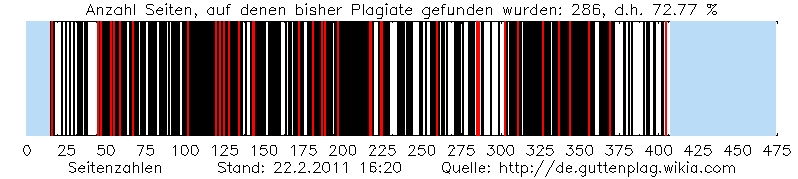
The GuttenPlag Wiki is expanding . Over 68% of the pages in his thesis contain plagiarised material.

http://de.guttenplag.wikia.com/wiki/GuttenPlag_Wiki

Plagiat graphic.jpg

Pages where plagiarism were found (black). The Table of Contents (pages 1-14) and Annexes, page 408 (blue) were not included in calculating the percentages. Pages with imitations of various sources are shown in red. Plagiat graphic.jpg

Professor DEBORA WEBER-WULFF writes

I’m wondering if KTzG thought that this crazy quilt is how we do science. Or if he is perhaps suffering from an advanced version of cryptomnesia. Wikipedia quotes Macrae, C.N., Bodenhasen, G. V. & Calvini, G. (1999). Contexts of cryptomnesia: May the source be with you. Social Cognition, 17, 273–297:

Cryptomnesia is more likely to occur when the ability to properly monitor sources is impaired. For example, people are more likely to falsely claim ideas as their own when they were under high cognitive load at the time they first considered the idea.

Sounds fitting. The saga continues.
 

Perhaps the rumour that zu Guttenberg (aka “zu Googleberg”) actually used ghost writers for his thesis is more than just rumour.

Baron zu Googleberg image: emperorswithoutclothes.com

Der Spiegel reveals:

In May 2004, when Guttenberg was a member of parliament for the conservative Christian Social Union party, Ulrich Tammler, a civil servant in the department with two PhDs of his own, wrote an analysis for Guttenberg headlined “The Question of the Link to Faith in the US Constitution and Supreme Court Rulings on the Separation of the Church and State.”

Tammler completed the 10-page document on May 13, 2004 and passed it on to Guttenberg’s parliamentary office under the reference number WF III – 100/04, according to an article due to be published in SPIEGEL on Monday.Even though members of Bundestag, or lower house of parliament, are only supposed to use of the department for work relating to their parliamentary mandate, Guttenberg included almost the entire article in his dissertation, with only minor word changes.

Tammler himself isn’t cited in any of Guttenberg’s footnotes. Only the parliamentary research department itself is mentioned, a footnote 83. The 60 staff of the department are meant to help lawmakers fulfil their duties as members of parliament. The department’s guidelines state: “The German Bundestag reserves all rights to the work of the Research Department. Publication and distribution require the approval of the departmental management.”

A man of no shame!

Gockel-guttenberg.jpg

Gockel-guttenberg.jpg

And the question becomes whether his thesis contains anything original at all.

On Friday Angela Merkel was still giving her Defence Minister her public support but it is going to be difficult for her to continue with this line. Associating with him is now a burden that few will be able to bear. The Süddeutsche Zeitung reported that the defense minister had plagiarised at least 19 authors. According to the Berliner Zeitung he also copied the work of first-year students at the Free University of Berlin.