Archive for the ‘Solar science’ Category

Piers Corbyn forecasts a 3rd solar-influenced wave of snow in UK

December 23, 2010


Reproduced from Climate Realists.com:
Image Attachment

A THIRD period of “Solar Climate Change” on the UK will take place from Christmas Day to the End of December, this comes right after the first & second periods correctly predicted by WeatherAction.com & Piers Corbyn

The forecast made in November says….Snow deluges and blizzards in most of England and Wales, heaviest in East parts. Snow showers in Scotland. Sleet/rain and less cold in far West Ireland.

This “triple hit” of “Solar Climate Change” announced to WeatherAction.com users in November, means that the UK will go on to complete the “worst ever” December for High street retailers and business with the lack of essential public service due to road/rail/airport closures and again bring the country to it’s knees, and with “road salt” running out fast this “third” wave will take it’s toll on the “holiday” work force.

This is likely to add to one of the worst if not THE worst period of disruption in the UK to have been seen in modern times.

I will repeat what was said on the previous statement as this will still apply….

There are potential “life threatening” conditions that will be underestimated by the media (inc. Met Office).

With the aid of this forecast we hope to give some advance warning to those of you who are already suffering hardship and warn you of a very real risk of further and even bigger snow storms and blizzard conditions set for Scotland & England and Eastern Europe.

Please spread news of this forecast to all of those who are vulnerable and try to ensure that food supplies are sufficient to cope with this impending crisis.


Landscheidt minimum is here — a new Dalton is indicated

December 21, 2010
SDO Sunspot

Spotless Sun

All the indicators are that the Landscheidt minimum is here and that this is going to be close to a Dalton minimum.

2010/12/20 8:00  Five Days in a row spotless is achieved 12 months after solar cycle 24 began it’s ramp up.

A Dalton Minimum Repeat is Shaping Up

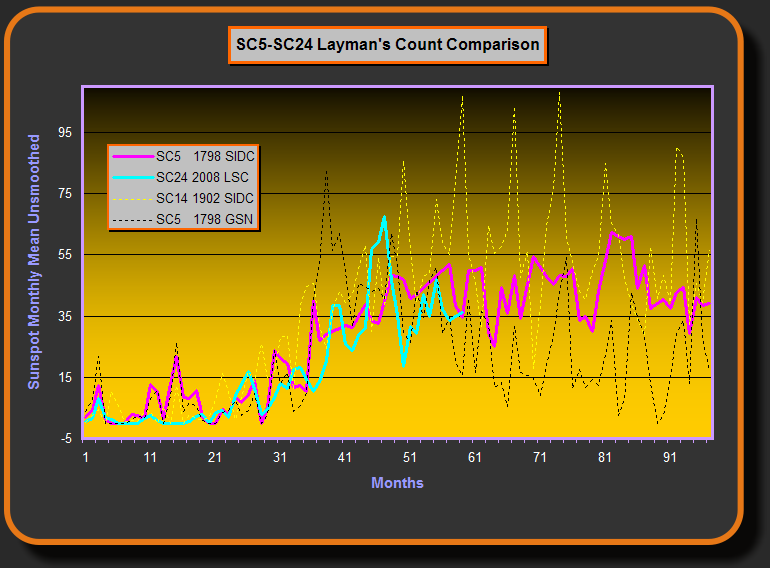
The Dalton Minimum was a period of low solar activity, named after the English meteorologist John Dalton, lasting from about 1790 to 1830. Like the Maunder Minimum and Spörer Minimum, the Dalton Minimum coincided with a period of lower-than-average global temperatures. The Oberlach Station in Germany, for example, experienced a 2.0°C decline over 20 years. The Year Without a Summer, in 1816, also occurred during the Dalton Minimum. Solar cycles 5 and 6, as shown below, were greatly reduced in amplitude.

http://solarcycle24.com/sunspots.htm

Sunspot number till December 7th


http://www.landscheidt.info/images/sc5_sc24.png

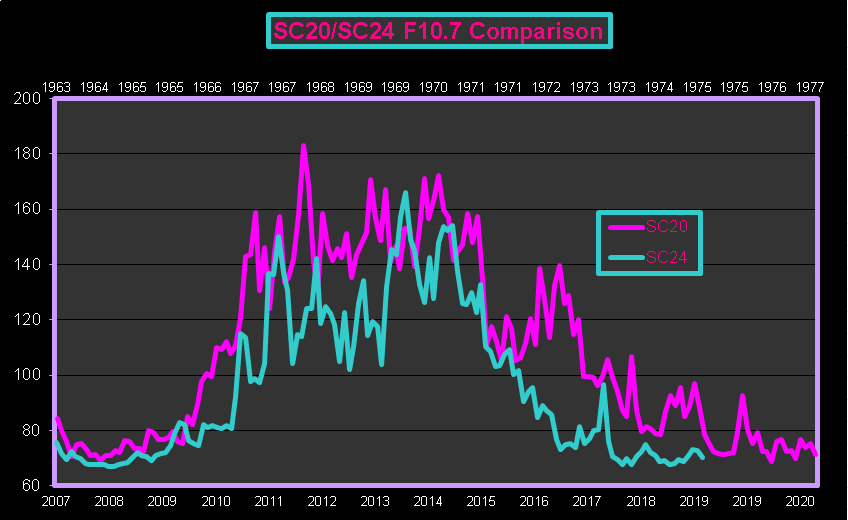
To compare solar cycles we can also use the F10.7 radio flux values that have been recorded since 1947 in Canada. Solar cycle 20 was a weak cycle which is currently looking strong against solar cycle 24. Data is taken from the AU adjusted monthly average values.

Nasa/University of Colorado establish Sun-Climate Research Center

November 30, 2010

The “settled science” of climate change seems to be opening up to real science  – at last. Nasa and the University of Colorado are establishing a new research centre dedicated to studying the effect of the sun on climate.

And about time too.

Perhaps they could let the 15,000 gathered in Cancun know about the importance the Sun may have!

Today the University of Colorado Laboratory for Atmospheric and Space Physics (LASP) and NASA’s Goddard Space Flight Center announced the formation of a new collaborative research center dedicated to the study of the Sun’s effect on Earth’s climate. The Press release goes on to say:

Solar Image

The newly announced Sun-Climate Research Center, a collaboration between LASP and Goddard, will focus on research areas such as how solar variations shape Earth’s atmosphere and climate. This image of the sun is from the LASP-built NSF Precision Solar Photometric Telescope (PSPT). (Courtesy NASA/GSFC Scientific Visualization Studio; source data courtesy of HAO and LASP PSPT project team)

The center, called the Sun-Climate Research Center (SCRC), will be directed by Peter Pilewskie, a LASP research scientist and CU professor, Robert Cahalan, Head of Goddard’s Climate and Radiation Branch, and Douglas Rabin, Head of Goddard’s Solar Physics Laboratory.

Pilewskie said, “The exciting thing about this collaboration is that we believe it will promote studies to help answer a key question about the climate system: how does Earth’s atmosphere respond to the sun’s variability, and how does that affect climate? This question is particularly important now, as we seek to quantify the human-induced impact on Earth’s climate.”

The SCRC, which has been made possible by a Federal Space Act Agreement, will foster collaboration between Earth-atmosphere and solar sciences at the two institutions. Opportunities will include a scientist exchange program between the organizations, the ability for post-doctoral scientists and graduate students in science, engineering, and mission operations to move between LASP and Goddard, annual international Sun-Climate research symposia, and the ability for the two institutions to collaborate more fluidly on future research opportunities.

Robert Cahalan, SCRC co-director and Goddard scientist, said, “In recent years Goddard and LASP have worked together on several Earth and Sun missions. Now we look forward to continuing to drive growth in this key interdisciplinary field of Sun-Earth research, bringing new focus to the study of multiyear changes in the Sun and their influence on Earth’s climate.”

With a limited number of such agreements between U.S. universities and any of NASA’s ten field centers, the SCRC represents a rare and innovative step, underscoring LASP’s ability to develop high-caliber research and programmatic opportunities with Goddard.

Daniel Baker, LASP Director, said, “LASP has developed some remarkable areas of expertise that are key to studying the sun and its effect on climate and on human activities. By working with our colleagues at Goddard, we can leverage our skills—and help take an important step toward greater cooperation between NASA centers and leading university research teams.”


Unsettled science?

October 9, 2010


History of sunspot number observations showing...

Image via Wikipedia


Within the space of two days there have been two scientific papers with entirely different conclusions about the effect of the active sun on climate. That there is a difference from two different studies is perfectly normal (and desirable if we are to learn), but what is obvious is the inanity of considering that the effects of solar variations on climate is a “settled science”. Solar Science and Climate are still in the realm of “where we don’t know what we don’t know”.

The first on October 5th, led to the conclusion that:

an increase in solar activity from the Sun actually cools the Earth

The second reported here comes to the conclusion that:

“The contribution of the active sun, indirectly via cosmic rays, to global warming appears to be much stronger than the presently accepted [IPCC] upper limit of 1/3.”


????

(more…)

Why Forecasts need to be wrong

October 7, 2010


The Lorenz attractor is an example of a non-li...

Image via Wikipedia


This started yesterday as a short comment on the changing forecasts by Hathaway on solar activity in Solar Cycle 24 but has now become something else.

As clarification, I  distinguish here between prophecies and forecasts  where:

  • I take prophecies to be a promise about the future  based primarily on faith and made by prophets , witchdoctors, soothsayers and politicians such as “You will be doomed to eternal damnation if you don’t do as I say”,
  • I take “forecasts” to be an estimate of future conditions based on known data with the use of calculations, logic, judgement, some intuition and even some faith. They are extrapolations of historical conditions to anticipate – and thereby plan for -future conditions.

(more…)

New Research – “A stronger sun cools the earth”??

October 6, 2010

New research and like all good research poses more questions than it answers. And the caveat is that the 3 year period of the research may not be very significant in the rythms of the sun. But it only emphasises to me that climate models which ignore the sun are not really worth very much. And climate models will only begin to become interesting when the sun’s influences and mechanisms by which they apply are far better understood.

From The Telegraph:

An increase in solar activity from the Sun actually cools the Earth, suggests new research that will renew the debate over the science behind climate change.

A stronger Sun actually cools the Earth

Stronger Sun actually cools the Earth??

Focused on a three-year snapshot of time between 2004 and 2007, as solar activity waned at the end of one of the Sun’s 11-year cycles, the new data shows the amount of light and heat reaching the Earth rose rather than fell. Its impact on melting polar ice caps, and drying up rivers could therefore have been exaggerated by conventional climate models during the period.

Scientists also believe it may also be possible that during the next upturn of the cycle, when solar activity increases, there might be a cooling effect at the Earth’s surface.

In the New Scientist:

Joanna Haigh of Imperial College London studied satellite measurements of solar radiation between 2004 and 2007, when overall solar activity was in decline.

Haigh’s measurements showed that visible radiation increased between 2004 and 2007, when it was expected to decrease, and ultraviolet radiation dropped four times as much as predicted. Haigh then plugged her data into an atmospheric model to calculate how the patterns affected energy filtering through the atmosphere. Previous studies have shown that Earth is normally cooler during solar minima.Yet the model suggested that more solar energy reached the planet’s surface during the period, warming it by about 0.05 °C.

An influence of solar spectral variations on radiative forcing of climate

by Joanna D. Haigh, Ann R. Winning, Ralf Toumi & Jerald W. Harder

(Nature, DOI: 10.1038/nature09426).

The effect is slight, but it could call into question our understanding of the sun’s subtle effects on climate. Or could it? Stefan Brönnimann of the University of Bern in Switzerland says Haigh’s study shows the importance of looking at radiation changes in detail but cautions that her the results could be a one-off. He points out that the sun’s most recent cycle is known to have been atypical

The Sun moves to its own music

October 6, 2010

Totally impervious to vulgar 10:10 videos, biodiversity 10.10 campaigns, 0% interest rates and other goings-on on Earth, the Sun moves to its own music.

It was spotless again.

Spotless Sun 5th October 2010: NASA image

Sunspot numbers and 10.7 flux continue to be significantly lower than forecast (and the forecast for Cycle 24 were pretty low to begin with).

2010/10/05 08:00 Today was spotless although Locarno managed to see two groups. The specks were tiny and would be on the fringe of visibility on the original Wolf 64x telescope on a perfect day. What could be old area 1106 may be returning in the next two days.

Yesterday’s adjusted F10.7 flux figures recorded a high of 76.6 (81.4) and a low of 74.7 (78.8), unbelievably low.

F10.7 Radio Flux (including September 2010)

That we are in a solar minimum (the Landscheidt minimum) seems clear but whether it will be a grand minimum remains to be seen.

sc5 sc24 comparison

sc5,sc14 comparison with sc24

And the sun will surely impact our climate — but how?

And in any case the sun gets no feedback and it does not much care.