Archive for the ‘Sport’ Category

Officials at World Athletics championship do not impress

August 13, 2013

I have just been watching the World Athletic Championships from Moscow on TV and need to have a little rant at bumbling officialdom.

I am not sure if this is to the account of the IAAF or to the Russian organisers but the officials at the 2013 World Championships in Moscow have been less than impressive.

  1. Idiot officials at the winning line who try to shoo away decathlon and heptathlon athletes who have collapsed on the track after completing their grueling final runs in the 1500m and 800m respectively.
  2. The utter lack of interest from idiot officials who merely watched as an athlete (Diego Ferrin high jump) was writhing in pain from a pulled muscle (hamstring?).
  3. The apparent lack of medical facilities  around the stadium which takes many minutes for assistance to come to injured or physically drained athletes (Hansle Parchment, Diego Ferrin)
  4. Idiot officials who try to keep winning athletes from celebrating and approaching their supporters.
  5. Idiot officials who are unable to ensure that the athletes competing in the 20km walk follow the designated route and where the position of the winning line is obscure.

I’m sure many of the officials are just temporary help drafted in off the streets for the championships but they do remind me of the security staff at airports – instructed to follow some rigid protocol and not – in any circumstances – to use their brains or their discretion.

Boston marathon winning times fail as a proxy for global warming temperature rise

March 31, 2013

I am not sure whether to call this “bad science” or to be generous and call it “trivial science”.

There is a new paper in PLOS ONE (open access) from “researchers” at Boston University:

Effects of Warming Temperatures on Winning Times in the Boston Marathon by Abraham J. Miller-Rushing, Richard B. Primack, Nathan Phillips and Robert K. Kaufmann, PLoS ONE 7(9): e43579. doi:10.1371/journal.pone.0043579

The only conclusions of any little value in this paper are that

  • Boston marathon winning times fail – so far – as a proxy for global warming temperature rise, and
  • if global warming increases Boston temperatures by about 5.8°C there is a 95% chance that the effect on winning time may be detectable!

Of course they could simply have reported that the variability of temperatures on race day drowned out the effects – if any – of any global temperature change. But that would have been too simple, too truthful and would not have helped towards publication.

The findings of this so-called “research” are:

  1. Higher temperatures and higher headwinds on the day of the race increase winning times for the marathon. Who would think otherwise? I would not have thought that weather conditions on any other day than race day would have much impact. Collecting this data is mildly useful but it is all readily available. Trivial.
  2. If temperatures do not increase relative to temperature variability on race days, the effects of warming on marathon times may not be detectable. However, at some point temperature increases may be large enough to affect marathon times. Amazing! So what exactly was the point of this work? Trivial.
  3. In summary, despite the well-known effect of temperature on marathon performance, we found that warming trends in Boston have not caused winning times to slow over time because of high variability in temperatures on race day. So race day temperature overrides any effects – due to global warming or anything else – on average annual temperatures. Obvious and Trivial.
  4. …. our models indicate that if race starting times had not changed and average race day temperatures continue to warm by 0.058°C/yr, a high-end estimate, we would have had a 95% chance of detecting a consistent slowing of winning marathon times by 2100. If average race day temperatures warm by 0.028°C/yr, a mid-range estimate, we would have had a 64% chance of detecting a consistent slowing of winning times by 2100. So your model says that if global warming increases race day temperatures above and beyond the natural daily variability then you have some chance of detecting this effect in the winning times! By modelling high rates of global warming  (5.8°C per century) you can force the race day temperatures to show an underlying increase such that there is a 95% chance that the effect on winning times could be detected.  The Boston marathon itself provides no evidence of global warming so far. Wow!! This is not just trivial but borders on “idiot science”.

The effects of global warming clearly cannot be detected in the results of the Boston marathon. In the paper their Figure 2 and Table 1 are fairly trivial but of passing interest. The rest of their modelling efforts (input and output) are just garbage.

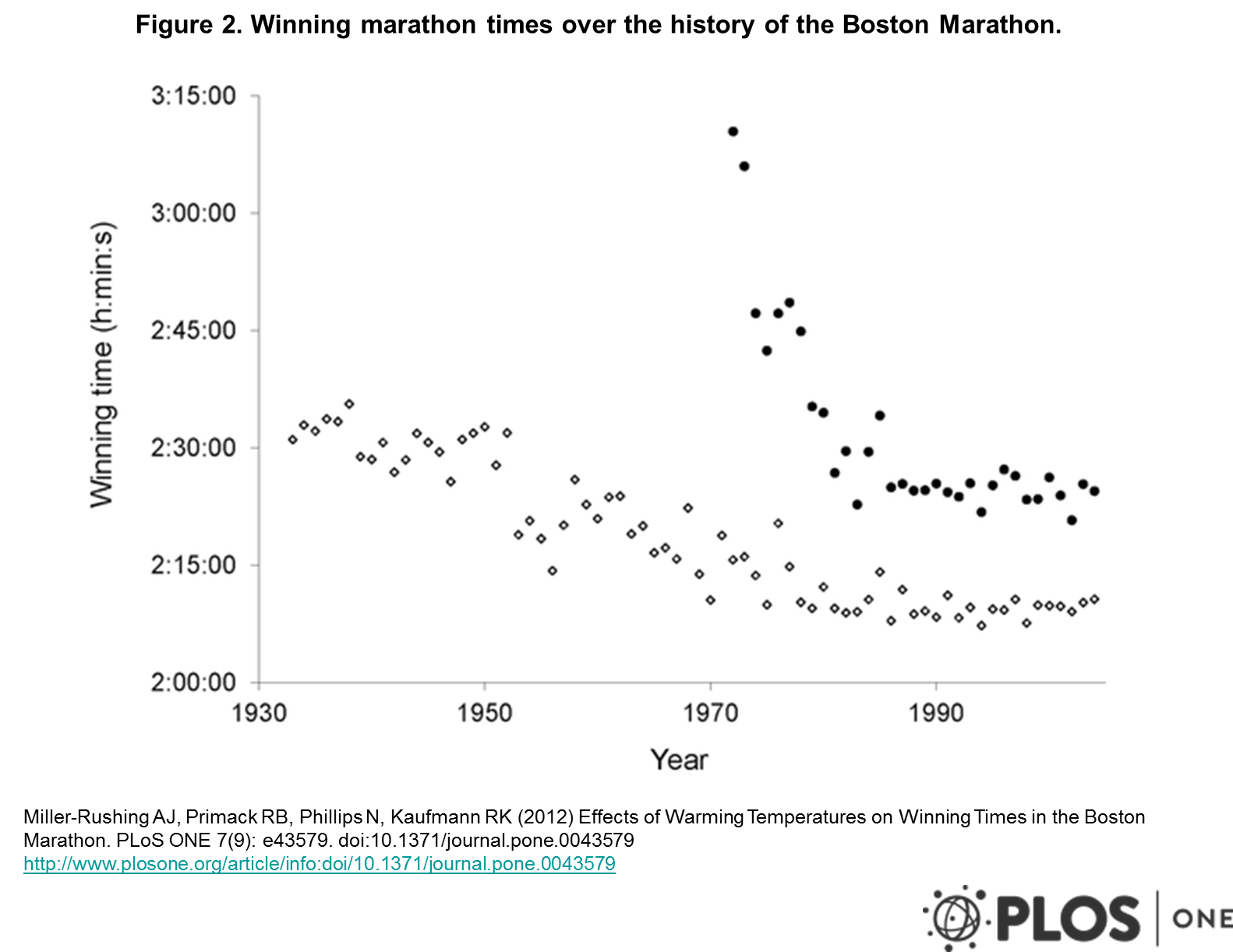
Miller-Rushing et al Figure 2

Open diamonds represent men’s times from 1933–2004. Closed circles represent women’s times from 1972–2004. Women’s running times improved rapidly in the first 14 yr of women’s participation in the marathon. From 1983 to 2004, the differences between men and women’s winning times held relatively constant at an average of 15 min 47 s.

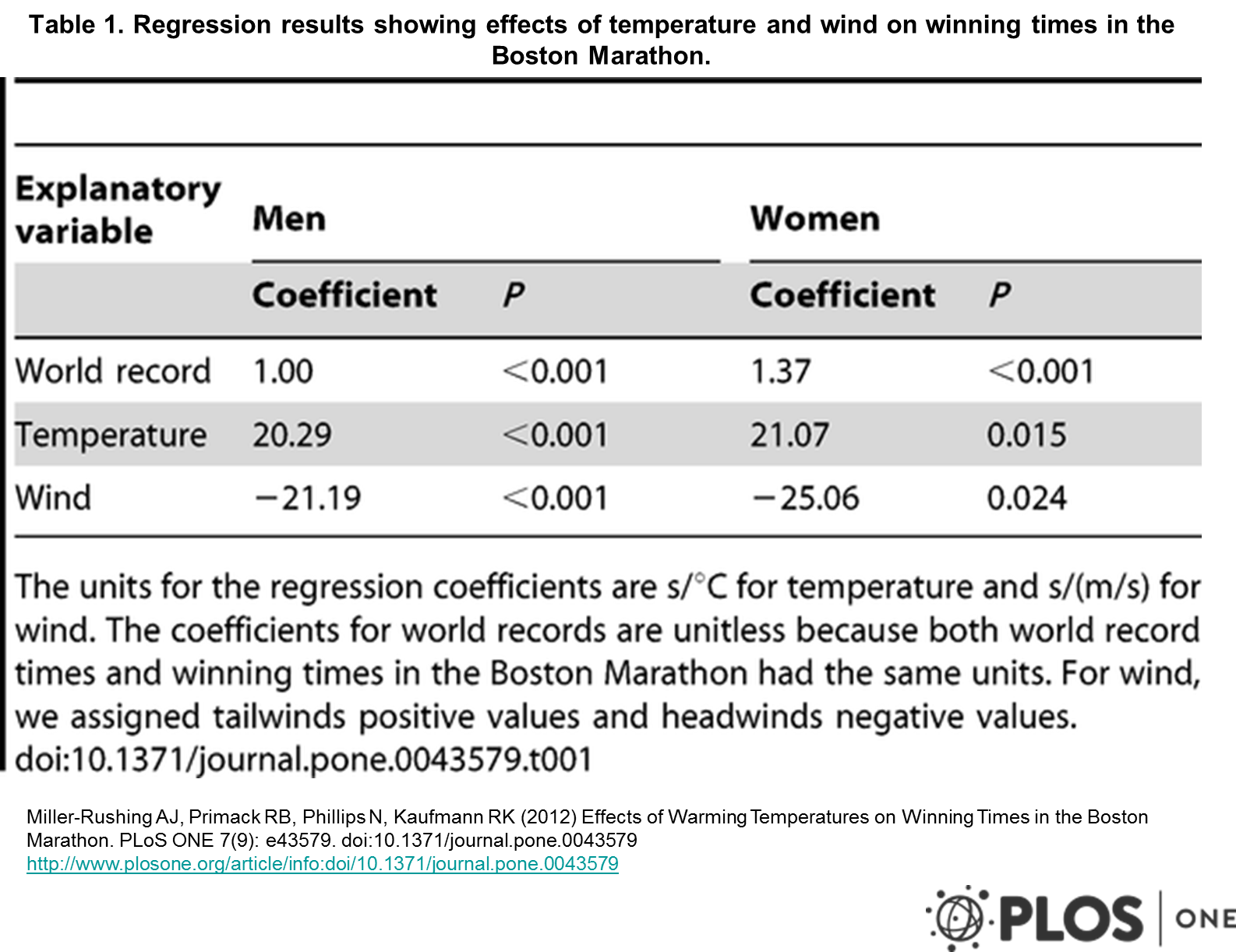
Table 1. Regression results showing effects of temperature and wind on winning times in the Boston Marathon.

Table 1. Regression results showing effects of temperature and wind on winning times in the Boston Marathon.

AbstractIt is not known whether global warming will affect winning times in endurance events, and counterbalance improvements in race performances that have occurred over the past century. We examined a time series (1933–2004) from the Boston Marathon to test for an effect of warming on winning times by men and women. We found that warmer temperatures and headwinds on the day of the race slow winning times. However, 1.6°C warming in annual temperatures in Boston between 1933 and 2004 did not consistently slow winning times because of high variability in temperatures on race day. Starting times for the race changed to earlier in the day beginning in 2006, making it difficult to anticipate effects of future warming on winning times. However, our models indicate that if race starting times had not changed and average race day temperatures had warmed by 0.058°C/yr, a high-end estimate, we would have had a 95% chance of detecting a consistent slowing of winning marathon times by 2100. If average race day temperatures had warmed by 0.028°C/yr, a mid-range estimate, we would have had a 64% chance of detecting a consistent slowing of winning times by 2100.

On balance I shall just classify this as Trivial Science bordering on Bad Science

Border-Gavaskar trophy: Australia win 4 in a row but get white-washed

March 24, 2013

The first time ever that India has managed a white-wash on their opponents in a test series. They won 4 tests of the 4 test series at home against Australia. (They already know how to be white washed!)

But the Australian team can take comfort in the fact that practice paid-off and they won the toss 4 times in a row – and elected to bat each time and lost each time. 

And they all learned how to use PowerPoint.

Cricket by PowerPoint

Cricket by PowerPoint

Cricinfo: 

  • This is the first time India have won four Tests in a series. They’ve won three in a series on three occasions, two of which were clean sweeps at home – against England in 1992-93, and against Sri Lanka the following season.
  • For Australia, this is only their second clean-sweep defeat in a series, after their 4-0 rout in South Africa in 1969-70. This is the sixth time they’ve lost four or more Tests in a series, and the first such instance since the Ashes at home in 1978-79, when an Australian team depleted by the Kerry Packer exodus lost 5-1.

  • This is only the second time in Test history that a team has won four or more tosses in a series, and lost four or more Tests in the same series. The only previous such instance was in the Ashes series of 1978-79 mentioned above, when Australia won the toss in five out of six Tests, but lost the series 5-1.
  • India have won 12 Tests at the Feroz Shah Kotla, which is next only to the MA Chidambaram Stadium in Chennai, where they’ve won 13. Of their last ten Tests here, India have won nine and drawn one. Their last defeat at this venue was in 1987, against West Indies.
  • Cheteshwar Pujara was not only one of the Indian heroes for the match and the series, but also for the entire season: he scored 857 runs in eight Tests 85.70, which puts him in 15th place in the all-time list forruns scored in a season for India. With a 600-run cut-off for a season, Pujara’s average of 85.70 puts him inseventh place.
  • Pujara’s unbeaten 82 in the fourth innings came off only 92 balls. His strike rate of 89.13 is the third-best for India in fourth-innings knocks of 75 or more.
  • The 104-run stand between Pujara and Virat Kohli is the tenth century stand for India for the second wicket in the fourth innings of a Test match.
  • R Ashwin’s series haul of 29 wickets is the seventh-best for India in a Test series, and the best since Harbhajan Singh’s 32 against Australia in 2001. The only Indian bowlers who’ve taken more wickets in a series are BS Chandrasekhar, Vinoo Mankad, Subhash Gupte, Kapil Dev, Harbhajan and Bishan Singh Bedi.
  • There were five five-fors for India in the series; only three times have there been more five-fors in a series for India.
  • Peter Siddle became the first batsman in Test history to score at least a half-century in each innings of a Test. He scored 51 in the first innings and 50 in the second, top-scoring for Australia in each innings.
  • Glenn Maxwell became the first Australian to open the batting and bowling in the same Test since Percy Hornibrook in 1929. Hornibrook, a left-arm bowler who bowled some medium-pace and spin, opened the batting and bowling at the MCG Test against England.
  • For only the third time in their entire Test history, Australia opened the attack with two spinners. The last such instance for Australia was in Georgetown in 2003 against West Indies, when Stuart MacGill and Brad Hogg opened the bowling in West Indies’ second innings.

India tops the list of Olympics underachievers

August 14, 2012

London 2012  has been a fantastic Olympics – the Bolt Games – notwithstanding a fairly pathetic closing ceremony.

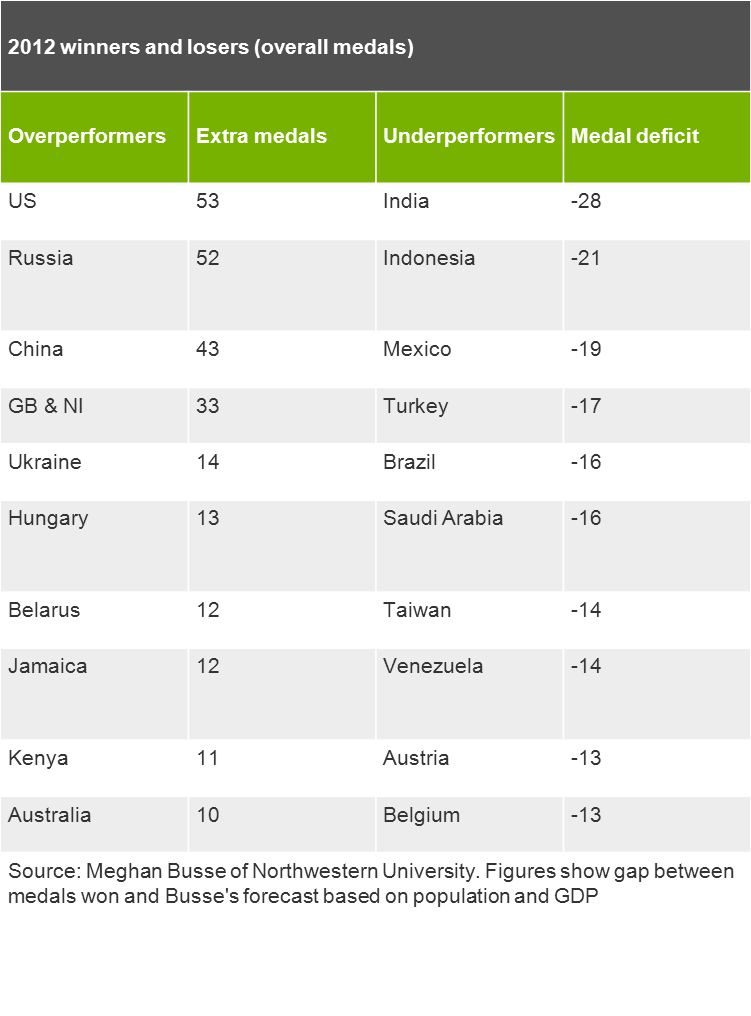
The BBC with the help of Meghan Busse from the Kellogg School of Management at Northwestern University in the US has produced a table of the underachieving and overachieving nations (based on population and GDP).

The top-10 list of countries that won most Olympic medals barely changed between 2008 and 2012. The top four – US, China, Russia, UK – were identical. Just one country dropped out – Ukraine – which was replaced by Japan. But which countries did better or worse than we should have expected?

Before the Games started, BBC Radio’s More or Less programme decided to level the statistical playing field by working out how many medals nations could expect to win based on population and GDP alone.

“If you use those predictions as a kind of benchmark, then you can ask the question, who’s done well and not so well relative to that prediction – who won more medals than they should have, and who won fewer,” says Meghan Busse from the Kellogg School of Management at Northwestern University in the US, who helped with the sums.

THE ALTERNATIVE MEDAL TABLE

The Bolt Games are coming to an end …… and some events need to go

August 10, 2012

Three days of competition left and then I can get back to a normal routine again. But Usain Bolt and David Rudisha were well worth waiting for last night. And behind David Rudisha in the 800m came two unheralded teenagers. What is left to say about Usain Bolt? The sprint double at successive Games is unprecedented and will not be repeated for a long time. From day one – and long before the athletics had even begun – it has been the Usain Bolt show even if the Team GB performance has been quite remarkable. Almost a fairy tale for the host nation. The organisation of the games has – to all appearances – been a great success. Journalists still look for negative stories but London has coped and coped quite easily. But London 2012 will be – should be – known as the Bolt Games.

Of course Usain Bolt has the 4 x 100m relay yet to come but that does not carry the majesty that the 100m and the 200m does. Rudisha vs. Bolt at the compromise distance of 400m could be interesting.

But – and without any disrespect to the proponents – there are far too many events which just don’t feel Olympian to me. I think I would prefer to see the emphasis on the performance of individuals. Faster, higher, stronger. All team events then feel wrong. This would remove football and hockey and volleyball and handball and basketball and beach volleyball. Even the doubles events in the racquet games would go (and do we really need three racquet games?). Wrestling and boxing are surely enough of the “combat sports” without having to suffer the judo and Tae-kwon-do bouts. Even wrestling has become quite unintelligible for the uninitiated. Pairs and fours in rowing could go. Events where performance is entirely subjective have no place here I think. This would remove artistic gymnastics and synchronised diving for example. And synchronised swimming would die a natural death if it was not an Olympic event. The equestrian events are interesting and dressage is an equine ballet that can be a joy to watch. But for riders to be feted for the performance of their horses seems a little ridiculous.

The Olympics must be the celebration of individual performance – I think – rather than team performances (with their nationalistic overtones).

Faster, Higher and Stronger!

And Tae-kwon-do, Wrestling, Judo, Water polo and all team events would be the first to go if I could choose.

Olympics: OBS coverage is amateur and cycling road race graphics were pathetic

July 29, 2012

Maybe it’s just teething troubles on Day 1, but yesterday’s coverage of the cycling road race was pathetic. Coverage of the boxing was bad and the rowing and swimming graphics were amateur. Their choice of pictures generally from their many cameras managed to miss many of the critical moments.

Olympic Broadcasting Services – OBS – provides all pictures from the Olympics to broadcasters around the world.

Of course, OBS is a wholly-owned subsidiary of the International Olympic Committee and hosts the broadcasting operation for several major sporting events.

The coverage was amateur rather than incompetent – but for the premier sporting event it needs to be at a different level. It certainly cannot get much worse.

The Guardian

Olympics have started – blogging will be light

July 28, 2012

London 2012 has begun.

London 2012

A pretty good start with the opening ceremony last night. The  industrial revolution and the molten metal and the rise of the rings was superb.

Execution was fine but  I thought the NHS section was ill conceived and Mr. Bean was a little self-indulgent. The Queen and James Bond was actually nondescript. It was an impressive bit of film making – but only because it was the Queen. Her corgis did well. Home crowd of course but not a very “sporting” reception for some of the “unknown countries”. Excusable because some of the “countries” were not countries at all.

The “Former Yugoslav Republic of Macedonia” sorted under “F” was ridiculous but that can be put down to the IOC rather than to the London organisers.

The Beijing opening ceremony was far more spectacular but humourless. Some of the London themes were more “socialist” than at Beijing. Beijing was trying to hide its “socialism” while London seemed to be doing the opposite. The ceremony had some humour – but some of which fell flat.

The raising of the rings in London though will stick in my memory.

Blogging will be extremely light for the next 3 weeks.

Peter Roebuck committed suicide after accusation of sexual assault on young cricketers

November 14, 2011

Yet another case of predatory behaviour by sports people in authority over young boys. Peter Roebuck committed suicide in S. Africa by jumping out of his hotel window after being questioned by police about drugging and sexually assaulting a young boy. Many people must have known anout his behaviour.

He wrote very well and I always enjoyed his articles. But he had some dark secrets and they are not very pretty. In 2001 he was found guilty of caning 3 young S. African cricketers he was training.

Daily Telegraph Australia: In 2001, the former Somerset cricket captain was given a suspended jail sentence after admitting caning three young cricketers he had offered to coach. Roebuck, of Exmouth in Devon, pleaded guilty to three charges of common assault involving three South African teenagers between 1 April and 31 May, 1999. He had pleaded not guilty to three counts of causing actual bodily harm, which was accepted by the prosecution. Roebuck was sentenced to four months in jail for each count, with the sentences suspended for two years, at Taunton Crown Court. Judge Graham Hume Jones told Roebuck he had abused his power and influence over the boys, who were far from home and far from friends and family.

Update! I see that tributes, and here, are flowing in about his writing and his cricket career. But I am afraid that whatever he may have done well, his sexual predations and the lives of all the young people he has traumatised is too heavy a price.
Better that he had never written a single word if that would have meant that his horrible behaviour to young cricketers under his authority could have been avoided.

(more…)

Tiger Pataudi passes away

September 22, 2011

Skipper Mansur Ali Khan, the Nawab of Pataudi in 1967: image THE HINDU PHOTO LIBRARY

Tiger Pataudi, MAK , the Nawab of Pataudi, passed away today at the age of 70. Captain of Oxford, captain of Sussex and captain of India.

He was a hero for me through my teens and beyond and was the first Indian captain who gave the Indian cricket team a belief in themselves and that they could win against any other.

He was a dashing batsman but it was his attitude which was his most vital quality and which earned him the nickname “Tiger”.

I had the privilege of watching him play in the 1960’s in England.

He had class.

RIP

MAK Pataudi: the eye of the Tiger

Tiger Pataudi was a prince among cricketers

College athletes and accommodating professors

August 22, 2011

The massive commercialisation of college sports in the US has led to the situation where coaches can make $10 million per annum and sometimes have salaries which are 25 times higher than what the college president may earn. The media payments to the colleges for covering these sports is enormous and provides the incentive for colleges to have sports programs attracting the best athletes in spite of any academic shortcomings. Colleges provide the forum and the vehicle for the money-spinning sports enterprises. And since the colleges are supposed primarily to be academic institutions it becomes necessary to have – or seem to have – minimum academic standards that even the athletes must satisfy.

A PRICE TO PLAY  ‘Corrupt’ system in danger of collapse

But the academic standards to be fulfilled are merely a cover for the sports-based enterprise.  This in turn creates the pressure for colleges to create easy courses especially designed for academically disabled athletes and  for academics to go easy on athletes attending their courses. Effectively athlete students are encouraged to cheat and all the different codes of ethics and integrity that are created serve only as a way to define all the loop-holes in the code that can then be used to cheat without being declared a cheat.

“(Stanford) accommodates athletes in the manner that they accommodate students with disabilities.” Prof. Donald Barr, Associate Professor of Sociology and Human Biology

The recent case of Prof. Julius Nyang’oro and his 400 level class in Bioethics in Afro-American Studies is a case in point. An athlete got into the class despite having a score on the written portion of the SAT that was low enough that he needed to take a remedial writing class, which he took in the subsequent fall semester. No student received less than a B-minus on Nyang’oro’s course. The Charlotte Observer writes:

Julia Nichols, the student services manager for UNC’s Academic Advising Program, said it is unusual for any freshman to begin his or her college education with a 400 level course. The exceptions, she said, are freshmen who have demonstrated an aptitude, either through advanced placement classes or other experience and petition the professor to be allowed to take the course.

“As a general, blanketed rule, freshmen are not normally allowed to take 400 or 500 level classes,” she said.

There is little doubt that while inter-collegiate athletes are privileged, others suffer from being stigmatised as academically stunted. It would be unthinkable however for an academic student to be required to satisfy some minimum sports or athletic standard to graduate or to be stigmatised as athletically stunted. No athletically inept student is stigmatised because he cannot catch a ball.

If a professor knows you are an athlete, you are assumed to be stupid until you can prove otherwise. (White male water polo)

In a big, class (400 people). Before test professor said, “It’s an easy test. Even athletes can pass.” (White male swimming)

Professor asked the student athletes to stand on the first day of class and said, “These are the people who will probably drop this class.” (African American female, basketball)

….. They are seen as academically unqualified illegitimate students whose only interest is athletics, who expect and receive special treatment from professors and others. The perception is that in order to remain eligible and participate in sports they put in minimum effort, do little academic work, take easy classes and have others do their work for them. …..

But there is no reason to confine a college to only the so-called academic courses.

Perhaps if every college had a sports or athletic faculty where grades were obtained for performance and where courses at this faculty demanded a minimum level of performance, some of the hypocrisy would be eliminated. Promoting excellence in any discipline – even a sport – is surely a legitimate activity for any University or College. The brain does not have to be separated from the brawn.