Archive for the ‘Sweden’ Category

Winter time tomorrow and the elk are in the garden

October 25, 2014

We change to winter time tonight.

This evening at dusk we had the privilege of two elk (moose) visiting the garden. A mother and a rather large calf it seemed. It was getting quite dark but I managed to get this blurry picture on my I-phone through a window. The calf was just about 2 m from the window. They stayed for about half an hour till they got spooked when I came out of the house.

elk in the garden 20141025 1802

elk in the garden 20141025 1802

I am no hunter and the elk are quite welcome to whatever they can find in my garden. The hunting regulations for this season in our county are:

The moose hunt begins on the second Monday in October, according to Appendix 2 of the Hunting Ordinance (1987: 905)

Hunting for moose calf Monday, October 13 – Wednesday, October 15 2014
(unregistered area)
Licensed area Monday, October 13 – Saturday, February 28 2015
Moose fostering area Monday, October 13 – Saturday, February 28 2015
Recommendations:
1. Cows with calves should not be culled  unless the calf or calves have been shot before the cow.
2. At least 50-60% of the shoot should consist of calves. 
3. Avoid posted restrictions limiting calf shooting.
4. Of the total shoot of adult animals no more than 30% should be males.
5. The variation in moose density and injury rate in different geographical areas should be clearly reflected in the shoot. Avoid assigning the moose shoot solely on an acreage basis.
6. The shoot in January-February should primarily focus on calves

Sweden gets it wrong in rejecting treatment for Ebola infected UNICEF worker

October 24, 2014

Swedish Social Services received a request yesterday to accept a UNICEF worker smitten with Ebola for treatment. They merely responded with a demand for more information and when they did not get that information they rejected the request.

They got it wrong I think.

I imagine the request was urgent in an effort to find a place willing and capable to treat the unfortunate UNICEF worker. The correct response should have been “Yes, in principle, subject to practical feasibility”. To note the limitations or constraints on what help could be provided would have been perfectly in order. But just a counter-request for more information would have been taken – and rightly so – as prevarication and a fundamental unwillingness to help.

I hope that some country with suitable medical services has accepted the unfortunate patient.

From my little experience of emergency situations, the bottom line is that emergency requests for help must be answered YES or NO, and not just generate requests for further information. A YES can – and must – be qualified with the constraints or limitations of what help can be provided. The requests usually originate from the “front line” (whether disease or earthquake or tsunami or typhoon) and it is unreasonable for those receiving requests for help, to burden those at the “front” with more bureaucratic requests for information. Responses must be for the sake of being helpful for those at the “front line” to take a call and make decisions and take actions. A response cannot be – as in this case – something which makes it more difficult for the “front line” to act.

(I would give Fukushima as an example. When the plant engineers and managers at the Fukushima nuclear plant requested permission from Headquarters in Tokyo to use sea water for emergency cooling – which they well knew would permanently disable the plant – TEPCO HQ responded by asking for more information. The “front line” at the plant knew they were no other options but the lack of clear response and unending requests for more information from Tokyo led to many hours (about 6 hours) being lost).

As a response from someone called the “Emergency Management Director” of the National Social Service Board, Sweden’s response left a lot to be desired.

Dagens Nyheter:

On Thursday, Sweden received a request to receive a suspected Ebola infected person who worked for UNICEF in Sierra Leone. But the reflection period was too short and the information was very sketchy and therefore rejected by the National Social Services Board writes expressen.se.

“We had no medical information in general, and requested it, but received no such information. Therefore it was hard to know what to say yes to and what to prepare”, says Johanna Sandwall, emergency management director on the National Social Services Board.

I would suggest that the National Social Services Board has not yet distinguished sufficiently between normal processes and emergency procedures. I take it for granted that Sweden, in fact, does want to assist and is probably among the more capable countries for treating patients.

Swedish submarine hunt continues ….. but is it just a play to promote NATO membership?

October 23, 2014

The hysteria is dying down.

Well nothing has been found so far but the search continues for “foreign” underwater activity. There are military officers addressing press conferences every day. Of course, it is implied, the military cannot reveal all the information they have. “We know much more than we are telling you — but trust us. We know what we are doing” is the impression they try to foster. They have even threatened to use “live fire” to force the dastardly, foreigners to the surface.

The coverage, not only from the outside world but even in Sweden, is more amused than concerned. Coverage from European NATO countries tends to paint a picture of a naive Sweden terribly “unprepared” for the real and nasty Russian Bear (implying that Sweden needs to join NATO). Some of the Swedish comments are about the threat to the West from Russia through the Baltic (implying that NATO needs Sweden to join the club). Other commentary in Sweden is about the lack of personnel and ships and equipment and how the defence budget needs to be increased sharply. Some claim that Sweden’s military has only the capability to resist foreign (read Russian) aggression for about 3 days!! This needs – so the story goes – to be urgently increased to at least 4 days of resistance.

The Russian press and social media comments have treated the whole story as a bit of a joke.

Dagens Nyheter:

That there is any real foreign submarine in the Stockholm archipelago is anything but convincing. Meanwhile, “the hysterical” submarine hunt is part of Sweden’s effort to get ever closer to the Western defense alliance NATO. These are some of the general comments in the Russian media in response to the feverish search for a “possible submarine” in Swedish waters.

“Sweden has suffered from a ‘Russian submarine syndrome’ since 1981, when a Soviet submarine through a navigational error came into Swedish waters and went aground near the Swedish naval base in Karlskrona. Since then ‘Russian submarines’ show up in Swedish waters just before a defense budget is to be adopted”, says the Russian newspaper, Pravda, about events in the Stockholm archipelago. 

Pravda, which has consulted with military experts, also dismisses press reports (in Svenska Dagbladet) that the Swedish military had captured emergency radio signals from an unidentified submarine in Swedish waters. The signals were reported to have been directed to and received in Kaliningrad, where the Russian Baltic fleet’s main base is located. The signals were said to be on a frequency that the Russian Navy uses in extreme situations, hence the conclusion that there may have been a submarine that was in distress.

But according to Igor Kurdin, president of the Submarine Men’s club in St Petersburg, the information about a distress signal is baseless. “There are several channels of communication on board submarines. Registering a signal is possible, but it is impossible to decrypt them, and to determine the direction of a radio signal is impossible according to the laws of physics”, says Kurdin (Interfax news agency).

Perhaps there is a submarine out there. Perhaps it was in distress. Perhaps it was testing Swedish defences.

I have my doubts. Maybe I am just being cynical but I see two “drivers” here. A push for NATO membership and a larger defence budget. There is a new Red/Green government in place and they are due to present their first budget proposal today. Normally the Red/Greens could be expected to cut back on defence spending and they are ideologically not at all comfortable in joining NATO. They have an idealised and somewhat glorified vision of a “Swedish neutrality” even if it is completely contradicted by the reality of cooperation with the US and NATO for at least the last 30 years. Public opinion is against NATO membership – but only just. The Swedish military would just love to be part of NATO and take part not only in exercises but also in some real live fire-fights. The Swedish military – for all its restricted defence budget – is quite technologically advanced but lack playgrounds for their toys. Being part of NATO would provide more playgrounds and even more toys and many more players to play with. The difference between playing The World of Warcraft all by yourself or playing it on the internet!!

There are therefore – as I see it –  three parties who could possible lie behind the furore in the Stockholm archipelago:

  1. It could have been a real Russian submarine on a testing or a training exercise, or
  2. It could be a play by the Swedish military to try and get a larger defence budget, or
  3. It could be a joint NATO/ Swedish military exercise to show the benefits of NATO membership.

There is a faint possibility there was something real but relatively innocent by the Russians but which has been opportunistically seized and blown up by the defence lobby and NATO supporters.

The budget proposal today is now expected to have some defence spending increase included.

A partial success for someone.

Hide-and-seek with Russian subs in the Stockholm Archipelago

October 20, 2014

It is the 1980s again and a sense of déjà vu. A real Red October and the hunt is on.

Fifty shades of the Cold War!

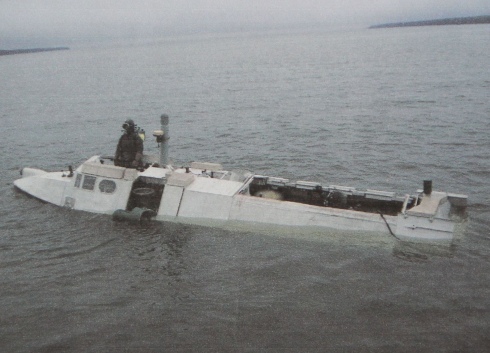
Of course it may not be a Triton -NN, Russian, stealth, submersible, high-speed craft wandering around the Stockholm archipelago – but it may be. It could just be probing Swedish defences or the boat may be in trouble. Or it could be nothing at all (though that seems unlikely). The Russians could be testing the new Red/Green Swedish government. Or carrying out a “live” training exercise but “against” a non-NATO member to minimise the risk of live fire. Or it could be a German or even a Polish submarine on a surreptitious training exercise!

The Russians have announced that they have no boats in trouble or missing so it is unlikely to be another Kursk.

The Triton-NN concept has been known for some time but there are few actual sightings.

Triton NN Submersible image padelt-online-de

Triton NN Submersible concept image padelt-online.de

There are many theories around but the most “objective” update I have found is from the Finnish -Swede military blogger Corporal Frick. He writes:

The major news was when Swedish newspaper Svenska Dagbladet reported that a signal emerging from the archipelago outside of Stockholm had been sent on a Russian Navy distress channel. When the search operation got underway, there was renewed traffic, which was encrypted, and a transmitter located in Russian Kaliningrad answered. This was the first evidence that decidedly pointed towards Russia as the country of origin. This could also explain the, in my opinion, rather strong and decisive response by the Swedish Navy when the first visual sightings occurred.

Representatives of the Swedish Defence Forces have denied that they have received knowledge about a distress signal, although the exact wording leaves the possibility open that A) the info has been distributed on a strict need-to-know basis, and as such is not available to the officers involved in the operation, or B) the interpretation that a signal on a known foreign military channel used for distress signals does not equal a known distress signal. They have also clearly stated that they do not know the country of origin or exact nature of the underwater activity, and as such they will continue to refer to it simply as “foreign underwater activity”. Most importantly, it has been confirmed that three visual sightings have taken place, and that the operation will continue for a number of days. Imagery from one of the sightings has also been released. The picture is grainy, but could be interpreted to show some kind of a midget submarine, e.g. the Russian Triton NN.

20120210-225617.jpg

A real Triton-NN? image from 2008 oplatsen.wordpress.com

The question of where the mother ship is located has been focused on the Russian-owned Liberian-flagged crude carrier NS Concord. The ship has been anchored outside of St Petersburg since the beginning of May, acting as a floating storage. Last week, it set sail and sailed to a position right outside the border of Swedish territorial waters, where it has since loitered. To begin with its AIS-data gave the destination as Danish Straits, but today this was changed to Primorsk. When the tanker suddenly found itself in the limelight, the Russian research/sea survey vessel Professor Logachev suddenly headed out to sea, destined for Las Palmas(?). It remains to be seen if this vessel will make a stop outside of Stockholm, but the timing seems somewhat suspicious. The Logachev also happened(?) to be traveling in the middle of the three-ship Dutch naval flotilla heading home from Tallinn, with the Walrus-class submarine HNLMS Bruinvis probably not far away either.

The Triton-NN could – it is speculated – carry upto 6 Spetsnaz divers and 2 crew. There is also some suggestion after a sighting of a black-clad figure that somebody could have disembarked and come ashore on an island in the archipelago.

A Russian Ethan Hunt?

New red/green Swedish government attacks the elderly who would dare to work

October 12, 2014

Traditional socialists it seems would prefer that the elderly not work for longer. They should should leave the work-place, sit-out their days in an old-age home and die out quietly without making too much fuss. “Self-employed” has always been a dirty word in the socialist lexicon and the new Swedish government is training its sights especially on the elderly self-employed.

As it is, the age discrimination that is endemic in Sweden makes it virtually impossible for the elderly (>65 years old) to get employment. About the only real possibility for the elderly to work is to employ themselves and to be self-employed. The new government in Sweden wants to make it even harder for the elderly to be employed (by others) and to milk them for extra taxes when they do. The special payroll tax is to be increased by 8.5%. Employers must pay the extra and if the elderly are self-employed then they will have to pay the extra themselves. When the discrimination is built into the tax code then it must count as institutionalised age-discrimination.

It seems such a waste of experience and knowledge. The evidence shows, and common sense says, that it is not the elderly who take jobs away from the young. The elderly – when they are employed – are usually employed for the depth of their experience which is not an area of competition with the young. The previous government had managed to increase the employment of the over-65s by 1.5 percentage points. But the new government clearly wants to change that.

Of course the key point is that when over-65s lose their jobs, they do not – statistically – swell the ranks of the unemployed. And the new socialist government wants to milk whatever taxes it can from the elderly – especially if they are self-employed.

But in the long term the demographics dictate that with increasing longevity, society will have to encourage that people remain gainfully employed – on average – much beyond the age of 65. By 2050, this will need to be at least 70 years. The left will have to lose their antipathy for the elderly.

From Swedish Radio:

The red-green government is making it more expensive to hire seniors. From next year, the fee paid by employers for workers over 65 will be raised. Finance Minister Magdalena Andersson says that the government needs the money.

The government wants to increase national revenues by 18 billion kronor next year. More than two billion will come from the increase in the fee paid by the employer to employ people over 65 years, the so-called special payroll tax. 

It thus becomes more expensive for firms to hire the over-65s from 1st January 2015.

The previous Alliance government had lowered the special payroll tax in 2007, and given the over-65s higher earned income tax credit. This resulted in more over-65s working according to a study by the Institute for Labour Market Policy Evaluation, IFAU.

“These reforms led to an increase in employment by 1.5 percentage points”. says researcher Lisa Laun at IFAU. The study could not determine what impacedt employment most; the lower payroll tax or the higher tax credit. But both reforms together gave more jobs for the over-65s.

Lars Calmfors is a Swedish economist and Professor of international economics at the Institute for International Economic Studies at Stockholm University. He spoke to Swedish TV:

“It does not seem wise, if one wants to get older people to stay and work. We know that we have large departures in many professions, not least in health care and the teaching profession. One is keen to keep people at work here so the measure is probably ill advised”.  So said Professor Lars Calmfors  after the government proposed that the payroll tax for the elderly over 65 years will increase by 8.5 percent from the year-end. It is a tax paid by the employer for each employee. The self-employed must pay the tax themselves. 

Lars Calmfors sees two reasons why the payroll tax is now being raised for the elderly; first that the government needs more tax revenue, and second, that the government might think that fewer older people will take away jobs from the young – something that is not at all supported by research. 

“There’s very little support for the theory that higher employment of the elderly leads to lower employment among young people. Most indications are that in countries that have high levels of employment for the elderly there are also high levels of employment for young people. They don’t seem to compete against each other” said Lars Calmfors to SVT.

Nobel prize announcements next week

October 4, 2014

It is that time of the year again.

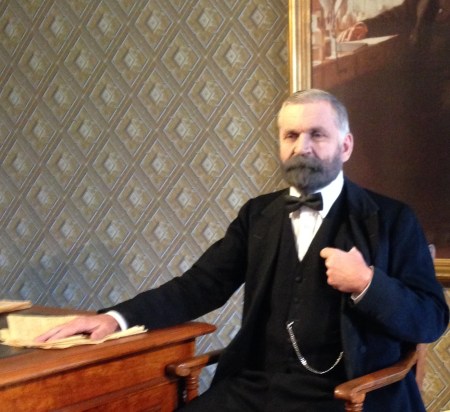
Alfred Nobel at his desk (photo kkp)

“Alfred Nobel” at his desk (photo kkp)

2014 Nobel Prize Announcements

Physiology or Medicine:
Monday 6 October, 11:30 a.m. CET at the earliest

Physics:
Tuesday 7 October, 11:45 a.m. CET at the earliest

Chemistry:
Wednesday 8 October, 11:45 a.m. CET at the earliest

Peace:
Friday 10 October, 11:00 a.m. CET

Economic Sciences:
Monday 13 October, 1:00 p.m. CET at the earliest

Literature:
The date will be set later

I only learned the story behind how the Nobel prizes came into being this summer – on a visit to Björkborn Manor in Karlskoga.

How Sohlman and 3 white Russian stallions ensured the establishment of the Nobel prizes

The Thomson-Reuters Nobel predictions are here.

An unrepresentative Swedish parliament

October 3, 2014

There is a 90% under-representation of the over-65s in the Swedish parliament.

The older I get the more I seem to encounter “age discrimination”. I have the perception that wisdom, knowledge and experience – but not wealth – are given a diminishing value by society. But it is not just perception. The numbers don’t lie. But the numbers also suggest that the elderly themselves contribute to this perception by giving less value to their own hard-earned qualities.

The new Swedish Parliament has just convened and a new socialist/green government (a minority government) is being formed. The media touted that this was the youngest ever Swedish Parliament and possibly one of the youngest in the world – as if it was a good thing. Perhaps it is – though I doubt it. I found the election debates degenerated often into childish squabbles. Wisdom, knowledge and experience were conspicuous by their absence from many of the candidates.

Riksdag 2014

Riksdag 2014

The Numbers (from SCB and the Election Commission):

  1. The total population of Sweden is currently (31st July 2014) 9.7 million and 19.2% (1.9 million) are over 65 years old. By 2060 the population is expected to be 11.6 million with 25.3% (2.9 million) over 65 years old.
  2. Of the 7.33 million eligible to vote, 25.6% (1.87 million) were over 65.
  3. Of the 5,901 candidates, only 13.5% were over 65 (a 53% representation).
  4. Of the major parties only the Folk Party and the Centre Party had a representation of the over-65’s among their candidates which was higher than 75%.
  5. Of the 349 elected to parliament only 2.6% were over 65 (a 10% representation)
  6. Women (86% representation) are slightly underrepresented.
  7. Under 30’s ( 56% representation) are underrepresented.
  8. Over 65s are grossly underrepresented (10% representation)

“Age discrimination” is endemic in Sweden. To be labelled a “pensioner” in Sweden has the “kiss of death” about it. This is no doubt partly due to the elderly’s perception of themselves and their disinclination to be strident. Under-representation cannot be solved by quotas since quotas are fundamentally unjust and discriminatory in nature.. The skewed representation can only be addressed by greater participation of the over-65s through the entire chain.

But a 10% representation in Parliament is untenable. Perhaps the over-65s need to take to the streets.

NO TAXATION WITHOUT REPRESENTATION!!


More milk from comfortable Swedish cows

October 2, 2014

The cows are “going to the mattresses”!

Instead of the usual hard rubber mat, some lucky Swedish cows will now enjoy a two inch thick mattress with a protective layer of Goretex developed especially to give them a more comfortable life.

Swedish Radio reports:

Custom designed mattresses to get the cows to give more milk and live longer. That is the expectation of  the Natural resource program at the Nils Holgersson Gymnasium, Skurup.

“Research has shown that the milk is produced when the cow is lying down” says Göran Thorsson, barn foreman at the Gymnasium. “It is when she is resting and ruminating that production starts and a cow needs to be lying down for twelve hours a day to feel really good”. Most of his  cows are lying down, and some seem to be really enjoying themselves with outstretched legs but at first they were greatly skeptical explains Göran Thorsson. 

“At first they did not dare to lie down.  They just stood and stared for several hours and we were really worried that we had made ​​the wrong bet, but then they stepped gently up and once they settled we could hardly get them up gain”, he laughs. 

In an adjacent box lie cows soon after giving birth in a thick layer of straw but using  straw with many cows is difficult to keep clean, and too heavy for the cleaners. The purpose of the specially designed mattresses is not only milk  production but also to give the cows a longer life. On hard surfaces they often injure their legs which leads to infections.  Additionally, hard surfaces stress the cows’ joints and the reduced stress is intended to extend their life. “A dairy cow lives five years on average  and we of course hope that the mattresses keep them healthier and for longer”. 

After just a few weeks with the new mattress it seems that both cows and their carers are satisfied, but there is a problem. “We have a tough job to get them up in the morning” he says, smiling a wide smile. “When we normally arrived at 5 am the cows were all up, but now they are all still lying down and can be hard to rouse”.

Swedish investment in wind power collapses while waiting for new subsidies

September 22, 2014

The simple fact is that wind power investment depends upon subsidies. The greater the subsidy offered the greater the investment. The higher the electricity price the greater the value of any subsidies and the greater the investment.

Subsidies just don’t work.

And in the meantime the world has begun to cool.

From Swedish Radio:

During the second quarter of this year, decisions were made to invest in future wind power totaling 37 megawatts, down 83 percent compared with the same period last year according to statistics from the Swedish Federation of Wind Energy.

One reason for the decline is the low price of electricity, another is that the industry is waiting for next year’s so-called checkpoint in parliament on changes to the certificate system, a decision which, according to Annika Helker Lundström, CEO of Swedish Wind Energy, will be of great importance for Swedish wind power company.

……

The certificate system was introduced in 2003 and means that the government supp…orts producers of renewable electricity by handing out certificates worth one megawatt per piece which can then be sold to electricity suppliers. Electricity suppliers are in turn obliged to buy a certain amount of renewable electricity.

The current system is certified to award equivalent to 25 terawatt-hours by 2020, and already has a certificate for over 20 terra watt hours distributed. The Agency has proposed to the government that more certificates to be awarded and the dividend period is extended to 2030.

This should increase the willingness to invest in the electricity generators.

Sweden votes “against”, but what is Sweden “for”?

September 15, 2014

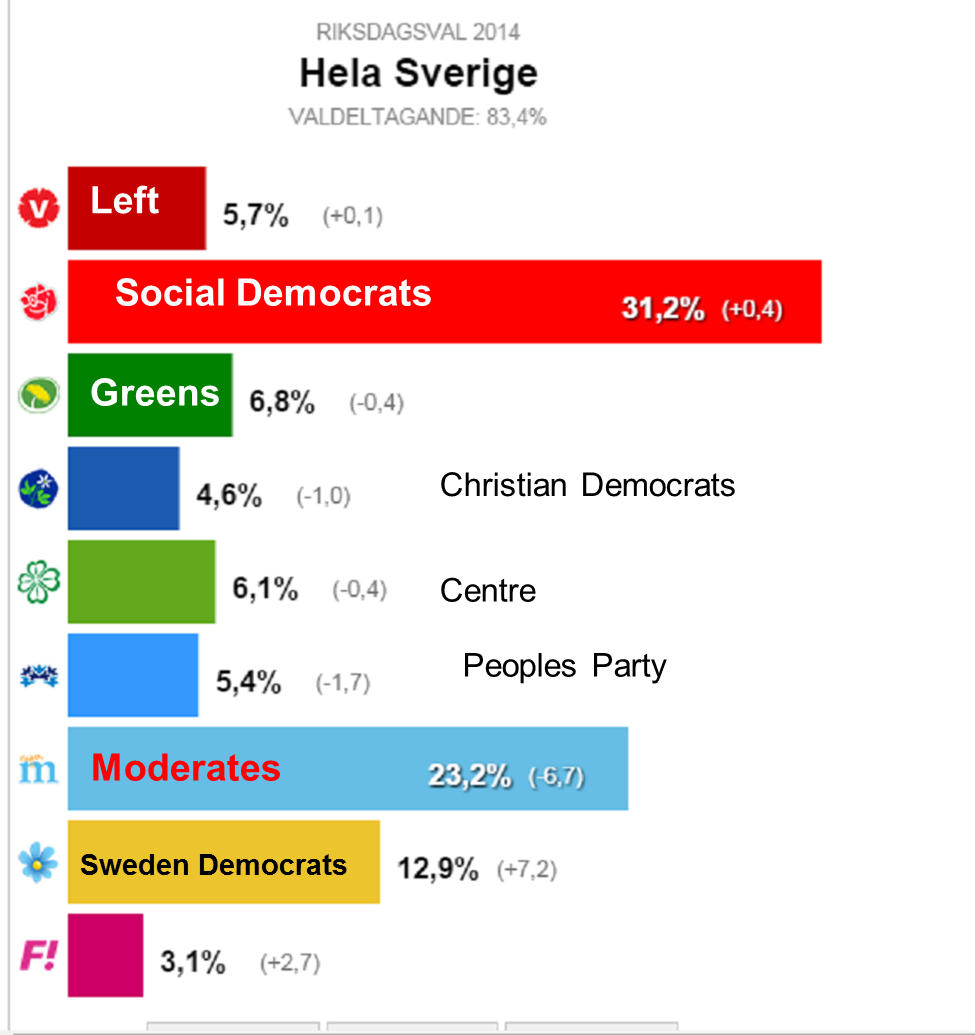
It was quite a high turnout at 83.4% in the general election.

The results show that Sweden has voted “against” many trends but has not really voted “for” anything. The left (red-red-green) will govern while the far-right show the greatest gains. Perhaps this is an indictment of all parties in that none succeeded in presenting any compelling vision of the future. 

After 8 years in power, the free market Alliance have lost power quite decisively, but the Social Democratic block (including the Environment and the Left Party) while clearly the largest grouping, are quite a bit short of an absolute majority. The Moderates lost 6.7% of the vote share. The clear gain is for the anti-Europe, anti-immigration, nationalistic, neo-Nazi party the Sweden Democrats who have more than doubled their vote from 5.7 to 12.9% – a gain of 7.2%. The Social Democrats actually gained virtually nothing (+0.4%). The losers are the small right-of-centre parties supporting the Moderate coalition in government (the Centre Party, Peoples Party and the Christian Democrats). The Environmental Party also lost a bit but will find itself in government anyway. The top 3 parties cover 67% of the vote. As much as 30% of the vote share is split between 6 parties with less than 7% share each. The Left Party (erstwhile communists) are now absolutely necessary to the Social Democrats and may well even be formally in government.

The Feminine Initiative were neither here nor there and ended up as being yet another “spoiler” party.

Sweden election 2014 - graphic from SvD

Sweden election 2014 – graphic from SvD

So a very fractured picture emerges but what strikes me is that voters have generally voted “against” trends they do not like far more than voting “for” anything. Maybe it is simplistic but my reading of the results is that Sweden has expressed strong opposition to:

  1. European meddling in Swedish society
  2. EU bureaucracy
  3. Further immigration (but not necessarily against immigrants)
  4. the Euro
  5. profit – rather than quality – as the basis of health care
  6. profit – rather than quality – as the basis of elderly care
  7. profit – rather than quality – as the basis of schools
  8. ideology in environment

But what Sweden is in favour of is not at all clear.

It will not be easy for the Social Democrats to build a stable government which has any clear direction. The votes “against”  do not allow any block to find a clear way forward – in any direction. Nobody wants to treat – visibly – with the Sweden Democrats. Their votes “for” anything are of little value in themselves and provide neither opportunity or risk to anybody else. They have not the power to get their proposals accepted but they will have the parliamentary votes to stop many things.

I am afraid that we have 4 years of horse-trading and vacillation and drift ahead.