Archive for the ‘Sweden’ Category

Sweden’s general election – unsatisfactory choices in a quiet campaign

September 11, 2014

Sweden goes to the polls on Sunday for its four-yearly general election (parliamentary, county level and municipal level). Even though there are sporadic efforts to inject some excitement into the proceedings, excitement is notably lacking. But engagement is not and a fairly high turn-out can be expected – thought it will probably be slightly lower than 4 years ago. We shall be voting and I – for one – am quite happy that the noise and the circus of an Indian or a US election will be absent. I am also quite happy that the nastiness (but stupid nastiness) of a UK election will also be missing. I find nastiness in campaigning can be mitigated to some extent if there is some cleverness involved but the campaigns of all the various parties in Sweden are not nasty but neither are they very inspiring or very clever.

The only little “excitement” has been the “shock” disclosures by the Expressen newspaper about the various members of the neo-Nazi, right-wing, nationalistic Swedish Democrats who have been busy making anonymous, nasty, racialist and anti-zionist comments on the internet on a number of “hate” sites. But there has not been much shock involved. Their attempted nastiness is only to be expected. The Swedish Democrats remain largely a party of “junkies and hooligans” but the party leader, Jimmy Åkesson, is actually the most personable of all the party leaders on display and more articulate than most.

Though quiet campaigns are much to be desired they do not necessarily ensure rational discussion. There are some serious issues facing Sweden (schooling, health care, the balance between private profit and quality of service, integration of immigrants, energy policy and – above all – job creation) but the limited coalitions of parties that are available lead only to unsatisfactory choices for the electorate. There has been -unfortunately – little intellectual content in the debates even though there could have been much more. Cliche has been set against cliche. “Political correctness” has been immune to challenge. In fact one of the fundamental problems is that Swedish “political correctness” is well past its “sell-by date”. All the parties talk down to the electorate. They give voters little credit for being able to think and that has been a pity. The Swedish electorate is probably more capable of applying their minds to the many issues than in many other countries. But they have not been given the chance.

The choice is limited to either a coalition of the Moderates, the Christian Democrats, the Centre Party and the Peoples Party (a sort of libertarian, right-leaning, profit oriented, market oriented grouping) or a coalition of the Social Democrats with the Environmental Party and supported by the Left party and the Feminine Initiative (a sort of socialistic, do-gooding, left-leaning, we-know-best, authoritarian grouping with tinges of communistic zeal). These two blocks actually demonstrate the undemocratic nature of party politics. You don’t actually vote for individuals as your representatives or that of a constituency – you vote for people on the party lists. How people are selected to be on the party list has little to do with democratic principles and everything to do with activism within the party. Those elected represent their party first, party members next and the general electorate last. Whichever block wins, a coalition is inevitable. And the evils of all coalition governments will be again on display. The smaller parties will have a disproportionate influence and importance in the policies followed by each block. If the two large political blocks are evenly balanced it will put an undemocratic balance-of-power into the hands of the extremist, but small, Swedish Democrats.

The two major parties (the Moderates and the Social Democrats) have little choice but to put up with the foibles of their smaller partners. Rather than providing a natural check and balance, mollifying the smaller parties leads to fractured and inconsistent policies. The Moderates are forced to adopt some policies to satisfy the fundamentalism of the Christian Democrats and others to satisfy the Big-Nanny tendencies of the Peoples Party (Folkpartiet). The Centre Party is chasing the youth vote but are remarkably superficial about everything. The Social Democratic Party (which is just a straight-forward, if anachronistic, Big Union Party) has to put up with the eco-fascism and intellectual bankruptcy of the Environmental Party. They will have to ignore the job-destructive consequences of all the so-called Green policies. They may have to accept the support and some far-left policy elements of the Left Party (which is just an old-fashioned Communist Party by another name). The Feminist Initiative is neither here nor there.

Not great choices then. I expect the Social Democratic, red-green coalition will probably win – just. But jobs are going to be destroyed mainly by the Green initiatives which will have to be pandered to. And where jobs are created they will be in the public sector and will be wealth consuming rather than wealth creating.

But it will be a quiet election. And I do appreciate that.

Swedish researcher faces disciplinary proceedings for plagiarism

August 20, 2014

Back in March this year, Jesper Johansson, a senior lecturer at Linnaeus University had a 2012 article in the Nordic Journal of Migration Research retracted for plagiarism as reported by Retraction Watch. The University mounted an investigation and the University Vice-Chancellor Stephen Hwang  has now announced that the plagiarism is confirmed and that the University’s Personnel Committee will meet in September to consider disciplinary actions to be taken. Dr. Johansson is currently on leave. It is reported that he has acknowledged his plagiarism. There is also a report that it was a case of self-plagiarism but as Retraction Watch reported some of the material was copied from at least one other author:

The article, Swedish Employers and Trade Unions, Varieties of Capitalism and Labour Migration Policies,” was written by Jesper Johansson, of Linnaeus University in Växjö. It’s available as a PDF here, but not on the website of the publisher, De Gruyter — nor is it listed on Johnansson’s own site.

We chose a sentence a random from the abstract:

Employers are also thought to support policies incentive-compatible with the prevailing mode of capitalism.

And found it in this 2007 preprint of an article, “Varieties of Capitalism and Labor Migration Policy,” by another in researcher Sweden, Gregg Bucken-Knapp, of University West.

We’re guessing this wouldn’t be the only successful fishing expedition — and we wonder why the editors didn’t bother to use plagiarism detection software.

Had they done so, they would have been able to avoid having to issue this retraction notice:

This article has been withdrawn by the editors-in-chief, because it has been found to plagiarise already published work.

Johansson reports 21 publications on his site but does not include the retracted paper.

Johansson Linnaeus

Johansson Linnaeus

Johansson generally takes left-wing positions in his writings. Some extreme, racist parties in Sweden are rubbing their hands with glee.

IKEA shopping bags provide “efficient” storage for 500 year old skeletons

August 10, 2014

It would be just as easy to consecrate an IKEA shopping bag as a shrine or a piece of turf – so I don’t see anything sacrilegious or anything to be much indignant about. This story from The Local:

The Kläckeberga church is using Ikea bags to store the remains of around 80 people who were once buried under the floorboards. The macabre collection, which is almost overflowing from a set of large blue Ikea bags, was found by local woman Kicki Karlén. 
“There were around 80 skeletons,” she told The Local.
Woman finds Ikea bags stuffed with 80 skeletons

Ikea bags stuffed with 80 skeletons – photo The Local

“I was on the team called in to dig out the bones five years ago,” archaeologist Ludvig Papmehl-Dufay told The Local.  
“Our mission was to document and rebury the bones, which may be as much as 500 years old. But the reburial was delayed and I have no idea why. The plan was to rebury them as soon as possible, but that’s up to the church. The county board said they couldn’t leave church ground, and it became complicated.”  
He explained that the bones were likely reburied in a secondary deposition many years ago in what he called a “bone house”. The collection is mostly skulls and longer bones, he added.  
While Papmehl-Dufay denied storing the bones in the Ikea bags himself, he admitted that it sounded like an efficient storage technique.   
“It’s not standard practice, definitely not for archaeologists, but the Ikea bags aren’t actually that bad. They’d be great for stopping the moulding process. But it can’t be that good to have them in the basement for so long.”
But what will future archaeologists and anthropologists make of the bags (which may well survive) when they are rediscovered in a few hundred years time. Possibly of the existence of an IKEA cult (which would not be so far from the truth)? With strange burial rituals?  or perhaps that the Swedish church was a department within IKEA?

Swedish Environmental Party makes a fool of itself (again)

August 9, 2014

The Swedish Environmental Party (Miljöpartiet) has not been slow in trying to cash in on the large forest fire in Västmanland. The Swedish General Elections are in September and “anything goes”. Especially if it is alarmist. I don’t expect much intellectual or scientific honesty from them any longer but I though their behaviour yesterday was particularly opportunistic and crass.

  1. Never mind that forest fires in Sweden reduced from over 250,000 hectares destroyed every year before 1850 to less than 1,000 hectares per year in recent times when forest “cultivation” increased.
  2. Never mind that because of the reduced incidence of forest fires the owners have reduced their fire watches.
  3. Never mind that the number of military helicopters suitable for fire fighting have reduced from 33 to 3 in the last 20 years.
  4. Never mind that Sweden no longer has any planes suitable for water bombing.
  5. Never mind that in the grip of complacency, fire fighting equipment has reduced under 3 successive governments.
  6. Never mind that global temperatures have been stagnant for the last 18 years and have actually reduced slightly in the last decade.
  7. Never mind that carbon dioxide emissions by humans are apparently having no impact on real global temperatures (but are absolutely fundamental to every climate model)
  8. Never mind that temperatures in Västmanland this summer are nothing out of the ordinary.

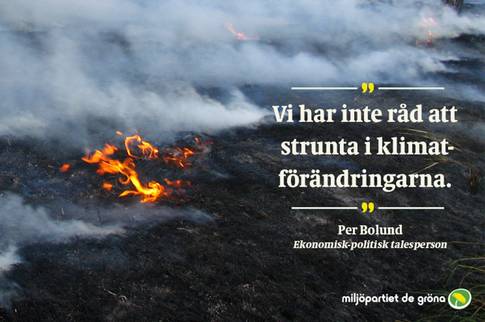
Never mind the facts, just feel the fear. They came out with this picture yesterday even though the Västmanland fire has yet to be brought under control.

“We cannot afford to ignore Climate Change” it reads.

I get the impression that the Swedish Greens have prostituted themselves on the altar of global warming orthodoxy (sorry – climate change >> sorry – extreme events >> sorry – global cooling?).

mp västmanland

mp västmanland

But the temperature anomalies in Västmanland are nothing out of the ordinary.

Västmanland temperatures - The Stockholm Initiative

Västmanland temperatures – The Stockholm Initiative


Swedish forest fire largest in recent times but a tiny fraction of pre-industrial times

August 6, 2014

Västmanland, Sweden

Increasing humidity and some rain has limited the spread of the largest forest fire which has been ongoing for 7 days in the northern part of Västmanland in Sweden. One person has been found dead  and some 4,000 homes were evacuated a few days ago. Some of those evacuated can now begin to return.

The fire followed 2 weeks of quite warm weather over the entire country with temperatures around 30ºC (high, but not unknown at this times of year and no records were broken).

What became quite clear was that the equipment available to the emergency services was sadly lacking. Three successive governments have taken the easy opportunity of cutting emergency services and there were just no helicopters or planes available in the country for containing the fire. One was requested from Italy yesterday but could not be sent. Another from France is only arriving today. Needless to say they will probably arrive after the point at which they could have done the most good. If it continues to rain today, they will be irrelevant.

Before 1850, fires consumed 250 times larger areas of forest in Sweden than today. It has been the “industrial harvesting” of forests which has drastically reduced the incidence of forest fires. And it has been the complacency brought about by the low incidence of forest fires which has led to a reduced preparedness to fight the fires when they do occur.

The climate alarmists (and there are many of them in Sweden) have not been slow to blame the fire on global warming. A little depressing to hear people so ready to switch off all their rational faculties and parroting what sounds like a climate catechism.!!

But a few sane voices can also be heard.

Swedish Radio:

Two hundred years ago forest fires raged much more freely in Swedish forests. It was when humans began to harvest the forest that fires reduced.

“Swedish forests burned much more in historical times”  says Bengt-Gunnar Jonsson, professor of plant ecology at Mid- University. “Just a few hundred years ago one percent of Swedish forests burned each year. 250 thousand hectares every year. Today only about a thousand acres are lost to forest fires every year“.

Bengt-Gunnar Jonsson sees three separate  eras of fires in the Swedish forests. From prehistoric times to the seventeenth century there were only a few but very large fires. From the seventeenth century until the mid-nineteenth century, when the population increased and people started residing there, the number of fires increased but they were smaller. In the mid-nineteenth century industrial forestry started and the number of forest fires declined sharply. There was a dramatic shift to a landscape where people – rather than fire – harvested the trees.

“Even the very first people in Sweden might have affected how much it burned in the woods”, according to Bengt-Gunnar Jonsson. “Although we have observed fires for several thousand years, we cannot really explain effects of climate and lightning. Many argue that even the ancient fires had a human footprint. It could be that humans have influenced fire history since the ice retreated”.

Västmanland forest fire 2014 - Jocke Berglund -TT

Västmanland forest fire 2014 – Jocke Berglund -TT

“Euthanasia is both profitable and cost effective”

July 28, 2014

I think an individual should be able to choose, and be assisted, to die peacefully and painlessly – provided he is of sound mind and is suffering from a terminal and painful illness.

But I am afraid that part of the building momentum for euthanasia in Europe is cost driven and not driven by a concern for the individual. Countries with aging populations and with well developed public health programs are facing increasing costs for the care of the elderly. In Sweden and the UK for example this care is often “out-sourced” or privatised. Many of these establishments are owned by risk capital companies – which is a little strange – but not fundamentally wrong. But the “quality” requirements they are required to meet are set by the public institutions doing the out-sourcing. Inevitably these “quality” requirements are specified in such a way that the out-sourcing succeeds and contracts are let. To ensure this the requirements always allow the service provider sufficient room to make a profit. There is a clear incentive for the service provider to “increase the throughput” and reduce the cost per person they are tasked to care for. That – in turn – is leading to a deterioration in the care provided especially to the aged who are no longer competent or able to complain about the service received. It is clearly cheaper to allow a general reduction of service, and to only do more than the minimum if and when a complaint from a relative is received. Of course, relatives have only limited opportunities to notice any deterioration of service. The “out-sourcing” itself is driven by cost. There have been many “scandals” (such as this one) associated with the “quality” of service in “privatised” homes for the aged. But it is not by accident that the State and the municipalities and health authorities have pushed these scandals into the “privatised” sphere rather than to be found wanting themselves. Part of the reason for out-sourcing these services has clearly been to also out-source the scandals waiting to come as care of the elderly inexorably deteriorates. The more the care of the aged deteriorates the more attractive a voluntary euthanasia scheme becomes – for all parties involved.

I have a clear perception that in Sweden the quality of public medical and palliative care for the elderly is already driven by cost considerations. It is illegal in Sweden but age discrimination is endemic. We hear about procedures and expensive treatments being denied to the elderly for many ostensible reasons, but in reality because the patients are – in the judgement of the care-providers – just too old and too big a drain on costs. For public medical and palliative care, a form of unwritten age-discrimination is already in place. The aged patient has little recourse except to opt for private treatment and then euthanasia may be a much more cost effective solution..

The euthanasia debate is picking up steam in Europe but my fear is that though much of it is carried out under the guise of concern for an individual’s right to die, much of the debate is actually being driven by public health cost considerations. Many of the statements by politicians seem to me to be trial balloons or electoral posturing – but they have an underlying smell of preparing for curbing the costs of caring for the increasing number of the elderly.

It may be very cynical but I note that a healthy growth rate in voluntary euthanasia among the aged has many public and social and economic benefits. The cost of health care for the aged is both capped and reduced. The demographic of the ratio of elderly to working population is improved. Medical resources are freed for the more valuable, younger patients. And the aged patient gets what he or she wants.

A true win-win!

BioEdge: 

Euthanasia might be needed for poor people who cannot access palliative care, the new Lithuanian Health Minister has suggested. Rimantė Šalaševičiūtė was sworn earlier this month, but already she has made waves by backing an open discussion of the legalisation of euthanasia.

Without making any specific proposals, she told local media that Lithuania was not a welfare state with palliative care available for all and that euthanasia might be an option for people who did not want to torment relatives with the spectacle of their suffering.  

The minister has also raised the idea of euthanasia for children. She noted that this option had been approved for Belgian children after a long public debate. It was an option which might be appropriate in Lithuania as well after public debate.

Ms Šalaševičiūtė will face an uphill battle in her campaign to introduce Lithuanians to euthanasia. Many doctors and the Catholic Church oppose it. Dr Andrius Narbekovas, who is both a priest and a doctor, and a member of the Health Ministry’s bioethics commission, told the media:

“The Ministry of Health should protect health and life, instead of looking for ways to take life away. It goes without saying that it is … profitable and cost effective … But a democratic society should very clearly understand that we have to take care of the sick, not kill them.”

Lithuania merely reflects the debate all over Europe which is probably most advanced in Belgium where even involuntary euthanasia (is that not murder?) has been proposed.

Politicians and many aged sufferers could find this irresistible: “Euthanasia is both profitable and cost effective”.

Two of my friends have utilised the services of Dignitas. So, for whatever reasons it may come, I do hope that voluntary euthanasia is available to me when my time comes.

Justice without balance as mass murderer Flink is to be released today

June 11, 2014

Mattias Flink (born March 8, 1970, in Falun, Sweden) is a Swedish mass murderer who killed seven people on June 11, 1994, in Falun, Sweden. He was 24 at the time and a second lieutenant in the Swedish Army. He is to be released today on the 20th anniversary of his killing Karin Alkstål, 22, Therese Danielsson, 20, Helle Jürgensen, 21, Lena Mårdner-Nilsson, 29, Jenny Österman, 22, Maths Bragstedt, 35 and Johan Tollsten, 26.

There is a fundamental lack of balance in a justice system where someone gets drunk and murders 7 people, is sentenced to life in prison and is released exactly 20 years after he went on his murderous spree. He will be given a protected identity and state support to “re-establish” himself in society. The lack of balance lies in that society does not consider what may be due to the 7 victims. The discussion is only whether the murderer is now rehabilitated and whether he is any longer a danger to society. His debt to society is considered quit. But what about his debt to the victims? He deprived his victims and society of almost 500 man-years of life.

But the rights of the victims – it seems – died with them. The Swedish Crime Victim Compensation and Support Authority (Brottsoffermyndigheten) is not known for its generosity to victims. A murder victim’s relatives can expect damages of about 50,000 kronor (about $8,000). For 70 years of life deprived! For example relatives of a woman who was crippled for life and where her attacker was sentenced to 12 years in prison were awarded all of 10,000 kronor ($1,500).

Capital punishment will not bring any better balance though. But surely the rest of his productive life must be in the service of his 7 young victims or their dependents or of society at large? His own objectives with his life and earnings are surely forfeit till the debt to his victims is paid off?

Swedish RadioToday Mattias Flink will be released exactly twenty years to the day after he shot seven young people to death in Falun. Under the law he must be released exactly on the anniversary when he was arrested, said Maria Löfgren, Correctional Officer of Dalarna.

In September this year, Mika Kalevi Muranen a Finnish army soldier who murdered 3 people will also be released after serving 20 years of a life sentence.

Anders Behring Breivik in Norway killed 77 people. He deprived them and society of over 5,000 man-years of life. I wonder how long his life-sentence will actually last?

Justice? Perhaps, but without balance.

Ericsson’s headcount in India now exceeds that at HQ in Sweden

June 11, 2014

Ultimately, adding value as close to the customer as possible is not only inevitable but it is also going to be the critical criterion which determines which companies will survive.

Ericsson the Swedish manufacturer of telecommunications equipment has just passed a kind of milestone when its headcount in India has now exceeded the headcount at its headquarters in Sweden. This will be seen negatively in Sweden especially by the unions, but it is this readiness and ability to get close to the market which actually gives me confidence that they are on the right track. Ericsson, I think, have played this balancing act of changing roles at headquarters while growing close to the market rather well. (Which is why I have Ericsson in my portfolio).

Mobiletor: Ericsson which prides itself as a growing provider of communications technology and services, now has more employees in India than it does in its home country of Sweden, according to the company’s Facts & Figures web page. The headcount is 17,991 staff in India and 17,545 employees in Sweden, with about 80 percent of its workforce being male. In total, Ericsson has 111,383 employees from across the world working for it and has its headquarters in Stockholm, Sweden. …..

India is the fastest growing smartphone market on the globe and 4G LTE is still at its nascent stage, with few operators still appearing to be in the mood for testing the waters before diving right in. Going by an Ericsson report, the country’s mobile broadband users will grow in number to touch four times the present figures by the year 2020. This is directly tied to the 80 percent of consumers who still haven’t adopted smartphones and are yet to experience the mobileweb.

Ericsson have a fairly upbeat view of the mobile market in the latest Ericsson Mobility Report and their own prospects:

The number of mobile subscriptions worldwide grew approximately 7 percent year-on-year during Q1 2014. The number of mobile broadband subscriptions grew even faster over this period – at a rate of 35 percent year-on-year, reaching 2.3 billion. The amount of data usage per subscription also continued to grow steadily. Around 65 percent of all mobile phones sold in Q1 2014 were smartphones. Together, these factors have contributed to a 65 percent growth in mobile/cellular data traffic between Q1 2013 and Q1 2014.

By 2019, global mobile broadband subscriptions will exceed the world population.

Total mobile subscriptions are expected to grow from 6.8 billion in Q1 2014 to 9.2 billion by the end of 2019. Global mobile broadband subscriptions are predicted to reach 7.6 billion by 2019 and will gain an increasing share of the total mobile subscriptions over time.

Mobile broadband users in India will grow in numbers to reach four times the present figures by 2020. In 2013, people accessing data on their mobile devices reached 90 million. The smartphone penetration of 10% or 90 million devices will grow to 45% or 520 million mobile gadgets by 2020. The mobile subscriber base is expected to increase from 795 million last year to 1145 million by 2020.

Sweden’s national day today (but little nationalism on show)

June 6, 2014

sveriges-flagga

Perhaps the best thing about Sweden’s national day today is that there is not very much jingoism and nationalism and patriotic fervour in evidence. If anything it is more a celebration of the values of human freedoms rather than any particular celebration of the nation state within its geographical boundaries. Even the national (but unofficial) anthem is more a paean to the North – Scandinavia (“Oh! I wish to live, I wish to die in Norden”) rather than specifically to Sweden.

The vast bulk of the population don’t make very much fuss about the day. Politicians tend to attend some official function or the other –  more for political correctness – it seems to me. Immigrants take part in some of the (fairly low-key) festivities. Many municipalities have some ceremony to welcome new citizens on this day. The loony right don’t like this welcoming of “New Swedes”. They usually try and whip up some artificial feelings of nationalism with anti-immigration rhetoric – but even their efforts are somewhat half-hearted.

The 6th of June has been a national holiday only since 2005, has been officially the National Day only since 1983 and before that was the Swedish Flag day but only since 1916. It was chosen ostensibly because the 6th of June was the day on which Gustav Vasa was crowned in 1523. But the real reason of course is that because there is a very good chance that the 6th of June will be a nice warm summer day!

The real origin of the choice of 6th June was bad weather and the ensuring of revenues from an organised festival! In 1893, a Spring Festival had to be reorganised hastily by Artur Hazelius for the 6th of June because it rained heavily on the day he had planned. The “Festival” was planned to draw in money from the public of course!

In any event, it is nice, warm, sunny day today. And it is a public holiday.

And I will not be doing anything special to celebrate – but I shall enjoy the day.

Swedish Foreign Minister warns of the “Balkanisation of Britain”

June 5, 2014

Carl Bildt was once Sweden’s Prime Minster and was the UN’s envoy to the Balkans and is now the Foreign Minister. Not uncontroversial since he has many business interests ranging from Russia to Africa but generally radiates confidence and competence with a not insignificant measure of arrogance.

For a Foreign Minister he can be quite undiplomatic at times (not that it is always wrong to be undiplomatic). He has now poked his nose into the Scottish referendum and warns of the Balkanisation of the UK if Scotland decides to vote for Independence. He has a point of course. It would only be a matter of time before Wales, Ulster, the Channel Islands –  but perhaps not the Falklands – would all choose to go their own separate  ways into insignificance:

The Scotsman: SWEDEN’S foreign minister has claimed that Scottish independence would lead to the ‘Balkanisation’ of Britain.

 Carl Bildt also warned that a Yes vote would have ‘far-reaching consequences’ for the rest of Europe, in comments that echoed those made by former UK Defence Secretary Lord Robertson, in which he claimed that Scottish independence would have ‘cataclysmic’ geopolitical consequences.

Mr Bildt told the Financial Times that there would be ‘unforeseen chain reactions’ in Europe and the United Kingdom if Scotland voted for independence on September 18th.

The former UN special envoy to the Balkans between 1999 and 2001 said: “I think it’s going to have far more profound implications than people think. The Balkanisation of the British Isles is something we are not looking forward to.

“It opens up a lot, primarily in Scotland but also in the UK. What are the implications for the Irish question? What happens in Ulster?”

Mr Bildt also hinted that a victory for the Yes campaign could lead to the UK having to renegotiate some of its own EU membership terms. 

“The vote is one thing,” he added. “But there will then be a fairly painful period of separation and how is that going to affect the EU relationship? I assume there will have to be renegotiation of votes.” ……….. 

………… He likened the UK to ‘an island adrift in the Atlantic’ if it left the EU.

And the Swedish politician commented that both the EU and independence referendums showed that the debate in Europe was in the process of moving away from the Eurozone crisis to a more political phase.

“The main challenges in the past five years have been economic ones,” he explained. “Looking ahead for the next five years, it is political challenges in the east fairly obviously and also in the west fairly obviously.”