Archive for the ‘Sweden’ Category
March 8, 2011

The 2010 winter cold can be coupled to the NAO and to large blocking high pressure areas: image smhi
My actual experiences during 2010 (in Asia and in Northern Europe) and my very real electricity bills are far more compelling than fudged statistics and Hockey Stick Illusions from the global warming alarmists. The reality is that we are in for 2 or 3 decades of cooling courtesy of the sun and man-made carbon dioxide is of little consequence. The sun drives the ocean currents and the North Atlantic Oscillation was negative as it was for the 2009/10 winter.
The global warming / carbon dioxide scare is driven not only by carbon trading scams and catastrophe promoting insurance companies but also by so-called climate scientists who have lost the scepticism that is at the heart of science and developed a Nostradamus complex.
From Stockholm News:
Most people who live in Sweden most certainly remember some really cold months last year, particularly the winter months of January, February and December. There was for certain a serious heat wave in July. But that did not help out: 2010 was the coldest year in Sweden in 23 years.
The Swedish Weather Agency’s preliminary estimations show that Sweden as a whole had around one degree Celsius below normal temperatures last year.
Since 1987, all years have been warmer than normal, except in 1996, which had a small temperature deficit. “Normal” in this context is the average for the years 1961-1990.
The coldest part of the country was in the west, and consequently the western neighbouring country of Norway also had a cold last year. Their general temperature was likewise one degree Celsius below normal. This made last year the coldest in Norway since 1941 and the tenth coldest year since 1900, writes the Norwegian Meteorological Institute.
Tags:coldest year, global warming, North Atlantic Oscillation, Sweden, weather
Posted in Alarmism, Climate, Scientific Fraud, Sweden, Weather | Comments Off on 2010 was coldest year in Sweden in 23 years and coldest in Norway since 1941
March 2, 2011
From Svenska Dagbladet: On 7th February last year two Swedish officers Gunnar Andersson and John Palmlöv and their Afghan interpreter Mohammad Shahab Ayoulay were killed in an exchange of fire in the village of Gurgi Tappeh, about 35 kilometers from the Swedish Afghanistan headquarters in Mazar-i-Sharif. An Afghan man dressed in police uniform opened fire against the Swedes and the two officers, their interpreter and the attacker were all killed.

Capt.John Palmlöv, Lt. Gunnar Andersson, and flags at half mast at Camp Northern Lights. FOTO: FÖRSVARSMAKTEN OCH SCANPIX
On 25 March last year, the Swedish Military said that it could not be ruled out that the Swedish officers and the interpreter had been hit by stray Swedish bullets but that the three were killed in the initial hail of bullets. Despite promises of transparency the military investigation and that of the Stockholm Prosecutors Office have been stamped “Secret”.
But yesterday a TV4 News broadcast showed that their review of the autopsy report and of the military’s confidential report proves beyond all reasonable doubt that it was Swedish ammunition that killed the officers and their interpreter. The autopsy report from the medical centre in Solna and the Armed Forces’ own secret investigation show that there is no evidence that it was the Afghan man’s Russian ammunition which hit the Swedes. From the wounds in the bodies, the shot trajectories show that they must have been fired from a height of 4 metres and could only have come from the Swedish armoured car on the side of the road according to TV 4 News.
A clear case of “friendly fire” and most likely a tragic mistake. But it is not very clear as to why the military and the government and the prosecutor’s office will not reveal or even comment on the results of their investigations. If it was a tragic mistake and caused by panic and some incompetence by one (or more) of the dead officers’ comrades then perhaps the secrecy is just to protect the identity of these soldiers for what has been judged to be a mistake.
But perhaps not. The terms “collateral damage” and “friendly fire” are synonymous – always – with a certain lack of competence. I do not imply that they are unavoidable but just their occurrence is proof of some lack of competence. Sometimes these terms are used to cover-up a level of incompetence which is much higher than it should be. It is quite conceivable that the fault is institutional either in the Swedish Rules of Engagement or in the training of the soldiers or in their management and leadership. The use of confidentiality in this case suggests that the investigations did find some level of institutional incompetence.
There is also the unlikely scenario that the fire was from “friendly guns” but that the shooting was “unfriendly”. Very unlikely of course, but cases of unpopular officers being killed by the “friendly fire” of their soldiers are not unknown. And such cases are usually surrounded by intense secrecy.
Tags:Afghanistan, Friendly fire, Swedish Armed Forces
Posted in Afghanistan, Behaviour, Sweden | Comments Off on Swedish officers were killed by “friendly fire” in Afghanistan
March 1, 2011

In spite of the coldest and snowiest December in 100 years Sweden’s gross domestic product (GDP) grew by 7.3 per cent in the fourth quarter of 2010 compared to same period last year.
Compared with the third quarter of last year, GDP grew by 1.2 percent, according to StatisticsSweden (SCB). This is the highest Swedish growth ever measured. GDP figures were higher than analysts had anticipated. According to Reuters, they expected on average, a growth of 7.0 per cent annually and 1.0 percent from the last quarter.
During the full year 2010, GDP grew by 5.5 percent from the year before, the largest increase since 1970. In 2009, GDP shrank by 5.3percent. It was household consumption which gave the largest contribution to GDP growth, according to StatisticsSweden.
With the latest GDP figures showing a growth of 7.3%, economic analysts are waxing lyrical:
Annika Winsth, chief economist at Nordea:
The Swedish economy is growing across the board. The recovery continues with positive signals also from the labor market. It means that the Riksbank will most likely continue to raise rates. The labor market is developing well and that the hours worked increases mean that households are well equipped for future interest rate hikes. That you get such a strong figure, a growth of over seven percent, also creates a positive psychological effect and a confidence in the Swedish economy which is important. This is something completely different than when the crisis was at its worst.
SBAB’s chief economist Tomas Pousette:
We knew that growth was strong but did not anticipate anything this strong. We expected a number around 6.5%. The economy is at full speed. But it is still in the vicinity of what the Riksbank has anticipated.
Finance Minister Anders Borg:
In the budget we expected that we would land on 4.8 percent growth for 2010, and now we arrive at 5.5 percent. This is a stronger growth than we expected. There is a real challenge ahead for us to cope with both strong growth and low unemployment without creating imbalances.
Tags:Anders Borg, Gross domestic product, Sveriges Riksbank, Sweden, Swedish tiger economy, Tiger GDP growth
Posted in Economics, Politics, Sweden | Comments Off on Swedish GDP at “tiger” levels
February 28, 2011

Image via Wikipedia
Swedish Radio reports that some 60 vessels were trapped in the Baltic sea ice yesterday and that 5 icebreakers are working feverishly to clear their paths. The ships are trapped in the southern section of the Gulf of Bothnia known as “Bottenhavet”.
This problematic situation was not helped by the strong southerly winds which compressed the ice sheet. To the north of Sundsvall, ships cannot proceed without icebreaker assistance.
Most ships trapped on Sunday are now free but some yet have problems and are waiting for assistance from icebreakers.
“At all ports north of Sundsvall, it remains very difficult ” says
Johny Lindvall at FMA Icebreaking.
Last weekend 250 000 square kilometers of the Baltic Sea was covered with ice, which according to SMHI was the largest area covered by ice since the winter of 1986-87.
The Swedish Maritime Administration warns:
The strong winds that we have had the last couple of days has resulted in a severe ice situation, mainly in the northern part of the Sea of Bothnia. This makes it hard to predict how long time each individual assistance will take.
Ice breaking vessels and their activities:
| Ale: |
|
Assisting/supervising the traffic on Lake Vänern. |
| Atle: |
|
During the evening/night assisting Red Spirit from Karlsborg to Haraholmen and then Salsa out from Haraholmen. |
| Frej: |
|
Now assisting a convoy of four southbound ships , that were stuck on the finnish side, over to the channel that has opened up on the swedish side. |
| Ymer: |
|
Assisting/supervising the traffic in Ålands Sea |
| Baltica: |
|
Visit in shipyard |
| Scandica: |
|
Assisting and supervising the traffic in Kalmar Sound. |
| Fyrbyggaren: |
|
Assisting/supervising in Bay of Havringe. |
| Balder Viking: |
|
On her way with a convoy to Ornskoldsvik and Holmsund. |
| Tor Viking: |
|
Breaking loose Merwborg and then assist her to Holmsund. |
| Vidar Viking: |
|
Assisting/supervising on the northern Baltic Proper, Bay of Havringe and Landsort. |

Ice levels in Bottenhavet are the most widespread since 1987. Photo Swedish Coast Guard
Tags:Baltic ice levels, Baltic Sea, Bottenhavet, Gulf of Bothnia, Icebreaker, Swedish Maritime Administration
Posted in Sweden, Travel, Weather | 1 Comment »
February 26, 2011
From The Local:

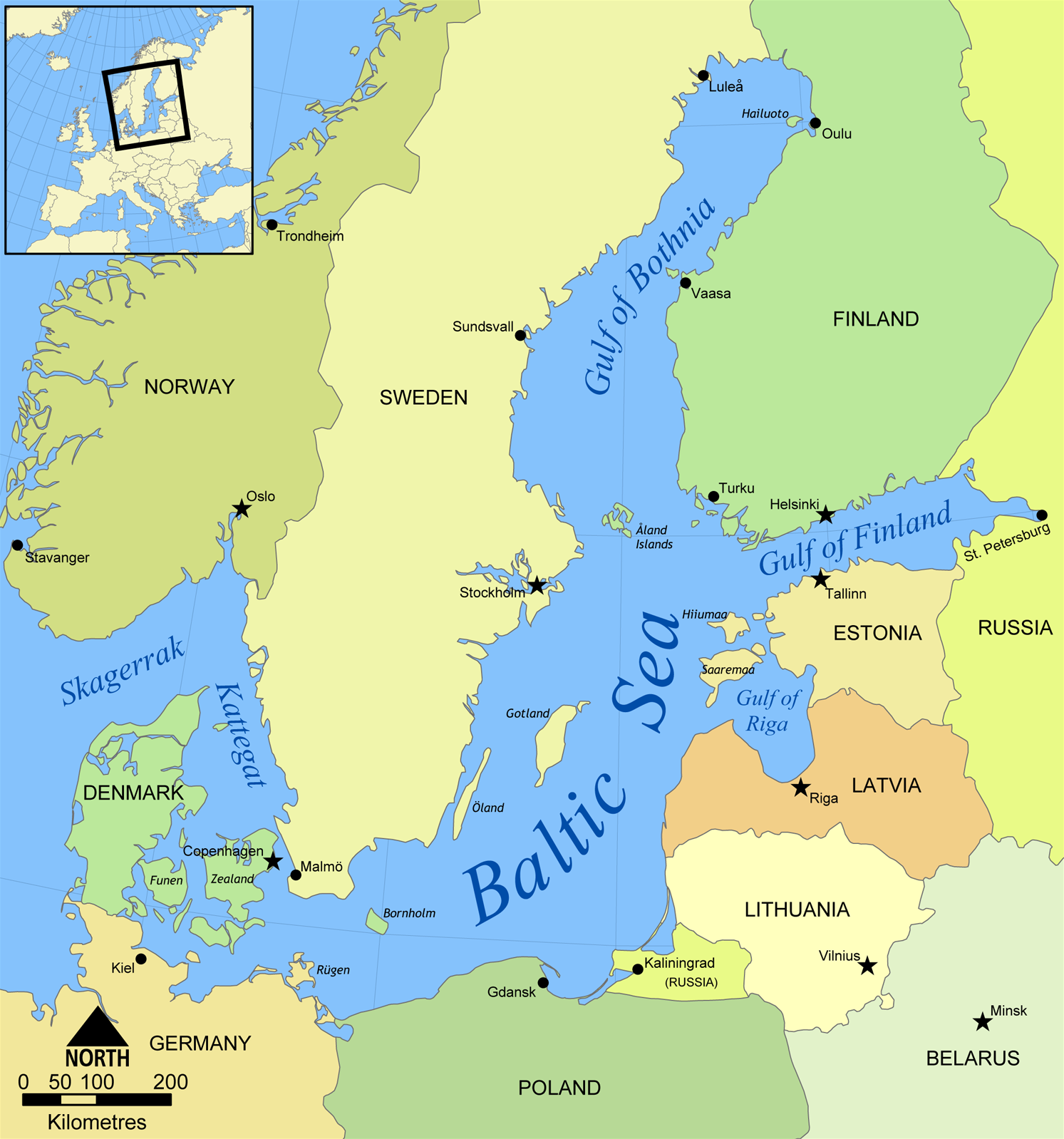
Baltic Sea: image Wikipedia
Deep freeze puts Baltic on track for record ice
Following another extended stretch of sub-zero temperatures, ice coverage on the Baltic Sea is greater than it’s been in nearly a quarter century, Sweden’s meteorological agency reports. About 250,000 square kilometres of the Baltic Sea are now covered in ice according to the Swedish Meteorological and Hydrological Institute (SMHI).
The last time so much of the Baltic was frozen was the winter of 1986-87, when ice covered nearly 400,000 square kilometres of the sea’s surface.
SMHI warns that ice coverage on the Baltic could expand further in the coming days, possibly setting a new record. “The surface water is cold and if winter-like temperatures continue in the region a few more weeks, we’ll probably get an icy winter on par with 1984-85, one of the toughest winters in the 1980s,” SMHI oceanographer Amund E. B. Lindberg said in a statement.
According to SMHI’s estimates, ice may eventually connect the Swedish mainland all the way out to the Baltic island of Gotland, which lies about 90 kilometres off of Sweden’s eastern coast.
Baltic ice cover is not only unusually wide this winter, but also unusually thick, especially in Gulf of Bothnia off Sweden’s northeastern coast, where air temperatures have consistently hovered around -30 degrees Celsius in recent months.
In some areas far out at sea, ice is more than 60 centimetres thick in the northern parts of the gulf. Recent cold temperatures near the southern areas of the Gulf of Bothnia have resulted in ice thickness growing by 30 centimetres in just two weeks.
Icebreakers from the Swedish Maritime Administration (Sjöfartsverket) have been working round the clock to ensure that sea routes on the Baltic remain open, but strong winds expected at the weekend may complicate their work.
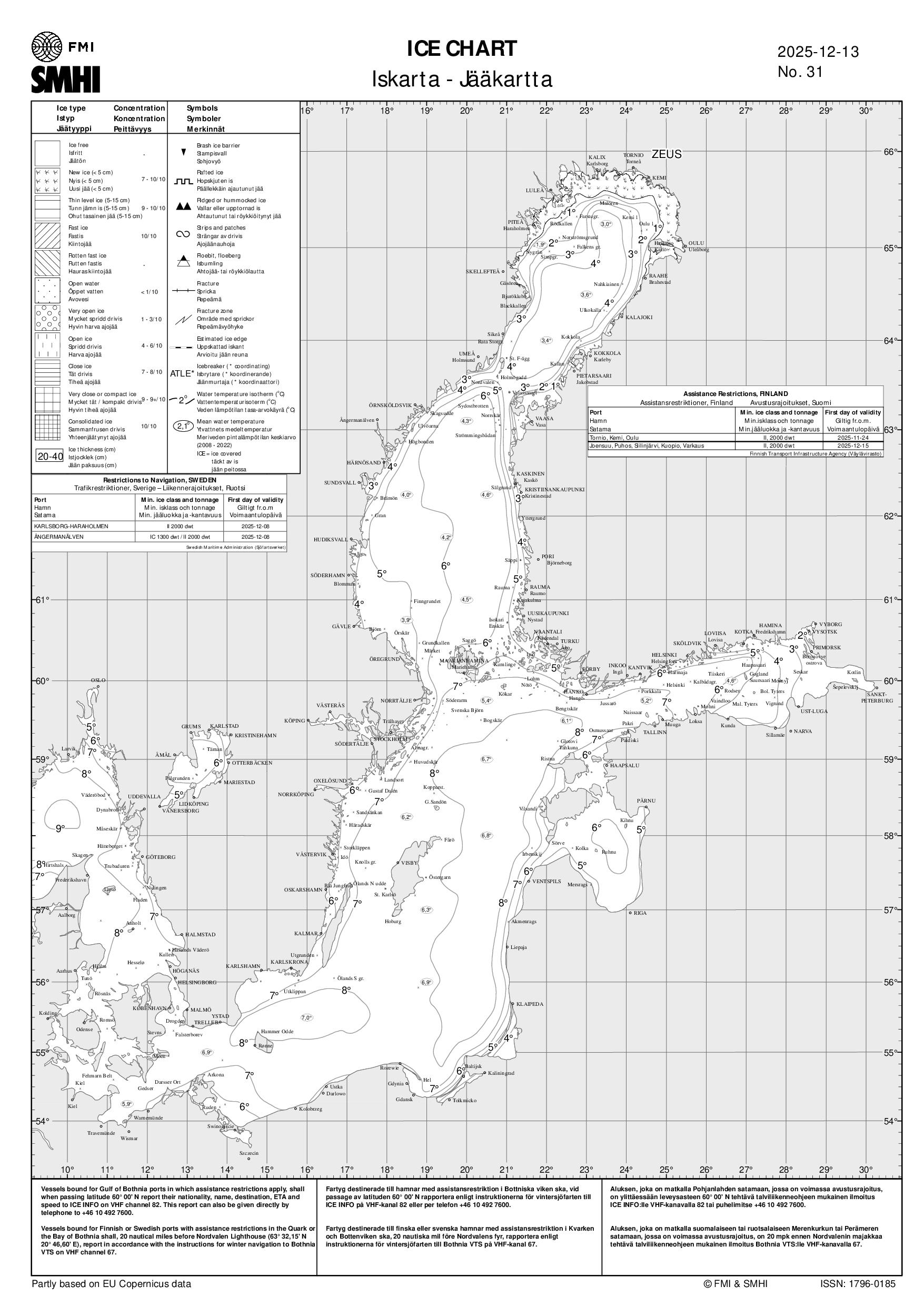
SMHI’s daily ice report says:
During the next two days heavy ice drifting and ridge forming is expected in all waters of the Baltic Sea north of N58 °.
A detailed sea ice map is available here:

Baltic Sea ice levels 20110225: image smhi
Tags:Baltic Sea, Record Baltic sea ice, Sea ice, SMHI
Posted in Climate, Oceans, Science, Sweden, Weather | 1 Comment »
February 21, 2011
Freely translated from KvällsPosten
The unusual phenomenon of snow-ice balls has once again appeared on the island’s southern tip. “They varied in size. Some were as big as tennis balls and others like volleyballs” said Göran Andersson, ornithologist and guide at the Ottenby Bird Observatory. It is not often this phenomenon is spotted in Sweden. It was last observed was on 18th December 2009.
These snow-ice balls probably formed in connection with the weather on 11th February. After a period with mild temperatures a low pressure system set in and temperatures dropped. In addition, the wind increased considerably.
“This is a natural process where the wind formed and rolled the snowballs into the shore zone in the shallow water which then built up layers of ice” says George Anderson.
When the water receded snow-ice balls froze solid froze solid at Kapellvilken on Ölands southern tip.

Snow-ice balls rolled naturally by the wind on Öland Photo: Göran Andersson
The current set of snow-ice balls were not as large and as well-formed as in 2009.

Snow-ice balls in 2009: image Ottenby Bird Station
Tags:Öland, natural snow-ice ball, Snowball, Sweden, wind-blown snowball
Posted in Natural Phenomena, Sweden, Weather | Comments Off on The wind-blown snow-ice balls on Öland
January 9, 2011
Lately there has been an increasing view that some of the catastrophe scenarios about the ozone hole which led to the Montreal Protocol of 1989 were exagerrated and based on poor science. The effects of humans on ozone variations as opposed to natural variations may have been exaggerated. In fact there are now some suggestions that the actions taken were not only unnecessary but that they have not had much to do with the natural increase of ozone layer thickness observed in recent times.
The Local reports:
Sweden’s government weather agency reported on Friday that the ozone layer over southern Sweden reached its thickest levels at the end of last year, surpassing the previous record set in 1991.
Sweden’s Meteorological and Hydrological Institute (Sveriges Meteorologiska och Hydrologiska Institut, SMHI) explained that the weather was particularly favourable at the end of 2010 and it explain why the ozone layer was especially thick at the time. “It is a step in the right direction, but it is still too early to say that the ozone layer has recovered. The favourable weather situation over the last few months has contributed to a record high,” said Weine Josefsson, a meteorologist at SMHI, in a statement on Friday.
The annual value of the ozone layer’s thickness over Norrköping in 2010 stood at a new high of 351.7 Dobson units (DU). The previous record was set in 1991 at 341.8 DU. The November and December values in particular set new records among the measurements regularly made at SMHI since 1988. ………. Even in Norrland in the country’s north, the values have been positive in the last year. The ozone layer has been measured regularly in Vindeln northwest of Umeå in northern Sweden since 1991 and the latest results were also positive in this area.
However, it is not possible to record complete ozone measurements in the winter, so it is uncertain whether a record was set there as well at the end of last year. In November and December, air flows were affected by a special weather situation over western Europe, resulting in an extra thick ozone layer over this part of the world in these two months.
It is possible that the restrictions on ozone-depleting substances proposed in the Montreal Protocol in 1987 have also contributed to the thickening of the ozone layer. However, this type of measure is effective over a long period of time and it is difficult to distinguish the effect of natural variations in this case.
Tags:Meteorology, Montreal Protocol, Ozone layer, Ozone thickness at record levels, Sweden
Posted in Alarmism, Chemistry, Climate, Environment, Geosciences, Physics, Sweden | 1 Comment »
January 6, 2011

jackdaw: Image via Wikipedia
The birds found dead in Falköping yesterday died of external trauma.
Svenska Dagbladet reports:
Jackdaws found dead in Falköping on Wednesday night died of external trauma according to the autopsies carried out by the National Veterinary Institute (SVA). According to Marianne Elvander the birds died of severe internal bleeding. None of the birds showed signs of infection or disease.
Aftonbladet reports that a professional chauffeur said he had driven over a large flock of jackdaws during Tuesday night at that location. “The man came driving late at night when he saw a lot of birds that were alive. They were probably eating road salt ” said Bengt Ljungberg of the Falköping-Tidaholm rescue service.
The dead jackdaws were discovered shortly before midnight last night. Between 50 and one hundred birds lay dead on the road and five of them were taken to the National Veterinary Institute for autopsy. According to Marianne Elvander, it is unclear what caused the birds to die.
But why they were sitting on the road? Investigations are continuing.
Tags:bird deaths, jackdaws, Swdeen
Posted in Sweden, Trivia, Wildlife | Comments Off on Swedish jackdaws died of external trauma
December 30, 2010
Krypton the drug (and not the element nor the fictional planet nor anything related to Superman’s kryptonite) is thought to have led to the deaths of 9 young people in Sweden.
http://www.thelocal.se/31134/20101229/ reports:
A team of Swedish forensic physicians have concluded that nine young people have died over the past year after having taken the legal drug Krypton. Krypton is sold widely over the internet and is marketed as a safe drug but the risk of overdosing is high, the physicians have observed.
“Krypton reminds me of other opiates such as morphine. It is not some sort of party drug,” said Björn Bäckström, who works at the National Board of Forensic Medicine in Umeå, to the local Västerbottens Kuriren daily. Bäckström, together with colleagues Gisela Classon, Peter Löwenheim and Gunilla Thelander, have penned an article published in the medical journal Läkartidningen warning of the risks of Krypton.
The National Board of Forensic Medicine receives intakes after deaths from across Sweden and one case involving Krypton led the physicians to consider the effects of the drug and found several more cases. The Krypton-related deaths are spread across Sweden and involve both heavy addicts and occasional users, while they all concern people born in the 1970s and 1980s, the newspaper reported.
Krypton is derived from the south-east Asian plant kratom which has been traditionally used for potency and to improve mood. Aside from the leaves and extracts from kratom, Krypton has also been found to contain caffeine and the synthetic opioid O-Desmethyltramadol.
O-Desmethyltramadol is a breakdown of the product tramadol, which is prescribed in moderation to alleviate severe pain and when taken as Krypton is turned into tramadol in the liver and becomes more potent. It is due to this high potency contained in the O-Desmethyltramadol that the risk of overdosing is considered high, leading to respiratory paralysis. The Swedish physicians expect the extract and opiate to turn up in other forms if they are not classified as narcotics.
“That is one of the purposes of the article – to bring attention to this drug so that it should be narcotics classified,” Björn Bäckström told the newspaper.
(news@thelocal.se)
Tags:kratom, Krypton, krypton deaths, O-Desmethyltramadol, Sweden, tramadol
Posted in Behaviour, Medicine, Sweden | 1 Comment »
December 27, 2010
Over 500 parishioners at Luleå Cathedral were treated to something of an improvised Christmas Day service when the pastor overslept and only made it in time for the after service- coffee.

Luleå Cathedral: image panoramio.com
http://www.thelocal.se/31088/20101227/
Those thronging the packed pews early on Saturday morning began to get restless after a while as it became apparent that something was amiss, the local Norrbottens Kuriren daily reported.
When it was confirmed that the duty pastor, Stefan Widman, had not awoken from his slumbers, the Christmas service was saved by the initiative of churchwardens Georg Johansson and Hans Brusevitz.
The pair read the Christmas gospel and the Lord’s Prayer and the organist Lena Stenlund ensured that the faithful were given a musical accompaniment to their song, the newspaper reported.
When the pastor did eventually make it to the church, after the guests had retired for coffee, he was deeply apologetic, but was met with laughter by forgiving parishioners.
“In the church hall, when I asked for forgiveness for the whole thing, I was told that it is human to oversleep. And I have rarely had such nice discussions with people,” Stefan Widman told Norrbottens Kuriren. Widman, meanwhile, expressed concern that his tardiness would lead to congregation gossip. “You become something of the ‘talk of the town,’ but that you have to take when you have been sloppy with your clock radio,” he said.

The New City of Luleå in Sweden * Engraving made sometime between 1690-1710 * Scanned from Erik Dahlberg, ''Svecia Antiqua et Hodierna'', facsimile, 1983: wikimedia.org
Tags:Christmas Day, Luleå, sleeping pastor
Posted in Festivals, Sweden, Trivia | Comments Off on A Christmas tale – but all’s well that ends well




 The k2p blog