Archive for the ‘Technology’ Category

Having no pilot will soon be less risky than having a pilot

March 28, 2014

The cockpit of the future will have one pilot and a dog. The pilot is there to watch the systems and make sure everything is operating correctly. The dog is there to bite the pilot if he tries to touch anything.

Much of the speculation about the MH370 disappearance is about the role of the pilots in whatever transpired. But whether they were heroes or villains or under duress or on a suicide trip, they achieved the changes in the flight path by reprogramming the on-board, flight computer.

For a commercial flight all the pre-flight instrument checks and the programming and the reprogramming where necessary, can be accomplished in advance or remotely. The role of the pilot nowadays seems most intense during taxiing on the ground and at take-off. Thereafter he does not need to play much part. He is still – it is thought – indispensable if an emergency situation were to arise. But even that perception is only true for unforeseen emergencies. For all situations which can be foreseen and then are pre-defined emergencies, the automatic controls would react faster and with more certainty than any human intervention. I am not sure if control systems are already sufficiently sophisticated to cope with all situations on the ground. But even here it is human error which is the main cause of incidents. Collisions on the ground are usually due to some incompetence on the part of pilots or of the ground traffic control.

But it is just a matter of time and we are getting close to the point where the risks of having a pilot will outweigh the risks of not having a pilot!

For military attacks and even for surveillance we are already at the point where pilotless craft pose less risk – for the attacker – than manned aircraft. Drones for military and civil applications are proliferating. In modern fighter jets, the pilot’s survival now limits some of the design and performance parameters of the aircraft. Altitude, speed, maneuverability, rate of climb, g-forces are all constrained by what the pilot can survive. Of course some new risks would be introduced with pilotless, commercial aircraft. With aircraft under remote control, hijacking would become a matter of hacking into the flight computer. On the other hand, the possibility of in-flight hijacking by a passenger would be eliminated. Drunken or suicidal pilots would pose no risk – but computers “drunk” on contaminated code might constitute a new risk. The risk with unmanned cargo aircraft would then be just the possibility of crashing into inhabited areas. Unforeseen emergencies remain an unknown unknown. But even here, the solution will lie with how “smart” the control computers can be made. My car can already correct for a skid faster than I can. It can park in a tight spot neater than I can. Some more “smartness” and automation will also be required in the air traffic control systems. The security and integrity of communications to on-board computers and how and when over-rides will be permitted will pose their challenges.

Driverless cars are coming. I would guess that in 20 years the road infrastructure will allow the majority of cars being sold to be driverless. There are developments in the infrastructure of airports and air traffic control systems which will be necessary and there will be a psychological barrier to overcome, but pilotless commercial aircraft will also – I think – start flying within 20 years. Cargo planes probably first  – before passengers are ready to take the plunge.

Airbus future

Airbus future

Related: Future by Airbus

US technology giants were complicit in NSA’s data trawling

March 19, 2014

Microsoft, Google, Apple,Yahoo, Facebook and AOL all claimed they did not know that the access they provided led to the NSA trawling their clients’ and customers’ data. But while they may not have liked it, they certainly knew all about it according to the NSA’s chief legal counsel. It would seem that these large technology companies all cooperated – even if reluctantly – and were complicit in the NSA’s indiscriminate data gathering.

It seems they have all been protesting too much as they have tried to build up their facade of innocence.

The Guardian: 

The senior lawyer for the National Security Agency stated unequivocally on Wednesday that US technology companies were fully aware of the surveillance agency’s widespread collection of data, contradicting month of angry denials from the firms. 

Rajesh De, the NSA general counsel, said all communications content and associated metadata harvested by the NSA under a 2008 surveillance law occurred with the knowledge of the companies – both for the internet collection program known as Prism and for the so-called “upstream” collection of communications moving across the internet.

Asked during at a Wednesday hearing of the US government’s institutional privacy watchdog if collection under the law, known as Section 702 or the Fisa Amendments Act, occurred with the “full knowledge and assistance of any company from which information is obtained,” De replied: “Yes.”

……. The NSA’s Wednesday comments contradicting the tech companies about the firms’ knowledge of Prism risk entrenching tensions with the firms NSA relies on for an effort that Robert Litt, general counsel for the director of national intelligence, told the board was “one of the most valuable collection tools that we have.”

“All 702 collection is pursuant to court directives, so they have to know,” De reiterated to the Guardian.

The technology giants do not really believe in the privacy of their clients. They have been complicit all along in the NSA’s data trawling exercises and have put up – in reality – very little resistance. And all their protests of innocence and reluctance and resistance are merely a public relations exercise.

As the Jungle Drum reported in December last year:

Let’s start with Gates and MS, which allowed the NSA to access every 9x series OS via a backdoor tailored especially for the purpose — that much is verified. Then we have master data censor and exploiter Eric Schmidt of Google, who has been a regular attendee at Bilderberg meetings over the past few years — for those unaware, the shadowy Bilderberg group of mega wealthy business people, bankers, media magnates, monarchs and strategically placed people of influence, hold annual meetings where ‘they’ outline future directions for the world — and you thought your elected puppets represented you and made all the decisions!

The latest well publicised manoeuvres by tech giants are simply part of an overall damage control plan to convince the public that their data will not be compromised by the NSA when in fact these companies were willing and complicit partners to US agency spying. Schmidt, Gates and Zuckerberg are probably the worst pretenders/offenders.

What Snowden’s revelations have done is make the public aware of a well known fact in digital underground circles, that privacy is a myth, in fact it was Eric ‘Google’ Schmidt who stated publicly that people have to fight to maintain privacy today. So let’s cut the crap and just admit that large tech companies are complicit in attacks on the public and follow the globalist agenda.

……. Do not be deceived by the pretence of mega tech companies, they voluntarily entered into partnerships with the NSA and in Google’s and Facebook’s case, the CIA. Private mail services are already being offered on the net and its only a matter of time before other companies, not related to the above nefarious data corporations, make huge inroads in the digital world.

Boeing 787 Dreamliner still not out of the woods

March 9, 2014

The Dreamliner woes continue with cracks in the wings found during manufacture and another emergency landing for a JAL Dreamliner. And in the meantime Norwegian Airlines is in rough seas as a consequence of their Dreamliner problems but have still ordered another four aircraft. Their eggs are all in the Dreamliner basket now but Boeing must have provided a great many sweeteners. The Dreamliners are proving not to be as fuel efficient as it was claimed they would be when they were being sold. Air India which has taken delivery of 13 Dreamliners and has a total of 27 on order is also reported to be seeking compensation from Boeing.

JAL Dreamliner makes emergency landing in Honolulu

Japan Airlines said Sunday its Dreamliner flight from Tokyo to San Francisco made an emergency landing in Honolulu, reportedly due to a possible problem with its hydraulic system.

The pilot of flight JL002, carrying 171 passengers and crew, decided to divert to Hawaii after a warning message about falling pressure of lubricant oil in its right engine, according to Japanese national broadcaster NHK.

Boeing Has a New 787 Dreamliner Headache With Wing Cracks

Boeing’s 787 is the airplane program that keeps on giving—problems. The company will inspect about 40 airplanes and delay some 787 deliveries after Mitsubishi Heavy Industries, which makes the plane’s carbon fiber wing, discovered small cracks in newly built wings following a change in its manufacturing process, Boeing said Friday.

The cracked area is very small and will require repairs that will take a week or two per airplane, Boeing spokesman Marc Birtel said. “We are confident that the condition does not exist in the in-service fleet,” the company said in an e-mailed statement. “We understand the issue, what must be done to correct it, and are completing inspections of potentially affected airplanes.”

Mitsubishi Heavy crafts the wings in Nagoya, Japan, and Boeing flies them to its 787 assembly plants in Everett, Wash., and North Charleston, S.C. About 17 of the 787s being inspected are fully completed, and seven have been undergoing predelivery flight tests, according to the Wall Street Journal, which first reported news of the cracks.

Profits down after Dreamliner dramas

Norwegian Air reported a profit in 2013 for the seventh year running on Thursday, but takings were significantly down on previous years. Major problems setting up its new long-haul routes with trouble-plagued Boeing 787 Dreamliners led to a huge amount of customer complaints, and the budget carrier angered unions and other airlines over pay conditions and its use of cheaper Asian crews. Norwegian reported its pre-tax profits for 2013 were NOK 437 million (USD 71.5 million), down from NOK 623 million in 2012. The airline lost NOK 283 million in the fourth quarter.

Norwegian orders four more Dreamliners and reports Q4 losses

Norwegian Air Shuttle announced on Thursday the lease of four more Boeing 787 Dreamliner aircraft, despite a series of technical hitches with the planes. The contract, which brings Norwegian’s planned Dreamliner fleet to 14, was signed with the US aircraft leasing company International Lease Finance Corporation (ILFC) but no financial details were released.

Boeing Says Air India Unhappy With 787 Dreamliner’s Performance

Boeing Co. said Air India Ltd. is dissatisfied with the performance of its 787 Dreamliner, joining other carriers including Norwegian Air Shuttle ASA in slamming the manufacturer for repeated faults on its marquee jet. “Yes, they are not happy with the reliability portion, neither are we,” Dinesh Keskar, a senior vice president at the Chicago-based planemaker, said in an interview at the Singapore Air Show today. “Over the last few months, we understood which are the components that were causing issues, which software needs to be upgraded.”

…. Air India diverted one of its 787s to Kuala Lumpur this month as a precaution after a software fault on a flight to New Delhi from Melbourne. Boeing is upgrading software and changing some components on Air India 787s whenever the planes can be taken out of service, Keskar said, adding that a 13th Dreamliner will be delivered to the carrier this month. …… Air India, which has ordered 27 Dreamliners, will seek compensation from Boeing after the carrier found that its 787s aren’t as fuel efficient as the planemaker had claimed while selling them ……. Fuel efficiency of the Dreamliner is improving after earlier models didn’t “quite make the mark” on this count, Keskar said.

Going nuclear for a nanowatt battery life of 20+ years

February 28, 2014

Tritium batteries are now available commercially and can have a life exceeding 20 years (Tritium has a half-life of 12.3 years). These thumb-size batteries can produce enough nanowatt (1 nW = 10−9 watt) power to keep micro-electronics going. An 8-bit PIC microcontroller chip when in “sleep” mode consumes around 10 nW. The cost is still in thousands of Dollars but should come down fast. It appears that they could be scaled up to the microwatt (1 µW = 10−6 watt) range which would be enough to power a wristwatch.

Commercial nanoTritium battery by City Labs

Commercial nanoTritium battery by City Labs

Tritium (symbol T or 3H, also known as hydrogen-3) is a radioactive isotope of hydrogen. The nucleusof tritium (sometimes called a triton) contains one proton and two neutrons, whereas the nucleus of protium (by far the most abundant hydrogen isotope) contains one proton and no neutrons. Naturally occurring tritium is extremely rare on Earth, where trace amounts are formed by the interaction of the atmosphere with cosmic rays. The name of this isotope is formed from the Greek word “tritos” meaning “third”.

Tritium is produced in nuclear reactors by neutron activation of lithium-6. This is possible with neutrons of any energy, and is an exothermic reaction yielding 4.8 MeV. In comparison, the fusion of deuterium with tritium releases about 17.6 MeV of energy. High-energy neutrons can also produce tritium from lithium-7 in an endothermic reaction, consuming 2.466 MeV. This was discovered when the 1954 Castle Bravo nuclear test produced an unexpectedly high yield.

Gizmag reports:

(Tritium) although occurring naturally in the upper atmosphere, it’s also produced commercially in nuclear reactors and used in such self-luminescent products as aircraft dials, gauges, luminous paints, exit signs in buildings and wristwatches. It’s also considered a relatively benign betavoltaic, providing a continuous flow of low-powered electrons for a good many years.

According to the Environmental Protection Agency, tritium has a half-life of 12.3 years and the Model P100a NanoTritium betavoltaic power source from Toronto’s City Labs is claimed to be capable of providing juice to low-power micro-electronic and sensor applications for over 20 years. It’s described as robust and hermetically sealed, and the tritium is incorporated in solid form.

Independent testing undertaken by Lockheed Martin during an industry-wide survey also found the technology to be resistant to broad temperature extremes (-50° C to 150° C/-58° F to 302° F), as well as extreme vibration and altitude.

Examples of possible applications for the technology offered by City Labs include environmental pressure/temperature sensors, intelligence sensors, medical implants, trickle charging lithium batteries, semi-passive and active RFID tags, deep space probes, silicon clocks, SRAM memory backup, deep-sea oil well electronics, and lower power processors.

It is still a long way from microwatts to the kilowatts needed to power a home or to drive electric vehicles and the Megawatts needed for small scale power generation. Central power generation requires Gigawatts.

It is easier to convert nuclear radiation into heat and only some materials are betavoltaics which generate current. If only all low-grade radioactive waste from nuclear plants could be converted into batteries! Perhaps nuclear batteries are the breakthrough that electric cars are waiting for!! With current battery technology they are not going anywhere very fast.

From graphene to borophene

January 29, 2014

Technology development waves

The discovery of graphene is leading to a new excitement in materials research. I have a notion that technology advances take place in step waves, where each step is both enabled and constrained by the materials available. Each time a new material (or material family is discovered), technology development starts very fast and then tapers off until another material comes along and ignites a new development wave.

Boron is Carbon’s neighbour in the periodic table and the discovery of graphene has ignited studies to see if a similar variation of boron would be possible.

Boron is a Group 13 element that has properties which are borderline between metals and non-metals (semimetallic). It is a semiconductor rather than a metallic conductor. Chemically it is closer to silicon than to aluminium, gallium, indium, and thallium. Crystalline boron is inert chemically and is resistant to attack by boiling HF or HCl. When finely divided it is attacked slowly by hot concentrated nitric acid.

Boron, Symbol: B, Atomic number: 5, Atomic weight: 10.811, solid at 298 K

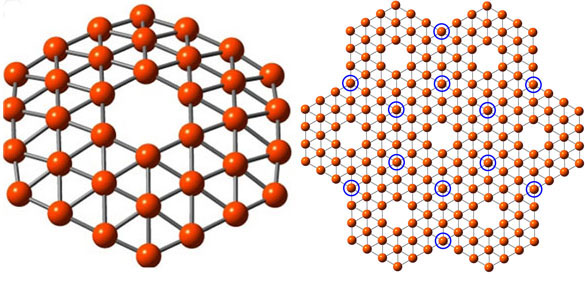
“Boron has one fewer electron than carbon and as a result can’t form the honeycomb lattice that makes up graphene. For boron to form a single-atom layer, theorists suggested that the atoms must be arranged in a triangular lattice with hexagonal vacancies — holes — in the lattice.”

A new paper shows that borophene is possible – now it just has to be made!

Zachary A. Piazza, Han-Shi Hu, Wei-Li Li, Ya-Fan Zhao, Jun Li, Lai-Sheng Wang.Planar hexagonal B36 as a potential basis for extended single-atom layer boron sheetsNature Communications, 2014; 5 DOI: 10.1038/ncomms4113

Brown University Press Release:

Unlocking the secrets of the B36 cluster
A 36-atom cluster of boron, left, arranged as a flat disc with a hexagonal hole in the middle, fits the theoretical requirements for making a one-atom-thick boron sheet, right, a theoretical nanomaterial dubbed “borophene.” Credit: Wang lab/Brown University

Graphene, a sheet of carbon one atom thick, may soon have a new nanomaterial partner. In the lab and on supercomputers, chemical engineers have determined that a unique arrangement of 36 boron atoms in a flat disc with a hexagonal hole in the middle may be the preferred building blocks for “borophene.”

Researchers from Brown University have shown experimentally that a boron-based competitor to graphene is a very real possibility.

Lai-Sheng Wang, professor of chemistry at Brown and his research group, which has studied boron chemistry for many years, have now produced the first experimental evidence that such a structure is possible. In a paper published on January 20 in Nature Communications, Wang and his team showed that a cluster made of 36 boron atoms (B36) forms a symmetrical, one-atom thick disc with a perfect hexagonal hole in the middle.

“It’s beautiful,” Wang said. “It has exact hexagonal symmetry with the hexagonal hole we were looking for. The hole is of real significance here. It suggests that this theoretical calculation about a boron planar structure might be right.”

It may be possible, Wang said, to use B36 basis to form an extended planar boron sheet. In other words, B36 may well be the embryo of a new nanomaterial that Wang and his team have dubbed “borophene.”

“We still only have one unit,” Wang said. “We haven’t made borophene yet, but this work suggests that this structure is more than just a calculation.” ……..

Wang’s experiments showed that the B36 cluster was something special. It had an extremely low electron binding energy compared to other boron clusters. The shape of the cluster’s binding spectrum also suggested that it was a symmetrical structure. ……..

…… That structure also fits the theoretical requirements for making borophene, which is an extremely interesting prospect, Wang said. The boron-boron bond is very strong, nearly as strong as the carbon-carbon bond. So borophene should be very strong. Its electrical properties may be even more interesting. Borophene is predicted to be fully metallic, whereas graphene is a semi-metal. That means borophene might end up being a better conductor than graphene.

“That is,” Wang cautions, “if anyone can make it.”

AbstractBoron is carbon’s neighbour in the periodic table and has similar valence orbitals. However, boron cannot form graphene-like structures with a honeycomb hexagonal framework because of its electron deficiency. Computational studies suggest that extended boron sheets with partially filled hexagonal holes are stable; however, there has been no experimental evidence for such atom-thin boron nanostructures. Here, we show experimentally and theoretically that B36 is a highly stable quasiplanar boron cluster with a central hexagonal hole, providing the first experimental evidence that single-atom layer boron sheets with hexagonal vacancies are potentially viable. Photoelectron spectroscopy of B36 reveals a relatively simple spectrum, suggesting a symmetric cluster. Global minimum searches for B36 lead to a quasiplanar structure with a central hexagonal hole. Neutral B36 is the smallest boron cluster to have sixfold symmetry and a perfect hexagonal vacancy, and it can be viewed as a potential basis for extended two-dimensional boron sheets.

China’s Jade Bunny apparently stuck on the moon

January 26, 2014

(I see that Chinese news reports usually translate “Yutu” as “Jade Rabbit” but from this version of the legend I prefer “Jade Bunny” as being more appropriate to the lunar creatures who went to Chang’e’s assistance and where the reincarnation of her husband Hou Yi was the Jade Bunny)

In a setback – apparently due to the difficult lunar terrain, the Jade Bunny lunar rover has suffered a “mechanical control abnormality” – which I take to mean that it is stuck and not responding to commands. China Daily has the story

China’s moon rover, Yutu (Jade Rabbit), has experienced a mechanical control anomaly, and scientists are organizing repairs. The abnormality occurred due to “complicated lunar surface environment,” the State Administration of Science, Technology and Industry for National Defence (SASTIND) said on Saturday, without giving further details. The abnormality emerged before the rover entered its second dormancy at dawn on Saturday asthe lunar night fell, according to SASTIND.

The lander, another part of the Chang’e-3 probe, also “fell asleep” earlier on Friday. The pair went dormant for two weeks about one month ago when the first lunar night of the mission occurred.

 ….. The Chang’e-3 lunar probe soft-landed on the Moon on December 14. Yutu separated from the lander hours later.

The success of the Chang’e-3 mission makes China the third country to soft-land a spacecraft on lunar soil after the United States and the former Soviet Union.

Lunar panorama: Chang’e 3 lander in Out of this World

Jade Bunny on the moon on 22nd December 2013 (photo Xinhua)

Jade Bunny on the moon on 22nd December 2013
(photo Xinhua)

Leaking fuel from the wing captured by Norwegian Dreamliner passengers

January 24, 2014

Following on from my previous post, Norwegian’s troubles with Boeing Dreamliner planes continue. This report from Nordlys.no is about a cancelled Norwegian Dreamliner flight from Bangkok to Oslo on 19th January where passengers took pictures and video of fuel pouring out of the aircraft’s wing while it was taxiing at take-off! The take-off was aborted and the flight cancelled – fortunately

...

Fuel leaking from the wing of a Norwegian Dreamliner at Bangkok Airport – photo Ann Kristin Balto

Nordlys.no: Ann Kristin Balto of Tromso was one of the 285 passengers waiting 19 hours for the delayed flight from Bangkok to Oslo.

She took the photo which shows how large amounts of fuel flowed out of the right wing of the Boeing 787-8 Dreamliner aircraft, …..

“When they discovered the error, they asked us not to take pictures because of the explosion hazard. Those who had already taken pictures were asked by the cabin crew if they could delete them”, said Balto.

Lasse Hagerupsen, a bank manager from Harstad was in a group of six and also noticed fuel leaking from the aircraft during taxiing.

“As the plane taxied to the runway and was about to take off, more passengers began to smell gasoline. The passengers alerted flight attendants who in turn reported to the cockpit. When the fuel ran out of the wing a half a meter long puddle of fuel was left by plane”. …. 

The bank manager confirmed that the attendants did not like that it was photographed. It was described by Norwegian as being due to defects in a valve.

The flight was canceled and the nearly 300 passengers were bussed to different hotels.

This one gives me some goose-bumps. I have seen the devastation from fuel-leak explosions and this could have gone really bad.

But all’s well ……

Dreamliner reliability is still short of the mark

January 24, 2014

Whether an aircraft is “available” to fly – whether a flight is scheduled or not –  is a measure – mainly – of the intrinsic soundness of that aircraft and its maintenance. The “dispatch reliability” of an aircraft or a type of aircraft is a composite measure of the performance of both the aircraft and the operator.

Aircraft availability and dispatch reliability and availability are two vital signs of any aviation operation. Availability refers to whether the aircraft is available for a flight, whether scheduled or not. An aircraft in for maintenance cannot be flown, and thus is not available. …. At its most basic, aircraft dispatch reliability accounts for whether the aircraft took-off on time and if not, why? If the dispatch performance and/or reliability of the aircraft is poor, then so is the level of service. …….

(more…)

Electric vehicles have no impact on emissions

January 22, 2014

If electric vehicles are to succeed they will have to provide the consumer with some real benefits by way of cost or convenience which are more than for feeling good. That in turn depends upon the further development of battery technology and increasing the range of the vehicle on a single charge. The cost of the vehicle and the speed of charging are other key factors.

The supposed environmental benefits are largely illusory since they merely shift the source of power generation (combustion from the internal combustion engine in a vehicle) to a power plant. In the United States this power generation is most likely to be fossil fired (coal or shale gas). A new study shows that even if electric vehicles made up more than 40% of all vehicles, emissions would be largely unchanged. As of 2012 electric vehicles made up about 0.5% of new vehicle sales and about 0.06% (170,000 of 254 million) of all vehicles on the road in the US.

(Phys.org)A new study from North Carolina State University indicates that even a sharp increase in the use of electric drive passenger vehicles (EDVs) by 2050 would not significantly reduce emissions of high-profile air pollutants carbon dioxide, sulfur dioxide or nitrogen oxides. … The researchers ran 108 different scenarios in a powerful energy systems model to determine the impact of EDV use on emissions between now and 2050. They found that, even if EDVs made up 42 percent of passenger vehicles in the U.S., there would be little or no reduction in the emission of key air pollutants. …..

The energy systems model also showed that key factors in encouraging use of EDVs are oil price and battery cost. If batteries are cheap and oil is expensive, EDVs become more attractive to consumers.

“How Much Do Electric Drive Vehicles Matter to Future U.S. Emissions?” Published: online January 2014 in Environmental Science & Technology pubs.acs.org/doi/abs/10.1021/es4045677

Abstract Image

Energy System Model

Abstract
Hybrid, plug-in hybrid, and battery electric vehicles—known collectively as electric drive vehicles (EDVs)—may represent a clean and affordable option to meet growing U.S. light duty vehicle (LDV) demand. The goal of this study is twofold: identify the conditions under which EDVs achieve high LDV market penetration in the U.S. and quantify the associated change in CO2, SO2, and NOX emissions through mid-century. We employ the Integrated MARKAL-EFOM System (TIMES), a bottom-up energy system model, along with a U.S. dataset developed for this analysis. To characterize EDV deployment through 2050, varying assumptions related to crude oil and natural gas prices, a CO2 policy, a federal renewable portfolio standard, and vehicle battery cost were combined to form 108 different scenarios. Across these scenarios, oil prices and battery cost have the biggest effect on EDV deployment. The model results do not demonstrate a clear and consistent trend towards lower system-wide emissions as EDV deployment increases. In addition to the tradeoff between lower tailpipe and higher electric sector emissions associated with plug-in vehicles, the scenarios produce system-wide emissions effects that often mask the effect of EDV deployment.

Rosetta awakes

January 21, 2014

The European Space Agency is – justifiably – feeling pleased with itself:

Rosetta wake-up signal

It was a fairy-tale ending to a tense chapter in the story of the Rosetta space mission this evening as ESA heard from its distant spacecraft for the first time in 31 months.

Rosetta is chasing down Comet 67P/Churyumov-Gerasimenko, where it will become the first space mission to rendezvous with a comet, the first to attempt a landing on a comet’s surface, and the first to follow a comet as it swings around the Sun.

Since its launch in 2004, Rosetta has made three flybys of Earth and one of Mars to help it on course to its rendezvous with 67P/Churyumov-Gerasimenko, encountering asteroids Steins and Lutetia along the way.

Operating on solar energy alone, Rosetta was placed into a deep space slumber in June 2011 as it cruised out to a distance of nearly 800 million km from the warmth of the Sun, beyond the orbit of Jupiter.

Now, as Rosetta’s orbit has brought it back to within ‘only’ 673 million km from the Sun, there is enough solar energy to power the spacecraft fully again.

Thus today, still about 9 million km from the comet, Rosetta’s pre-programmed internal ‘alarm clock’ woke up the spacecraft. After warming up its key navigation instruments, coming out of a stabilising spin, and aiming its main radio antenna at Earth, Rosetta sent a signal to let mission operators know it had survived the most distant part of its journey.

The signal was received by both NASA’s Goldstone and Canberra ground stations at 18:18 GMT/ 19:18 CET, during the first window of opportunity the spacecraft had to communicate with Earth. It was immediately confirmed in ESA’s space operations centre in Darmstadt and the successful wake-up announced via the @ESA_Rosetta twitter account, which tweeted: “Hello, World!”