Archive for the ‘Technology’ Category

Boeing issues warning: Further icing problems with GE GenX engines on Boeing aircraft

November 23, 2013
GenX 2B GE

GenX 2B GE

UPDATE:

Reuters: Boeing advised airlines on Friday about a risk of engine icing problems on its new 747-8 and 787 Dreamliner planes with engines made by General Electric, urging 15 carriers to avoid flying them near high-level thunderstorms. 

The move followed six incidents from April to November involving five 747-8s and one 787 when aircraft powered by GE’s GEnx engines suffered temporary loss of thrust while flying at high altitude. The problem was caused by a build-up of ice crystals, initially just behind the front fan, which ran through the engine, said a GE spokesman, adding that all of the aircraft landed at their planned destinations safely.

Boeing on Friday issued a notice prohibiting the affected aircraft from flying at high attitude within 50 nautical miles of thunderstorms that may contain ice crystals.

Icing problems with GE engines on Boeing’s Dreamliner has led to Japan Airlines pulling the Dreamliner from two international routes.

This comes on top of the icing problems noticed recently on the latest 747 cargo aircraft. A few weeks ago it was reported that a number of the latest long-haul Boeing 747 cargo aircraft fitted with the new GenX series of GE engines experienced engine icing problems when flying in particular cloud conditions at 41,000 feet:

Wall Street JournalIcing Hazards Surface on Boeing’s Newest 747 Jet

Years after aviation-safety experts thought they had eliminated the danger of airliner engines abruptly shutting down from internal ice accumulation, the same airborne hazard is showing up on a new generation of Boeing Co. jumbo jets.

The Chicago plane maker and General Electric Co., whose engines are installed on the biggest and newest Boeing 747 model, are now working together on fixes to prevent ice buildup that can prompt the giant airliner’s engines to temporarily malfunction or even stop working while cruising roughly 7 miles, or 41,000 feet, above the earth.

A GE spokesman said there are proposed software changes—which still need to be tested and then approved by the Federal Aviation Administration—designed to detect the presence of ice crystals in the atmosphere and eject the tiny particles before they form a coating deep inside engines that can melt or break into chunks.

… challenges with the GEnx-2B engines on extra-long 747 aircraft—known as 747-8s—highlight complex and nagging icing hazards that once again are forcing industry leaders and an international research team to scramble for answers. Before the partial government shutdown, according to industry officials, the FAA was moving toward mandating modifications to the 747-8’s computerized engine controls and making plans to warn pilots about susceptibility to internal engine icing while flying over storm-prone regions at roughly 40,000 feet.

Previously, experts believed such icing occurred primarily below 25,000 feet. ….

These cases of icing are different to those normally encountered and which are relatively well understood.

Aviation Week: 

….. The AirBridge Cargo event is the latest in a growing number of engine-icing incidents, which have triggered recent changes in international certification requirements. Unlike traditional engine icing, in which supercooled liquid droplets freeze on impact with exposed outer parts of the engine as the aircraft flies through clouds, engine core ice accretion involves a complex process where ice particles stick to a warm metal surface. These act as a heat sink until the metal surface temperature drops below freezing, thereby forming a location for ice and water (mixed-phase) accretion. The accumulated ice can either block flow into the core or shed into the downstream compressor stages and combustor, causing a surge, roll-back or other malfunction.

Until relatively recently, it was assumed that ice particles would bounce off structures and pass harmlessly through bypass ducts, or melt inside the engine. Now, there is evidence of an environment where a certain combination of water, ice and airflow is susceptible to accreting ice. Like many of the other known core icing events, the ABC 747-8F incident occurred near convective clouds. When incidents were first reported, investigators initially assumed supercooled liquid water, hail or rain were responsible because they had been lifted to high altitudes by updrafts. Yet most events have been recorded above 22,000 ft., which is considered the upper limit for clouds containing supercooled liquid water. ……

To find out exactly what is happening inside the convective systems that most frequently cause core icing, particularly in mid-latitude and tropical regions, an international team plans to conduct the High Ice Water Content (HIWC) test campaign in Darwin, Australia. The team includes NASA, FAA, Environment Canada, Transport Canada, Airbus, Boeing, the U.S. National Center for Atmospheric Research and the Australian Bureau of Meteorology. Also joining the effort will be the European Union’s High Altitude Ice Crystals (HAIC) project, which will be contributing a specially configured Falcon 20 research aircraft. ……

But now Boeing has warned all its clients who use aircraft with GE’s GenX engines not to fly them near certain kinds of storm clouds. And Japan Airlines whose Boeing 787 Dreamliners are powered by GenX engines has pulled the aircraft from two of its international routes:

Reuters: Japan Airlines (JAL)  said on Saturday it will pull Boeing 787 Dreamliners from two international routes after the U.S. aircraft maker notified it of icing problems in engines produced by General Electric .

Japanese carrier said Boeing notified airlines not to fly aircraft with GE’s GEnx Series engines near storm clouds following a recent incident in which a 747 aircraft experienced a loss of thrust after flying through anvil cloud.

As a result, JAL will replace Dreamliners on its Tokyo-Delhi and Tokyo-Singapore flights with other types of aircraft while also dropping a plan to use 787s for its Tokyo-Sydney route from December.

JAL will continue to fly 787s for other international and domestic routes, which are unlikely to be affected by cumulonimbus cloud for the time being.

Androids will dream of this electric “J”

November 22, 2013
Android on a Kawasaki J

Android on a Kawasaki J

It will never go into production.

It’s electric (note the artistic and symbolic flashes of green), but they are sticking to a NiMH battery rather than a lithium-ion fire hazard.

It’s what some androids will dream of instead of electric sheep.

It’s the Kawasaki J-concept motor cycle being displayed at the 2013 Tokyo Motor Show.

DigitalTrends: The Kawasaki J technically has three wheels, but in Sport Mode the two front wheels are pushed together, and the entire machine hunkers down to lower the center of gravity. In Comfort Mode, the stance is raised and the front wheels separate, giving the ride a more upright position that is, well, more comfortable.

Instead of handlebars, steering is accomplished with two levers, one attached to each of the front wheels. It’s a decidedly Steampunk mechanism, compared to the bike’s Cyberpunk styling.

In three-wheeled Comfort Mode, the J concept looks like a scooter used by mall cops in the futuristic Grid city from Tron. In maximum-attack Sport Mode, it looks completely otherworldly.

Powering the Kawasaki J is an electric motor hooked to a nickel-metal hydride (NiMH) battery pack. The packaging advantages of an electric powertrain were probably needed to accomplish the J’s transformation stunt. Note that it doesn’t use the lithium-ion batteries that are found in most electric cars and plug-in hybrids.

The Kawasaki J looks awesome on the show stand, and it won’t be going anywhere else. Kawasaki has no plans to put it into production. That’s just as well; it’ll save owners from having to try to explain it to their neighbors.

MOM turns its camera on Earth while preparing for critical insertion into Mars trajectory

November 21, 2013

While the MOM spacecraft “Mangalyaan” is in orbit around Earth, its systems and scientific instruments are being tested to prepare for the critical burn at 0036 IST on 1st December (1906 GMT 30th November) to inject it into a Mars trajectory. The colour camera has been turned on Earth during testing and ISRO has released this photograph.

This image was taken yesterday at around 1350 hrs (IST) from a height of almost 70,000 km above earth and has a spatial resolution of 3.5 km.

Earth from MOM 20131120 image ISRO

Earth from MOM 20131120 image ISRO

The spacecraft’s engine has so far been fired as follows:

  • first orbit-raising manoeuvre 416 seconds
  • second orbit raising manoeuvre 570.6 seconds
  • third orbit raising manoeuvre 707 seconds
  • fourth orbit-raising manoeuvre (time not specified, firing curtailed inadvertently)
  • fourth supplementary orbit raising manoeuvre 303.8 seconds
  • fifth orbit raising manoeuvre 243.5 seconds

The next critical burn (the seventh) has to to use the 440 Newton liquid engine again to impart a delta-v of nearly 648 m/s and the engine will have its longest burn time of 1,351 seconds. Three mid course corrections on the spacecraft’s journey to Mars are planned for and the fuel carried has to also cater for finally braking to enter into Mars orbit.

The Hindu carries a long, fascinating interview with  K. Radhakrishnan, ISRO Chairman. The article is a little unusual in its length and technical detail which most Indian newspapers would fight shy of! Some selected extracts below but the entire interview is worth reading:

After the Polar Satellite Launch Vehicle (PSLV-C25) put India’s Mars Orbiter into a perfect earth-bound orbit on November 5, it has been a smooth journey so far for the spacecraft. The Indian Space Research Organisation (ISRO) boosted the Mars Orbiter’s apogee in six complex manoeuvres executed between November 7 and 16. ISRO did this by giving commands from the ground to the spacecraft’s propulsion system, called 440 Newton engine, to fire. A crucial event of the trans-Mars injection of the spacecraft will take place on December 1 by a prolonged firing of the 440 Newton engine.

…. Till now, we have completed six manoeuvres including a supplementary one. Currently, the spacecraft’s apogee is 1,92,915 km. 

In the early hours of December 1, around 00.36 hours, we have the trans-Mars injection of our Mars spacecraft. On that day, we are going to use the 440 Newton liquid engine again to impart a delta-v, that is, an incremental velocity of nearly 648 metres a second to the spacecraft and the engine will burn for 1,351 seconds. It is crucial in the sense that we need to give the exact velocity required to take the spacecraft from the earth-orbit, passing through the sphere of influence of the earth which extends up to 9.25 lakh km from the earth, cruise through the long helio-centric phase, then get into the sphere of influence of Mars, and on its arrival near Mars on September 24, 2014, it has to be put into 376 km plus or minus 50 km above Mars at that point of time. On the same day, the next crucial operation of the spacecraft’s Mars orbit insertion has to take place. When this running of the 440 Newton liquid engine takes place on December 1, we also have eight numbers of 22 Newton control thrusters firing. 

There are two tasks for them. One is the spacecraft’s attitude control. Secondly, if it is required, they will aid the 440 Newton thrusters to augment its thrust-level. Both the functions will be performed and the Mars spacecraft will then be moving towards the helio-centric orbit. Then on December 11, we plan to have one small firing for mid-course correction of the spacecraft. There may be one more mid-course correction during the helio-centric phase, and subsequently, a fortnight before the spacecraft’s arrival near Mars, there will be one more mid-course correction. So there will be three mid-course corrections between December 1, 2013 and September 24, 2014. 

With the velocity imparted to the spacecraft on December 1, 2013, we will have an estimate of its expected position on September 24, 2014. We will be continuously tracking the spacecraft and if there are deviations vis-à-vis the end goal, we will make the corrections. So December 1 will be a crucial operation. The spacecraft’s propulsion system, i.e., the 440 Newton liquid engine, will complete its first phase of operations on December 1. It has to be re-started for its operation on September 24. There is thus a long gap. 

How confident are you that you can re-start the 440 Newton engine after it has hibernated in deep space for about 300 days during the spacecraft’s voyage? 

We have been using the 440 Newton engine for our Geo-synchronous Satellite – GSAT- missions where the spacecraft’s orbit has to be raised about a week after its launch. In the case of Chandrayaan-1, we had to restart the operation after a fortnight. For that, we had qualified the liquid engine in 2008 to restart after one month. 

During the last two years, considering the specific requirements of our Mars Orbiter Mission for re-starting the spacecraft’s 440 Newton engine after it has idled for about 300 days, we had done these two actions. One is we have provided a set of parallel circuits for the propellants’ flow-lines and also provided redundancy in the form of a latch-valve. So what essentially happens is that one portion of the fluid circuit will be closed after December 1. The parallel path will be energised for the operation in September 2014. 

……. In the spacecraft’s orbit-raising manoeuvres, during its trans-Mars injection and its insertion into the Martian orbit, the firing of the liquid engine is done in a closed loop mode. Here, a precision accelerometer is used to estimate the incremental velocity added as the liquid engine burns and when the accelerometer gives a feedback that the required incremental velocity added to the spacecraft has been achieved, the burning of the liquid engine is automatically terminated. So, minor variations in the performance of the liquid engine will not matter because we are cutting off its burning based on the delta-v that is achieved. That is why we call it closed loop of firing. …… 

Up to (925,000) km from the Earth, the spacecraft will be in the sphere of influence of the Earth. Subsequently, it will be moving into the helio-centric phase of its flight. It is a long one, where you have to look at the influence of other planets and the Moon and then the solar radiation pressure acting on the spacecraft. That pressure varies with respect to time because the geometry of the sun and the spacecraft matters here. This is something we have not done so far and this helio-centric phase of the flight is new to us. 

In Chandrayaan-1, we had travelled up to (400,000) km, which was well within the sphere of influence of the Earth. But here for the first time, we are moving out of the sphere of influence of the earth. So how the spacecraft will behave during the helio-centric flight of 680 million km along the arc is new to us. Then the spacecraft gets into the sphere of influence of Mars which is nearly six lakh km from Mars. 

From our understanding of the Mars gravity model, the influence of the atmosphere of Mars, the influence of the two satellites of Mars and the solar radiation pressure there on the spacecraft are very important. This is also a new thing that we are attempting. 

So the navigation of the Mars spacecraft from the orbit of the Earth to the orbit of Mars, passing through all these three phases, is a new knowledge that we are acquiring and validating during the next 300 and odd days.

Read the whole article.

A private, auspicious trip to Mars and back

November 20, 2013

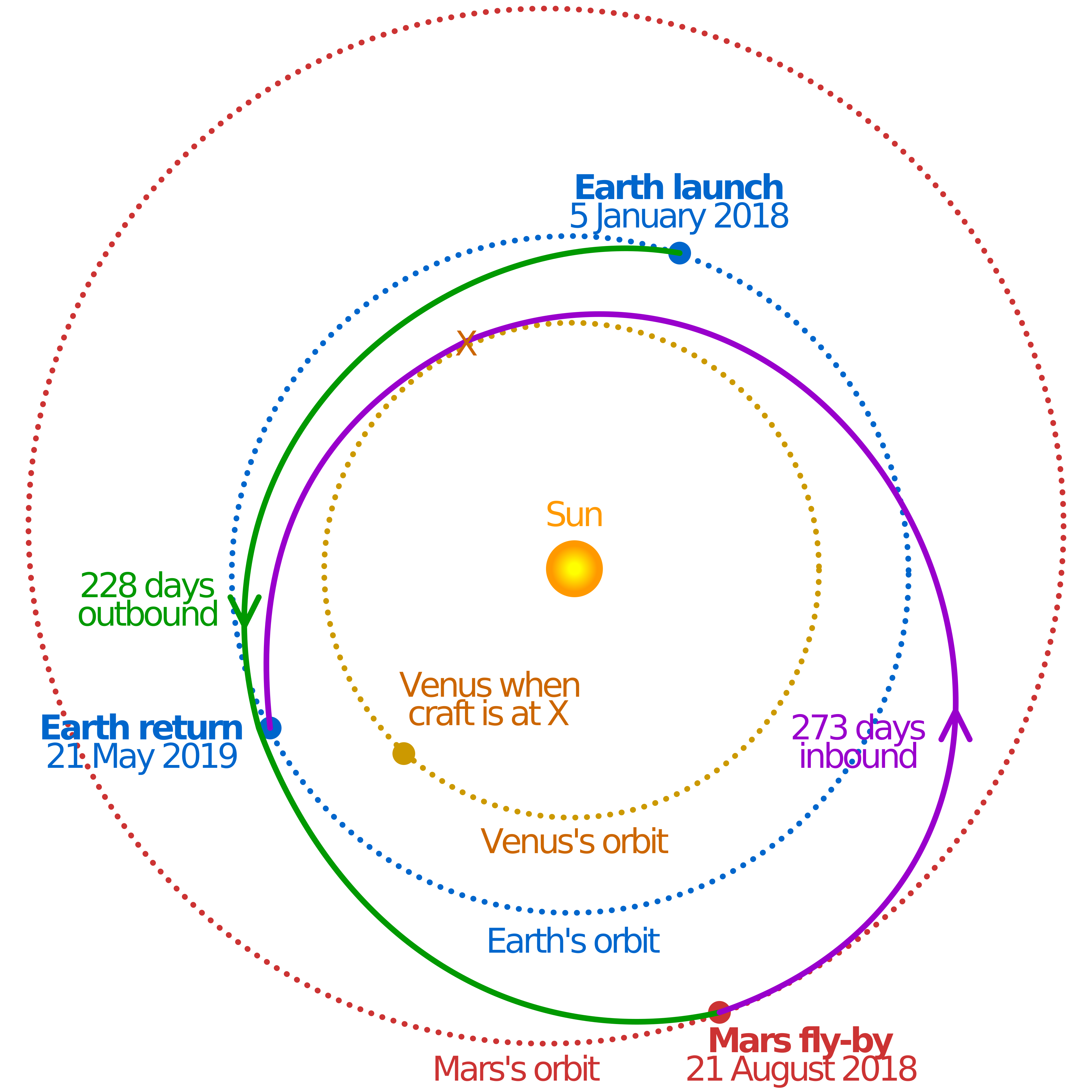
I don’t believe in Astrology but 5th January 2018 is a particularly auspicious and propitious date for a quick jaunt to Mars and back. And billionaire Denis Tito plans to take advantage of the advantageous alignment of Mars and Earth to make the first manned trip to Mars and back. It would be a “free-return” trajectory so the couple making the trip would only fly around Mars and return to a landing on Earth 501 days after they left.

InspirationMars: The mission’s target launch date is Jan. 5, 2018. This exceptionally quick, free-return orbit opportunity occurs twice every 15 years. After 2018, the next opportunity won’t occur again until 2031. The mission will provide a platform for unprecedented science, engineering and education opportunities, using state-of-the-art technologies derived from NASA and the International Space Station. It will be financed primarily through philanthropic donations, with some potential support from government sources.

The closest distance between Mars and Earth varies by almost a factor of two over an 18 year period. Note that 1 AU (Astronomical Unit) is the average distance between the Sun and the Earth (about 150 million kilometers). NASA

Inspiration Mars Press Release: 

Dennis Tito, founder and chairman of the Inspiration Mars Foundation, testified today before the House Science Subcommittee on Space during a hearing on commercial space. Tito shared the results of a 90-day study undertaken by Inspiration Mars and developed through collaborative efforts with
NASA centers and industry partners to define a baseline architecture for a human mission to Mars. The
Foundation proposes to send a spacecraft in late 2017 or early 2018 bearing two astronauts, a man and
woman, to the far side of Mars and return them to Earth. ….. Inspiration Mars’ Architecture Study Report describes the proposed mission architecture to enable the voyage of 314 million miles in 501 days, which requires collaboration through a public-private partnership with NASA. The plan calls for two launches to keep crew and cargo separate, an inherent safety feature to the mission architecture. First, the SLS will lift off from Kennedy Space Center with a four-part payload to place cargo into Earth’s orbit, consisting of: an SLS upper-stage rocket to propel spacecraft from Earth’s orbit to Mars; a service module containing electrical power, propulsion and communication systems; a Cygnus-derived habitat module where the astronauts will live for 501 days; and an Earth Reentry Pod derived from Orion. The second launch will take the crew into orbit aboard a commercial transportation vehicle (selected from competing designs under NASA’s Commercial Crew Program). From there, the crew and Inspiration Mars vehicle stack will rendezvous in orbit using docking procedures perfected by more than 130 trips to the International Space Station. ….

Tito noted there is a window for a mission by a different trajectory, a mission longer by 88 days that could be flown in 2021. Tito stated, “Given Russia’s clear recognition of the value and prestige of accomplishments in human space exploration, and their long-time interest in exploring Mars, my personal belief is that in all likelihood the Energia super-heavy rocket revival announcement signals Russian intent to fly this mission in 2021. Their heavy lift rocket, along with their other designs for modules and the Soyuz, can fly this mission with modest upgrades to their systems. China is also developing suitable capabilities and must surely be contemplating this opportunity to be first to Mars. It is our civic duty to bring this to the attention of the executive and legislative government branches. The 2010 NASA authorization has given America the opportunity to be first to Mars, and we believe it should be taken by launching the mission to Mars in 2017.”

Fast Free return trajectories between Earth and Mars occur twice every 15 years:

Low energy Free Returns with TOFS around 3 years (or less) are plentiful and occur every synodic period. Higher energy Free Returns with TOFS around 2 years are also plentiful and occur synodically. Of particular interest are fast Free Returns which occur in 2015 and 2017 and have the shortest TOF of about 1.4 years. These trajectories may provide a timely opportunity for the first human mission to Mars.

File:Inspiration Mars trajectory.svg

Inspiration Mars trajectory: Wikimedia

“Practical schemes for sending humans to Mars have been on the drawing boards for more than 60 years. Pioneering space engineer Wernher von Braun, author of the 1952 book “Project Mars,” proposed Mars flyby flights using Apollo lunar spacecraft in the 1960s.” space.com

Final Mars Orbiter orbit increase successfully completed 15th November 2110 CET

November 15, 2013

ISRO has announced via Facebook that the next burn to raise the earth orbit (apogee) to close to 200,000 km will be carried out at 0127 IST (2057 CET 15th November). If this goes as planned the next manoeuver is expected to be to inject the probe into a Trans-Mars trajectory on 1st December.

2130 CET: Just reported to have been successfully completed The observed change in Apogee is from 118642 km to 192874 km”.

Updates here as they become available.

UPDATES:  

  • 2045 CET Forward rotation to prepare for burn completed. 
  • 2058 CET: 440N Liquid Engine started firing to raise the apogee to about 192,000 km in this 5th Manoeuver
  • Craft at perigee. Awaiting post burn report.
  • 2110 Burn reported completed
  • It may be a while before tracking data can confirm the new orbit
  • The fifth orbit raising manoeuvre of Mars Orbiter Spacecraft, starting at 01:27:00 hrs (IST) on Nov 16, 2013, with a burn Time of 243.5 seconds has been successfully completed.The observed change in Apogee is from 118642km to 192874km.

===================================

Tonight is going to be the culmination of the various baby steps MOM has been taking by gradually soaring to higher apogees around Mother Earth. This manoeuver, scheduled at 01:27 hrs IST, will take the spacecraft to – almost half the way to moon – about two lakh (200,000) kilometers.

The distance to the moon is 384,400 km (and I make 200,000 to be a little more than half-way)!

mangalyaan final earth orbit increase - isro

mangalyaan final earth orbit increase – isro

At this distance Deep Space Tracking will become necessary.

The Indian Deep Space Network consists of a 18-m and a 32-m antennae that are established at the IDSN campus, Byalalu, Bangalore. The Network is augmented with a couple of stations in the western hemisphere in addition to the 64-m antenna in Bearslake, Russia to improve the visibility duration and to provide support from the antipodal point. …..

External network stations APL, JPL (Goldstone, Canberra, Madrid), Hawaii, Brazil (Alcantara, Cuiaba) are requisitioned in for the purpose of extended visibility of Launch and Early Orbit Phase (LEOP) operations, as well as to gain the near continuous visibility during the normal phase operations. All the external stations will ensure the required compatibility to communicate with the spacecraft.

The network as used for Chandrayaan and expected to be used for Mangalyaan is shown below.

Indian Deep Space Network used for Chandrayaan - isro

Indian Deep Space Network used for Chandrayaan – isro

Chinese Li-Fi development moves faster than in Europe

October 22, 2013

“Light Fidelity” – Li- Fi  for using light from LED’s as a data carrier instead of radio frequencies was coined at the University of Edinburgh:

PhysOrg: Li-Fi is a term referring to “light fidelity” coined by Prof. Harald Haas from the University of Edinburgh and refers to a type of visible light communication (VLC) technology that delivers a networked, mobile, high-speed communication solution. He set up a private company, PureVLC, to continue exploring the technology.

But now it seems that the Chinese have developed this technology a lot faster than Prof. Haas’ company and could be closer to commercial application than the originators.

Xinhua: 

Successful experiments by Chinese scientists have indicated the possibility of the country’s netizens getting online through signals sent by lightbulbs (LiFi), instead of WiFi.

Four computers under a one-watt LED lightbulb may connect to the Internet under the principle that light can be used as a carrier instead of traditional radio frequencies, as in WiFi, said Chi Nan, an information technology professor with Shanghai’s Fudan University, on Thursday.

A lightbulb with embedded microchips can produce data rates as fast as 150 megabits per second, which is speedier than the average broadband connection in China, said Chi, who leads a LiFi research team including scientists from the Shanghai Institute of Technical Physics of the Chinese Academy of Sciences.

With LiFi cost-effective as well as efficient, netizens should be excited to view 10 sample LiFi kits that will be on display at the China International Industry Fair that will kick off on Nov. 5 in Shanghai.

The current wireless signal transmission equipment is expensive and low in efficiency, said Chi. 

“As for cell phones, millions of base stations have been established around the world to strengthen the signal but most of the energy is consumed on their cooling systems,” she explained. “The energy utilization rate is only 5 percent.”

Compared with base stations, the number of lightbulbs that can be used is practically limitless. Meanwhile, Chinese people are replacing the old-fashioned incandescent bulbs with LED lightbulbs at a fast pace.

“Wherever there is an LED lightbulb, there is an Internet signal,” said Chi. “Turn off the light and there is no signal.”

However, there is still a long way to go to make LiFi a commercial success.

“If the light is blocked, then the signal will be cut off,” said Chi.

More importantly, according to the scientist, the development of a series of key related pieces of technology, including light communication controls as well as microchip design and manufacturing, is still in an experimental period.

Prof. Haas and his company are not very amused and expressed some skepticism.

PhysOrg again: 

As for reactions to the report from China, a spokesperson, according to the BBC, said they thus far had not seen any evidence such as videos or photos in support of the claims. PureVLC spokesman Nikola Serafimovski said they did not know how valid was the report “without seeing more evidence.”

In 2011, Haas demonstrated how an LED bulb equipped with signal processing technology could stream a high-definition video to a computer. Haas performed the first public demonstration of visible light communications live at TED Global, where he showed an angle poise lamp fitted with an LED bulb transmitting high-definition video displayed on a screen. When he interrupted the light with his hand, the video froze and it was then restored when he removed his hand.

Removing visual pollution

October 16, 2013

The wind turbines seem to have been replaced by sheep!

Four wind turbines in the Yorkshire Dales are the first in Britain to be torn down

The 150ft high turbines of Chelker Reservoir, near Ilkley, will not be replaced after the council refused permission for two even bigger machines. According to campaigners, the turbines have not worked in years. In an unprecedented move, the utility company sent in contractors at the end of last month to dismantle the rusting structures.

Chelker Reservoir, Addingham, Yorkshire - Chelker Reservoir wind turbines are dismantled

Chelker Reservoir, Addingham, Yorkshire – Daily Mail


Nightmare continues: Panel falls off Air India Dreamliner in flight

October 15, 2013

A new problem every few days for Boeing with their Dreamliner but their share price does not seem to be much affected:

The Hindu: 

An Air India Boeing 787 Dreamliner. File photo

An Air India Boeing 787 Dreamliner. File photo

A large panel in the belly of a Bangalore-bound Dreamliner of Air India fell off mid-air, putting about 150 passengers on board at a grave risk, but the aircraft landed safely.

The DGCA is probing the incident which occurred on Saturday when an 8X4 feet panel in the fuselage fell off while the plane was on its way to Bangalore from Delhi, leaving a gaping hole in the cargo hold, official sources said.

There were 148 persons, including the crew, on board flight AI-803 which landed safely at the Bangalore airport, the sources said, adding that the hole was noticed by the ground staff when they came to inspect the aircraft for its return journey.

A spare panel was flown to Bangalore and fitted on the Boeing 787, which was later declared fit to fly. But the return flight was delayed by over nine hours, they said.

Confirming the incident, airline officials said a panel had fallen off but was replaced and the aircraft was cleared for flights.

“Yes, there was a gaping hole. During the normal transit inspection, it was observed. Engineers immediately rectified it,” an AI official said requesting anonymity.

“It was not an emergency. There was no safety problem,” he added.

Besides long-haul international operations, Air India operates the Dreamliners on domestic routes like from Delhi to Chennai, Bangalore and Kolkata.


No end to new materials with super-strength

October 10, 2013

From the days of the alchemists and then the metallurgists who mixed different materials – often in the molten state – and then to the chemists we have now moved into the age when materials are designed in the lab to have desired properties. The challenge then is to synthesise the desired composition with the atomic structure required and then to devise manufacturing processes for the materials.

“A material called carbyne could be stronger even than graphene or diamond, according to researchers who have calculated its properties”, reports the BBC.

Carbyne is a chain of carbon atoms held together by double or alternating single and triple chemical bonds.

In their paper, Boris Yakobson and colleagues from Rice University in Houston show that carbyne’s tensile strength – the ability to withstand stretching – surpasses that of “any other known material” and is double that of graphene, the flat sheet of carbon atoms that is often held up as a “supermaterial”.

They also calculated that carbyne has twice the tensile stiffness of graphene and carbon nanotubes and nearly three times that of diamond.

It should display a number of other useful properties say the researchers. For example, it could be turned into a magnetic semiconductor (these are materials with electrical conductivity between that of a metal and an insulator like glass) and could be used as a sensor to detect twisting.

Some scientists have reported synthesising small amounts of carbyne in the lab, but it was thought to be extremely unstable. And some chemists have suggested that two strands coming into contact could react explosively.

“Our intention was to put it all together, to construct a complete mechanical picture of carbyne as a material,” said Vasilii Artyukhov, also from Rice University.

“The fact that it has been observed tells us it’s stable under tension, at least, because otherwise it would just fall apart.”

Mingjie Liu , Vasilii I. Artyukhov , Hoonkyung Lee ,Fangbo Xu , and Boris I. Yakobson, Carbyne From First Principles: Chain of C atoms, a Nanorod or a Nanorope,

ACS Nano,  DOI: 10.1021/nn404177r, October 5, 2013

Abstract: We report an extensive study of the properties of carbyne using first-principles calculations. We investigate carbyne’s mechanical response to tension, bending, and torsion deformations. Under tension, carbyne is about twice as stiff as the stiffest known materials and has an unrivaled specific strength of up to 7.5×10^7 N∙m/kg, requiring a force of ~10 nN to break a single atomic chain. Carbyne has a fairly large room-temperature persistence length of about 14 nm. Surprisingly, the torsional stiffness of carbyne can be zero but can be ‘switched on’ by appropriate functional groups at the ends. Further, under appropriate termination, carbyne can be switched into a magnetic-semiconductor state by mechanical twisting. We reconstruct the equivalent continuum-elasticity representation, providing the full set of elastic moduli for carbyne, showing its extreme mechanical performance (e.g. a nominal Young’s modulus of 32.7 TPa with an effective mechanical thickness of 0.772 Å). We also find an interesting coupling between strain and band gap of carbyne, which is strongly increased under tension, from 3.2 to 4.4 eV under a 10% strain. Finally, we study the performance of carbyne as a nanoscale electrical cable, and estimate its chemical stability against self-aggregation, finding an activation barrier of 0.6 eV for the carbyne–carbyne cross-linking reaction and an equilibrium cross-link density for two parallel carbyne chains of 1 cross-link per 17 C atoms (2.2 nm).

From a sublime “Dreamliner” to the ridiculous

October 10, 2013

Nightmares (for Boeing) are made of this:

ReutersJapan Airlines Co was forced to turn around its Tokyo-bound flight from Moscow on Thursday due to a problem in the Boeing 787 jet’s lavatory, a spokesman for the Japanese carrier said. … 

JAL spokesman Takuya Shimoguchi said the toilet malfunction on the flight from Moscow was likely caused by an electronic glitch. The airline was working on repairs on the ground, he added.

The flight, carrying 141 passengers, departed Moscow on Wednesday evening and returned after about five hours, he said.

Shares in JAL, which made headlines this week by signing with Boeing rival Airbus for the next generation of long-haul jets, were up 2.1 percent on Thursday morning, outperforming the broader market.

Updated 10th October:

BBC: 

Japan Airlines (JAL) says it has turned around two of its Boeing 787 Dreamliner aircraft during flights due to technical problems.

On one plane one of the two anti-ice systems, which prevent ice building up around the engine, failed.

Meanwhile, an electrical glitch made six toilets unusable on another flight.

These are the latest technical issues to hit the Dreamliner, which saw the entire fleet being grounded earlier this year following battery problems.