Spice addiction prolongs your life

August 7, 2015

red chilliesEven growing up in a family which liked its food very spicy I was regarded as being extreme in my like of fiery dishes. The story is – and I have only some very vague reflections of this – that I sucked my thumb as a child for a very long time. After my parents gave up on their attempts to stop this depraved habit my grandmother took charge. She wrapped my thumb every morning in a gauze bandage steeped in powdered red chillies. This continued all through one winter she spent with us when I was about two. She was “accused” by mother of “child cruelty” but she was determined to bring the depraved child back into line. Apparently I did not cry or complain – unnatural child that I was. Only my right thumb was wrapped in the chillie-bandage but it did not get me to stop or even to shift to my left thumb. In any event this “torture” went on for about 3 months but did not cure me of sucking my thumb (and that continued, I am told, till I was almost four). Thumb-sucking came to its natural end in due course but by then red chillies had been established as my “natural comforter”. I no longer suck my thumb, even at times of great stress – but I do find a blisteringly fiery meal strangely comforting.

But perhaps my grandmother has helped prolong my life. A new study in the BMJ reports on an observational study which makes no claims about cause and effect but merely reports a correlation between the eating of spicy food and a decrease in mortality.

Jun Lv et al. Consumption of spicy foods and total and cause specific mortality: population based cohort study. BMJ, 2015 DOI:10.1136/bmj.h3942

Press ReleasePrevious research has suggested that beneficial effects of spices and their bioactive ingredient, capsaicin, include anti-obesity, antioxidant, anti-inflammation and anticancer properties. So an international team led by researchers at the Chinese Academy of Medical Sciences examined the association between consumption of spicy foods as part of a daily diet and the total risk and causes of death. They undertook a prospective study of 487,375 participants, aged 30-79 years, from the China Kadoorie Biobank. Participants were enrolled between 2004-2008 and followed up for morbidities and mortality. …… 

During a median follow-up of 7.2 years, there were 20,224 deaths. Compared with participants who ate spicy foods less than once a week, those who consumed spicy foods 1 or 2 days a week were at a 10% reduced risk of death (hazard ratios for death was 0.90). And those who ate spicy foods 3 to 5 and 6 or 7 days a week were at a 14% reduced risk of death (hazard ratios for death 0.86, and 0.86 respectively).*In other words, participants who ate spicy foods almost every day had a relative 14% lower risk of death compared to those who consumed spicy foods less than once a week.

The association was similar in both men and women, and was stronger in those who did not consume alcohol. Frequent consumption of spicy foods was also linked to a lower risk of death from cancer, and ischaemic heart and respiratory system diseases, and this was more evident in women than men.

Fresh and dried chilli peppers were the most commonly used spices in those who reported eating spicy foods weekly, and further analysis showed those who consumed fresh chilli tended to have a lower risk of death from cancer, ischaemic heart disease, and diabetes.

spice tinThere is no chocolate dessert which is not better for the addition of a sprinkle or two of red chillie powder. It is not just chillies of course. A little cumin in the cheese can do wonders. A touch of cinnamon in the Irish coffee is decadently good. A little asafoetida in the traditional Swedish pea-soup can bring it to life. Bangers and mash with hot mustard on the bangers and onions and red chillies in the mash is a student’s delight. Coriander added to the mint with any lamb dish is the way to go. A touch of saffron on any fish or crustacean dish can hardly go wrong. I even find that there is no over-rated, Michelin-starred, French dish which cannot be improved by the addition of a little of the right spice.

A Guantanamo in Chicago?

August 5, 2015

I have a perception – from the other side of the Atlantic – that race relations and especially the relations between the police and the black community in the US have deteriorated under Barack Obama. The number of  black people reported killed by police seems much too high. Deaths of black people in police custody seems also unnaturally high. Again my perception is that Obama is dangerously risk averse both domestically and in foreign policy. He has not addressed this issue forcefully. I suspect a certain lack of capability and an undue fear of action.

Chicago is as close to Obama’s “home city” as any. Moreover the current mayor of Chicago, Rahm Emanuel is a close friend of Obama’s and was his former Chief of Staff (2008 – 2010). So one would expect that Chicago would lead the way in race relations under the first “black” president of the US. But it seems that Chicago has been running its own Guantanamo-style facility (Homan Square) in plain view. It also seems that during Rahm Emanuel’s term the use of the facility against black suspects has been maximised.

Chicago Homan Square arrests via The Guardian

Chicago Homan Square arrests via The Guardian

Of course The Guardian leans very heavily to the left and has a tendency to be rather sanctimonious, but their report – even after being discounted for their “goody-goody” bias – is rather disturbing. It does not speak well of what Obama and his friend have achieved in their “home city”.

It seems a real shame that under the first “black” president of the US, race relations, especially between the police and the black community, have apparently deteriorated quite badly.

The Guardian:

At least 3,500 Americans have been detained inside a Chicago police warehouse described by some of its arrestees as a secretive interrogation facility, newly uncovered records reveal.

Of the thousands held in the facility known as Homan Square over a decade, 82% were black. Only three received documented visits from an attorney, according to a cache of documents obtained when the Guardian sued the police.

Despite repeated denials from the Chicago police department that the warehouse is a secretive, off-the-books anomaly, the Homan Square files begin to show how the city’s most vulnerable people get lost in its criminal justice system.

The Chicago police department has maintained – even as the Guardian reported stories of people being shackled and held for hours or even days, all without legal access – that the warehouse is not a secret facility so much as an undercover police base operating in plain sight. “There are always records of anyone who is arrested by CPD, and this is no different at Homan Square,” the police asserted in a March statement.

But an independent Guardian analysis of arrestees’ records, obtained through the Freedom of Information Act, shows that Homan Square is far from normal: 

  • Between September 2004 and June 2015, around 3,540 people were eventually charged, mostly with forms of drug possession – primarily heroin, as well as marijuana and cocaine – but also for minor infractions such as traffic violations, public urination and driving without a seatbelt.
  • More than 82% of the Homan Square arrests thus far disclosed – or 2,974 arrests – are of black people, while 8.5% are of white people. Chicago, according to the 2010 US census, is 33% black and 32% white.
  • Over two-thirds of the arrests at Homan Square thus far revealed – at least 2,522 – occurred under the tenure of Mayor Rahm Emanuel, the former top aide to Barack Obama who has said of Homan Square that the police working under him “follow all the rules”. ……….

Read the report

The Obama legacy will certainly show that he was the first half-black president of the US. More than that, history may only record that “he was one who could have, but didn’t”.

Russia claims the North Pole as part of its continental shelf

August 4, 2015

Russia has officially claimed the North Pole as being part of its continental shelf. In 2007, they sent a mini-sub to the North Pole and planted a Russian flag on the sea-bed. It’s only a matter of time before China claims large chunks of the seabed surrounding its artificial islands in the Pacific. Claims for Antarctica will not be far behind. Why Norway and the UK have territorial claims in Antarctica is not much of a mystery but there is no logic to it. Which is also why the Falklands will never be given up in any foreseeable future by the UK to Argentina. It is the promise of Antarctica and not the Falkland Islanders which governs.

Antarctica claims

Barents Observer:

After years of comprehensive research, Russia on 3 August submitted its claims for additional territories in the Arctic. The claim includes both the Mendeleev and Lomonosov Ridges, two major structures beneath the Arctic Ocean.

“… the claim determinating the outer borders of the continental shelf in the Arctic Ocean is based on the scientific understanding that the central Arctic underwater ridges, among them the Lomonosov, Medeleev, Alfa and Chukotskoye Heights, as well as the in between basins of Podvodnikov and Chukotskaya, have a continental character”, an offical statement, refered to by RIA Novosti, reads.

It will now be up to the UN Commission on the Limits of the Continental Shelf to decide if Russia should be entitled to include the huge additional areas under its sovereignty. The Commission confirms that “the consideration of the partial revised submission made by the Russian Federation will be included in the provisional agenda of the next ordinary session”, the Commission website informs.

Russia in 2001 made a first official submission of its Arctic claims to the UN Commission. However, the Commission in 2002 responded that additional research is needed before a decision can be taken.

Neighboring Norway was in 2009 the first country to get its Arctic territorial claims approved, while Denmark/Greenland submitted a claim in December 2014. That latter claim includes ownership of the North Pole and is consequently in conflict with the Russian claim.

If approved, the Russian claim will expand the country’s territory by 1.2 million square kilometers. Estimates indicate that the area include 594 oil fields and 159 gas fields as well as two major nickel fields and more than 350 gold deposits. Initial recoverable fuel resources are estimated to 258 billion tons of fuel equivalent, representing 60 percent of Russia’s total hydrocarbon resources.

Claims to the moon  and Mars can be expected.


A gas turbine as a higher level of art

August 4, 2015

It all started with the wheel of course. Mechanical engineering became art – or was it the other way around?

13th century stone chariot wheel - Konark

13th century stone chariot wheel – Konark

The “art” of mechanical engineering is not just about beauty of form, it is about a beauty of both form and substance. It is a higher level of art because it must not only be aesthetically pleasing to the eye – look good – it must also function as it was meant to.  Da Vinci’s helicopter sketches are interesting and even look good but they don’t represent anything which ever worked or can work. Lovely things which do nothing or do things badly may be some kind of art, but they are not examples of the “art” of engineering. Even sketches of humble pulleys or levers or gears which actually work are – for me – a higher level of art in that they have both the form and the substance.

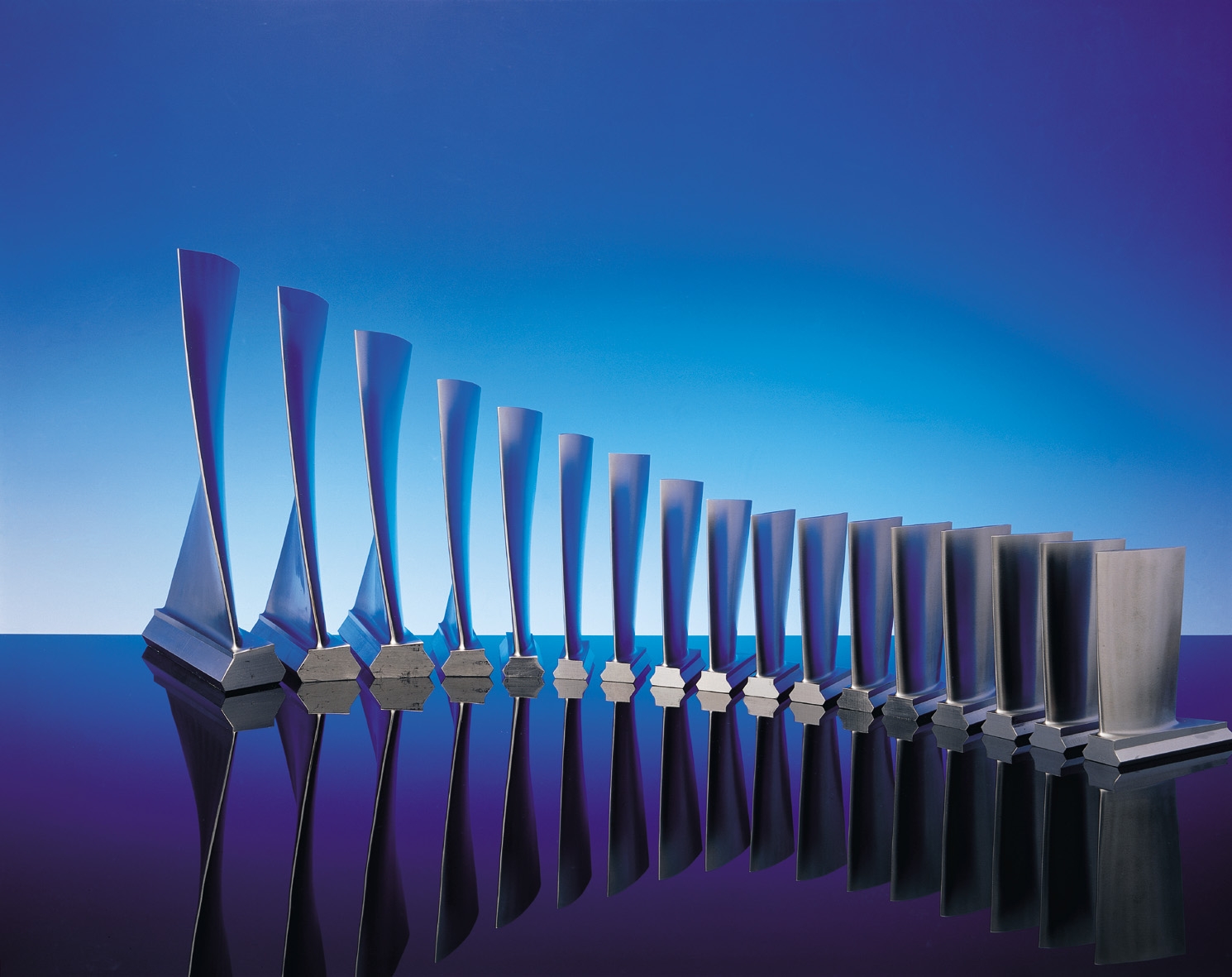
gt blades

GT Blades (image Siemens)

The requirement of substance – that some artefact functions as it should – constrains the degrees of freedom available for aesthetic expression or satisfaction. It is easier to design pleasing shapes which don’t also have to work. When things that work have a form which is also aesthetically pleasing, or inspiring or challenging we have the art in engineering. And in the world of mechanical engineering, it is turbines in general (wind , water, steam and gas), and modern heavy duty gas turbines in particular, which represent, for me, an awe-inspiring and almost frightening beauty in the sublime combination of form and function. From windmills to jet engines there is art in the engineering. State-of-the-art gas turbines are art epitomised.

GT Compressor blading

GT Compressor blading (image Stork)

Artefacts of engineering don’t have to be beautiful. Not all engineering is art. Gas turbines don’t have to be pleasing to the eye – but they are. Mathematics and physics and chemistry are combined to satisfy the substance and the resulting form – perhaps not entirely intentionally – becomes beautiful. The beauty lies not only in the shape and profile of the compressor and turbine blades (which are in themselves almost mesmerising in their irregular regularity), but in the sheer cleverness of the whole engine. The concept of how a gas turbine functions is itself beautifully ingenious. It is far more “intelligent design” than the ineffective (99% failure rate), hit and miss of evolution (just a trial of random mutational errors), which requires billions of years and innumerable failures. A compressor is an unnatural animal. The “natural” order of fluid flow from higher to lower pressure is subverted. To conceive of the use of an unnatural machine, the compressor, to create a high pressure stream of air, to burn a suitable fuel and raise the temperature of the gas such that it can be expanded in a turbine which not only provides the power to drive the compressor but produces surplus power, is genius. And then to do all that and drive an electrical generator as well , while the blades are rotating at 3000 or 3600 revolutions per minute, when they are at temperatures where even the best steels have the strength of soft butter, is more than awesome. Fine, powerful stuff.

GE 9HA

The GE 9HA “Harriet” gas turbine

An infinite number of monkeys pounding away at keyboards for an infinite amount of time would surely reproduce the works of Shakespeare.

But they couldn’t produce a gas turbine.

It is silly season and the clowns (Trump and Corbyn) are pulling ahead

August 3, 2015

August is silly season and most – including journalists – are on vacation. I have this perception – but no data – that even natural catastrophes take a break in August. (It might be that they just don’t get reported). In any event the political scenes in the US and in Europe are relatively subdued. Politicians have much leeway to be sillier than usual without being permanently penalised. Political polls, in August, are somewhat lightweight. Probably even those polled are inclined towards the “silly”. Too much should not be read into August poll results but of course they do have some significance.

Both in the UK and in the US, the clowns are having a field day. Strangely, Jeremy Corbyn , a clown of the loony left, has increased his lead in the race for leadership of the British Labour Party in spite of dire warnings of the imminent self-destruction of the Party. Donald Trump, a clown of the far right, has increased his lead – against all predictions – in spite of his gaffes (immigration, McCain, rape in marriage ……) in the race for the Republican nomination. It is almost as if those being canvassed have a perverse contempt for the process and are determined to clown around themselves in their responses. Or perhaps it is a deeper malaise in both the UK Labour Party and in the US Republican Party. Perhaps the Labour Party just expects to be in the wilderness for the next decade. And perhaps the Republicans see no way in which they can win next year. Perhaps they are so sunk in despair that it is only by indulging in ridiculous fantasies that they can lighten the blackness that surrounds them.

The UK race will be settled in September and there may not be enough time to “correct” the advances that Corbyn makes during the silly season. By the time September comes along, the race could be over. In the US there is ample time for Trump to be shot down or – as is more likely – for him to shoot himself. But in the very weak and uninspiring field of Republican candidates the clown may yet have the last word.

But I have a tendril of a thought that maybe it is the time of the clowns. Maybe the political process needs the Corbyns and the Trumps. Maybe they have to win once in a while.

And where are the clowns? There ought to be clowns. Quick, send in the clowns. Maybe they’re here.

Climate science (global warming) has lost the plot

August 3, 2015

When (not if) the next little ice age or even the end of this interglacial begins, we will first observe it by cooler summers – not initially by colder winters. While the “climate scientists” are chasing non-existent links between man-made carbon dioxide emissions and “global temperature”, they are reduced to data tampering and cooling the past. There is not a shred of evidence but only much conjecture that man-made emissions are of any significance.

They cannot predict the future so they are rewriting history. Every year the temperatures of the past are adjusted downwards. No model forecast of global temperature has come anywhere near predicting actual development. When the models don’t fit, it is time to dump the models. “Climate science” is now two decades out of date. Today Obama will announce another round of restrictions on the climate bogey-man – anthropogenic carbon dioxide emissions – even though his plans will have no impact on climate and will only make life more expensive.

The primary “forcing” or feed-back loop which will set off the little ice age or glacial conditions will be a reduction of ice melt over a few summers and followed by an increase of ice accumulation, which in turn will increase the solar energy reflected directly back into space. That will further reduce the ice melt in subsequent years. Cold winters and an increase of rate of ice growth is not required to set this off. Current, “normal” rates of ice growth in the winter are quite sufficient to reproduce the little ice age or even the return to glacial conditions provided that the summer melt is reduced and reducing. A large volcanic eruption with much dust ejected could well be the key factor to enhance the “forcing”. A year or two or three without summers in the higher latitudes could well be the key. It is probably of more significance in the northern hemisphere with its larger land mass which would support the direct growth of surface ice. In the southern hemisphere there is no reason that Australia could not also be covered with glacial ice sheets but more sea-ice would have to be created first. That would require much colder winters and not just cooler summers to trigger the change. It is not the climate near the equator or the tropics which controls. It is the regions above 50N and below 50S where we will first see the indications. It is the combination of reduced ice-melt followed by increased ice accumulation which will be critical.

Here in Sweden it has been a miserable July. The Finnish summer has been the coldest on record – so far. It has been the coldest July in most of Australia in twenty years. Iceland has seen snow in summer which is not that common. Scotland is said to have seen its worst summer in 40 years. Montana, Wyoming and Idaho have seen anomalous summer snow. The Greenland ice melt started very late and seems to already have come to an end. “Freak” snow storms have come to the Rockies in July. Over 40 people and 250,000 alpacas died in Peru in a cold wave and Chile declared cold emergencies..

“Global temperature” is not a real thing. It is an artefact, a number calculated by massaging and adjusting real data. No matter what the self-styled “climate scientists” believe and worship, “climate change” which is not manifested as changes to local weather and which can actually be experienced probably does not exit. We are now in for 2 – 3 decades of cooling which will include a little ice age. But over the next 1,000 years we will also be back into glacial conditions.

Right now, I experience more indicators of cooling than of any warming.

And when the cooling does start – as it will – we shall be very thankful for the more than 1,000 years of fossil fuel reserves we have.

Windows 10 buys your soul (with your consent)

August 2, 2015

I suppose I have little option but to upgrade.

And I am resigned to being “targeted” by advertisers selected specifically for me. I take some comfort in the fact that I cannot recall actually buying anything because of a web advertisement. I suppose I am just too old for them.

Image result for windows 10

The soul – however you want to define it – is manifested (not defined) in your behaviour. The advent of the internet and its apparent anonymity actually makes visible some parts of your hidden self.  People visit sites and make comments that they would never otherwise do if they were in public view. Of course much of that anonymity is only a perception. Your internet “self” (ID, email, passwords, sites visited, on-line community memberships,…. ) comes closer to painting a picture of your soul than just your visible behaviour.

And Windows 10 acquires more of your soul than ever before – and all with your consent.  It is with your consent because few will ever read and understand the 45 pages of terms and conditions that must be agreed to. Not that Apple and Google are not also involved in photographing and capturing your soul. But even an on-line presence is only a manifestation of your soul and each of Microsoft or Google or Apple have have their own painting of your essence. And these perceptions of who you are, these paintings of your soul, are theirs to sell – to advertisers or to governments or to other interested parties.

The Guardian:

Hundreds of commenters on sites such as Hacker News and Reddit have criticised default settings that send personal information to Microsoft, use bandwidth to upload data to other computers running the operating system, share Wi-Fi passwords with online friends and remove the ability to opt out of security updates.

Many of the complaints relate to the new personalised adverts embedded in Windows 10. When the OS is installed, Microsoft assigns the user a unique advertising ID, which it ties to the email address registered with the company. That email address is also associated with a raft of other services, such as the company’s productivity and communication programs, as well as app downloads and cloud-storage uploads.

Using that information, Microsoft is able to personalise ads to the user, during both web surfing and, for newer apps downloaded from the Windows Store, app usage. Microsoft itself is leading the way on that front, even turning the in-built version of Solitaire (the card game that has been a staple of Windows installations since 1990’s Windows 3.0) into a freemium game, complete with unskippable video adverts.

Elsewhere, Windows 10 also harvests user information in order to teach the built-in personal digital assistant Cortana, Microsoft’s answer to Siri. To enable Cortana, the company says, it “collects and uses various types of data, such as your device location, data from your calendar, the apps you use, data from your emails and text messages, who you call, your contacts and how often you interact with them on your device”.

“There is no world in which 45 pages of policy documents and opt-out settings split across 13 different Settings screens and an external website constitutes ‘real transparency’.”

……. The European digital rights organisation (EDRi) sums up the company’s 45 pages of terms and conditions by saying: “Microsoft basically grants itself very broad rights to collect everything you do, say and write with and on your devices in order to sell more targeted advertising or to sell your data to third parties.”

In many ways, however, Windows 10 is merely moving closer towards what has become the new normal thanks to mobile operating systems. Both Siri and Google Now require access to the user’s personal information to personalise responses, while both Apple and Google offer developers the ability to deliver personalised ads to users based on information such as app installs.

Chinese greens?

July 31, 2015
Photo taken on July 30, 2015 shows leaf insect phyllium at the Yinggeling natural reserve in south China's Hainan Province.  (Xinhua/Jiang Enyu)

Photo taken on July 30, 2015 shows leaf insect phyllium at the Yinggeling natural reserve in south China’s Hainan Province. (Xinhua/Jiang Enyu)

Half-way through, Indian monsoon on course to be close to “normal”

July 31, 2015

Compared to “normal” the Indian monsoon has a large downside and a limited upside. It is thought that a “bad” monsoon (accumulated rainfall 20% less than normal) can depress GDP by 2 percentage points. A “good” monsoon (20% greater than normal) however can raise GDP by only about 1 percentage point since the benefits are capped by areas of local flooding. The monsoon lasts 4 months (June – September) but its indirect effects are felt all the way through to the start of the next monsoon. Agriculture contributes only 17% of India’s GDP directly but agriculture employs almost 65% of the Indian work-force.

Indian Economy

The immediate impact of a good monsoon is increased employment in rural areas (September – October) followed by increased rural consumption of consumer goods (October – December) and even sales of two-wheelers and tractors (November – March). Pesticide sales increase during the monsoon and again in the following pre-monsoon period. Fertiliser sales pick-up strongly in the pre-monsoon period following a good monsoon. The December – June period following a good monsoon is when rural “investments” are mainly made (machinery, equipment, construction, consumer goods). The indirect effects of agriculture on the services and manufacturing sectors are critical. However, even more important is the effect of a good monsoon on food price stability and general economic sentiment.

The current monsoon is now half-way through. June saw accumulated rainfall about 15% higher than normal while July has seen a shortfall of about 16%. For the 2 months the accumulated rainfall is now just short of “normal”. Revised forecasts are for a small shortfall during August followed by some excess in September and for the whole period rainfall to be close to “normal”. Timing of rainfall is important but the rains have kept reasonably close to the expected time-line.

The potential downside of a “bad” monsoon seems to have evaporated. My conclusion is that India should see a strong growth period in the September 2015 – May 2016 period, as the Modi government’s sluggish reforms pick up some steam and as the seasonal effects of a near-normal monsoon trickle through the economy.

Rome in 320CE

July 30, 2015

Our town planners could look, with some advantage, to their predecessors from 1700 years ago.

And all that without electricity or even steam power.

Uploaded on Aug 25, 2011 by Bernie Frischer

This video presents a fly-through of the latest version of Rome Reborn (2.2). The new version incorporates some new content (including the Pantheon) and for the first time includes animations.

Rome Reborn is an international initiative to create a 3D digital model of the ancient city as it might have appeared in A.D. 320. For more about the project, please see: http://www.romereborn.virginia.edu.

Music “Long Past Gone (Jami Sieber)” by Sieber, Kammen, Fulton and Schatz