Tokyo scraps “bicycle helmet” Olympic stadium – thank goodness

July 17, 2015

I have not been all that impressed by the much vaunted Zaha Hadid‘s architectural designs. I think her Jockey Club Innovation Tower for Hong Kong’s Polytechnic University is a particularly self-indulgent, 15-storey monstrosity. I find most of her buildings are terribly pompous and bordering on the presumptuous.

I haven’t found any of her designs that I truly like. Some are less grandiose or less offensive than others. But I don’t have to pay for her presumptions.

Hadid Jockey Club

Hadid Jockey Club

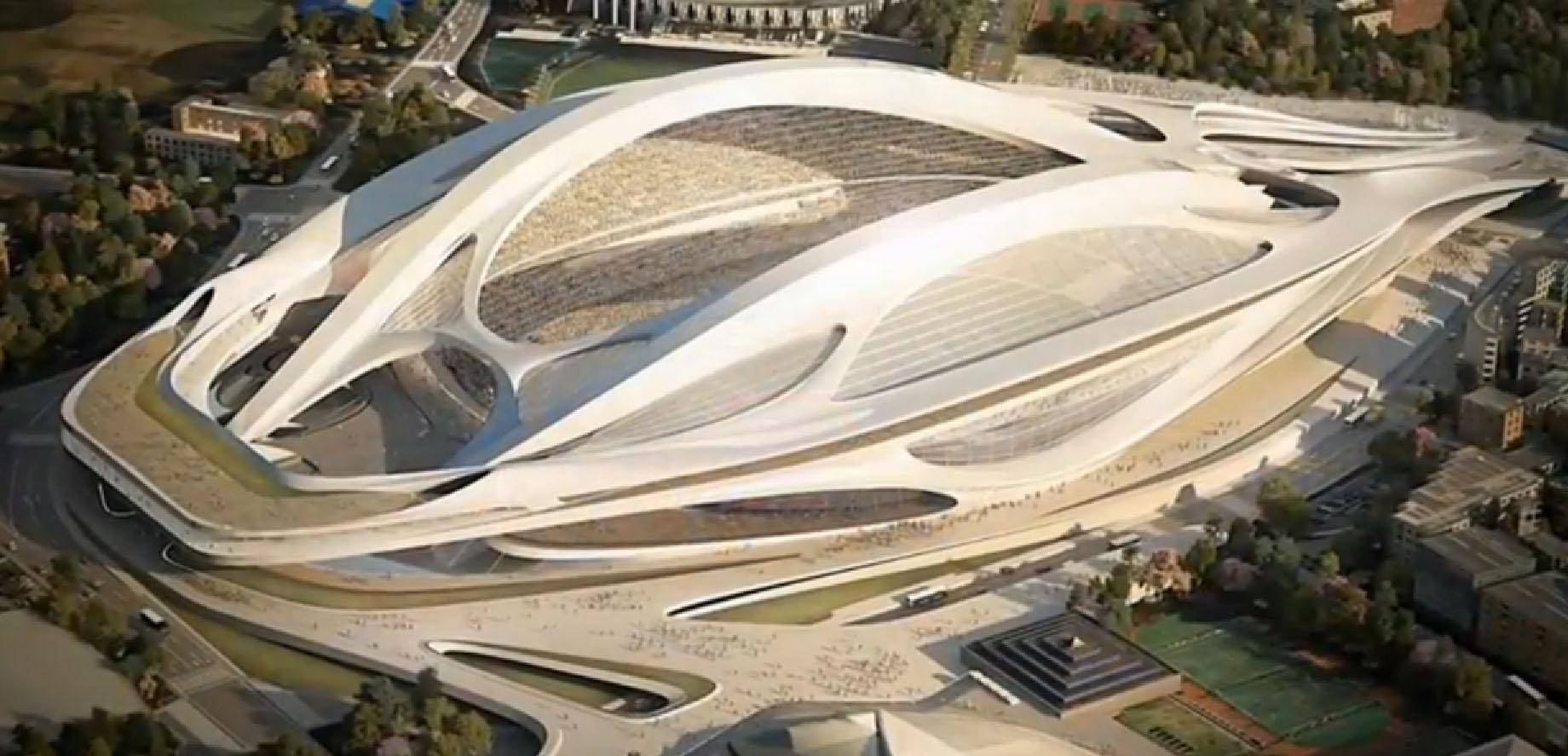
She had designed the Olympic Stadium for Tokyo 2020 which looked remarkably like a bicycle helmet and quite ugly. Fortunately it has proven to be too expensive (over 300 billion Yen – c. $2 billion), or perhaps it is an estimate of cost which is being used as the cover story for cancelling a structure which should never have been selected. Whatever the real reason, it has been scrapped.

Thank Goodness.

hadid Tokyo Olympic stadium  - image Kyodo

hadid Tokyo Olympic stadium – image Kyodo

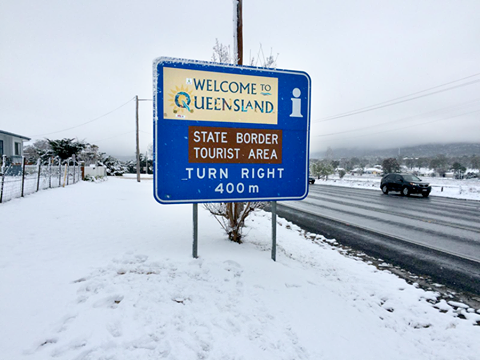
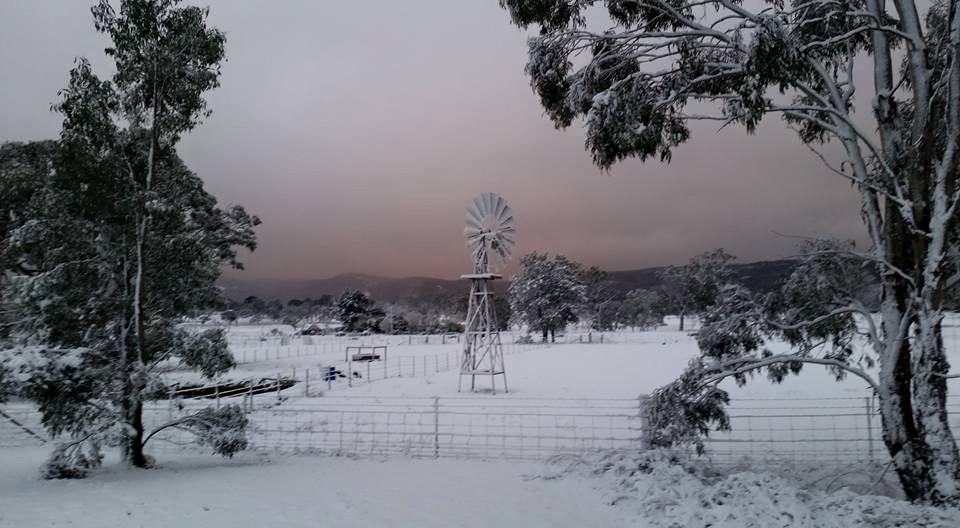
More snow in Queensland and NSW than for a decade – harbinger of the coming ice age?

July 17, 2015

Carbon dioxide concentration in the atmosphere is the highest in modern times and has been increasing for well over a decade. But global temperatures – however that is defined – has shown no sign of warming and a slight decrease in that period. The Sun’s activity is down and reducing to levels similar to that of the Maunder Minimum in this Landscheidt Minimum. A new Little Ice Age is likely by 2030.

The small little signs of weather that are harbingers of the coming Little Ice Age are accumulating – even in the southern hemisphere. Australia is experiencing a “cold” wave (though +12ºC does not seem particularly cold). The cold wave is also giving “unprecedented” (for a decade) levels of snow.

It is inevitable that since the global warming priesthood have been preparing for the icecaps melting that we will now enter a new ice age.

Maybe this time the glaciers are going to spread in the southern hemisphere across Australia and South America?

SMH: Snow creates winter wonderland … in Queensland, as well as NSW


Solar Impulse voyage abandoned after irreversible battery damage

July 16, 2015

The Solar Impulse 2 “adventure” is over. The lithium-ion batteries have overheated and have been irreversibly damaged. It may fly again in April 2016. Even if it does, that cannot – by any stretch of creative hype – be considered a part of this journey which has effectively been abandoned. By April 2016 a new plane could be built. The planned duration of the whole flight was to have been 5 months. But 4 months after starting in Abu Dhabi the plane has been grounded in Hawaii after completing 17,800 km of its planned 35,000 km journey.

The much hyped journey of Solar Impulse 2 as a solo flight circumnavigating the world was never really about technology or science. It was all about perceptions and PR. The project has been made into a symbol for solar energy  with claims that

Solar Impulse is the only airplane of perpetual endurance, able to fly day and night on solar power, without a drop of fuel. 

This revolutionary single-seater aircraft made of carbon fiber has a 72 meter wingspan (larger than that of the Boeing 747-8I) for a weight of just 2,300 Kg, equivalent to that of a car. The 17,000 solar cells built into the wing supply four electric motors (17.5 CV each) with renewable energy.

During the day, the solar cells recharge lithium batteries weighing 633 Kg (2077 lbs.) which allow the aircraft to fly at night and therefore to have virtually unlimited autonomy.

This flight has done little to demonstrate “perpetual endurance” or “unlimited autonomy”. Every flight starts with fully charged batteries (presumably charged from the grid and that would be fossil energy) and the solar cells need to top up the charge lost during night flying during the day. What has actually been demonstrated with the maximum flight length of five days is that – at best – the stored charge declined by 20% each day. Moreover the batteries suffered irreversible damage after a 5 day flight. That suggests fatal-flaws in the design of the plane, both in the sizing of the solar panels and in the design of the batteries. Firstly, either the power absorbed during flight has been under-estimated or the recharging capacity has. Secondly the immaturity of the battery technology and the inherent risk of over-heating during recharging has popped up again (as with Tesla, Volt and the Dreamliner).

Certainly it has demonstrated the endurance of the pilot flying solo and all credit to him for that. But it has not provided much in the way of new science or demonstration of engineering or technology. That solar cells work and solar energy can be converted into electricity is not new. That battery technology is still struggling to provide efficient, reliable and sustainable charging and recharging has been demonstrated but it did not need a plane to do that. That the cost and weight of extra cells needed to compensate for the lack of solar energy at night is still a major challenge, remains the state of the art.

Following the longest and most difficult leg of the round-the-world journey which lasted 5 days and 5 nights (117 hours and 52 minutes), Solar Impulse will undergo maintenance repairs on the batteriesdue to damages brought about by overheating.

During the first ascent on day one of the flight from Nagoya to Hawaii, the battery temperature increased due to a high climb rate and an over insulation of the gondolas. And while the Mission Team was monitoring this very closely during the flight, there was no way to decrease the temperature for the remaining duration as each daily cycle requires an ascent to 28’000 feet and descent for optimal energy management.

solar impulse route . based on BBC graphic

solar impulse route . based on BBC graphic

Log (BBC):

LEG 1: 9 March. Abu Dhabi (UAE) to Muscat (Oman) – 772km; in 13 hours and 1 minute

LEG 2: 10 March. Muscat (Oman) to Ahmedabad (India) – 1,593km; in 15 hours and 20 minutes

LEG 3: 18 March. Ahmedabad (India) to Varanasi (India) – 1,170km; in 13 hours and 15 minutes

LEG 4: 18 March. Varanasi (India) to Mandalay (Myanmar) – 1,536km; in 13 hours and 29 minutes

LEG 5: 29 March. Mandalay (Myanmar) to Chongqing (China) – 1,450km; in 20 hours and 29 minutes

LEG 6: 21 April. Chongqing (China) to Nanjing (China) – 1,241km; in 17 hours and 22 minutes

LEG 7: 30 May. Nanjing (China) to Nagoya (Japan) – 2,852km; in 44 hours and 9 minutes

Leg 8: 28 June. Nagoya (Japan) to Kalaeloa, Hawaii (USA) – 7,212km; 117 hours and 52 minutes.

The story is now being spun madly to get some PR benefit, but if the objective was to demonstrate unlimited autonomy then it has been a fiasco. Five days and nights is a long way from being unlimited.

Germany pips France in the rush to Tehran

July 15, 2015

The French Foreign Minister Laurent Fabius announced yesterday that he had been invited by his counterpart to Tehran and would soon be visiting there. But he did not announce any date for his visit. In the meantime while Fabius was talking the Germans were making their travel arrangements. The German Economy Minister has moved fast and has already arranged to take a large trade delegation to Tehran in 4 days time on 19th July (Tehran and Isfahan).

Both France and Germany were major trading partners for Iran before the sanctions and are looking to take a serious chunk of the frozen moneys now being released (about €800 million every month) and which Iran will most likely use to get equipment and components it has long been starved of. There is likely to be a rush of trade delegations and Germany and France are sure to be in the front. However the three countries which have had most trade with Iran during the sanction years have been Russia, China and India and they will also be expecting to be preferred suppliers for whatever they can offer. In any event the world economy will see an increase of trade by about €10 billion per year and increasing as Iran’s oil revenues pick up.

France24:

Fabius noted that French firms were “very well thought of” in Iran but denied the nuclear deal was struck with an eye on business. “Trade is very important. It fosters growth. It’s important for the Iranians, it’s important for us,” he said.

“But when the president of the Republic (Francois Hollande) and I took the strategic decision (to agree to a deal) … we did not take it for commercial reasons, but for strategic reasons because we wanted to avoid nuclear proliferation,” stressed the minister.

France used to have a strong presence in Iran before the sanctions went into effect, with Peugeot and Renault being major players in the Iranian auto industry and energy giant Total heavily involved in the oil sector. But two-way trade has fallen from four billion euros ($4.4 billion) in 2004 to just 500 million euros in 2013, according to French statistics.

PressTV:

Germany sees a big rise in trade with Iran, preparing the first high-profile foreign delegation for visit to Tehran this week since the conclusion of nuclear talks on Tuesday. 

Economy Minister Sigmar Gabriel will arrive at the head of a large political and trade delegation on Sunday for a two-day visit which will also take him to the central Iranian city of Isfahan.

The 60-strong delegation will include representatives of big German industrial companies such as Linde and Siemens, Amir-Hossein Zamaninia, Iran’s deputy oil minister for commerce and international affairs, said.

Gabriel, who is also Germany’s vice chancellor, will meet with President Hassan Rouhani, Minister of Petroleum Bijan Zangeneh as well as Iranian ministers of trade and energy and the central bank governor.

“We expect to see a big increase in trade, especially in German sales of capital goods,” the Deutsche Welle website quoted Michael Tockuss, chief executive at the German-Iranian Chamber of Commerce, as saying.

According to the German Foreign Ministry, bilateral trade grew by 27% to 2.7 billion euros ($3 billion) in 2014 because of the sanctions relief. With the conclusion of nuclear talks on Tuesday, conservative estimates foresee bilateral trade expanding to 6 or 7 billion euros in 2016 assuming sanctions are dropped quickly, DW said.


Bibi Netanyahu loses his security blanket

July 14, 2015

I particularly like this from B Michael in a Haaretz opinion column, even if his sarcasm is a little over the top. But with Bibi nothing registers if it does not go over the top.

My heart goes out to Benjamin Netanyahu. With one cold, cruel stroke of the pen, the rulers of the world have taken away his most beloved toy – the apple of his eye and the joy of his heart, the rock of his existence and the source of his strength, and above all, the rock of his refuge and safe haven. Or in short, the Iranian bomb. ……… From now on, Netanyahu is like a baby that has lost its security blanket, or like one whose favorite teddy bear was thrown into the garbage – the one that warmed his heart during the long nights and infused him with calm and serenity during times of trouble and election campaigns.

But Bibi has an easy solution says Michael. He could just take one of Israel’s greater than 200 nuclear warheads and smuggle it into Iran and he can then rest easy that he can get back to crying “Wolf” whenever he has nothing else to say.

But our hope has not yet been lost. If salvation doesn’t come from without, we will bring it from within, from ourselves. ….. As everyone already knows, the State of Israel – of course only according to strange foreign sources – has a respectable arsenal of atomic bombs that long since crossed the 200 mark. More than enough to destroy half the world. 

And here, in these surplus bombs, lies the solution to Netanyahu’s distress. All he has to do is take one of those 200 bombs of ours (according to foreign sources), wrap it up nicely in gift wrapping and give it secretly, as an anonymous donation, to the Islamic Republic of Iran. …… To anyone who fears the move might be discovered and embarrass us, don’t worry; nobody will notice the loss of one bomb out of 200. And even if a curious journalist does discover that one is missing, it’s not so terrible. As is the norm in such cases, Israel will grab the lowly guard on duty and cast him into purgatory the way one usually does with scapegoats, and that will settle the matter.

And thus, everyone will once again be happy.

But to be serious for a moment, bringing Iran back into the fold and creating a more balanced situation could be the best thing to happen in the Middle East for a long time. It is actually the 3-pronged balance between Israel, Saudi Arabia and Iran which gives hope. A military, political, financial and even a religious balance. Ultimately the Middle East has to find its own solutions for what constitutes “democracy” and of living together, without solutions being imported and imposed from Washington.

Iran deal is done, Bibi unhappy, Greek deal done, Greeks unhappy.

July 14, 2015

Reuters and other anonymous sources are reporting that an Iran deal has been done.

Greece yesterday, Iran today, what’s for tomorrow?

Bibi is neither pleased nor amused. A “pre-emptive” strike by Israel on Iran now becomes that much more difficult. Saudi Arabia will not be too pleased either. If sanctions are  lifted and also on weapons sales by Iran then we can see the pro-Iranian factions across the Middle East getting a boost. Which will probably constrain the advance of ISIS somewhat (and whatever the Saudis might say it is private Saudi money funding the barbarians). The pro-Iranian factions in Syria and Iraq will not only get a boost, they may also be more successful on the ground than the US-led coalition.

However Saudi Arabia will not be too unhappy about the additional downward pressure on oil prices. It will be sometime before Iran can ramp up production and during this time, low-cost Saudi oil will win further market share. Though Saudi Arabia failed to wipe out shale oil from the US, it is still increasing production and contributing further to the current oil glut. Saudi seems to be pursuing a revised strategy of keeping oil prices relatively low for 2 years or more in a war of attrition against the higher-cost oil producers. Market share is perceived as their prime weapon to try and get rid of the higher-cost producers. But I think they have miscalculated even here. A discontinued shale oil well can be restarted with very little investment and at very short notice. Production costs of shale oil have decreased sharply. Shale oil developers will just ramp their production up and down depending upon the prevailing oil price. And the larger shale oil wells can make money even with oil prices down at $40/ barrel.

It isn’t quite time for vacation yet in Europe (apart from Sweden which is closed for July). Some kind of framework resolution for the whole package of the 3rd bailout needs to be passed by the Greek parliament by tomorrow. Some resistance is showing today but the resolution will surely pass. Of course that says nothing about the Greek government’s implementation of all they have signed up for. Their track record of implementing what has been solemnly promised is not good. And if the reports today that the ECB will not be pumping liquidity willy-nilly into the Greek banks are correct, then the banking system will have to start issuing IOU’s to keep functioning while the negotiations are concluded. That will effectively be an alternative currency and it won’t be long before the IOU’s start trading at a different value to par. A currency by another name than “Euro” is still a Grexit for as long as that currency is used.

But an Iran back in the international fold is undoubtedly a good thing.

Varoufakis (backed by Krugman) chose the wrong game

July 13, 2015

Yanis Varoufakis is a Marxist economist and an “expert” on game theory. Paul Krugman is about as close to a Marxist economist as one can get in the US. The only thing that “star” economists get right are back casts where they force their theories to apply to things that have already happened. Krugman is a Nobel prize winner – but in economics that is not something to be very proud of. Krugman has been a vociferous supporter of the anti-austerity camp. He has even criticised those who have argued against debt write-offs. Thomas Piketty is another “star”, French, “socialist” economist who has also been supportive of the anti-austerity brigade.

(In my own view this is not a battle of ideologies since austerity and anti-austerity are not ideologies. If anything it is a battle between profligate public expenditure on the one hand and prudence and good housekeeping on the other.)

In any event, tonight Greece is contemplating the stringent austerity measures they must sign up to by Wednesday along with the loss of fiscal independence required to be able to just enter negotiations on a 3rd bailout of some €85 billion. Debt restructuring is not included in the package though some rescheduling of debt service will be discussed. It is a package is much more stringent than the Greeks rejected in their much-vaunted and self-indulgent referendum. (What referendum if posing the question “Do you want more taxes?”, would not answer “No”. I was surprised that as many as 39% answered “Yes”.) If the negotiations had been completed 3 months ago, Greece would have been able to conclude a much less painful package.

But it all makes sense if seen as a high stakes “game” that Varoufakis convinced Tsipras and his Syriza colleagues to play. With his game theory credentials and the support of empty “heavyweights” such as Krugman and Piketty, Varoufakis probably thought that he could outmaneuver Schauble especially as he was initiating the game. Perhaps he even felt he was defining the game. A threat to leave the Euro was the nuclear weapon in his arsenal. Seen as such a game, the calling of the referendum was probably planned as the decisive, pre-ultimate move. Even his resignation immediately after the referendum was probably a premeditated move for the negotiation they expected to have. But these moves backfired. First, against Greek expectations, the banks were asphyxiated. Varoufakis had probably miscalculated in thinking that the ECB under friendly French influence would not shut off the liquidity tap. Schauble’s decisive counter-move came yesterday when, for the first time, a Grexit, in the form of a 5 year time-out, was openly named as the alternative. Once Schauble had hijacked that as the nuclear weapon, the game was over. Tsipras had no weapons left and no alternative to capitulating completely.

The Greek population are not only paying for the profligacy of the past. They are also now paying for a game started by Varoufakis which went horribly wrong.

This game is over but the match is still going on. Tsipras would do well to ignore Varoufakis (and Krugman and Piketty) for the rest of the match. Marxists and economy just don’t mix. Marxism may be able to hide its face in the blend but the economy is poisoned.

It may be small but Pluto is still a planet

July 13, 2015

It orbits the Sun. It has five moons. It is the tenth most massive object orbiting the Sun. It is not that Pluto is not a planet, but that there are many more planets than the “big ten”. The asteroid belt and the Kuiper belt objects are all also planets. Inventing new definitions and calling them “dwarf planets” or “planetoids” doesn’t change the fundamentals.

The International Astronomical Union (IAU) defines a planet thus:

A planet is a celestial body which:

  1. is in orbit around a Star,
  2. has sufficient mass to assume hydrostatic equilibrium (a nearly round shape), and
  3. has “cleared the neighbourhood” around its orbit.

Calling Pluto a “dwarf planet” rather than a “planet” has nothing to do with its properties or the properties of the Sun. It is not even a matter of language or semantics. It is merely for the convenience of a bunch of lazy astronomers who were afraid of having too many planets to classify.

Ultimately it is just a matter of usage. For me any celestial body orbiting another is and remains a planetary body. And every body which orbits the Sun directly (and not by virtue of orbiting a planetary body first) is a planet. Every asteroid is a planet of the Sun. Jupiters moons remain planets of Jupiter. And that makes Pluto a planet. New planets may well have been found in the Kuiper belt – but Pluto remains a planet for me, in spite of the failings of the IAU.

Neither in or out, but a temporary Grexit is now on the table

July 12, 2015

As always in the EU or in the Eurozone countries, differences of opinion end up with wishy-washy compromises which only maximise the level of dissatisfaction. The EU has become expert at choosing the least attractive solutions in its quest for divine consensus.

After 5 years of trying to keep Greece from leaving the Euro, Germany has finally put forward the compromise position of a 5 year time-out from the Euro, a temporary Grexit which, in all likelihood, would become permanent if it is adopted. The time-out would be offered to Greece if they do not manage to pass some emergency resolutions through their parliament by Wednesday. But the matter of greatest significance, which highlights the fundamentally flawed nature of the Euro, is that a Grexit – even just a temporary one – is for the first time formally acknowledge by the Eurozone countries as being on the table.

It will be painful in the short term but the best for Greece is to leave the Euro, stay in the EU and build up a strong New Drachma. I hope they do take a time-out, that their debt is then restructured, that they get help to and do get back on to their feet and eventually that they make the time-out a permanent exit. And that then leads to an orderly dismantling of the Euro – or at least a suspension of the Euro – to be revisited again when political union is achieved – if ever.

A currency union has to be the natural consequence of a political union and cannot be used to coerce politically unequal nations into a phoney political union that their populations do not want.

It has always been the Sun as new model predicts another ice age

July 12, 2015

I can see the evidence that the earth goes through warming and cooling cycles. But I have seen no evidence that man-made carbon dioxide emissions have had any significant impact on global climate in general or on global warming in particular. I am more inclined to the view that our climate is overwhelmingly dominated by the Sun – both directly with insolation variations and indirectly through the clouds and the oceans. Solar activity indicates we are approaching – or have arrived at – a new minimum, the Landscheidt Minimum – which will be similar to the Maunder Minimum. Another Little Ice Age in the next decade or two has always been on the cards.

(On a longer timescale, I believe a large volcanic eruption could be one of the possible triggers which tips the earth from interglacial to glacial conditions and our current interglacial cannot last more than another millennium or so.)

Now another model of the suns activity level also suggests that a Maunder-like Minimum and another Little Ice Age is just around the corner.

PhysOrg:

A new model of the Sun’s solar cycle is producing unprecedentedly accurate predictions of irregularities within the Sun’s 11-year heartbeat. The model draws on dynamo effects in two layers of the Sun, one close to the surface and one deep within its convection zone. Predictions from the model suggest that solar activity will fall by 60 per cent during the 2030s to conditions last seen during the ‘mini ice age’ that began in 1645. Results will be presented today by Prof Valentina Zharkova at the National Astronomy Meeting in Llandudno.

It is 172 years since a scientist first spotted that the Sun’s activity varies over a cycle lasting around 10 to 12 years. But every cycle is a little different and none of the models of causes to date have fully explained fluctuations. Many solar physicists have put the cause of the solar cycle down to a dynamo caused by convecting fluid deep within the Sun. Now, Zharkova and her colleagues have found that adding a second dynamo, close to the surface, completes the picture with surprising accuracy.

“We found magnetic wave components appearing in pairs, originating in two different layers in the Sun’s interior. They both have a frequency of approximately 11 years, although this frequency is slightly different, and they are offset in time. Over the cycle, the waves fluctuate between the northern and southern hemispheres of the Sun. Combining both waves together and comparing to real data for the current solar cycle, we found that our predictions showed an accuracy of 97%,” said Zharkova.

Zharkova and her colleagues derived their model using a technique called ‘principal component analysis’ of the magnetic field observations from the Wilcox Solar Observatory in California. They examined three solar cycles-worth of magnetic field activity, covering the period from 1976-2008. In addition, they compared their predictions to average sunspot numbers, another strong marker of solar activity. All the predictions and observations were closely matched.

Looking ahead to the next solar cycles, the model predicts that the pair of waves become increasingly offset during Cycle 25, which peaks in 2022. During Cycle 26, which covers the decade from 2030-2040, the two waves will become exactly out of synch and this will cause a significant reduction in solar activity. 

“In cycle 26, the two waves exactly mirror each other – peaking at the same time but in opposite hemispheres of the Sun. Their interaction will be disruptive, or they will nearly cancel each other. We predict that this will lead to the properties of a ‘Maunder minimum’,” said Zharkova. “Effectively, when the waves are approximately in phase, they can show strong interaction, or resonance, and we have strong solar activity. When they are out of phase, we have solar minimums. When there is full phase separation, we have the conditions last seen during the Maunder minimum, 370 years ago.”

It really is time to acknowledge the Landscheidt Minimum:

Landscheidt also predicted that after the next solar minimum in 2030 the following minimum would occur in 2200.

It is perhaps time to officially name this minimum that is coming as the “Landscheidt Minimum”.