French Minister warns EC not to hold up GE acquisition of Alstom

May 30, 2015

Previous posts on the GE acquisition of Alstom are here.


The GE 9HA gas turbine (nicknamed Harriet after a Galapagos giant tortoise) is being built at their Belfort factory and is surely a giant. At 400 MW it will be the largest gas turbine ever built and will give a combined cycle of, nominally, 600 MW output from a single GT/ST block. This will be the first “H” class Frame 9 machine (Frame 9 is for 50Hz and Frame 7 is for 60 Hz) and it is reported that just scaling up the 7HA engine to the 9HA has cost GE about $1 billion in R & D.  Two such 9HA GT’s with a single steam turbine in a 2+1 configuration would give a 1000 MW power block. The 9HA weighs in at about 400 tonnes. Strong, powerful stuff.

GE 9HA

The GE 9HA turbine, aka Harriet. (GE)

This is the same facility which was part of Alstom while Alstom was a GE licencee and before it was separated from the rest of the site when Alstom acquired ABB’s power generation business. This particular engine is for a gas turbine combined cycle plant for EdeF’s Bouchain North plant. Alstom still has a large part of the Belfort site but Alstom’s power part of the site will go to GE if the acquisition of Alstom’s power and grid businesses now gets approval for the EC. The portion of the site dedicated to transport will remain with Alstom. The steam turbine business at Belfort for nuclear turbines will be in a GE/Alstom JV (project name Arabelle) but I expect that Alstom will (must) exit in due course, though the French government will not allow the nuclear power part to be entirely out of their control. If the deal goes through the French government will have 20% of what is left of Alstom (mainly transport plus their share of the 2 JV’s with GE) and Bouygues will have their (albeit partial) exit.

Most other countries have already approved the acquisition including India, South Africa and Brazil. It has not been much of an issue in the US where Alstom’s business is small compared to GE’s. The long draw-out EC process sticks out.

Yesterday the French Economy Minister, Emmanuel Macron, visited Belfort and his highly publicised visit to both the GE and the Alstom parts of the site was a very visible “blessing” from the French government for the deal. He took the opportunity to warn the EC and Margrethe Vestager, the European commissioner for competition, not to hinder the deal since this would only help the Chinese competitors. I note that Patrick Kron, Alstom’s CEO, was conspicuous by his absence. His €4 million termination deal with Alstom (once the GE deal goes through) has been heavily criticised by the French socialist government. Mind you these same leftists had also talked about “treachery” when the deal was first announced. The French press has also criticised Vestager for being too finicky. Needless to say the EC is not amused.

PoliticoEmmanuel Macron warned that blocking the deal would only bolster Chinese rivals and cost jobs in Belfort, where GE and Alstom are the largest private employers. He has met with Margrethe Vestager, the European commissioner for competition, on two occasions in recent months.

The Commission put the brakes on the deal in late February, announcing an in-depth investigation into the combined market power of the two companies. The Commission said it was concerned about preserving competition in Europe for heavy-duty gas turbines. As the clocked ticked down in May to the Commission’s deadline for GE to submit more information and data, GE’s Chief Executive Jeff Immelt signaled he was ready to bargain, potentially selling some of the intellectual property.

The Commission reset the clock and must now decide by August 21.

Macron assured factory workers and told local newspaper L’Est Républicain, “We think that competition policy is important and we support the Commission’s role in this domain. But we ask it to really look at the right market: that market is global, and the competitors are Chinese. And it is above all them that would benefit from the Commission blocking the rapprochement between GE and Alstom!”

Macron’s intervention is unlikely to please European Commission officials. Seldom do national governments take a public stance on mergers being reviewed by the EU competition authority, which does not take into account a deal’s effect on employment. …… Immelt has drawn a red line around Alstom’s business that services gas turbines. That lucrative segment underpins the economic rationale.

As I have posted earlier, GE will walk away from the deal if the EC demands conditions which impairs the service revenue from Alstom’s existing gas turbine fleet. From my experience it is this revenue which probably enables the deal and impairment here could be fatal.

The EC will need to be very precise in demanding concessions from GE while ensuring that the deal does go through. Divesting parts of the HDGT business to unknown (and probably non-existent) buyers is probably a lose-lose solution. I expect that GE’s walk-away point will be reached if earnings from the service of Alstom’s fleet of gas turbines is removed from the mix. In fact any conditions set by the EC which dilute future revenues could prove fatal for the deal going through. Assurances about keeping R & D located in Europe and assurances about jobs and even about R & D budgets could be absorbed by a robust business plan. But no business plan can survive if something as fundamental as the revenue stream is adversely affected. And it is the volume of that revenue stream – and not just the margin from those revenues – which is crucial.

Macron does have a point though. If EC conditions are so onerous that GE walks away from the deal, Alstom will most likely have to find another (or several) buyers who will not pay anything like as much as GE have offered. If the EC insists that GE must sell Alstom’s sequential combustion business or the technology, any buyer would need to have a high enough technological base and very deep pockets – and that may be an impossible ask. Alstom clearly has no heart left to continue the business by itself. And then Shanghai Electric (leveraging its 40% ownership of Ansaldo) has some interesting possibilities of becoming one of the Big 4 in the gas turbine world (the others being GE, Siemens and Mitsubishi).

A jawbone with a Neanderthal for a great-great-grandmother

May 30, 2015

That humans today have genes from Neanderthals, Denisovans and some other ancient cousin species seems to be quite clear from the genetic evidence (though I am always quite amazed at the wondrous ability to extract DNA from ancient bones). In fact, it seems that the mainstream of AMH had various breeding encounters with these other species at many different times and (presumably) at many geographic locations. These encounters could not have been rare isolated events suggesting that there was more than a little promiscuity in the pleistocene.

Gene flow in the late pleistocene (Kay Prüfer et al)

It has been thought that most of the Neanderthal/AMH interactions must have taken place in the Middle East or central Asia, but new work indicates that these interactions took place in Europe as well. DNA analysis of a jawbone from a Romanian cave from about 40,000 years ago had a Neanderthal for a great-great- grandparent.

I take this grandparent to be a Neanderthal grandmother who was abducted by some marauding group of promiscuous humans only because the ensuing child survived to give rise to us and it is the human environment which has continued. The picture I have is that our Neanderthal genes today are due mostly to the Neanderthal females who were “impressed” into service by an aggressive and expanding human population. There may well have been Neanderthal male – human female offspring but they would more likely have been brought up in a Neanderthal environment, which – along with them -has not survived.

Ewen Callaway reports in Nature News:

Early European may have had Neanderthal great-great-grandparent

One of Europe’s earliest known humans had a close Neanderthal ancestor: perhaps as close as a great-great-grandparent.

The finding, announced on 8 May at the Biology of Genomes meeting in Cold Spring Harbor, New York, questions the idea that humans and Neanderthals interbred only in the Middle East, more than 50,000 years ago.

Qiaomei Fu, a palaeogenomicist at Harvard Medical School in Boston, Massachusetts, told the meeting how she and her colleagues had sequenced DNA from a 40,000-year-old jawbone that represents some of the earliest modern-human remains in Europe. They estimate that 5–11% of the bone’s genome is Neanderthal, including large chunks of several chromosomes. (The genetic analysis also shows that the individual was a man). By analysing how lengths of DNA inherited from any one ancestor shorten with each generation, the team estimated that the man had a Neanderthal ancestor in the previous 4–6 generations. (The researchers declined to comment on the work because it has not yet been published in a journal).

……. All humans who trace their ancestry beyond sub-Saharan Africa carry a sliver of Neanderthal DNA — around 1–4% of their genomes. Researchers have long thought it most likely that early humans exiting Africa interbred with resident Neanderthals somewhere in the Middle East around 50,000—60,000 years ago, before travelling on to Asia, Europe and the rest of the world.

That possibility has gained support in the past year. Last year, a team that included Fu used the genome of a 45,000-year-old human from Siberia to date his Neanderthal ancestors to between 50,000 and 60,000 years ago (when modern humans were probably starting to leave Africa)2. Another reported finding the 55,000-year-old partial skull of a human in an Israeli cave not far from sites at which Neanderthals lived around the same time3.

But radiocarbon dating of remains from sites across the continent suggests that humans and Neanderthals lived together in Europe for up to 5,000 years in some areas — plenty of time for them to have met and interbred there, too.

But the AMH / Neanderthal co-existence was not a short-lived thing.

Encounters between AMH and Neanderthals probably took place at different times in different places to leave the genetic signal of some 3% Neanderthal genes in non-African AMH. Early encounters would have taken place in central Asia (perhaps 50,000 years ago) with later encounters in Europe (c. 30,000 years ago). Now new methods of radiocarbon dating at archaeological sites is providing evidence which indicates that Neanderthals and AMH overlapped for many hundreds of generations.


Tit for tat: EU politicians among 89 banned by Russia

May 29, 2015

Russia has made and already implemented a list of 89 EU citizens to be banned from entering Russia. From the information appearing today it would seem that there are many politicians on this “blacklist”.

  1. YahooNews (AFP)Moscow has issued a blacklist of European Union politicians barred from Russia in response to EU sanctions over Crimea and Ukraine, Dutch Prime Minister Mark Rutte said on Friday. “Russia yesterday handed over a list of people to diverse EU embassies who may not enter Russia any longer,” Rutte said at a weekly press conference, adding that two Dutch MPs and a Dutch MEP were on the list. The list contains 89 names, according to a letter from Belgian Foreign Minister Didier Reynders tweeted by Belgian MEP Mark Demesmaeker. The letter, which was confirmed as authentic by the foreign ministry to AFP, said that Moscow had asked for the list not to be made public. Guy Verhofstadt, head of the Liberal group in the European Parliament and a former Belgian PM, is also on the list, his spokesman Jeroen Reijnen told AFP.
  2. Swedish Radio: Russia has banned 80-90 EU citizens including 8 Swedish citizens. The Foreign Ministry has asked the Russian Embassy for an explanation but has not revealed any names.
  3. DutchNews: Three Dutch MPs banned from entering Russia: foreign ministry (update) — According to broadcaster Nos, two members of the lower house of parliament and one MEP have been stopped from entering the country. Former PVV parliamentarian Louis Bontes said in Friday’s AD he is one of those affected. Bontes, who described the list as ‘bizarre’, recently called Russian president Vladimir Putin a ‘KGB crook’. The other two are Labour MP Michiel Servaes and Hans van Baalen, who represents the VVD in Europe. Servaes said he has no idea why he has been included and described the list as ‘absurd’, the Post Online reported.
  4. NewsweekSince the start of the Ukraine crisis several European politicians have been refused entry into Russia, under unclear circumstances sparking rumours of a secret blacklist of European politicians. German MP Karl-Georg Wellmann was stopped at Moscow’s Sheremetyevo airport yesterday and was told he was banned from entering Russia until 2019. In September German Greens politician Rebecca Harms was denied entry to Russia in similar circumstances and both have said they believe they are on a secret Kremlin blacklist of politicians who backed sanctions on Moscow.

Somehow the banning of Russians from Europe and now the reciprocal banning of Europeans from Russia does not arouse – in me – any great indignation or heat. It almost seems like the orchestrated moves of some diplomatic chess game. Europe started with an Elephant-in-a-china-shop Opening Gambit and Russia has responded with the Dutch Defense.

Indian-American domination of the Spelling Bee – by the numbers

May 29, 2015

The domination of the Spelling Bee by Indian-Americans continues. It resembles the domination of long distance running events by East Africans. It is highly unlikely that a genetic component is not involved.

Vanya Shivashankar of Olathe, Kansas, and Gokul Venkatachalam, St. Louis, Missouri lift the trophy after becoming co-champions after the final round of the 88th annual Scripps National Spelling Bee at National Harbour, Maryland on Thursday.

  1. Vanya Shivashankar and Gokul Venkatachalam, both 8th graders, jointly won the 88th Scripps Spelling Bee.
  2. Vanya is the first sibling of a past champion to win, with her sister, Kavya, winning in 2009.
  3. 285 spellers took part in the 88th US Scripps Spelling Bee competition.
  4. They came from the 50 U.S. states, American Samoa, Guam, Puerto Rico, the U.S. Virgin Islands, and Department of Defense Schools in Europe, the Bahamas, Canada, China, Ghana, Jamaica, Japan and South Korea.
  5. Though Indian-Americans make up just 1% of the nations population, they (64 or 65) constituted more than 20% of the Spelling Bee contestants .
  6. Three contestants, all of Indian origin, Vanya Shivashankar, Jairam Hathwar, and Srinath Mahankali, had siblings who have previously won the Scripps National Spelling Bee.
  7. Indian Americans have won for seven years in a row and all but four of the last 15 years.
  8. At the semi-final stage 29 of the 50 contestants were Americans of Indian origin.
  9. Seven of the ten finalists were Indian Americans.

FIFA blattered, bothered and bewildered

May 29, 2015

to blatter, v, to maintain power by institutionalised corruption

So Blatter is going to be reelected.

FIFA’s wild again
Beguiled again
Simpering, whimpering children again
Blattered, bothered and bewildered, are they

Couldn’t play fair
And wouldn’t play fair
Could only cheat where they shouldn’t cheat
Blattered, bothered and bewildered, are they

with apologies to Lorenz Hart

I heard some football federation representatives describe on radio that they supported Blatter because their federations received so much “honest” money from FIFA!!

Sounded like the federations of most African and Asian nations had been “institutionally bribed” to continue with the status quo.

Hail Blatter.

Emperor Blatter and his Praetorian Guards

Shale oil resists as Saudi attack fails and oil glut may last till 2017

May 29, 2015

Shale oil production in the US seems to have resisted the Saudi attack. While some of the smaller wells have decreased and even stopped production, they can restart very quickly if and when the price is right. US inventories are extremely high, but perhaps of more significance in the long run is that with the pressure of low oil price, shale oil production costs have come down drastically. The Saudi attack on shale has only forced cost cutting measures which the shale industry had not bothered with when prices were high.

Wells which were thought to have a break-even oil price of $60/brl have come down to $40 and those thought to have been at $40 are now closer to $20. Of course they are a long way from Saudi production levels of about $3/brl, but it is the Saudi attack which has now improved their competitive position. Europe – when it eventually gets past its debilitating green lobbies – will be able to take advantage of the much improved and streamlined shale oil production process. Shale oil with a production cost around half of that from the North Sea could provide a bigger boost for the England economy than North Sea gas provided for Scotland.

Saudi shale war

Saudi shale war

It is still a bit of a mystery as to why oil price has stabilised above $50 when inventories are so high. It is probably because OPEC was expecting to take greater market share – which they haven’t – in a recovering Chinese economy – which has not yet happened. The pressure on price is downwards and the current stability is probably temporary. It is likely that oil price is in for almost 2 years at a price averaging around $45/barrel or less.

US oil inventories may 2015 (EIA)

US oil inventories may 2015 (EIA)

ReutersThe North American oil boom is proving resilient despite low oil prices, producer group OPEC said in its biggest and most detailed report this year, suggesting the global oil glut could persist for another two years. A draft report of OPEC’s long-term strategy, seen by Reuters ahead of the cartel’s policy meeting in Vienna next week, forecast crude supply from rival non-OPEC producers would grow at least until 2017.

Sluggish global demand for oil means the call on OPEC’s crude will fall from 30 million barrels per day (bpd) in 2014 to 28.2 million in 2017, effectively leaving the group with two options – cut output from current levels of 31 million bpd or be prepared to tolerate depressed oil prices for much longer.

….. Brent crude has collapsed from $115 a barrel in June 2014 due to ample supplies amid a U.S. shale oil boom and a decision by OPEC last November not to cut output. Instead the group chose to increase supply in a bid to win back market share and slow higher-cost competing producers.

But shale oil production has proved to be more resilient than many had originally thought. “Generally speaking, for non-OPEC fields already in production, even a severe low price environment will not result in production cuts, since high-cost producers will always seek to cover a part of their operating costs,” the OPEC report said.

…… since 1990, most of the forecasts concerning future non-OPEC oil supply have been pessimistic and often erroneous: “For example, non-OPEC production was once projected to peak in the early 1990s and decline thereafter.”


Can a religious person be a “good” scientist?

May 28, 2015

Can a religious person be a “good” scientist?

I find this to be rather a simple question to address and one which does not need to be unnecessarily complexified*. I find diagrams simpler and more powerful than jargon which revels in its own complexity.

What is outside of knowledge – by definition –  is ignorance.

Beliefs – by definition – lie in the space of ignorance.

Faith and Religions lie in the space of beliefs, and

therefore within the space of ignorance.

Science is the rigorous process by which we reduce ignorance and gain knowledge.

knowledge in the space of ignorance

knowledge in the space of ignorance

Science is a process

Science is a process

Science is in conflict with religion only if the religion contains a belief which is falsified as science converts some ignorance to knowledge.

There is no reason why a religious person cannot be a “good” scientist except if he maintains a belief in a piece of ignorance which has been falsified.

A religious person who declines to subject some belief to the scientific process for conversion into knowledge can not be a scientist (let alone a “good” scientist) with regard to that piece of ignorance. But he could still be a scientist, and a “good” scientist in areas which are not impinged by his beliefs.


* I use complexify to mean “complicate unnecessarily”


Deeply corrupt Asian Football Confederation backs Blatter as FIFA sponsors are silent

May 28, 2015

Qatar has the World Cup in 2022 partly because the former President of the Asian Football Confederation (and Vice President of FIFA) orchestrated the efforts to make it so. The AFC is entirely in the hands of oil money and is perhaps the most opaque of all the World’s football federations. That the corrupt football federations around the world now support Blatter is only to be expected.

FIFA sponsors

But why are the FIFA sponsors so silent? Adidas, Coca Cola, Gazprom, Hyundai/Kia, Visa, Budweiser and McDonalds. Sony had the sense to withdraw in 2014. FIFA received some $1.6 billion from these sponsors in 2014. That they don’t know about FIFA’s practices is virtually impossible. That they are directly complicit in these practices may not be so clear but some of their money is certainly flowing into some administrators’ pockets.

Yesterday the AFC put out a statement supporting Sepp Blatter for President of FIFA and resisting any suggestion that the Presidential election scheduled for Friday should be postponed.

The Asian Football Confederation expresses its disappointment and sadness at Wednesday’s events in Zurich whilst opposing any delay in the FIFA Presidential elections to take place on Friday May 29 in Zurich.

The AFC is against any form of corruption in football …….. blah …… blah ……. whilst recognising that there is still much work to do.

Furthermore, the AFC reiterates its decision taken at the AFC Congress in Sao Paulo in 2014, endorsed at subsequent Congresses in Melbourne and Manama in 2015, to support FIFA President Joseph S. Blatter.

But the AFC is itself a hotbed of corruption and so perhaps their support of Sepp Blatter and the status quo is only to be expected. The former President of the AFC is heavily implicated in improprieties with the awarding of the 2022 World Cup to Qatar. He could not finally be protected by even his friends in FIFA and was removed from office in 2012.

HuffPo: Media reports of questionable payments by a company owned by banned former world soccer body FIFA vice president and Asian Football Confederation (AFC) president Mohammed Bin Hammam to another disgraced former FIFA executive committee member, Jack Warner, raise renewed questions about Qatar’s controversial winning of the right to host the 2022 World Cup as well the integrity of FIFA and the AFC’s efforts to root out corruption.

The Daily Telegraph reported that the Doha-based Kemco Group wholly owned by Mr. Bin Hammam, a Qatari national who was banned by FIFA in 2012 because of “conflicts of interest” during his AFC presidency and FIFA vice presidency, had paid some $2 million to former FIFA vice president Jack Warner and others related to him shortly after Qatar was awarded the World Cup.

Three weeks ago the President of the AFC, Sheikh Salman Bin Ebrahim Al Khalifa of Bahrain, who is a Vice President of FIFA was re-elected in Bahrain amid corruption allegations. Sepp Blatter spoke in Bahrain but his opponents for the FIFA presidency were not allowed to speak.

Sheikh Salman Bin Ebrahim Al Khalifa has been elected president of the Asian Football Confederation (AFC) for a second term and vice president of world soccer body FIFA amid unanswered questions about the AFC’s handling of corruption investigations and his apparent failure to enforce good governance in his own organization as well as among its members.

In an indication of the AFC’s apparent weak adherence to standards of propriety, the group decided to move the congress at which Sheikh Salman was re-elected from Kuala Lumpur to Bahrain, the candidate’s home country, even before it became clear that he would not be challenged in the election. …… 

The AFC’s non-transparent, manipulative politics were on display at the Bahrain congress, reaffirming former AFC general secretary Peter Velappan’s assessment in 2011 that “there is no democracy in AFC.” Sheikh Salman prevented Korean football association president Chong Mong-gyu from expressing criticism of gerrymandering of elections for Asian representatives in FIFA’s executive committee that ensured that Kuwaiti Sheikh Ahmad Al Fahad Al Sabah, one of the most powerful figures in international sports, won the seat that could position him for a candidacy for president of the world soccer body in 2019. Sheikh Salman argued that such criticism would assault the AFC’s integrity and respect.

Similarly, FIFA president Sepp Blatter was allowed to address the congress as well as a gala dinner but his challengers in next month’s FIFA presidential elections were not.

And just 2 weeks ago the Secretary General of the AFC was suspended for allegations that he tried to hide evidence about the former President’s corruption:

ESPN: The Asian Football Confederation says that deputy general secretary Windsor John has replaced suspended general secretary Alex Soosay while the governing body investigates corruption allegations.

Soosay is accused of asking another official to hide documents during a review of AFC practices under disgraced former president Mohamed bin Hammam three years ago.

The claims were made last week by a Malaysian newspaper, the Malay Mail.

“Asian Football Confederation General Secretary Dato’ Alex Soosay was today suspended by the AFC following media allegations which have recently surfaced concerning a case in 2012,” said a statement released on Wednesday.

“A video statement conducted as part of a FIFA investigation was passed to media recently and the AFC has now been able to verify its authenticity.”

The Malay Mail reported that the video showed a conversation between AFC financial director Bryan Kuan Wee Hoong and FIFA investigator Michael John Pride in which Kuan refers to a discussion he had with Soosay in 2012.

When will the sponsors wake up? In this morass, silence is acquiescence.


Football gang-raped by its officials, but Blatter still won’t go

May 27, 2015

There are a lot of headlines, but is anybody really surprised?

A dozen corrupt schemes have been found by the US justice authorities, including the award of the 2010 World Cup.. But that is only those schemes which have a clear US connection. What about all the others? There is absolutely no probability that the 2018 and 2022 World Cups were not also awarded according to the existing practices. That Qatar have bought their World Cup is an open secret. That money has changed hands to reschedule the championship to the winter is not so surprising either. The Qatar World Cup will have the highest number of deaths per goal than any previous championship. That the sponsorships and TV rights will generate more money than any previous games is also certain. Every sponsor has paid millions in kick-backs or in bribes to get the exposure that they have wanted. There is probably not a single FIFA contract which has not also had a side-stream of monies channelled through the sticky fingers of the administrators.

But Sepp Blatter denies any involvement and the FIFA spokesman has the nerve to say that “this is good for football and for FIFA”. FIFA is quickly distancing itself and blaming the “rogues” who have abused their trust, but there is little credibility left in FIFA. So we shall probably see Blatter re-elected on Friday. Even if Blatter loses the election, the institutionalised practices will continue. Nothing will be done to withdraw the championships in 2018 and 2022 from Russia or from Qatar.

And the existing practices will continue. The gang-rape of football by its administrators will not end anytime soon.

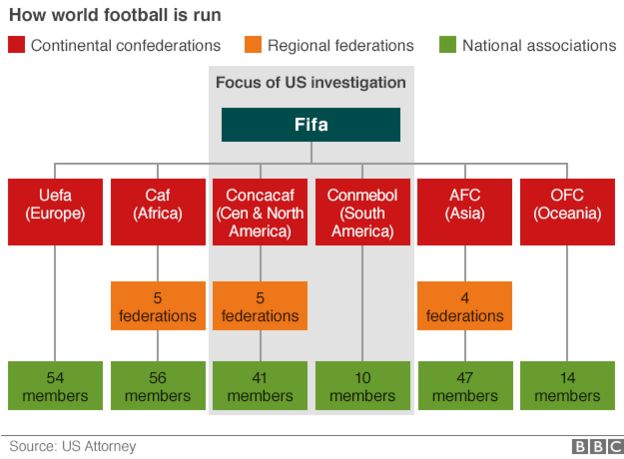
Graphic

BBC graphic

And the abuse is not limited to administrators.

We heard also today that David Lagercrantz, the ghostwriter of the Zlatan Ibrahimovic autobiography, I am Zlatan , admitted that the book was just all a big lie. All the quotations were just made up by the ghost-writer. The whole book was just fiction, a novel – not an autobiography.

Dreadful Swedish interview of President causes upset in India

May 27, 2015

I have posted earlier about the dreadful interview conducted by the Editor-in Chief of Dagens Nyheter, Peter Wolodarski, with President Pranab Mukherjee in advance of the latter’s State visit to Sweden at the end of this week. It was not quite incompetent but it was pretty bad in that the interviewer’s own preconceptions, misconceptions and “political correctness” were all on display. Of course Pranab Mukherjee was quite inept as well and kept referring to the Swiss instead of to the Swedish. But the President did manage to resist all the words that Wolodarski tried to put into his mouth regarding the Bofors affair. And Wolodarski’s condescension to a Head of State is both embarrassing and contemptible.

The interview seems to have caused some upset in India and there is now a threat in the air to cancel/postpone the first ever State visit of an Indian Head of State to Sweden. The main stream media in Sweden – in spite of their quite pathetic and slavish following of political correctness – are usually quite competent but their ethical standards are not of the highest. Wolodarski’s interview was particularly cringe-worthy.

The Indian Ambassador writes to Wolodarski and accuses him of being unprofessional, unethical, condescending, misleading, patronising and flippant. Maybe Wolodarski did not lie, but if the Ambassador is correct, he was certainly shading the truth when he told the Ambassador that his readers were not interested in Bofors which then became his lead-in to his sensationalised story.

But my real quarrel with Wolodarski is that he was thoroughly unprofessional.

Indian Embassy letter

Of course the fault also lies with the Ambassador or whoever else organised the interview. They should have known better than to trust or rely on any journalist – especially since Swedish journalists have no concept of anything being “off the record”.