Weak El Nino conditions but timely monsoon still expected

May 18, 2015

El Nino conditions can suppress the Indian southwest monsoon. Weak El Nino conditions exist for the second year running but the IMD’s forecast is for the monsoon to hit the mainland at Kerala on 30th May ± 4 days.

Whenever an El Nino is about, the doomsayers compete with catastrophe scenarios, but the possibility of a “bad” monsoon in 2015 is diminishing.The economic and industrial recovery should not be adversely affected to any great extent.

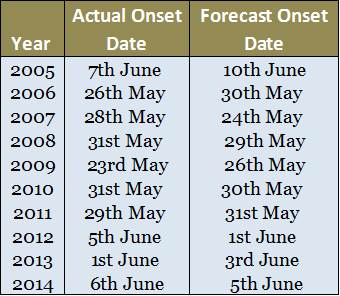
Forecasts for the last nine years (2005 to 2014) were as in the table below.

Monsoon onset dates.emf

A timely monsoon (onset during May) does not necessarily mean a “good” monsoon during the official 4 months (June to September) of the season, but does decrease the probability of a “bad” monsoon. The pre-monsoon rains during May have been somewhat higher than normal but not uniformly across the country. Rainfall at the wrong time is not that useful of course but early rainfall in May and late rainfall in October does still have value.

IMD ForecastFor the last about six months, positive SST anomalies have been prevailing over the western and the central Pacific Ocean. However, the SSTs over eastern Pacific after remaining near to below normal between late December 2014 and mid-March 2015 have now become above normal. Thus currently, weak El Nino conditions are prevailing over the Pacific.

The latest forecast from the IMD-IITM coupled model forecast indicates El Nino conditions are likely to persist during the southwest monsoon season.

At present, slight negative Indian Ocean Dipole (IOD) conditions are prevailing over Indian Ocean. The latest forecast from the coupled model indicates negative IOD conditions are likely to persist during the monsoon season. ……. the extreme sea surface temperature conditions over Pacific and Indian Oceans particularly ENSO conditions over Pacific (El Nino or La Nina) are known to have strong influence on the Indian summer monsoon.

 Quantitatively, the monsoon seasonal rainfall is likely to be 93% of the Long Period Average (LPA) with a model error of ± 5%. The LPA of the season rainfall over the country as a whole for the period 1951-2000 is 89 cm.

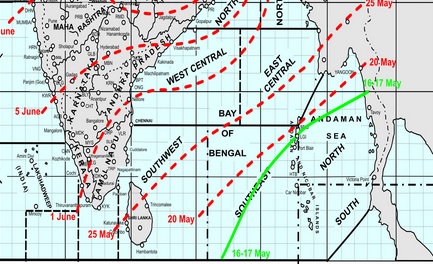
It is early days yet, but currently the advancing monsoon front is past the Andamans and slightly ahead of the long term average.

Monsoon front May 2015 IMD

Monsoon front May 2015 IMD

Post-election leadership battles provide the entertainment lacking in UK election campaign

May 16, 2015

The UK general election was just like the Eurovision song contest. No substance in the songs and great excitement during the vote. There was no substance either during the rather lacklustre campaign and then intense excitement during the vote count. The foregone conclusion of a hung parliament with a possible Labour/SNP “majority” first morphed into possibly another Conservative/Lib Dem majority and then – almost unthinkably – into an outright Conservative win. High drama on election night. I was switching between BBC (TV and radio) and Sky TV´and the BBC tried valiantly to be objective but could not quite hide their Labour bias. (For the education of the judges of the EU General Court, there was absolutely no confusion in my mind between Sky TV and Skype).

But now after the election, the contortions of the Labour party to elect a new leader and the non-election of a UKIP leader after Farage’s non-resignation are providing much of the entertainment that I had hoped for, but did not materialise, during the campaign. The Lib Dems are also choosing a leader after Nick Clegg but there is no excitement here and it is difficult to see that it is of any great relevance.

For the Labour party, battle lines are being drawn up between the New Blairites and the union supported left-wing. It is no longer politically correct to be considered a straight Blairite because Tony Blair has brought himself so much into disrepute with his money-grubbing ways. However, when he was leader, he held the centre ground with his New Labour which addressed all those with aspirations. The New Blairites see that it is necessary to attract more than just those who live on handouts. They have to appeal, they think, to the aspirational centre.  This makes for a rather clear distinction with the left wing who want to increase the number of people getting handouts and thereby increase the number of voters beholden to Labour. The New Blairites want to shift policy to address  the middle-ground, while the unionists want to increase the size of the “left”. If the unions succeed in getting one of their candidates elected as leader, we shall probably not see the Labour party governing in Britain for the next decade.

One of the main New Blairites, Chuka Umunna, threw his hat into the ring and then, 3 days later, withdrew from the fight saying that the pressure and stress of the increased scrutiny was too much. There are hints in some papers that actually there was a fear about the increased scrutiny revealing tax avoidance on the purchase of his house or that his “girl-friend” had been rolled out for PR purposes. Whatever the real reason, Umunna has effectively put paid to his chances of ever becoming the leader of the Labour party. If he could not withstand 3 days of pressure just as candidate for leader, it would be quite irresponsible of the party to ever actually make him leader. And if they made him leader he would never become a Prime Minister who was unable to withstand any pressure.

Within UKIP the entertainment has the character of pure farce. Nigel Farage said he would resign if he failed to win a seat. When he lost, he duly announced that he was going to resign. But he never actually did resign. (Which also emphasises my perception of noise without substance). So then when the UKIP executive committee met they had no decision to take since thay had no resignation to consider. This was then presented as being a unanimous call for Farage to remain leader. He then withdrew the resignation that he had never submitted. Clever Nigel! Tricky Nigel! Douglas Carswell who shifted from the Tories to join UKIP won his seat handily – but he was the only UKIP candidate to do so. His joining UKIP was entirely opportunistic and his decision to shift paid of – at least for himself. But his view of the UKIP is through his blue-tinted glasses and  what he sees – or would like to see – is not quite what UKIP actually is. As the only UKIP MP he “controls” the £650,000 the party is entitled to every year for the number of votes it won. This puts Farage in the frustrating position of not being able to sack Carswell from the party, but also gives Carswell the nuclear deterrent of threatening to leave. I suppose he could sit as an independent but I am not sure what would happen to the money if he did.

Labour and UKIP, at least, are now providing the light entertainment that was so lacking during the campaign.

3 UK relief helicopters not allowed into Nepal as retaliation for prosecution of Nepalese Army officer

May 16, 2015

The report today is that 3 RAF Chinook helicopters, which were sent by the UK as part of the earthquake relief effort, have now returned after spending a week grounded in Delhi and never having even entered Nepal. The undertone in all the British reports is that this was an inexplicable and callous act of an incompetent Nepalese government.

But of course, there is more to the story than that and the roots lie in the Nepalese Army and its efforts against the Maoist terrorists in late 1990s and early 2000s. During the height of the conflict the UK intelligence services assisted the government but some retired British Army officers are known to have advised and helped the Maoist terrorists. Then in 2013 a Nepalese Army officer, Colonel Kumar Lama, was charged by the UK in London for torture against Maoist prisoners under the UN’s conventions.

Why Colonel Lama was singled out by the UK for prosecution was partly due to the fact that he had settled in “St Leonard-on-Sea, East Sussex, with his family. He had been serving as a UN peacekeeper in South Sudan shortly before being detained”. But it was also because the British Army officers – all now retired – who had helped the Maoists and some so-called human rights groups were either instigating or assisting the prosecution. Some of the Maoist leaders are now within the normal political process.

The bottom line is that the Nepalese government declined to accept the 3 RAF Chinook helicopters because of the prosecution – perceived as being totally unjustified – of Colonel Lama and the history of British mercenaries in helping the Maoist rebels. The UK has also been accused of assisting the government of the time against the Maoists and to have been complicit in some of the torture – which no doubt took place. But making Colonel Lama the scapegoat by mounting a prosecution in London has irritated the Nepalese government intensely.

The two decades of conflict was marked by abuse by both sides:

S Singh et al, Nepal’s war on human rightsInt J Equity Health. 2005; 4: 9.

…, both the Maoist rebels and the Royal Nepalese Army are engaged in regular intimidation and extortion leading to a climate of intense fear in Nepal. The government forces have resorted to large-scale arbitrary arrests, detentions, “disappearances”, extra judicial executions and torture including rape. Human rights defenders, including lawyers; journalists and members of NGO’s have been arrested, tortured, killed or “disappeared” in Nepal. Nepal held the unique distinction for the highest number of “disappearances” of any country in 2003 and 2004. The Maoists have resorted to torture and deliberate and unlawful killings. According to INSEC (Informal Sector Service Centre), a human rights organisation, nearly 3000 people were killed and about 26,000 people were abducted in 2004 in Nepal. The Maoists have abducted civilians, including teachers and schoolchildren for the purpose of ‘political indoctrination’. 

Sources:

BBCThree RAF Chinook helicopters sent to Nepal to help the aid effort in the country are to return to the UK having not been used, the government has said. The CH47 Chinooks left the UK two weeks ago to help transport “life-saving aid supplies” and reach stranded victims “in desperate need” of help.

But the helicopters have been grounded in Delhi, in India, for the past week. The Ministry of Defence said it was “disappointed”, saying the decision had been made by the Nepalese government. An MoD spokesman said the Nepalese government, while thanking the UK for the offer, had said the helicopters will not take part in the relief effort.

The GuardianA Nepalese army officer has gone on trial at the Old Bailey accused of torturing two alleged Maoist rebels in his homeland 10 years ago. The prosecution of Lieutenant Colonel Kumar Lama, 47, was brought before a London court because of the UK’s obligations under the UN convention against torture to bring suspects to justice wherever they are detained. Torture, like war crimes, is subject to universal jurisdiction, allowing those who allegedly committed crimes abroad to be tried in Britain.

Lama was arrested in 2013 after settling in St Leonard-on-Sea, East Sussex, with his family. He had been had been serving as a UN peacekeeper in South Sudan shortly before being detained. Charged with presiding over the torture of two men – Janak Raut and Karam Hussain – while in charge of Gorusinghe barracks in Kapilvastu in 2005, Lama denies both counts of inflicting severe pain or suffering.

The prosecution has been brought under section 134 (sub-section 1) of the Criminal Justice Act 1988. The colonel has indefinite leave to remain in the UK. Opening the case, prosecutor Bobbie Cheema QC said: “The authorities in this country have an obligation in cases where torture is alleged to have been committed if the alleged perpetrators are found within England. “This commitment to prosecute alleged torturers even if the torture happened in an entirely different country and continent is sometimes called the principle of providing no safe haven for torturers.”

Southasia.comAnnapurna Dainik, a Nepali-language newspaper, has claimed the government took the ‘informal decision’ of not allowing the three Chinook helicopters to enter the Nepali airspace because of the arrest and prosecution of Nepalese Army’s Colonel Kumar Lama as well as for the relationship that existed between a senior British Army officer (now retired) and the Maoist guerrillas while they were still in war with the state. …

….. The Royal Air Force flew the helicopters in a transporter aircraft on April 30. It is understood they were originally planned to be flown straight to Kathmandu for reassembly but the aircraft carrying them was diverted to New Delhi when the Tribhuvan International Airport became clogged with relief flights due to the limited number of runways.

The GuardianBritish authorities have been accused of funding a four-year intelligence operation in Nepal that led to Maoist rebels being arrested, tortured and killed during the country’s civil war.

Thomas Bell, the author of a new book on the conflict, says MI6 funded safe houses and provided training in surveillance and counter-insurgency tactics to Nepal’s army and spy agency, the National Investigation Department (NID) under “Operation Mustang”, launched in 2002.

Nepal’s decade-long civil war left more than 16,000 dead, with rebels and security forces accused of serious human rights violations including killings, rapes, torture and disappearances.

“According to senior Nepalese intelligence and army officials involved in the operation, British aid greatly strengthened their performance and led to about 100 arrests,” said Bell, whose book Kathmandu is released in south Asia on Thursday. “It’s difficult to put an exact number on it, but certainly some of those who were arrested were tortured and disappeared,” he said.

Representing laughter

May 15, 2015

“ho ho”; a guffaw, an insincere or forced laugh

“ho ho ho”; Santa, a jolly laugh, boisterous amusement

“ho hum”; incredulity, not laughter

“ha ha”; a sarcastic laugh

“ha” = “Aha!”

“ha ha ha”; genuine amusement, open-mouthed laugh

“he he” or “tee hee”; giggling, surreptitious laughter, laugh with hand covering mouth

“he he he”; teenage laugh

“heh heh”; chuckle, laugh from the side of the mouth

“haw haw”; slapstick laughter, slapping of thighs

“hi hi”; sneer

“hi hi hi”, cackle

“hee haw”; a donkey braying

NASA “US has not seen landfall of any hurricane of Category 3 or higher for nine years”

May 15, 2015

What exactly is this man-made climate change which is caused by the use of fossil fuels?

It cannot be global warming which has been absent for almost 20 years while the use of fossil fuels has doubled.

“It is stormier weather”, I hear the warmists say.

Well not according to NASA at least for hurricanes. And when NASA can do no better than to reckon that the non-occurrence of hurricanes is a matter of “luck” I have little tolerance for the alarmists and their “religious belief” that every storm which occurs is caused by human influences.

NASA:

Statistical analyses from hurricane track data indicate that for any particular Atlantic Hurricane season, there is about a 40 percent chance that a major hurricane (category 3 or higher) will make landfall in the continental United States. However, during the period from 2006 to 2014, no major hurricanes have made landfall.
NASA’s Goddard Space Flight Center

The United States hasn’t experienced the landfall of a Category 3 or larger hurricane in nine years – a string of years that’s likely to come along only once every 177 years, according to a new NASA study.

The current nine-year “drought” is the longest period of time that has passed without a major hurricane making landfall in the U.S. since reliable records began in 1850, said Timothy Hall, a research scientist who studies hurricanes at NASA’s Goddard Institute for Space Studies, New York.

The National Hurricane Center calls any Category 3 or more intense hurricane a “major” storm. The last major storm to make landfall in the U.S. was Hurricane Wilma on Oct. 16, 2005 – the fourth major storm landfall of that year, which was the most active Atlantic hurricane season on record. Of course, storms smaller than a Category 3 have made landfall with destructive results, such as Hurricane Sandy in 2012.

Hall and colleague Kelly Hereid, who works for ACE Tempest Re, a reinsurance firm based in Connecticut, ran a statistical hurricane model based on a record of Atlantic tropical cyclones from 1950 to 2012 and sea surface temperature data. While hurricane records stretch back to 1850, the data becomes less complete prior to 1950, Hall said. The study was published recently in Geophysical Research Letters.

The researchers ran 1,000 computer simulations of the period from 1950-2012 – in effect simulating 63,000 separate Atlantic hurricane seasons. They found that a nine-year period without a major landfall is likely to occur once every 177 years on average.

While the study did not delve into the meteorological causes behind this lack of major hurricane landfalls, Hall said it appears it is a result of luck.

“The last nine hurricane seasons were not weak – storms just didn’t hit the U.S.,” Hall said. “It seems to be an accident of geography, random good luck.” ….. “Each year is roughly independent of the year before,” Hall said. “There are known signals, and natural cycles, and possibly human-induced influences. But for the most part, they are independent, especially for the rare intense landfalls.”

The Antarctic has more ice cover than has ever been measured before. Global sea ice extent is at its highest levels seen in a decade. Snow cover in the Northern hemisphere are at among the highest levels recorded. So if the 9-year non-occurrence of US hurricanes is only to be expected every 177 years, what exactly is this man-made climate change which is caused by fossil fuels?

The Lorentz effect does not apply to climate, and fossil fuels are not the “flap of a butterfly’s wings” causing climate change.

The butterfly effect

coined by Edward Lorenz, is derived from the metaphorical example of the details of a hurricane (exact time of formation, exact path taken) being influenced by minor perturbations such as the flapping of the wings of a distant butterfly several weeks earlier. Lorenz discovered the effect when he observed that runs of his weather model with initial condition data that was rounded in a seemingly inconsequential manner would fail to reproduce the results of runs with the unrounded initial condition data. A very small change in initial conditions had created a significantly different outcome”.


Explaining inflation as resistance to motion

May 14, 2015

“Dad, What’s inflation? Why are Sweden and the UK trying to increase inflation and why are India and China trying to reduce it? Is inflation good or bad?”

Well, it all starts with the economic cycle and the resistances in …….

“What’s an economic cycle?”

OK. Let’s start at the beginning.

Let’s start at the very beginning
a very good place to start
when you read you begin with abc
An economy begins with “N”, “P”, “C”
“N”, “P”, “C”
the three legs needed just happen to be
“N”, “P”, “C”; “N”, “P”, “C”

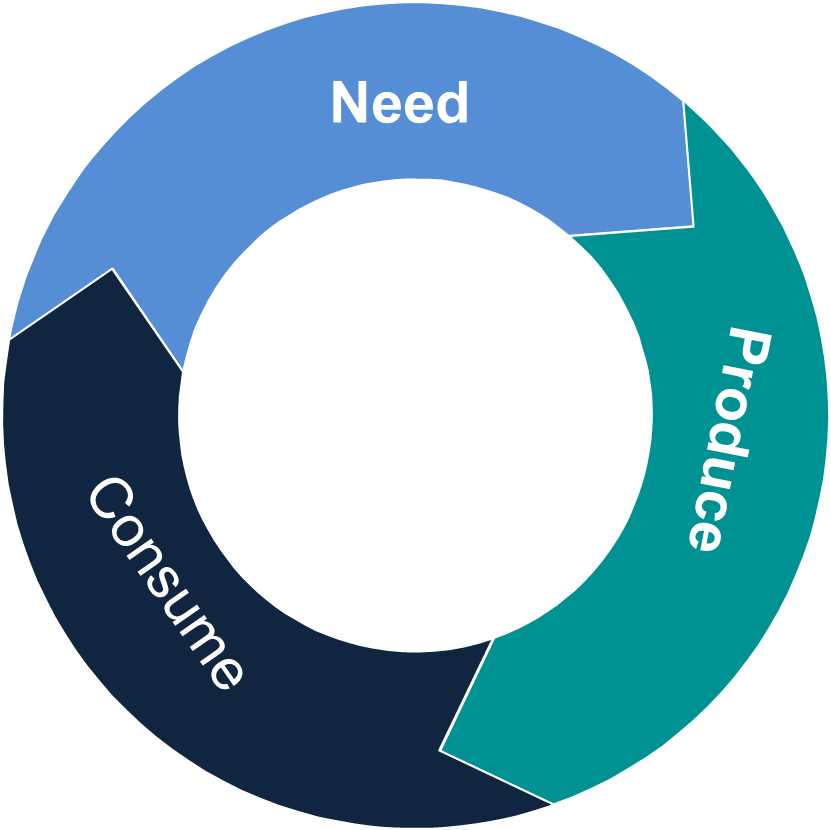
When you get hungry you have a Need, a need for food. That’s where all economies start – with a need, the “N”. So you shout “Mom, What’s for dinner? I’m starving”. It’s fortunate that Mom is there and responds to your shout and starts Producing some dinner. Thats the “P”. And after some time you get your dinner and you Consume it. That makes you a consumer. And then when you’re ready to go out to your party you shout “Dad, can you drop me off at Jimmy’s (and pick me up later)?” you are just another Consumer expressing another Need – a need this time for transport. And when I take you there and bring you back, I am the Producer. And when you come home you’re hungry again. This is the basic cycle – Needs lead to Production which in turn leads to Consumption which leads to new Needs.

A production-consumption loop provides a business process.
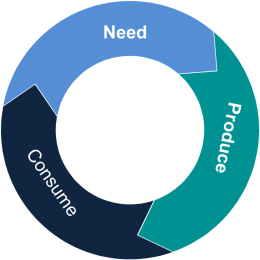
economic cycle

The fundamental economic cycle


Every human is a consumer. All producers are consumers. But not all consumers are producers. The economic cycle is the cycle of living. And the more complex the society, the more complex and interconnected are all the various business processes that go to making up the economic cycle. Much of the production may be indirect or the production is of abstract things. Teachers produce “education”. Policemen produce “safety”. Actors and sports stars produce “entertainment”. It can be difficult to discern what politicians and priests produce but they too satisfy human needs. Even you produce something – mainly tension and stress which we consume for the goodness of our souls.

But time is the necessary additional dimension. All these various processes take time. It takes time for a new need to entice a producer and it takes time for the production and then it takes time to get to the point of consumption. The economic cycle is not just a circle. It is a continuous circle wrapped around the time axis. With time involved, the economic cycle reflects “motion” – a movement in time. And wherever there is motion there is resistance to motion. Each part of the cycle and of its subcycles is subject to inertia and friction. Inertia is the resistance not only to the start of motion but also to a change in an existing motion. It comes into play whenever a new need or a changed need requires some new production process or a change to a production process. And once the motion is in progress – and this applies to every business process and to every interaction between processes – there is a frictional resistance to the motion. Inertial resistance is generally higher than rolling friction.

And so we come to inflation. You can think of inflation as a measure of the resistances (inertial and frictional) to motion within an economic cycle. For any business process it can never be zero except if motion stops. When an economic cycle is said to have a negative inflation or a deflation, it only means that some of the component business processes are coming to a halt. For a well functioning economy, the resistances will be as low as possible and that represents the “healthy” level of inflation for that economy.  When inflation is said to be very high it means that business processes are operating sub-optimally – maybe in a stop-go manner, or that they are not meshing together very well or that there is turbulence in the work place.

So when the UK and Sweden try to bring their inflation rate up to about 2%, it is because 2% is judged to be representative of the resistance if all parts of the economy are functioning as smoothly as possible and growing modestly. When India tries to bring its inflation down from double digits to about 4% as a target, it means that many component parts of their economic cycle are functioning – or not – with too high a level of resistance. Processes are starting and stopping or are very inefficient – within themselves or that their inter-connections are broken or damaged.

In a rapidly growing economy where there are inertial resistances to overcome, the “healthy” level will have to be greater than the assumed 2% norm.

So, inflation is neither bad or good – it is a consequence of the business processes making up the economic cycle. It is measure of resistance to the motion of business processes. Even when operating smoothly these processes are subject to frictional resistance. Any growth of the cycle itself requires that production processes start or change and that brings in inertial resistance in addition to the frictional resistance. So inflation can never be zero but for every economic cycle, it needs to be as low as possible for a given complexity, a given size and a given growth. A too low inflation means that some of the component business processes are shrinking or coming to a halt. A too high level of inflation in an economy indicates that resistances are much too high and that the component business processes are not functioning as they should.

In developed countries of Europe the target inflation is at about 2% whereas in faster growing economies (China or India) the target is to be at around 4%.

It’s just a simple matter of “N”, “P”, “C”.

Got it?

“Duh!

With the resistances in this house, my pocket money needs to go up by 20% – at least!”
EC looking for GE concessions to approve Alstom acquisition

May 12, 2015

UPDATE!

The New York Times also reports on the potential anti-trust issues and GE’s readiness to make some accommodations for EC concerns. However my take away from the NYT article is that GE is warning the EC that Alstom and the European Union have more to lose than GE has if the deal does not go through:

In now dealing with the European Commission’s antitrust office, Mr. Immelt has not forgotten the harsh experience of his predecessor, Jack Welch. In 2001, Mr. Welch failed to win approval for a proposed $42 billion takeover of Honeywell International after objections were raised by Mario Monti, the European antitrust commissioner at the time.

Mr. Immelt was worried enough last week that he met with Ms. Vestager in Brussels, where he also gave an address at the American Chamber of Commerce highlighting Europe’s economic potential. In that address, Mr. Immelt said young Europeans were “awesome” and “amazing,” but he emphasized that Europe needed investment to gain competitiveness and beat unemployment.

Speaking to reporters later, Mr. Immelt said his meeting with Ms. Vestager was “very constructive” and he described her as “a good leader.” G.E., he said, was engaged in “a process” with Brussels, and would “take the process where it goes.”

If G.E. is unable to convince Ms. Vestager of the merits of its case, the next step could be a so-called statement of objections, as soon as next month — formal charges that would outline the commission’s specific antitrust concerns. G.E. and Alstom could avoid that step by offering remedies sooner, perhaps proposing to sell parts of the gas turbine business in Europe.


My expectation was that the European Commision would look for some concessions from GE and would only grant a conditional approval for the acquisition of Alstom’s power and grid businesses.

The EC concerns seemed to be focused on Heavy Duty Gas Turbines (HDGT), and I wrote:

Will the EC approve GE’s acquisition of Alstom’s power business?

…. In any event,  I expect that the deal will go through, but I will not be surprised to see an approval conditional on some assurances from GE regarding R & D centres, R & D jobs and/or R & D budgets in Europe. I think it highly unlikely – and a little meaningless – if the EC were to ask for divestment of Alstom’s HDGT business to a third party (if any such exists). The bottom line is, I think, that Alstom’s HDGT technology has come to a dead-end and can not be developed any further in their own hands. While the business can continue in a diminishing way for some years, Alstom technology has no long-term value except to another party which has access to high temperature cooling technology. To have Alstom continue with the HDGT business as an unwilling and reluctant player does no one any service at all.

This Reuters report today suggests that my expectation may be close to the mark. However it also seems that if the EC demands too much in the way of concessions, GE might walk away. Clearly GE are already getting a little irritated at the protracted nature of the EC approval process. The failure of the deal is not something that Alstom or the EU would look forward to.

The EC decision may also be delayed somewhat beyond August 6th.

Reuters:

General Electric Co said on Monday for the first time it would be willing to consider concessions in order to win European approval to acquire the power equipment unit of France’s Alstom. “We are willing to explore remedies to get this deal done even though again we believe in the merits of the deal,” Steve Bolze, president and CEO of GE Power & Water, the conglomerate’s biggest industrial unit, told Reuters in an interview. Any concessions would have to “preserve the deal economics and our strategic value,” he said. …

… EU regulators typically prefer merging companies to sell overlapping assets or make it easy for rivals to enter the market. GE’s gas turbine competitors include Siemens AG and Mitsubishi Heavy Industries Ltd.

…GE already altered the deal to win the French government’s backing during last year’s two-month battle, in which it fended off Siemens and Mitsubishi. In the interview, Bolze acknowledged the “protracted process” for Alstom, and said GE was focused on “how to move … forward as it makes sense.”

In GE’s first-quarter conference call last month, Chief Executive Jeff Immelt backed the deal’s fit for GE, but said if it “ever would become unattractive, we wouldn’t do it.”

…. GE, which is undergoing an overhaul involving the exit of most of its finance assets, has said it expected synergies from the Alstom deal to add between 6 to 9 cents in earnings per share in 2016. But some analysts have told Reuters they doubt GE’s stock would take a big hit should the deal collapse, with the idea that GE could make up those earnings with stock buybacks or other deals. ……. 

…… EC spokesman Ricardo Cardoso said regulators are waiting for data from the companies before a setting a new deadline to act. The previous deadline was Aug. 6.

The EC will need to be very precise in demanding concessions from GE while ensuring that the deal does go through. Divesting parts of the HDGT business to unknown (and probably non-existent) buyers is probably a lose-lose solution. I expect that GE’s walk-away point will be reached if earnings from the service of Alstom’s fleet of gas turbines is removed from the mix. In fact any conditions set by the EC which dilute future revenues could prove fatal for the deal going through. Assurances about keeping R & D located in Europe and assurances about jobs and even about R & D budgets could be absorbed by a robust business plan. But no business plan can survive if something as fundamental as the revenue stream is adversely affected. And it is the volume of that revenue stream – and not just the margin from those revenues – which is crucial.

Reality check: Increasing sea ice making it difficult to reach Antarctic stations

May 12, 2015

This is reality – not a forecast from a a mathematical model.

news.com:

THE size and power of ships needed to break through Antarctica’s increasing sea ice levels is a worry for the global research community.

IN recent years countries including Australia have battled to reach their stations on the frozen continent, making resupply missions time consuming and expensive, Australian Antarctic Division spokesman Rod Wooding said.

“We’re noticing that the sea ice situation is becoming more difficult,” he told reporters on Monday.The sea ice through the Southern Ocean and around Australia’s Mawson Station usually breaks up for a couple of months a year allowing ships to enter the bay but that did not happen in 2013-14.“We had to get fuel in by helicopter which is inadequate for the long-term sustainability of the station,” Dr Wooding said.“Other national programs have had similar problems: the French in particular, Japanese also.”

The problem has been the main driver for a meeting of more than 50 international experts, convening in Hobart until Wednesday, to try and nut out a plan to accurately forecast sea ice levels.Meteorologists along with ice and Antarctic experts will take part in a series of workshops, looking at trends in satellite imagery and the environment.“One of the things that Antarctic programs will need to understand going forward is what sort of ice breaking capability we’re going to need to get through the ice in these areas,” Dr Wooding said.“Australia is currently in a tender process for a new ice breaker … and it’s important in understanding what sort of ice breaker we might need … to have a good understanding of likely sea ice conditions.”The

re is no single reason why sea ice levels are increasing but Hobart-based expert Tony Worby said it tends to gather around icebergs and wind patterns also play a part.“We know sea ice extent is increasing, there was a record maximum in September 2014,” Prof Worby said. “It’s quite hard to forecast but whatever effort we put in to improving our ability to forecast sea ice will ultimately pay dividends in terms of savings for national programs.”

Sunshinehours also points out that current Antarctic sea ice extent is the highest measured for this time of year. (In fact the global sea ice extent is the 3rd highest ever measured for this day of the year).

Antarctic_Sea_Ice_Extent_Zoomed_2015_Day_130_1981-2010

from sunshinehours


Swedish Green party leader exhibits her immaturity to be in government

May 11, 2015

Green party “co-spokesperson” (a euphemism for “leader”) Åsa Romson has once again demonstrated that the greens have great difficulty in making the transition from being demonstrators on the streets to actually being in government. Åsa Romson is even the Deputy Prime Minister. She has been silly enough to first compare the Mediterranean to Auschwitz and then to refer to the Roma as “zigenare” which means gypsy and as a term has officially been declared to be “offensive”.

Of course she wasn’t around during the Holocaust, but who does she see as the Nazis of today? The Mediterranean may well be a graveyard for many but the reference displays an amazing ignorance.

TheLocalGreen party co-spokesperson Åsa Romson has apologized after calling Roma people “zigenare” (gypsies) as well as comparing the migrant crisis in the Mediterranean to the Holocaust. ……. 

The leader later told SVT that she was sorry, adding that she had used an expression that “did not fit”, while trying to make a strong argument about the migrant crisis in the EU.

Her press spokesperson Hellström Gefvert later told the broadcaster that Romson had been “tired” after the debate and knew that her choice of words was “indefensible”.

On Monday, Romson issued another apology on Twitter, posting: “Again: It was wrong to make an Auschwitz analogy. I sincerely apologize”.

But this is not the first time that the greens have demonstrated their lack of judgement. They show little evidence of exercise of mind. The Swedish Greens border on being anti-semitic. They are definitely pro-Palestine, even have mild islamists in positions of power and are generally anti-Israel. It is sometimes difficult to tread the balance between being anti-Israel and being anti-semitic and, unfortunately, the Swedish Greens just don’t have the judgement and quality of thought necessary to walk the line. Mehmet Kaplan and Gustav Fridolin are Green party members and Ministers in the current Red/Green government. Kaplan was also unthinking enough to equate Swedes joining IS with Finns fighting against Russians during WW2. Also a remarkable display of ignorance of history and an apologist remark – in any interpretation – for the IS.

TimesofIsrael: Housing Minister Mehmet Kaplan, of Sweden’s Green Party, was arrested in 2010 by Israeli forces after participating in the Mavi Marmara flotilla, which was headed to the Gaza Strip. The Turkish-born MP was later deported from Israel over his involvement. 

During this summer’s Operation Protective Edge in Gaza, Kaplan called for the “liberation of Jerusalem” at a pro-Palestinian rally.

He also downplayed the evils of the Islamic State in a July address, saying that Swedes joining their ranks in Iraq and Syria were similar to those who went to Finland during World War II to combat the Soviet Union. His comparison was lambasted by many Swedes, who consider the soldiers who volunteered to fight the Soviets on behalf of Finland freedom fighters.

In addition, Sweden’s Education Minister Gustav Fridolin was detained by Israeli forces in 2004 for protesting the security barrier near Ramallah. Fridolin left the country shortly after he was released.

The thoughtlessness is evident even in environmental issues which ought to be their strength – but is not. In fact even on many environmental matters they tend to be remarkably uninformed and blindly follow an eco-fascist line. They know best what everybody else should do – for their own good.

Greens in government just don’t work and in Sweden they are an embarrassment to rational thought.

A “British Solution” for a federal Britain

May 11, 2015

The “British Solution” has traditionally been to draw new lines on maps. In India, in Africa, in Arabia and the Middle East and even in the Eastern US and Canada, the British expertise at and love of cartography has provided the “solutions” of the day. Notwithstanding any tribal affiliations and nomadic behaviour, ethnic and religious and political divisions have been enshrined – and confined – in situ by drawing lines on maps to keep the warring parties separated.

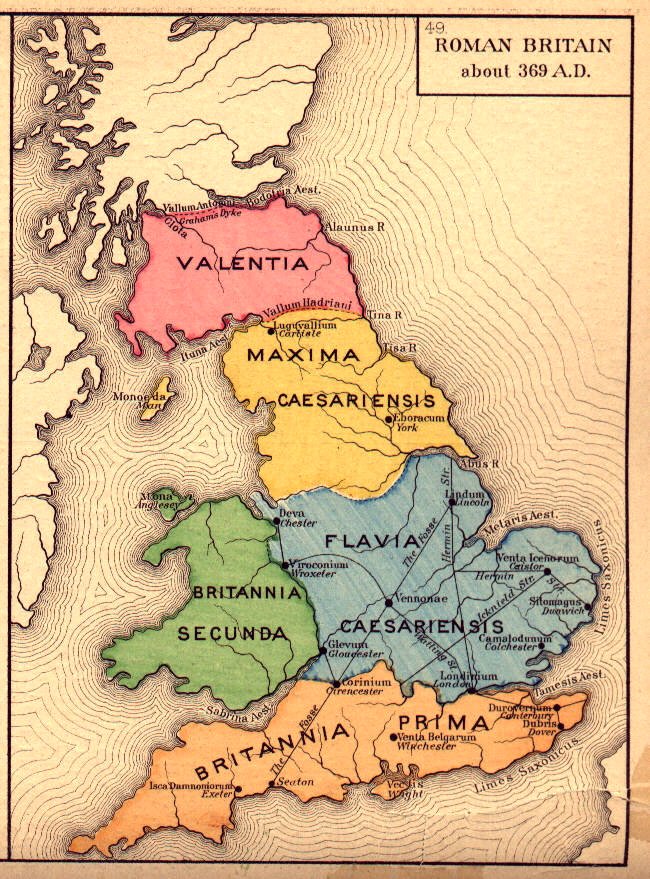
After this election, a federal Britain is now in the realm of the possible – if not yet probable. And the British Solution should be applicable without really inventing anything new. 1,800 years ago the Romans already drew the lines that could be applied.

roman britain (thedockyards.com)

roman britain (thedockyards.com)

Of course this requires that Scotland be split into a northern and a southern part and they would, obviously, be called Upper Scotland and Lower Scotland. England would have to split into three parts (with a somewhat expanded Wales). Upper England, Middle England and Lower England would be quite fitting.. Wales would of course be called Cymru. Northern Ireland (Ulster) could pretty much stay as it is (geographically). Manx, the Channel Islands, the Falklands and the Hebrides could be independent Crown territories and could serve as tax and gambling havens (since any self-respecting federal, monarchic, republic must have these).

The great job-creation opportunity is that 9 parliaments (8 national and one federal parliament) could be set up, each with its supporting paraphernalia and bureaucracy.  And it could be 10 parliaments if the House of Lords is kept as a tourist attraction.

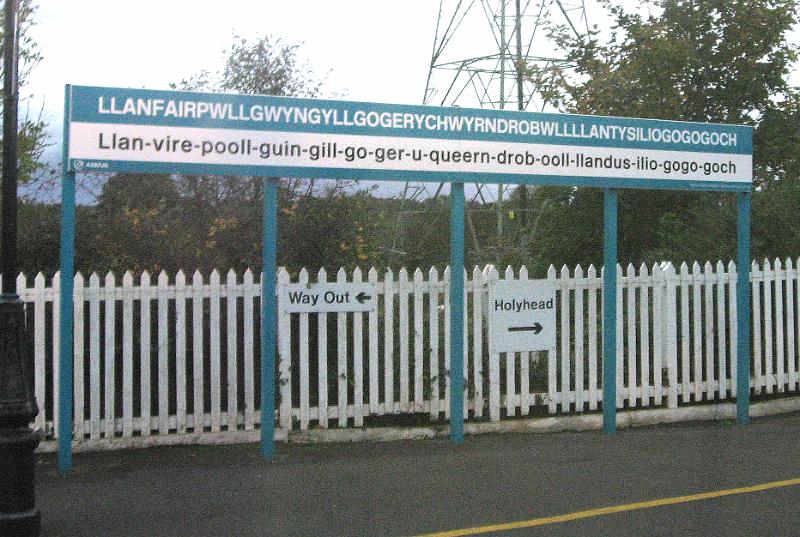
And Welsh place names would continue to be used.

lllanfair pg station

llanfair pg station