Germany needs to dump the profligate Energiewende

October 22, 2014

The German economy is export driven.

As long as Greece and Spain and the weaker Euro zone countries were holding back the value of the Euro, German exports and its economy boomed. Unemployment reached extremely low levels. There was a shortage of qualified labour. But now the German economy is stagnating and the high cost for energy, resulting from the misguided, self-mutilating Energiewende, is one of the chief contributors. The total cost to German consumers and German industry is comparable to the bailouts of the weak Eurozone countries. For no benefit.

Der Spiegel (2013): German consumers already pay the highest electricity prices in Europe. But because the government is failing to get the costs of its new energy policy under control, rising prices are already on the horizon. Electricity is becoming a luxury good in Germany, and one of the country’s most important future-oriented projects is acutely at risk. …..

….. For society as a whole, the costs have reached levels comparable only to the euro-zone bailouts. This year, German consumers will be forced to pay €20 billion ($26 billion) for electricity from solar, wind and biogas plants — electricity with a market price of just over €3 billion. Even the figure of €20 billion is disputable if you include all the unintended costs and collateral damage associated with the project. Solar panels and wind turbines at times generate huge amounts of electricity, and sometimes none at all. Depending on the weather and the time of day, the country can face absurd states of energy surplus or deficit.

How the Energiewende has increased German electricity price graphic notrickszone

These are unsustainable costs. Industries dependent on high electricity consumption have found it increasingly difficult to compete against the lower electricity costs especially in the US. Investment and jobs have started shifting to areas with lower operating costs.

WSJ (sep 2014):

The project is the linchpin of Germany’s Energiewende, or energy revolution, a mammoth, trillion-euro plan to wean the country off nuclear and fossil fuels by midcentury and the top domestic priority of Chancellor Angela Merkel.

But many companies, economists and even Germany’s neighbors worry that the enormous cost to replace a currently working system will undermine the country’s industrial base and weigh on the entire European economy. Germany’s second-quarter GDP decline of 0.6%, reported earlier this month, put a damper on overall euro-zone growth, leaving it flat for the quarter.

Average electricity prices for companies have jumped 60% over the past five years because of costs passed along as part of government subsidies of renewable energy producers. Prices are now more than double those in the U.S.

Now the business climate is sharply down, orders are falling and costs are still increasing.

Graphic: German Economy Weakens.

Der Spiegel (Oct 2014)The problem, though, is that Europe’s motor is losing steam, with a slew of bad news about the German economy in recent weeks. The latest business climate index published by the respected Munich economic think tank Ifo, which is considered to be a reliable early indicator, fell for the fifth straight month in September to its lowest level in almost a year and a half. Furthermore, German factory orders are down and exports are collapsing. And last week, the country’s leading economic research institutes issued downward revisions of their economic forecasts for this year and next.

Merkel’s new government have been on a give-away spree and that has not helped. Now finding funds to spur investment is becoming increasingly difficult. Meanwhile the ludicrous subsidies for renewable energy continue to drain the economy. The Energiewende is profligate, has no measurable benefits and has only led to more coal being burnt.

At the very beginning of its term, Merkel’s current government approved an expensive package of what amounted to pension gifts for women and older workers that is now consuming up to €9 billion a year in public finances. In their autumn economic forecast released last week, the country’s leading economic think tanks warned that the German government has “already given away a substantial amount of its room for maneuver.”

Compounding the problem is that measures taken by the government — a coalition of Merkel’s CDU and the center-left Social Democrats (SPD) — are contributing to weak growth. The think tanks predict that projects undertaken by the coalition, including allowing people to retire at the age of 63 and the introduction of Germany’s first-ever national minimum wage, will cause around 300,000 jobs a year to disappear. The CDU and SPD haven’t done much to fuel investments to counter that trend either. Interest rates in Germany may be lower than they’ve ever been before, but few companies have plans to build new factories or buy additional heavy machinery, they warn. The report states that while the many international crises do play a role — from the Middle East to Ukraine — homegrown factors do as well, especially the hostile environment created by (the government’s) economic policies.”

In Poland a different kind of energy revolution is taking place. Two new nuclear plants are being planned. Shale gas development is inevitable but is being hampered by the environmentalists. So more coal is being burned as in Germany.

The world has more to gain from a Germany with a strong economy exporting its excellent products. The pointless and profligate Energiewende needs to be dumped. Germans and Germany and the world are paying the price of pointless political correctness.
Lockheed-Martin and compact fusion – a long way away but more credible than the E-Cat cold-fusion hype

October 21, 2014

Andrea Rossi and his E-Cat cold fusion claims still smell like a fraud. It has been hyped for over 4 years now with little to show. I am somewhat surprised that there are still a few gullible academics and journalists around who keep the circus going.

The Lockheed-Martin development of a compact fusion reactor has a long way to go but I find it much more credible. I could consider betting some money on the compact fusion reactor but would not touch the E-Cat with a very, very, long barge pole.

Th availability of a fusion reactor of any kind would revolutionise the availability of electrical energy but always subject to cost. Mere availability would not be enough to cause a paradigm shift. The availability of gas (natural gas, shale gas and gas from methane hydrates) now extends to about 1,000 years. The use of gas turbine combined-cycle power plants, which have a 2 year construction period, will provide the cost benchmark for electricity production. Where fusion might place in the power generation mix will depend on its operating cost but the level to which it may penetrate will depend on the capital cost and the construction time.

A compact reactor as envisaged by Lockheed- Martin however would be a game changer not only for electricity generation but also for desalination, electrical vehicles and even space travel. The beauty of “compact” if achieved is that it “automatically” leads to low-cost and modular construction.

The probablity of success in the time-frame envisagesd is still low. It is a high risk development and it will not be cheap. But the potential reward is immense.

Some of the characteristics of their high-beta, compact reactor are:

  • The device is cylindrical and 2×2×4 meters in size.
  • The magnetic field increases the farther out that the plasma goes, which pushes the plasma back in.
  • It also has very few open field lines (very few paths for the plasma to leak out; uses a cylinder, not a Tokamak ring).
  • Very good arch curvature of the field lines.
  • The system has a beta of about 1.
  • This system uses deuterium and tritium.
  • The system heats the plasma using radio waves.

L-M Press Release: 

PALMDALE, Calif., Oct. 15, 2014 – The Lockheed Martin [NYSE: LMT] Skunk Works® team is working on a new compact fusion reactor (CFR) that can be developed and deployed in as little as ten years. Currently, there are several patents pending that cover their approach.

While fusion itself is not new, the Skunk Works has built on more than 60 years of fusion research and investment to develop an approach that offers a significant reduction in size compared to mainstream efforts.

“Our compact fusion concept combines several alternative magnetic confinement approaches, taking the best parts of each, and offers a 90 percent size reduction over previous concepts,” said Tom McGuire, compact fusion lead for the Skunk Works’ Revolutionary Technology Programs. “The smaller size will allow us to design, build and test the CFR in less than a year.”

After completing several of these design-build-test cycles, the team anticipates being able to produce a prototype in five years. As they gain confidence and progress technically with each experiment, they will also be searching for partners to help further the technology.


US shale oil boom visible from space

October 21, 2014

The drop in oil prices continues though somewhat slowed down by Chinese import demand:

WSJU.S. and global crude benchmarks ended lower Monday amid choppy trading and concerns that member nations of the Organization of the Petroleum Exporting Countries will maintain high production levels in a bid to compete for market share despite growing global crude supplies.

The current drop in oil prices is put down to a glut on the market caused by the boom in shale oil production in the US and the slow-down in the global economy.

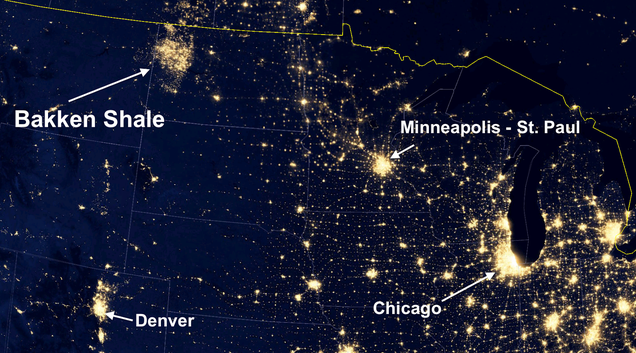
The boom in shale oil production is even visible from space.

Satellite Images Reveal How the U.S. Oil Boom Is Creating New Cities

bakken shale field shows up from space Image NASA/io9

io9This image from NASA reveals a massive cluster of lights in what was — until recently — desolate prairie. This is the Bakken Shale, an oil-rich rock formation stretching across parts of North Dakota, Montana and Canada. The lights are from the illuminated derricks, local boomtowns and gas flares of the oil fields.

Misguided alarmists who have demonised fossil fuels don’t like this. But I find the picture and the visibility of the shale production greatly encouraging. Carbon dioxide has no significant deleterious impact on climate and the availability of fossil energy is what will ensure continued human development.

The Bakken Shale field is a vast resource across Montana, North Dakota, Sasketchewan and Manitoba and a significant contributor to the game changing advent of shale oil and shale gas.

The Bakken Shale ranks as one of the largest oil developments in the U.S. in the past 40 years. The play has single-handedly driven North Dakota’s oil production to levels four times higher than previous peaks in the 1980s. As of 2012, ND is second to Texas in terms of oil production and boasts the lowest unemployment rate in the country at ~3%.

The Bakken Shale Play is located in Eastern Montana and Western North Dakota, as well as parts of Saskatchewan and Manitoba in the Williston Basin. Oil was initially discovered in the Bakken play in 1951, but was not commercial on a large scale until the past ten years.

… The Bakken is estimated to hold as much as 400 billion barrels of oil equivalent in place.

US shale fields map EIA


Fate? destiny? Drunken snowplow driver causes death of Total CEO

October 21, 2014

Following on from my previous post about the season of birth having some effect on temperament, this news item got me to wonder about how much of our lives is – or can be – “fixed” by our genes, our place of birth or our time of birth. How much “free will” and freedom of behaviour and freedom of action do we actually have?

Vnukovo plane crash: Snowplow driver drunk in collision with Total CEO’s aircraft

It was determined in the course of the investigation into the Moscow plane crash that killed the CEO of French oil giant Total that the driver of the snowplow which likely caused the crash was drunk.

“It has been determined that the driver of the snowplow was under the influence of alcohol,” head of Russia’s Investigative Committee Vladimir Markin told the reporters on Tuesday.

Markin added that “there is a possibility that a number of airport staff will be suspended from carrying out their duties pending criminal investigation.”

During the taxiing before take-off, at around 0:10 am Moscow time on Tuesday, the Falcon 50 business jet hit a snow-clearing machine. Although previous reports indicated otherwise, the plane did not leave ground following the collision. The CEO of France’s oil and gas giant Total, Christophe de Margerie, was the only passenger in the jet, while three crew members who were also French citizens perished as well.

Psychologists seem to find that more and more of our behaviour is due to our genes. This seems to be used increasingly often as a mitigating factor – if not as an excuse – in court cases where socially unacceptable behaviour and actions are judged. Our sexual preferences and our positions on the bi-modal gender scale are also increasingly put down to genes rather than upbringing – nature rather than nurture. Intelligence is thought to be at least 50% due to genetic factors. Our adult heights are said to be 80% genetic and 20% due to nurture. Mental and physical abilities and disabilities are increasingly said to be due to our genes. Our moods and our temperaments are said to affected by when we were born.

I have little doubt that – at some macro level – it is our genes that define the envelope of our possible behaviours. It is clearly predetermined by our genes that we cannot – however much we wanted to – behave like a whale or a bird. Our genes constrain us to behave within the narrow envelope of behaviour open to humans. To that extent we are surely “fated” or “destined” to behave within the envelope of possibilities open to us as determined by our individual genetic make-up at birth as humans. Even aspects of nurture can said to be pre-determined. The parents we are born to – pre-determined – in turn determine the education we get, our nutrition and the religions we follow. To that extent our decisions through life which we believe are a consequence of our individual characteristics and who we are and our exercise of our “free will” are already constrained and channeled by parameters fixed at birth.

If two individuals having predetermined behaviour interact, then the envelope of possible results of that interaction are also “fated” or “destined”. It may be an intractable problem with our current state of knowledge to predict the results of such interactions, but that does not mean that the “result” is any less pre-determined. The butterfly problem is also intractable but that does not mean that it may not exist. Extending that thought leads to the conclusion that all the possible results of all our interactions – between humans and with other species and with our surrounding environment – are already largely constrained and predetermined.

I would like to think I have free will and everything is not determined in advance — but it also seems self-evident that everything that happens is caused by what happened immediately before. If not we would have to be able to explain how some event does not have to be dependent upon the preceding events. And that would require that we redefine the nature of time. What comes afterwards cannot escape what came before.

So was the death of Christophe de Margerie a random, unfortunate and “unlucky” accident, or was it fate? A “fate” already determined with his birth and the birth of the drunken snowplow driver?

Study shows that season of birth affects personality – sounds like astrology

October 20, 2014

A new study to be presented at the European College of Neuropsychopharmacology (ECNP) suggests that there may be something in astrology after all. The study is being presented at the ECNP Congress in Berlin. The researchers from Hungary find statistically significant links between season of birth and mood disorders.

astrology

I have always thought of astrology being ridiculously fanciful and horoscopes just so much hokum. But a tiny little part of my brain is always a touch uncertain. Clearly the seasons are controlled by the Earth’s relative position and its motion around the Sun. If the season of birth can affect personality then the effects of the Sun and other celestial bodies become real. That the moon may have effects on the results of cardiac surgery is apparently not just rubbish. The lunar nodal cycle does seem to correlate with happenings on Earth. The mechanisms leading to most lunar effects on tides and sedimentation and geologic accumulations and tidal flows and sea surface temperatures and climate can be put down to some interplay of gravitational forces. It is not such a long stretch to think that the gravitational effects of the larger planets may have some quite unlooked for effects on life on Earth.

Back in the days of psychedelia and Hair, we used to think that strange things would take place as the age of Aquarius dawned,  “When the moon is in the seventh house, And Jupiter aligns with Mars”.

Neuropsychopharmacology however is something quite new for me and sounds almost as arcane as astrology.

 Neuropsychopharmacology, is an interdisciplinary science related to psychopharmacology (how drugs affect the mind) and fundamental neuroscience, and is the study of the neural mechanisms that drugs act upon to influence behavior.

Professor Xenia Gonda is a clinical psychologist and pharmacist currently working as assistant professor at the Department of Clinical and Theoretical Mental Health at Semmelweis University, Budapest.

AlphaGalileo: According to lead researcher, Assistant Professor Xenia Gonda 

“Biochemical studies have shown that the season in which you are born has an influence on certain monoamine neurotransmitters, such as dopamine and serotonin, which is detectable even in adult life. This led us to believe that birth season may have a longer-lasting effect. Our work looked at over 400 subjects and matched their birth season to personality types in later life. Basically, it seems that when you are born may increase or decrease your chance of developing certain mood disorders”.

“We can’t yet say anything about the mechanisms involved. What we are now looking at is to see if there are genetic markers which are related to season of birth and mood disorder”.

The group found the following statistically significant trends:

  • cyclothymic temperament (characterized by rapid, frequent swings between sad and cheerful moods), is significantly higher in those born in the summer, in comparison with those born in the winter.
  • Hyperthymic temperament – a tendency to be excessively positive –  were significantly higher in those born in spring and summer
  • Those born in the winter were significantly less prone to irritable temperament than those born at other times of the year.
  • Those born in autumn show a significantly lower tendency to depressive temperament than those born in winter.

 Commenting for the European College of Neuropsychopharmacology, Professor Eduard Vieta (Barcelona) XY said:

“Seasons affect our mood and behavior. Even the season at our birth may influence our subsequent risk for developing certain medical conditions, including some mental disorders. What’s new from this group of researchers is the influence of season at birth and temperament. Temperaments are not disorders but biologically-driven behavioral and emotional trends. Although both genetic and environmental factors are involved in one’s temperament, now we know that the season at birth plays a role too. And the finding of “high mood” tendency (hyperthymic temperament) for those born in summer is quite intriguing.”

Hide-and-seek with Russian subs in the Stockholm Archipelago

October 20, 2014

It is the 1980s again and a sense of déjà vu. A real Red October and the hunt is on.

Fifty shades of the Cold War!

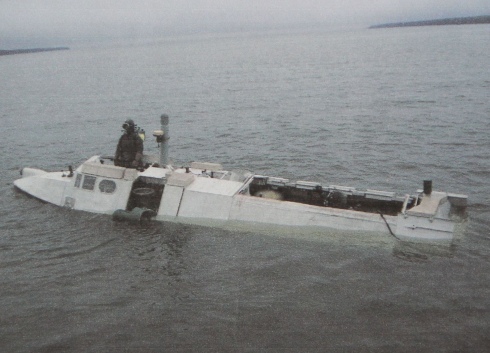
Of course it may not be a Triton -NN, Russian, stealth, submersible, high-speed craft wandering around the Stockholm archipelago – but it may be. It could just be probing Swedish defences or the boat may be in trouble. Or it could be nothing at all (though that seems unlikely). The Russians could be testing the new Red/Green Swedish government. Or carrying out a “live” training exercise but “against” a non-NATO member to minimise the risk of live fire. Or it could be a German or even a Polish submarine on a surreptitious training exercise!

The Russians have announced that they have no boats in trouble or missing so it is unlikely to be another Kursk.

The Triton-NN concept has been known for some time but there are few actual sightings.

Triton NN Submersible image padelt-online-de

Triton NN Submersible concept image padelt-online.de

There are many theories around but the most “objective” update I have found is from the Finnish -Swede military blogger Corporal Frick. He writes:

The major news was when Swedish newspaper Svenska Dagbladet reported that a signal emerging from the archipelago outside of Stockholm had been sent on a Russian Navy distress channel. When the search operation got underway, there was renewed traffic, which was encrypted, and a transmitter located in Russian Kaliningrad answered. This was the first evidence that decidedly pointed towards Russia as the country of origin. This could also explain the, in my opinion, rather strong and decisive response by the Swedish Navy when the first visual sightings occurred.

Representatives of the Swedish Defence Forces have denied that they have received knowledge about a distress signal, although the exact wording leaves the possibility open that A) the info has been distributed on a strict need-to-know basis, and as such is not available to the officers involved in the operation, or B) the interpretation that a signal on a known foreign military channel used for distress signals does not equal a known distress signal. They have also clearly stated that they do not know the country of origin or exact nature of the underwater activity, and as such they will continue to refer to it simply as “foreign underwater activity”. Most importantly, it has been confirmed that three visual sightings have taken place, and that the operation will continue for a number of days. Imagery from one of the sightings has also been released. The picture is grainy, but could be interpreted to show some kind of a midget submarine, e.g. the Russian Triton NN.

20120210-225617.jpg

A real Triton-NN? image from 2008 oplatsen.wordpress.com

The question of where the mother ship is located has been focused on the Russian-owned Liberian-flagged crude carrier NS Concord. The ship has been anchored outside of St Petersburg since the beginning of May, acting as a floating storage. Last week, it set sail and sailed to a position right outside the border of Swedish territorial waters, where it has since loitered. To begin with its AIS-data gave the destination as Danish Straits, but today this was changed to Primorsk. When the tanker suddenly found itself in the limelight, the Russian research/sea survey vessel Professor Logachev suddenly headed out to sea, destined for Las Palmas(?). It remains to be seen if this vessel will make a stop outside of Stockholm, but the timing seems somewhat suspicious. The Logachev also happened(?) to be traveling in the middle of the three-ship Dutch naval flotilla heading home from Tallinn, with the Walrus-class submarine HNLMS Bruinvis probably not far away either.

The Triton-NN could – it is speculated – carry upto 6 Spetsnaz divers and 2 crew. There is also some suggestion after a sighting of a black-clad figure that somebody could have disembarked and come ashore on an island in the archipelago.

A Russian Ethan Hunt?

Can consumer countries fuel global growth with sharply reduced oil prices?

October 20, 2014

Oil prices have “crashed”.

Currently prices are at less than $80 per barrel compared to over $110 in June and the peak of $147 just before the financial bubble burst in 2008. It seems that it is due to the oil glut brought about by the shale oil revolution in the US together with a downturn in global growth. The $147 peak was, I think, more of a trial balloon by the oil producers to test where the resistance lay and the producers concluded that a level of a little over $100 would maximise profits and was sustainable. But I suspect that this $100 level itself has contributed to delaying and prolonging the recovery. Not only because of the increased direct costs to the oil consumer but also due to its knock-on effects which have unnecessarily raised the cost to all electricity consumers. The prolongation of the path to recovery in Europe is certainly – if only partly – due to the very high energy prices that prevail. But right now it is the abundance of shale oil and gas which seems dominant.

BloombergBut the bigger factor appears to be surging global oil production, which outpaced demand last year and is shaping up to do so again in 2014. To try to keep prices high, Saudi Arabia, the world’s biggest petroleum exporter, has reduced its oil production from 10 million barrels a day—a record high—in September 2013 to 9.6 million as of Sept. 30. That hasn’t done much to raise prices, mostly because other OPEC countries are pumping more crude as the Saudis try to slow down. Sharply higher production increases from Libya and Angola, along with surprisingly steady flows out of war-torn Iraq, have pushed OPEC’s total output to almost 31 million barrels a day, its highest level this year and 352,000 barrels a day higher than last September. Combined with the continued increase in U.S. oil production, the world has more than enough oil to satisfy current demand.

crude oil price history 2000-2014

crude oil price history 2000-2014

But this crash in oil prices is probably a “good thing”.

The additional revenues from increasing oil price to the few in the oil producing countries have not been sufficient to counter the hit to the many in the consuming countries. Much of the additional revenue has gone not to fuelling growth but in blowing up new real-estate bubbles.

The additional spending power in consumer countries with reducing oil price is spread among the many (at the lower end of the wealth scale) whereas the reduction in producer oil revenues is generally spread among an affluent few. My contention is that the additional revenues with high oil price in – for example –  the Middle East does not need to be spent on real things which could fuel growth. Revenues in Saudi Arabia and Qatar and other countries have fuelled bubbles and jihad instead of just growth. A great deal went instead into very high margin, weapons systems and to the imaginary values of real estate. In Russia the oil revenue did contribute to some growth but there was still a large proportion spent on imaginary values of various bubbles (which by definition cannot contribute to growth). My simple calculation tells me that 1000 people buying washing machines in China contribute more to global growth than one person spending the same amount on an apartment (his second or third home) in London. A $10 drop in oil price is said to shift 0.5% GDP growth from producer countries to consumer countries. But the pattern of consumption where the “few” fuel the bubbles of imaginary value while the “many” consume mundane goods and services means that the real effect on growth is greater than a net zero. It is shifting an ineffective 0.5% to a more efficient consumption for growth. The net effect is probably a growth in global GDP of 0.2 – 0.3%. Similarly the purchase of large-volume, low-margin goods and services provides more growth and jobs than spending the same amount on low-volume, high margin goods and services. Spending $1000 on an 80% margin Gucci handbag provides less direct growth and fewer direct jobs than buying ten $100, 10% margin travel bags.

Historically – though it is a relatively crude generalisation – low oil price has usually given – or coincided with – consumer-led growth and stability.

crude oil price history 1970-2014

crude oil price history 1970-2014

Some oil producers are more vulnerable than others to the fall in expected revenues. Russia’s budget needs an oil price of over $100 to be balanced. Venezuela spends nearly all of its revenues as it is generated and has nothing put by. The war-torn areas of the Middle East also have nothing put by. Saudi Arabia and the Gulf States have put by vast reserves though some of it is in “bubble” values. A pricking of some of the bubbles they have inflated is probably no bad thing. It is also no bad thing if they have to fall back on reserves and have less excess cash to fund jihadists from Afghanistan to Libya.

Most Asian countries are oil importers and gain from a low oil price.

Clarion Ledger: The picture is reversed in Asia, where most countries are major importers and some subsidize the price of fuels.

China is the second-largest oil consumer and on track to become the largest net importer of oil. Falling prices will provide China’s economy some relief, according to Huang Bingjie, professor from the School of Economics and Management at China University of Petroleum. But lower oil prices won’t fully offset the far wider effects of a slowing economy.

India imports three-quarters of its oil and analysts say falling oil prices will ease the country’s chronic current account deficit. Samiran Chakraborty, head of research in India for Standard Chartered Bank, also says the cost of India’s fuel subsidies would fall by $2.5 billion during its current fiscal year if oil prices stay low.

Japan imports nearly all of the oil it uses. Following the accident at the Fukushima Dai-Ichi nuclear power plant in 2011, Japan has turned more to oil and natural gas, which is priced based on oil, to generate electric power.

The picture is a little more mixed in the Americas and Europe:

Low prices could eventually threaten the boom in oil production in such countries as the U.S., Canada, and Brazil because that oil is expensive to produce. Investors have dumped shares of energy companies in recent weeks, helping to drag global stock markets lower.

For now, lower crude oil and fuel prices are a boon for consumers. In the U.S., still the world’s biggest oil user, consumer spending accounts for two-thirds of the U.S. economy, and lower energy prices give consumers more money to spend on things other than fuel.

The same is true in Europe. Christian Schulz, senior economist at Berenberg Bank, says that a 10 percent fall in oil prices would lead to a 0.1 percent increase in economic output. That’s meaningful because the 18-country currency union didn’t grow at all in the second quarter.

There could be another market crash coming though it is not likely to be as deep as the 2008 crash. But to get back onto a solid, sustainable growth path again it does need the oil consumer countries to grow. And that probably needs a steady oil price at less than $70 per barrel. The oil producer countries will have to revamp their economies to live with the loss of their monopoly as the production of oil from shale spreads.

IFRC: In 2013, deaths by natural disasters were 80% down from average

October 19, 2014

The “climate change” brigade would have us believe that every storm, every hurricane, every incidence of heavy rain and every blizzard is an unprecedented event and due to man-made global warming (which in turn, they would have us believe, is primarily due to the combustion of fossil fuels).

But they are denied by the numbers.

The International Federation of the Red Cross and Red Crescent Societies has published its “World Disasters Report 2014”. They compile data for both natural and technological disasters. Last year (2013) saw deaths by natural disaster at very low levels (22,452) and about 20% of the decadal average (97,954). Regarding natural disasters they say:

According to the Centre for Research on the Epidemiology of Disasters (CRED), 337 disasters related to natural hazards and 192 related to technological hazards (typified hereafter as “natural disasters” and “technological disasters”) were reported worldwide in 2013. The number of natural disasters was the lowest of the decade. As regards technological disasters, their number was the second lowest of the decade, almost half the number in 2005, the peak year of the decade.

Floods remain the most frequent natural disasters. Storms were the second most frequent, but the number of events in 2013 was slightly higher than the decade’s average.

The number of deaths caused by natural disasters (22,452) is almost 80 per cent below the average for the decade (97,954), much lower than the peak years of 2004 (242,829 deaths), 2008 (235,272 deaths) and 2010 (297,728 deaths).

IFRC Deaths by natural disaster

IFRC Deaths by natural disaster

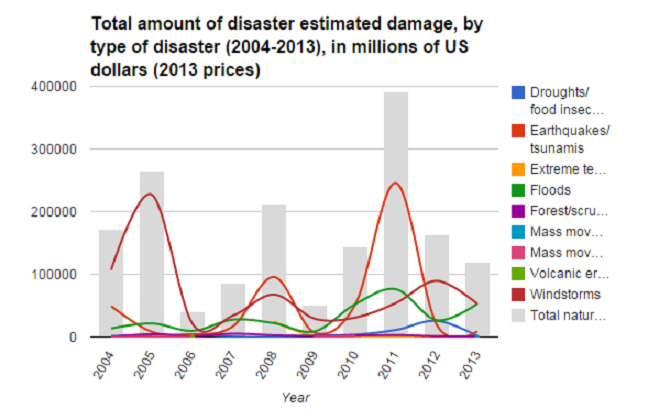
Monetary losses are dominated by the effects of earthquakes and tsunamis – when they occur. Windstorm deaths are also sporadic. Floods are more regular.

IFRC Monetary Losss by disaster type

IFRC Monetary Losss by disaster type

Was it biological or nuclear materials on X-37B?

October 18, 2014

The technicians servicing the  X-37B spaceplane shortly after the unpiloted craft glided to a computer-controlled landing Friday at Vandenberg Air Force Base are very well protected from something.

With Ebola protective suits in mind, their clothing would suggest the presence of nuclear or biological materials being on the spaceplane which has just returned from its 674 day secret mission.

They seem to be carrying their own completely isolated environment.

Technicians service an X-37B spaceplane shortly after the unpiloted craft glided to a computer-controlled landing Friday at Vandenberg Air Force Base, Calif., to close out a classified military mission, CBS/ U.S. AIR FORCE

WHO’s politically appointed country heads in Africa dropped the Ebola ball

October 18, 2014
Dr Louis Sambo

Dr Louis Sambo, WHO Regional Director Africa

Why are the WHO’s Regional Directors (for Africa, Dr. Luis Sambo) not answerable to the head of the WHO in Geneva?

The first indications that the Ebola ourbreak was getting out of control were raised in April by Medecins Sans Frontieres (MSF).

BBC: Medical charity Medecins Sans Frontieres (MSF) warned in April that the outbreak was out of control – something disputed by the WHO at the time.

…… In the worst affected countries – Liberia, Guinea and Sierra Leone – the Ebola virus has now killed 4,546 people with cases of infection numbering 9,191, according to the latest WHO figures.

AP carries a damning story of the complacency of the African WHO representatives who seem to have been unwilling to even acknowledge that there was a problem on their turfs. That the country heads of the WHO are mainly political appointments is not perhaps so surprising, but even all the Regional Directors around the world are apparently not responsible or accountable to the WHO head in Geneva.  That does not seem to be an organisation very conducive to taking actions on medical reasons alone. Presumably the African Regional Director is himself a political appointee (from Angola in this case) and  was elected to his position in 2005. It would seem that the position of Regional Director primarily reflects some political balance rather than just competence for the job to be done.

The outbreak began at least in January and by April had already killed 69 just in Guinea (around 70% fatalities of those infected).

AP:

In a draft document, the World Health Organization has acknowledged that it botched attempts to stop the now-spiraling Ebola outbreak in West Africa, blaming factors including incompetent staff and a lack of information.

In the document obtained by The Associated Press, the agency wrote that experts should have realized that traditional infectious disease containment methods wouldn’t work in a region with porous borders and broken health systems.

“Nearly everyone involved in the outbreak response failed to see some fairly plain writing on the wall,” WHO said in the document. “A perfect storm was brewing, ready to burst open in full force.”

The U.N. health agency acknowledged that, at times, even its own bureaucracy was a problem. It noted that the heads of WHO country offices in Africa are “politically motivated appointments” made by the WHO regional director for Africa, Dr. Luis Sambo, who does not answer to the agency’s chief in Geneva, Dr. Margaret Chan.

 ….. The document — a timeline on the Ebola outbreak — was not issued publicly but the AP was told the health agency would be releasing it earlier this week. However, WHO officials said in an email Friday that the timeline would now probably not be released publicly. No official at the agency would comment Friday on the draft report.

Dr. Peter Piot, the co-discoverer of the Ebola virus, agreed in an interview Friday that WHO acted far too slowly, largely because of its Africa office.

“It’s the regional office in Africa that’s the front line,” he said at his office in London. “And they didn’t do anything. That office is really not competent.” 

WHO’s other regional directors — the Americas, Southeast Asia, Europe, Eastern Mediterranean and the Western Pacific — are also not accountable to Geneva and are all elected by their regions.

Piot, director of the London School of Hygiene and Tropical Medicine, also questioned why it took WHO five months and 1,000 deaths before the agency declared Ebola an international health emergency in August.

“I called for a state of emergency to be declared in July and for military operations to be deployed,” Piot said. But he said WHO might have been scarred by its experience during the 2009 swine flu pandemic, when it was slammed for hyping the situation.

In late April, during a teleconference on Ebola among infectious disease experts that included WHO officials, Doctors Without Borders and the U.S. Centers for Disease Control and Prevention, questions were raised about the performance of WHO experts, as not all of them bothered to send Ebola reports to WHO headquarters, according to the draft document.

In the timeline, WHO said it was “particularly alarming” that the head of its Guinea office refused to help get visas for an expert Ebola team to come in and that $500,000 in aid was being blocked by administrative hurdles. ….

In fact the outbreak dates back at least to the beginning of this year. In Guinea, 69 people had already died between January and April 21st of Ebola:

MedicalDaily: Apr 21, 2014

Sixty-nine people have died since January of Ebola in the West African country of Guinea with 109 cases now confirmed by the World Health Organization (WHO). … WHO’s Dr. Rene Zitsamele-Coddy said in a press release. “As soon as the outbreak was confirmed on March 21, we started to work with [Guinea officials] and other partners to implement necessary measures,” she said. ”It is the first time the country is facing an Ebola outbreak, so WHO expertise in the area is valuable.”