Strange goings-on at Rajasthan University’s Physics Department

August 19, 2014

UPDATE!

The Rajasthan University website is suddenly “not available” – whatever that may imply.

A cached version of the page referred to below is here. (under the tab “Associate Professors”)

Update 2: The University website is up again and now updated. Presumably they went down to make the update.

=============================

The University of Rajasthan has a reputation of being very feudal (even if it is ranked 41 in a list of 511 Indian Universities). On anecdotal evidence they allow quite vicious ragging of first-year students and harassment of female students is quite common. Clearly all is not well at the University and specifically in the Department of Physics. Not just the academic misconduct evident from the manipulation and fabrication of data leading to multiple retractions, but also nasty charges of sexual misconduct and blackmail against the same professors.

1. Academic misconduct. Associate Professor RK Singhal has the dubious distinction of having achieved his own “category” at Retraction Watch as reward for his four (five?) retractions (so far). In his latest transgression Retraction Watch reports:

Here’s a physics retraction whose use of an exclamation point — the only one we’ve ever seen in a retraction notice! — makes the editors’ exasperation palpable.

It’s also the the fourth retraction for R. K. Singhal, of the University of Rajasthan, Jaipur, India. Behold the notice for “Magnetic behavior of functionally modified spinel Ni0.4Ca0.6Fe2O4 nanoferrite,” in the International Journal of Modern Physics B:

The editorial board discovered that the data points in several sections of the Moss-bauer spectra as given in Figs 3.(a) and 3(b) are exactly identical. This is impossible and nonphysical for the measurement of two different samples (or for that matter not even for the same sample!). The only conclusion we can draw from this figure is that some of the data is fabricated. As a result, the results and conclusions as described in the paper are unacceptable. This article is retracted from its publication in Int. J. Mod. Phys. B.

Prof. Singhal had to retract a 2010 paper and then he had to retract a correction to that retraction in 2013!!

Singhal and colleagues have another retraction — or two, depending how you look at it — in the Journal of Applied Physics. The journal has retracted a 2010 study, “Study of defect-induced ferromagnetism in hydrogenated anatase TiO2:Co,” but first they had to retract a 2013 correction of that study:

AIP Publishing LLC retracts this erratum because it was submitted and published without the knowledge of all the co-authors. Upon further investigation, it was found that the article that this erratum addressed warranted a retraction. Please also see the Retraction 1 associated with the original article.

Singhal’s colleague, Associate Professor SN Dolia of the same Department of Physics, was a co-author on the 4 Singhal papers retracted so far. They are both present as current faculty on Rajasthan University’s website. They have even had a physics paper retracted because their data was “unphysical”!!

2. Sexual Misconduct: But Singhal and Dolia have other problems to contend with. They are charged with extortion of sexual favours from a PhD student as a condition for being awarded her degree. They are said to have also fabricated obscene photographs to blackmail the student.

NDTV News: 30th June 2011.

In a huge embarrassment for teachers across the country, a professor at the Rajasthan University has been arrested for allegedly demanding sexual favours from his student.
The victim has alleged that her research guide Dr R K Singhal of the Physics department was harassing her for months.

The professor asked the girl to have sexual relations with him if she wanted to complete her PhD. Besides molesting her in February, Singhal and his colleague S N Dolia allegedly even blackmailed the student by morphing her face onto some obscene pictures. 
“While submitting her PhD thesis, the victim was asked for sexual favours by the teacher. Our preliminary investigation has found that the allegations are true and so we have arrested the Professor,” said BL Soni, Commissioner of Police, Jaipur. ….. Shockingly, despite the victim complaining about the teacher’s misconduct, the university authorities took no action initially. It was only after the girl lodged a police complaint that the accused teacher was arrested. Both Singhal and his colleague Dolia were later suspended from the university.
Besides suspending the two teachers, the university has also asked two retired Judges of the High Court to probe this shocking issue.

The legal mills in India grind on slowly and the case reached court in October 2013.

TOI: 16th October 2013.

JAIPUR: A court here on Tuesday framed charges against two assistant professors of University of Rajasthan (RU) who were accused of demanding sexual favours from a PhD student preparing thesis under their guidance.

The court of chief metropolitan magistrate (CMM) Bharat Bhushan Gupta, on Tuesday, framed charges against Dr Rishi Kumar Singhal and Dr S N Dolia under Sections 354, 341, 292 of the Indian Penal Code (IPC) and Section 4/6 of the Indecent Representation of en (Prohibition) Act.

On June 27, 2011 a girl belonging to Bharatpur, registered an FIR against the two professors at the Gandhi Nagar police station. In her complaint, the girl alleged that her research guide, RK Singhal, from the Physics department was harassing her and forcing her to have sexual relations with him. He allegedly used to threaten the girl that if she did not do as she was told, he would not let her complete her PhD.

While charges have been framed, the court hearings have not yet – apparently – commenced.

But there is no news of any results from the University investigation or of any actions being taken by the University. Interestingly the supposed University investigation reported is about the sexual misconduct charges. Nothing is reported from the University about the academic misconduct.

My expectation is that the University will not have the courage to actually do anything or to take any kind of moral or ethical position themselves. They will merely slip-stream behind the legal proceedings to avoid having to do anything.

 

Low-salt pseudo science

August 19, 2014

For almost 100 years, some scientists have been warning about the harmful effects of salt in our diets. For the last 40 years or so that has also been the “consensus” view of the medical/regulatory establishment. It was “settled science” we were told. There was complete “consensus” within the medical world it was proclaimed.

Salt was evil.

But apparently the “settled” science was not quite so settled after all. The “consensus” was nothing more than “group think”. In the words of the Wall Street Journal:

Yet the latest USDA food pyramid, which was updated as recently as 2011, clings to simplistic low-salt pseudo-science. The FDA is pressuring food manufacturers and restaurants to remove salt from their recipes and menus, while the public health lobby is still urging the agency to go further and regulate NaCl as if it were a poison.

The larger point is that no scientific enterprise is static, and political claims that some line of inquiry is over and “settled” are usually good indications that real debate and uncertainty are aboil. In medicine in particular, the illusion that science can provide some objective answer that applies to everyone—how much salt to eat, how and how often to screen for cancer, even whom to treat with cholesterol-lowering drugs, and so on—is a special danger.

It is not so easy now to retrace exactly how the salt scare developed and became part of the establishment view. Certainly Lewis Dahl of the Brookhaven National Laboratory was one of the key actors who spread the alarm. He was well placed within US Government circles and soon rather dubious and alarmist conclusions became part of the “establishment view”. Pseudo science became “settled science”:

Scientific American:

In 1904 French doctors reported that six of their subjects who had high blood pressure—a known risk factor for heart disease—were salt fiends. Worries escalated in the 1970s when Brookhaven National Laboratory’s Lewis Dahl claimed that he had  “unequivocal” evidence that salt causes hypertension: he induced high blood pressure in rats by feeding them the human equivalent of 500 grams of sodium a day. (Today the average American consumes 3.4 grams of sodium, or 8.5 grams of salt, a day.)

Dahl also discovered population trends that continue to be cited as strong evidence of a link between salt intake and high blood pressure. People living in countries with a high salt consumption—such as Japan—also tend to have high blood pressure and more strokes. But as a paper pointed out several years later in the American Journal of Hypertension, scientists had little luck finding such associations when they compared sodium intakes within populations, which suggested that genetics or other cultural factors might be the culprit. Nevertheless, in 1977 the U.S. Senate’s Select Committee on Nutrition and Human Needs released a report recommending that Americans cut their salt intake by 50 to 85 percent, based largely on Dahl’s work.

Thereafter “group think” took over. Consensus opinion – and not objective science – ruled. Now we are finding out that there is no clear evidence that salt is harmful and there is some evidence that too little salt is dangerous and can increase the risk of heart disease.

Scientific American:

In April 2010 the Institute of Medicine urged the U.S. Food and Drug Administration to regulate the amount of salt that food manufacturers put into products; New York City Mayor Michael Bloomberg has already convinced 16 companies to do so voluntarily. But if the U.S. does conquer salt, what will we gain? Bland french fries, for sure. But a healthy nation? Not necessarily.

This week a meta-analysis of seven studies involving a total of 6,250 subjects in the American Journal of Hypertension found no strong evidence that cutting salt intake reduces the risk for heart attacks, strokes or death in people with normal or high blood pressure. In May European researchers publishing in the Journal of the American Medical Association reported that the less sodium that study subjects excreted in their urine—an excellent measure of prior consumption—the greater their risk was of dying from heart disease. These findings call into question the common wisdom that excess salt is bad for you, but the evidence linking salt to heart disease has always been tenuous.

It has taken 40 years for this alarmist meme that salt is harmful to be brought down to earth. Group-think and “consensus science” has its own inertia which makes it difficult to overturn what becomes matters of faith rather than of evidence.

And just a few days ago another establishment paper created headlines when it stated that salt “causes 1.65 million deaths every year across the globe. A published study in New England Journal of Medicine on Thursday, found that an average consumed salt (sodium) per day is twice the amount recommended by the World Health Organization. A 3.95 gm consumption per day beyond the recommended amount of 2 gm”. But all they actually did was measure/estimate salt consumption and then multiplied that by an assumed death rate.  By the time the headlines were written a simple measurement of salt consumption became evidence of the dangers of salt! That’s consensus science!

The 1970s and 80s saw many such alarmist memes – based on little and dubious science – become the “consensus view” and the “politically correct” faith to be followed. It was the time when the nonsensical “Limits to Growth” became the bible of the day. It was the time of the DDT scare where the disadvantages were blown out of all proportion and the subsequent ban has been a case of “throwing the baby out with the bath water. Natural variations of the ozone hole were taken to be due to the human use of fluorocarbons. Acid rain was going to kill all the forests.

Whenever I now hear that some science is “settled” or that there is a consensus around some “belief” – as with climate science today – I am inclined to view the claims with a very large bushel of salt.

Sensory and evolutionary deficiencies

August 18, 2014

What shapes our bodies? We can only sense what our shapes permit but are our shapes a result of the survival advantages of what we can sense? Certainly there is much of the physical world that we cannot sense directly – but which we can sense by the instruments we have crafted.There may be many things we don’t even know about which are outside the range of our senses and our instruments (lumped together as extra-sensory things and the source of much speculation and much fraud). Our view of the world and of physical reality is totally dependent upon our senses and what we can perceive directly or through our instruments. Even what we can imagine is limited (a la Rumsfeld) to areas that we know we don’t know. But we cannot even conceive of – let alone imagine – what we don’t know we don’t know.

But why are the ranges of what can be detected by our senses limited to what they are? As hunter-gatherers surely it would have been of survival advantage to see in the dark at least as well as the big cats that were our predators. We must – before agriculture – have had the ability to track our prey. Did humans have a more acute sense of smell then, in the distant past? Did we once use smell as a communication tool as some animals apparently do? Has our sense of smell deteriorated as we have developed as an agrarian society. We can feel minute changes of heat flow on our skins but we cannot “see” thermal images with our eyes. Is there no survival advantage in seeing further into the ultra-violet or the infra-red? Why is our ability to hear high frequency sounds so much inferior even to animals we have domesticated?

There is also a fundamental difference between our ability to perceive some sensory inputs and our ability to generate such sensory signals. We can make as well as detect sounds. We can see certain wave-lengths of reflected radiation but we are not luminescent. Our olfactory sense can detect some trace chemicals but we cannot generate smells at will. Taste buds taste but cannot generate tastes.

It is now thought that humans have many more than just the five traditional “Aristotelian” senses of sight, hearing, touch, taste and smell. Nowadays some recognise pressure, itch, balance, thermoception, proprioception, pain, magnetoception and perhaps even chronoception (the ability to discern passage of time) as being human senses. We can even perhaps sense the force of gravity. If our inherent senses were powerful enough and varied enough, we would not need any instruments. What we cannot detect because our senses are limited could well be called sensory deficiencies, but whether these are evolutionary deficiencies or not depends upon whether the lack of capability could have provided some survival advantage.We can measure brain waves in a fashion with our instruments but we don’t always know what they mean. The existence of an instrument to measure something is itself evidence of a sensory deficiency. But what an instrument can measure we can also imagine some organ may be able to sense.

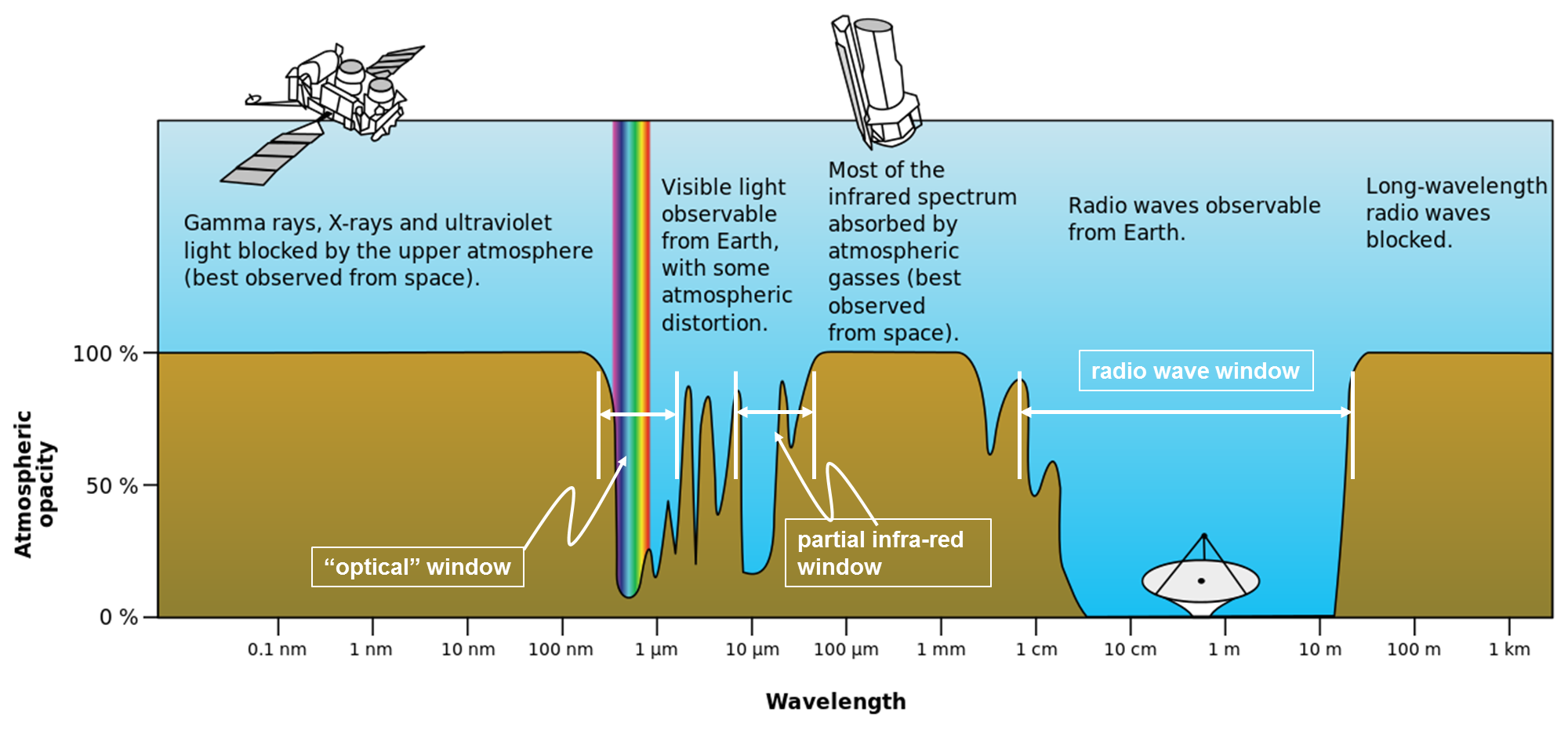
There are some who point to the evolution of the eye as some kind of proof of Intelligent Design. But it is actually the reverse. Human eyes actually see a very small part of the spectrum available to be discerned. Compared to what it could be, vision is a key area of sensory deficiency. Electromagnetic radiation exists in the range from gamma rays having a wavelength of 0.1 Angstrom (10−11 m  corresponding to a wavelength of 1019 Hz) all the way up to long wave radiation with a wave length of about 1,000 m and a frequency of 100,000 Hz. Within this range we find radio waves (wavelength 50 cm – 10 m), microwaves and radar (between 1cm – 10 cm wavelengths), infra-red (between 1 μm and 1 mm), “visible light” (between 360 nm to 720 nm), ultra-violet (20 nm to 100 nm) and X-rays (0.2 nm to 1 nm). The gases in the Earth’s atmosphere prevents much of the electromagnetic radiation from reaching the surface. But the atmosphere is virtually transparent in 3 main bands

  1. an “optical window” including the visible spectrum along with the near uv and near ir regions,
  2. a partial infra-red window, and
  3. a radio wave window
emr windows - based on wikimedia

emr windows – based on wikimedia

There is some reason therefore for life on earth to develop senses which take advantage of these windows to detect the electromagnetic radiation that passes through the atmosphere and bombards the earth. Yet no animal can detect all radiation just in the “optical window”. Some of the infra-red radiation can be detected as warmth on the skin. Bats can both see and emit along the radar bands but not at longer radio wave-lengths. Humans are virtually blind in the top two windows.

daffodil in visible and UV light image Dr. Mccarthy

daffodil in visible and UV light image Dr. Mccarthy

http://drmccarthysciencehgms.blogspot.se/2010/01/how-do-insects-see-flowers.html

Even within the optical window, the range of wave-lengths that are “visible” to humans is much narrower than the range visible to all animal-life. Pollinating creatures (bees and butterflies), for example, see well into the ultra-violet. The colours and patterns on flowers look quite different in ultra-violet light. They appear like landing lights to guide the pollinator “home”.While the picture on the right above is exclusively in uv light, an extended range of human visibility would lead to “seeing” some combination of the two pictures above. And so it would be if we could see further into the infra-red as well. We would need non-existent – but imaginable organs, to sense radiation within the other two windows.

Whether or not an extended range of vision could have helped humans better to survive, it is apparent that human vision is – compared to what is possible in the animal world – deficient. Compared to what is there to be “seen”, we see only a tiny fraction. It is highly unlikely that having an extended range of vision would have been a disadvantage in the survival stakes. It may not have provided a critical advantage but it still remains a sensory and an evolutionary deficiency!

Humans also lack the organs which allow bats to be radar receivers and emitters. A deficiency. We lack the organs that allow sharks to detect electric currents or birds to detect and navigate along magnetic lines of force. Our olfactory senses are far inferior to that of most animals. Dogs may be able to smell cancer cells but we can’t. Our hearing of high frequency sounds is also much inferior to that of most animals. All deficiencies. Humans do very well with low frequency sounds and perhaps only elephants and the largest of whales can generate and hear lower pitched sounds than humans can. We do not have the senses to even discern what some of our instruments measure.

For every human sense, and comparing only with the range exhibited by other life on Earth, our range of detection is deficient. There is no instance where the range of a human sense represents the entire range available within the animal world. Clearly, with a greater sensory range, humans could be much more capable – inherently – of discerning the world around them than they actually are.

Evolution of course is not about excellence. It is not even about the survival of the fittest. It is just the result of the demise of the unfit and therefore represents the minimum required to survive. Evolution is not about being “best” but only about being “good enough”. Evolution therefore sorts out individuals with sensory deficiencies when they are debilitating and prevent survival but evolution does not – except by accident – lead to an increase in a sensory range.

Natural de-selection which has dominated evolution so far is essentially without direction and is not a “selection for excellence”. Now as artificial selection comes into play, it becomes possible for humans – for the first time ever – to consider the direction to be taken for the development of future humans. This is the stuff of Frankenstein and Dr. Moreau and other evil genetic manipulators. Nevertheless I wonder which senses I would want/desire to be improved or enhanced or even created. (Though I would prefer that the deterioration of senses with age be addressed first).

Vision: I would quite like to have a much better night vision sensitivity together with some further range into the infra-red (but perhaps not much further into the uv range). I exclude Superman like X-ray vision as being too far removed from the optical window. To be able to “light-up” whatever I was looking at – say within 1 m – would require some new organ of luminescence which may be asking for too much.

Sound: A slightly larger range of hearing into the high frequency bands is, I think, to be desired. At least so I can hear what a dog hears. This would change human music and musical instruments quite drastically. I don’t think I want a more acute hearing sense (we are surrounded by enough noise as it is) but I would like to be able to hear a greater range of sounds than I can produce.

Magnetoception: It would have been a boon for explorers 500 years ago if they had had an innate sense of magnetic north. As we go out away from earth, humans will be exploring again and being able to discern lines of magnetic force without relying on instruments could well come in useful.

I have no great desire for enhancing the sense of touch or of smell. They are fine as they are and I see no clear benefits in their enhancement. But a new organ of extra-sensory perception (esp) to pick up the brain waves of others could be very handy. In its simplest form it would just detect when somebody was lying or some kind of “empathy” level being broadcast. But in its most evolved form it could be what is so beloved of science fiction writers. An organ that allowed mind-to-mind contact would lead to a profound paradigm shift in communication between humans which would rival the introduction of speech and language.

Language and Bombay and Madras and Calcutta

August 17, 2014

During the period when Suresh Prabhu and Anant Geete were Ministers of Power in India I used to have to follow up any discussions with them about power projects with visits to the head of their party, Bal Thackeray, in Bombay. (They were in their posts as representatives of the Shiv Sena Party in the then BJP led coalition but had little freedom to act on their own. The Shiv Sena was embodied in Bal Thackeray and he always had the final word). Bal Thackeray and the Shiv Sena had led the very vocal, sometimes violent and parochially nationalist movement to change the name of “Bombay” to “Mumbai” in 1995. I have found all these “nationalist” movements – whether in Bombay or Madras or Calcutta or Delhi or Bangalore – to be small-minded, rooted in insecurity and representing a deeply-felt  – but real – inferiority.

On my first meeting with Bala-saheb I was given strict protocol instructions by one of his aides before being ushered into the sanctum sanctorum at Mathoshree. I was to make sure that I always referred to “Mumbai” and not to “Bombay”. At the end of the audience I was expected to end my taking leave of him with the words “Jai Maharashtra” (long live Maharashtra). I remember asking the aide then whether, if I said “Bombay”, he would not understand what I meant. As he spluttered and I entered, I remember telling him that while I had no desire to insult anybody, I used language and words and names to best communicate my meaning.

In the event, in about 6 or 7 meetings over a number of years with Bal Thackeray, I never once used the terms “Mumbai” or “Jai Maharashtra“. But I did not go out of my way to use “Bombay” excessively or to provoke. I do not recall that Bala-saheb was ever discomfited or upset at my use of language (or non-use of “Mumbai”), or that we had any difficulty in getting our messages across to each other.

I grew up with “Bombay” and it evokes for me a world of glamour and wealth but also of modernity and substance and rectitude. As a child we lived in Poona (not Pune) and travelled through Bombay regularly. Bombay was avant-garde. “Mumbai” for me conjures up an old dirty village. A picture of slums and unfinished construction and uncollected garbage and rotting mill buildings. All very subjective of course but names and language are about communicating meanings. I note that the international airport designation of Bombay remains “BOM”. Since it takes an Act of Parliament to change it, the “High Court of Bombay” remains the “High Court of Bombay” in Mumbai. The Bombay Electric Supply & Tramways Company Limited (B.E.S. & T Co.Ltd) remains BEST but the “B” now stands for “Brihanmumbai” (meaning Greater Bombay). The name of the main railway station Victoria Terminus (VT) was changed to Chatrapati Shivaji Terminus but it is still referred to by everybody as VT. “Bollywood” remains “Bollywood” and I see no moves to make that “Mullywood”. Bombay Gin would not taste the same as Mumbai Gin. Bombay duck is far superior to Mumbai duck. In the 2000’s I used to stay at a guest house on Malabar Hill. Taxi drivers know exactly what I mean when I refer to Flora Fountain or Cuffe Parade or Kemp’s Corner or Napean Sea Road. The magic of Marine Drive on a misty evening is still untouched. Bombay, Meri Jaan is still the original song with Dev Anand in the movie CID.

The politically correct name is “Mumbai” and foreigners – especially – are very concerned about being politically correct. When I use “Bombay” I have no fear of being misunderstood. And even ardent Marathi nationalists understand exactly what I mean when I say “Bombay”, and the cleverer ones (there are not many of them) may even understand that I don’t think much of their rabid parochialism.

I finished my schooling in Calcutta and my image of the city has to mirror that reality. I am not misunderstood today when I still refer to Calcutta rather than Kolkata. The Calcutta High Court is still going strong. The international airport code is still CCU. Back in 1963 the British Council Library on Theatre Road was one of my favourite haunts. The name of the road was changed to Shakespeare Sarani but when I was there earlier this year – 50 years on –  taxi drivers still referred to Theatre Road (and did not even know that there was any other name). School was on Park Street and Park Circus is just as congested as it always was. Lansdowne Road  and many others have been renamed, but the old names live on. Bangalore remains Bangalore for me and Bengaluru does not trip off my tongue very easily – if at all. In Delhi CP is the supposedly defunct Connaught Place but it is still CP and not Rajiv Gandhi Chowk. Madras airport remains MAA and the Madras High Court is now located in Chennai. Mount Road is still Mount Road and everybody knows where Parry’s corner is.

I am told that Mumbai and Chennai and Kolkata and Bengaluru are the only “correct” forms but that is just a rather empty political statement. There are no rights or wrongs with language. There are only successful communications or misunderstood ones. There is no correctness about grammar – only compliance with a prevailing usage. My point is that as with grammar so with names. Inventing words or rules of grammar – or names – is of little account if the invented terms are not used.

Maybe the old names will be forgotten in a generation or two – or maybe not. The reality of usage always trumps the desires of  “political correctness”.

It’s coming, but don’t invest just yet in mining Helium-3 on the moon

August 16, 2014

Helium (4He) is the second most abundant element in the known Universe (after hydrogen) but only makes up 5.2 parts per million (ppm) of the Earth’s atmosphere. Helium-3 (3He) is an isotope of helium with two protons and one neutron. It is not radioactive and very rare on Earth (7 parts per trillion) but exists in recoverable concentrations in the lunar topsoil (in the top 2 -3 m of lunar regolith). It is even more abundant on the gas giants Jupiter, Saturn, Uranus and Neptune.

Lunar soil sample #75501 brought back by Apollo 17 in 1972 revealed the presence of He-3 and since then every country planning moon missions has the vision of mining for 3He on the moon and of vast quantities of energy production by means of a aneutronic fusion process on earth. (For old fogies like me, 1972 was the year of Watergate!)

In fusion reactions neutrons are “nasty”. They are very hard to contain and make other materials radioactive on collision. The first generation fuels of Deuterium and Tritium (reactions 1 and 2 below) produce many neutrons. A second generation with Deuterium and 3He only produces a few. A 3He – 3He reaction would produce none.

Kulcinski: Fusion Energy could provide that new energy source in the middle of the 21st Century. ….. However, ……  the DT Tokamak does not appear to be the ultimate answer. The problem lies in both the DT fuel cycle, which emits 80% of its energy in highly damaging and radioisotope producing neutrons, and in the complex design of the Tokamak.

fusion reactions after Kulcinski

fusion reactions after Kulcinski

But the promise of having 3He available to produce power is immense.

Read the rest of this entry »

Challenge to Bollywood union’s ban on women for make-up

August 15, 2014

It is nothing new that the modus operandi of a trade union is founded on discriminating against non-members. But a Bollywood trade union – the Cine Costume, Make-up Artists and Hair Dressers Association – has for the last 55 years forbidden women from being make-up artists or hair-dressers. But they are now being challenged in court and the Indian Supreme Court is expected to hand down its decision on August 26th.

The union’s defense – that allowing women into the profession would lead to all men losing their jobs – is particularly stupid. I expect the union will lose – as it should.

As an aside, the contemptuous attitude to women demonstrated by newly urbanised Indian youth is – I think – at least partially a consequence of the portrayal of women in Bollywood movies.

The National: Charu Khurana, 32, a make-up artist who trained at the Cinema Makeup School in Los Angeles in 2008 and returned to India with dreams of working in Bollywood. But Khurana found herself being confined to doing bridal make-up, fashion shows and commercials in New Delhi and unable to find work in Mumbai because the Cine Costume, Make-up Artists and Hair Dressers Association turned down her application in 2009.

“They rejected me, saying only men could work as make-up artists. It’s my basic human right to work in any field I wish. They can’t exclude women. I, too, have children and a family to support,” says Khurana.

Indignation prompted her to contact the New Delhi lawyer Jyotika Kalra, who took up the case and also asked the National Commission for Women – the state organisation that protects women’s rights – for support.

Kalra says she did not know whether to laugh or cry at the explanation she received from the Association.

“They wrote saying that the rule was intended to protect a man’s livelihood because, if women were allowed to do make-up, no actor would ever choose a man to do it. What kind of logic is that?” asks Kalra.

First woman ever among four awarded 2014 Fields medals

August 13, 2014

The Fields medal is the most prestigious award for mathematics and was first awarded in 1936. For 2014, four winners were announced this week and Maryam Mirzahkani, Professor of Mathematics at Stanford,  becomes the first woman ever to be awarded a Fields medal.

Though women are generally underrepresented in mathematics – I suspect partly because of a lack of interest and partly because it is not a “politically correct” occupation – there have been many prominent female mathematicians. But this is the first time in the almost 80 years since it was established that a woman has won the Fields medal.

The Fields Medal is awarded every four years on the occasion of the International Congress of Mathematicians to recognize outstanding mathematical achievement for existing work and for the promise of future achievement.

The Fields Medal Committee is chosen by the Executive Committee of the International Mathematical Union and is normally chaired by the IMU President. It is asked to choose at least two, with a strong preference for four, Fields Medallists, and to have regard in its choice to representing a diversity of mathematical fields. A candidate’s 40th birthday must not occur before January 1st of the year of the Congress at which the Fields Medals are awarded.

The Guardian:

Maryam Mirzakhani, a professor of mathematics at Stanford University in California, was named the first female winner of the Fields Medal – often described as the Nobel prize for mathematics – at a ceremony in Seoul on Wednesday morning.

The prize, worth 15,000 Canadian dollars, is awarded to exceptional talents under the age of 40 once every four years by the International Mathematical Union. Between two and four prizes are announced each time.

Three other researchers were named Fields Medal winners at the same ceremony in South Korea. They included Martin Hairer, a 38-year-old Austrian based at Warwick University in the UK; Manjul Bhargava, a 40-year old Canadian-American at Princeton University in the US and Artur Avila, 35, a Brazilian-French researcher at the Institute of Mathematics of Jussieu in Paris.

There have been 55 Fields medallists since the prize was first awarded in 1936, including this year’s winners. The Russian mathematician Grigori Perelman refused the prize in 2006 for his proof of the Poincaré conjecture.

The citations for the four winners:

MOM and MAVEN approach Mars

August 12, 2014

Both the Indian Mars Orbiter Mission (MOM – Mangalyaan, budget $70 million) and NASA’s MAVEN (budget $672 million) are now approaching Mars. Both are doing well according to their latest status updates.

MOM was launched on 5th November last year and MAVEN on 18th November, 2013. Whereas MAVEN on its Atlas 5 rocket could directly enter into a  Hohmann Transfer Orbit with periapsis at Earth’s orbit and apoapsis at the distance of the orbit of Mars, MOM had to take the low-cost, scenic route. Because of the relatively low payload capability of the PSLV launch rocket, MOM had to spend 26 days in ever-increasing earth orbits. MOM had to fire its Liquid Motor six times to work its way up to departing Earth orbit using a standard Hohmann Transfer Orbit on 1st December.

Alternate paths to Mars: NASA’s MAVEN compared to India’s MOM

MAVEN - MOM trajectories

MAVEN – MOM trajectories


When they were launched MAVEN was expected to reach Mars on 22nd September 2014 and MOM 2 days later on 24th September 2014. The time lines have shifted slightly subsequent to the mid-course corrections carried out and MOM is now expected to reach Mars orbit about a week ahead of MAVEN. I suspect that the time of Mars Orbit Insertion is still a little fluid, but both are about 1 month away. MOM is currently about 6 minutes away in radio signal distance.

Discovery News:

India’s Mars Orbiter Mission (MOM) is more than 80 percent of the way to Mars and performing well, according to a Facebook update posted July 21 by the Indian Space Research Organization. MOM is expected to enter orbit on Sept. 14.

The second craft, NASA’s Mars Atmosphere and Volatile EvolutioN (MAVEN), is also performing well. MAVEN is scheduled to embark on its final approach to the Red Planet on Sept. 21, one week after MOM’s arrival, principal investigator Bruce Jakosky said. After months of checkouts and tests, the spacecraft will now be left quiet until close to the big day.

NASA’s MAVEN has now gone into a “pre-Mars Orbit Insertion moratorium.” All systems required for a safe Mars Orbit Insertion remain powered on. But other systems like the instruments are shut down until late September because they are not needed for a successful MOI. We want the spacecraft system to be as “quiet” as possible and in the safest condition during the critical event on September 21st”.

Related: Frugal engineering for India’s Mars mission

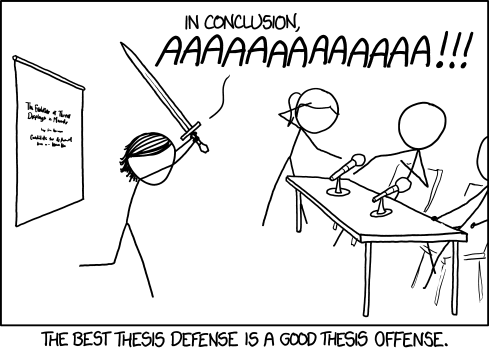
Offending a thesis

August 12, 2014

Another evocative one from xkcd.

If only ……

Thesis Defense

Thesis Offense from xkcd

You can defend against an offensive but offending against a defensive is not so easy.

Climate models wrong again in ignoring brown carbon from wildfires

August 11, 2014

So much for global warming being settled and the infallibility of incomplete and inadequate climate models.

Climate models generally take the effect of wildfires (brown carbon) on climate to be zero (it is not a parameter that is normally included). Both black and brown carbon particulates are products of incomplete combustion.

A new paper reports on experiments with the combustion of biomass and the brown carbon particulate matter in the smoke:

Saleh et alBrownness of organics in aerosols from biomass burning linked to their black carbon content. Nature Geoscience (2014) doi:10.1038/ngeo2220

The research provides information which can now be included in climate models but since it is a parameter which is not usually included, the obvious conclusion is that for any given level of warming some other effect (most likely that of man-made emissions of carbon dioxide) has been overestimated in the models.

But it is not the obvious conclusion that makes the headlines. Instead it is the ridiculous and alarmist statement that Forest fires can heat the climate that is the headline that Swedish Radio (which is about as orthodox as they come) chooses to lead with. They would clearly like to project the picture of a greater threat and not that of inadequate climate models.

Abstract: …. Here we present smog chamber experiments to characterize the effective absorptivity of organic aerosol from biomass burning under a range of conditions. We show that brown carbon in emissions from biomass burning is associated mostly with organic compounds of extremely low volatility. In addition, we find that the effective absorptivity of organic aerosol in biomass burning emissions can be parameterized as a function of the ratio of black carbon to organic aerosol, indicating that aerosol absorptivity depends largely on burn conditions, not fuel type. We conclude that brown carbon from biomass burning can be an important factor in aerosol radiative forcing.

The paper claims that brown carbon is a significant factor which must be taken into account and the more significant it is the less significant is man-made carbon dioxide.