The blackest of them all..

August 5, 2014

Vantablack (from Vertically Aligned Nano Tube Array) absorbs upto 99.965% of all radiation it receives and is now the blackest material known. It is blacker than NASA’s “super-black” (99%) and, I suppose, will be the start of ultra-black.

The uncoated part of this foil remains three-dimensional but the coated part reflects virtually no light and appears flat.
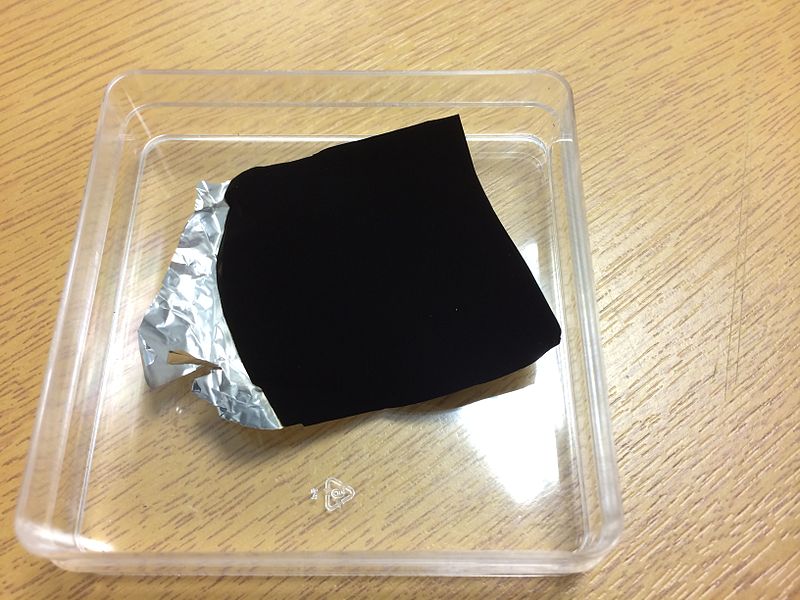
Piece of foil partially coated with Vantablack

Vantablack is manufactured by Surrey Nano Systems and is already in production.

The Engineer: Vantablack, a so-called ‘super black’ coating from Surrey Nanosystems, combines exceptionally low mass, thermal stability and an ability to absorb 99.96 per cent of incident radiation. Consequently, the coating is suited to applications including apertures, baffles, cold shields and Micro Electro Mechanical Systems (MEMS)–type optical sensors.

The material also overcomes limitations encountered in the manufacture of super-black carbon nanotube-based materials, where high temperatures precluded direct application to sensitive electronics or materials with relatively low melting points. This, along with poor adhesion, prevented their application to space and airborne instrumentation.

There is no established blackness scale. Black paint reflects almost 10% of incident light. Newly laid asphalt reflects 2 – 5% depending upon surface composition. Carbon black (polycrystalline carbon resulting from incomplete combustion) reflects only 1% of incident light. Though we take blackness to be the absence of reflection of radiation, material may reflect radiation at a different wave-length to the incident radiation. All light photons that are absorbed must eventually become heat and all bodies will radiate heat (infra-red) dependent upon only their surface temperature. In physics, a black body is theoretical and absorbs all incident electromagnetic radiation, at all wavelengths and all angles of incidence. In practice such a body can’t exist.

NASA SuperblackNASA engineers have produced a material that absorbs on average more than 99 percent of the ultraviolet, visible, infrared, and far-infrared light that hits it — a development that promises to open new frontiers in space technology. …… 

The nanotech-based coating is a thin layer of multi-walled carbon nanotubes, tiny hollow tubes made of pure carbon about 10,000 times thinner than a strand of human hair. They are positioned vertically on various substrate materials much like a shag rug. The team has grown the nanotubes on silicon, silicon nitride, titanium, and stainless steel, materials commonly used in space-based scientific instruments. (To grow carbon nanotubes, Goddard technologist Stephanie Getty applies a catalyst layer of iron to an underlayer on silicon, titanium, and other materials. She then heats the material in an oven to about 1,382 degrees Fahrenheit. While heating, the material is bathed in carbon-containing feedstock gas.)

The tests indicate that the nanotube material is especially useful for a variety of spaceflight applications where observing in multiple wavelength bands is important to scientific discovery. One such application is stray-light suppression. The tiny gaps between the tubes collect and trap background light to prevent it from reflecting off surfaces and interfering with the light that scientists actually want to measure. Because only a small fraction of light reflects off the coating, the human eye and sensitive detectors see the material as black.

In particular, the team found that the material absorbs 99.5 percent of the light in the ultraviolet and visible, dipping to 98 percent in the longer or far-infrared bands. “The advantage over other materials is that our material is from 10 to 100 times more absorbent, depending on the specific wavelength band,” Hagopian said.

Currently, instrument developers apply black paint to baffles and other components to help prevent stray light from ricocheting off surfaces. However, black paints absorb only 90 percent of the light that strikes it. The effect of multiple bounces makes the coating’s overall advantage even larger, potentially resulting in hundreds of times less stray light.

In addition, black paints do not remain black when exposed to cryogenic temperatures. They take on a shiny, slightly silver quality, said Goddard scientist Ed Wollack, who is evaluating the carbon-nanotube material for use as a calibrator on far-infrared-sensing instruments that must operate in super-cold conditions to gather faint far-infrared signals emanating from objects in the very distant universe. If these instruments are not cold, thermal heat generated by the instrument and observatory, will swamp the faint infrared they are designed to collect.


Prof. Rajanish Dass wins in court but IIM Ahmedabad tries to parse the court’s verdict

August 3, 2014

Two years ago I had posted, here and here,  about the case of Prof. Rajanish Dass who resigned – under pressure – from the Indian Institute of Management Ahmedabad after being accused of plagiarism. IIM also made a police complaint accusing him of sending offensive e-mails.

But Prof. Dass has fought his case and won in court.

Now Prof. Dass has sent me an e-mail

“….. Previously, allegations of plagiarism had been manufactured against me, which were baseless, frivolous and were without any cogent proof or evidence. In fact, one of these allegations made was on a report, which did not exist at all. The same have been proved baseless over a period of time in the court of law and the inquiry report for these allegations had already been trashed when challenged in the High Court of Gujarat in 2012 (see http://timesofindia.indiatimes.com/city/ahmedabad/Hear-Dass-Out-Gujarat-high-court-tells-IIM-A/articleshow/12154670.cms.) ….

….. However, I am happy to mention to you that after a rigorous investigation by the Crime Branch Ahmedabad, I have been given a clean chit against the allegations made against me and the honorable Criminal Court has also discharged me with honor (see

  1. http://timesofindia.indiatimes.com/City/Ahmedabad/Courts-clean-chit-to-former-professor/articleshow/32382468.cms
  2. http://epaper.dnaindia.com/story.aspx?id=46728&boxid=110273&ed_date=2014-03-21&ed_code=1310005&ed_page=3… Now IIMA says that the charges of plagiarism were neither proved nor disproved. The question is had there been any legal charges, why did IIMA accept my resignation?).  ….”

India, unlike Scotland, does not have a  “not proven” verdict. If you are “not guilty” you revert to being “innocent”. IIM-A it seems to me are trying to claim that the plagiarism charges are something separate and are neither unproven nor proven though the court has thrown out their charges – now shown to be false – of malicious e-mails. But if plagiarism can not be proven – as IIM-A admits – then what was all the fuss about? If plagiarism is not proven then surely a presumption of innocence applies. 

IIM-A’s response – it seems to me is a trifle disingenuous, since if the plagiarism charges are not proven then there was no cause to force his resignation in the first place. This seems like IIM-A trying to parse the verdict of the court and convert a “not guilty” verdict to be instead “not guilty of this charge but not proven regarding plagiarism”. A mealy-mouthed response, I think.

Is IIM-A really saying that an allegation of plagiarism – which after 2 years is still unproven – was sufficient to force Prof. Dass to resign?

The honourable course for IIM-A – and especially as they cannot prove that any plagiarism took place – is to accept the verdict of the court gracefully and pay Prof. Dass his dues. Reinstatement may not be practical but IIM-A cannot keep accusing him of plagiarism which they are unable to prove.

(In his email Prof. Dass had requested me to remove the previous posts but I don’t think that would be the correct thing to do. He won his court case a few months ago – which I had missed at the time.)

The injustices of equality

August 3, 2014

We cannot both have individuality and equality.

And it would be a sorry day if humankind consisted just of clones and we had no differences. Without difference, equality is undefined and quality is meaningless and judgement is unnecessary. Discernment would not exist, there would be no “good” and no “bad”, and discrimination would cease to be.  Merely denying difference leads to injustice. Much of the legislation about “Rights” focuses on denying difference – as if that would make difference go away. Our very concepts of what is good or what is just depend upon being able to distinguish differences – in all the various differences that go to making individuals unique. Differences of capability, in behaviour, in performance, of competence, in appearance and – not least – in intelligence.

But it should not be beyond the wit of man to strive for justice – rather than a meaningless equality. Liberté, Égalité, Fraternité  is inherently unjust and should instead have been Liberté, Justice, Fraternité. 

We applaud discernment and judgement but condemn discrimination. We use reverse discrimination to try and correct discrimination. We use “affirmative action” and quotas of various kinds to favour some groups – defined by their difference – to right their “wrongs” by wronging still others. Some gender equality legislation tries to deny that gender difference exists. The Swedish government has just proposed that the term “race” should be removed from all legislation. As if that would make differences disappear.

Given individuality, equality is often incompatible with justice. They are not synonyms and one does not imply the other. It is not for nothing that the phrase “just and equitable” uses both words and having both together assumes that a compromise will be necessary to get a measure of both.

It is a “classic” issue that every society has to take a call on and related to the conflict interface between “what is desired” and “what is deserved”. Should the individuals in a society be granted (as “rights”) what they desire/need or should they only be rewarded for what they deserve/earn? (Desire in this context must be equated  with “need” and anything “deserved” then must have been “earned”.) What an individual “desires” he terms as “needs”, and what he believes that he “deserves” is what he thinks he has “earned”. The surrounding society he operates in may have quite a different view of what he should desire (his needs) or what he has earned (deserves).

Simplistically this is socialism versus capitalism. “Socialism” can be described simply as being the wealth of a society being appropriated and accumulated into a common pool and then distributed “according to the individual’s needs/desires”.  “Capitalism” can be described as a system where each individual generates wealth or is remunerated according to what he has earned/deserved and individuals – rather than their appropriated wealth – are accumulated to make up that society. In these terms, a socialist society assumes ownership of all wealth and then takes a call on how much individualism it will suppress or permit, whereas a capitalist society assumes that ownership of wealth lies with the creators of the wealth who must then determine how much individualism they are prepared to give up for the “common good”.

In practice every society or organisation has a mix – often illogical and irrational – of the balance between “the needs of society” and the “rights of the individual”. Every society or organisation exhibits a mix of rewards for performance (earned) and allowances for needs (desires). This is a classic ideological problem that all trade unions face today. Once upon a time they advocated – for example – that a father of six should be paid more than a father of two because his needs/desires were greater. To even accept payment for “piecework” or any remuneration for “performance” was once seen as being heresy. Most large corporations today are essentially capitalist but generally implement remuneration on a mix of need and performance factors. Housing allowances, child allowances, education allowances are all examples of payments for perceived needs. Performance bonuses or allowances for extra qualifications or “danger money” have to be earned.

Inevitably socialistic societies tend towards an oppression of minorities by the “majority of wealth consumers” while capitalistic societies lean towards an oppression of the majority by the “minority of wealth creators”. This is the fundamental divide between the Right and the Left; to what extent should individuals and societies be subservient to or dominate the other? It is also the fundamental reason why there must usually be a conflict between “equality” and “justice”.

In this context, socialism maps to equality while capitalism maps to justice.

The desired versus deserved schism cannot be separated from how “equality” is viewed and consequently on defining what discrimination consists of. There is no equality of humans at birth. To be all born equal we would have to be clones and genetically identical which we are not. We are born to parents not of our choice, to our random positions on the predominantly bi-nodal gender scale. Our genetic traits (nature) and our subsequent experiences (nurture) determine our different capabilities and our different behaviours. Since it is these differences in our capabilities, our behaviour and our performance which make us individuals, what, then, should be “equalised” by subsequent unequal treatment?

In the name of “Equal Rights” we try to correct existing injustices. We use “Equal Opportunites” to mean removing the handicaps of unequal nurture for some individuals but in so doing we add handicaps for others. We don’t handicap athletes at the start of an Olympic 100 m race to ensure that all participants finish equal. For “gender equality” two women are paid the same amount at Wimbledon for 3 sets of tennis as two men for five but we accept that it would be an unequal match for the men to play against the women. Striving for equality, Wimbledon has achieved equality of pay for unequal performance. All societies tax their members unequally (and what does equal taxation mean anyway?) Creating or having wealth is taxed more heavily – perhaps justly – than wealth consumption. We punish (hopefully) justly – but unequally – for the same bad behaviour by different individuals.  We reserve places in educational institutions for those considered disadvantaged and thereby deny those same places for the deserving. A just health care system must provide unequal care with more care for those less healthy.

Given individuality, equality and justice will often be in conflict. To be just requires a recognition of differences and to then treat unequally to make suitable compensation for the difference. In theory “equality” should be an objective measure but as soon as it becomes the equality of something, it is just as subjective as notions of what is just.

Far better we strive for justice for individuals rather than for some diffuse and meaningless “equality for all”.

Predictions of a “super” or a “monster” El Niño are fizzling out

August 2, 2014

The latest forecast from the Australian Bureau of Meteorology has now downgraded any El Niño event in 2014 to be  – at worst – a normal or a weak El Niño. There is still a reasonable possibility that it will develop, but that itself means that there is now a significant probability that it may not even happen. The alarmist clamour of 3 months ago, enthusiastically disseminated around the globe was clearly somewhat exaggerated.

ENSO Wrap-Up – 29th July 2014:

Despite the tropical Pacific Ocean being primed for an El Niño during much of the first half of 2014, the atmosphere above has largely failed to respond, and hence the ocean and atmosphere have not reinforced each other. As a result, some cooling has now taken place in the central and eastern tropical Pacific Ocean, with most of the key NINO regions returning to neutral values.

While the chance of an El Niño in 2014 has clearly eased, warmer-than-average waters persist in parts of the tropical Pacific, and the (slight) majority of climate models suggest El Niño remains likely for spring. Hence the establishment of El Niño before year’s end cannot be ruled out. If an El Niño were to occur, it is increasingly unlikely to be a strong event.

Given the current observations and the climate model outlooks, the Bureau’s ENSO Tracker has shifted to El Niño WATCH status.

Back on 6th May, the ABM wrote ” The tropical Pacific Ocean has warmed steadily in recent months, with large warm anomalies in the ocean sub-surface (5-day values up to +6 °C) and increasingly warm sea surface temperatures. Climate models surveyed by the Bureau suggest El Niño development is possible as early as July”.

Climate models are not as robust as some would like us to believe.

The alarmists such as Joe Romm went to town with dire predictions just 3 months ago and were predicting a “super” and a Monster” El Niño for 2014. Of course, dire predictions which never ever materialise are the stuff of alarmism.  The clever alarmist is the one who makes unverifiable predictions which will never happen but which cannot be disproved.

Joe Romm, 26th March: Is A Super El Niño Coming That Will Shatter Extreme Weather And Global Temperature Records?

Signs are increasingly pointing to the formation of an El Niño in the next few months, possibly a very strong one. When combined with the long-term global warming trend, a strong El Niño would mean 2015 is very likely to become the hottest year on record by far. ……. 

John Upton, May 16th: A monster El Niño could be on its way, and it will likely have a complicated effect on the world’s breadbaskets.

Something fierce is rising out of the Pacific Ocean, and its appetite for the world’s major carb crops could be even more ravenous than that of a monstrous mythical sea creature. …… A dinosaurian belch of warm water thousands of miles wide has appeared at the surface of the Pacific Ocean near the equator. The warming ocean conditions have spurred NOAA to project a two-thirds chance that an El Niño will form by summer’s end. It’s tipped to be of the monster variety—the extreme type that could become more common with global warming.

El Niño events come regularly and we can expect that will continue. But in 2014 it will at worst be a “normal” or a weak El Niño. Its feared effects on the Indian monsoon have also been downgraded. The monsoon which is now half-way through its season has recovered somewhat.

But the simple truth is that not a single one of the dire predictions that global warming alarmists are wont to make has come to pass.

Eugenics by surrogacy – Australian style

August 1, 2014

It was an Australian couple in this case but of course there are many who use surrogacy in Thailand and other poor countries to carry out procedures they cannot in their own countries. In nearly all cases of surrogacy the mother is required to abort if a serious medical problem is detected.

In the Sydney Morning Herald:

Gammy, a six-month-old baby abandoned by his Australian parents, could die because his impoverished Thai surrogate mother cannot pay for medical treatment for his congenital heart condition.

The child will never know his twin sister, who was born healthy with him in a Bangkok hospital and has been taken away by their parents, who are living anonymously in Australia.

The story of how 21-year-old Pattharamon Janbua was cheated by a surrogacy agent in Bangkok and left to try to save the life of her critically unwell baby has emerged as Thai authorities move to crack down on IVF clinics, …… 

Ms Pattharamon says three months after a doctor injected the Australian woman’s fertilised egg into her uterus, she discovered she was having twins. The agent promised her an additional $1673 to have the second baby.

The couple asked the Thai mother to abort the Downs syndrome twin which she was not prepared to do.

Four months into the pregnancy, doctors doing routine checks discovered one of the babies had Down syndrome. They told the Australian parents, who said they did not want to take the boy, according to a source familiar with the case.  

“They told me to have an abortion but I didn’t agree because I am afraid of sin,” Ms Pattharamon says, referring to her Buddhist beliefs. 

This couple probably should be barred from being parents but their genes are being carried forward.

How many surrogate conceptions are aborted is not known but they happen –  it is thought – mainly because a medical defect in the fetus has been detected.  However, it is known that many surrogate clinics do select for the sex of the child and babies of the undesired gender are also aborted. Many of the Thai surrogacies for Australians are for same-sex couples. I don’t believe that any child – if given and capable of an informed choice – would prefer to do without a father or a mother.

Currently around 25-30% of all “normal “human conceptions are aborted. But most of these are abortions for convenience rather than for defects in the fetus. If being a reluctant mother has a genetic component then every abortion is also a genetic deselection of reluctant mothers.

Related: On birth rates, abortions and “eugenics by default”

No mass extinction! Dinosaurs shrank to become birds

August 1, 2014

Sixty five million years ago, the theory goes, a 6 mile long asteroid slammed into the earth and caused the extinction of all non-avian dinosaurs as part of a mass extinction event. Some 50% of all species living at the time – the hypothesis proclaims – vanished in this mass extinction event. It’s the stuff of catastrophe theories and movie scripts.

Smithsonian: Sixty-five million years ago the dinosaurs died out along with more than 50% of other life forms on the planet. This mass extinction is so dramatic that for many years it was used to mark the boundary between the Cretaceous Period, when the last dinosaurs lived, and the Tertiary Period, when no dinosaurs remained. This is called the Cretaceous/Tertiary (or K/T) boundary, and the associated extinction is often termed the K/T extinction event. …….  Most theories focused on climate change, perhaps brought on by volcanism, lowering sea level, and shifting continents. But hundreds of other theories were developed, some reasonable but others rather far-fetched (including decimation by visiting aliens, widespread dinosaur “wars”, and “paläoweltschmertz”­the idea that dinosaurs just got tired and went extinct). It was often popularly thought that the evolving mammals simply ate enough of the dinosaurs’ eggs to drive them to extinction.

But a new paper now suggests that dinosaurs actually shrank as they evolved over 50 million years to become the birds we know today. This still means that it was the dinosaurs vacating space on land which gave rise to the growth of mammal species, but it was not a one-time catastrophic event. No mass extinction then!

No fireworks apparently. Just a gradual, fairly mundane process where the large and cumbersome were deselected as they ran out of the ability to feed themselves and died off.  While the small and the nimble both needed less food and were more capable of getting it.

Michael S. Y. Lee, Andrea Cau, Darren Naish, Gareth J. Dyke. Sustained miniaturization and anatomical innovation in the dinosaurian ancestors of birds. Science, 1 August 2014: Vol. 345 no. 6196 pp. 562-566 DOI:10.1126/science.1252243

University of Southampton Press ReleaseA new study involving scientists from the University of Southampton has revealed how massive, meat-eating, ground-dwelling dinosaurs evolved into agile flying birds: they just kept shrinking and shrinking, for over 50 million years.  

Today, in the journal Science, the researchers present a detailed family tree of dinosaurs and their bird descendants, which maps out this unlikely transformation.  They showed that the branch of theropod dinosaurs, which gave rise to modern birds, were the only dinosaurs that kept getting inexorably smaller.  

“These bird ancestors also evolved new adaptations, such as feathers, wishbones and wings, four times faster than other dinosaurs,” says co-author Darren Naish, Vertebrate Palaeontologist at the University of Southampton.  

“Birds evolved through a unique phase of sustained miniaturisation in dinosaurs,” says lead author Associate Professor Michael Lee, from the University of Adelaide’s School of Earth and Environmental Sciences and the South Australian Museum.  

“Being smaller and lighter in the land of giants, with rapidly evolving anatomical adaptations, provided these bird ancestors with new ecological opportunities, such as the ability to climb trees, glide and fly. Ultimately, this evolutionary flexibility helped birds survive the deadly meteorite impact which killed off all their dinosaurian cousins.”  

Co-author Gareth Dyke, Senior Lecturer in Vertebrate Palaeontology at the University of Southampton, adds: “The dinosaurs most closely related to birds are all small, and many of them – such as the aptly named Microraptor – had some ability to climb and glide.”  

The study examined over 1,500 anatomical traits of dinosaurs to reconstruct their family tree. The researchers used sophisticated mathematical modelling to trace evolving adaptions and changing body size over time and across dinosaur branches.  The study concluded that the branch of dinosaurs leading to birds was more evolutionary innovative than other dinosaur lineages. “Birds out-shrank and out-evolved their dinosaurian ancestors, surviving where their larger, less evolvable relatives could not,” says Associate Professor Lee.


Obscenity takes many forms

July 31, 2014

When war and destruction becomes a spectator sport. All that’s missing is a hot dog stand.

This picture  by Andrew Burton/Getty Images was published in the New York Times

Israelis gathered on a hilltop outside the town of Sderot on Monday to watch the bombardment of Gaza. Andrew Burton/Getty Images via NYT

Israelis gathered on a hilltop outside the town of Sderot on Monday to watch the bombardment of Gaza. Andrew Burton/Getty Images via NYT

Similar scenes, of Israeli spectators gathered on the high ground above Gaza to view the destruction below, were documented in a Times of London article and a video report from Denmark’s TV2 during Operation Cast Lead in 2009.

Adapting to climate change requires the further development and use of fossil fuels

July 31, 2014

The single thing that differentiates the human species from every other known species on earth has been the control and use of fire.The step change then from primitive to modern humans has been due not least to the control and development of the combustion process and the utilisation of fossil fuels. This in turn has multiplied many times the intensity of energy available to be harnessed by man. I would suggest that the human capability of handling change is largely a function of the power intensity available.

power intensity

power intensity

Fossil fuels have been demonised (by association with carbon dioxide emissions) for the last 30 years. In spite of that most  of the growth in the developing world has been – and continues to be – powered by fossil fuels. Fortunately the lack of evidence of any significant linkage between man-made carbon dioxide and global warming  (which is still the politically correct ideology) is beginning to be realised. The unnecessary, misplaced and ineffective increase of electricity prices in countries which have curtailed their use of fossil fuels has prolonged the recession and has cost many millions of jobs.

We have now had almost 20 years with the highest level ever of fossil fuel utilisation but “global temperature” has remained stubbornly static. In the last decade global temperatures have declined slightly. The hypothesised link between man-made carbon dioxide (which constitutes only about 3% of carbon dioxide emissions) and global temperature is well and truly broken. All the various climate computer models – which build on this link being amplified – have failed miserably.

The indicators of a global cooling cycle having started are piling up.

  1. There is more ice in the antarctic than has ever been measured
  2. There is more ice in the arctic than about a decade ago
  3. Total ice cover is higher now than has ever been measured
  4. Ice cover on the Great Lakes reached levels not seen for over 50 years and has persisted into the spring (even summer) later than has been observed for at least 40 years.
  5. The expected super El Nino forecast for this year has been dampened by a cooling Pacific and only a mild El Nino event – if at all – is now to be expected
  6. Sea level rises are no different to the long term average for sea level recovery since the last glacial minimum and may even have slowed.
  7. The deep oceans are cooling and are no repository of “hidden heat”
  8. The net cooling effect of clouds has been underestimated in nearly all models and cloud cover over the world is increasing (slightly).
  9. Man made water vapour is of greater significance than man made carbon dioxide for climate effects. But man made water vapour is almost insignificant compared to the water vapour flux due to evaporation and respiration.
  10. Solar effects are virtually ignored by all climate models but the sun does not much care for models and is reaching a low level of activity comparable to the Dalton or Maunder Minima.

Crying wolf about global warming has been the politically correct thing to do for 3 decades. Before that it was politically correct to be alarmist about the coming ice age. No doubt all the old fears about an ice age can be dusted off and recycled.

Climate change has been the most powerful force which has shaped human evolution and expansion. Sea level changes and patterns of precipitation and desertification have driven both evolution and migrations. Sea level during an ice age is about 120 m lower than it is today. More land is exposed in equatorial and tropical regions during a glacial period while land is rendered uninhabitable by the ice sheets of the north. But even primitive humanity survived during the glacials.

It is the global cooling cycles and not global warming cycles which will place the greatest demands on farming and energy. The greatest sea level change that humanity has had to – and will have to – adapt to  is the 120 m difference between glacial and interglacial conditions. During an ice age precipitation will drop sharply and river water flows will decline. Hydro power will all but dry up. It is the inevitable coming of the next ice age that will pose the real challenge – not the 1 m sea level rise that may come with another warming cycle. And when the ice age comes again it will be fossil fuels which will keep the home fires burning. It is the further exploitation of nuclear energy and fossil fuels in all its forms – coal, oil, natural gas, shale gas, gas from methane hydrates – that will be needed. It is the availability of power at the intensities provided by nuclear power and fossil fuel combustion which is what will provide humans with the wherewithal to cope with climate change, whether warming or cooling, but especially when the next ice age begins.

Whatever the alarmists would have us do in the short term, reality will eventually bite. The use of fossil fuels will – thankfully – continue as will the exploration for new sources of gas. The next generation of nuclear power plant will be developed – even though nuclear alarmism has led to a dearth of nuclear engineers. No doubt some market niches will be filled by wind and solar power but that will not be very significant in the large picture.


Australia covers up corruption in getting plastic currency contracts

July 30, 2014

The supply of, and the technology for producing, plastic currency are a big business for the Reserve Bank of Australia. Plastic currency is now used by 23 countries around the world. But it is also apparent that Australian parties have been involved in bribing high officials in Malaysia, Indonesia and Vietnam (at least) in securing contracts for plastic currency. The Australian courts are apparently cooperating in some form of cover-up.

That has become apparent from the Wikileaks release of a gagging order by the Supreme Court of Victoria at Melbourne where the court forbids

any discloures, by publication or otherwise, of any information relating to the court case by anyone, including the Australian media, ensuring complete secrecy around the largest corruption case in Australia. The order also forbids any disclosures about the order itself, and specifically commands no mention be made of the affirmed affidavit submitted to the court by Gillian Bird, a career diplomat, currently appointed as a deputy Secretary of the Department of Foreign Affairs and Trade (DFAT). Bird is one of Australia’s most senior and experienced diplomats and is responsible for relations with South East Asia which is why her affidavit, currently held sealed by the court, is so important.

Not only a gagging order but also a gag on revealing the gag!

For such a blanket gagging order to have been issued suggests that some “big” names – both at home and abroad but probably mainly abroad – are running a little scared of embarrassment or something worse.

My “rule of thumb” is that in corruption cases of this sort about 3 – 4% of the contract value will find its way into the hands of individuals (officials/politicians) in the buying country and that from this amount about ½- 1% of the contract value will be channeled back to individuals in the selling organisation. The 3% is an important number since it is what is unofficially accepted as being acceptable as legitimate facilitation costs for selling by OECD rules. If bribes can be held to less than about 3% (including the kick-back to the kick-back), the contract can usually escape too much scrutiny.

Plastic currency is one of the few areas where Australian technology leads the world. As such it provides a very valuable source of revenue (and prestige) for the RBA.

Currently seven Australians have been charged in an ongoing $17 million corruption case:

SMH: A seventh Australian man has been charged over an alleged $17 million banknotes bribery scandal engulfing companies related to Australia’s central bank.

Clifford John Gerathy, 60, of Maroubra, in south-eastern Sydney, faced Melbourne Magistrates Court in Melbourne on Wednesday.

A former Securency sales manager, Gerathy faces two charges of conspiring to bribe a foreign official and falsifying documents in connection to the scandal involving currency contracts.

Before Gerathy appeared in court, the Australian Federal Police said it would be alleged he facilitated payments of $17.2 million in commissions to an agent in Vietnam and falsified accounts in relation to a contract in Malaysia.  …… 

Gerathy will next appear in court on September 23 with his co-accused, all six of whom are from Victoria. The others charged with bribes allegedly paid to secure banknote contracts are Myles Curtis, 55, John Leckenby, 66, Mitchell John Anderson, 50, Peter Sinclair Hutchinson, 61, Barry Thomas Brady, 62, and Rognvald Leslie Marchant, 64.

They all seem to have been represented for the gagging order hearing in front of the Hounarable Justice Hollingworth.

Australia gagging order attendants

Australia gagging order attendants

Australia was the first country to use plastic currency using technology developed jointly by the Reserve Bank of Australia and the Commonwealth Scientific and Industrial Research Organisation (CSIRO). In 1996, RBA and Belgian multinational Union Chimique Belge (UCB) formed a joint venture, Securency Pty Ltd, to service demand for the polymer technology.

CSIRO: ……. polymer and synthetic chemistry was used to develop a non-fibrous and non-porous plastic film, which the banknotes are printed on. This substrate gives high tear initiation resistance, good fold characteristics and a longer lifetime than paper.

The substrate and the specially-developed protective overcoat prevent the absorption of moisture, sweat and grime so that the polymer banknotes stay cleaner.

CSIRO has also developed a variety of overt and covert security features for use on polymer banknotes. These security features are produced from a combination of spectroscopic techniques, synthetic chemistry, nanotechnology, surface science microstructure manipulation and polymer chemistry. …

….. Currently there are over thirty different denominations totalling some 3 billion polymer notes in service in 22 countries worldwide. 

In addition, a press-ready polymer substrate (Guardian™) is available for countries with their own note printing facilities.

Guardian™ is produced by Securency Pty Ltd, a joint venture between the Reserve Bank of Australia and Innovia Films PLC, a European-based manufacturer of polypropylene films.

Innovia Security

The first Guardian® banknote was issued as a commemorative $10 note in 1988, the year of Australia’s bicentenary, containing both the first transparent window and first hologram of any type, making it the most secure banknote of its time. After being successfully received by the public, the RBA introduced a $5 note for general circulation in 1992 followed by successive notes in the years following. Throughout the 1990s, Guardian® banknote substrate steadily grew in popularity throughout the world, with the innovative polymer-based technology gaining the trust and confidence of more than 30 Central Banks to either adopt Guardian® for use in mainstream denominations or as a commemorative note as a test and forerunner to future use.

In 1996, the Reserve Bank of Australia (RBA) and Innovia Films entered into a joint venture to create Securency International, an arrangement that was concluded in February 2013 when Innovia acquired the RBA’s 50% share in the business. The RBA proved an outstanding partner in helping Securency establish itself in the global banknote industry during a period in which some of the world’s most successful companies including 3M and Mobil also attempted to enter the banknote substrate market but were unable to do so.


“Euthanasia is both profitable and cost effective”

July 28, 2014

I think an individual should be able to choose, and be assisted, to die peacefully and painlessly – provided he is of sound mind and is suffering from a terminal and painful illness.

But I am afraid that part of the building momentum for euthanasia in Europe is cost driven and not driven by a concern for the individual. Countries with aging populations and with well developed public health programs are facing increasing costs for the care of the elderly. In Sweden and the UK for example this care is often “out-sourced” or privatised. Many of these establishments are owned by risk capital companies – which is a little strange – but not fundamentally wrong. But the “quality” requirements they are required to meet are set by the public institutions doing the out-sourcing. Inevitably these “quality” requirements are specified in such a way that the out-sourcing succeeds and contracts are let. To ensure this the requirements always allow the service provider sufficient room to make a profit. There is a clear incentive for the service provider to “increase the throughput” and reduce the cost per person they are tasked to care for. That – in turn – is leading to a deterioration in the care provided especially to the aged who are no longer competent or able to complain about the service received. It is clearly cheaper to allow a general reduction of service, and to only do more than the minimum if and when a complaint from a relative is received. Of course, relatives have only limited opportunities to notice any deterioration of service. The “out-sourcing” itself is driven by cost. There have been many “scandals” (such as this one) associated with the “quality” of service in “privatised” homes for the aged. But it is not by accident that the State and the municipalities and health authorities have pushed these scandals into the “privatised” sphere rather than to be found wanting themselves. Part of the reason for out-sourcing these services has clearly been to also out-source the scandals waiting to come as care of the elderly inexorably deteriorates. The more the care of the aged deteriorates the more attractive a voluntary euthanasia scheme becomes – for all parties involved.

I have a clear perception that in Sweden the quality of public medical and palliative care for the elderly is already driven by cost considerations. It is illegal in Sweden but age discrimination is endemic. We hear about procedures and expensive treatments being denied to the elderly for many ostensible reasons, but in reality because the patients are – in the judgement of the care-providers – just too old and too big a drain on costs. For public medical and palliative care, a form of unwritten age-discrimination is already in place. The aged patient has little recourse except to opt for private treatment and then euthanasia may be a much more cost effective solution..

The euthanasia debate is picking up steam in Europe but my fear is that though much of it is carried out under the guise of concern for an individual’s right to die, much of the debate is actually being driven by public health cost considerations. Many of the statements by politicians seem to me to be trial balloons or electoral posturing – but they have an underlying smell of preparing for curbing the costs of caring for the increasing number of the elderly.

It may be very cynical but I note that a healthy growth rate in voluntary euthanasia among the aged has many public and social and economic benefits. The cost of health care for the aged is both capped and reduced. The demographic of the ratio of elderly to working population is improved. Medical resources are freed for the more valuable, younger patients. And the aged patient gets what he or she wants.

A true win-win!

BioEdge: 

Euthanasia might be needed for poor people who cannot access palliative care, the new Lithuanian Health Minister has suggested. Rimantė Šalaševičiūtė was sworn earlier this month, but already she has made waves by backing an open discussion of the legalisation of euthanasia.

Without making any specific proposals, she told local media that Lithuania was not a welfare state with palliative care available for all and that euthanasia might be an option for people who did not want to torment relatives with the spectacle of their suffering.  

The minister has also raised the idea of euthanasia for children. She noted that this option had been approved for Belgian children after a long public debate. It was an option which might be appropriate in Lithuania as well after public debate.

Ms Šalaševičiūtė will face an uphill battle in her campaign to introduce Lithuanians to euthanasia. Many doctors and the Catholic Church oppose it. Dr Andrius Narbekovas, who is both a priest and a doctor, and a member of the Health Ministry’s bioethics commission, told the media:

“The Ministry of Health should protect health and life, instead of looking for ways to take life away. It goes without saying that it is … profitable and cost effective … But a democratic society should very clearly understand that we have to take care of the sick, not kill them.”

Lithuania merely reflects the debate all over Europe which is probably most advanced in Belgium where even involuntary euthanasia (is that not murder?) has been proposed.

Politicians and many aged sufferers could find this irresistible: “Euthanasia is both profitable and cost effective”.

Two of my friends have utilised the services of Dignitas. So, for whatever reasons it may come, I do hope that voluntary euthanasia is available to me when my time comes.