More spying, less intelligence?

June 13, 2014

The level of blanket spying by the US agencies (aided and abetted by so-called intelligence agencies of friendly countries), apparently on anyone and everything, as revealed by Edward Snowden, was amazing but not particularly shocking. It is not just enemies abroad who have been monitored. Even US citizens and organisations  have been subject to eavesdropping, hacking, entrapment and plain theft. The NSA has even targeted the conversations of heads of friendly countries in their insatiable quest for information. The volume of information gathered and still being collected is truly staggering. All kinds of information is collected across every conceivable field. It covers law enforcement interests, foreign policy and industrial espionage. It ranges from financial matters related to tax evasion or money laundering, to the plans of terrorist groups, to the criminal activities of international gangs to industrial espionage of benefit to US corporations.

Of course converting information into intelligence takes much analysis which requires the application of mind. Then converting intelligence into actions requires the will and the ability to act upon the intelligence. In spite of the huge amount of information that has been gathered, I have a clear perception that both the conversion of raw information into intelligence and the translation of intelligence into actions have been conspicuous by their absence.

The events in Iraq over the last week are just one of a long line of instances where either the intelligence services have been caught napping or there is an extraordinary sequence of political failures to act upon available intelligence. Probably it is a combination of both.

By the nature of spying, cases of successful intelligence analysis may never be known. But the number of apparent failures gives no confidence that the extensive spying is leading to any better intelligence. The massive gathering of information has certainly not managed to anticipate or prevent a very large number of unpleasant happenings – both domestically in the US and abroad.

  • 74 school shootings in the US since the start of 2013
  • bank scandals in the last 10 years where raw information was around but was not properly analysed
  • the Boston marathon bombing
  • the Arab Spring and especially the revolution in Egypt and the return of the military more recently
  • the premeditated attack on the US Embassy in Benghazi
  • the consequence of supporting the rebels in Syria and the rise of the jihadists (including ISIS),
  • the return of the Taliban in Afghanstan
  • the rise of ISIS in Iraq and the collapse of the regular, US-trained, Iraqi troops

Of course some of the failures to act may well have been due to a lack of political action rather than a failure of intelligence. Barack Obama is so risk-averse that he generally overthinks every issue and then always chooses the “do nothing” option. In Iraq now, all that was ever supposedly gained during the war there is threatened and crumbling. Even so, in the face of this “urgent emergency” (is there any other kind?) he stated cautiously yesterday that all options were still on the table and that he is considering every option. But he may not actually order anything beyond a few drone strikes in support of  Nouri al-Maliki. And once again – as in the case of Syria – he may find that the US has helped create a monster for the future. And he may find himself reluctantly allied with Iran.

NYTimes:

The possibility of coming to Iraq’s rescue raises a host of thorny questions for Mr. Obama, who has steadfastly resisted being drawn into sectarian strife in Iraq or its neighbor, Syria. Republican lawmakers accused him of being caught flat-footed by the crisis and of hastening this outcome by not leaving an adequate American force behind after 2011.

Reports that Iran has sent its paramilitary Quds Force to help the struggling Iraqi Army battle the militant group, the Islamic State of Iraq and Syria, raised the awkward possibility that the United States could find itself allied with Iran in shoring up an unpopular Shiite government in Baghdad. The White House said it was aware of the reports, but did not confirm them.

Mr. Obama insisted he had been monitoring the threat from Sunni militant groups for several months. The United States, he said, had supplied Iraq with military equipment and intelligence. 

The Washington Post writes that “despite years of training and billions of dollars in U.S. time and equipment, Iraq’s military is still a “checkpoint Army,” more interested in manning roadblocks than developing intelligence and engaging in counterinsurgency missions”.

Saddam Hussain was no doubt one of the “bad guys”. But under his regime no mad jihadist leader or an ISIS army would have been allowed to establish itself, grow and then expand as Nouri al-Maliki’s government with US military support has permitted.

Few high points as World Cup kicks-off

June 13, 2014

We are off.

An own goal, a disputed penalty and two mediocre shots elevated by poor goal keeping.

The real battle going on within FIFA but off the pitch. Football fever muting the social unrest in Brazil.

Not a very noisy or musical crowd.

But Brazil won as they should have and Croatia can’t complain. Tradition has been upheld and the hosts have won the opening game.

No vuvuzelas.


Muted felicitations to Putin on Russia’s national day

June 13, 2014

I don’t much care for jingoistic “National Days”.

I suspect that the time when humans have evolved sufficiently such that “nation states” based on a geographical territory become merely administrative regions is still at least a thousand years away. And just what would replace the simple, geographical “nation state” is not yet clear to me. “Nations” based on “values” perhaps, except that if such “nations” cutting across geography were based on religion or political leanings, it would be a giant step backwards. Imagine the nightmare of a “Nation of Islam” consisting of al Qaeda, al Shabab, ISIS, Boko Haram,the Taliban and other groups sharing a similar lack of values!! Or a “Nation of the Neo-Nazis”! Or the Nation of Rock!

In any event we will have nation states and will be plagued by National Days for many centuries yet.

Yesterday was Russia’s National Day but the 12th of June does not have a very long history.

VoiceofRussia:

The document that laid the basis of Russia’s new statehood was adopted on June 12, 1990, when Russia was a republic within the former Soviet Union. This day was put on the list of memorable dates in 1992. The holiday gained its official status in 1994 when it was declared to be a day-off.

President Vladimir Putin will present State Prizes for 2013 to outstanding citizens of the country on Thursday. At the close of the presentation ceremony, a ceremonial reception will be given in the Kremlin. A concert is to be given in the Red Square in the evening. Such concerts have become a tradition on this day. This year, it will feature sports motives with elements of Russian folklore. The audience is draw visual parallels between the victory of Russia’s national team at the Winter Games in Sochi, reunification with Crimea and the forthcoming FIFA World Cup. The topic of the Year of Russian Culture will be also highlighted.

Along with the events in the Red Square, about 250 festival events will be organized in Moscow, including the Moscow press festival on Poklonnaya Hill and the Kremlin Mile running event.

Many countries followed diplomatic niceties and sent their congratulation to Vladimir Putin and the Russian nation. But I detect that in the shadow of Syria and Ukraine these diplomatic messages have been somewhat muted and were not oozing with great enthusiasm!

NewIndiaExpress“My greetings to the people of Russia on Russia’s National Day. India values the long-standing & strong bond with Russia,” Modi tweeted. “I have written to President Putin & Prime Minister Medvedev, conveying greetings on the occasion of Russia’s National Day,” another tweet of his said.

There were the usual messages from most countries but those from the US and Western Europe were relatively muted.

WashingtonPost(blog):

Back in the old days of the Russia “reset,” then-Secretary of State Hillary Clinton issued statements on Russia’s National Day on June 12, emphasizing warming relations.

In 2010 and 2012 the announcements noted the country’s “rich history” and culture. Clinton then quickly pivoted to talk about “building a new partnership” and all the “progress in areas of common concern” between the United States and Russia, such as reducing nuke stockpiles and working to stop proliferation and terrorism. …….. 

But this year, there was a decided chill in the air and no talk of policy matters in Secretary of State John Kerry’s perfunctory five-sentence note on Wednesday. Kerry instead wanted “to pause today and appreciate the great works of Russian literature, music and art that have touched so many people around the world.” He celebrated “the 200th anniversary of the birth of Mikhail Lermontov,” the great Russian poet, then poet and playwright Aleksandr Pushkin and poet Anna Akhmatova. (Hey! No Tolstoy? Dostoevsky?)

What about mutual cooperation? And “warmest wishes?” Fuggedaboudit.

“May the Russian and the American people share in a peaceful, stable and prosperous future,” Kerry concluded.
Oh Well. Better a cool message than a drone carrying a bomb.

Can Modi break down the Indian millstone of caste and clan?

June 12, 2014

If Narendra Modi manages to break – or even to weaken – the debilitating stranglehold that caste and clan have on Indian life, he stands some chance of releasing the huge potential that is still buried deep in the country. Paradoxically, his brand (now mellowing) of Hindu nationalism may allow him the freedom not only to challenge the shackles of caste and clan but also to keep in check the extravagant expectations engendered by the pampering of minority groups (which was unavoidable with a coalition government).

The caste system in India probably represents the oldest surviving form of institutionalised racism in the world. It predates Hinduism and probably started first by classifying specialists by the virtue of their professions. That was possibly 5,000 years or 250 generations ago. But with sons following fathers in their professions heredity entered into the social classification. In due course – the caste system was probably hijacked by Hinduism and then evolved into a genetic classification defining social status and even “permissible” professions for each caste.

The caste system is so prevalent and so insidious that it can even survive religious conversions. I know of some Christian families – who converted to Christianity some 200 years (10 generations) ago – but where the pre-conversion caste still survives and comes into play when arranging a marriage.

Whatever and whenever the origin, the caste system is still so ingrained that the vast majority of Hindu marriages still conform to caste rules. In many parts of rural India, close to 50% of marriages may be consanguineous (first cousins) but this drops to less than 30% in urban areas. In many communities the level of inbreeding is reaching worrying levels. Development and improvement of living standards has given a slow reduction in these numbers. But very often the castes and clans are perpetuated by the very “affirmative actions” that were supposed to eliminate them. The advantages and privileges afforded by many of these programmes has led to whole communities fighting to retain their caste differentiation. They are committed to protecting – genetically – the purity of their “low caste” to retain the privileged status they enjoy within “affirmative action” programmes for education and employment.. The caste system still dominates political life in many areas and can lead to local and state governments often being dominated by a particular caste or clan. And when one particular caste or clan is in power they regress to a medieval feudalism and see the territory they govern as their fiefdom.

Modi made all the right noises when he addressed Parliament for the first time as Prime Minister and acknowledged that casteism and regional differences had damaged India. But the difficulties he will face in trying to root out the racism inherent in the caste system cannot be underestimated. An entire political party may be dominated by a particular caste or clan. The recent barbarism in central India is a case in point. Currently Uttar Pradesh has a government – it seems  – “of the Yadvas, by the Yadavs for the Yadavs”!!

FirstPost: The rape and murder of two girls in Badaun seems to have triggered a shake-up in the Uttar Pradesh government machinery which even the near-decimation of the party in the recent Lok Sabha election could not do. Not only has Chief Minister Akhilesh Yadav transferred hundreds of officers, suspended more than half a dozen, withdrawn security or armed guards from dozens of individuals and dismissed dozens of nominated officials, but the Samajwadi Party president Mulayam Singh Yadav has disbanded party units at various levels.

But what the SP leadership has been unable to shake off is the popular perception that all the moves are more political in nature rather than an honest effort to actually change the way the state is being governed.  …….. the feeling has grown that the establishment is trying to protect the alleged culprits in the Badaun case despite the international outrage at the rape and murder of two cousins aged 15 and 14, whose bodies were found hanging from a mango tree in a village in Badaun district on 27 May. Preliminary post-mortem investigation had revealed that both had been gangraped and then hanged from a tree, and that the cause of death was hanging.

….. Mulayam’s nephew Dharmendra Yadav is the MP from Badaun and most of the police stations in the district – as well in the state – have Yadavs on the force. This phenomenon is typical of the Samajwadi Party’s reign in Uttar Pradesh and had been seen during the 2004-2007 SP regime also. “The ruling family in the SP has always been protective and supportive of the Yadavs, regardless of the criticism it attracts. The police recruitment in 2004 also reflected this. The perception among the Yadav community is very strong that the ruling family would go to any extent to protect their clansmen,” says a non-Yadav SP sympathizer. “In the Lok Sabha election the party lost all seats contested by non-family members, and it is now critical for it to consolidate whatever Yadav support it has in the community in view of the coming by-elections in the state, including Mainpuri which is close to Badaun.”

Justice without balance as mass murderer Flink is to be released today

June 11, 2014

Mattias Flink (born March 8, 1970, in Falun, Sweden) is a Swedish mass murderer who killed seven people on June 11, 1994, in Falun, Sweden. He was 24 at the time and a second lieutenant in the Swedish Army. He is to be released today on the 20th anniversary of his killing Karin Alkstål, 22, Therese Danielsson, 20, Helle Jürgensen, 21, Lena Mårdner-Nilsson, 29, Jenny Österman, 22, Maths Bragstedt, 35 and Johan Tollsten, 26.

There is a fundamental lack of balance in a justice system where someone gets drunk and murders 7 people, is sentenced to life in prison and is released exactly 20 years after he went on his murderous spree. He will be given a protected identity and state support to “re-establish” himself in society. The lack of balance lies in that society does not consider what may be due to the 7 victims. The discussion is only whether the murderer is now rehabilitated and whether he is any longer a danger to society. His debt to society is considered quit. But what about his debt to the victims? He deprived his victims and society of almost 500 man-years of life.

But the rights of the victims – it seems – died with them. The Swedish Crime Victim Compensation and Support Authority (Brottsoffermyndigheten) is not known for its generosity to victims. A murder victim’s relatives can expect damages of about 50,000 kronor (about $8,000). For 70 years of life deprived! For example relatives of a woman who was crippled for life and where her attacker was sentenced to 12 years in prison were awarded all of 10,000 kronor ($1,500).

Capital punishment will not bring any better balance though. But surely the rest of his productive life must be in the service of his 7 young victims or their dependents or of society at large? His own objectives with his life and earnings are surely forfeit till the debt to his victims is paid off?

Swedish RadioToday Mattias Flink will be released exactly twenty years to the day after he shot seven young people to death in Falun. Under the law he must be released exactly on the anniversary when he was arrested, said Maria Löfgren, Correctional Officer of Dalarna.

In September this year, Mika Kalevi Muranen a Finnish army soldier who murdered 3 people will also be released after serving 20 years of a life sentence.

Anders Behring Breivik in Norway killed 77 people. He deprived them and society of over 5,000 man-years of life. I wonder how long his life-sentence will actually last?

Justice? Perhaps, but without balance.

Ericsson’s headcount in India now exceeds that at HQ in Sweden

June 11, 2014

Ultimately, adding value as close to the customer as possible is not only inevitable but it is also going to be the critical criterion which determines which companies will survive.

Ericsson the Swedish manufacturer of telecommunications equipment has just passed a kind of milestone when its headcount in India has now exceeded the headcount at its headquarters in Sweden. This will be seen negatively in Sweden especially by the unions, but it is this readiness and ability to get close to the market which actually gives me confidence that they are on the right track. Ericsson, I think, have played this balancing act of changing roles at headquarters while growing close to the market rather well. (Which is why I have Ericsson in my portfolio).

Mobiletor: Ericsson which prides itself as a growing provider of communications technology and services, now has more employees in India than it does in its home country of Sweden, according to the company’s Facts & Figures web page. The headcount is 17,991 staff in India and 17,545 employees in Sweden, with about 80 percent of its workforce being male. In total, Ericsson has 111,383 employees from across the world working for it and has its headquarters in Stockholm, Sweden. …..

India is the fastest growing smartphone market on the globe and 4G LTE is still at its nascent stage, with few operators still appearing to be in the mood for testing the waters before diving right in. Going by an Ericsson report, the country’s mobile broadband users will grow in number to touch four times the present figures by the year 2020. This is directly tied to the 80 percent of consumers who still haven’t adopted smartphones and are yet to experience the mobileweb.

Ericsson have a fairly upbeat view of the mobile market in the latest Ericsson Mobility Report and their own prospects:

The number of mobile subscriptions worldwide grew approximately 7 percent year-on-year during Q1 2014. The number of mobile broadband subscriptions grew even faster over this period – at a rate of 35 percent year-on-year, reaching 2.3 billion. The amount of data usage per subscription also continued to grow steadily. Around 65 percent of all mobile phones sold in Q1 2014 were smartphones. Together, these factors have contributed to a 65 percent growth in mobile/cellular data traffic between Q1 2013 and Q1 2014.

By 2019, global mobile broadband subscriptions will exceed the world population.

Total mobile subscriptions are expected to grow from 6.8 billion in Q1 2014 to 9.2 billion by the end of 2019. Global mobile broadband subscriptions are predicted to reach 7.6 billion by 2019 and will gain an increasing share of the total mobile subscriptions over time.

Mobile broadband users in India will grow in numbers to reach four times the present figures by 2020. In 2013, people accessing data on their mobile devices reached 90 million. The smartphone penetration of 10% or 90 million devices will grow to 45% or 520 million mobile gadgets by 2020. The mobile subscriber base is expected to increase from 795 million last year to 1145 million by 2020.

2014 Scientific Art Competition

June 10, 2014

The winner of the 2014 Competition was this image created by Dr. David A. Barrow

“Don’t forget your umbrella”

This digital artwork was created with a fractal software program called Apophysis, which can generate “IFS fractal flames”. IFS stands for Iterated Function System, a relatively new branch of mathematics. Fractal patterns often resemble structures in nature, and many viewers enjoy identifying familiar plants or animals, similar to “cloud watching”. The delicate lines in this image are similar to the vein patterns found in leaves, and are typical of the Apophysis styles “Breach” and “Elliptic Splits”. With skillful and practiced command of the software, the fractal/digital artist can shape and enhance these similarities to approach traditional, representational art.

Don't forget your umbrella by David Barrow

Don’t forget your umbrella by David Barrow

In last years competition David Barrow had an image placed second

Never Neverland

Never Neverland – David Barrow


World Cup 2014 forecast

June 10, 2014

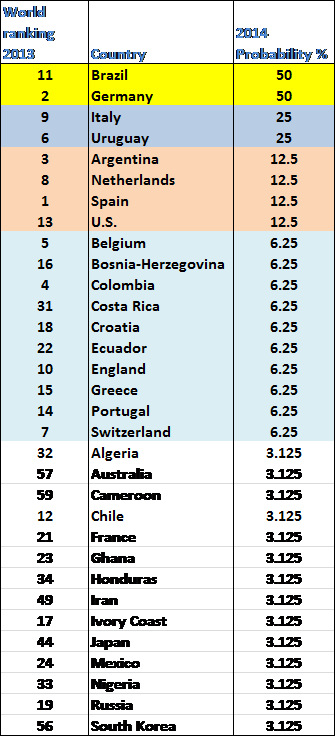
It’s that time again and there is no point in not sticking my neck out. It’s a mixture of “science”, wishful thinking and my prejudices. If I get one of the finalists and at least 8 of the last 16 correct I shall claim my system works!!!

My probabilities of winning for the 32 participants are:

WC 2014 Probabilities

WC 2014 Probabilities

And for the peace of the world and to avoid a full-blown revolution, Brazil will win.


Polar bears neither threatened nor endangered

June 10, 2014

It has become increasingly clear that polar bear numbers have been grossly (and probably intentionally) underestimated and that reality is beginning to displace the alarmist myth of the species being under threat. Canada has declined to classify the polar bears as being “threatened or endangered”.

This has not pleased the environmental priesthood  at all. The Center for Biological Diversity has lobbied heavily in the US against the Canadian decision not to toe the politically correct lineThey appealed to an international NAFTA environmental panel to “investigate”  Canada’s failure to implement NAFTA rules by failing to classify the thriving polar bears as “threatened and endangered”.

This appeal has been rejected.

Polar bears remain unthreatened and unendangered in Canada.

An international trade panel has decided not to review whether Canada is enforcing its own environmental legislation to protect its polar bear population.

photo Geoff York/Reuters

cbcnews:

An international trade panel has decided not to review whether Canada is enforcing its own environmental legislation to protect its polar bear population.

The Commission for Environmental Co-operation voted 2-1 to reject a request for an investigation into why Canada has chosen not to designate the bears as threatened or endangered. A U.S. environmental group had filed a submission claiming that decision leaves the bears without protection, despite the ongoing loss of their sea-ice habitat and resulting projections of declining numbers.

Related:

Activists pressure tactics to force Canada to list polar bears as ‘threatened’ have failed June 7th, 2014

Canada under international pressure to list polar bears as threatened, so far holds out January 27, 2013

Canada again under international pressure to list polar bears as threatened November 24, 2013

Bad forecasts and grovelling apologies have become standard for the IMF

June 9, 2014

It’s not what you say but what you do that counts.

Economics is clearly not a science though many would like us to think it is. But with the IMF it is just apology followed by apology for wrong forecasts and bad advice. It smacks of forecasts made to suit a political agenda or just plain incompetence. Based on their track record nothing that is said by Christine Lagarde or the International Monetary Fund that she heads can be taken very seriously. She spends more time apologising than would seem to be healthy.

The latest apology by Christine Lagarde has been called “grovelling”:

‘Do I have to go on my knees?’: grovelling apology from IMF head for incorrect warnings on UK economy

Head of the International Monetary Fund, Christine Lagarde, accepts her organisation’s low growth forecasts for the UK economy were wrong.

Christine Lagarde has asked whether she needs to grovel on her knees before George Osborne over the IMF’s incorrect warnings on the UK economy, as she warned against raising taxes.

“Do I have to go on my knees?” Ms Lagarde, the head of the International Monetary Fund said, when asked whether she has apologised to George Osborne over the fund’s low growth forecasts and calls to adopt a ‘Plan B’ of less austerity – calls the body now accept it got wrong.

In a blow to Ed Miliband, who has called for higher rates of personal taxation and new levies on banks, Ms Lagarde said tax rises are “not recommendable”.

But this is not an isolated incident. Time after time the IMF announces that some country has got its economic policy wrong and warns of dire consequence if the country does not follow the advice of the IMF. Then – a few months later – they admit that the IMF got it wrong. And ususally by then they have caused much misery and wailing and gnashing of teeth.

12th January 2012: Does the EU-IMF Owe Ireland an Apology?

2nd June 2012: IMF apology to Greece after Lagarde remarks – YouTube

3rd January 2013: An amazing mea culpa from the IMF’s chief economist on austerity

6th June 2013: For hard-hit Greeks, IMF mea culpa comes too late

In any normal corporation Christine Lagarde and the IMF’s Chief Economist,  Olivier Blanchard would have been sacked a long time ago. And to think that some are suggesting Christine Lagarde for the top job in the EU only reduces my respect for the IMF and the EU.