Ants which adapt to human behaviour are considered a threat

August 14, 2013

Why do we penalise successful species and protect the failures? Almost as if we we wish to deny evolution by ensuring the survival of those which don’t deserve to survive.

If Giant Pandas were not as disinterested as they seem to be in reproducing themselves and as specialised in eating only a few species of bamboo, but instead were immensely successful in increasing their own numbers, then we would no doubt be organising Panda culls. But since they are an almost perfect example of a species bent on its own extinction we go to all possible lengths to keep them going!

Yet another story where a successful species which adapts to and make use of humans and human behaviour is then considered a “threat”. Unsuccessful species of course would become “endangered” and would then be protected!

BBCThe problem of invasive ants may be far worse than previously thought. 

A Spanish team of scientists has found that larger than expected numbers of the insects are being unwittingly shipped around the world. The researchers warn that many of these species are establishing colonies in their new habitats that could pose a threat to the environment, infrastructure and human health. The research is published in the journal Royal Society Biology Letters.

Lead author Veronica Miravete, from the University of Gerona in Spain, said: “Due to their small size, most ants are transported involuntarily in containers and other boxes, together with soil, wood, ornamental plants and fruits etc, on ships or airplanes.”

The research team looked at the numbers of exotic ants in the Netherlands, the United States and New Zealand.

Fire ant

They found far more of these accidental stowaways than had previously been reported.

Extrapolating from this data, they estimate that 768 exotic ant species could have been introduced around the world through trade routes.

Of these, they believe that more than 600 species could have established new colonies.

Dr Miravete said: “The number of ants arriving is very large and 85% of the introduced species are able to establish successfully. This indicates that there are many introduced species that are living around us as of yet undetected.”

While not all animals that move to a new region pose a threat, some can wreak havoc – and invasive ants are some of the worst alien offenders.

Indian Navy: The tragic, the good, the bad and the ugly

August 14, 2013

The Indian Navy’s diesel submarine, INS Sindhurakshak, experienced an explosion and fire while at port in Bombay and has sunk with 18 sailors trapped and possibly dead.

The Indian navy's Sindhurakshak submarine in Visakhapatnam earlier this year. Photograph: Kamal Kishore/Reuters

The Indian navy’s Sindhurakshak submarine in Visakhapatnam earlier this year. Photograph: Kamal Kishore/Reuters

Accidents happen, everywhere but there is always the real possibility with accidents in India that institutional or individual “negligence” has a significant part to play. The negligence is often institutional in that processes and routines are lax or ill-defined or incomplete. It is not only in construction and repairs that India often exhibits the “last mile syndrome” where the last 5% of anything just does not get done!. Cost or budget considerations are a very common excuse for not making the final quality checks – whether in processes or in products.

In state owned establishments – like the Navy – institutional weaknesses can also arise because political considerations and politicians can subvert the processes. Individual negligence is not unknown and is usually a case of incompetence at some level. Not least because of the incompetence of the recruitment, training or supervision of the individuals concerned. In the Defense Services (and not just in India), seniority very often overrules competence in the making of appointments. Indian military appointments – and especially senior appointments – have been the subject of much (idiotic) litigation. Unfortunately even the Indian Courts give little importance to competence and have enshrined the appointment of the “most senior”. For fears of being accused of nepotism it is always easiest to appoint the “most senior” rather than the “most competent” or the “best suited” candidate for an appointment.

Of late the Indian Navy has been the subject of many news articles ranging from today’s tragic story to stories of achievement but also of decadence and dissolution.

All these stories are just from the last 30 days:

Navy sex scandal: wife of official arrested

A 25-year-old estranged wife of a navy officer, who rocked the Indian Navy earlier this year by accusing her husband of forcing her to get “sexually involved” with his colleagues, has been arrested by the south Delhi police on charges of cheating and fraud.

First Indian nuclear submarine set for open sea trials

India announced Saturday that its first indigenously-built nuclear submarine is ready for sea trials, a step before it becomes fully operational, and called it a “giant stride” for the nation. India unveiled the 6,000-ton INS Arihant — Destroyer of Enemies — in 2009 as part of a project to built five such vessels which would be armed with nuclear-tipped missiles and torpedoes.

Prime Minister Manmohan Singh said he was “delighted to learn that the nuclear propulsion reactor on board INS Arihant, India’s first indigenous nuclear powered submarine, has now achieved criticality”.

Indian SSBN Arihant Achieves Milestone, Govt Messes Up By Releasing Photo Of US Navy Submarine

The Indian Information & Broadcast Ministry has just released this Youtube clip which contains a single still photograph of what it wants you to believe is the INS Arihant SSBN, which reached a milestone today with its pressure water reactor finally going criticial. Well, guess what. Even on a day like this, the government didn’t mind filching a photograph of a US Navy Ohio-class submarine in an officially released video.

Indian-built aircraft carrier INS Vikrant launched

India has unveiled its first home-built aircraft carrier from a shipyard in southern Kerala state. The 37,500 tonne INS Vikrant is expected to go for extensive trials in 2016 before being inducted into the navy by 2018, reports say. With this, India joins a select group of countries capable of building such a vessel.

Massive Explosion Sinks Indian Submarine At Berth, Salvage On

A huge explosion inside Indian Navy Kilo-class submarine INS Sindhurakshak late last night sunk it in its berth at the Mumbai naval dockyard, with just a tiny portion visible. A major fire spread inside the submarine post the explosion. The navy put out a statement a short while ago to say that 18 personnel were on board when the explosion ripped through the submarine, but doesn’t say yet if they’ve been rescued. Salvage and rescue operations are on right now, and have been through the night.

Launching of INS Vikrant August 12th 2013 – image Livefist

Officials at World Athletics championship do not impress

August 13, 2013

I have just been watching the World Athletic Championships from Moscow on TV and need to have a little rant at bumbling officialdom.

I am not sure if this is to the account of the IAAF or to the Russian organisers but the officials at the 2013 World Championships in Moscow have been less than impressive.

  1. Idiot officials at the winning line who try to shoo away decathlon and heptathlon athletes who have collapsed on the track after completing their grueling final runs in the 1500m and 800m respectively.
  2. The utter lack of interest from idiot officials who merely watched as an athlete (Diego Ferrin high jump) was writhing in pain from a pulled muscle (hamstring?).
  3. The apparent lack of medical facilities  around the stadium which takes many minutes for assistance to come to injured or physically drained athletes (Hansle Parchment, Diego Ferrin)
  4. Idiot officials who try to keep winning athletes from celebrating and approaching their supporters.
  5. Idiot officials who are unable to ensure that the athletes competing in the 20km walk follow the designated route and where the position of the winning line is obscure.

I’m sure many of the officials are just temporary help drafted in off the streets for the championships but they do remind me of the security staff at airports – instructed to follow some rigid protocol and not – in any circumstances – to use their brains or their discretion.

Great Tohoku quake in 2011 caused standing waves in Norwegian fjords 30 minutes later

August 13, 2013

Seismic seiches are standing waves set up on rivers, reservoirs, ponds, and lakes when seismic waves from an earthquake pass through the area. They are in direct contrast to tsunamis which are giant sea waves created by the sudden uplift of the sea floor.”

A new paper describes how these seiches -standing waves – observed in the Norwegian fjords in 2011 – for the first time since the 1950’s – have been linked to the Great Tohoku Quake of 2011 half an hour earlier.

Stein BondevikBjørn Gjevik and Mathilde B. Sørensen, Norwegian seiches from the giant 2011 Tohoku earthquake, Geophysical Research Letters, DOI: 10.1002/grl.50639, 2013

Abstract: Seismic waves of the giant 2011 Tohoku earthquake triggered seiches in western Norwegian fjords. The seiching began a half hour after the earthquake origin time. The oscillations were noted by eyewitnesses and recorded by surveillance and cell phone cameras. The observations show maximum trough-to-peak amplitudes of 1.0–1.5 m and periods of 67–100 s. The water waves were not triggered from the arrival of the surface waves, the timing inferred for other seiches. Instead, the seiching began during the passage of horizontal waves. We reproduced the S wave trigger by means of a shallow-water wave model calibrated previously to Norwegian tides and storm surges. The simulations, which used the observed earthquake motion as forcing, show water waves with periods and amplitudes similar to those in the film clips. However, the strongest horizontal ground oscillations with shorter periods (20–30 s) did not contribute much to the formation of the seiches.

It is not the first time that such standing waves have been observed so far away. As the US Geological Service notes:

The term seismic seiche was first coined by Anders Kvale in 1955 to describe oscillation of lake levels in Norway and England caused by the Assam earthquake of August, 1950. But this was not the first time that seismic seiches had been observed. The first published mention was after the great earthquake of November 1755 at Lisbon, Portugal. An article in Scot’s Magazine in 1755 described seiches in Scotland in Loch Lomond, Loch Long, Loch Katrine and Loch Ness. They were also seen in English harbors and ponds and were originally described in the Proceedings of the Royal Society in 1755.

…….

Seismic waves from the Alaska earthquake of 28 March, 1964, were so powerful that they caused water bodies to oscillate at many places in North America. Seiches were recorded at hundreds of surface-water gaging stations – although they had rarely been reported following previous earthquakes. Indeed, four seiches were observed in Australia.

Some of the 1964 seiches were very large. Waves as high as 1.8 meters were reported on the Gulf Coast – probably because they were generated in resonance with the seismic surface waves.

In the case of the Norwegian fjords and the Great Tohoku quake, PhysOrg reports:

The scene was captured by security cameras and by people with cell phones, reported to local media, and investigated by a local newspaper. Drawing on this footage, and using a computational model and observations from a nearby seismic station, Bondevik et al. identify the cause of the waves—the powerful magnitude 9.0 Tohoku earthquake that hit off the coast of Japan half an hour earlier.

In closed or semi-enclosed bodies of water, seismic waves can trigger standing waves known as “seiches.” Seiching had not been recorded in Norway’s fjords since 1950. Scientists have traditionally thought that seiching is caused by seismic surface waves, but the authors find that the fjord seiching was initiated before the surface waves had arrived.

Using seismic observations and a model for local fjord behavior, they find that in this case the seiching was triggered by S waves, which travel through Earth’s body, and later was amplified by Love waves, which travel on Earth’s surface. There are a lot of open questions surrounding the connection between earthquakes and seiching, but the authors’ research supports the idea that not all earthquakes will cause seiching in all enclosed bodies of water. The occurrence of the Japanese earthquake?induced seiches depended on the period and orientation of the seismic waves aligning with the natural frequency and orientation of the body of water.

What’s in an “e”? Berkley vs. Berkeley

August 12, 2013

From Copy, Shake and Paste

Everyone knows that Berkley is an excellent university in the United States. Or was that Berkeley? Whatever, if someone is sporting a degree that looks impressive, it must be from that place. 

Except when it is not.

It has come to light, as the Swiss daily paper Tages-Anzeiger noted on 9 August 2013, that the IT-boss at the University Hospital in Zürich has stepped down because of a missing ‘e’. The University of California, Berkeley, is indeed one of the top universities in the US. But it did not grant a doctoral degree to Jürgen Müller. Müller had been working on his doctorate at the University of Passau in Germany when his financing ran out.

Müller then heard about the University of Berkley, and for only $ 3000 in fees he was soon the proud owner of a sheepskin declaring him to be a “Doctor of Science”, according to the Tages-Anzeiger

…… 

…. The Tages-Anzeiger article ends with an interesting note. It seems that in March of 2013 a whistleblower tried to contact Müller’s boss about his purchased degree. Müller, as IT boss, apparently had this person on a blacklist, so that emails from him did not bounce, but were just silently destroyed. 

I suppose the University Hospital in Zürich is glad that he has resigned. The question is, where will he pop up again where people don’t know the difference one letter can make?

The University of Berkley’s rates for purchasing degrees are below. It’s best to buy your Master’s and Doctor’s degrees together and in advance!!

Buying your Berkley degree

Buying your Berkley degree

The University of Berkley is a diploma mill and the subject of many scam reports and warnings such as this one:

University of Berkley Distance Learning Accreditation Report

CAUTION: You should be aware… this college is NOT ACCREDITED by any agency recognized by the Council on Higher Education Accreditation or the US Department of Education to award degrees.
Distance learning accreditation claims include:

  • New Accrediting Partnership for Educators Worldwide (NAPEW)

You should be aware that this agency is NOT RECOGNIZED by the Council on Higher Education or the US Department of Education as a college accreditation institution. What does this mean? For you, as a consumer, this means credentials earned at this college might not meet with wide acceptance at other CHEA-accredited online colleges and might not meet with academic or employment acceptance across the USA. You should be aware that in some states and for some professions it may be illegal to use a degree from an non accredited school for employment purposes.

CAUTION: the following State Warnings apply to this online college

  • Michigan State Warning: CAUTION! The State of Michigan classifies this online college as an UNACCEPTABLE INSTITUTION for credentialing for those seeking jobs in the State’s Department of Civil Service: (Consult Michigan’s NON ACCREDITED COLLEGES/UNIVERSITIES – “Degrees from these institutions will not be accepted by the Department of Civil Service as satisfying any educational requirements indicated on job specifications”:  http://www.michigan.gov/documents/Non-accreditedSchools_78090_7.pdf)
  • Texas State Warning: CAUTION! The State of Texas classifies this online college as an ILLEGAL SUPPLIER of educational credentials in the State of Texas (Consult: Texas Higher Education Coordinating Board Institutions Whose Degrees are Illegal to Use in Texas:  http://www.thecb.state.tx.us/AAR/PrivateInstitutions/NoTX.cfm)

Australian election show makes a quiet start

August 12, 2013

Elections in a number of countries have fantastic entertainment value.The campaigns, the scandals, the gaffes, the TV pundits, the “fringe” idiots and personal animosities all can contribute to the fun.  Of course a certain amount of distance and having a real interest in the country while not being overly affected by the result does increase the potential. In my case having friends in the country on both sides of the political divide adds to the “fun index”. The US Presidential Elections of course lead in the entertainment ratings. Even though they go on for much too long they usually manage to keep the flow of scandals and blunders coming and the inanity level high enough to maintain the “fun level”.

Generally it requires a strong divide between two major parties to inject some excitement for voyeurs like myself. Single party states don’t provide any level of uncertainty and have too high a level of election violence to have much entertainment value. Proportional Representation – as in most of Europe  – tends to reduce the excitement level but even in the Scandinavian countries does not manage to kill all the fun. Generally in much of Europe the inanity and “fun” comes from the idiot fringe parties – usually on the far right but also from a few remnants of hard Marxists and Maoists.

Following the US Presidential I would put the UK General Election next for fun and games. The political and media circus that accompanies the multiple waves of voting in the Indian General Election are always good entertainment. Then – in my estimation and reflecting my interests – come the Australian, German, French and Japanese Elections.

The first week of the Australian Election campaign called by Kevin Rudd is over. It has been relatively quiet and there has been no heat – yet – and no real fireworks. But I still have hope. Murdoch made his views known – as if there was anybody who did not know what they were. I suspect – but I am not sure – that the days of Murdoch being King-maker (as he was for Tony Blair) have long gone. His stuff is now all pay-walled and the cyberworld has passed him by.

Most of the fun in the first week of this election has actually come from a candidate – Stephanie Banister – representing one of the idiot right fringe parties. She got her knickers properly into a twist and confused the Koran with haram, haram with halal, halal with kosher, Islam with a country and Jews with the worship of Jesus. She quit the next day. Quite amusing but peripheral, short-lived and of little consequence.

Keven Rudd – having disposed ruthlessly of Julia Gillard – flexed his new-found muscles and sacked two of his own candidates. There was a faint whiff of an old gender scandal surrounding one of them and the other was accused of accusing others as being too Catholic and racist. ( A case of against.against= for?). Nobody except some union members, seemed to care very much.

Rudd sees himself as a Shakespearean hero in the assassination of Julia Gillard – “for Gillard is an honourable man” (and “man” here is intentional).  He aroused some feelings of  machismo among his supporters and his party “bounced” in the polls. But that bounce has now withered away and Abbott’s coalition is back in the lead. No real trends are visible yet. Last night there was a pretty tame TV debate. Rudd and Abbott shook hands and came out mewling.  Not much “roar” or “cut and thrust”. Rudd was very cautious and apparently “cheated” and had to make use of “crib-sheets” during the debate. As the SMH put it “More mock and bore than shock and awe, Sunday’s debate was a crushingly dull affair where risk avoidance was the chief aim of both sides.” Tony Abbot got his tongue in a twist and instead of “repository of all wisdom” used the phrase “suppository of all wisdom”! I suppose a suppository – for some – could also be a repository.

As entertainment goes it was not a compelling start. Moscow and Usain Bolt took clear precedence yesterday. But there is still time for the fun and games to get up to speed.

Noted in passing 11th August 2013

August 11, 2013

A little brief this week since we have had some flooding in the cellar following a storm.

We are now busy mopping up.

Chemical analyses of bones leading to recreating the life of archaeological finds.

A new word for my vocabulary – Scripophily.

Carl Zimmer takes George Monbiot to task for being too simplistic about recreating extinct species.

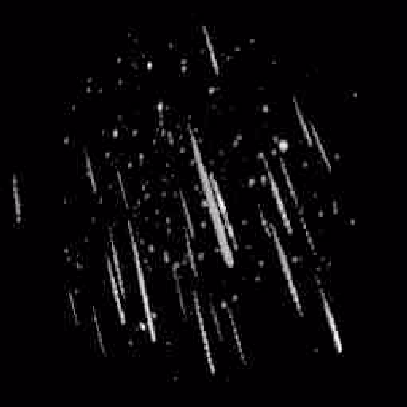
The  Perseid meteor shower  could be visible tonight and tomorrow night.

See Explanation.  Clicking on the picture will download  the highest resolution version available.

The Perseid Meteor Shower
Credit: Sirko Molau, IMO, Archenhold-Sternwarte

THE exam howlers

August 10, 2013

From this years submissions to the THE (not in any order of rank):

  1. “Sex has puzzled biologists ever since it was discovered by Darwin and Mendel.” (winning submission)
  2. “Eugenics was created by Charles Darwin’s cousin Gollum.”
  3. “Britain under the Cromwellian Protectorate was a piranha state.”
  4. “General Franco was supported by right-wing panties.”
  5. “Extremophiles can be defined as those that tolerate extremes of temperature, extremes of pH and extremes of pleasure.” 
  6. “Nigella seeds can cure all disease except death.”
  7. “Ebola could lead to death, in some cases fatal.”
  8. An Egyptian king,”was a pharaoh, not a common pheasant.”
  9. ..“depression rates are higher in areas of high social depravity.” 
  10. In a paper on HIV/AIDS transmission, as an example of “risky” behaviour likely to spread infection, a student listed “sharing a condom”.

  11. “Hadrian’s Wall’s heritage assets include a complex system of forts and earthworms.”
  12. “Stalin was extremely surprised when he was taken from behind by Hitler.”

Some rather interesting exam howlers can be found here.

“Carbon dioxide involved but not determinative in 100,000 year glacial cycles”

August 10, 2013

We are still struggling to explain what initiates an ice age (glaciation) and what causes them to end and the ice sheets to withdraw giving the interglacials.
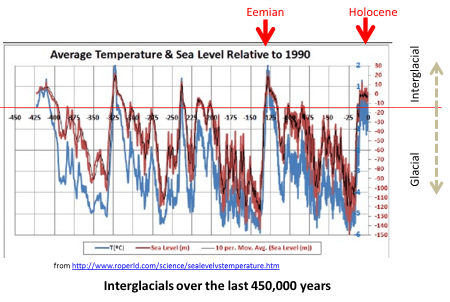
interglacials

That the Milankovitch cycles and variations of insolation are involved in the onset and retreat of glacial periods is clear but the “how” is still elusive. Now a new paper describes a model where the ice sheets and the mutual feedbacks with climate are considered.

“Carbon dioxide is involved, but is not determinative, in the evolution of the 100,000-year glacial cycles”.

Abe-Ouchi A, Saito F, Kawamura K, Raymo ME, Okuno J, Takahashi K, Blatter H: Insolation-driven 100,000-year glacial cycles and hysteresis of ice-sheet volume. Nature, 2013, 500: 190-193, doi: 10.1038/nature12374

ETH Press Release: 

Ice ages and warm periods have alternated fairly regularly in the Earth’s history: the Earth’s climate cools roughly every 100,000 years, with vast areas of North America, Europe and Asia being buried under thick ice sheets. Eventually, the pendulum swings back: it gets warmer and the ice masses melt. While geologists and climate physicists found solid evidence of this 100,000-year cycle in glacial moraines, marine sediments and arctic ice, until now they were unable to find a plausible explanation for it.

Using computer simulations, a Japanese, Swiss and American team including Heinz Blatter, an emeritus professor of physical climatology at ETH Zurich, has now managed to demonstrate that the ice-age/warm-period interchange depends heavily on the alternating influence of continental ice sheets and climate.

“If an entire continent is covered in a layer of ice that is 2,000 to 3,000 metres thick, the topography is completely different,” says Blatter, explaining this feedback effect. “This and the different albedo of glacial ice compared to ice-free earth lead to considerable changes in the surface temperature and the air circulation in the atmosphere.” Moreover, large-scale glaciation also alters the sea level and therefore the ocean currents, which also affects the climate. 

As the scientists from Tokyo University, ETH Zurich and Columbia University demonstrated in their paper published in the journal Nature, these feedback effects between the Earth and the climate occur on top of other known mechanisms. It has long been clear that the climate is greatly influenced by insolation on long-term time scales. Because the Earth’s rotation and its orbit around the sun periodically change slightly, the insolation also varies. If you examine this variation in detail, different overlapping cycles of around 20,000, 40,000 and 100,000 years are recognisable (see box).

Given the fact that the 100,000-year insolation cycle is comparatively weak, scientists could not easily explain the prominent 100,000-year-cycle of the ice ages with this information alone. With the aid of the feedback effects, however, this is now possible.

The researchers obtained their results from a comprehensive computer model, where they combined an ice-sheet simulation with an existing climate model, which enabled them to calculate the glaciation of the northern hemisphere for the last 400,000 years. The model not only takes the astronomical parameter values, ground topography and the physical flow properties of glacial ice into account but also especially the climate and feedback effects. “It’s the first time that the glaciation of the entire northern hemisphere has been simulated with a climate model that includes all the major aspects,” says Blatter.

Using the model, the researchers were also able to explain why ice ages always begin slowly and end relatively quickly. The ice-age ice masses accumulate over tens of thousands of years and recede within the space of a few thousand years. Now we know why: it is not only the surface temperature and precipitation that determine whether an ice sheet grows or shrinks. Due to the aforementioned feedback effects, its fate also depends on its size. “The larger the ice sheet, the colder the climate has to be to preserve it,” says Blatter. In the case of smaller continental ice sheets that are still forming, periods with a warmer climate are less likely to melt them. It is a different story with a large ice sheet that stretches into lower geographic latitudes: a comparatively brief warm spell of a few thousand years can be enough to cause an ice sheet to melt and herald the end of an ice age.

The Milankovitch cycles

The explanation for the cyclical alternation of ice and warm periods stems from Serbian mathematician Milutin Milankovitch (1879-1958), who calculated the changes in the Earth’s orbit and the resulting insolation on Earth, thus becoming the first to describe that the cyclical changes in insolation are the result of an overlapping of a whole series of cycles: the tilt of the Earth’s axis fluctuates by around two degrees in a 41,000-year cycle. Moreover, the Earth’s axis gyrates in a cycle of 26,000 years, much like a spinning top. Finally, the Earth’s elliptical orbit around the sun changes in a cycle of around 100,000 years in two respects: on the one hand, it changes from a weaker elliptical (circular) form into a stronger one. On the other hand, the axis of this ellipsis turns in the plane of the Earth’s orbit. The spinning of the Earth’s axis and the elliptical rotation of the axes cause the day on which the Earth is closest to the sun (perihelion) to migrate through the calendar year in a cycle of around 20,000 years: currently, it is at the beginning of January; in around 10,000 years, however, it will be at the beginning of July.

Based on his calculations, in 1941 Milankovitch postulated that insolation in the summer characterises the ice and warm periods at sixty-five degrees north, a theory that was rejected by the science community during his lifetime. From the 1970s, however, it gradually became clearer that it essentially coincides with the climate archives in marine sediments and ice cores. Nowadays, Milankovitch’s theory is widely accepted. “Milankovitch’s idea that insolation determines the ice ages was right in principle,” says Blatter. “However, science soon recognised that additional feedback effects in the climate system were necessary to explain ice ages. We are now able to name and identify these effects accurately.”

Download video: 

Simulated ice sheet change during the last glacial cycle (mov file, video: Abe-Ouchi et al. 2013)

Abstract: The growth and reduction of Northern Hemisphere ice sheets over the past million years is dominated by an approximately 100,000-year periodicity and a sawtooth pattern (gradual growth and fast termination). Milankovitch theory proposes that summer insolation at high northern latitudes drives the glacial cycles, and statistical tests have demonstrated that the glacial cycles are indeed linked to eccentricity, obliquity and precession cycles. Yet insolation alone cannot explain the strong 100,000-year cycle, suggesting that internal climatic feedbacks may also be at work. Earlier conceptual models, for example, showed that glacial terminations are associated with the build-up of Northern Hemisphere ‘excess ice’, but the physical mechanisms underpinning the 100,000-year cycle remain unclear. Here we show, using comprehensive climate and ice-sheet models, that insolation and internal feedbacks between the climate, the ice sheets and the lithosphere–asthenosphere system explain the 100,000-year periodicity. The responses of equilibrium states of ice sheets to summer insolation show hysteresis, with the shape and position of the hysteresis loop playing a key part in determining the periodicities of glacial cycles. The hysteresis loop of the North American ice sheet is such that after inception of the ice sheet, its mass balance remains mostly positive through several precession cycles, whose amplitudes decrease towards an eccentricity minimum. The larger the ice sheet grows and extends towards lower latitudes, the smaller is the insolation required to make the mass balance negative. Therefore, once a large ice sheet is established, a moderate increase in insolation is sufficient to trigger a negative mass balance, leading to an almost complete retreat of the ice sheet within several thousand years. This fast retreat is governed mainly by rapid ablation due to the lowered surface elevation resulting from delayed isostatic rebound, which is the lithosphere–asthenosphere response. Carbon dioxide is involved, but is not determinative, in the evolution of the 100,000-year glacial cycles.

What’s in a number? Defining a Mamillion

August 10, 2013

The New York Times reports today that the Japanese debt has reached one Quadrillion Yen (1015 Yen).

Japan’s soaring national debt, already more than twice the size of its economy, has reached a new milestone, surpassing one quadrillion yen.

A paltry million is the numeral one followed by six zeros. A billion? Nine zeros. A trillion is getting up there: 12 zeros. But the mighty quadrillion has 15 of them. … 

A quadrillion is a million billion, putting it into the kind of language used by middle schoolers to describe really humongous sums, along with gazillion and bazillion.

Measuring any currency in quadrillions brings to mind the hyperinflation of Germany between the wars, or Zimbabwe in the last decade. But a country with a real currency?

It is such a big and unusual word, describing such a big and unusual number, that its use is inconsistent: Bloomberg News used quadrillion in the headline of an early story on Friday about Japan’s debt, but later in the day the stories and headlines referred to a “thousand trillion,” which is not nearly as much fun.

…  How much is a quadrillion? The entire human body is said to have just 100 trillion cells; it takes 10 of us to make a quadrillion. Jeff Bezos has a personal fortune of some $25 billion, allowing him to plunk down $250 million for The Washington Post, which is essentially how much money he might find by looking behind his sofa cushions. To get to a quadrillion dollars, however, we would have to have 40,000 Bezoses, or as many people as live in Prescott, Ariz.

Neil deGrasse Tyson, the astrophysicist and director of the Hayden Planetarium at the American Museum of Natural History, helpfully offered a few other ways to think about a quadrillion. “It would take you 31 million years to count to a quadrillion — one number per second, never sleeping,” he said in an e-mail, adding that “a quadrillion yen, stacked in 1,000-yen notes, would ascend 70,000 miles high.”

He also wrote, though it is not clear how he would know such a thing, that “the total number of all sounds and words ever uttered by all humans who have ever lived is about 100 quadrillion.”

Numbers from 103 (Thousand) to 10123 (Quadragintillion) with the exponent increasing in steps of 3 and then upto 10603 (Ducentillion) in exponent steps of 30 and then upto 103003 (Milillion) in exponent steps of 300 have been named.

10100 is a Googol and 10Googol is a Googolplex.

But I cannot find a name for the relatively simple concept of one million raised to the power of one million.

A Zillion is undefined but language still needs such a word for a very large indeterminate number. Gazillion is often used instead of Zillion. The word “Million” itself is thought to have come about to represent a “Large Thousand” (from mille = thousand). A million raised to the power of itself would quite definitely be a Large Million.

So I propose a word to represent a “Large Million”, the mother of all millions,  a Ma Million

Mamillion = Millionmillion = 1,000,0001,000,000

Considering the magnitude of the current Japanese debt, it will be some time before the debt of the whole world reaches a Mamillion in whatever currency one cares to choose!.