Going East the Vikings were seen as “handsome but filthy”

July 18, 2013

ScienceNordic reports on a new doctoral thesis by an Icelandic historian:

The Icelandic historian Thorir Jonsson Hraundal has studied comments about what we call Vikings in original texts by Arab historians and geographers. The texts described Arab encounters with Scandinavians in areas around the Caspian Sea and the Volga River. 

Their depictions differ radically from images of fearsome Viking conquerors handed down from the British Isles and France in the same era. 

“A major difference between the Scandinavians who travelled eastwards and those who sailed west was that in the East they were far more subordinated in societies they came to,” says Jonsson Hraundal.

He recently presented his doctoral dissertation at the University of Bergen about the so-called Rus ― Scandinavian merchants and warriors who travelled to Eastern Europe, Central Asia and the Middle East.

“The Scandinavians appear to have been versatile people who were really good at adapting to diverse regions and participating in various power structures,” he says. …

…. For a number of reasons, the East-bound Vikings have been neglected by scholars in comparison to those who headed west. Political problems hampered Western archaeologists for decades. During much of the 20th century it was hard for West European researchers to access artefacts collected behind the Iron Curtain.

“We have a lot more source information from the West because of the linguistic and writing culture that dominated there,” adds Archaeology Professor Jan Bill of the University of Oslo.

“This doesn’t mean that the contact in the East was unimportant, but perhaps we haven’t had as much opportunity to study it.”

There are exceptions and Bill mentions that Arab silver coins and other artefacts from Kazakhstan and neighbouring areas have been found at Heimdalsjordet, a former marketplace not far from the Gokstad Viking Ship Mound in Sandefjord, southwest of Oslo.

“They come from the Silk Road and show that the Vikings definitely had contact with Islamic areas,” he says.

He draws on and analyses the writings of Ahmad ibn Fadlān ibn al-Abbās ibn Rāšid ibn Hammād.

He was a 10th-centuryArab traveler, famous for his account of his travels as a member of an embassy of the Abbasid Caliph of Baghdad to the king of the Volga Bulgars. His account is most known for providing a description of the Volga Vikings, including an eyewitness account of a ship burial.
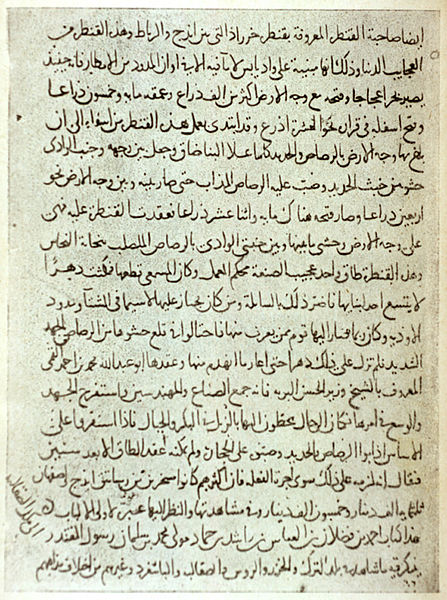
File:Ibn Fadhlan manuscript.jpg

Ibn Fadhlan manuscript

Elements of Ibn Fadlān’s account are used in the novel Eaters of the Dead  by Michael Crichton (adapted to film in The 13th Warrior with Antonio Banderas as Ibn Fadlan), in which the Arab ambassador is taken even further north and is involved in adventures inspired by the Old English epic Beowulf.

Some excerpts from Ahmad ibn Fadlān:

They are the filthiest of all Allah’s creatures: they do not purify themselves after excreting or urinating or wash themselves when in a state of ritual impurity after coitus and do not even wash their hands after food.

I have never seen more perfect physical specimens, tall as date palms, blond and ruddy; they wear neither tunics nor kaftans, but the men wear a garment which covers one side of the body and leaves a hand free. Each man has an axe, a sword, and aknife, and keeps each by him at all times. Each woman wears on either breast a box of iron, silver,copper, or gold; the value of the box indicates the wealth of the husband. Each box has a ring from which depends a knife. The women wear neck-rings of gold and silver. Their most prized ornaments are green glass beads. They string them as necklaces for their women.

In the case of a rich man, they gather together his possessions and divide them into three portions, one third for his household, one third with which to cut funeral garments for him, and one third with which they ferment alcohol which they drink on the day when his slave-girl kills herself and is burned together with her master.

Mandela Day today

July 18, 2013

Nelson Mandela is 95, critically ill in hospital and it is Mandela Day today.

Nelson-Mandela-by-Eli-Weinberg-1961

Nelson-Mandela-by-Eli-Weinberg-1961

“Where you stand depends on where you sit.”


retronaut images

Animal studies biased to give “positive” results

July 18, 2013

It is not suggested that the bias is any form of deliberate misconduct but a new paper shows that animal studies are subject to an “excess significance bias”.

Tsilidis KK, Panagiotou OA, Sena ES, Aretouli E, Evangelou E, et al. (2013) Evaluation of Excess Significance Bias in Animal Studies of Neurological Diseases. PLoS Biol 11(7): e1001609. doi:10.1371/journal.pbio.1001609

Author Summary

Studies have shown that the results of animal biomedical experiments fail to translate into human clinical trials; this could be attributed either to real differences in the underlying biology between humans and animals, to shortcomings in the experimental design, or to bias in the reporting of results from the animal studies. We use a statistical technique to evaluate whether the number of published animal studies with “positive” (statistically significant) results is too large to be true. We assess 4,445 animal studies for 160 candidate treatments of neurological disorders, and observe that 1,719 of them have a “positive” result, whereas only 919 studies would a priori be expected to have such a result. According to our methodology, only eight of the 160 evaluated treatments should have been subsequently tested in humans. In summary, we judge that there are too many animal studies with “positive” results in the neurological disorder literature, and we discuss the reasons and potential remedies for this phenomenon.

Roli Roberts writes at the PLOS blog:

But a study just published in PLOS Biology by Konstantinos Tsilidis, John Ioannidis and colleagues at Stanford University shows that a meta-analysis is only as good as the scientific literature that it uses. That literature seems to be compromised by substantial bias in the reporting of animal studies and may be giving us a misleading picture of the chances that potential treatments will work in humans. ….

Rather than wilful fraud, the authors of the PLOS Biology study suggest that this excess significance comes from two main sources. The first is that scientists conducting an animal study might analyse their data in several different ways, but ultimately tend to pick the method that gives them the “better” result. The second arises because scientists usually want to publish in higher profile journals that tend to strongly prefer studies with positive, rather than negative, results. This can delay or even prevent publication, or relegate the study to a low-visibility journal, all of which reduce their chances of inclusion in a meta-analysis.

The new work raises important questions about the way in which the scientific literature works, and it’s possible that the types of bias reported in the PLOS Biology paper have been responsible for the inappropriate movement of treatments from animal studies into human clinical trials. What do we do about it? Here are the authors’ suggestions:

  1. Animal studies should adhere to strict guidelines (such as the ARRIVE guidelines) as to study design and analysis.
  2. Availability of methodological details and raw data would make it easier for other scientists to verify published studies.
  3. Animal studies (like human clinical trials) should be pre-registered so that publication of the outcome, however negative, is ensured.

 Well, these are all excellent, but most people would also say that there are problems elsewhere in the system – in the high-profile journals’ desire to a have a cute story with well-defined conclusions, and in the forces exerted on authors by institutions and funding bodies to publish in those high-profile journals.

T Rex on the Seine

July 17, 2013

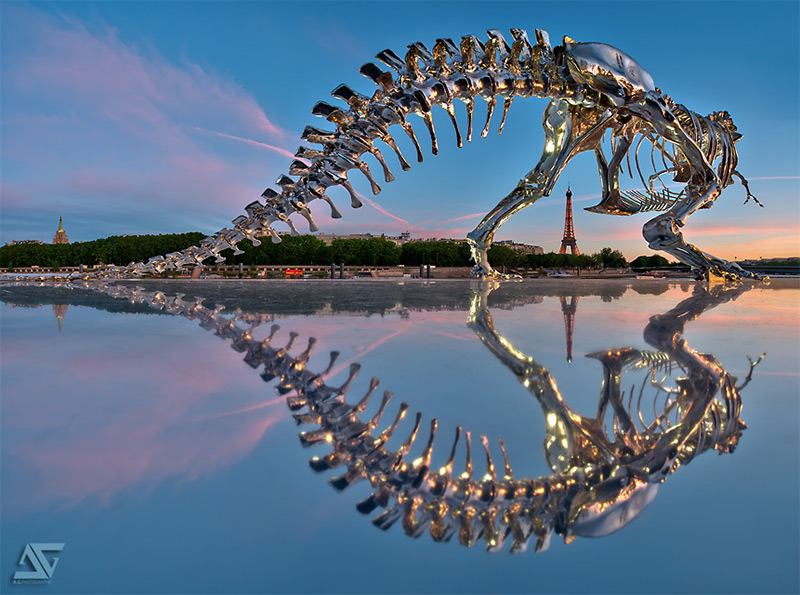
Colossal: Artist Philippe Pasqua recently completed installation of an impressive Tyrannosaurus Rex skeleton that now stands watch over the Seine river in Paris. The structure is made from 350 chrome molded bones and measures a full 21′ x 12′ (3m by 6m). Photograph courtesy Anthony Gelot.

trex on the seine - artist pasqua photo gelot

trex on the seine – artist pasqua photo gelot

Lunatic science? Cardiac surgery gives better results during a waning full moon!

July 17, 2013

It is not the 1st of April so presumably this “lunatic science” about the effects of a waning full moon on improved results after surgery  – taking “lunatic” in its proper sense of moon-sick  – is not just fantasy!

The message is clear. Schedule any cardiac surgery you may need during a waning full moon! But it does go against previous “lunatic belief” expressed by a UK politician as recently as 2009. Tredinnick, a Conservative MP,  is a supporter of astrology especially the use of it in medical practice!

 In October 2009, British politician David Tredinnick asserted that during a full moon “[s]urgeons will not operate because blood clotting is not effective and the police have to put more people on the street.”.

The belief that there is correlation between specific stages of the Earth’s lunar cycle and behavior in animals including human beings that cannot simply be explained by variation in light levels. There is no scientific reason to expect this to be the case and, in spite of numerous studies, no significant lunar effect on human behaviour has been established. Scholars debunking the effect sometimes refer to it as the Transylvanian hypothesis or the Transylvanian effect to emphasise its fanciful nature – Wikipedia

One wonders of course whether the effects of the full moon are affecting the surgeons or the patients.

This “study” – not funded- from the Rhode Island Hospital has just been published:

J. H. Shuhaiber, J. L. Fava, T. Shin, N. Dobrilovic, A. Ehsan, A. Bert, F. Sellke. The influence of seasons and lunar cycle on hospital outcomes following ascending aortic dissection repair. Interactive CardioVascular and Thoracic Surgery, 2013; DOI: 10.1093/icvts/ivt299

Franke Sellke

Franke Sellke

EurekAlert: 

Waning and full moon cycles impact length of stay, mortality

PROVIDENCE, R.I. – If you need cardiac surgery in the future, aortic dissection in particular, reach for the moon. Or at least try to schedule your surgery around its cycle. According to a study at Rhode Island Hospital, acute aortic dissection (AAD) repair performed in the waning full moon appears to reduce the odds of death, and a full moon was associated with shorter length of stay (LOS). The study is published online in advance of print in the journal Interactive Cardiovascular and Thoracic Surgery.

The purpose of the study was to assess the effect of natural time variations of both the season and the lunar cycle phase on hospital survival and length of stay (number of days a patient is in the hospital) following acute aortic dissection repair.

Read the rest of this entry »

The profligacy of “green” power is not sustainable

July 16, 2013

Chasing “green” fantasies about renewable energy are proving to be among the most profligate of all the misguided policies which build on alarmist scenarios. Renewable energy has its place but it is the “green” belief that it could replace fossil fuels which has proven to be nonsense. And what is worse is that the pursuit of “low carbon” energy serves no purpose whatsoever. It is just waste which has cost Europe many millions of jobs and has unnecessarily prolonged the recession. Perhaps as many as 15 million jobs in Europe have been “lost” based on the growth that has been suppressed by high energy prices.

Financial Times: 
RWE npower became the first of the big six power suppliers publicly to warn that the government’s green policies will cost consumers more, saying energy bills would rise by more than 19 per cent by the end of the decade.

The Telegraph:

A household’s energy bill will rise from £1,247 today to £1,487 by 2020 in real terms – not taking into account inflationary increases – if usage remains static, npower warns in a report. Costs caused by government policies such as subsidies for new wind farms and energy efficiency schemes will be the main driver, adding £144, it claims.

…. The report finds that the costs of upgrading Britain’s ageing gas and electricity networks would be the next biggest driver of bills, adding £114, while the costs of the nationwide roll-out of “smart meters” that send automatic meter readings back to suppliers will add £24.

Profits will account for £71, or just under 5pc, of the bill by 2020, up £12 from today, but a significant jump from £18 in 2007.

What food crisis?

July 16, 2013

In 1961 the world population was just over 3 billion. Now it is 7 billion. The UN Food and Agriculture Organisation’s 2013 Statistical Year Book is now out and shows that during this period:

Agricultural production has increased  

  • Global crop production has expanded threefold over the past 50 years, largely through higher yields per unit of land and crop intensification.
  • Global per capita food supply rose from about 2 200 kcal/day in the early 1960s to over 2 800 kcal/day by 2009
  • Buoyed by high commodity prices, agriculture has demonstrated astonishing resilience during global economic turmoil. In 2010, agricultural value-added at the world level rose by 4 percent, in contrast to a 1 percent increase in overall GDP.

image UNEP/GEAS

So while population has increased by a factor of 2.3, the food available per person has increased by about 30%. Of course there are many millions who still suffer from malnutrition but this is primarily due to poverty and a failing of distribution systems. It is not the availability of food which has failed. The proportion of the population which is under-nourished continues to steadily decline.

Read the rest of this entry »

And so to bed…

July 15, 2013
Delhi street

Delhi street (Photo credit: April_May)

It has been a hectic week in Delhi.

A trip covering about 30 degrees of latitude and 60 degrees of longitude. From 58.7057° N, 15.7674° E to 29.0167° N, 77.3833° E and back.

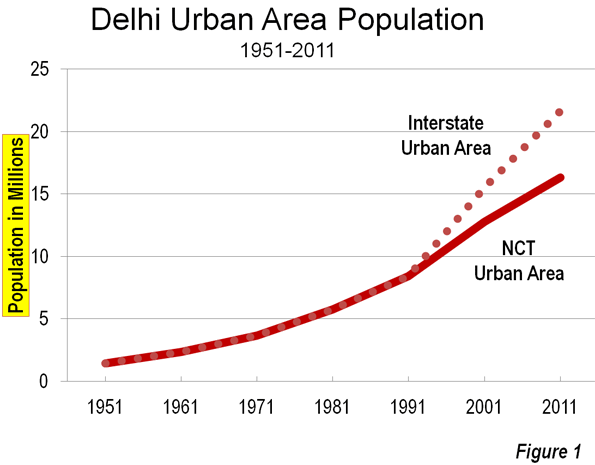
I first lived in Delhi in the 1950’s and the city has grown out of all recognition. Size and population and traffic have exploded. The infrastructure has only just about managed to keep pace. (Considering the rate of growth that itself is no mean achievement.) Every home boiled water then and uses water purifiers today. You were subject to sporadic loss of power then and now put up with regular “load shedding” (as demand side power management is called). But inverters and generators are common and the urban Delhi dweller can “make do”. He has to – he has no choice.

Delhi Urban population – newgeography.com

The same “standard meal” (a bowl of rice, 4 chappatis, a bowl of lentils, 2 servings of vegetables and a small bowl of yogurt) costs Rs 30 ($0.50) from the street vendor, Rs 60 from the roadside dhaba, Rs 70 from the office canteen and about Rs 800 at an upmarket hotel restaurant. But mangoes from Uttar Pradesh were in season and mangoes and papaya everyday for breakfast was refreshing. And my hosts were kind enough to pack 10kgs of mangoes I could bring back with me.

Read the rest of this entry »

That’s how to start a CV!

July 14, 2013

A CV needs to capture the interest of the reader within the first one or two paragraphs. ( Writing Your CV )

My congratulations to Professor Joachim Heberle of the Freie Universität Berlin who has this refreshing, compelling and exemplary start to his CV on his University web-page.

Heberle CV

Hi, my name is Joachim Heberle. My research interest is in the structure and function of membrane proteins and in the methodologies to investigate those … when I have time. Mostly, I am an adminstrative slave. The remainder of my time, I try hard to feed (i.e. raise funds) and comfort my coworkers (i.e. discuss science and give advice). I am not supposed to be a professor in Physics because I received my University education in Chemistry. However, my colleagues and students are so generous to tolerate my ignorance. If you are still interested in my professional CV, please click here.

Others in academia could do very well to follow his example.

“Now, gods, stand up for bastards!”

July 11, 2013

Shakespeare and Edmund – or Philip Sidney for that matter – could never have anticipated that by 2016 over half the children born in Great Britain (which country they knew not of) would be “bastards”.

The Telegraph:

The proportion of children born to unmarried mothers hit a record 47.5 per cent last year, according to the Office for National Statistics. The figure has risen from 25 per cent in 1988 and just 11 per cent in 1979.

If the trend continues at the current rate, the majority of children will be born to parents who are not married by 2016.

Four hundred years ago Shakespeare got Edmund to exclaim:

… Why “bastard”? Wherefore “base”?
When my dimensions are as well compact,
My mind as generous, and my shape as true
As honest madam’s issue? Why brand they us
With “base,” with “baseness,” “bastardy,” “base,” “base”—
Who in the lusty stealth of nature take
More composition and fierce quality
Than doth within a dull, stale, tirèd bed
Go to th’ creating a whole tribe of fops
Got ’tween a sleep and wake? Well then,
Legitimate Edgar, I must have your land.
Our father’s love is to the bastard Edmund
As to the legitimate.—Fine word, “legitimate”!—
Well, my legitimate, if this letter speed
And my invention thrive, Edmund the base
Shall top th’ legitimate. I grow, I prosper.
Now, gods, stand up for bastards!

But now 400 years on, “bastardy” continues in many shapes and forms even if “bastards” have all but lost their illegitimacy. I wonder what wonderful terms Shakespeare would have invented and what fun he would have had in describing the children of today. Children of two fathers, of two mothers, of one parent, of 3 parents, of the senior wife, of the junior wife and perhaps – in another 400 years – of no parents!

As long as there is even one parent we will of course continue to burden our children with our prejudices and foibles, with names not of their choosing, to brainwash them into our religions and “to suffer the slings and arrows” of our sins.
And without making any recourse to legitimacy, even 400 years from now some of them will still be “bastards” and “base”.