No mask needed, just don’t breathe

August 25, 2020

There are some who believe that epidemiology is a science. Others believe it is an art and yet others that it is the study of social behaviour based on gut-feel and science.

Whatever it is, it is not settled science.

An enveloped virus such as the Wuhan virus can survive for up to 2 months in a refrigerated corpse.

In studies looking at how bird flu (avian influenza virus, an enveloped virus) survives in chicken carcasses, 90% of the virus was inactivated in around 15 days when the carcass was left at room temperature. But if the carcass was held at refrigerator temperatures (4C/40F), the virus lasted 4.5 times longer—that’s more than two months.


Losing sleep

August 24, 2020

I have yet to find a political party which represents my views.

But of all the various parties from left to right, I find I am diametrically opposed to the various green parties on almost every issue. They have almost cornered the market on stupidity.


There’s carbon and there is organic

August 19, 2020

Organic chemistry is the study of the structure, properties, composition, reactions, and preparation of compounds containing carbon.

Carbon, at 4,600 ppm (by mass) is the 4th most abundant element in the Milky Way galaxy after Hydrogen, Helium and Oxygen.

The abundance of the element Carbon on Earth is not accurately known and estimates vary from 300 ppm to 1,800 ppm (by mass). 

For historical, but no good logical, reasons, some carbon-containing compounds (e.g., carbonate anion salts carbon dioxide and cyanide salts), are not classified as organic compounds.

The most abundant organic compounds on Earth are the carbohydrates, and Cellulose is the most plentiful of the carbohydrates.

Carbon is the primary component of all known life on Earth, representing approximately 45–50% of all dry biomass. 

Carbon chauvinism is the assumption that if life exists elsewhere in the Universe, it will also be carbon-based.

All fossil fuels are organic compounds containing carbon.

And then there is organic farming.


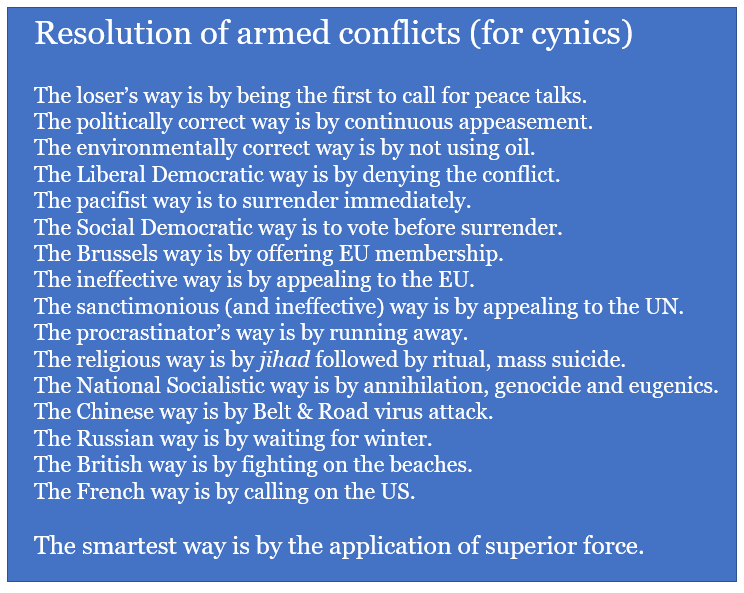
Resolution of armed conflicts

August 14, 2020

With age they say comes wisdom.

In my case it shows up as cynicism.

There are no effective arguments against Force Majeure.


What’s so bad about bias?

August 13, 2020

The dictionary definition usually goes like this:

biasn. inclination or prejudice for or against someone or something (a person or group, or an opinion, or a theory, ……). v. incline, or cause to be inclined, in favour of someone or something

Unbiased brain image johnnycullen.net

A preference for anything is a bias. A preference for a particular food, or person, or pet, or idea is a bias.  Animals too exhibit behaviour which humans would interpret as bias. A bias is clearly a cognitive state based on the knowledge, memories and values stored in that brain at that time. It is also clearly a dynamic state and changes as the state of the brain changes. Consider a brain fully capable of thinking but empty of all memory, all values, and all knowledge. A brain with no preferences for anything! Such a brain would begin as truly unbiased when required to form an opinion. An impossible state, of course, but useful as a thought experiment for defining a zero bias condition.

A preference for anything is, in fact, the result of a cognitive judgement made by a brain based on the knowledge and memories it has and on the internal value scales it uses. Our empty, thinking brain could not form an opinion about anything without first having some knowledge and some value scale to apply. Forming an opinion, is itself, the creation of a preference and a bias. Expressing an opinion is an expression of bias. All knowledge is bias. The greater the knowledge held by a brain, the greater the bias it has. The clearer the set of values held by a brain, the greater its bias. An unbiased mind is an empty mind.

Bias, itself, is not a value. It is, I think, a description of a cognitive state. A knowledgeable person, a person with opinions, is a biased person.

A learned judge is a biased judge. An unbiased music critic with no prior opinions is a useless critic. A food critic without taste preferences would be unbiased but would also be worthless as a critic. Unbiased parents would show no preference for their own children. Without bias, “good” and “bad” start with equal value. I am incurably biased against what I consider “bad” and against people I don’t like. Bias is merely the current state of a functioning brain.

Yet, bias is considered “bad” and to be unbiased is considered “good”. I suspect it is because we conflate the state of bias with the value scale of fairness.

But bias and fairness are entirely different things.


Mark Pillai

August 11, 2020

He would have been 109 today.

He was the first Allied officer (the first of only five) to escape from being a Japanese prisoner-of-war and successfully return to India. He left Singapore on 7th May 1942 and managed to reach India on 26th August 1942.

Mark Pillai 11.08.1911 – 07.06.1988


First Allied officer to escape from Japanese POW camp after fall of Singapore in 1942

I wrote this 3 years ago.

https://ktwop.com/2017/08/12/remembering-an-escape-from-singapore-75-years-on/


75 years since the bombs ended the war with Japan

August 9, 2020

It is 75 years since the nuclear bombs were dropped on Hiroshima and Nagasaki and the war with Japan ended in 1945.

There are many among the politically correct and the sanctimonious who are busy trying to revise history and like to fantasize that Japan may have surrendered without the bombs being used. Emperor Hirohito was totally opposed to surrender before the bombs and was reluctant after the first bomb. He was persuaded only after the second. Even that was opposed by the military who tried, but failed, in an attempted coup to avoid surrendering. Without the use of the bombs the earliest Japanese surrender would have been in spring 1947, and that too only after the destruction of their 1946 rice harvest. Without a rice famine in 1946 the Japanese “fight to the last” attitude could have prolonged the war till 1948.

The politically incorrect reality is that the use of the bombs did bring the war to an end. The expression of superior force is still the only effective way of ending armed conflicts.


Gods and devils and something from nothing

August 8, 2020

No science and no philosophy or theology has still got its head around the something from nothing problem.

Something from nothing:

This is a very handy subterfuge often used in science and mathematics. When looking for something unknown, zero can always be converted into the sum of something and not-something. So it is always possible to imagine what the something is, evoke it from zero and claim that the not-something exists but cannot be found.

0 = X + ~X

Anything can be derived from nothing provided its negative counter-part can also be tolerated (in absentia if necessary).

We observe matter.

We haven’t a clue as to where this matter came from. So we devise the concept of matter and an equivalent amount of anti-matter at the origin of everything. But we cannot find this anti-matter in sufficient quantities to negate all the matter we observe. The global nothing is not preserved. That leads to the next subterfuge. It was all energy to begin with. Some of that energy converted itself into matter. That does not quite explain where that energy came from. Of course “nothing” might have decomposed into lumps of energy and of not-energy. The energy, it is then surmised, is that which is driving the expansion of the universe or the inflation of the universe or both. The lumps of not-energy are more elusive. Where that might be is not yet part of the next subterfuge.

nothing can be anything

This is a powerful technique but still a subterfuge. The existence of matter here in our universe can always be balanced by antimatter somewhere else such that a total nothing can be maintained. But matter and antimatter when they meet annihilate each other creating energy (according to E=mc2). Now that creates the puzzle of where energy came from. But that is easily solved by creating the concept of negative energy. Energy here can be balanced by negative energy there. Negative energy is a concept used in physics to explain the nature of certain fields, including the gravitational field and various quantum field effects.

Modern physics and cosmology are based on the fundamental premise that the Greater Universe is a Great Big Zero.

Of course some resolve the something from nothing problem by invoking a Creator. The same technique (or subterfuge) is also available to theology. But just as resolving the matter/antimatter created energy then leads to negative energy, the invoking of a Creator needs the conjuring of anti-Creators. A Creator here balanced by a Destroyer there. In Hinduism, for example, Brahma is the Creator balanced by Shiva the Destroyer. (Vishnu is the preserver and is in balance anyway). One problem for most religions and theologies is that they must create Devils subservient or inferior to their gods. Theologies collapse if devils are taken to be equally powerful, but negative, gods. Satan, for example, is a fallen angel where the angels were created by God. Thus Satan is more a balance for the Son of God rather than a balance for God. (I ignore the inconsistencies of all-powerful gods incapable of controlling subservient devils).

Heavens need Hells. Gods lead necessarily to Devils. And,

Gods + Devils = Zero.


Related:

Antimatter (CERN):

In 1928, British physicist Paul Dirac wrote down an equation that combined quantum theory and special relativity to describe the behaviour of an electron moving at a relativistic speed. The equation – which won Dirac the Nobel Prize in 1933 – posed a problem: just as the equation x2= 4 can have two possible solutions (x = 2 or x = −2), so Dirac’s equation could have two solutions, one for an electron with positive energy, and one for an electron with negative energy. But classical physics (and common sense) dictated that the energy of a particle must always be a positive number. Dirac interpreted the equation to mean that for every particle there exists a corresponding antiparticle, exactly matching the particle but with opposite charge. For example, for the electron there should be an “antielectron”, or “positron”, identical in every way but with a positive electric charge. The insight opened the possibility of entire galaxies and universes made of antimatter.But when matter and antimatter come into contact, they annihilate – disappearing in a flash of energy. The Big Bang should have created equal amounts of matter and antimatter. So why is there far more matter than antimatter in the universe?

Antimatter:

… In theory, a particle and its anti-particle (for example, a proton and an antiproton) have the same mass, but opposite electric charge and other differences in quantum numbers. For example, a proton has positive charge while an antiproton has negative charge.

A collision between any particle and its anti-particle partner leads to their mutual annihilation, giving rise to various proportions of intense photons (gamma rays), neutrinos, and sometimes less-massive particle-antiparticle pairs. The majority of the total energy of annihilation emerges in the form of ionizing radiation. If surrounding matter is present, the energy content of this radiation will be absorbed and converted into other forms of energy, such as heat or light. The amount of energy released is usually proportional to the total mass of the collided matter and antimatter, in accordance with the mass–energy equivalence equation, E=mc2.

Antimatter particles bind with each other to form antimatter, just as ordinary particles bind to form normal matter. For example, a positron (the antiparticle of the electron) and an antiproton (the antiparticle of the proton) can form an antihydrogen atom. The nuclei of antihelium have been artificially produced with difficulty, and these are the most complex anti-nuclei so far observed. Physical principles indicate that complex antimatter atomic nuclei are possible, as well as anti-atoms corresponding to the known chemical elements.

There is strong evidence that the observable universe is composed almost entirely of ordinary matter, as opposed to an equal mixture of matter and antimatter. This asymmetry of matter and antimatter in the visible universe is one of the great unsolved problems in physics. The process by which this inequality between matter and antimatter particles developed is called baryogenesis.


On the matter of matter (or how something came from nothing)


Does the WHO chief add any value?

August 7, 2020

Below its political management the WHO does seem to add some value – though not anything much better than could be achieved without the WHO.

But the role of “WHO chief” adds no value that I can perceive (except perhaps to Chinese geopolitical aims). He (or his Press Corps) seem unable to avoid the obvious or the nonsensical.


Depraved, decadent and damned

August 5, 2020

Playing with words.

(For some unknown reason “depraved, decadent and damned” has the same rhythm in my mind as “bewitched, bothered and bewildered”).

Morality is entirely subjective and always relative. It varies with time and place and individual. The moral standards of a group are a composite of the individual standards of those making up the group. Yet we are obsessed in judging others about their immorality – and always by our standards. Why else would we have so many words to describe the nuances or gradations of immorality? I suspect that no age is more depraved or decadent than any other. The measuring stick is always the variable morality of the day and place.

One can always find an antonym for any of the plethora of words describing immorality, but I suspect that the words were coined first to describe the level of immorality rather than the level of morality. In English there seems to be an over-representation of words beginning with “d”. I just take a few of these though there are many, many others (corrupted, perverted, lewd, licentious, prurient, wanton, profligate, hedonistic, ……).

These ought to be put as questions but, since morality is subjective, I take the liberty to frame them as statements.

  • Hollywood is more debauched than Bollywood.
  • Los Angeles is more depraved today than ancient Rome ever was.
  • Tallulah Bankhead was more dissolute than Harvey Weinstein is.
  • JFK was more dissipated than LBJ.
  • Catholicism has degenerated more than Islam.
  • The West Coast of any country is always more decadent than the East (as evidenced by the US, Australia, India and Sweden).
  • California has more deviants now than Babylon had in its heyday.
  • China defiles the Uighurs as Genghis Khan defiled the Han.
  • Europeans despoiled the pyramids as ISIS despoiled Palmyra.

The nuances are fascinating. Decadence is not for the indigent but depravity is universal and indifferent to wealth. Decadence requires both wealth and indulgence to excess. (Clearly LA is more decadent than New York, Perth more decadent than Sydney, Bombay more decadent than Madras and Gothenburg more decadent than Stockholm). Depravity is simpler and just needs to be grossly immoral. On my very subjective scale of morality, I find depravity more immoral than decadence. Dissipation and dissolution include both moral and physical decay, though I tend to ascribe greater physical rottenness to dissipation. To be degenerate requires having had a high moral position to descend from. Debauchery always has innocence as a victim and is wasted on the already depraved. However, a debaucher would nearly always be depraved. Despoiling needs some artistic merit to begin with. What is foul and rotten cannot be despoiled. It does not take much to deviate from some norm to be considered a deviant. Every minority is necessarily deviant in fact, if not always in the popular discourse. In today’s politically correct world people who are fat, or old, or not pretty are the new deviants.

We are always morally superior to them. (This is inherent in the definition of we and them).

Naturally, all those others who are decadent and depraved are utterly damned.

Depraved, decadent and damned.