I am on the road on an assignment and shall then be attending a family wedding.
Blogging will be light and sporadic for 2 weeks or so.
I am on the road on an assignment and shall then be attending a family wedding.
Blogging will be light and sporadic for 2 weeks or so.
Idle thoughts:
The riddle of whether change and time are interrelated or independent. And which comes first? Within our cosmos perhaps we have many different states of stasis with paths by which these states can be connected. Our universe could then just be one specific change journey, on one particular path between two states of stasis along an axis of change. Perhaps time begins after change gets going. Where the change journey started with the Big Bang and where the end will be in another state of stasis at the end of time – and the end of change.
Time and change and states of stasis (pdf)
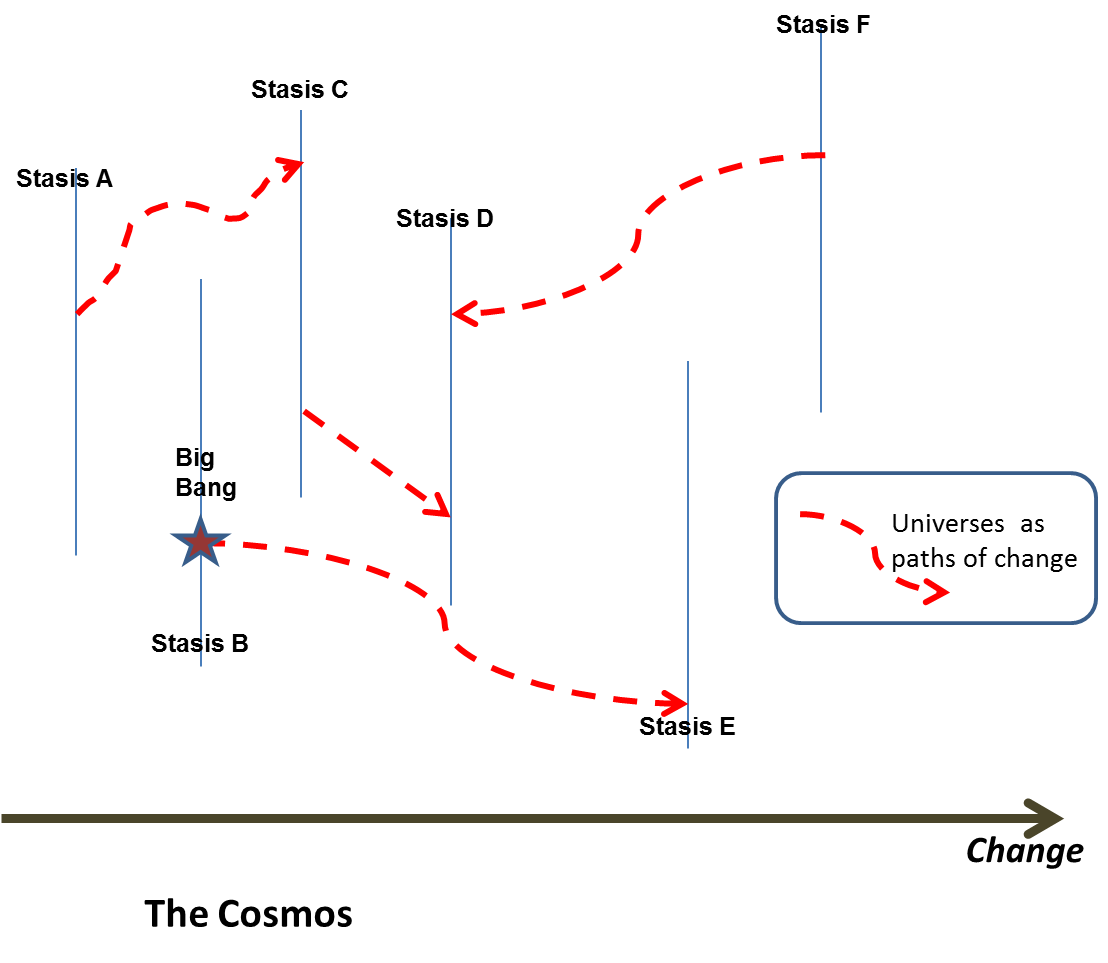
The Cosmos
I was listening to BBC radio this morning where somebody was talking about a new production of Chekhov’s Uncle Vanya. The play was written in 1896 and the speaker quoted this line from the play:
“There are fewer and fewer forests, rivers are drying up, wildlife has become extinct, the climate is ruined, and the earth is becoming ever poorer and uglier.”
“Prescient” commented the speaker.
Prescient? I wondered. There is no shortage of forests, climate continues its normal cycles, some species have died and new ones found and the world has become richer and cleaner. No, just a depressed Russian of the 1890’s, and one without hope or any belief in the ingenuity of humans. Not prescient, just another alarmist now proven wrong. And his kind of Malthusianism is alive and well even today – and is just as wrong.
In 1897 the world population was 1.5 billion with about 60% living in poverty. Life expectancy was about 32 years (average). At that time some 600 million people were being fed clothed and supported in a reasonably satisfactory way. In 2012 the world population has grown to 7 billion with about 25% still living in poverty (and the threshold for poverty has changed drastically). Average life expectancy is now 67 years. Today some 5 billion people are fed and clothed and supported in a reasonably satisfactory way. Almost 10 times as many as in 1896.
In another 120 years the current sayings of the Malthusians, the climate alarmists, the energy alarmists, the food alarmists, the resource alarmists and the bio-diversity alarmists will seem equally ridiculous. World population will probably stabilise at about 10 billion (at the current rate at which fertility rates are reducing) in the next 50 years or so. The challenges then will be the complete eradication of poverty and the biggest barrier may then be a shortage of “working” population.
By 2140 we will be close to 2.1 children per woman, studying longer (say till 27), working for 45 years (till say 72) and living much longer – say 85 years (on average). Maybe less than 5% of 10 billion people will be living in poverty. Hunger and malnourishment will have almost disappeared. It may well be that it is the proportion of “working population” which becomes the limiting factor in satisfactorily maintaining the young and the elderly.
But there will still be no Malthusian resource crunch.
The European Union has been awarded the Nobel Peace Prize for 2012 and the choice only confirms that the Peace Prize has become ridiculous and irrelevant and has little to do with Peace in the World. The brand value of the Nobel prize is only damaged by the bizarre choices of the Norwegian committee which chooses the recipients.

The present Norwegian Nobel Committee (from left): Geir Lundestad (secretary), Gunnar Stålsett, Berit Reiss-Andersen, Inger-Marie Ytterhorn, Kaci Kullmann Five and Thorbjørn Jagland (leader) © Photo: Odd-Steinar Tøllefsen / Norwegian Nobel Institute
The recipient is selected by the Norwegian Nobel Committee, a 5-member committee appointed by the Parliament of Norway and which is now becoming a laughing-stock. The laureates chosen in this century demonstrate that the Committee is living in some dream world of its own. That the choice is a political choice is inevitable. But in this century the choices have all represented a “political correctness” which has bordered on the cowardly. The recipients have had very little – by way of achievements – to do with the furthering of peace in the world. Liu Xiaobo may be a very worthy individual but what on earth has he done for world peace? Barrack Obama was chosen on hope and not for anything achieved. The three winners in 2011 were chosen from a politically correct desire just to prove that developing countries and women were not being ignored. Al Gore & Co. were a sop to politically correct alarmism and not for any achievement. The choice of the United Nations was because nobody else could be thought of. Muhammad Yunus and the Grameen Bank may well have contributed to the development of rural areas (though not without controversy) but they did nothing for world peace. Martti Ahtisaari – for one – had actually been an effective mediator and he was at least active in the right field. But his achievements were not something so very extraordinary in the world context. The International Atomic Energy Agency made a complete hash of Iraq and its WMD. And what on earth did Wangari Maathai or Jimmy Carter or Shirin Ebadi or Kim Dae Jung actually achieve for world peace?
This year’s choice of the European Union is about as ridiculous as they come. NATO would be a more relevant choice – but politically incorrect.
Alfred Nobel would not be pleased.
| 2012 | The European Union (EU) |
|---|---|
| 2011 | Ellen Johnson Sirleaf, Leymah Gbowee and Tawakkol Karman |
| 2010 | Liu Xiaobo |
| 2009 | Barack H. Obama |
| 2008 | Martti Ahtisaari |
| 2007 | Intergovernmental Panel on Climate Change (IPCC) and Albert Arnold (Al) Gore Jr. |
| 2006 | Muhammad Yunus and Grameen Bank |
| 2005 | International Atomic Energy Agency (IAEA) and Mohamed ElBaradei |
| 2004 | Wangari Maathai |
| 2003 | Shirin Ebadi |
| 2002 | Jimmy Carter |
| 2001 | The United Nations ( U.N.) and Kofi Annan |
| 2000 | Kim Dae Jung |
Reality Check.
The death of coal utilisation or the exhaustion of coal reserves is not even a glimmer on the world’s energy horizon — thank goodness.
Add to this the fact that carbon dioxide concentrations in the atmosphere (and man made CO2 emissions are a minor contribution to this concentration) simply have no significant effect on climate. Trying to control climate by reducing man-made carbon dioxide emissions must rank as one of the world’s most useless and wasteful efforts in the last 30 years.
Terence Corcoran writes in the Financial Post:
….. The idea that coal is dying seems to be mostly wishful thinking on the part of green activists, as well as some politicians and regulators in the United States and parts of Canada. Ontario aims to end dirty coal-fired power generation, at great cost to consumers who are now paying high prices for the putative clean alternatives, wind and solar. The United States, via regulation from the Environmental Protection Agency, has established rules that are said to present the coal-power industry with a “dead end.”
UPDATE! Awarded to Robert J Lefkowitz and to Brian K Kobilka “for studies of G-protein-coupled receptors“.
==================================
Thomson Reuters predicts conventional areas of research for the Chemistry Nobel
1. Louis E. Brus
For discovery of colloidal semiconductor nanocrystals (quantum dots)
2. Akira Fujishima
For the discovery of photocatalytic properties of titanium dioxide (the Honda-Fujishima Effect)
and
3. Masatake Haruta and Graham J. Hutchings
For independent foundational discoveries of catalysis by gold
But Swedish Radio is predicting / hoping that it might be awarded to a Swedish scientist Svante Pääbo who is himself the son of a Nobel laureate. He is Director, Department of Genetics at the Max Planck Institute for Evolutionary Anthropology. In February 2009 the Max Planck Institute completed the first draft version of the Neanderthal genome. In 2010 they discovered the Denisovan genome. The techniques developed by Pääbo and his team for the DNA analysis of ancient specimens is what might be acknowledged.
Even if anthropogenic effects on climate were significant – which they are not – the arrogance of politicians and bureaucrats is astounding when they believe they can
The sun will continue on its merry way and our climate will perforce follow willy-nilly, even if our politicians and bureaucrats and so-called climate scientists think that modern day “rain dances” will give them climate control.
Perhaps they truly believe that man can control climate – and then it would not be arrogance – just gullibility or just plain stupidity! The modern-day King Canute syndrome.
UPDATE 2!
Well the rumours were wrong and the prize has been awarded to Serge Haroche of France and David Wineland of the US.
UPDATE: There is a rumour doing the rounds in Sweden this morning that the Physics prize will go to Alain Aspect of France and Anton Zeilinger of Austria.
============================================
There is still some speculation that the Physics Nobel to be announced today could go to Higgs and CERN scientists for the much-hyped, “non-discovery” of the Higgs Boson but somehow I doubt it.
Thomson Reuters proposes three possible winners:
1. Charles H. Bennett, Gilles Brassard and William K. Wootters
For their pioneering description of a protocol for quantum teleportation, which has since been experimentally verified
2. Leigh T. Canham
For discovery of photoluminescence in porous silicon
3.Stephen E. Harris and Lene V. Hau
For the experimental demonstration of electromagnetically induced transparency (Harris) and of ‘slow light’ (Harris and Hau)
There is an outside chance that it may be awarded for work straddling Physics and Chemistry – in the world of nano-particles perhaps.
Thirty years ago when living in the UK I was a daily purchaser of The Times. Three years ago I was a daily visitor to the The Times website and an occasional purchaser of the newspaper (around 30 copies per year when I was travelling). Then they introduced their hard paywall and I abstained. But withdrawal symptoms did not last too long and I don’t miss them very much – if at all. In fact, the absence of The Times from my daily reading has had far less impact than I would have imagined. Nowadays it is very rarely that I find any references to articles in The Times that I would like to follow up on. The Times is no longer the paper of record in the UK and its restricted access makes it of little value as a reference for others.
I have a theory that the simplistic introduction of paywalls is not the model which will work for a very complex behavioural change in reading and news gathering and reference habits that is currently evolving. I suspect that the successful models will probably be those that involve an expansion of what can be viewed freely, but where this expanded readership can then be enticed into an increase in the purchase of valuable downloadable content. Restricting the initial readership – I think – can only lead to a collapsing spiral of interest and a destruction of brand value. The total circulation of The Times today for both the online and the paper versions together is less than the paper circulation before the paywall.
In an article actually about the Bonniers struggling to find their own model, Svenska Dagbladet writes about The Times:
It is well understood that for putting value on journalism it is central to be creative in the development of payment models. However, there are some really bad examples. Worst of all is the newspaper that really listened to Jeanette Bonnier.
End the free reading! Close the store! If you want to read, you must pay!
Which paper was that then? A certain paper called The Times, owned by Rupert Murdoch / News International. Just over two years ago they introduced a so-called hard pay wall. Not a thing was released over the fence without payment. The decision to completely close the site for open access – and even to the search engines, which they were forced to back down from the other week – possibly was by following Jeanette Bonnier’s intuition. Or was it a way for Murdoch to provoke the industry to act. Either way, it was a gigantic failure.
Before the pay wall The Times Online had 21 million readers each month. Today, they have … drum roll! … 130 000 paying customers. Nowhere else in the history of journalism have so many readers – and so many advertisers – been scared away so effectively.
Even more interesting is the effect on the paper version. Its circulation during the same period fell from 570,000 per day to 397000. It is much more than what other newspapers have lost.
The explanation?
- A brand fatally weakened as fewer and fewer read the content, and
- Subscribers to the paper version shifting their allegiance to the much cheaper on-line, pay-walled version
The result was fewer subscribers, sharply lower revenues and a significantly depleted brand. And that’s what happens if you’re looking for simple solutions to handle a complex situation.
I have the strong “guesstimate” and rather more than just a belief, that if The Times had increased their online (free) readership they could have bucked the trend and even increased their paper circulation – by offering more content in the paper version where such content was also available on-line – but for a fee.


