Arrogant and overbearing political correctness censures Tintin from Stockholm library

September 25, 2012

See update below:

I have little patience with the “do-gooders” who always know best what is good for others. But impatience turns to an active dislike when an arrogant young man (a certain Behrang Meri) presumes that his world-view shall prevail and takes it upon himself to be a censor by removing all copies of Tintin from the shelves of the 10-13 year old library of Stockholm’s Culture Centre. Of course he claims he is doing this “for their own good”. Arrogance and coercion are the stock-in-trade of the “do-gooders” and is wide-spread in Sweden. Banning things for the “good of others” is the order of the day. Some of the coercive tactics employed – even if now coming from the left of the political spectrum – are indistinguishable from those employed by the fascists in Europe almost 100 years ago.

Dagens Nyheter reports (my free translation):

Tintin has been ejected from the Culture Centre in Stockholm. DN can report that the beloved cartoon character has been cleaned out from the library shelves. Now the staff have been instructed to look for any more books which have racist or homophobic values.

The 10-13 year old library of Stockholm’s Culture Centre has  removed Tintin books from the shelves. In consultation with their staff, the artistic director with responsibility for children and activities for the young made ​​the decision.

“That’s right. The picture Tintin books give for example of Africans is afrofobisk. Africans are shown to be a bit silly while Arabs are sitting on flying carpets and Turks smoke water pipes. The image of  the “forest Turk” is still there. It’s about exoticism and Orientalism”, says Behrang Miri, who leads efforts to develop Child and Youth Culture activities in the sections for children, “Tiotretton” and “Lava”. ……. 

Behrang Meri, the self-appointed censor in this case, was appointed to his position in February this year.

He was on the radio this morning and tried to babble his way through by insisting that he was removing the books so that children could actually go deeper into the questions of racism!!  He seemed to be avoiding all questions and merely spouting a practised defence. I would have thought that deepening children’s understanding would only be possible by exposure to the books and not by his over-bearing, over-protectiveness denying exposure to the books. In any case the Tintin serials – which I greatly enjoyed through my childhood – were written in a colonial time and had no racist intentions. It depicted the world-view that existed at the time. Censorship will not change history or cause those times to disappear.

He failed to impress and I cannot help feeling that his ego has got the better of him and his objective is mere self-promotion rather than the cultural enrichment of 10-13 year old children.

UPDATE!

Following a storm of media criticism, officials at the Kulturhuset library in Stockholm have reversed their decision to remove Tintin comic books from its shelves, saying the move happened “too fast”.

I note that it was the head of the Culture Centre who reversed the censorship and Bahrang Meri has accepted being overruled. In spite of his vehement defence of his decision on the radio this morning this was clearly not a resigning issue. Some damage control is ongoing but damage there certainly is:

“I wanted to highlight an opinion piece about issues of discrimination, but realize now that it’s wrong to ban books,” Meri said in a statement. However, Kulturhuset head Sjöström applauded Meri for prompting a discussion about discrimination. 
“The issues of discrimination, equality and norms continue to be debated and discussed,” Sjöström said in a statement.
Now Toyota sees sense and backs away from all-electric cars

September 24, 2012

The hype about electric cars is just one more example of environmental alarmism leading to bad decisions. The list of “bad decisions” made to appease environmentalism is long and getting longer. Wind power before its time and solar power before it  was commercially viable have only helped to increase the costs to the consumer but they have been a windfall for those who have managed to “milk” the subsidies. The electric car fiasco is no different. Billions have been wasted in subsidising something that is not commercial and in trying to skew the market in the hope of artificially creating a demand where there is none. But a few have managed to live very well off the subsidies. Some day electric cars may well become commercially viable and when they do it will not be because an environmental lobby group or a government  merely wished for it but because the technology and supply network then will be sufficiently developed to offer the consumer a superior product at a reasonable price.

The simple reality is that:

  • electric car batteries are still too heavy and take too long to charge
  • the range they provide is too short
  • the cars are too expensive

More importantly the ostensible reason for subsidising the technology  – as being for the cutting of carbon dioxide emissions to try and reverse natural climate change –  is both based on a false premise and futile.

“The current capabilities of electric vehicles do not meet society’s needs, whether it may be the distance the cars can run, or the costs, or how it takes a long time to charge,” said, Uchiyamada, who spearheaded Toyota’s development of the Prius hybrid in the 1990s.

Reuters reports:

Read the rest of this entry »

At least 275 water molecules needed to form an ice crystal

September 24, 2012


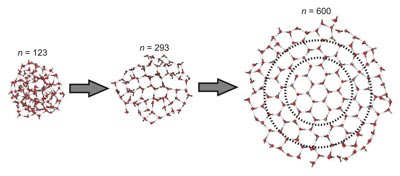
In idle moments I contemplate on strange things such as the origins of water on earth (which is largely unknown) and the life-span of water molecules (in the order of milliseconds) and the manner  in which water molecules are added to or lost from the apparently constant amount of water on earth. None of these questions are illuminated further but this interesting paper by researchers in Germany and the Czech Republic describes a technique for studying clusters of water molecules and provides some answers on the formation of ice crystals.

A Fully Size-Resolved Perspective on the Crystallization of Water Clusters by Christoph C. Pradzynski, Richard M. Forck, Thomas Zeuch, Petr Slavíček, Udo Buck . Science 21 September 2012:
Vol. 337 no. 6101 pp. 1529-1532 DOI: 10.1126/science.1225468

ABSTRACT

The number of water molecules needed to form the smallest ice crystals has proven challenging to pinpoint experimentally. This information would help to better understand the hydrogen-bonding interactions that account for the macroscopic properties of water. Here, we report infrared (IR) spectra of precisely size-selected (H2O)n clusters, with n ranging from 85 to 475; sodium doping and associated IR excitation–modulated photoionization spectroscopy allowed the study of this previously intractable size domain. Spectral features indicating the onset of crystallization are first observed for n = 275 ± 25; for n = 475 ± 25, the well-known band of crystalline ice around 3200 cm−1 dominates the OH-stretching region. The applied method has the potential to push size-resolved IR spectroscopy of neutral clusters more broadly to the 100- to 1000-molecule range, in which many solvents start to manifest condensed phase properties.

Illustrations of the molecular structure of three water clusters

Illustrations of the molecular structure of three water clusters : from http://physicsworld.com/cws/article/news/2012/sep/21/how-many-water-molecules-does-it-take-to-make-ice


Electric cars in the US: $7.5 billion of taxpayers money for “little or no impact” on gas consumption

September 22, 2012

The fantasy world of subsidies is compounded when the subsidies are for irrational but “politically correct” ends.

Reuters:

U.S. federal policies to promote electric vehicles will cost $7.5 billion through 2019 and have “little to no impact” on overall national gasoline consumption over the next several years, the Congressional Budget Office said in a report issued on Thursday.

Consumer tax credits for buying electric vehicles, which can run as high as $7,500 per vehicle, will account for about 25 percent of the $7.5 billion cost, the CBO said.

The rest of the cost comprises of $2.4 billion in grants to battery makers and projects to promote electric vehicles as well as $3.1 billion in loans to auto companies designed to spur production of fuel-efficient vehicles. …….

Momentum for shale gas builds in Europe

September 22, 2012

The momentum is now growing fast and it is difficult to keep up with the number of parties coming out in favour of the exploitation of shale gas in Europe. However the self-righteousness behind the “environmental correctness” of the European political establishment will not be overcome without a struggle.

France: Bosses demand shale gas rethink:

BUSINESS leaders have signed up to a call to reopen debate on the extraction of shale gas in France. 
The move comes shortly after President Hollande said he will halt exploration during his five-year term and announced refusals of seven oil company applications for drilling permits in the south, because they were thought to be looking for shale gas. …..

UK: IoD: Shale gas could provide 35,000 UK jobs :

The Government is expected to give the green light for more fracking in the UK to access shale reserves within weeks as it publishes a new gas strategy, but energy secretary Ed Davey warned yesterday that it was no “silver bullet”.

The IoD has released a new report on the process this morning which claims there will be an upward revision in the estimate of the size of the UK’s shale gas reserves later this year, up from 5.3 trillion cubic feet. It also suggests there would be “environmental benefits” to using shale gas over coal-fired power plants.

Russia: Gazprom Rethinks Shale as European Gas Prices Sink:

Gazprom has admitted it might yet adjust its attitude towards shale gas, as Russian policy makers assess new dangers to the country’s petro-dollar economy. First, Russia’s Economic Ministry warned that the increasing supply of shale gas on world markets will start hurting Gazprom’s pipeline sales to Europe in 2014. And it seems Gazprom might now be weighing the pros and cons of jumping onto the shale gas bandwagon.

In Europe, coal now offers both lower prices for electricity consumers and higher profits for utilities

September 22, 2012


The costs of coal fired power generation in Europe have been artificially inflated for some time now by the imposition of various forms of carbon taxes. These taxes and penalties – which are quite arbitrary – serve political and electoral goals and generally pander to the alarmist view of climate change. The electricity consumer has taken the hit.

Bloomberg reports:

Coal Era Beckons for Europe as Carbon Giveaway Finishes

European utilities are poised to add more coal-fired power capacity than natural gas in the next four years, boosting emissions just as the era of free carbon permits ends.

Power producers from EON AG to RWE AG (RWE) will open six times more coal-burning plants than gas-fed units by 2015, UBS AG said in a Sept. 5 research note. Profits at coal-fired power stations may more than double by then, according to a Goldman Sachs Group Inc. report published on Sept. 13.

Read the rest of this entry »

22nd IgNobel awards – 2012

September 21, 2012

“The Stinker”, the official mascot of the Ig Nobel Prizes.

Researchers who worked on statistics which show brain activity in dead salmon, changed height perceptions when leaning to the left, a “speech-jammer” and a report that recommends the preparation of a report about the report about reports about reports are some of the winners of this years IgNobel awards.  

The Guardian

The 22nd Ig Nobel awards, organised by the humour magazine Annals of Improbable Research and awarded on Thursday at Harvard University, are a spoof of the Nobel prizes, to be announced next month. They honour achievements that “first make people laugh, and then make them think”. …….

….. This year’s Ig Nobels were handed out by five Nobel laureates including the 2009 physics laureate Roy Glauber, 2009 physiology or medicine winner Jack Szostak, and 2007 economics winner Eric Maskin.

Marc Abrahams, editor of the Annals of Improbable Research, and founder of the Ig Nobels, ended the ceremony with the traditional goodbye: “If you didn’t win an Ig Nobel prize tonight – and especially if you did – better luck next year.”

Psychology prize:Anita EerlandRolf Zwaan and Tulio Guadalupe, for their study entitiled Leaning to the Left Makes the Eiffel Tower Seem Smaller.

Peace prize: The SKN company, for using technology to convert old Russian ammunition into new diamonds.

Acoustics prize:Kazutaka Kurihara and Koji Tsukada for creating the SpeechJammer, a machine that disrupts a person’s speech by making them hear their own spoken words at a very slight delay.

Neuroscience prize:Craig BennettAbigail BairdMichael Miller, andGeorge Wolford, for demonstrating that brain researchers, by using complicated instruments and simple statistics, can see meaningful brain activity anywhere – even in a dead salmon.

Chemistry prize: Johan Pettersson for solving the puzzle of why, in certain houses in the town of Anderslöv, Sweden, people’s hair turned green.

Literature prize: The US government general accountability office, forissuing a report about reports about reports that recommends the preparation of a report about the report about reports about reports.

Physics prize:Joseph KellerRaymond GoldsteinPatrick Warren andRobin Ball, for calculating the balance of forces that shape and move the hair in a human ponytail.

Fluid dynamics prize:Rouslan Krechetnikov and Hans Mayer, for studying the dynamics of liquid sloshing, to learn what happens when a person walks while carrying a cup of coffee.

Anatomy prize:Frans de Waal and Jennifer Pokorny, for discovering that chimpanzees can identify specific other chimpanzees from seeing photographs of their rear ends.

Medicine prize: Emmanuel Ben-Soussan, for advising doctors who perform colonoscopies how to minimise the chance of their patients exploding.

Solar Energy is in crisis

September 20, 2012

The solar energy industry is in crisis and I keep reading that it is because subsidies are being reduced or eliminated. As if subsidies come for free. I don’t believe subsidies work and the current crisis only proves that the fundamental issue is not subsidies but that solar energy is not (yet ?) commercially viable. It surely has a place in some very particular situations and the best use of solar energy remains with some isolated users or as a “support” for other energy sources. But for base-load power generation it is just  not viable.

Peter Glover writes in the Energy Tribune:

The global solar power industry is in crisis. The industry blames widespread national subsidy cuts and over productivity; China, in particular, being widely vilified on the second count. However, the real cause of the solar industry’s malaise runs deeper, rooted, as it is, in the inescapable fact that, in terms of current technology, commercial scale solar energy remains a non-viable proposition.

Read the rest of this entry »

Tax on income is easy to levy but fundamentally unsound

September 18, 2012

The latest Mitt Romney “gaffe” is getting much attention. But I was a little surprised to find that while what he said may well be a gaffe in electoral terms – and he may even have lost the Presidential election here – his statement was actually quite correct. I had not appreciated that almost half of all US households paid no federal income tax at all. In the US, federal income tax is a major source of tax revenues and contributes about half of all tax revenues (tax revenues about 15.4% of gdp in 2011 with federal income tax providing 7.3% of gdp). Romney in his leaked video said:

Read the rest of this entry »

When will my computer know who I am?

September 18, 2012

Passwords, Userid’s and 4-digit codes are the bane of my life and I am still waiting for the computer which knows – uniquely and reliably  – whenever I happen to be using it. I am probably very average when I find that I have twelve different passwords, five different Userid’s and eight 4-digit codes that I use regularly and which – so far – I generally manage to keep separate in my memory. As I get older I expect I shall have increasing difficulty in remembering and keeping track of these. I find that – already – I sometimes refrain from taking on new commitments, buying new on-line services, joining new groups or registering at new sites if I need to find yet another password to be remembered. The need for defining and remembering new passwords is now – in fact – limiting the extent to which I use the on-line world.

New models of computers, tablets and smart phones are released – it seems – every other day. For at least the last 10 years the possibility of personal identification of the user by the device has promised much but has not yet delivered. I look forward to each release eagerly only to be disappointed each time.  Each new device has new features. It can do more, remember more, is faster or more “intelligent” or has a larger memory but none has the capability to know – for sure –  who I am.

One of these days I will be able to switch on my device (computer, phone whatever) and it will know that it is “I” – and nobody else – who is operating the device and I will need no further passwords or pin-codes to access any connection or my account at any site through that particular device. That’s the dream.

In the meantime the search goes on but I am not sure that this aspect of “customer-friendliness” is very high up on the priority list. But it should be. I foresee a new explosion in on-line usage when a secure method of personal identification becomes available. PC manufacturers have been trying to use fingerprint recognition for some time, Intel is working on palm recognition and Apple is working on face recognition. Keystroke authentication, retina prints and other biometric or behavioural patterns have also been suggested. But before my dream is realised, the manufacturers have to hone in on a few methods which have then to be exhaustively tested before being widely accepted. New international standards will have to be agreed and  established before the banks and insurance  and credit card companies accept the identification method as being sufficiently secure.

It remains a dream – but passwords have to become obsolete sometime and I do hope it happens within the next two years.