In-flight electronics ban is based on fears – not on any evidence

September 17, 2012

I am always irritated when the regulations regarding in-flight electronics are announced at the start of a flight. I dutifully switch my phone off not because I have any perception of causing danger but only because I don’t want to be denied travel.

There is no evidence whatsoever that using electronic devices on flights – whether during take-off and landing or while cruising – has any deleterious effects on aircraft navigation or any other technical operations during the flight. But this regulation – like so many others – was based originally on fears. Getting rid of an existing regulation even when there is no evidence that the fear is justified is extremely difficult. Once any irrational – but fear-based – regulation is in place the onus of proof shifts from showing something to be unsafe to proving instead that it is not unsafe. And proving a negative is not very easy.

An FAA regulator is walking down the street snapping his fingers continuously. A guy stops him and asks, “Why are you snapping your fingers all the time?”  “To keep wild elephants away.” “That’s ridiculous!“, says the guy. The regulator replies, “Oh, yeah? You don’t see any wild elephants around do you?”

The Wall Street Journal writes:

Do Our Gadgets Really Threaten Planes?

The ban on electronic devices rests on anecdotes, not on hard evidence—because there isn’t any.

Read the rest of this entry »

Belgium introduces euthanasia for prisoners

September 15, 2012

Belgium allows euthanasia under very stringent conditions and now permits prisoners also to choose euthanasia.

If you agree with the concept of euthanasia  then the idea of allowing prisoners to opt for euthanasia would seem perfectly rational. There are ethical questions here which I am still thinking my way through but I think there are some dilemmas to be faced. However I cannot help feeling that a prisoner – almost by definition – is inevitably subject to some level of coercion. Within an isolated and vulnerable prison population where individuals are probably subject to the additional pressures of group phobias and pressure, I am not sure that an apparently voluntary choice can ever be a completely free choice.

And I have an additional dimension of nagging concern when organs for transplantation are harvested from euthanasia subjects:

BioEdge reports:

For the first time, a Belgian prisoner has been euthanased. A man identified as Frank V.D.B, who had spent 20 years in prison for two murders and rapes, died recently. The date is not clear from media reports, but it took place outside the prison. The death only became known because it was revealed by a politician, Senator Louis Ide, who was complaining about the lack of social services in Belgian jails. He seems to have been tipped off by a prison official.

The case has provoked a controversy in the media –not over euthanasia but over the violation of the prisoner’s right to privacy. All of the conditions for euthanasia in Belgium were carefully fulfilled: the prisoner had a terminal illness, he had made repeated requests for death, and three doctors had independently ratified the request. ….. 

Last year Belgian surgeons revealed that they had been harvesting organs obtained from persons who had requested euthanasia.

New paper – “Warming since 1850 is mainly the result of natural climatic variations”

September 13, 2012

A new paper in Global and Planetary Change byNorwegian researchers has identified persistent cyclic variations in temperature records from Svalbard and Greenland. They find that some of the identified cycles correspond to variations in the Moons’ orbit around Earth and some correspond to solar variations. They find that warming since 1850 is mainly the result of natural climatic variations and conclude that the persistence of cycles makes climate forecasting feasible for limited time ranges.

And if  “warming since 1850 is mainly the result of natural climatic variations” then it just confirms that the theory that anthropogenic carbon dioxide emissions are responsible for global warming remains in the realm of speculation.

Identifying natural contributions to late Holocene climate change

by Ole Humlum, Jan-Erik Solheim and Kjell Stordahl

http://dx.doi.org/10.1016/j.gloplacha.2011.09.005

Read the rest of this entry »

World population by latitude >>the world of unusual map projections

September 13, 2012

With both landmass and population concentrated in the Northern hemisphere, a northern-centric view of the world in most things is inevitable.

I was looking for some information on population distribution by latitude and came across this graph on Chris Blattman’s site. However he was not the source of the diagram but had obtained the image from Paul Kedrosky’s page which still exists but no longer has the image. He in turn referred to a Bill Rankin whose page no longer exists. The diagram is said to be from 2000 data but I have not been able to find the source or anything more recent. An excellent diagram.

UPDATE: The original seems to be here: http://www.radicalcartography.net/index.html?histpop

POPULATION HISTOGRAMS 
Bill Rankin, 2008 

More fun with numbers! Roughly 88% of the world’s population lives in the northern hemisphere, and about half the world’s population lives north of 27°N.

Taking the northern and southern hemispheres together, on average the world’s population lives 24 degrees from the equator.

World population by latitude and longitude: source unknown (via chrisblattman)

Trying to trace some of the data on which this diagram is based I came across the fascinating work of Waldo Tobler. Professor Emeritus. Geography Department. University of California. In his presentation from 1999 on Unusual Map Projections I found two diagrams which – I think – must be the source (perhaps updated) for the diagram above. Unusual Map Projections Tobler 1999

Read the rest of this entry »

2012 Nobel prize speculations begin

September 12, 2012

UPDATE – 8th October

(The Physiology / Medicine awards are to be announced today)

The 2012 Thomson Reuters predictions are here: http://www.reuters.com/article/2012/09/19/idUS36510+19-Sep-2012+HUG20120919

==========================================

Every year around this time with about a month to go before the awards are announced the predictions and speculation begin about potential Nobel prize laureates. I don’t believe there is as much lobbying / marketing involved in the Nobel speculations as for the Oscars – but certainly some institutions and laboratories do try – much earlier in the year – to get some appropriate publicity for “their candidate”. This year the CERN publicity machine – which made much ado about their discovery – or not – of the Higgs boson – has been in full swing. Perhaps the hype was just to ensure funding but I am sure the possibility of a Nobel was not very far from their thoughts.

Dates for the Announcements

The prize awarding institutions have set the following dates for their announcements of 2012 prize decisions:

PHYSIOLOGY OR MEDICINE– Monday 8 October, 11:30 a.m. at the earliest
PHYSICS – Tuesday 9 October, 11:45 a.m. at the earliest
CHEMISTRY – Wednesday 10 October, 11:45 at the earliest
PEACE – Friday 12 October, 11:00 a.m.
ECONOMIC SCIENCES – Monday 15 October, 1:00 p.m. at the earliest
LITERATURE – The date will be set later

The Thomson Reuters Citation Laureates will probably be announced in another 10 days or so.

Each year, Thomson Reuters uses data from its research solution, Web of Knowledge, to quantitatively determine the most influential researchers in the Nobel categories of Physiology or Medicine, Physics, Chemistry, and Economics. Based on a thorough review of citations to their works, the company names these high-impact researchers as Thomson Reuters Citation Laureates and predicts them to be Nobel Prize winners, either this year or in the near future.   

Thomson Reuters is the only organization to use quantitative data to make annual predictions of Nobel Prize winners. Since 2002, 21 Citation Laureates have gone on to win Nobel Prizes.

A few of the early predictions are out in the blogosphere:

Chemistry, Chemistry and PhysicsEconomics, Literature.

Global temperature dependence on CO2 concentration goes missing

September 12, 2012

That climate changes and will continue to change is obvious. That this is primarily due to solar effects via the oceans also seems obvious to me. It seems the height of arrogance when – like Canute attempting to hold back the tides – climate-politicians attempt to hold back the sun and its effects. The sun cannot be carbon-taxed into submission.

That CO2 concentration in the atmosphere has little impact on climate is the reality that climate-politicians continue to deny. That the effects of man-made carbon dioxide emissions are of even less significance is becoming increasingly obvious.

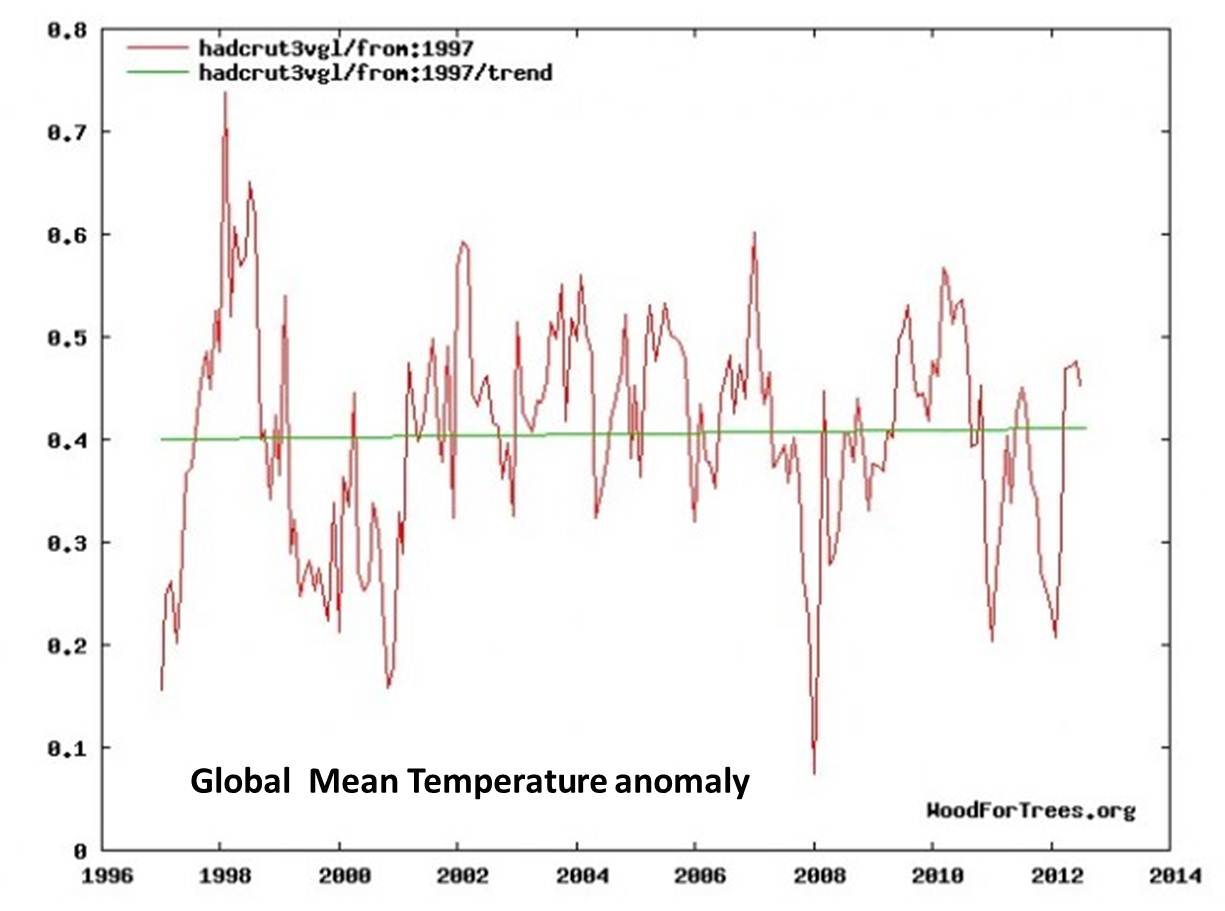
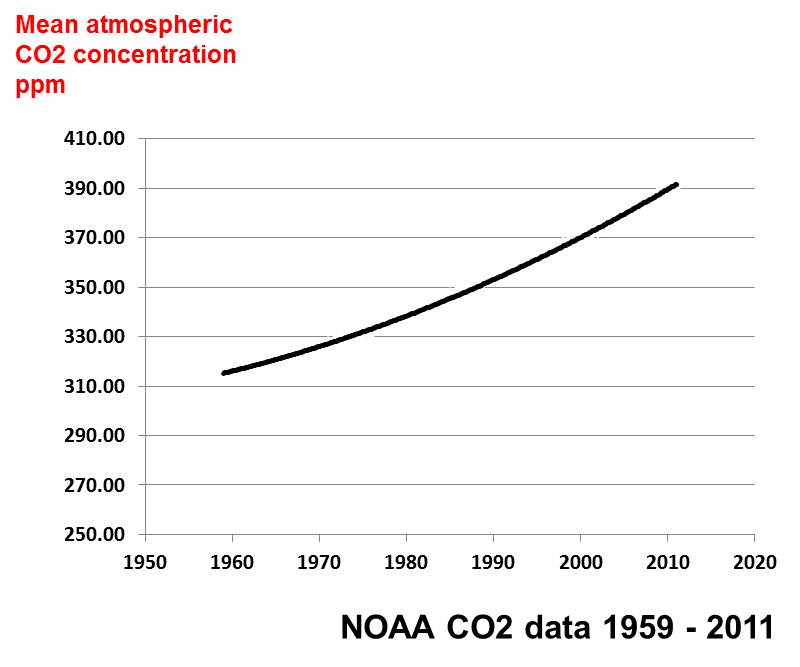
Over the last 16 years global temperatures have been pretty flat (actually the trend is very slightly downwards). During this same time  the atmospheric mean CO2 concentration has continued its increasing trend of between 1.5 and 2.5 ppm /year.

The data show no causality between CO2 concentration  and global mean temperature. How much or how little man-made emissions of CO2 contribute to the global mean concentration is still open to much question.

Global mean temperatures from woodfortrees.org

Global temperature anomaly hardcrut3vgl (via http://www.woodfortrees.org)

The following plot of mean annual atmospheric CO2 concentrations is from NOAA data 

(ftp://ftp.cmdl.noaa.gov/ccg/co2/trends/co2_annmean_mlo.txt)

NOAA ESRL data

“Greenpeace’s crime against humanity” – Patrick Moore

September 11, 2012

I perceive Greenpeace to be an organisation which was once well-intentioned  but which has degenerated to become an extremist, semi-religious group where advancing of its beliefs justifies the use of even unethical means. The fundamental error – as I see it – is that it sees “humans” as somehow being separate from “environment” and the development of humanity as a threat to environment. Greenpeace and other similar organisations  have lost sight of the fact that humans and their works are part of the “environment” and that the environment needs to be subservient to the needs of human development. They have become part of the coercive and alarmist movement that is eco-fascism.

Greenpeace has been known to exaggerate, mislead, cherry-pick data and even fake data in pursuing its religious goals. They may have done some good in the past but lately they have become one of the forces against improvements of the human condition.

So when Patrick Moore – a co-founder of Greenpeace – accuses them of crimes against humanity I am inclined to listen. Patrick Moore has been disillusioned with Greenpeace for some time and writes this article in Climate Depot which I have reproduced in full.

Special to Climate Depot

Greenpeace’s Crime Against Humanity

By Patrick Moore, PhD

September 10, 2012

Read the rest of this entry »

With 3 weeks to go the Indian monsoon rains have recovered somewhat

September 10, 2012

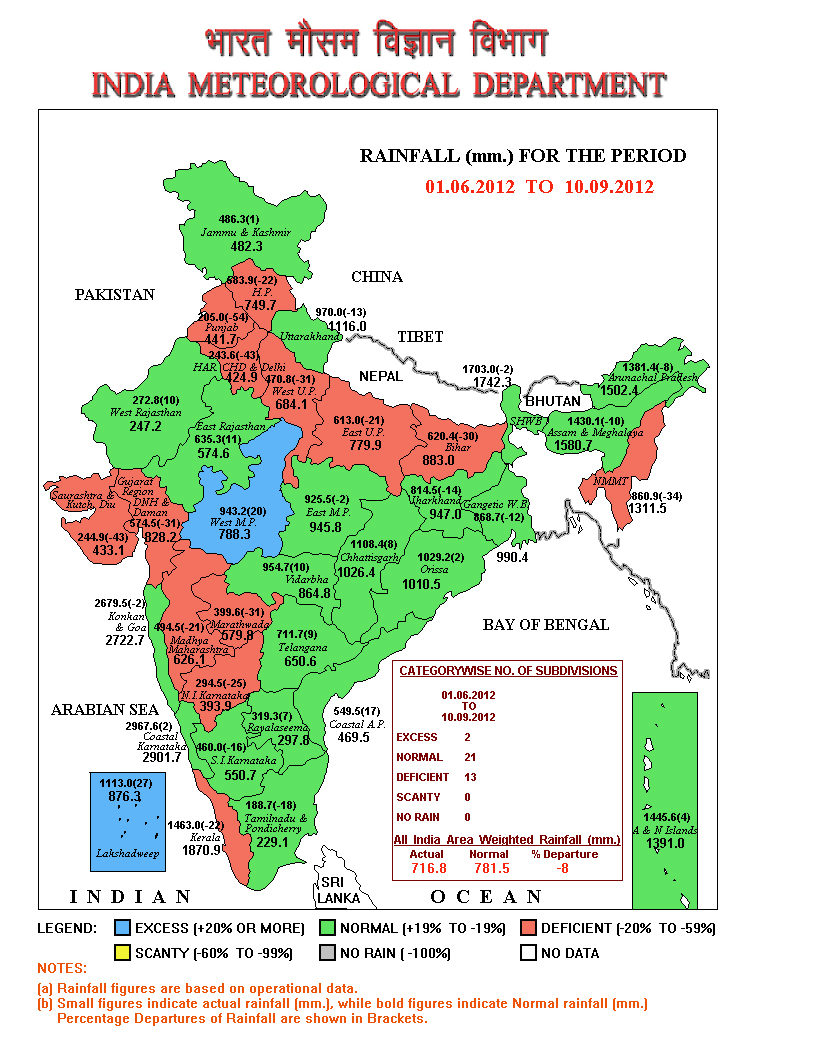
The Indian monsoon season officially covers the 4 months from June to September. Rainfall after the first 2 months was running some 25% less than “normal” and there were fears of severe effects not only directly on agricultural output but also for the knock-on effects on agriculture-related industry. But with 3 weeks left to go the rains seem to have recovered partially such that the total rainfall is running only 8% less than”normal”.

From IMD

2012 monsoon rainfall till 10th September / image IMD

At the end of July the rainfall map was dominated by “pink” deficient states and with even a couple of “yellow” scanty states. The situation has improved considerably though the late rains will not be as beneficial as they could have been a few weeks ago. Nevertheless, 2012 will probably be considered – statistically – a pretty average year and this monsoon will not be a “bad” one. Since the difference between a “good” monsoon (about +10 -15%) and a bad one (-15%)  is thought to about 2% for the annual GDP, this partial recovery will come as a relief to many.

India’s 100th space mission puts two satellites into orbit

September 10, 2012

The Indian space programme started 50 years ago and the Indian Space Research Organisation (ISRO) has now achieved its 100th mission. Of course there is a debate on whether this is money is well spent considering the many needs in the country. My own view is that it is. The long term development of technology, I think, takes precedence over some short term benefits if the money was spent elsewhere.

Daily Mail:The Indian space programme reached yet another milestone with the successful launch of the Polar Satellite Launch Vehicle (PSLV) carrying two foreign satellites from the Satish Dhawan spaceport, Sriharikota, in Andhra Pradesh on Sunday morning. 

This is the Indian Space Research Organisation’s (ISRO) 100th mission, which began with an experimental satellite called Aryabhata launched by a Russian rocket in April 1975. 

Incidentally, 2012 also marks 50 years of the start of the programme beginning with sounding rockets launched from Thumba in Kerala. …… 

The launch was delayed by two minutes – from 9.51 am to 9.53 am – after a safety analysis of data relating to space debris and asteroids. 

ISRO officials said this was a normal precaution taken to ensure safe journey for satellites to avoid any collision with space objects. 

Both satellites have been placed into their orbits precisely.

The count of 100 space missions includes 63 Indian satellites, 36 launch vehicle missions and one reusable space recovery mission.

The Hindu: 

Prime Minister Manmohan Singh on Sunday congratulated scientists of the Indian Space Research Organisation (ISRO) for the successful launch of the Polar Satellite Launch Vehicle C-21 from Sriharikota.

Expressing happiness at witnessing the launch, Dr. Singh complimented the Department of Space and the ISRO fraternity on this “spectacular success.”

“As ISRO’s 100th space mission, today’s [Sunday’s] launch is a milestone in our nation’s space capabilities,” he told a gathering of scientists that included the former ISRO chiefs.

Dr. Singh also congratulated EADS Astrium of France and the Osaka Institute of Technology of Japan on the successful launch of their satellites. This achievement was a testimony to the commercial competitiveness of the Indian space industry and a tribute to Indian innovation and ingenuity.

He noted that the year also marked the 50th anniversary of the commencement of India’s space programme and acknowledged the presence of many stalwarts of the earlier space programmes, including Project Directors of space missions. “Given the string of successes since then, we often forget how challenging space technology is and what a relatively new field it continues to be.” …..

Uncertainty in the Uncertainty Principle could give certainty of observation – perhaps

September 8, 2012

Heisenberg probably rules – OK?

I first saw this as graffiti in the 1970’s – at University in the UK  and at pubs around the University. But it seems that there are areas of doubt surrounding the Heisenberg Uncertainty Principle and – by extension – around some of the basic tenets of quantum mechanics. The “observer effect” where the observation itself alters the observation may be uncertain. The question is whether uncertainty of uncertainty can lead to certainty.

Phys. Rev. Lett. 109, 100404 (2012) 

Violation of Heisenberg’s Measurement-Disturbance Relationship by Weak Measurements by Lee A. Rozema, Ardavan Darabi, Dylan H. Mahler, Alex Hayat, Yasaman Soudagar, and Aephraim M. Steinberg  DOI: 10.1103/PhysRevLett.109.100404

Dilbert on uncertainty – from United Features Syndicate Inc.

 A synopsis by David Voss in the APS

When first taking quantum mechanics courses, students learn about Heisenberg’s uncertainty principle, which is often presented as a statement about the intrinsic uncertainty that a quantum system must possess. Yet Heisenberg originally formulated his principle in terms of the “observer effect”: a relationship between the precision of a measurement and the disturbance it creates, as when a photon measures an electron’s position. Although the former version is rigorously proven, the latter is less general and—as recently shown—mathematically incorrect. In a paper in Physical Review Letters, Lee Rozema and colleagues at the University of Toronto, Canada, experimentally demonstrate that a measurement can in fact violate Heisenberg’s original precision-disturbance relationship.

Read the rest of this entry »