Global temperature dependence on CO2 concentration goes missing

September 12, 2012

That climate changes and will continue to change is obvious. That this is primarily due to solar effects via the oceans also seems obvious to me. It seems the height of arrogance when – like Canute attempting to hold back the tides – climate-politicians attempt to hold back the sun and its effects. The sun cannot be carbon-taxed into submission.

That CO2 concentration in the atmosphere has little impact on climate is the reality that climate-politicians continue to deny. That the effects of man-made carbon dioxide emissions are of even less significance is becoming increasingly obvious.

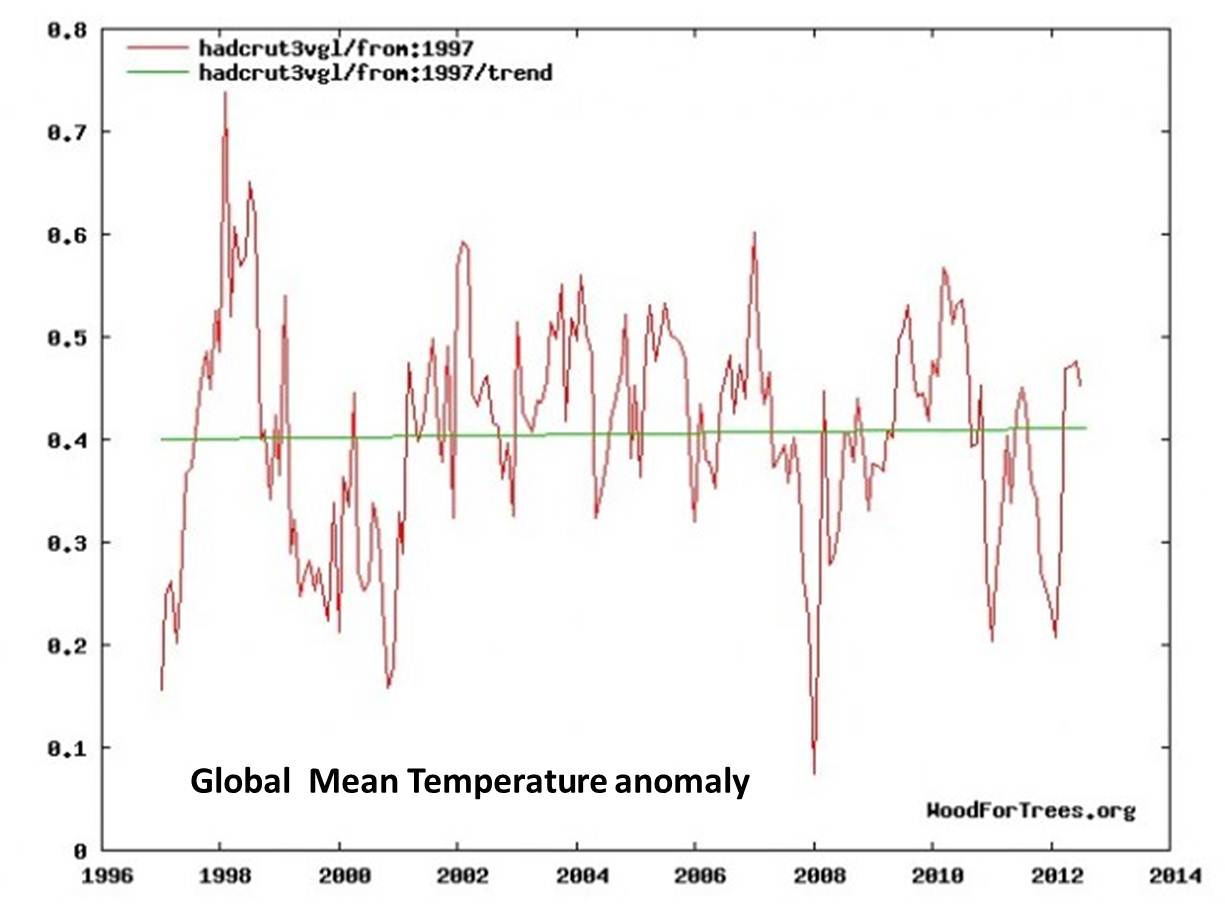
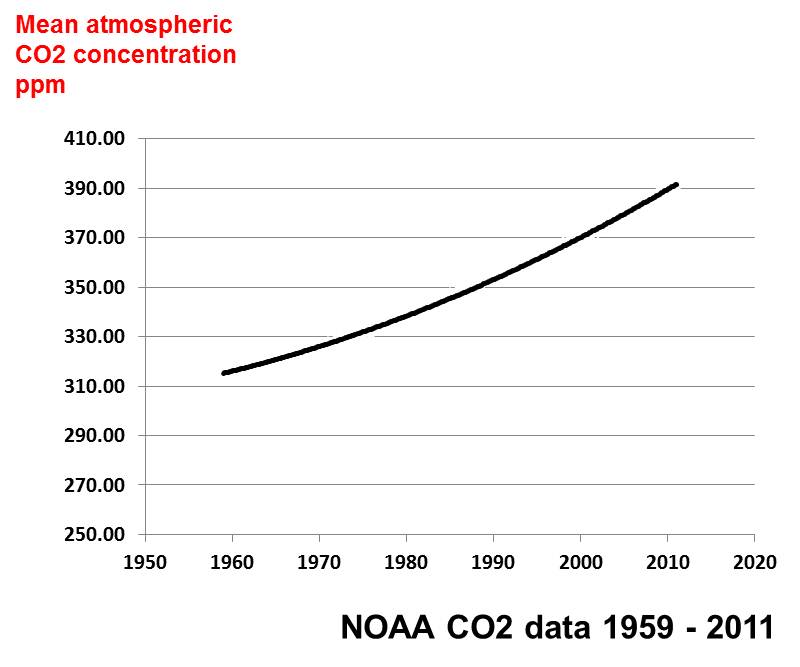
Over the last 16 years global temperatures have been pretty flat (actually the trend is very slightly downwards). During this same time  the atmospheric mean CO2 concentration has continued its increasing trend of between 1.5 and 2.5 ppm /year.

The data show no causality between CO2 concentration  and global mean temperature. How much or how little man-made emissions of CO2 contribute to the global mean concentration is still open to much question.

Global mean temperatures from woodfortrees.org

Global temperature anomaly hardcrut3vgl (via http://www.woodfortrees.org)

The following plot of mean annual atmospheric CO2 concentrations is from NOAA data 

(ftp://ftp.cmdl.noaa.gov/ccg/co2/trends/co2_annmean_mlo.txt)

NOAA ESRL data

“Greenpeace’s crime against humanity” – Patrick Moore

September 11, 2012

I perceive Greenpeace to be an organisation which was once well-intentioned  but which has degenerated to become an extremist, semi-religious group where advancing of its beliefs justifies the use of even unethical means. The fundamental error – as I see it – is that it sees “humans” as somehow being separate from “environment” and the development of humanity as a threat to environment. Greenpeace and other similar organisations  have lost sight of the fact that humans and their works are part of the “environment” and that the environment needs to be subservient to the needs of human development. They have become part of the coercive and alarmist movement that is eco-fascism.

Greenpeace has been known to exaggerate, mislead, cherry-pick data and even fake data in pursuing its religious goals. They may have done some good in the past but lately they have become one of the forces against improvements of the human condition.

So when Patrick Moore – a co-founder of Greenpeace – accuses them of crimes against humanity I am inclined to listen. Patrick Moore has been disillusioned with Greenpeace for some time and writes this article in Climate Depot which I have reproduced in full.

Special to Climate Depot

Greenpeace’s Crime Against Humanity

By Patrick Moore, PhD

September 10, 2012

Read the rest of this entry »

With 3 weeks to go the Indian monsoon rains have recovered somewhat

September 10, 2012

The Indian monsoon season officially covers the 4 months from June to September. Rainfall after the first 2 months was running some 25% less than “normal” and there were fears of severe effects not only directly on agricultural output but also for the knock-on effects on agriculture-related industry. But with 3 weeks left to go the rains seem to have recovered partially such that the total rainfall is running only 8% less than”normal”.

From IMD

2012 monsoon rainfall till 10th September / image IMD

At the end of July the rainfall map was dominated by “pink” deficient states and with even a couple of “yellow” scanty states. The situation has improved considerably though the late rains will not be as beneficial as they could have been a few weeks ago. Nevertheless, 2012 will probably be considered – statistically – a pretty average year and this monsoon will not be a “bad” one. Since the difference between a “good” monsoon (about +10 -15%) and a bad one (-15%)  is thought to about 2% for the annual GDP, this partial recovery will come as a relief to many.

India’s 100th space mission puts two satellites into orbit

September 10, 2012

The Indian space programme started 50 years ago and the Indian Space Research Organisation (ISRO) has now achieved its 100th mission. Of course there is a debate on whether this is money is well spent considering the many needs in the country. My own view is that it is. The long term development of technology, I think, takes precedence over some short term benefits if the money was spent elsewhere.

Daily Mail:The Indian space programme reached yet another milestone with the successful launch of the Polar Satellite Launch Vehicle (PSLV) carrying two foreign satellites from the Satish Dhawan spaceport, Sriharikota, in Andhra Pradesh on Sunday morning. 

This is the Indian Space Research Organisation’s (ISRO) 100th mission, which began with an experimental satellite called Aryabhata launched by a Russian rocket in April 1975. 

Incidentally, 2012 also marks 50 years of the start of the programme beginning with sounding rockets launched from Thumba in Kerala. …… 

The launch was delayed by two minutes – from 9.51 am to 9.53 am – after a safety analysis of data relating to space debris and asteroids. 

ISRO officials said this was a normal precaution taken to ensure safe journey for satellites to avoid any collision with space objects. 

Both satellites have been placed into their orbits precisely.

The count of 100 space missions includes 63 Indian satellites, 36 launch vehicle missions and one reusable space recovery mission.

The Hindu: 

Prime Minister Manmohan Singh on Sunday congratulated scientists of the Indian Space Research Organisation (ISRO) for the successful launch of the Polar Satellite Launch Vehicle C-21 from Sriharikota.

Expressing happiness at witnessing the launch, Dr. Singh complimented the Department of Space and the ISRO fraternity on this “spectacular success.”

“As ISRO’s 100th space mission, today’s [Sunday’s] launch is a milestone in our nation’s space capabilities,” he told a gathering of scientists that included the former ISRO chiefs.

Dr. Singh also congratulated EADS Astrium of France and the Osaka Institute of Technology of Japan on the successful launch of their satellites. This achievement was a testimony to the commercial competitiveness of the Indian space industry and a tribute to Indian innovation and ingenuity.

He noted that the year also marked the 50th anniversary of the commencement of India’s space programme and acknowledged the presence of many stalwarts of the earlier space programmes, including Project Directors of space missions. “Given the string of successes since then, we often forget how challenging space technology is and what a relatively new field it continues to be.” …..

Uncertainty in the Uncertainty Principle could give certainty of observation – perhaps

September 8, 2012

Heisenberg probably rules – OK?

I first saw this as graffiti in the 1970’s – at University in the UK  and at pubs around the University. But it seems that there are areas of doubt surrounding the Heisenberg Uncertainty Principle and – by extension – around some of the basic tenets of quantum mechanics. The “observer effect” where the observation itself alters the observation may be uncertain. The question is whether uncertainty of uncertainty can lead to certainty.

Phys. Rev. Lett. 109, 100404 (2012) 

Violation of Heisenberg’s Measurement-Disturbance Relationship by Weak Measurements by Lee A. Rozema, Ardavan Darabi, Dylan H. Mahler, Alex Hayat, Yasaman Soudagar, and Aephraim M. Steinberg  DOI: 10.1103/PhysRevLett.109.100404

Dilbert on uncertainty – from United Features Syndicate Inc.

 A synopsis by David Voss in the APS

When first taking quantum mechanics courses, students learn about Heisenberg’s uncertainty principle, which is often presented as a statement about the intrinsic uncertainty that a quantum system must possess. Yet Heisenberg originally formulated his principle in terms of the “observer effect”: a relationship between the precision of a measurement and the disturbance it creates, as when a photon measures an electron’s position. Although the former version is rigorously proven, the latter is less general and—as recently shown—mathematically incorrect. In a paper in Physical Review Letters, Lee Rozema and colleagues at the University of Toronto, Canada, experimentally demonstrate that a measurement can in fact violate Heisenberg’s original precision-disturbance relationship.

Read the rest of this entry »

Has Obama dumped Al Gore?

September 7, 2012

I expect that President Obama does have some electoral advantage in not being saddled with Al Gore – or it could just be that Gore is really upset that the income that would be generated for his companies by cap-and trade is not materialising.

TheDaily reports:

Al Gore is boycotting the Democratic National Convention because he doesn’t get along with President Obama and is disappointed that Obama hasn’t pushed harder for a cap-and-trade law that would force Americans to use less fossil fuels, sources tell Flash.

While tens of thousands of Democrats from across the country are gathered in Charlotte, N.C., Gore stayed in New York to cover the convention for his struggling Current TV channel. “Gore was not treated respectfully by the Obama team. He’s snubbing them, because they snubbed him,” said one Democratic fundraiser. 

Former President Bill Clinton has been given an active role in Obama’s re-election effort, and was given a prime-time slot to speak just before Obama accepted his nomination last night. But Clinton’s running mate, a winner of the Nobel Peace Prize, has been an invisible man. 

“He’s been missing in action. It’s not just the convention. Gore hasn’t made any speeches for  Obama, or campaign appearances, or fundraising solicitations … nothing,” said our source. …..

ORI finds misconduct by Marc Hauser in 4 NIH grants

September 6, 2012

Psychology is an academic discipline but it is not (yet) a science.

The Hausergate affaire followed by the Diedrik Stapel affaire only confirmed my view that psychology as an academic discipline is permeated by confirmation bias (and sometimes just plain fraud). Now the Marc Hauser affaire reaches some kind of a conclusion (at least until he has served his “sentence” and is then “rehabilitated”) with the Office of Research Integrity’s report.

Retraction Watch comments on the ORI report:

Two years after questions surfaced about work by former Harvard psychology professor Marc Hauser, an official government report is finally out.

It’s not pretty.

The findings by the Office of Research Integrity were first reported by the Boston Globe, which was also first to report the issues in Hauser’s work. They’re extensive, covering misconduct in four different NIH grants ……..

As I had posted at the end of last year, psychology as an academic discipline needs to start introducing some intellectual rigour:

That psychology is a discipline and a field of study is indisputable. That the study of human (or animal) behaviour is a worthy field and that experimentation and research are well worth pursuing is also obvious. But I am of the view that it is far from being a science.  Psychology can be considered to be a pre-science similar to alchemy. And the practitioners of psychology are similar to priests and shamans and witch-doctors and other practitioners of magic. Inevitably the field contains many charlatans.  …… In the various fields of psychology, the null hypothesis is rarely if ever brought into play. …..

…. As Paul Lutus so well puts it

…. psychology can make virtually any claim and offer any kind of therapy, because there is no practical likelihood of refutation – no clear criteria to invalidate a claim. This, in turn, is because human psychology is not a science, it is very largely a belief system similar to religion.

The year when “hot air avoided Sweden with uncanny precision.”

September 5, 2012

One summer (or one winter) does not a climate make – but ……..

The Swedish Meteorological and Hydrological Institute (SMHI) has posted its summary of the 2102 summer.

In summary, one can say that the summer of 2012 was the year when “hot air avoided Sweden with uncanny precision.”

The summer of 2012 was not one of the wettest and coldest, but was probably still a disappointment for most vacationers. There was not a single extended period of warmth, sunshine and clear blue skies throughout the summer. It is twelve years since it happened last. Previously, this type of summer occurred more frequently. 1987, 1993, 1998 and 2000 are examples.

Otherwise, there was absolutely no shortage of hot air over the Northern Hemisphere. But it avoided Sweden with uncanny precision.

Read the rest of this entry »

Carbon dioxide lags temperature

September 3, 2012

A new paper again confirming that the theory that carbon dioxide leads global temperature is misconceived.

” Changes in global atmospheric CO2 are lagging 9.5-10 months behind changes in global air surface temperature. CO2 released from use of fossil fuels have little influence on the observed changes in the amount of atmospheric CO2.” 

The phase relation between atmospheric carbon dioxide and global temperature

by Ole Humlum, Kjell Stordahl, Jan-Erik Solheim, Global and Planetary Change

Abstract

Using data series on atmospheric carbon dioxide and global temperatures we investigate the phase relation (leads/lags) between these for the period January 1980 to December 2011. Ice cores show atmospheric CO2variations to lag behind atmospheric temperature changes on a century to millennium scale, but modern temperature is expected to lag changes in atmospheric CO2, as the atmospheric temperature increase since about 1975 generally is assumed to be caused by the modern increase in CO2. In our analysis we use eight well-known datasets; 1) globally averaged well-mixed marine boundary layer CO2 data, 2) HadCRUT3 surface air temperature data, 3) GISS surface air temperature data, 4) NCDC surface air temperature data, 5) HadSST2 sea surface data, 6) UAH lower troposphere temperature data series, 7) CDIAC data on release of anthropogene CO2, and 8) GWP data on volcanic eruptions. Annual cycles are present in all datasets except 7) and 8), and to remove the influence of these we analyze 12-month averaged data. We find a high degree of co-variation between all data series except 7) and 8), but with changes in CO2 always lagging changes in temperature. The maximum positive correlation between CO2 and temperature is found for CO2 lagging 11–12 months in relation to global sea surface temperature, 9.5-10 months to global surface air temperature, and about 9 months to global lower troposphere temperature. The correlation between changes in ocean temperatures and atmospheric CO2 is high, but do not explain all observed changes.

Highlights

► The overall global temperature change sequence of events appears to be from 1) the ocean surface to 2) the land surface to 3) the lower troposphere.

►Changes in global atmospheric CO2 are lagging about 11–12 months behind changes in global sea surface temperature.

► Changes in global atmospheric CO2 are lagging 9.5-10 months behind changes in global air surface temperature. Changes in global atmospheric CO2 are lagging about 9 months behind changes in global lower troposphere temperature.

► Changes in ocean temperatures appear to explain a substantial part of the observed changes in atmospheric CO2 since January 1980.

► CO2 released from use of fossil fuels have little influence on the observed changes in the amount of atmospheric CO2, and changes in atmospheric CO2 are not tracking changes in human emissions.

Long term investment: Avoid the carbon taxers (Australia) and follow the shale gas (US)

August 24, 2012

It is electricity price – rather than energy price – which is I think the more telling parameter for growth and investment. And it is electricity price which matters fundamentally. Winning “brownie points” for being virtuous and politically correct is irrelevant and often counter-productive.

Historically, a  low (unsubsidised) electricity price has nearly always given high growth, increased exports to regions with higher electricity prices and an attractive climate to invest in. This simple observation will now lead to my shifting my (small) investments away from  Australia for some time – at least as long they continue with their virtuous but meaningless carbon tax. On the other hand, the relatively low electricity prices resulting from the advent of shale gas  in the US augur well for the US economy and for US exporters – irrespective of which party the President comes from.

In my own field of power generation I expect a gas turbine combined cycle boom in the US in 2014/15 (which will also be a boom for steam turbine manufacturers). So my message for the next 5 or 6 years is to shift your investments away from Australia (and other virtuous but economically silly countries) and into countries promoting low energy prices (US and other countries where the environmental regulations and tax regimes allow  production of electricity at the lowest possible cost).

Sydney Morning Herald: 

BHP Billiton head Marius Kloppers has told European investors that Australia’s carbon and mining taxes have helped to render the nation’s coal industry unworthy of further investment at this time. ……. 

In comments that appeared to be more pointed than those given in his Australian media conference, Mr Kloppers put some of the blame on the federal government’s two controversial new taxes.

”What I am seeing on the eastern seaboard in Australia is that the coal industry has been very heavily impacted by lower prices, higher operating costs, carbon taxes and increased royalties,” he said.

Royalties were increased by the New South Wales government as it sought to exploit a loophole in the federal government’s new mining tax, and a similar tactic is now being considered by the Queensland government. ….

Financial Times:

….. Today, few realise that the US stands on the cusp of significant economic gains stimulated by low energy costs. High quality global journalism requires investment.  …..

The consensus view discounts the economic boost from natural gas, arguing that the energy sector cannot generate so many jobs. The doubters wear blinkers; they see nothing but the energy market. They commit the mistake made by forecasters in 1991. They miss the tectonic shifts in trade,  ….

(The shale gas) advantage gives manufacturing plants in the US a 60 per cent, 70 per cent or even 80 per cent cost advantage over those operating in China, Japan, South Korea or European countries.

Read more: http://www.ft.com/intl/cms/s/0/09fbb2ac-87b8-11e1-ade2-00144feab49a.html#axzz24QutnD2A