Apocalypse Not!

August 18, 2012

I have a theory that within a hundred years we will be bemoaning the lack of world population. The collapse of society will be forecast as an impending catastrophe as the total world population stabilises at less than 10 billion with the proportion of the young working population decreasing relative to the increasing numbers of the “leisured” population.  And that apocalypse too shall not come to pass.

Matt Ridley has a new essay in Wired which needs to be read. Just some excerpts below:

Apocalypse Not: Here’s Why You Shouldn’t Worry About End Times

When the sun rises on December 22, as it surely will, do not expect apologies or even a rethink. No matter how often apocalyptic predictions fail to come true, another one soon arrives. And the prophets of apocalypse always draw a following—from the 100,000 Millerites who took to the hills in 1843, awaiting the end of the world, to the thousands who believed in Harold Camping, the Christian radio broadcaster who forecast the final rapture in both 1994 and 2011. ………

Read the rest of this entry »

India tops the list of Olympics underachievers

August 14, 2012

London 2012  has been a fantastic Olympics – the Bolt Games – notwithstanding a fairly pathetic closing ceremony.

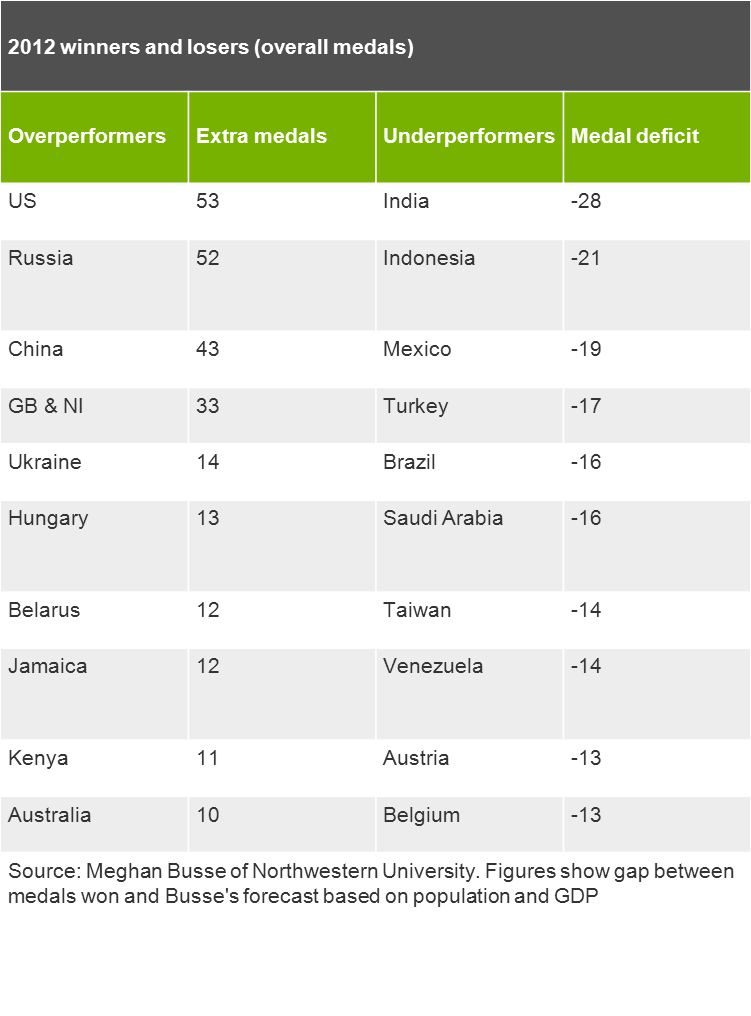
The BBC with the help of Meghan Busse from the Kellogg School of Management at Northwestern University in the US has produced a table of the underachieving and overachieving nations (based on population and GDP).

The top-10 list of countries that won most Olympic medals barely changed between 2008 and 2012. The top four – US, China, Russia, UK – were identical. Just one country dropped out – Ukraine – which was replaced by Japan. But which countries did better or worse than we should have expected?

Before the Games started, BBC Radio’s More or Less programme decided to level the statistical playing field by working out how many medals nations could expect to win based on population and GDP alone.

“If you use those predictions as a kind of benchmark, then you can ask the question, who’s done well and not so well relative to that prediction – who won more medals than they should have, and who won fewer,” says Meghan Busse from the Kellogg School of Management at Northwestern University in the US, who helped with the sums.

THE ALTERNATIVE MEDAL TABLE

Unions+con-men+lawyers+sleaze = Julia Gillard?

August 13, 2012

I first came across Australian politics some 25 years ago when trying to sell a turnkey power plant to be located in W. Australia. I found myself trying to negotiate through a morass of cronyism together with convoluted local and national politics which I never did succeed to decipher.  Since then I have been a fascinated – but always confused – observer of Australian politics. I never did manage to sell that particular power plant in Bunbury but I did manage to see a couple of Test matches at the WACA. I have subsequently sold steam and gas turbines  in Australia where these projects did not attract the same level of political interest. But I still have  a very meagre understanding of how things actually get done within Australian politics.

An Australian political cartoonist – Larry Pickering – has been running a series of articles on his blog (4 parts – so far – with part 5 yet to come just published). The contents seem to reveal a web of corruption and deceit encompassing a crooked union leader, the AWU, dirty weekends, a law firm and Julia Gillard who was then employed at that firm. Somewhere along the line Ms. Gillard was apparently sacked from the law firm and then entered politics. The revelations appear quite explosive to me but I note there is almost no coverage of these in the Australian media. I am not quite sure what to make of the apparent disinterest of the MSM. It could be that the “revelations” are pretty tame and just represent  the “normal” and expected behaviour of Australian politicians?

Part One: Our Prime minister is a Crook

Part Two: Is our Prime Minister a Crook?

Part Three: Is our Prime Minister a Crook?

Part Four: Is our Prime Minister a Crook?

UPDATE!

Part 5: Is our Prime Minister a crook?

Larry Pickering’s cartoons are pretty interesting as well. The Bolt Games are over now and I like this one:

Cartoon by Larry Pickering

The “luminiferous aether” has morphed to “dark matter” but we still don’t know why an apple falls…

August 12, 2012

A new paper claims to have found evidence of dark matter near the sun.

“We are 99% confident that there is dark matter near the Sun,” says the lead author Silvia Garbari. In fact, if anything, the authors’ favoured dark matter density is a little high: they find more dark matter than expected at 90% confidence. There is a 10% chance that this is merely a statistical fluke, but if future data confirms this high value the implications are exciting as Silvia explains: “This could be the first evidence for a “disc” of dark matter in our Galaxy, as recently predicted by theory and numerical simulations of galaxy formation, or it could mean that the dark matter halo of our galaxy is squashed, boosting the local dark matter density.”

But I cannot help thinking that “dark matter” and “dark energy” are no different  conceptually to the theories of phlogiston and luminiferous aether . They are plausible artefacts created to explain observations but are not themselves observable. I am not particularly convinced when

Read the rest of this entry »

The Bolt Games are coming to an end …… and some events need to go

August 10, 2012

Three days of competition left and then I can get back to a normal routine again. But Usain Bolt and David Rudisha were well worth waiting for last night. And behind David Rudisha in the 800m came two unheralded teenagers. What is left to say about Usain Bolt? The sprint double at successive Games is unprecedented and will not be repeated for a long time. From day one – and long before the athletics had even begun – it has been the Usain Bolt show even if the Team GB performance has been quite remarkable. Almost a fairy tale for the host nation. The organisation of the games has – to all appearances – been a great success. Journalists still look for negative stories but London has coped and coped quite easily. But London 2012 will be – should be – known as the Bolt Games.

Of course Usain Bolt has the 4 x 100m relay yet to come but that does not carry the majesty that the 100m and the 200m does. Rudisha vs. Bolt at the compromise distance of 400m could be interesting.

But – and without any disrespect to the proponents – there are far too many events which just don’t feel Olympian to me. I think I would prefer to see the emphasis on the performance of individuals. Faster, higher, stronger. All team events then feel wrong. This would remove football and hockey and volleyball and handball and basketball and beach volleyball. Even the doubles events in the racquet games would go (and do we really need three racquet games?). Wrestling and boxing are surely enough of the “combat sports” without having to suffer the judo and Tae-kwon-do bouts. Even wrestling has become quite unintelligible for the uninitiated. Pairs and fours in rowing could go. Events where performance is entirely subjective have no place here I think. This would remove artistic gymnastics and synchronised diving for example. And synchronised swimming would die a natural death if it was not an Olympic event. The equestrian events are interesting and dressage is an equine ballet that can be a joy to watch. But for riders to be feted for the performance of their horses seems a little ridiculous.

The Olympics must be the celebration of individual performance – I think – rather than team performances (with their nationalistic overtones).

Faster, Higher and Stronger!

And Tae-kwon-do, Wrestling, Judo, Water polo and all team events would be the first to go if I could choose.

By the grace of Allah – a water-powered car!

August 8, 2012

Of course it’s August and it’s silly season but the bottom is reached when a Pakistani Minister of Religious Affairs and cabinet ministers endorse a water-powered car!!

New York Times:

…..  “By the grace of Allah, I have managed to make a formula that converts less voltage into more energy,” the professed inventor, Agha Waqar Ahmad, said in a telephone interview. “This invention will solve our country’s energy crisis and provide jobs to hundreds of thousands of people.” …… 

Federal ministers lauded Mr. Ahmad and his vehicle, sometimes at cabinet meetings. The stand-in minister for religious affairs, Khursheed Shah, appeared on television with him and took a ride in his small Suzuki rental, which was hooked up to a contraption that Mr. Ahmad described as a “water kit.” Respected talk show hosts suggested he should get state financing and protection. …..

The country’s most famous scientist, Abdul Qadeer Khan — revered inside Pakistan as the father of the country’s nuclear weapons program and reviled elsewhere as a notorious figure in the international nuclear black market — gave it his imprimatur, too. “I have investigated the matter, and there is no fraud involved,” he told Hamid Mir, a popular television journalist, during a recent broadcast that sealed Mr. Ahmad’s celebrity.

The quest to harness chemical energy from water is a holy grail of science, offering the tantalizing promise of a world free from dependence on oil. Groups in other countries, including Japan, the United States and Sri Lanka, have previously made similar claims. They have been largely ignored. Not so with Mr. Ahmad, even if he is an unlikely scientific prodigy. Forty years old and a father of five, he graduated with a degree in mechanical engineering in 1990 from a small technical college in Khairpur, in southern Sindh Province, he said in the interview. For most of his career he worked in a local police department. He is currently unemployed.

Most of the Pakistani media went ape. But Dawn at least kept its cool and represented the voice of sanity:

TALK-SHOW hosts feted it. Politicians rode in it. Cabinet ministers discussed it. Well-known scientists backed it. Those of a particularly conspiratorial bent called for him to be provided security against a threatened oil industry. While a lone voice calling foul was barely given a chance to be heard, Agha Waqar Ahmad and his ‘water car’ were being hailed as the invention that would free the world from the tyranny of fossil-fuel dependence and transform Pakistan’s image around the globe. As was bound to happen eventually, his scientifically impossible claim, which defies the basic laws of physics, is now being exposed as gobsmacked scientists begin to write and speak about it. A technical examination of the water kit, planned at the highest levels of government, has been delayed indefinitely. Perhaps the best proof has come from the man’s own bumbling attempts to defend his device.

What won’t change as quickly are the unfortunate truths this episode has exposed about Pakistani society. For one, it highlighted again how easily the media here buys into seemingly exciting, but always improbable, news stories without any background research or inquiries. Also left looking more ridiculous than Mr Ahmad are the politicians, ministers and especially scientists who jumped on the bandwagon and hailed the car as a giant leap for Pakistan, showcasing in the process the national love of shortcuts and easy glory and the lack of quality education that makes even our leading public figures susceptible to such bogus claims. Meanwhile, no real work, scientific, managerial, technical or otherwise, is being done to actually address the energy crisis. And the fact that at the same time the breakthrough science of an actual national hero — the Nobel-prize-winning Dr Abdus Salam — is being erased from our official history is a telling comment on Pakistan’s commitment to knowledge.

AGW – “a monopoly that clings to one hypothesis”

August 6, 2012

Michael Crichton (2003): There is no such thing as consensus science. If it’s consensus, it isn’t science. If it’s science, it isn’t consensus. Period.”

Matt Ridley’s 3rd article on confirmation bias in the Wall Street Journal:

I argued last week that the way to combat confirmation bias—the tendency to behave like a defense attorney rather than a judge when assessing a theory in science—is to avoid monopoly. So long as there are competing scientific centers, some will prick the bubbles of theory reinforcement in which other scientists live.

image

image : Wall Street Journal – John S. Dykes

Last month saw two media announcements of preliminary new papers on climate. One, by a team led by physicist Richard Muller of the University of California, Berkeley, concluded “the carbon dioxide curve gives a better match than anything else we’ve tried” for the (modest) 0.8 Celsius-degree rise in global average temperatures over land during the past half-century—less, if ocean is included. He may be right, but such curve-fitting reasoning is an example of confirmation bias. The other, by a team led by the meteorologist Anthony Watts, a skeptical gadfly, confirmed its view that the Muller team’s numbers are too high—because “reported 1979-2008 U.S. temperature trends are spuriously doubled” by bad thermometer siting and unjustified “adjustments.” …

…. The late novelist Michael Crichton, in his prescient 2003 lecture criticizing climate research, said: “To an outsider, the most significant innovation in the global-warming controversy is the overt reliance that is being placed on models…. No longer are models judged by how well they reproduce data from the real world—increasingly, models provide the data. As if they were themselves a reality.” ….

….. Bring on the gadflies.

The late Michael Crichton’s lecture in 2003 is well worth reading again.

Crichton’s lecture is here: Crichton 2003 Caltech Michelin Lecture

On “consensus science” he has this to say:

I want to pause here and talk about this notion of consensus, and the rise of what has been called consensus science. I regard consensus science as an extremely pernicious development that ought to be stopped cold in its tracks. Historically, the claim of consensus has been the first refuge of scoundrels; it is a way to avoid debate by claiming that the matter is already settled. Whenever you hear the consensus of scientists agrees on something or other, reach for your wallet, because you’re being had.

Let’s be clear: the work of science has nothing whatever to do with consensus. Consensus is the business of politics. Science, on the contrary, requires only one investigator who happens to be right, which means that he or she has results that are verifiable by reference to the real world. In science consensus is irrelevant. What is relevant is reproducible results. The greatest scientists in history are great precisely because they broke with the consensus.

There is no such thing as consensus science. If it’s consensus, it isn’t science. If it’s science, it isn’t consensus. Period.

In addition, let me remind you that the track record of the consensus is nothing to be proud of. Let’s review a few cases. ……
The Luddite shades of Green

August 5, 2012


The Leader of the Luddites, engraving of 1812: Wikipedia

This editorial in The Australian about shale gas got me to wondering how it has come to pass that what were once very laudable anti-pollution goals have morphed  into an anti-technology and essentially anti-human movement. Luddites have always been among us and always need – and have always needed – a cloak of righteousness under which to operate. The current demonisation of technological advance has its roots – I think – in the politicisation of the concern for “the environment” which probably began in the 1960’s. As long as “environmentalism” focused on improvement of local conditions it did much good. It has contributed much to the clean-up of air and water pollution which had resulted from the speed of industrialisation. While industrialisation and technological development were necessary for growth and to ensure that humans could put food on their tables, the drive against pollution did much to improve their quality of life. But then the Luddites – who have always been around – “found” evironmentalism. The destructive forces had found a new righteous cover – this time coloured green. Politicisation and globalisation have now transformed what was once a relatively simple anti-pollution campaign focused on improving the quality of life for humans into something else – a fanatical movement with religious overtones. A coercive, destructive, backward-looking, anti-development, anti-human Green Monster.

The Green movement has become the cloak under which modern Luddites can hide and operate.

The Australian:

POLITICAL parties preoccupied with environmental protection, including the Greens, should take on board the benefits of breakthrough technology that is already allowing easier access to shale gas in the US.

As environment editor Graham Lloyd reports today, with 250 years’ worth of gas reserves now in play, the shale revolution is cutting power costs and carbon emissions and increasing energy supplies. In the longer term, it promises energy security, export earnings and stability as the West’s dependence on Middle East oil diminishes.

The unexpected emergence of shale, foreseen by very few four or five years ago, underlines the folly of governments trying to “pick winners” by investing in various forms of renewable energy, such as wind and solar power, which will only be viable on a large scale if technology improves.

Too little attention has been paid to Australia’s vast shale reserves, which are potentially far bigger than coal-seam gas. Apart from the volume of water needed to access it, shale poses fewer environmental problems than coal-seam gas. The geological formations are more stable and located in more remote areas. Given the reluctance of our politicians to pursue nuclear power, shale has the potential to be an important energy source for decades.

OED:

Luddite – In modern usage, “Luddite” is a term describing those opposed to industrialisation, automation, computerisation or new technologies in general

Greenie – a person who campaigns for protection of the environment

the environment – the surroundings or conditions in which a person, animal, or plant lives or operates; the natural world, as a whole or in a particular geographical area, especially as affected by human activity


Reported 1979-2008 U.S. temperature trends are spuriously doubled by NOAA

July 29, 2012

1. Anthony Watts has a new publication

This pre-publication draft paper, titled An area and distance weighted analysis of the impacts of station exposure on the U.S. Historical Climatology Network temperatures and temperature trends, is co-authored by Anthony Watts of California, Evan Jones of New York, Stephen McIntyre of Toronto, Canada, and Dr. John R. Christy from the Department of Atmospheric Science, University of Alabama, Huntsville.

A reanalysis of U.S. surface station temperatures has been performed using the recently WMO-approved Siting Classification System devised by METEO-France’s Michel Leroy. The new siting classification more accurately characterizes the quality of the location in terms of monitoring long-term spatially representative surface temperature trends. The new analysis demonstrates that reported 1979-2008 U.S. temperature trends are spuriously doubled, with 92% of that over-estimation resulting from erroneous NOAA adjustments of well-sited stations upward. The paper is the first to use the updated siting system which addresses USHCN siting issues and data adjustments.

The new improved assessment, for the years 1979 to 2008, yields a trend of +0.155C per decade from the high quality sites, a +0.248 C per decade trend for poorly sited locations, and a trend of +0.309 C per decade after NOAA adjusts the data. ……

2. Massive Human CO2 Emissions Still Unable To Reverse Nature’s Global Cooling Over Last 15 Years

Hadcrut global cooling co2 ipcc climate models global warming june 2012

CO2 and temperature


Olympics: OBS coverage is amateur and cycling road race graphics were pathetic

July 29, 2012

Maybe it’s just teething troubles on Day 1, but yesterday’s coverage of the cycling road race was pathetic. Coverage of the boxing was bad and the rowing and swimming graphics were amateur. Their choice of pictures generally from their many cameras managed to miss many of the critical moments.

Olympic Broadcasting Services – OBS – provides all pictures from the Olympics to broadcasters around the world.

Of course, OBS is a wholly-owned subsidiary of the International Olympic Committee and hosts the broadcasting operation for several major sporting events.

The coverage was amateur rather than incompetent – but for the premier sporting event it needs to be at a different level. It certainly cannot get much worse.

The Guardian