Robovie-PC wins robot marathon by one second

February 26, 2011

From AFP via PhysOrg

Five bipedal machines began the non-stop 42.2-kilometre contest on a 100-metre indoor track in Osaka

Robovie PC (right) beats his brother Robovie PC-Lite by one second

Robovie-PC, a toy-sized humanoid, won the world’s first full-length marathon for two-legged robots by a whisker Saturday, beating its closest rival by a single second after more than two days of racing.

Five bipedal machines began the non-stop 42.2-kilometre (26.2-mile) contest on a 100-metre indoor track in the western Japanese city of Osaka Thursday morning after doing knee bends or raising their hands to greet spectators.

One of the competitors retired after finishing only the first lap, but the others continued running day and night, getting up by themselves every time they fell to the floor or got into collisions with rivals.

Robovie-PC, 40 centimetres (16 inches) tall and weighing 2.4 kilograms (5.3 pounds), stormed into first place with only a few laps to go after Robovie-PC Lite, which had established a comfortable lead and appeared to have secured an easy victory, suddenly locked up.

Robovie-PC Lite managed to return to the track and fiercely chased the leader, but after 422 laps Robovie-PC crossed the line in 54 hours 57 minutes 50 seconds, organisers said, one second ahead of its rival.

Their average speed was 0.77 kilometres per hour.

After the dramatic finish the two robots — both made by Vstone Co., a robot technology firm based in the industrial city which also organised the “Robo Mara Full” race — waved their arms and bowed, to wild applause from the crowd.

According to the event’s regulations, competitors were allowed to change batteries and the servomotors which control the robots’ speed and other functions.

The other two robots still running had yet to complete the race Saturday evening.

Baltic sea ice highest in 25 years

February 26, 2011

From The Local:

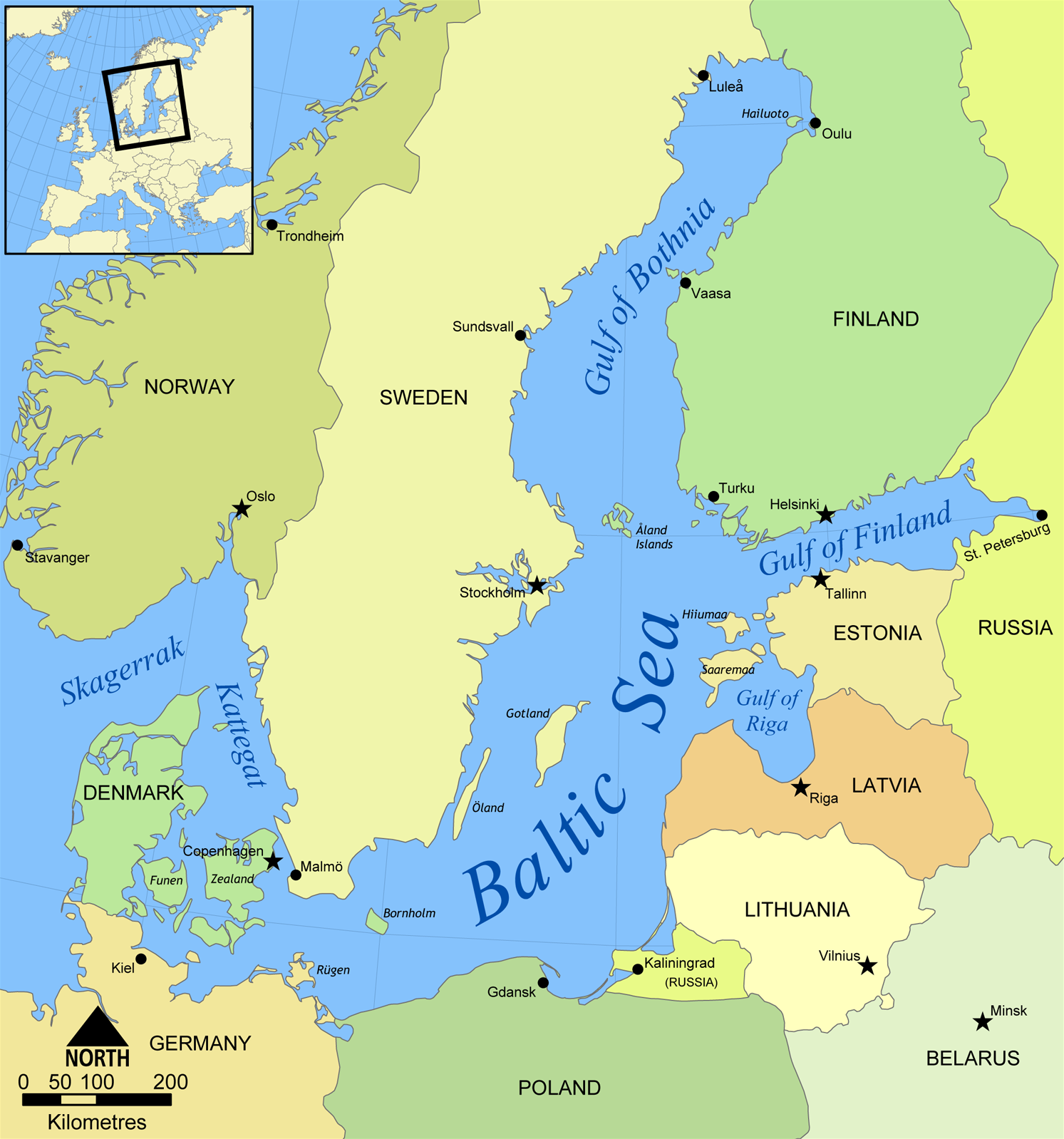
Baltic Sea: image Wikipedia

Deep freeze puts Baltic on track for record ice

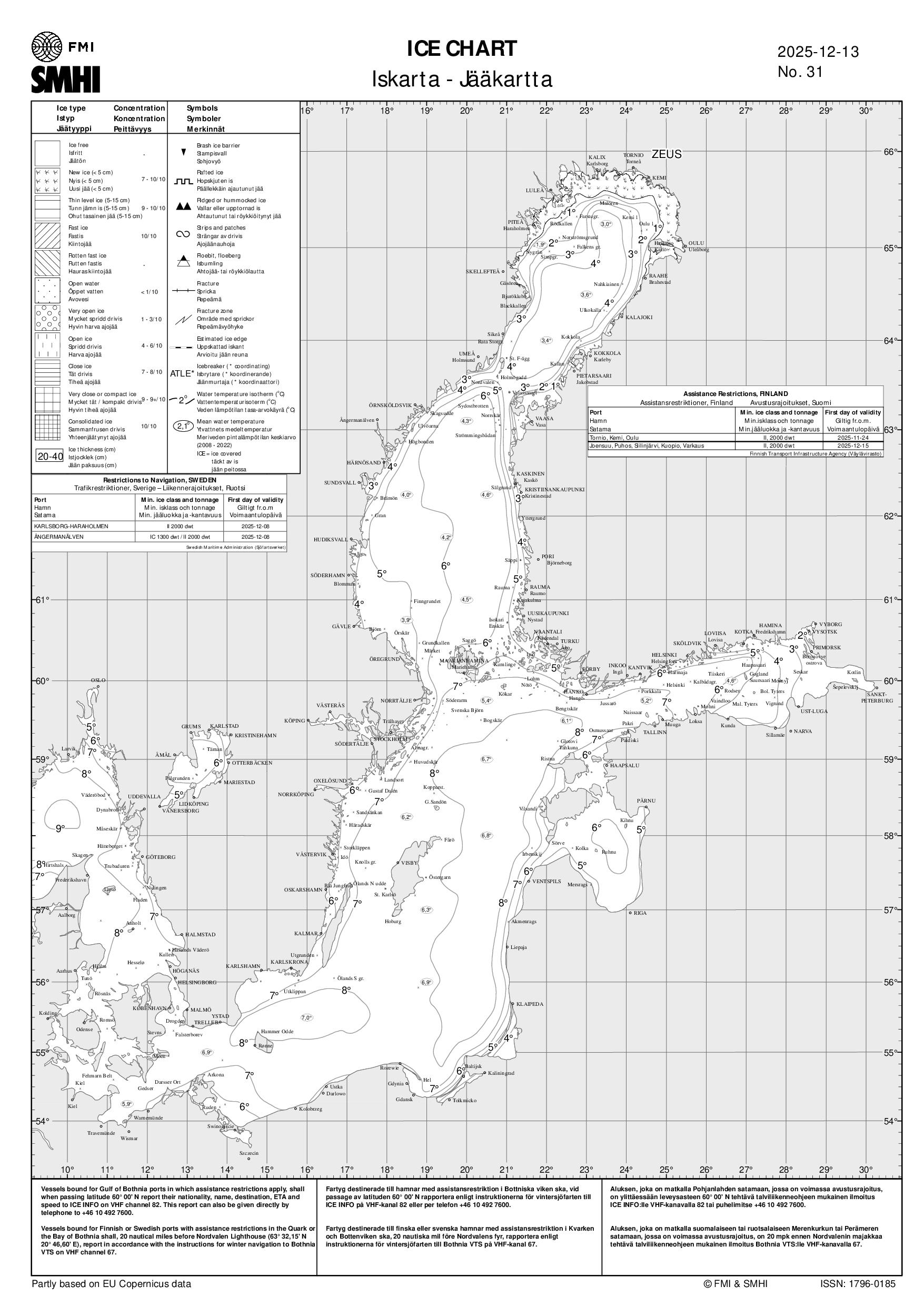
Following another extended stretch of sub-zero temperatures, ice coverage on the Baltic Sea is greater than it’s been in nearly a quarter century, Sweden’s meteorological agency reports. About 250,000 square kilometres of the Baltic Sea are now covered in ice according to the Swedish Meteorological and Hydrological Institute (SMHI).

The last time so much of the Baltic was frozen was the winter of 1986-87, when ice covered nearly 400,000 square kilometres of the sea’s surface.

SMHI warns that ice coverage on the Baltic could expand further in the coming days, possibly setting a new record. “The surface water is cold and if winter-like temperatures continue in the region a few more weeks, we’ll probably get an icy winter on par with 1984-85, one of the toughest winters in the 1980s,” SMHI oceanographer Amund E. B. Lindberg said in a statement.

According to SMHI’s estimates, ice may eventually connect the Swedish mainland all the way out to the Baltic island of Gotland, which lies about 90 kilometres off of Sweden’s eastern coast.

Baltic ice cover is not only unusually wide this winter, but also unusually thick, especially in Gulf of Bothnia off Sweden’s northeastern coast, where air temperatures have consistently hovered around -30 degrees Celsius in recent months.

In some areas far out at sea, ice is more than 60 centimetres thick in the northern parts of the gulf. Recent cold temperatures near the southern areas of the Gulf of Bothnia have resulted in ice thickness growing by 30 centimetres in just two weeks.

Icebreakers from the Swedish Maritime Administration (Sjöfartsverket) have been working round the clock to ensure that sea routes on the Baltic remain open, but strong winds expected at the weekend may complicate their work.

SMHI’s daily ice report says:

During the next two days  heavy ice drifting and ridge forming is expected in all waters of the Baltic Sea north of N58 °.

A detailed sea ice map is available here:

Baltic Sea ice levels 20110225: image smhi

Kepler telescope finds two planets sharing the same orbit

February 25, 2011

Architecture and Dynamics of Kepler’s Candidate Multiple Transiting Planet Systems

by Jack J. Lissauer, Darin Ragozzine, Daniel C. Fabrycky, Jason H. Steffen, Eric B. Ford, Jon M. Jenkins, Avi Shporer, Matthew J. Holman, Jason F. Rowe, Elisa V. Quintana, Natalie M. Batalha, William J. Borucki, Stephen T. Bryson, Douglas A. Caldwell, David Ciardi, Edward W. Dunham, Jonathan J. Fortney, Thomas N. Gautier III, Steve Howell, David G. Koch, David W. Latham, Geoffrey W. Marcy, Robert C. Morehead, Dimitar Sasselov

Astrophysical Journal (arxiv.org/abs/1102.0543).

From the New Scientist:

Room for two (Image: NASA/Ames/JPL-Caltech)

Room for two (Image: NASA/Ames/JPL-Caltech)

Buried in the flood of data from the Kepler telescope is a planetary system unlike any seen before. Two of its apparent planets share the same orbit around their star. If the discovery is confirmed, it would bolster a theory that Earth once shared its orbit with a Mars-sized body that later crashed into it, resulting in the moon’s formation.

The two planets are part of a four-planet system dubbed KOI-730. They circle their sun-like parent star every 9.8 days at exactly the same orbital distance, one permanently about 60 degrees ahead of the other. In the night sky of one planet, the other world must appear as a constant, blazing light, never fading or brightening.

Gravitational “sweet spots” make this possible. When one body (such as a planet) orbits a much more massive body (a star), there are two Lagrange points along the planet’s orbit where a third body can orbit stably. These lie 60 degrees ahead of and 60 degrees behind the smaller object. For example, groups of asteroids called Trojans lie at these points along Jupiter’s orbit.

In theory, matter in a disc of material around a newborn star could coalesce into so-called “co-orbiting” planets, but no one had spotted evidence of this before. “Systems like this are not common, as this is the only one we have seen,” says Jack Lissauer of NASA’s Ames Research Center in Mountain View, California. Lissauer and colleagues describe the KOI-730 system in a paper submitted to the Astrophysical Journal (arxiv.org/abs/1102.0543).

File:Lagrange points2.svg

Lagrange Points: image Wikipedia

Human vultures out after Christchurch quake

February 25, 2011

Amid the stories of resilience and indomitable spirit that represent the heights to which human behaviour can ascend come also the stories of the human vultures and the depths to which behaviour can fall.

Police sickened by Christchurch looting

A view shows a damaged cathedral after an earthquake in central Christchurch February 22, 2011. A strong quake hit New Zealand's second-biggest city of Christchurch on Tuesday for the second time in five months, toppling buildings, causing multiple fatalities, trapping people beneath rubble and sparking fires.

Damaged cathedral after an earthquake in central Christchurch February 22, 2011: Photograph by: HO Credit: REUTERS

New Zealand police said Friday they were “sickened” at a spate of looting, email scams and bogus appeals for charity in the wake of the deadly Christchurch earthquake.

…. They said residents in the stricken city had reported conmen posing as government officials, wearing reflector vests and brandishing fake identification, going door to door trying to gain access to properties.

Looting and burglaries, including one at the home of a woman feared dead in the disaster, have also been reported, while fraudulent emails soliciting charity donations were also doing the rounds.

“I am frankly sickened by people like this, who see this disaster as an opportunity to prey on vulnerable people,” police superintendent Russell Gibson told Radio New Zealand.

District commander Dave Cliff said drunken disorder was also on the rise in the city, where stressed residents have endured two major earthquakes and thousands of aftershocks in the past six months.

Generators being used to restore infrastructure were among the items stolen.

The consumer affairs ministry warned of an email designed to look like it was from the Red Cross which redirected Internet users to a website where they were asked for credit card details.

“The scam website has the same look and feel as the genuine Red Cross website,” it said.

Another fraudulent email claimed to be from Donate4Charity NZ, a legitimate British-based charity, the department said.

Space shuttle Discovery sets of on her last mission

February 25, 2011

Shuttle Discovery sets out on last voyage

Space shuttle Discovery

Space shuttle Discovery lifts off from the Cape Canaveral. Photograph: Chris O'Meara/AP

The US shuttle Discovery has launched from the Kennedy Space Center for the last time. The orbiter roared into a bright blue Florida sky, leaving the pad at 1653 local time (2153 GMT).

Its 11-day mission will see it deliver a new store room and a sophisticated humanoid robot to the International Space Station (ISS). Only two further flights remain by Endeavour and Atlantis, which Nasa is trying to see concluded this year.

The orbiter fleet is then expected to retire to museums.

….. First launched in 1984, this is its 39th outing. When it lands back on Earth in nearly two weeks’ time it will have covered a cumulative career distance of 230 million km (143 million miles). That’s further than the distance from the Earth to the Sun (149 million km).

Once the shuttles are retired, the plan is for US astronauts to fly to the space station on Russian Soyuz rockets until perhaps the middle of the decade.

Related:

Space shuttle Discovery prepares for final mission

Surprise! Boeing wins $35 billion tanker order

February 25, 2011

Airbus will no doubt protest but if they really expect to displace Boeing for the US Air Force  tankers they are living in a dream world. They should have seen the writing on the wall when the whole contract was re-tendered even after they had won the order for 179 aircraft in 2008. There is no US politician who would have the courage to place such an order outside of the US.

Bloomberg reports:

Boeing Co., the sole supplier of aerial refueling tankers to the U.S. Air Force since 1948, beat European Aeronautic, Defence & Space Co. for a $35 billion program to build 179 new tankers, the Pentagon said yesterday.

It was the Chicago-based company’s third try at the contract since Congress and the Air Force first proposed the tanker replacement program in late 2001 — a contest in which Boeing was viewed as an underdog, said an analyst.

“Boeing’s victory was a major upset, and not at all what the industry was expecting,” Richard Aboulafia, a military aircraft analyst with the Fairfax, Virginia-based Teal Group, said in an e-mail.

Boeing will manufacture basic 767-model aircraft in Everett, Washington, and convert them into tankers in Wichita, Kansas, during the first stage of a three-part Air Force program stretching decades to replace its tanker fleet.

The initial contract for the development phase was valued at $3.5 billion. The entire first phase covers 13 production lots through 2027. The Pratt & Whitney unit of United Technologies Corp. will provide the engines. Boeing says the win will create and sustain 50,000 jobs among 800 suppliers in 40 states.

Related:

$35 billion US tanker decision imminent: Boeing and Airbus prepare to protest a loss

Gaddafi Jr.’s PhD thesis from LSE being examined for plagiarism

February 24, 2011

After the success of the on-line analysis of Guttenberg’s PhD thesis from Bayreuth University which proved that more than two-thirds of the pages had plagiarised content, the suspect thesis of Gadaffi Jr. from the LSE is also being examined on line here.

It would probably be a good idea for LSE to apply some plagiarism software and get ahead of the curve.

From Wikipedia:

Saif Al-Islam Gaddafi received his Ph.D. from the London School of Economics in 2008. Through the Gaddafi International Charity and Development Foundation, Saif subsequently pledged a donation of £1.5 million to support the work of the LSE’s Centre for the Study of Global Governance on civil society organizations in North Africa. Following the political uprising in Libya in February 2011, the LSE has issued a statement indicating that it will cut all financial ties with the country and will accept no further money from the Foundation, having already received and spent the first £300,000 installment of the donation.

Saif’s Ph.D. thesis has been made available online and commentators have already identified several passages which appear to have been copied from other sources without attribution. There is speculation that the thesis was plagiarized and/or ghostwritten by another individual.

Saif Al-Islam Gaddafi

Analysis of Saif Al-Islam Gaddafi’s LSE Thesis:

“THE ROLE OF CIVIL SOCIETY IN THE DEMOCRATISATION OF GLOBAL GOVERNANCE INSTITUTIONS”
(PDF)

In the Guttenberg case, Bayreuth University has now rescinded his PhD in an investigation which lasted less than a week. As Professor Debora Weber-Wulff points out this must be the fastest ever decision by a German University in over 400 years!!

Well, this has to be a record. I believe this is the shortest university decision process in the last 400 years or so. Last Tuesday evening the story broke, just over a week later the university commission for good scientific work at the University of Bayreuth reached a decision. They are rescinding his doctorate.

They didn’t go into details, and most important, didn’t decide if he plagiarized on purpose. He says he didn’t, the documentation found on the GuttenPlagWiki screams a different story. Since he has announced that he wanted to withdraw his doctorate anyway, he won’t contest it, so they don’t have to do the normal detailed analysis.

Robot Marathon underway

February 24, 2011

The world’s first full-length marathon for two-legged robots kicked off in Japan on Thursday, with the toy-sized humanoids were due to run 42.195 kilometres (26 miles) over four days.

http://www.physorg.com/news/2011-02-robot-marathon.html

Five robots are competing. Results will be reported in 4 days.

A humanoid robot named "Robovie-PC" (R) leads in a race against other robots during the world's first full-length marathon for two-legged robots, in Osaka. image:physorg.com

Saudi King Abdullah summons Bahraini King to receive his orders

February 24, 2011
King Abdullah bin Abdul Aziz. (2002 photo)

King Abdullah bin Abdul Aziz: Image via Wikipedia

That the King of Bahrain owes a sort of feudal allegiance to King Abdullah of Saudi Arabia is a reality on the ground. That the Saudis are most concerned about growing Iranian and Shi-ite ifluence  is also apparent. That Bahrain is “giving in” to demonstrators and – thereby – empowering the Shia majority is not a development that the Saudis like. That Bahrain may move from being an absolute monarchy towards a constitutional monarchy -or even worse- a parliamentary democracy is anathema in Saudi Arabia.

It is significant that the King of Bahrain, Shaikh Hamad bin Isa Al Khalifa, has rushed of to meet King Abdullah who has just returned after a long period abroad on medical grounds and can only be in response to a summons from his feudal lord. But Sheikh Hamad has a fine balancing act to perform. He must assuage the Saudi fears sufficiently to prevent an influx of a Saudi military presence into Bahrain while at the same time continuing the relaxation of his regulations to pacify his people. Saudi Arabia has instead decided to bribe its people rather than make any structural or political concessions and has announced $37 billion of financial benefits.

File:Hamad-Bin-Isa-Al-Khalifa.jpg

King Hamad-Bin-Isa-Al-Khalifa: image from Wikipedia

From the Washington Post:

MANAMA, BAHRAIN – On Wednesday morning, King Hamad bin Isa al-Khalifa boarded a plane to pay his respects to King Abdullah of neighboring Saudi Arabia, who had returned home after months abroad for medical treatments.

It was a trip that underscored the extent of Saudi Arabia’s sway over the teardrop-shaped island off its eastern shore, as well the prospect that the turbulence still whirling in tiny Bahrain could have outsize repercussions in its giant neighbor.

A day after tens of thousands of demonstrators turned out in Bahrain’s capital, the king is still under pressure from demonstrators who are demanding that he make democratic concessions or step aside. The Shiite-led protesters in Bahrain are demanding that the Sunni royal family grant them equal rights and an equal voice, and Saudi Arabia, home to Sunni Islam’s holiest sites, is worried that their campaign might give ideas to its own large Shiite minority. ……

……. “Saudi Arabia fears a constitutional monarchy in Bahrain,” said Kristin Smith Diwan, an assistant professor at American University who studies Islamic movements in the Persian Gulf region. “It’s about empowerment of the Shia and what that might mean for Shia in the eastern province” of Saudi Arabia, she said, in addition to fears about Iran’s influence, which she deemed largely unjustified.

“In this current crisis, none of the solutions look good for Saudi Arabia,” Diwan said. “A crackdown in Bahrain would be destabilizing. A reform itself would be destabilizing, unless Saudi Arabia was willing to make some reforms.”


$35 billion US tanker decision imminent: Boeing and Airbus prepare to protest a loss

February 24, 2011

The much awaited winner of the order for 179 tanker aircraft for the US Air Force worth about $35 billion will be announced after markets close this evening (Thursday 24th February) reports Reuters (via the NYT):

KC-767-200ER/300ER is a credible replacement for the KC-135R: image ausairpower.net

The decision, expected after U.S. financial markets close, marks another pivotal point in the Air Force’s nearly decade-long struggle to begin replacing its 50-year-old KC-135 Stratotankers, which refuel fighter planes and other aircraft in mid-flight to extend the range of military operations.

But analysts say there is no guarantee an epic industry battle will end there. The losing bidder is likely to file a protest that could delay — or overturn — the contract.

The competition to supply 179 air-to-air tankers has sparked sporadic transatlantic tensions and clashes in Congress among lawmakers eager to bring jobs to their states. …. Now, the Pentagon is close to giving its decision on the third attempt to replace aging Eisenhower-era tanker planes and senior defense officials say the choice between Boeing and EADS could come on Thursday.

A330 MRTT tanker (EADS)

A330 MRTT tanker (EADS)

Both Boeing and EADS, through its North American subsidiary, are offering specially adapted versions of existing twin-engined wide-body passenger jets: the Boeing 767 and the Airbus A330.

Analysts widely expect the losing side to file a protest against the decision with the Government Accountability Office, the arm of Congress which rules on federal contract disputes.

The Air Force has been trying since 2001 to begin replacing its Boeing-built KC-135 tankers.

An initial $23.5 billion plan to lease and then buy 100 modified Boeing 767s as tankers, fell apart in 2004. …. EADS, partnered with Northrop Grumman Corp, won a 179-plane deal in February 2008, only to have it canceled after government auditors upheld parts of a protest by Boeing.

Northrop subsequently pulled out, leaving the European aerospace and defense company to bid alone.