La Niña will last well into 2011 and could extend into 2012

February 5, 2011

A new article has been posted on the National Oceanic & Atmospheric Administration website and comes to the conclusion that there is an even chance that La Niña conditions could extend into 2012:

Multivariate ENSO Index (MEI) by Klaus Wolter 4th February 2011

El Niño/Southern Oscillation (ENSO) is the most important coupled ocean-atmosphere phenomenon to cause global climate variability on interannual time scales. Here we attempt to monitor ENSO by basing the Multivariate ENSO Index (MEI) on the six main observed variables over the tropical Pacific. These six variables are: sea-level pressure (P), zonal (U) and meridional (V) components of the surface wind, sea surface temperature (S), surface air temperature (A), and total cloudiness fraction of the sky (C). …… Negative values of the MEI represent the cold ENSO phase, a.k.a.La Niña, while positive MEI values represent the warm ENSO phase (El Niño)………

Discussion and comparison of recent conditions with historic La Niña events

In the context of the rapid transition of the MEI into strong La Niña conditions, this section features a comparison figure with strong La Niña events that all reached at least minus one standard deviations by June-July, and a peak of at least -1.4 sigma over the course of an event. The most recent moderate La Niña events of 1998-2001 and 2007-09 did not qualify, since they either did not reach the required peak anomaly (the first one) or became strong too late in the calendar year (both).

The updated (December-January) MEI value has strengthened slightly to -1.62 standard deviations after almost dropping below -2 standard deviations in August-September. Nevertheless, the most recent value ranks 2nd for this time of year, clearly below the 10%-tile threshold for strong La Niña MEI rankings , but slightly weaker than the value recorded in 1974. If one were to take the average of all MEI rankings since July-August (a six-month period), the strongest La Niña half-year periods of mid-55, ’73-74, and late ’75 averaged slightly stronger than the current event, for now (this is means Rank 4 for the current event, up one from last month).
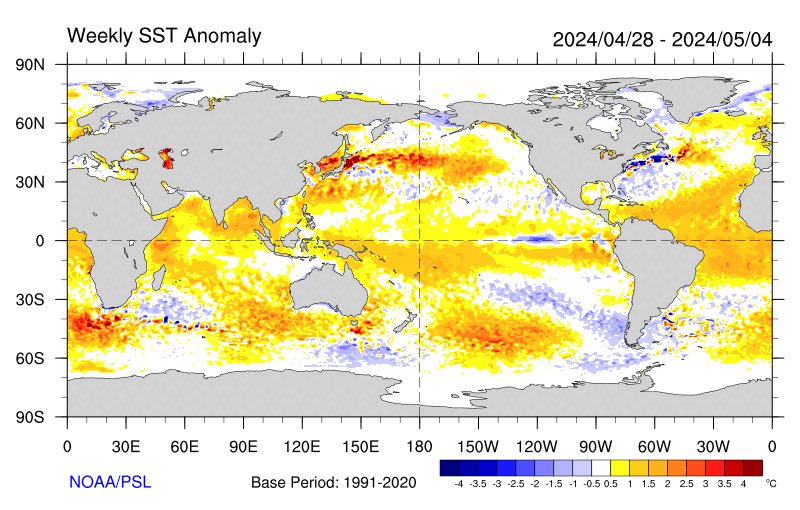
Negative SST anomalies are covering much of the eastern (sub-)tropical Pacific in the latest weekly SST map. Many of these anomalies are in excess of -1C.
For an alternate interpretation of the current situation, I highly recommend reading the latest NOAA ENSO Advisory which represents the official and most recent Climate Prediction Center opinion on this subject. In its latest update (6 January 2011), La Niña conditions are expected to last “well” into the Northern Hemisphere spring of 2011. …….. While La Niña conditions are guaranteed well into 2011, it remains to be seen whether it can rally once more to cross the -2 sigma barrier, and/or whether it will indeed last into 2012, as discussed six months ago on this page. I believe the odds for a two-year event remain well above 50%, made even more likely by the continued unabated strength in various ENSO indices.

It seems self-evident ( even if not fashionable or politically correct) that the sun controls our climate and that the oceans do the sun’s bidding as they drive the atmosphere which then determines our weather.

The consequences of an extended La Niña into 2011 / 2012 could be

  • another good monsoon year in India,
  • a cold winter again for 2011/2012 in the Northern hemishere


German freighter sinks Indian Navy frigate

February 4, 2011

From thelocal.de:

Cargo Ship Nordlake IMO 9057173 by MSC Michi

Cargo Ship Nordlake 22,450 tons

A German cargo ship has slammed into an Indian frigate in the port of Mumbai, causing the military vessel to catch fire and eventually sink.

The ocean liner Nordlake, based in Hamburg and managed by the Klaus E. Oldendorff shipping company, crashed into the Indian navy vessel Vindhyagiri in a narrow navigation channel at the entrance to the port of Mumbai on Sunday, Indian broadcaster NDTV reported.

The nearly 400 people on board the Vindhyagiri – including the ship’s crew and their visiting families, who were celebrating Navy Day – were successfully evacuated before a massive fire broke out on the vessel some 12 hours later.

A preliminary investigation found that the Nordlake was exiting the harbour as theVindhyagiri was navigating its way in. The Nordlake swerved to avoid another ship and subsequently struck the Vindhyagiri.

INS Vindhyagiri 2682 tons

The Indian navy called the sinking of the Vindhyagiri India’s greatest peacetime casualty, noting that a frigate has never been sunk by a civilian vessel. Built in 1981, the Vindhyagiri suffered extensive damage, but the navy said the ship could possibly be repaired and eventually brought back into service.

The nearly 180-metre-long Nordlake, which flies a Cypriot flag, did not sustain any serious damage. The freighter supports an international crew, and no Germans were on board at the time of the crash.

“We are happy that, to our current understanding, the accident has caused neither environmental harm nor any human casualties,” Peter Rybarczyk, chief executive of the Klaus E. Oldendorff shipping company, told Hamburg broadcaster NDR.

The Director General of Shipping in Mumbai has ordered an inquiry into the collision, NDTV reported, while the navy has also filed a complaint that argues the ship from Cyprus did not follow standard operating procedure.

The Nordlake has a deadweight of 22,450 tons and almost ten times greater than the standard weight of INS Vindhyachal at 2682 tons.

Photo: DPA

Mumbai harbour after collision: photo DPA


Wind Power capacity compromised in Texas: Rolling blackouts as Mexico supplies some back up

February 4, 2011

That wind power generating capacity is intermittent capacity and cannot be relied upon is obvious but sometimes escapes notice in the enthusiasm for “renewable energy”. That wind power must be backed up by other more reliable generating capacity for the periods when winds are too low or too high or when the weather is too cold is also often glossed over. That wind power must be used when the wind does blow irrespective of level of demand  and thereby displace more stable power (thus rendering it more expensive) is an inevitable consequence.

The following report comes as no surprise.

METEOROLOGICAL MUSINGS reports:

The Electric Reliability Council of Texas said 7,000 megawatts of generating capacity tripped [“tripped” means failed]Tuesday night, leaving the state without enough juice. That’s enough capacity to power about 1.4 million homes. By rotating outages, ERCOT said it prevented total blackouts.
“We have the double whammy of extremely high demand, given the lowest temperatures in 15 years, combined with generation that’s been compromised and is producing less than expected or needed,” said Oncor spokeswoman Catherine Cuellar. Oncor operates power lines in North Texas and facilitated the blackouts for ERCOT.
The article didn’t give a clue as to what generating capability failed, but I can make a pretty good guess: Wind energy…
For a time, Texas was bragging about being the #1 state for “wind power” (it still is) and we were bombarded with TV commercials and newspaper editorial touting the “Pickens Plan” for massive spending on wind energy. Pickens himself was building a huge wind farm in northwest Texas. He has now ceased construction.
Now, because of relying so much on wind power, the state is suffering blackouts.
Mexico is trying to help by shipping power to Texas, but it is not enough.

Sylvia Bulfone-Paus misconduct story stretches back to at least 1999

February 3, 2011

I have posted earlier about 12 retractions of papers concerning research done under the supervision of Sylvia Bulfone-Paus, a Director at the Research Center Borstel in Germany. Six of the retracted papers had been identified earlier and the next six are reported in Retraction Watch.

The retractions came after an investigation which confirmed the misconduct but put the blame squarely on two Russian researchers Dr. E. Bulanova and Dr. V. Budagian with comments that Bulfone-Paus bore responsibility as their supervisor but that she herself  had not committed any misconduct. The blogger / whistle blower represented by the Marco Berns / Martin Frost persona had commented that the singling out of Bulanova and Budagian was suspicious and hinted darkly at much earlier wrong-doings (and in fact had specifically mentioned the year 1999).

The latest 6 retracted papers  listed include one from 1999 giving some credence to the Martin Frost allegations:

Bulfone-Paus, S., Bulanova, E., Pohl, T, Budagian, V., Dürkop, H., Rückert, R., Kunzendorf, U., Paus, R., and Krause, H. Death deflected: IL-15 inhibits TNF-α-mediated apoptosis in fibroblasts  by TRAF2 recruitment to the IL-15Rα chain. FASEB J. 13:1575-1585 (1999, cited 118 times)

For this paper Bulfone-Paus was both first author and corresponding author. It would seem that any misconduct here cannot be passed off onto authors nos. 2 and 4.

After the investigation Martin Frost  wrote:

It was confirmed that the Institute Directors have been “snooping” on their workforce.  They have indeed viewed the log files of e-mails of the workers.  This deeply distressing news was compounded when it was revealed that the only person who the management arraigned after the Stasi-like “snooping” exercise was a member of der Betriebsrat (workers council) showing that the confidence essential for the worker – Betriebsrat relationship is now severely compromised.

The two other Directors are now discussing what to do next with Bulfone-Paus.

But as Retraction Watch describes, some damage control is being done by the institute with some assistance from the Editor of the EMBO Journal who includes the following sentence in his retraction notice:

The authors declare that key experiments presented in the majority of these figures were recently reproduced and that the results confirmed the experimental data and the conclusions drawn from them.

Why would the Journal publish a line so blatantly intended to white-wash some of the authors? Or does the editor mean that the retraction of the paper is somehow negated!

On this theme of the behaviour of Journals Martin Frost also wrote:

We have been sent the exchange of e-mails below from Dr. Karin Wiebauer.  They describe Dr. Wiebauer’s efforts to rid the scientific literature of the contamination of the mainpulated Bulfone-Paus papers. ….. One interpretation of the exchange is that the Editor-in-chief of the Journal of Immunology is stonewalling and attempting to bury the scientific miscconduct.

The sad saga goes on….


First Sukhoi Superjet 100 to be delivered this month – 2.5 years late

February 3, 2011

Embraer E-Jet: Wikipedia

The Sukhoi Superjet 100 is a modern, fly-by-wire regional jet in the 75- to 95-seat category. The Superjet 100 will be produced by Russian aerospace firm Sukhoi’s civil division, of which Finmeccanica of Italy owns 25%. The jet airliner is being developed in collaboration with Finmeccanica subsidiary Alenia Aeronautica.

The SSJ is designed to compete against the Embraer E-Jets and the Bombardier CRJ programs. The SSJ aims for lower operating costs than its Embraer or Bombardier counterparts for the price of $31.7 million.

The deliveries were first scheduled to begin in late 2008, and Sukhoi predicted that 163 units of all variations of the Superjet 100 would be delivered by the end of 2016. On 7 July 2008, Sukhoi officially confirmed that the original schedule was too optimistic, and first deliveries would begin in December 2009.

Bombardier CRJ: image altairva-fs.com

In September 2010, the CEO of SuperJet International said that certification was expected in November 2010. In October 2010, the Sukhoi Superjet 100 (SN95004) passed noise testing carried out under the auspices of Russian and European certification authorities (AR IAC and EASA respectively). On 4 November 2010, the first production Superjet (SN95007) intended for Armavia was test flown.

Now the first delivery is scheduled for this month but – ominously – only after  “further tests”. This schedule is likely to slip but perhaps not by much.

Ria Novosti reports:

File:Sukhoi Superjet 100.jpg

Sukhoi Superjet 100 at the MAKS 2009 Airshow. image Wikimedia

The delivery of the first Sukhoi Superjet 100 to Armenian Armavia airlines is scheduled for next month, officials in the Russian Far Eastern Khabarovsk region said on Wednesday.

The SN 95007 will be handed over to Armavia after further tests, regional transport minister Sergei Ivashkin said, adding that 64 test flights had already been conducted.

The Superjet 100 is a family of medium-haul passenger aircraft developed by Sukhoi in cooperation with U.S. and European aviation corporations, including Boeing, Snecma, Thales, Messier Dowty, Liebherr Aerospace and Honeywell.

The tally for orders for the plane has reached 170, with more regional airlines expected to line up as customers. Russian flagship carrier Aeroflot has signed for 40 Superjets.


Reward for fraud: $285 billion in Pentagon contracts

February 3, 2011

The Corruption Perception Index produced annually by Transparency International becomes meaningless relative to the scale of fraud and corruption with large contracts in the developed world and which do not seem to be reflected in the CPI.

An AP report carried by 660news.com reports:

Hundreds of defence companies that defrauded the U.S. military between 2007 and 2009 still received $285 billion in contracts from the Pentagon during the same period, a U.S. senator said Wednesday.

Citing a January report prepared by Pentagon acquisition officials at Sanders request, the senator said the bulk of the contracts, just over $280 billion, went to 211 companies that had civil judgments against them or settled fraud charges of more than $1 million.

During the same period, 30 defence contractors were convicted of criminal fraud, but still were awarded $682 million in new work, according to the Pentagon’s report.

Among the contractors listed in the report is AEY Inc., a Miami, Florida-based company that received a $300 million contract to supply ammunition to Afghan security forces. AEY got the work despite a record of poor performance on other government contracts.

The fraud involved shipment of millions of rounds of banned Chinese-made military ammunition that was repackaged to appear of Albanian origin. After nearly $67 million in payments, the Afghan ammunition contract was terminated in May 2008. The owner of AEY was sentenced to four years in federal prison after pleading guilty in 2009 to a fraud conspiracy charge.

In the report, defence officials listed a series of actions the military has taken to guard against contractor wrongdoing, including the formation of a working group focused on procurement fraud.

I am quite sure that many lobbyists, middlemen, bureaucrats and politicians all received their share of the largesse in these Defence Contracts. The margins available in Defence contracts far exceed those available in other large infrastructure contracts.

Related posts:

  1. https://ktwop.wordpress.com/2011/01/12/corruption-in-the-european-union-is-alive-and-well/
  2. https://ktwop.wordpress.com/2011/01/07/chief-risk-officer-of-bayerische-landesbank-arrested-for-50-million-bribes/

La Niña begins to show up in global temperature

February 3, 2011

From Dr. Roy Spencer:

credit:drroyspencer.com

…although this, too, shall pass, when La Nina goes away.

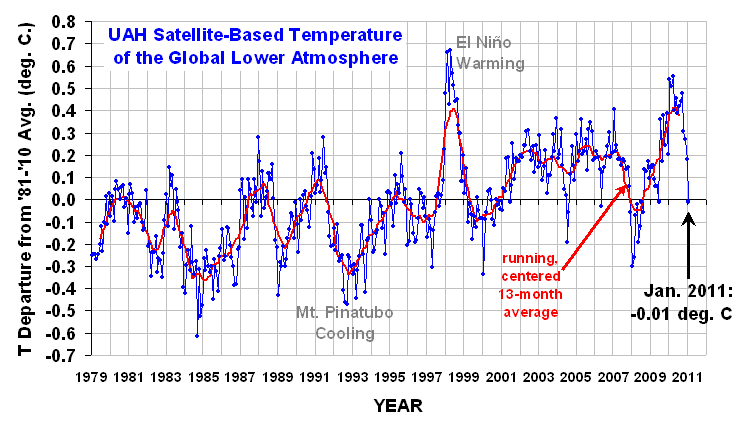
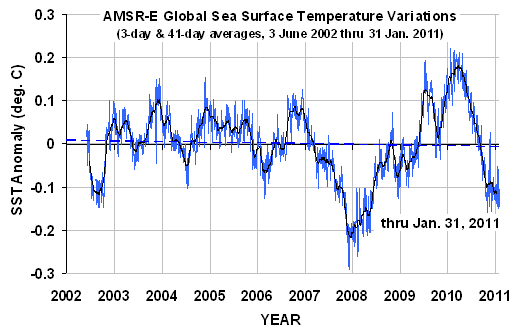
January 2011 experienced a precipitous drop in lower tropospheric temperatures over the tropics, Northern Hemisphere, and Southern Hemisphere. This was not unexpected, since global average sea surface temperatures have been falling for many months, with a head start as is usually the case with La Nina.

This is shown in the following plot (note the shorter period of record, and different zero-baseline):

credit:drroyspencer.com

Read original report: http://www.drroyspencer.com/2011/02/uah-update-for-january-2011-global-temperatures-in-freefall/

Queensland sees off Yasi: Preparedness ensures it was no Katrina

February 3, 2011

Cyclone Yasi has come and gone.

Its speed was a blessing in disguise and has ensured that it is already well inland and reducing in strength. It has left behind a trail of destruction but few (if any) serious injuries or fatalities. The township of Cardwell was warned to evacuate, but about 100 residents chose not to leave and they have not been contacted as yet.

BBC:

Worst hit were the coastal towns of Tully, Mission Beach and Cardwell, with hundreds of houses destroyed. The cities of Cairns and Townsville were relatively unscathed but are being lashed by heavy rains; warnings of further storm surges have been issued. Queensland Premier Anna Bligh said there had been no reports of deaths or serious injuries so far.

The similarities of Yasi to Katrina is apparent but the differences in their respective impacts is quite striking.

This may be partially due to geography and demographics and the speed with which Yasi drove inland, but observing both from across the world leads me to the perception that the primary differences between Queensland and Louisiana were

  • the preparedness of the government and the population,and
  • the sense of civic duty in Queensland, and
  • the level of trust in the state government institutions, and
  • the level of perceived duty within the institutions

The thought of Queensland police looting after Yasi as some New Orleans police did after Katrina is  inconceivable. It’s just my perception but I believe it shows the difference between institutions having a fundamental belief that they have a duty to the population they serve and others where the concept of duty is much less developed.

Cyclone Yasi compared to Hurricane Katrina

credit bbc


Response from VC Kalasalingam Unversity

February 2, 2011

Following the case of plagiarism that was brought to light by the retraction of a paper in the journal Biotechnology Advances, the Vice Chancellor has responded by email:

Dear Sir,
Thanks for your mail.
As soon as we came to know about the plagiarism complaint against the reesearchers from our division of Molecular and cellular biology, we have formed a committe of senior faculty members of our university  to probe the same.

We have also taken action as per the committee’s report. The committee’s report and the action taken details were informed to the DST and other funding agencies in India.
We have also advised our university’s research community to take proper care to strictly avoid occurring of such complaints in future
Dr.S.Radhakrishnan
Vice-Chancellor Kalasalingam University

Update 4th February:

The VC’s response is a little disappointing in that he has advised the university’s research community only to avoid future complaints and not to avoid the misconduct itself. He surely can not mean that the actions are acceptable if complaints are  avoided.

So far there has been no response to a request to provide a copy of the “committees report”. It is still not known as to who served on this committee and what their conclusions and recommendations were. What sanctions are to be applied to those found responsible for misconduct is also unknown.

Receiving compensation for incompetence in executing 100 huskies is obscene

February 2, 2011

Details emerging about the husky massacre in British Columbia makes it seem grotesque and macabre and certainly obscene. Not least is the fact that the General Manager of Howling Dogs received compensation for his own incompetence for the trauma of being attacked by a wounded sled-dog that he had failed to kill properly.

The solicitor knew, the employer knew, the employee knew, all the members of the Compensation Review Board knew —— and the employee was awarded compensation for his own acts of self-induced trauma. He was supported by his employer.

Did they receive some part of  the compensation?  Did the costs include those of the solicitor?

The Review Officer was a certain Allan Wotherspoon. The original claim was denied but Mr. Wotherspoon overturned that decision. He calls the incident of “the worker fighting off a wounded sled-dog and eventually despatching it”  an “accident” and allows the claim! The executioner’s incompetence is called an accident and he gets compensated for it. Twisted logic indeed.

The Review report is here.

http://www.cbc.ca/bc/news/bc-110131-worksafebc-whistler-dog-cull.pdf