January 17, 2011

The Krasin: Image via Wikipedia
The rescue of the ships trapped by ice in the Sea of Okhotsk has been completed. A tour de force at temperatures as low as – 27°C by the three ice breakers, Magadan, Admiral Makarov and Krasin. The Krasin joined last and was the star of the show.
Richard North has been following and anticipating the story and a more complete description of this admirable rescue is available here.
This morning from Ria Novosti:
http://en.rian.ru/russia/20110117/162171301.html
07:04 17/01/2011The Krasin and Admiral Makarov icebreakers have managed to take the Sodruzhestvo mother fishery ship and the Bereg Nadezhdy refrigerator vessel out of thick ice in the Sea of Okhotsk, the Far Eastern Shipping Company said Monday.
“The icebreakers first towed the mother ship to a safer area, and then returned for the Bereg Nadezdy, which they took to thinner ice,” company spokeswoman Tatyana Kulikova said.
The Bereg Nadezhdy ship, the Professor Kizevetter research vessel, and the Sodruzhestvo mother fishery ship, carrying altogether over 400 people, got stuck in two-meter-thick ice in the Sea of Okhotsk on December 31. Two other ships, the Mys Yelizavety and the Anton Gurin, became trapped a few days later.
The Admiral Makarov released the Professor Kizevetter and the Mys Yelizavety vessels from the ice trap, while the Anton Gurin managed to cope on its own.
Then the operation to rescue the Bereg Nadezhdy started, but the two icebreakers changed their plans, returning to the Sodruzhestvo vessel, which was the hardest to tow due to its wide body. Towing ropes snapped soon after the start of the operation, which resumed next day.
The rescue effort has been hampered by strong winds, low visibility and shifting ice floes in the area.
Tags: Admiral Makarov, ice rescue, icebreakers, Krasin, Magadan, Sea of Okhotsk
Posted in Engineering, Environment, Russia, Technology, Weather | 2 Comments »
January 16, 2011
Last year 890, 000 cars hit Beijing’s streets contributing to the city’s legendary gridlock and traffic emissions.

Gridlock in Beijing: image care2.com
From 1st January this year a lottery for number plates will provide only 20,000 winners each month restricting sales of both new and second-hand cars in the city to 240,000 this year. 210,000 people have applied for the 20,000 licenses available for January. Winners must buy a car within six months. Losers in this month’s lottery will be included in next month’s drawing along with all new applicants.
CRIenglish reports:
Car dealerships in Beijing may opt to shift their focus on boosting sales to neighboring cities after the municipal government imposed an annual quota on new car license plates as part of efforts to ease traffic gridlock in the capital city.
Some car dealerships, especially of domestic brands, are making plans to expand sales to areas outside Beijing where the policy restriction does not apply, the China Business Times reported. The new limit means buyers will favor high-end and luxury types of cars once they obtain the hard-to-get licenses. Domestic brands and small cars, which sell mostly at below 100,000 yuan, will see lower sales in Beijing, the newspaper article said.
The policy stipulates that buyers of secondhand cars must go through the monthly lottery system to obtain a license and sellers of used cars will see their license annulled in a year if they make no new purchases. That puts dealers of both new and used cars to compete in the same arena for the annual 240,000 new car license plates.
The combined factors have driven many companies to stock up cars, including used cars, in preparation for the coming hike in rental businesses. Car dealerships are tapping into this market, putting types of cars idling for sale ready for renting….. Meanwhile, industry experts predict the big automakers will likely adapt by focusing more on smaller cities further inland, the China Daily quoted Zhong Shi, an independent analyst in Beijing as saying.
“The best and most efficient way for automakers to offset the declining sales in Beijing and maybe other first-tier cities in the near future is to shift rapidly their dealer network expansion inland,” said Zhong.
Besides easing traffic jams, the new policy will help address serious air pollution problems in the Chinese capital city. Car emissions account for around 50 percent of the air pollution in Beijing.
Tags: Beijing, car sales reduction, number plate lottery, Traffic congestion
Posted in Behaviour, China, Development, Urban Living | Comments Off on Beijing introduces number plate lottery to cut car sales by 75%
January 16, 2011
A new paper in Science giving ocean currents in the Atlantic their due (and without finding it necessary to appeal to tales of carbon dioxide). Perhaps the science is not so settled after all!

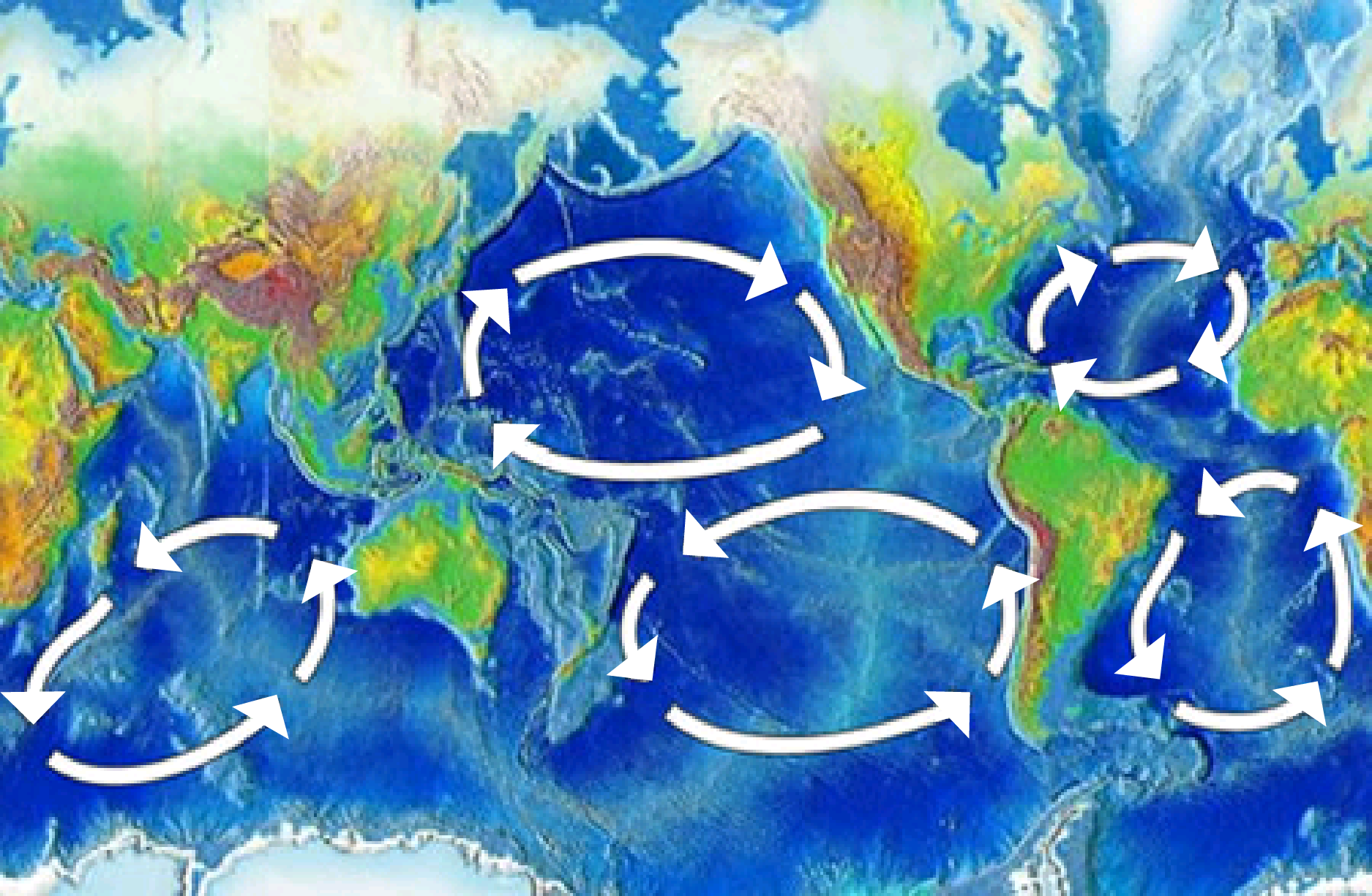
The five major ocean-wide gyres — the North Atlantic, South Atlantic, North Pacific, South Pacific, and Indian Ocean gyres. Each is flanked by a strong and narrow “western boundary current,” and a weak and broad “eastern boundary current”: Wikimedia
The Deglacial Evolution of North Atlantic Deep Convection. by D. J. R. Thornalley, S. Barker, W. S. Broecker, H. Elderfield, I. N. McCave. Science, 2011; 331 (6014): 202 DOI: 10.1126/science.1196812
Science Daily reports:
… Scientists have long suspected that far more severe and longer-lasting cold intervals have been caused by changes to the circulation of the warm Atlantic ocean currents themselves.
Now new research led by Cardiff University, with scientists in the UK and US, reveals that these ocean circulation changes may have been more dramatic than previously thought. The findings, published January 14, 2011 in the journal Science, show that as the last Ice Age came to an end (10,000 — 20,000 years ago) the formation of deep water in the North-East Atlantic repeatedly switched on and off. This caused the climate to warm and cool for centuries at a time.
The circulation of the world’s ocean helps to regulate the global climate. One way it does this is through the transport of heat carried by vast ocean currents, which together form the ‘Great ocean conveyor’. Key to this conveyor is the sinking of water in the North-East Atlantic, a process that causes warm tropical waters to flow northwards in order to replace the sinking water. Europe is kept warmer by this circulation, so that a strong reduction in the rate at which deep water forms can cause widespread cooling of up to 10 degrees Celsius. ….. The new results suggest that the Atlantic ocean is capable of radical changes in how it circulates on time scales as short as a few decades.
Dr Thornalley said: “These insights highlight just how dynamic and sensitive ocean circulation can be. Whilst the circulation of the modern ocean is probably much more stable than it was at the end of the last Ice Age, and therefore much less likely to undergo such dramatic changes, it is important that we keep developing our understanding of the climate system and how it responds when given a push.”
Paper Abstract:
Deepwater formation in the North Atlantic by open-ocean convection is an essential component of the overturning circulation of the Atlantic Ocean, which helps regulate global climate. We use water-column radiocarbon reconstructions to examine changes in northeast Atlantic convection since the Last Glacial Maximum. During cold intervals, we infer a reduction in open-ocean convection and an associated incursion of an extremely radiocarbon (14C)–depleted water mass, interpreted to be Antarctic Intermediate Water. Comparing the timing of deep convection changes in the northeast and northwest Atlantic, we suggest that, despite a strong control on Greenland temperature by northeast Atlantic convection, reduced open-ocean convection in both the northwest and northeast Atlantic is necessary to account for contemporaneous perturbations in atmospheric circulation.
Tags: Atlantic Ocean, global cooling, global warming, ice ages, Last glacial period, Ocean currents
Posted in Climate, Geosciences, Oceans, Science, Weather | 1 Comment »
January 15, 2011

Image via Wikipedia
This is good news!
New studies have found that specific properties of blueberries may help reduce the risks of developing high blood pressure. Blueberries contain high concentrations of anthocyanins and are very antioxidant rich. Anthocyanins are very dark in color, usually blue, purple or dark red. Other foods with similar antioxidant qualities are red wine, chocolate, tea, vegetables, and some grains.
For the study, scientists fromHarvard University analyzed information of about 135,000 women and nearly 50,000 men. Individuals were followed for 14 years and were asked to complete health surveys every two years. Each person also had their diet analyzed every four years. None of the individuals experienced hypertension at the start of the research period.
During the study, about 35,000 individuals became hypertensive. Researchers found that individuals consuming a large amount of food containing anthocyanins noticed an 8 percent lower risk of developing hypertension than those who consumed very little. Additionally, people under the age of 60 noticed the most benefit from these antioxidants.
For this study, blueberries appeared to be more effective than strawberries for preventing hypertension.
Red wine followed by dark chocolate and a good helping of blueberries – is something I can live with.
Tags: Anthocyanin, Blueberry, chocolate, Hypertension, wine
Posted in Food, Medicine | Comments Off on Blueberries and chocolates keep blood pressure in check !
January 15, 2011
Itar-Tass reports.
MOSCOW, January 14 (Itar-Tass) — The Admiral Makarov and Krasin icebreakers, which are leading the Sodruzhestvo mother ship out of an ice trap in the Sea of Okhotsk, have reached the drifting refrigerator ship Bereg Nadezhdy, a source at the Transport Ministry told Itar-Tass.
“The convoy of the Admiral Makarov, the Krasin and the Sodruzhestvo reached the drifting Bereg Nadezhdy at 10:30 a.m. Moscow time on Friday,” he said.
The Admiral Makarov cleared a two-mile strip in the afternoon and returned to the convoy. “The coordinating staff led by Deputy Transport Minister Viktor Olersky is analyzing weather and ice conditions for elaborating the tactics of the further operation,” the source said.
The ships need to cross the ice for meeting with the Magadan icebreaker and the Victoria tanker.
A number of ships trapped in the ice in the Sea of Okhotsk, among them the Sodruzhestvo, the Bereg Nadezhdy, the Professor Kizevetter research ship and the Mys Yelizavety trawler, asked for help on December 31, 2010. Two vessels were taken to a safe area.
It is yet unknown when the rescue of the Sodruzhestvo and the Bereg Nadezhdy may be over, as weathermen have a bad forecast for about one week.
Tags: Icebreaker Admiral Makarov, Krasin, Magadan, Sea of Okhotsk, Sodruzhestvo
Posted in Engineering, Environment, Russia, Technology, Weather | 1 Comment »
January 15, 2011
Climate Science – if there is such a thing – had long ago abandoned science to become a lobby for “global warming theory”. But the “scientists” are plumbing new depths.
It has not taken long for “climate scientists” to claim that all extreme weather events (heat wave in Russia, floods in Pakistan, coldest December in 100 years , droughts in Australia and now floods in Brazil and Australia) are all “not inconsistent with global warming” implying by some strange, convoluted logic that all these weather events (which are also consistent with history repeating itself) somehow add to the body of “evidence” which “proves” that man-made global warming is happening. There have even been crack-pot scientists with such a vested interest in the “man-made global warming” ideology who have found it possible to blame volcanic activity and even the earthquake in Haiti on “global warming”!!!
The current strength of the La Ninã conditions are perfectly consistent with other theories based on ocean variation and the frigid winters are quite consistent with the quiet Sun (which went spotless again yesterday). All current weather is also consistent with man-made effects being totally negligible and instead being dominated by the sun’s cycles and with the oceans as the primary vehicle for transporting heat around the globe. Weather is not climate and in fact none of the “extreme” weather events are outside the range of weather variations that have been experienced over the last 1000 years.
The floods in Brazil have claimed over 500 lives and in Australia – which is far better prepared – the death toll will likely be between 20 – 30. In Australia where a higher flood occurred in 1974 in Brisbane voices are beginning to be raised that the “global warming” lobby have actually prevented the use of dams and implementation of proposed water management policies which could have been able to better manage these regular and recurring flood conditions.
The history of floods in Brisbane is telling:

Highest annual flood peaks for Brisbane
The floods this year in Queensland are nothing new. Why would this flood be evidence of man-made global warming but not the floods of the 1800s? In fact the history of these weather conditions in Brisbane is not inconsistent with global cooling, the coming of an ice-age or an apocalyptic end to the earth in 2012!

thepunch.com.au
Any scientist who is concerned with science and not with religion, politics or defending his past conclusions would know that being “not inconsistent” with some theory carries no weight in a scientific proof – but it does sound so credible in a TV sound-bite.
But we can expect that over the next few years that every natural disaster or extreme weather event will be taken by the members of a dying religion as being “not inconsistent with” and therefore as proof of man-made global warming.
Tags: droughts, floods, global cooling, global warming, La Niña effects, ocean circulation, solar effects
Posted in Alarmism, Climate, Natural Disasters, Science, Weather | Comments Off on “Not inconsistent with man-made global warming” !!
January 14, 2011
La Niña is expected to continue well into the Northern Hemisphere spring 2011.
The latest report from NOAA’s Climate Prediction Center (CPC) noted that “A moderate-to-strong La Niña continued during December 2010 as reflected by well below-average sea surface temperatures (SSTs) across the equatorial Pacific Ocean.” The CPC report said that La Niña is expected to continue well into the Northern Hemisphere spring 2011.
Physorg reports:
New NASA satellite data indicate the current La Niña event in the eastern Pacific has remained strong during November and December 2010.

The La Niña is evident by the large pool cooler than normal (blue and purple) water stretching from the eastern to the central Pacific Ocean, reflecting lower than normal sea surface heights. "This La Niña has strengthened for the past seven months, and is one of the most intense events of the past half century," said Climatologist Bill Patzert of NASA JPL. Credit: NASA JPL/Bill Patzert
A new Ocean Surface Topography Mission (OSTM)/Jason-2 satellite image of the Pacific Ocean that averaged 10 days of data was just released fromNASA. The image, centered on Dec. 26, 2010, was created at NASA’s Jet Propulsion Laboratory (JPL), Pasadena, Calif.
“The solid record of La Niña strength only goes back about 50 years and this latest event appears to be one of the strongest ones over this time period,” said Climatologist Bill Patzert of JPL. “It is already impacting weather and climate all around the planet.”
“Although exacerbated by precipitation from a tropical cyclone, rainfalls of historic proportion in eastern Queensland, Australia have led to levels of flooding usually only seen once in a century,” said David Adamec, Oceanographer at NASA’s Goddard Space Flight Center, Greenbelt, Md. “The copious rainfall is a direct result of La Niña’s effect on the Pacific trade winds and has made tropical Australia particularly rainy this year.”
The new image depicts places where the Pacific sea surface height is near-normal, higher (warmer) than normal and lower (cooler) than normal. The cooler-than normal pool of water that stretches from the eastern to the central Pacific Ocean is a hallmark of a La Niña event.
Related: https://ktwop.wordpress.com/2011/01/12/la-nina-driving-severe-rains-and-floods-in-brazil-and-australia/
Tags: intense La Niña, La Nina, Ocean Surface Topography Mission, weather
Posted in Climate, Environment, Weather | 1 Comment »
January 14, 2011
The European Space Agency reports:

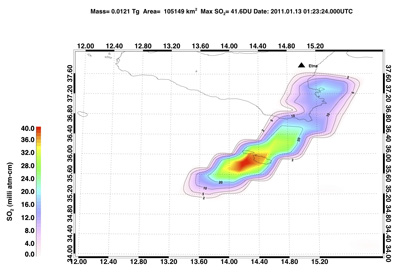
This image, which was acquired by the Atmospheric Infrared Sounder on NASA's EOS-AQUA satellite, shows the plume of sulphur dioxide currently being carried over the Mediterranean Sea. Credits: NASA, Norwegian Institute for Air Research
13 January 2011
Europe’s largest active volcano, Mount Etna on the Italian island of Sicily, erupted briefly yesterday sending flames and ash hundreds of metres into the air.
This image, which was acquired by the Atmospheric Infrared Sounder on NASA’s EOS-AQUA satellite, shows the plume of sulphur dioxide currently being carried over the Mediterranean Sea.
The data have been processed by the Norwegian Institute for Air Research within the framework of ESA’s Data User Element and can be used to warn aviation companies on the hazardous plume.

Mount Etna, Sicily, topped in snow 5 February 2009: image Wikimedia
Tags: European Space Agency, Mount Etna, Volcano, Volcano eruption
Posted in Air pollution, Environment, Volcanos | 1 Comment »
January 14, 2011

Depths in Sea of Okhotsk: Image via Wikipedia
The suspended rescue operation of the trapped ships in the Sea of Okhotsk has restarted and is progressing slowly in deteriorating weather and increasing ice.
From Ria Novosti:07:45 14/01/2011
Russia’s Krasin and Admiral Makarov icebreakers continue to lead the Sodruzhestvo mother fishery ship through thick ice floe to clear waters, the Far Eastern Shipping Company said Friday.
The fishing ship with about 300 people on board has been stranded in heavy ice in the Sea of Okhotsk for two weeks. The Admiral Makarov and Krasin started towing the vessel on Wednesday afternoon, but towing ropes snapped soon after the start of the operation. The rescue resumed on Thursday morning.
“The convoy has covered 17 miles since the beginning of the rescue operation, and will reach the Bereg Nadezdy refrigerator ship after another eight miles,” spokeswoman Tatyana Kulikova said. “After the meeting with the refrigerator, they will face a very difficult stretch of ice floe before reaching clear waters.”
According to the rescue plan, the icebreakers will continue towing the Sodruzhestvo, while the Bereg Nadezhdy will attempt to sail on its own along the channel cut in the ice by Admiral Makarov and Krasin.
The weather conditions in the area continue to deteriorate rapidly. Strong winds, low visibility and shifting ice floes hamper the rescue effort, the spokeswoman said.
Photographs from the Sea of Okhotsk can be seen here:
http://en.rian.ru/photolents/20110111/162101793.html
and here:
http://english.ruvr.ru/photoalbum/39338590/39338722/index.html
Related: https://ktwop.wordpress.com/2011/01/03/unusually-thick-ice-traps-ships-in-the-sea-of-okhotsk/
https://ktwop.wordpress.com/2011/01/11/sea-of-okhotsk-rescue-update-tartar-straits-frozen-to-the-bottom/
Tags: Admiral Makarov, Krasin, Rescue, Russia, Sea of Okhotsk, Sodruzhestvo
Posted in Engineering, Environment, Russia, Technology | Comments Off on Sea of Okhotsk rescue operations restarted
January 13, 2011

Image via Wikipedia
Doomsday proponents will not like this new on-line publication in Nature and are already beginning to object. But I see no resource or food crunch that cannot be addressed by human ingenuity and the development of technology.
Paillard, S., Treyer, S. & Dorin, B. Agrimonde: Scenarios and Challenges for Feeding the World in 2050 (Editions Quae, 2011) doi:10.1038/news.2011.14
From Nature News:
Future of food could be bright: French agencies’ study punctures assumptions about the state of global agriculture.
The world will be able to feed the predicted 2050 population of nine billion people, according to two French agricultural research organizations. In a joint report published today, they lay out findings gleaned from 2006 to 2008 that could overturn some current assumptions about the state of global farming.
The report, titledAgrimonde, is published by the French National Institute for Agricultural Research (INRA) and the Centre for International Cooperation in Agronomic Research for Development (CIRAD), both headquartered in Paris. It contains some surprise findings on Africa and other regions — the latest results from an ongoing study by the two research agencies.
Agricultural productivity in Africa doubled between 1961 and 2003 — a finding that overturns most assumptions “and is one of the most surprising results of our work”, Patrick Caron, CIRAD’s director-general for research and strategy, told reporters last night.
African productivity remains the lowest in the world, however, averaging 10,000 kilocalories per hectare (kcal ha–1) compared with 20,000 kcal ha–1 globally and 25,000 kcal ha–1 in Asia. Productivity elsewhere doubled or tripled over the same period.
Asia scored higher on productivity than in other studies, because the agencies looked at aggregate rather than independent annual yields of wheat, rice and other crops, explains Bruno Dorin, an economist at CIRAD and one of the report’s authors. “In Asia, the wheat yield may be lower, but if you take account of rice and other crops grown in the same year, the total yield is higher,” he says.
Another finding to emerge is that major reserves of potential farmland exist across the globe, especially in Africa and Latin America, Dorin says. “The 1.5 billion hectares of land now cultivated could be increased to 4 billion, but this would of course be at the expense of pastures and forests, which are a reservoir of biodiversity and carbon,” he adds.
Read the original article:
http://www.nature.com/news/2011/110112/full/news.2011.14.html
Tags: Agriculture, Feeding the world in 2050, Food crisis, Food production
Posted in Agriculture, Development, Food, France | Comments Off on No food crisis in sight: World can feed its 9 billion in 2050






 The k2p blog