Solid demand for bond issues by Spain, Portugal and Italy boost Euro

January 13, 2011
The euro sign; logotype and handwritten.

Image via Wikipedia

The countries are considered among those dragging down the Eurozone but strong demand for Portugese bonds on Wednesday was followed by solid demand for those issued by Spain and Italy today. Earlier this week both Japan and China had pledged to buy the bonds in Europe. Both countries have large cash reserves and are probably attracted by the higher yields but are also making a political statement in supporting the Eurozone. China is on a charm offensive and wishes to be seen to be reaching out to Greece and Portugal.

BBC:

Spain has raised 3bn euros ($3.9bn; £2.5bn) in an auction of five-year government bonds. The average yield on the bonds was 4.542%, which was nearly one percentage point higher than the rate reached in the last auction in November. However, analysts had feared the yield would be even higher.

The debt sale, which follows a similar auction by Portugal on Wednesday, is soothing fears over the eurozone’s ability to service its debts. Michael Lister, strategist at West LB in Dusseldorf, said: “The figures look really good, it’s the perfect sequel to the Portugal auction yesterday.”

Wall Street Journal:

The Hong Kong dollar rose against the U.S. dollar Thursday as a successful bond auction in Portugal helped ease concerns about the euro zone’s debt problems, encouraging investors to shift funds from the U.S. currency to riskier assets.

Traders said gains in the local stock market will continue to boost demand for the Hong Kong dollar. They said they expect the U.S. dollar to trade between HK$7.7720 and HK$7.7780 Friday.

“Portugal’s bond auction temporarily eased concerns over European debt. Also, the U.S. dollar isn’t likely rise sharply ahead of (Chinese) President Hu Jintao’s visit to the U.S. next week,” said a senior trader at a Chinese bank. Hu plans to meet U.S. President Barack Obama in Washington on Jan. 19.

The Portuguese government sold EUR1.25 billion worth of bonds in an auction overnight, offering good news to investors worried an unsuccessful bond sale could signal tougher austerity measures in parts of the euro zone.

Financial Times:

Spain and Italy on Thursday followed Portugal by holding successful bond auctions, providing a glimmer of optimism in the eurozone debt crisis. Italy sold €6bn of five-year and 15-year debt while Spain issued €3bn in five-year bonds, but both countries were forced to pay higher interest rates than in previous auctions.

The three successful auctions this week from peripheral eurozone countries provide a small amount of breathing room in the crisis. But the elevated yields paid by all of them and their high funding needs mean that investors are still waiting for decisive action from European policymakers.

Italy sold €3bn of 15-year bonds at a yield of 5.06 per cent, up from 4.81 per cent at a previous auction in November. Likewise, the yield on €3bn of five-year debt rose from 3.24 per cent two months ago to 3.67 per cent. Both auctions were fully covered. Spain paid almost a percentage point more than it did in November with a five-year yield of 4.54 per cent.

Sea of Okhotsk rescue attempt suspended

January 13, 2011

In worsening weather the first attempts to tow the trapped Sodruzhestvo mother ship clear of the ice by the icebrakers Krasin and Admiral Makarov have had to be suspended when towing lines broke.

From Voice of Russia:

Sea of Okhotsk rescue: image Ria Novosti

The operation to tow the ice-locked mother ship Sodruzhestvo (Commonwealth) in the Okhotsk Sea to clear water has been suspended due to a rupture of the tow rope. This operation was being carried out by icebreakers “Krasin” and “Admiral Makarov”.

A mile and a half after the start of the towing the cables broke, their attaching mechanisms were damaged. Today they are undergoing repairs on the “Commonwealth” and “Admiral Makarov”.

Throughout the night icebreaker “Krasin” was clearing a passageway for the caravan of vessels. Today it shall continue this work.

At least one woman required to be brought for every 4 men! – WEF Davos

January 13, 2011
DAVOS/SWITZERLAND, 17JAN08 - Aerial Photo of D...

Hotel Steigenberger, Davos: Image via Wikipedia

The World Economic Forum is requiring its strategic partners to bring along at least one woman in every group of five.

I am not sure whether this is a blow for or against gender equality. Coming as it does from the World Economic Forum for the meeting in Davos to be held in 2 weeks, I suspect that it is primarily about having a good time rather than about gender equality!!

From The Guardian:

Each year, prime ministers, bankers, business tycoons and other movers and shakers of the global elite gather at the World Economic Forum (WEF) in the Swiss Alpine town of Davos. And each year, one key thing has been missing: women.

Now, in an attempt to improve the traditionally dismal gender balance at this month’s event, which starts a week next Tuesday, the WEF has for the first time imposed a minimum quota of women.

The forum’s “strategic partners” – a group of about 100 companies including Barclays, Goldman Sachs and Deutsche Bank – have been told they must bring along at least one woman in every group of five senior executives sent to the high-profile event. Strategic partners account for 500 of the 2,500 participants expected this year at a gathering where David Cameron will rub shoulders with the Russian president, Dmitry Medvedev, historian Niall Ferguson, UN secretary general Ban Ki-moon, at least one member of the Saudi royal family and countless business supremos and members of the academic elite.

“The World Economic Forum annual meeting engages the highest levels of leadership from a variety of sectors and participation figures are a reflection of the scarcity of women in this external pool,” said Saadia Zahidi, who heads the gender parity programme at the WEF and came up with the quota plan.

At Davos, the world’s most powerful men (and a few women) broker multimillion-pound deals behind the scenes of the conferences. The forum’s black-tie dinners, cocktail parties and other less formal encounters are the ultimate networking events and those present follow the old “contacts lead to contracts” motto.

But so far, relatively few women have benefited from this high-level schmoozing. Women made up only 9-15% of those present between 2001 and 2005.


Penguin rings of death in the name of research

January 13, 2011

A new paper on-line in Nature today reports a 10 year study which shows that when researchers’ put flipper bands on the birds they can seriously dent penguin survival, and also skew the results of research.

Saraux, C. et al. Nature 469, 203-206 (2011)

Nature News:

banded penguins

Flipper banding has been found to hurt penguins: image Benoît Gineste

Attaching bands to penguins’ flippers makes them easier for scientists to study, but may also up the birds’ death rates and lower their chances of reproducing. A team studying king penguins (Aptenodytes patagonicus) has rekindled this debate, which has been running for more than 30 years, and thrown up an additional concern. Not only do bands placed around the birds’ flippers make life more difficult for penguins, their effects also undermine the conclusions drawn from such studies.

Yvon Le Maho at the University of Strasbourg in France, an author of the current study, published in Nature, says that the time has come for ecologists to embrace new technologies and abandon flipper bands, “certainly as a precautionary principle”.

His group’s paper also highlights a wider issue: studies on penguins can and are being used to look at the effects of climate change on ecosystems. Le Maho and colleagues have previously used electronic tagging of king penguins to show that just 0.26 ºC of warming in sea-surface temperatures could trigger a 9% decline in adult survival. If banding were used in such studies, its consequences on a population could cripple attempts to extrapolate a climate-linked trend from the data.

“It’s very difficult to anticipate what the consequences are,” Le Maho says. He says there is a problem with warming affecting ecosystems, but “the numbers have to be reconsidered” where they have been derived from banded studies…..

As long ago as the 1970s, zookeepers noticed that bands could cause wounds on penguins, especially when the birds were moulting……. Despite these findings, bands are still widely used. Le Maho and his colleagues have now added to the debate with their 10-year study. They banded 50 king penguins selected from a population on Possession Island in the southern Indian Ocean that had already been implanted with minute, subcutaneous electronic tags.

When compared with 50 unbanded birds, those fitted with bands had around 40% fewer chicks and a 16% lower survival rate over the study period.

ScienceNews also reports on the study:

And in another worrisome development, the flipper-banded penguins averaged 12.7 days away from home on foraging trips instead of 11.6. “One day or two days is a huge difference,” says ecologist and study coauthor Claire Saraux of the University of Strasbourg and France’s CNRS research network. Chicks back at the breeding site eat only when a parent swims home with food collected hundreds of kilometers, sometimes thousands of kilometers, away. And young chicks have to build up reserves to survive their first winter, when parental food delivery drops off to only a few times during the whole season.

Slower foraging fits with worries that flipper bands may be increasing drag on penguins during swimming, Saraux says. In a swimming test in a tank, an Adélie penguin wearing a band expended 24 percent more energy than an unbanded penguin.

“From an ethical point of view, I think we can’t continue to band,” Saraux says.


La Niña driving severe rains and floods in Brazil and Australia

January 12, 2011

The La Niña event established this year is particularly intense and maybe the most severe in a 100 years. Such events are known to give warm sea surface temperatures and greater evaporation giving heavy rains in the Western Pacific in Australia, less rain in the Eastern Pacific on the western coast of S. America (coastal Chile and Peru) but increased rain on the east coast in southern Brazil and  northern Argentina.

Yesterday, heavy rainfall and floods in Brazil  claimed 80 lives.

UPDATE!! This morning the death toll is reported to be over 250.

UPDATE 2!! 13th January: Now death toll is around 400.

BBC:

More than 80 people have died in towns near Rio de Janeiro as heavy rains continue to cause flooding and mudslides in south-eastern Brazil. Overnight downpours triggered landslides in the mountain town of Teresopolis, where more than 50 were reported to have died. At least three firefighters were among several people buried in mudslides in Nova Friburgo.

Brazil has seen severe flooding this year which has left thousands homeless.

The death toll is expected to climb as rescuers reach remote villages in the mountains. One report, compiling official and media figures, put the toll so far at 93.

This week, torrential rains in neighbouring Sao Paulo state left 13 people dead and brought traffic chaos to Brazil’s biggest city. In Teresopolis, 100km (62 miles) north of Rio Janeiro, a river burst its banks, submerging buildings, while the rainfall set off several mudslides.

The rains and floods in Queensland have claimed 13 lives so far but the peak in Brisbane a few hours ago was fortunately about 1 m lower than in the 1974 floods. Nevertheless many thousands of homes have been inundated and the damage to Queensland industry and agriculture is severe. The final death toll is likely to be higher since it is feared that some bodies will only be discovered after the waters recede. Now heavy rain and flash floods have hit Victoria as well.

The Guardian:

The devastating flooding in Queensland is the result of Australia being in the grip of an unusually strong “La Niña”, a periodic climate phenomenon that brings more rain to the western Pacific, and less to South America along the eastern Pacific.

“The Queensland floods are caused by what is one of the strongest – if not the strongest – La Niña events since our records began in the late 19th century,” said Prof Neville Nicholls at Monash University and president of the Australian Meteorological and Oceanographic Society. “The La Niña is associated with record warm sea-surface temperatures around Australia and these would have contributed to the heavy rains.” Warmer oceans produce damper air and hence more rain. This is driven onshore by the stronger east-to-west trade winds characteristic of La Niña.

In both Australia and S. America the rains have about another 2 months to run.

related posts:

June 2010 – https://ktwop.wordpress.com/2010/06/26/high-probability-of-la-nina/

October 2010 – https://ktwop.wordpress.com/2010/10/25/la-nina-strengthens-further/

Indian low-cost carrier signs record Airbus deal, plans to fly overseas routes

January 12, 2011

Bloomberg reports:

IndiGo, the Indian low-cost carrier that agreed to a record plane order, may begin overseas flights in August as economic growth stokes travel in the world’s second-most populous nation. The carrier eventually plans to fly to the Middle East, Southeast Asia and other South Asianations, President Aditya Ghosh said in a phone interview today. The New Delhi-based carrier is unable to start international flights before August because of government regulations.

VT-INA - IndiGo - Airbus A320-232: image PlanespottersNet_026313.jpg

IndiGo may consider sale-and-leaseback deals and debt issuances to help pay for the 180 Airbus SAS A320 planes it has signed a preliminary agreement for, Ghosh said. The aircraft, worth about $15 billion at list prices, will boost the carrier’s fleet as it competes with Air India and Jet Airways India Ltd. in Asia’s second fastest-growing major economy.

The new order, which was announced yesterday, builds on the 100 A320s that IndiGo signed up for in 2005, the year before it began services. The carrier was operating 32 planes at the end of November, according to data on Airbus’ website. The other planes in the initial order for 100 are due to be delivered by 2015, Ghosh said. The airline is a unit of closely held InterGlobe Enterprises Ltd., which also runs hotels and offers technology services…..

Deliveries of the next 180 single-aisle planes will run from 2016 to 2025, Ghosh said. These planes will include 150 of Airbus’s revamped A320, which will be fitted with new engines. The carrier is the first customer for this new version.

Indian carriers are buying aircraft and adding overseas routes as rising wages and trade stoke leisure and business travel. Domestic passenger numbers will likely surge fourfold to 180 million a year by 2020, according to a government forecast…..

Airlines in India have to fly domestically for at least five years before they can start overseas services, under government rules.

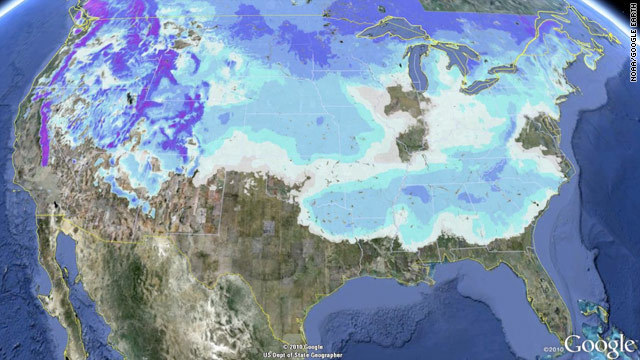
Snow in all US States except Florida

January 12, 2011

A map of snowfall in the United States is revealing right now: 49 states have snow on this 1/11/11 and only one does not.

From the southern snow storm heading north, which is affecting air travel, to the pending storm in New York City, and flurries out west, there’s plenty of white stuff going around.

The lone state without a flake? It’s the Sunshine State…Florida. Locals are celebrating the fact, though interestingly, parts of the state saw snow just days ago.

Even Hawaii has snow, in Mauna Kea on the Big Island.


Corruption in the European Union is alive and well

January 12, 2011
Constituency for the European Parliament elect...

Image via Wikipedia

Transparency International’s work and its Corruption Perception Index are both important and necessary, but they are just a small contribution to trying to restore ethics and integrity into public life. It mainly addresses the public sector and takes little account of the lack of ethics in the commercial world. Another problem with the CPI is that is skewed and as a perception index tends to be overly representative of the petty but widespread corruption (the so-called “facilitation fees”) in public services and among government employees. These are more common in developing countries and newly “democratised” countries where wage levels are low and institutional processes are still under evolution. But what the CPI does not address properly is the high level of corruption and fraud among politicians and bureaucrats in the developed world (Europe, the US, Japan, Korea for example) – which are not as numerous as in developing countries  but where the monetary values involved are huge. If we distinguish between petty bribery and corruption on the one hand and “grand” fraud and corruption on the other, I have little doubt that the US, Europe and Japan continue not only to lead the “grand” fraud and corruption stakes by a long way but are also the most innovative in finding new ways of being corrupt.

Politicians in the European Parliament and bureaucrats in the European Union are particularly venal and are subject to even less scrutiny than the national parliaments of the member countries (where padding expenses, influence peddling and basic corruption are also well established). The latest example of institutionalised corruption in Europe comes from The Telegraph:

The EU’s financial watchdog has systemically “sabotaged” investigations and caved into intimidation from countries including France and Italy to cover up fraud, according to a senior official.

Maarten Engwirda, a former Dutch member of European Court of Auditors for 15 years, who retired 10 days ago, has alleged that abuse of EU funds was swept under the carpet by an auditing body that was supposed to expose wrongdoing.

“There was a practice of watering down if not completely removing criticism,” he told the Dutch Volkskrant newspaper yesterday.

Slim Kallas, the European Commission’s vice-president, who was responsible for anti-fraud measures from 2004 to 2010 and who is now the EU transport chief, is accused of putting “heavy pressure” on investigators to tone down findings of abuse.

Mr Kallas also clashed with the Court of Auditors over its use of strict accounting standards which meant that the EU’s annual accounts have embarrassingly never been given a clean bill of health. Mr Engwirda, 67, also described an endemic “cover-up culture” within the court and wider EU institutions that had prevented the true extent of fraud from being disclosed.

Marta Andreasen, a Ukip MEP and a member of the European Parliament’s budgetary control committee, that she had come under “huge pressure to conceal the truth about EU expenditure” before being sacked as the commission’s chief accountant for whistle-blowing in 2002. “I witnessed the arm twisting of the Auditors each time they attempted to reveal the failures in the EU accounting and control systems. They came under huge pressure to keep the accountancy fraud hushed up,” she said. “Sadly the auditors did not support me when I stood up in defence of European taxpayers. In my opinion the court is not an independent body.”

Pieter Cleppe, the Brussels spokesman of the Open Europe pressure group said: “This insider story should serve as a warning not to give in to EU demands for more money until the culture of financial irresponsibility is being dealt with more fundamentally.”

http://www.telegraph.co.uk/news/worldnews/europe/eu/8252958/EU-financial-watchdog-systemically-sabotaged-fraud-investigations.html

There is little doubt that European politicians have received their pay-offs whenever a “fraud” investigation has been “sabotaged”.

Related: https://ktwop.wordpress.com/2011/01/07/chief-risk-officer-of-bayerische-landesbank-arrested-for-50-million-bribes/

https://ktwop.wordpress.com/2011/01/09/widespread-corruption-within-turkish-customs-bribes-pool-of-125-million/

A metallic glass tougher than steel

January 11, 2011

An exciting new paper in materials technology

A damage-tolerant glass by Marios D. Demetriou, Maximilien E. Launey, Glenn Garrett, Joseph P. Schramm, Douglas C. Hofmann, William L. Johnson & Robert O. Ritchie

Nature Materials (2011) doi:10.1038/nmat2930
From EurekAlert:

A new type of damage-tolerant metallic glass, demonstrating a strength and toughness beyond that of any known material, has been developed and tested by a collaboration of researchers with the U.S. Department of Energy (DOE)’s Lawrence Berkeley National Laboratory (Berkeley Lab)and the California Institute of Technology. What’s more, even better versions of this new glass may be on the way. The new metallic glass is a microalloy featuring palladium, a metal with a high “bulk-to-shear” stiffness ratio that counteracts the intrinsic brittleness of glassy materials.

Glassy materials have a non-crystalline, amorphous structure that make them inherently strong but invariably brittle. Whereas the crystalline structure of metals can provide microstructural obstacles (inclusions, grain boundaries, etc.,) that inhibit cracks from propagating, there’s nothing in the amorphous structure of a glass to stop crack propagation. The problem is especially acute in metallic glasses, where single shear bands can form and extend throughout the material leading to catastrophic failures at vanishingly small strains.

In earlier work, the Berkeley-Cal Tech collaboration fabricated a metallic glass, dubbed “DH3,” in which the propagation of cracks was blocked by the introduction of a second, crystalline phase of the metal. This crystalline phase, which took the form of dendritic patterns permeating the amorphous structure of the glass, erected microstructural barriers to prevent an opened crack from spreading. In this new work, the collaboration has produced a pure glass material whose unique chemical composition acts to promote extensive plasticity through the formation of multiple shear bands before the bands turn into cracks.

“Our game now is to try and extend this approach of inducing extensive plasticity prior to fracture to other metallic glasses through changes in composition,” Ritchie says. “The addition of the palladium provides our amorphous material with an unusual capacity for extensive plastic shielding ahead of an opening crack. This promotes a fracture toughness comparable to those of the toughest materials known. The rare combination of toughness and strength, or damage tolerance, extends beyond the benchmark ranges established by the toughest and strongest materials known.”

The initial samples of the new metallic glass were microalloys of palladium with phosphorous, silicon and germanium that yielded glass rods approximately one millimeter in diameter. Adding silver to the mix enabled the Cal Tech researchers to expand the thickness of the glass rods to six millimeters. The size of the metallic glass is limited by the need to rapidly cool or “quench” the liquid metals for the final amorphous structure.

“The rule of thumb is that to make a metallic glass we need to have at least five elements so that when we quench the material, it doesn’t know what crystal structure to form and defaults to amorphous,” Ritchie says.

The new metallic glass was fabricated by co-author Demetriou at Cal Tech in the laboratory of co-author Johnson. Characterization and testing was done at Berkeley Lab by Ritchie’s group.

Sea of Okhotsk rescue update: Tartar Straits frozen to the bottom

January 11, 2011

Little news is coming out of Russia where icebreakers are battling to rescue the ships trapped in the Sea of Okhotsk. It all seems to be going much slower than hoped for and bringing the Sodruzhestvo out is clearly posing some challenges.

Itar-Tass reports:

The icebreakers Krasin and Admiral Makarov have escorted the Bereg Nadezhdy refrigerator ship to ice-free water in the Sea of Okhotsk and now are heading to rescue the Sodruzhestvo floating base still trapped in the ice, a spokesman for the Russian Ministry of Transport told Itar-Tass on Tuesday.

“Taking into account weather forecasts, it has been decided to leave the Bereg Nadezhdy refrigerator ship in a safe sea area and send the Krasin and Admiral Makarov icebreakers to the Sodruzhestvo floating base to help it get out of ice and reach the area where the Bereg Nadezhdy is waiting,” the spokesman said, adding that the move would cut back on the length of the rescue operation. The Sodruzhestvo remains trapped in ice. It has fuel and foodstuffs enough for 75 days. Experts believe that it will be harder to take it out to clear waters because its hull is wider than that of an icebreaker. The Krasin icebreaker is expected to widen the canal for the ship’s passage.

artar Straits: graphic Wikimedia

The Tartar Straits is reported to be frozen right down to its bottom for the first time in many years. The ice field in the Sea of Okhotsk is also reported to have grown from 25km wide to 45 km wide.

“The ice has hit the bottom and the ice field is spreading northwards. The icebreakers have broken through two big floes and are facing another one. After the icebreakers get the Sodruzhestvo base to the area, where they left the Bereg Nadezhdy, the four ships will proceed to a loose ice area in a single caravan. The Magadan icebreaker and a tanker ship are waiting for them there”.