EASA eases safety inspections for A380’s Trent 900 engines

December 22, 2010

From the WSJ:

EUAIR1

Agence France-Presse/Getty Images The damaged Rolls-Royce Trent 900 engine and wing section from a Qantas Airways Airbus A380.

European aviation regulators on Tuesday substantially relaxed tight inspection rules covering Rolls-Royce Group PLC engines on Airbus A380 superjumbo jetliners, signaling that safety concerns about the planes are fading. The European Aviation Safety Agency, dropping emergency mandates to inspect Trent 900 engines after every 20 flights, moved to require repetitive inspections of most of the engines after 100 flights. The change is likely to reduce disruption of flight schedules, according to industry officials.

EASA’s move follows intensive inspections of Trent 900s on A380s operated by Qantas, Singapore Airlines Ltd. and Deutsche Lufthansa AG. In its latest directive, the agency said a review of manufacturing and inspection data convinced safety officials that many “lower risk” tubes are less prone to fracture and therefore don’t need such frequent checks.

Lifting the emergency directives so quickly, particularly after such a high-profile and dangerous event, indicates much of the fleet is unaffected by oil-system manufacturing defects.

To further assure the safety of Rolls-Royce-powered A380 jets, European regulators previously also ordered upgrades of Trent 900 electrical systems to prevent engine parts from turning dangerously fast, a condition that can lead to disintegration of spinning disks. Those enhancements already have been incorporated into the A380 fleet.

Problems caused by a manufacturing defect on an oil-supply tube have been blamed for the explosive failure of a relatively new Trent engine on the Qantas jet shortly after takeoff from Singapore. The fault has been found on the current fleet as well as at least one new plane slated for delivery to Qantas, according to industry officials. But on Tuesday, EASA for the first time specifically defined what it considers to be an acceptable minimum thickness for the walls of the tubes.

EASA’s decision also is good news for Qantas and the other carriers that fly A380s with Rolls-Royce engines because those airlines have been concerned about potential schedule disruptions and longer required layovers to accomplish the inspections.

EUAIR2

Australian Transport Safety Bureau report: The Trent 900 engine blew out after the Qantas A380 took off from Singapore on Nov. 4.

It would seem that the initial failings of the Trent 900 have now been found and are being rectified. But it needs a few more months of operation before it can be said that all the “teething” problems of the Trent 900 have been identified and resolved. The costs for the fix – mainly to be borne by Rolls Royce – have still to be added up and will not be finally clear for a few more months.

EASA had also relaxed inspection requirements before the explosion on the Qantas A380 probably in response to representations by the engine manufacturer and /or the airlines. One hopes that their decision to relax inspections this time is not just in response to pressure.

Global warming arrogance takes “credit” for the white-out in Europe and the White Christmas in Australia

December 21, 2010

It used to be that the Global Warming zealots warned about the possible disappearance of snow and the mild and wet winters to come in Europe. But their arrogance knows no bounds. They have changed their tune and irrespective of what weather may prevail they mange to put it down to Global Warming. They now put the coldest December in a hundred years and the current white-out across Northern Europe down to Global Warming.

That snow outside is what global warming looks like

James Delingpole at The Telegraph is lauging his socks off.


Not to be outdone, the SMH thinks the possibility of having a White Christmas during the height of Australia’s summer is also due to Global Warming!!!!

The Alarmists cannot live with the thought that man made effects are puny and inconsequential compared to the effects of the sun.

Mild winters, warm winters, early winters, coldest winters in 100 years are all quoted in defence of global warming dogma.  They are all merely grist to the mill of Global Warming arrogance.

Science has been left behind in some far and distant galaxy.


A small bright spot in the murky world of corporate ethics

December 21, 2010

Laws tell us what we must not do and morals tell us what we ought not to do – whether illegal or not.

But ethics – when they exist – tell us what is the right and proper and desirable thing to do.

Far too many corporates seem to think that mere compliance with laws is sufficient as a code of ethics. Much trumpeted Corporate Social Responsibilities are primarily public relations and image building exercises with little relation to ethics. Token gestures of engaging in some social programme are assumed to be evidence of the existence of an ethical code but the reality is that most corporates have no ethics. They are content – like children – to let others tell them by law what is forbidden and then take the easy path provided by assuming that all behaviour which is not illegal is – by default – ethical.

As if it is not possible to be completely compliant and completely corrupt at the same time. British Aerospace and their utter lack of ethics being a case in point.

Retraction Watch carries the refreshing story of Wnt Research which shows that some bright spots still exist in the murky world of corporate ethics.

Two weeks ago, we covered the retraction of a PNAS paper on a potential breast cancer treatment, one that would make tumors that didn’t respond to tamoxifen respond to the drug. We learned earlier this week from a Retraction Watch commenter that Wnt Research, a company based on the breast cancer finding and other work, was about to go public.

In fact, their initial public offering (IPO) happened today, and you can follow the price of their stock — listed on the Stockholm Stock Exchange as WNT — here. But what we learned when we looked into the IPO was that it was originally scheduled for late November, and was delayed because of the retraction.

Tommy Andersson, one of the researchers on the now-retracted paper and Wnt Research’s chief scientific officer, told Retraction Watch that the company had initially planned on going public on November 26. They had written a memorandum describing the company’s work to date, and its plans, and the public was given a chance to invest before shares hit the Stockholm exchange. That memorandum included a mention of the PNAS paper, as follows (translated from Swedish):

The research group has even shown that combining Wnt-5a or Foxy-5 will increase the expression of estrogen receptors in estrogen-negative breast cancer cells. It turned out that human breast cancer cells exposed to Foxy-5 regained tamoxifen sensitivity, which is clear from the increased apoptosis and reduced cell growth as a response to the endocrine treatment. Likewise, the research group found that administration of Foxy-5 in the body brought back the expression of estrogen receptors in a mouse model. Apart from the therapeutic potential of these observations, there is a potential to use the outcome of estrogen receptors as a biological marker, which should advance research.

The deadline for investment was October 27, and a number of people responded, allowing the company to continue its work. But on November 11, Andersson and his colleagues realized there were serious errors in the paper, and that it would need to be retracted. When Andersson called Wnt Research’s CEO, Bert Junno, on the 12th:

He rapidly called upon an extra Board meeting on the 15th of November (the same day my email of retraction was sent to the PNAS office). At this meeting we decided to make a press release on this matter and this went out on the 16th of November.

We again had an extra Board meeting on the 19th of November to discuss what other things that we needed to do. We agreed that the short press release must be accompanied by an addition to the already published memorandum, the reason being that you cannot change in the original memorandum. The CEO wrote this addition together with the people at the office of the small Stockholm Exchange “Aktietorget” where the company was to be listed. We also decided to ask for legal advice in how to handle the public that had already paid for shares in the company.

The board held another meeting on the 22nd, during which they approved the addition to the memorandum saying that the PNAS paper had been retracted. They also did something that can only be described as the right thing: They decided to write all of the approximately 275 people who had invested in the company by the October 27 deadline and offer their money back:

The reason for this was that the lawyer advised us to act according to good morals rather than to what we were required to do by law. His belief was that this would pay off in the long run.

The memorandum addition was published on November 25. And some people did ask for their money back:

The offer to retract their investments in the company resulted in a net loss of investments, but we still obtained enough investments to continue our work.

All of that back and forth also meant that the IPO was delayed by three weeks, until today.

We find this story wonderfully refreshing. Imagine, a company bending over backward to let investors — and potential investors — know about problems with its data.

I can only agree that this little story proves that, unlike what Milton Friedman had to say, it is perfectly possible to be ethical in the corporate world.

Today I did my bit and bought some shares in Wnt Research. I know too little about cancer research to judge whether this was or will be a good buy. But I applaud their ethics and my share purchase is just to put my money where my mouth is.

Landscheidt minimum is here — a new Dalton is indicated

December 21, 2010
SDO Sunspot

Spotless Sun

All the indicators are that the Landscheidt minimum is here and that this is going to be close to a Dalton minimum.

2010/12/20 8:00  Five Days in a row spotless is achieved 12 months after solar cycle 24 began it’s ramp up.

A Dalton Minimum Repeat is Shaping Up

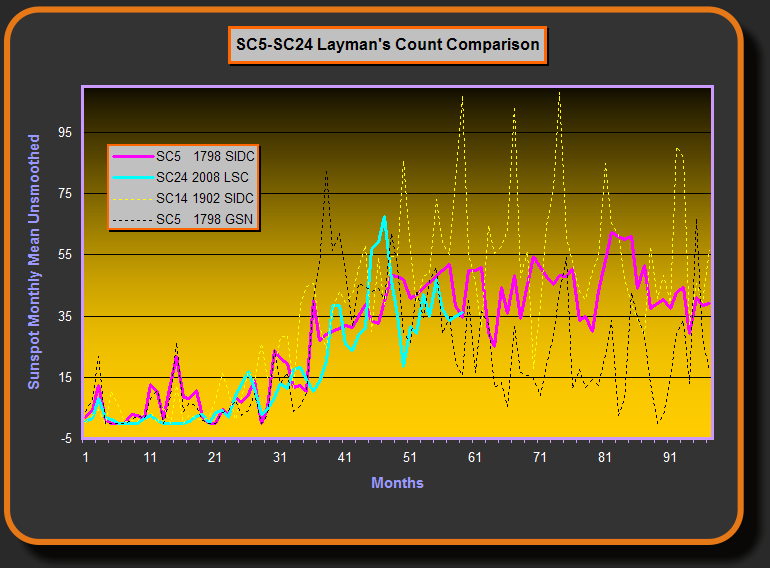
The Dalton Minimum was a period of low solar activity, named after the English meteorologist John Dalton, lasting from about 1790 to 1830. Like the Maunder Minimum and Spörer Minimum, the Dalton Minimum coincided with a period of lower-than-average global temperatures. The Oberlach Station in Germany, for example, experienced a 2.0°C decline over 20 years. The Year Without a Summer, in 1816, also occurred during the Dalton Minimum. Solar cycles 5 and 6, as shown below, were greatly reduced in amplitude.

http://solarcycle24.com/sunspots.htm

Sunspot number till December 7th


http://www.landscheidt.info/images/sc5_sc24.png

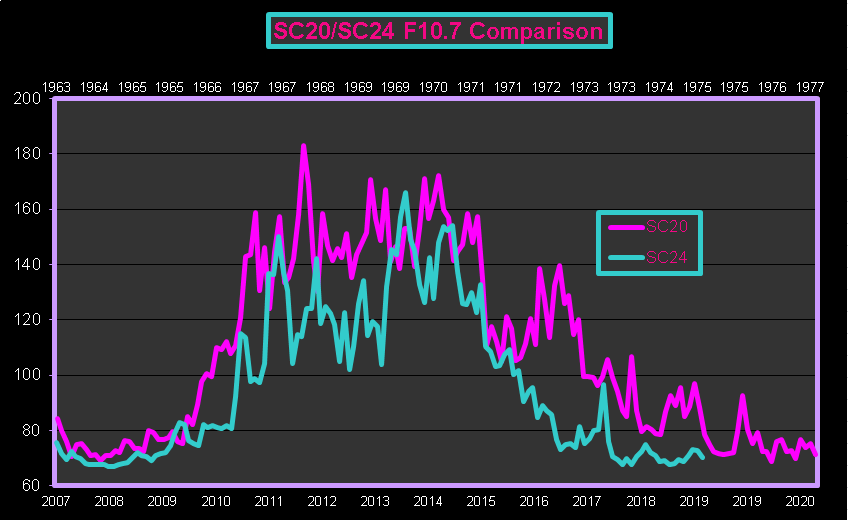
To compare solar cycles we can also use the F10.7 radio flux values that have been recorded since 1947 in Canada. Solar cycle 20 was a weak cycle which is currently looking strong against solar cycle 24. Data is taken from the AU adjusted monthly average values.

Snow Chaos

December 21, 2010

Just returned from India via Frankfurt through Europe’s coldest December in over 100 years.

Two successive flights to Stockholm were cancelled (due to snow and the logistics of getting aircraft and crew to the right places) and I finally made it home with a delay of about 12 hours. Not too onerous.

But nothing unusual for Stockholm’s Arlanda airport  where operations continued without any fuss at -10°C and masses of snow. Flights cancelled from Arlanda were only those to the UK and Frankfurt!!!!

Heathrow

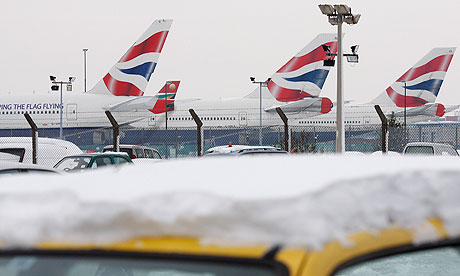
Heathrow snow chaos


UK snow: Christmas cancelled for travellers as Heathrow warns of days of delays

Heathrow authorities effectively cancelled the Christmas plans of hundreds of thousands of travellers yesterday as the Transport Secretary admitted the chaos at Britain’s busiest airport was “not acceptable”.

Amid mounting criticism of Heathrow’s response to the weekend’s snowfall, airline passengers were told to expect delays and flight cancellations “beyond Christmas Day”.

Snow and ice grounded two thirds of flights at Heathrow yesterday, with Terminals One and Three becoming so congested that passengers were told to stay away.

Only one of the airport’s runways was open and staff had cleared just half of the planes’ docking bays. All short-haul flights were cancelled. Some travellers faced a fourth night sleeping in terminal buildings in the hope of getting on a plane.

But even if the next Ice Age is coming I have no doubt that human ingenuity will ensure a successful adaptation.

Coldest December in 135 years

December 18, 2010

Kallaste december på 135 år

says the Svenska Dagbladet

http://www.thelocal.se/30914/20101217/

Power outages, traffic accidents as well as train and flight delays have left Swedes reeling from Thursday’s snowstorm, which forecasters say isn’t over yet.

“Slippery conditions will continue across the country. There is already a lot of snow on the roads,” SMHI’s Elin Torstensson told the TT news agency.

She explained that Sweden has experienced more cold days and more snow than is normal for December.

“There were a number of days in a row with below-freezing temperatures, so called ice days. And that we have that before Lucia (December 13th) hasn’t happened in more than 100 years,” she said.

Meteorology agency SMHI has issued a class 1 warning covering all of northern Sweden due to the large amounts of new snow, combined with the strong winds.

The agency also forecasts that the snow will continue throughout much of the country on Friday. Snow showers are expected to continue throughout the weekend over parts of Götaland and southern Svealand in central Sweden, with light flurries forecast for the north of the country.

“We’re expecting about five centimetres of new snow,” said SMHI’s Torstensson. Temperatures on Saturday are expected to range from a few degrees below freezing in Götaland to -25 Celsius in the far north, before cooling somewhat on Sunday when temperatures in the northern Sweden may dip down to 35 degrees below zero.

Weather not climate of course, but the credibility of so-called climate science is disappearing with its alarmist  displays of arrogance.

UN to “investigate” its introduction of cholera to Haiti

December 17, 2010

More than a month after the outbreak , the United Nations secretary-general plans to call for an independent commission to study whether U.N. peacekeepers caused a cholera outbreak that has killed more than 2,400 people in Haiti, an official said on Wednesday.

http://www.thehindu.com/health/policy-and-issues/article956037.ece?homepage=true

U.N. officials initially dismissed speculation about the involvement of peacekeepers. The announcement indicates that concern about the epidemic’s origin has now reached the highest levels of the global organization.

“We are urging and we are calling for what we could call an international panel,” U.N. peacekeeping chief Alain Le Roy said at a news conference at U.N. headquarters in New York. “We are in discussions with (the U.N. World Health Organization) to find the best experts to be in a panel to be completely independent.”

Le Roy said details about the commission would be announced Friday by Secretary-General Ban Ki-moon. He said cholera experts and other scientists will have full access to U.N. data and the suspected military base.

“They will make their report to make sure the truth will be known,” Le Roy said.

Soon after the cholera outbreak became evident in October, Haitians began questioning whether it started at a U.N. base in Meille, outside the central plateau town of Mirebalais and upriver from where hundreds were falling ill. Speculation pointed to recently arrived peacekeepers from Nepal, a South Asia nation where cholera is endemic.

U.N. officials rejected any idea the base was involved, saying its sanitation was air-tight.

WHO and the U.S. Centres for Disease Control and Prevention said at the time that it was unlikely the origin would ever be known, and that pinning it down was not a priority.

Then the Associated Press found not only sanitation problems at the base, but that the U.N. mission was quietly taking samples from behind the post to test for cholera.

When the CDC determined the strain in Haiti matched one in South Asia, cholera and global health experts said there was now enough circumstantial evidence implicating the likely unwitting Nepalese soldiers to warrant an aggressive investigation.

The experts have also said there are important scientific reasons to trace the origin of the outbreak, including learning how the disease spreads, how it can best be combated and what danger countries around Haiti could face in the coming months and years.

Many think the U.N. mission’s reticence to seriously address the allegations in public helped fuel anti-peacekeeper riots that broke out across the country last month.

This outbreak, which experts estimate could affect more than 600,000 people in impoverished Haiti, involves the first confirmed cases of cholera in Haiti since WHO records began in the mid-20th century. Suspected outbreaks of a different strain of cholera might have occurred in Haiti more than a century ago.

The current outbreak has spread to the neighbouring Dominican Republic and isolated cases have been found in the United States.

French epidemiologist Renaud Piarroux argues that “no other hypothesis” from the Nepalese being the origin could explain his findings that cases of the diarrheal disease first appeared near the U.N. base in Haiti’s rural centre, far from shipping ports and the area affected by the Jan. 12 earthquake.

Winter variations and global warming

December 16, 2010

After a week in Southern India with minimum nighttime temperatures of around 20°C and maximum daytime temperatures of about 28°C, I am now in Delhi where the minimum nighttime temperature is about 5°C and where the daytime maximum touches about 25°C. Without widespread central heating being available, Delhi feels cold and on the streets everybody is bundled up in woollens, jackets, scarves and blankets and the occasional Balaclava.

In the meantime, Scandinavia and the UK and Northern Europe are bracing themselves for another cold wave and much snow. Next week I shall be back in about minus 20°C.

Swedish winter

Humans thrive in daily variations – every day – which range from 10 to 20°C and seasonal variations of temperature – every year – of 40 °C and sometimes upto 50°C.

The global warming doomsday scenarios seem  puny and nonsensical in the face of human adaptability and ingenuity.

A good thing that Cancun didn’t do too much and deferred everything again but of course the jamboree can – and will – continue next year in S. Africa. But “global warming” is going out of fashion and I have the gut feeling that climate alarmism is beginning to be seen in perspective.

Since the 1970s, the long-term rate of global warming has been around 0.16C a decade but that slowed in the last 10 years to between 0.05C – 0.13C depending on which of the three major temperature record series are used.

Global warming has slowed down in the past decade

Chemistry unsettled

December 16, 2010
International Year of Chemistry Logo

Image via Wikipedia

Atomic weights of 10 elements on periodic table about to make an historic change

For the first time in history, a change will be made to the atomic weights of some elements listed on the Periodic table of the chemical elements posted on walls of chemistry classrooms and on the inside covers of chemistry textbooks worldwide.

The new table, outlined in a report released this month, will express atomic weights of 10 elements – hydrogen, lithium, boron, carbon, nitrogen, oxygen, silicon, sulfur, chlorine and thallium – in a new manner that will reflect more accurately how these elements are found in nature.

“For more than a century and a half, many were taught to use standard atomic weights — a single value — found on the inside cover of chemistry textbooks and on the periodic table of the elements. As technology improved, we have discovered that the numbers on our chart are not as static as we have previously believed,” says Dr. Michael Wieser, an associate professor at the University of Calgary, who serves as secretary of the International Union of Pure and Applied Chemistry‘s (IUPAC) Commission on Isotopic Abundances and Atomic Weights. This organization oversees the evaluation and dissemination of atomic-weight values.

Modern analytical techniques can measure the atomic weight of many elements precisely, and these small variations in an element’s atomic weight are important in research and industry. For example, precise measurements of the abundances of isotopes of carbon can be used to determine purity and source of food, such as vanilla and honey. Isotopic measurements of nitrogen, chlorine and other elements are used for tracing pollutants in streams and groundwater. In sports doping investigations, performance-enhancing testosterone can be identified in the human body because the atomic weight of carbon in natural human testosterone is higher than that in pharmaceutical testosterone.

The atomic weights of these 10 elements now will be expressed as intervals, having upper and lower bounds, reflected to more accurately convey this variation in atomic weight. The changes to be made to the Table of Standard Atomic Weights have been published in Pure and Applied Chemistry and a companion article in Chemistry International.

For example, sulfur is commonly known to have a standard atomic weight of 32.065. However, its actual atomic weight can be anywhere between 32.059 and 32.076, depending on where the element is found. “In other words, knowing the atomic weight can be used to decode the origins and the history of a particular element in nature,” says Wieser who co-authored the report.

Elements with only one stable isotope do not exhibit variations in their atomic weights. For example, the standard atomic weights for fluorine, aluminum, sodium and gold are constant, and their values are known to better than six decimal places.

“Though this change offers significant benefits in the understanding of chemistry, one can imagine the challenge now to educators and students who will have to select a single value out of an interval when doing chemistry calculations,” says Dr. Fabienne Meyers, associate director of IUPAC.

http://www.eurekalert.org/pub_releases/2010-12/uoc-awo121510.php

Capitation fees: The stench of corruption in the Indian body academic

December 10, 2010
Varkala in Kerala. India.

Image via Wikipedia

This past week I have been travelling in the southern Indian states of Tamil Nadu and Karnataka.

The growth is palpable and vibrant. But it is chaotic and uncontrolled – and probably uncontrollable, The best that can be hoped for is that movement is in the general direction desired but it is futile to to try and exercise any micro-control. The speed is such that there is no time for consolidation, for reflection, for developing values or standards or for any feedback. Feed forward is the only thing that can keep up.

But in every field of operation – whether construction or government or industry or financial institutions or academia – the stench of corruption is contained under a thin veneer of apparent sophistication. The overpowering fundamental value which gets free reign is greed.

What has become apparent to me is that in spite of many good intentions by government, the shortage of supply in the face of an ever-increasing demand for education has allowed the unfettered growth of  private colleges and universities. But the demand is only used as a vehicle for satisfying greed not for satisfying educational needs.

All degrees and especially post graduate degrees in medicine, engineering and IT related subjects from private colleges in India are granted solely for the payment of a capitation fee.

http://en.wikipedia.org/wiki/Capitation_fee

Capitation fee refers to the unlawful collection of payment by educational bodies in exchange for a seat in the institution. It is also known as donations. This practice is popular in private colleges and universities in India, especially those that grant baccalaureate degrees in Engineering, IT and the sciences. This is an example of institutionalized corruption prevalent in India.The practice goes mostly unnoticed because the board/owners of these institutions hold political/financial powers and also the parents who pay the donations are more than happy to do so.

The Concise Oxford Dictionary defines capitation as follows:

The payment of a fee or a grant to a doctor, school, etc., the amount being determined by the number of patients, pupils etc. Origin (denoting the counting of heads)

The Kerala Self Financing Professional Colleges (Prohibition of Capitation Fees and Procedure for Admission and Fixation of Fees) Act 2004 defines capitation fees as follows.

“capitation fees” means any amount by whatever name called, whether in cash or in kind paid or collected or received directly or indirectly in addition to the fees determined under section 4.

The Supreme Court Judgement in 1993 in the Unni Krishnan Case declared that charging capitation fees was illegal.

But capitation fees are now the only way of  getting a seat in a private college. It guarantees a degree will be awarded. Academic staff  have no say in the selection of students. That selection is reserved for the owners and they usually auction the seats to the highest bidder. Capitation fees are unrecorded, undeclared and paid in cash. Academic standards are irrelevant.

This is not to say that competent engineers and doctors do not exist. But a degree from a private college is an empty thing. It only proves that a capitation fee was paid and is totally silent regarding the capability or competence of the person receiving a degree.