November 8, 2010
From Pajamas Media:
Global warming-inspired cap and trade has been one of the most stridently debated public policy controversies of the past 15 years. But it is dying a quiet death. In a little reported move, the Chicago Climate Exchange (CCX) announced on Oct. 21 that it will be ending carbon trading — the only purpose for which it was founded — this year.
Although the trading in carbon emissions credits was voluntary, the CCX was intended to be the hub of the mandatory carbon trading established by a cap-and-trade law, like the Waxman-Markey scheme passed by the House in June 2009.
At its founding in November 2000, it was estimated that the size of CCX’s carbon trading market could reach $500 billion. That estimate ballooned over the years to $10 trillion.
The CCX was the brainchild of Northwestern University business professor Richard Sandor, who used $1.1 million in grants from the Chicago-based left-wing Joyce Foundation to launch the CCX. For his efforts, Timenamed Sandor as one of its Heroes of the Planet in 2002 and one of its Heroes of the Environment in 2007.
CCX’s panicked original investors bailed out this spring, unloading the dog and its across-the-pond cousin, the European Climate Exchange (ECX), for $600 million to the New York Stock Exchange-traded Intercontinental Exchange (ICE) — an electronic futures and derivatives platform based in Atlanta and London. (Luckier than the CCX, the ECX continues to exist thanks to the mandatory carbon caps of the Kyoto Protocol.)
The ECX may soon follow the CCX into oblivion, however — the Kyoto Protocol expires in 2012. No new international treaty is anywhere in sight.
While we don’t know how well Al Gore and Goldman Sachs fared on their investments in the CCX, we do know that there’s no reason to cry for Sandor. He received $98.5 million for his 16.5% stake in CCX when it was sold. Not bad for a failure that somebody else financed.
http://www.chicagoclimatex.com/market/data/daily.jsf
Carbon Financial Instruments – Nov 5, 2010
| Product |
Vintage |
Open |
High |
Low |
Close |
Change |
Volume |
| Total Electronically Traded Volume |
– |
| CFI |
2003 |
$0.00 |
$0.00 |
$0.00 |
$0.05 |
– |
0 |
| CFI |
2004 |
$0.00 |
$0.00 |
$0.00 |
$0.05 |
– |
0 |
| CFI |
2005 |
$0.00 |
$0.00 |
$0.00 |
$0.05 |
– |
0 |
| CFI |
2006 |
$0.00 |
$0.00 |
$0.00 |
$0.05 |
– |
0 |
| CFI |
2007 |
$0.00 |
$0.00 |
$0.00 |
$0.05 |
– |
0 |
| CFI |
2008 |
$0.00 |
$0.00 |
$0.00 |
$0.05 |
– |
0 |
| CFI |
2009 |
$0.00 |
$0.00 |
$0.00 |
$0.05 |
– |
0 |
| CFI |
2010 |
$0.00 |
$0.00 |
$0.00 |
$0.05 |
– |
0 |
| Price and volume reported in metric tons CO2 |
Tags: Carbon Trading, Chicago Climate Exchange, European Climate Exchange, fraud, Kyoto Protocol
Posted in Energy, Environment, Ethics, Fraud, International Trade, Investing | Comments Off on Carbon Trading dies quietly in the US; time for Europe to follow suit
November 8, 2010

Mt. Merapi hazard map: image worldlywise.pbworks.com
Yogyakarta lies some 35 km from Mount Merapi but one of the “hazard” tongues from the volcano (see map above) leads directly to the city.
The Jakarta Globe reports:
Frightened residents in a bustling city of 400,000 at the foot of Indonesia’s rumbling volcano headed out of town Monday, cramming onto trains and buses and even rented vehicles to seek refuge with family and friends far away.
Mount Merapi, one of the world’s most active volcanoes, has erupted many times in the last century, killing more than 1,400. But Friday was the mountain’s deadliest day since 1930, with nearly 100 lives lost. The notoriously unpredictable mountain unleashed its most powerful eruption in a century Friday, sending hot clouds of gas, rocks and debris avalanching down its slopes at highway speeds, smothering entire villages and leaving a trail of charred corpses in its path.
All (international flights) were back in the air Monday and White House officials said Obama was still scheduled to touch down on Tuesday.
Merapi, meanwhile, showed few signs of tiring Monday, sending out thunderous claps as it shot clouds of gas and debris high into the air.
The Indonesian government has put Yogyakarta on high alert. Though there have been no orders to evacuate, many residents decided to go on their own.
Tags: Indonesia, Mount Merapi, Volcano, Yogyakarta
Posted in Environment, Indonesia, Natural Disasters, Volcanoes | Comments Off on Merapi: Residents flee Yogyakarta but flights resume to Jakarta
November 7, 2010
The 3 Trent 900 engines that Qantas had earlier been thought to have been investigating now seems to have grown to 4 engines – 2 in Sydney and 2 in Los Angeles. These engines were tested following a Rolls Royce recommended 8-hour test procedure but have now been taken off the wings of their aircrafts for further investigation.
These are in addition to the Trent 900 which exploded on the A 380 which returned to Singapore and the RB 211-524 on the Boeing 747-400 which also returned to Singapore when an engine failed.
The Herald Sun:
MORE Qantas A380 jet engines are out of service and undergoing further tests, the airline says. Qantas spokeswoman Olivia Wirth said two of the Rolls-Royce built engines were in LA. “There are some engines being subject to further tests, but in line with normal procedure,” Ms Wirth told ABC radio today.
“In Los Angeles, there are two other engines that have been removed and we’ve been inspecting those. But this is, actually, common practice. It’s how you can make sure that you’re doing the right investigation.”
Fairfax newspapers today reported that Qantas had found issues with three more Rolls-Royce jet engines on its grounded Airbus A380 fleet. They also reported that two engines – one in Sydney and one in LA – had been taken off for closer inspection as a result of the eight-hour tests Rolls-Royce recommended.
“Deeper inspection could be for a number of things,” Ms Wirth said.
ABC reports:
Qantas says it has found problems with more of its A380 jet engines overnight, dashing hopes of an early return to service for the massive aircraft.
Steve Purvinis, the federal secretary of the Australian Licensed Aircraft Engineers Association, says he is concerned about the “general safety culture” in the airline. But Qantas spokeswoman Olivia Wirth rejects any suggestions the airline is dropping its standards. “The reality is that for the last decade in fact … 80 to 85 per cent of maintenance is done onshore,” she said. “In fact, last year 92 per cent of all Qantas maintenance was done onshore in Australia, so it is simply untrue. In fact, the 747 which was involved in QF6 was maintained in Avalon in Melbourne.”
Ms Wirth says Qantas hopes to have its A380 aircraft back in action in the next three days.
Tags: Airbus A380, Qantas, Rolls Royce, Trent 900 failures
Posted in Aviation, Engineering, Technology | Comments Off on Qantas A380 fleet to stay grounded for 3 more days as more engine issues are discovered
November 7, 2010
Plenty of activity and a full schedule for President and Mrs Obama in Mumbai and Delhi today. There were no new announcements of any agreements or any business deals but no doubt these will be saved up for the final, ritual press conference.
Fielding questions from students on issues ranging from Pakistan to jehad, establishing an e-connect with farmers and breaking into an impromptu jig, US President Barack Obama got into the groove in more ways than one as he ended the first leg of his India visit here before heading for New Delhi Sunday afternoon. Obama took on a host of sharp questions from eager students at the St Xavier’s College this morning in Mumbai.
Obama met hundreds of American and Indian business leaders yesterday at the USIBC event. “India is the United States’ 12th largest trading partner. It could be number one or two if the conditions for trade between these two giant economies continue to improve,” said The McGraw-Hill Companies Chairman and CEO Harold Terry McGraw III, who is also the Chairman of the US-India Business Council (USIBC). Along with the USIBC Chairman, the meeting was attended by GE CEO Jeff Immelt, PepsiCo CEO Indra Nooyi, Honeywell Chairman David Cote, Reliance Industries Ltd Chairman Mukesh Ambani and Bharti Enterprises Vice Chairman Rajan Bharti Mittal.
Having mixed serious business with interactions with schoolchildren and a town hall-style meeting at St Xavier’s College, U.S. President Barack Obama and First Lady Michelle Obama began the second leg of their Indian trip in New Delhi.
President Obama has now arrived in Delhi where he was met at the airport by the Prime Minister.

Humayun's Tomb, Delhi: tripadvisor.com
It was as close to the slum-dog moment as the Obamas could get in their India tour. The US President Barack Obama and First Lady Michelle Obama met with 16 children of labourers at Humayun’s tomb in New Delhi today. The children, aged between five and seven, do not go to a regular school because they are too poor. They receive informal education due to the voluntary efforts of Mr K.K. Mohammad, the Superintendent of the Archaeological Survey of India who has taken upon himself to get some basic literacy tools to these kids. At Humayun’s tomb, the children attired in uniforms of checked shirt and shorts spoke in Hindi to the U.S. President and the First Lady. They had small slate tablets in their hands and scribbled with white chalk on those tablets were the words “Welcome to India, Obamajee”. The President spoke to one eight-year-old Vishal, whose father Ram Das is a restoration worker at the Humayun’s tomb.
On the eve of their formal talks, Prime Minister Manmohan Singh and US President Barack Obama had a meeting in New Delhi on Sunday during which the two leaders are understood to have taken stock of bilateral ties and ways to push these to higher levels of strategic partnership. Singh and Obama had a one-on-one meeting for about 25 minutes before the private dinner hosted by the Prime Minister for the visiting leader and his wife Michelle at his 7, Race Course Road residence.
Tags: Barack Obama, Humayun's Tomb, Manmohan Singh, US President's visit to India
Posted in Business, Defense, Development, India, US | Comments Off on Obama in India: Day2: Networking aplenty but no new contracts announced today
November 7, 2010
Over 25 million shares were sold on Thursday and Friday as Rolls Royce shares plummetted from 654p to 591p as their problems with the Trent 900 engines for the Airbus A380 and with the RB211-524 engines for the Boeing 747 became apparent.
Further delays of the Boeing Dreamliner which is to use the RR Trent 1000 engines were reported causing speculation that some of these delays were due to delays with the engine.
Boeing Co. has told several of its early customers that delivery of the 787 Dreamliner will be delayed by as long as 10 months, Aviation Week reported Friday, citing industry sources. Korean Air will receive its first 787 in August 2012, 10 months later than planned. Air India, previously slated to receive the plane in April 2011, will get it in September or October of that year.
Boeing has said it intends to make the first delivery of the plane to All Nippon Airways in the middle of the 2011’s first quarter, according to reports.
Aviation news website FlightGlobal.com reported Thursday that Japan Airlines Corp. had expected to receive its first 787 delivery in March 2011, will now get the plane in June 2011.
http://www.aviationweek.com/aw/generic/story_channel.jsp?channel=comm&id=news/awx/2010/11/05/awx_11_05_2010_p0-267220.xml&headline=Boeing%20Tells%20Carriers%20About%20More%20787%20Delays
Tags: Airbus A380, Boeing, Boeing 787, Boeing delays, Rolls-Royce Trent, Trent 1000, Trent 900 failures
Posted in Aviation, Engineering, Technology | 1 Comment »
November 7, 2010
The Age reports that Qantas has removed three more Rolls Royce Trent 900 engines on A380’s parked in Sydney and Los Angeles after putting them through 8 hour tests recommended by Rolls Royce.

Engine trouble: An Airbus A380's Rolls-Royce engine. Photo: Reuters via The Age
QANTAS has found issues with three more Rolls-Royce engines on its grounded Airbus A380 fleet that have required their removal from the wings, dashing the prospect of an early return to the skies.
Two of the engines taken off for closer inspection were on an A380 parked in Sydney and one is from a craft in Los Angeles. They were removed after the eight-hour tests Rolls-Royce recommended for each engine after the fleet was grounded.
The airline has one A380 in Singapore under investigation, one in Germany for servicing, one in Sydney and three in Los Angeles undergoing checks in the wake of the mid-air engine explosion last Thursday.
While Qantas will not say what the nature of the engine issues are, or whether the three engines are being examined for the same or different matters, the concern was sufficient to warrant their removal from the wings.
There is a disturbing silence from Rolls Royce and also from Singapore Airlines and Lufthansa who with Qantas use Trent 900’s on their A 380 aircraft.
Tags: Airbus A380, Qantas, Rolls Royce, Trent 900 failures
Posted in Australia, Aviation, Engineering, Technology | 1 Comment »
November 7, 2010

Borobudur Temple: Image via Wikipedia
Update from CNN:
The death toll from recent eruptions at Indonesia’s Mount Merapi continues to rise as the volcano spewed hot ash clouds and gas on Sunday. At least 156 people have died since Merapi started erupting on October 26. Ash columns reached as high as 6 kilometers (3.7 miles), according to the Indonesian Volcanology and Geological Disaster Mitigation Agency.
The Borobudur temple lies about 45 km from Mount Merapi and is currently covered with ash which is being painstakingly cleared.
Employees of Borobudur temple on Sunday were working to keep the historic site from being damaged by the thick black ash that has fallen from nearby Mount Merapi’s eruption.
Karyono, a parking lot employee who has been working there since 1986, was taking the ash off the driveway and the parking lot. Using a small iron shovel, he and his 10 coworkers were squatting and painstakingly taking the ash away in buckets.Karyono said that he has been cleaning since Saturday and piling up the ashes to be dumped elsewhere.
While the cleanup operation continues, the famous temple is closed to visitors from Nov. 5 to 9.
Mount Merapi unleashed nearly 50 million cubic meters of gas, rocks and ash on Friday, its most powerful eruption in a century.
Up to 138 people have now died on Merapi’s slopes in the past ten days of eruptions and gas cloud ash emissions.
Authorities charged with conserving the temple say that
ash up to 3-centimetres deep has covered it and the acidity could erode the temple’s stones. They believe that if the ash it is not cleared away quickly it will accelerate the decay of the stones. The monument comprises six square platforms topped by three circular platforms, and is decorated with 2,672 relief panels and 504 Buddha statues. A main dome, located at the center of the top platform, is surrounded by 72 Buddha statues seated inside perforated stupa. The monument is both a shrine to the Lord Buddha and a place for Buddhist pilgrimage. The journey for pilgrims begins at the base of the monument and follows a path circumambulating the monument while ascending to the top through the three levels of Buddhist cosmology, namely Kāmadhātu (the world of desire), Rupadhatu (the world of forms) and Arupadhatu (the world of formlessness). During the journey the monument guides the pilgrims through a system of stairways and corridors with 1,460 narrative relief panels on the wall and the balustrades. Officials however confirm that over the next few days they will be conducting a technical evaluation for the cleaning process. The temple was again closed down for visitors temporarily after volcanic ash covered it following the Merapi volcano’s powerful eruptions on Friday. When the cleanup is completed visitors will be allowed to visit the site early next week – but they will still not be permitted to climb up to the temple.
Evidence suggests Borobudur was abandoned following the 14th-century decline of Buddhist and Hindu kingdoms in Java, and the Javanese conversion to Islam. Worldwide knowledge of its existence was sparked in 1814 by Sir Thomas Stamford Raffles, then the British ruler of Java, who was advised of its location by native Indonesians. Borobudur has since been preserved through several restorations. The largest restoration project was undertaken between 1975 and 1982 by the Indonesian government and UNESCO, following which the monument was listed as a UNESCO World Heritage Site. It is still used for pilgrimage; once a year Buddhists in Indonesia celebrate Vesak at the monument. Borobudur remains Indonesia’s single most visited tourist attraction.
Since Borobudur was built sometime in the 9th Century it has probably seen – and survived – over one hundred eruptions from Mount Merapi in the following 1200 years. Mount Merapi is Indonesia’s most active volcano and has certainly been erupting regularly at least since 8000 BC. Since 1548 written eruption records are available but earlier eruptions are inferred.

Mount Merapi as seen from Borobudur: image ghumakkar.com
Tags: Borobudur Temple, Central Java, Earth Sciences, Indonesia, Mount Merapi, Volcanoes
Posted in Environment, Geosciences, Indonesia, Volcanos | Comments Off on Borobodur Temple covered by Merapi volcano ash
November 7, 2010

Guiyang-skyline: Image via Wikipedia
Xinhua reports on a diesel shortage because electricity consumers are forced to use diesel generators as authorities shut down power generation to reach “emissions targets”. Needless to say the emissions from the diesel generators are a lot worse than the forced power shut-downs they replace!
An unprecedented diesel shortage is sweeping through Chinese cities, as numerous enterprises have to resort to diesel fuel to generate electricity to continue operation during periods of forced power outages. Local governments are rushing to switch off electricity as part of their commitment to the central government on energy conservation and emissions reductions.
However, the blackouts have apparently led to the linking effect of the diesel shortage. Long queues of cars and even “Sold-out” signs at gas stations are increasingly common scenes in many cities. Additionally, the market monitoring of the China Chamber of Commerce for the Petroleum Industry has acknowledged that more than 2,000 privately-owned gas stations in southern China had shut down due to their not having diesel fuel to sell.
During the period of the 11th Five-Year Plan (2006-2010), China sought to reduce energy consumption per GDP unit by 20 percent. In the first four years of the 11th five-year plan, a 15.6 percent reduction (compared to between year 2005 and year 2009) was reached. But energy consumption per unit of GDP increased 0.09 percent in the first half of 2010, year on year. In a hurry to meet their regional targets assigned by the central government, many local governments chose the blackout method for enterprises in the remaining two months. This method quickly spread to many provinces around China.
In Wenzhou city of Zhejiang Province, with China’s most prosperous private economy, power supplies for some enterprises will be cut for two to four days following one day with electricity. “My company’s electricity consumption is about 150,000 kw-hr, but the local government’s allotment is only 60,000 kw-hr.” said the owner of an export-oriented farm products deep-processing company, who only gave his surname, Ye. Just as is being done by many of his peers, Ye had to purchase a diesel generator with 200,000 yuan (about 30,000 U.S. dollars). It will cost him an additional 10,000 yuan (about 1,500 U.S. dollars) to generate electricity, twice the normal cost for electricity.
“The irrational blackout policy by some local governments is contrary to the energy conservation and emissions reduction target as was set by China’s 11th Five-Year Plan,” said Dr.Zhang Jianyu, China Program manager of the U.S. Environmental Defense Fund. Also, more emissions and fuel consumption might be produced by the diesel generators. “The blackout is not a wise choice. What the local governments need to do now is to pay attention to change the mode of economic growth with high efficiency and low energy consumption,” said Zhong Yongsheng, deputy director of the Center for China’s Urban-Rural Development Studies.
Environmentalism gone mad.
Tags: Air pollution, China, diesel use, emissions, forced power outages
Posted in Air pollution, China, Energy, Environment | Comments Off on China: Cutting power generation to cut emissions makes things worse
November 7, 2010
The Telegraph today carries the story that the Eurofighter Typhoon came out best in the technical and flight evaluation just completed for the Indian M-MRCA contract for 126 fighters worth about 11 billion $. However the Telegraph’s conclusion that
The European-made Typhoon fighter is winning the fight for the $11.5bn (£7.1bn) contract to supply 126 fighters to the Indian Air Force in a deal worth $5 billion and 2,000 new jobs to Britain.
is a little premature.
In a recent interview Air Chief Marshal Pradeep Naik Chief of Air Staff said
The IAF has completed the Field Evaluation Trials on all six M-MRCA aircraft and has submitted its Staff Evaluation Report to MoD for further processing.The likely time frame for completion of various activities before the contract is signed is about 6-8 months. So, we expect the contract to be signed by March 2011.
Now begin the strategic evaluations and these include a number of different levels of nested strategies. In addition to the IAF’s own views of what is required in its goals of becoming a Strategic rather than a Tactical Air Force and the mix of aircraft required for that, come the strategic requirements of the Armed Forces as a whole including the views of the Army and Navy not only for tactical support needs but also including the Navy’s carrier based fighter requirements. The Ministry of Defence and the Ministry of Finance are obviously involved together with the Prime Ministers Office (PMO) in the highest level of strategic evaluation of the National Interests. The initial costs, life-cycle costs and operating costs are all separate parameters in the final evaluation. Then the impacts of future jobs, technology transfer, development of indigenous capabilities and National political aspirations come into play here.
The reason I believe that the Telegraph story is a little too optimistic about the EurofighterTyphoon’s chances is that the “Medium” representing the first “M” of M-MRCA (Medium Multi Role Combat Aircraft) is a critical factor. In the “Heavy” class India has the Russian Su-30MKI, which is under series production at HAL in Nasik, India. The Heavy class will probably represent about 60% of India’s combat aircraft for some time to come. The need for a “Medium” fighter comes about because most of India’s MIG 21s are obsolete and “life-expired” and the IAF only has some 50 Mirage 2000s which are a decade old. The indigenous Light Combat Aircraft which was to have replaced the MIG 21s is a long way behind schedule and has not yet resolved all its technical issues. It is the need for around 15 -20% of the IAF’s combat aircraft being in the “Medium” class which generates the 126 fighters required in the current contract. The winner of this contract is likely to then sell another 80 -100 aircraft in a second phase.
The Eurofighter Typhoon and the French Rafale at around 24,000 kg maximum weight are close to the level that would be classed as “Heavy”. The aircraft coming closest to meeting the Indian definition of “Medium” are Lockheed Martin’s F-16 IN Super Viper and the Swedish Saab Gripen IN and they have both been configured specifically for the IAF.

JAS Gripen Image via Wikipedia
Political considerations cannot be ignored and this gives the F-16 an edge even though there can be a perception issue since the F-16 is the mainstay of the Pakistani Air Force and the IAF must be seen to be getting something superior to that supplied to the Pakistan Air Force. The Swedish fighter may actually be closest to Indian requirements but bears the political burden of the Bofors affaire and the perception issues in India that domestic Swedish politics may suddenly intrude into a long term supply arrangement which must last for some 30 years.
The Eurofighter cannot be dismissed but my top three at this stage would be:
- Lockheed Martin F-16 IN Super Viper
- Saab Gripen IN, and
- Eurofighter Typhoon.
But there are many angles to be looked at and there is a very long way to go before the contract is awarded in March 2011.
Tags: Eurofighter Typhoon, Indian MRCA competition, JAS 39 Gripen, Lockheed Martin F-16, M-MRCA competition, Saab Gripen IN
Posted in Aviation, Defense, India, Technology | 5 Comments »
November 6, 2010
Jökulhlaup from Grímsvötn subsides
The earlier concern about meltwater flooding from the Grimsvotn glacial lake in Iceland which could have signalled that the volcano underneath was about to erupt has subsided.

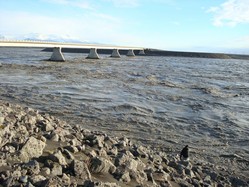
Figure 1. The jökulhlaup from Grímsvötn: image vedur.is
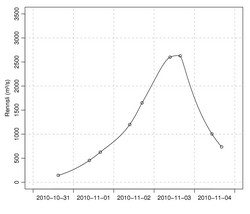
The jökulhlaup (glacial outburst flood) from Grímsvötn that began near the end of October is now coming to an end. The flood reached a maximum level shortly after noon on November 3, and scientists from IMO visited the site on that day to study the effects of the flood on the region adjacent to the ice margin. Two IMO technicians have performed regular discharge measurements on the bridge over the river Gígjukvísl throughout this week (Figure 1) and the results from their measurements are shown in Figure 2.

Figure 2. Discharge (m3/s) measurements at Gígjukvísl bridge: From the curve the total amount of floodwater is estimated 0.45 km3
The discharge curve is typical for jökulhlaups from Grímsvötn that do not result from volcanic activity: Over the course of several days, the amount of water flowing through an ice tunnel at the glacier bed steadily increases. Loss of frictional heat from the floodwater causes melting of the tunnel walls, thereby increasing the flow capacity of the tunnel.
In past centuries, most jökulhlaups from Grímsvötn have entered the course of the river Skeiðará. This time, however, floodwater that emerged from beneath the eastern part of the glacier went westwards along the glacier margin and then entered the river Gígjukvísl. Skeiðará has deposited very large amounts of sediment on the eastern part of Skeiðarársandur plains over the centuries, increasing the elevation of the sandur area there relative to the central part. In addition, the glacier has carved a trench during times of advance. Thus, it was clear that retreat of the glacier over the past 15 years would sooner or later lead to a drastic shift in the direction of meltwater flow from this part of the glacier. In the summer of 2009, this shift occurred and water has ceased to enter the course of Skeiðará.
Tags: Flood, Glacier, Grímsvötn, Iceland, Volcano
Posted in Environment, Iceland, Natural Disasters | Comments Off on Iceland volcano watch stands down



 The k2p blog