The EU cannot expel the UK and any UK government will need parliament’s approval to invoke Article 50
June 26, 2016The key question for the timing of a UK exit becomes “Can any UK government invoke Article 50 merely on the strength of an advisory referendum and without the express approval of parliament?” I think not. It may be that merely changing Prime Minister will not create a majority in parliament and then a General Election on the question of Brexit will be needed. Without a government willing to apply for withdrawal, Brexit does not begin.
The core founding members of the EU met yesterday and have issued demands that the UK leave the EU quickly. But the EU bureaucrats and the core founding countries seem terrified of a slow measured process of withdrawal. It is not difficult to see that they are expecting a domino effect and further countries holding referenda about EU membership. No matter what they do referenda in the Netherlands and France are just a matter of time.
But their strident calls yesterday for a quick withdrawal seem to be a knee-jerk reaction. David Cameron and his government cannot now invoke Article 50 (he could theoretically do that but after his resignation speech he would then have to emigrate). Suppose the UK, by October, gets a pro-Brexit Prime Minister. He would have a new cabinet and it is inconceivable that he could invoke Article 50 without first getting that action approved by the UK parliament. That approval will not be so easy. Assume that such approval is forthcoming. The timing of an invocation of Article 50 would then be at the discretion of that new government and that would surely not happen until all member countries had been sounded at the political level (rather than the elite bureaucrats of the EU), as to the conditions of the withdrawal.
The EU bureaucrats can talk as tough as they like, but they know very well that there are no provisions in the EU treaties to expel a member.
Extract from : Withdrawal and expulsion from the EU and EMU. Legal Working Paper Series No 10 / December 2009.
Unlike the Charter of the United Nations (UN), Article 6 of which expressly provides for the possibility of a UN Member being expelled for persistently infringing the principles of the Charter, there is no treaty provision at present for a Member State to be expelled from the EU or EMU. The closest that Community law comes to recognising a right of expulsion is Article 7(2) and (3) TEU, allowing the Council to temporarily suspend some of a Member State’s rights (including its voting rights in the Council) for a ‘serious and persistent breach by a Member State of the principles mentioned in Article 6(1)’ of the EU Treaty. This might be thought of as a preliminary step to the expulsion of a Member State, but it is not the same as its definitive expulsion.
In fact the EU cannot expel a member without effectively negating all its treaties:
A Member State’s expulsion from the EU or EMU would inevitably result in an amendment of the treaties, for which the unanimous consent of all Member States is necessary under Article 48 TEU. Given that a Member State’s expulsion would, by definition, be contrary to the presumed wish of that Member State to continue its membership of the EU, a right of expulsion would be inconceivable, since it would have to entail an unauthorised Treaty amendment, in breach of Article 48 TEU. Besides, it is likely that some Member States would object to the introduction of a right of expulsion in the treaties, coupled with an amendment of Article 48 TEU to make that possible, since this would expose them to the risk of being forced out at some future date.
In practice I begin to think that a General Election will be needed before Article 50 can be invoked and where the incoming government will need to have been elected to implement a Brexit.
An independent Scotland could probably not join the EU until 2030
June 25, 2016Scotland’s desire to remain a part of the EU is not so easily satisfied even if a new independence referendum is carried out rapidly. Three different timetables (which can partly be in parallel) have to mesh.
- Exit process for UK from EU
- Independence process for Scotland from the UK
- Application and accession process for an independant Scotland into the EU.
Looking at these 3 timetables, I reckon the earliest an independent Scotland could enter the EU in its own right would be around 2030.
Brexit now sets in motion an exit process for the UK from the EU. The only deadline is that the process will be completed 2 years after the UK invokes Article 50. However it is up to the UK to invoke Article 50. So the start point is flexible and is solely in the control of the UK government of the day. Even if Cameron is replaced by another Prime Minister, it will be up to his new government and the UK parliament to decide when they are comfortable enough to start the ball rolling (because then the 2 year deadline will apply). There is no reason for the UK to give up too early its current time pressure advantage which will pass to the EU once Article 50 has been invoked. I see the earliest that a UK government is prepared for this will be around March 2017. That would give an exit being effective in March 2019.
March 2017 is probably the earliest a new referendum on the independence of Scotland could be held. Using the timetable put forward by the SNP for the 2014 referendum, it would then be March 2019 before Scotland was an independent nation. This may be a little too optimistic both for when the referendum could be held and for the time required for the legal measures necessary. Whether the UK parliament could be handling the bills necessary for exiting the EU simultaneously with passing the bills for Scotland’s exit from the UK is also doubtful. Nevertheless I assume a referendum could be held by March 2017.
To apply for EU membership, Scotland would need to have, and be able to show, a “stable” economy and stable, established institutions. With the best will in the world, this is going to require at least 3 years (and probably more) as an independent nation. Assume anyway that Scotland can submit an application for membership sometime around 2022/2023. The minimum time needed for accession of a new member has been the 3 years for Finland and Sweden. It is more usually of the order of 10 years with countries with weaker economies taking longer. It is not unreasonable to assume that a newly independent Scotland would need 7 years for accession.
Accession times to the European Union (pdf)
And that would take us to 2030 for an independent Scotland’s accession to the EU.
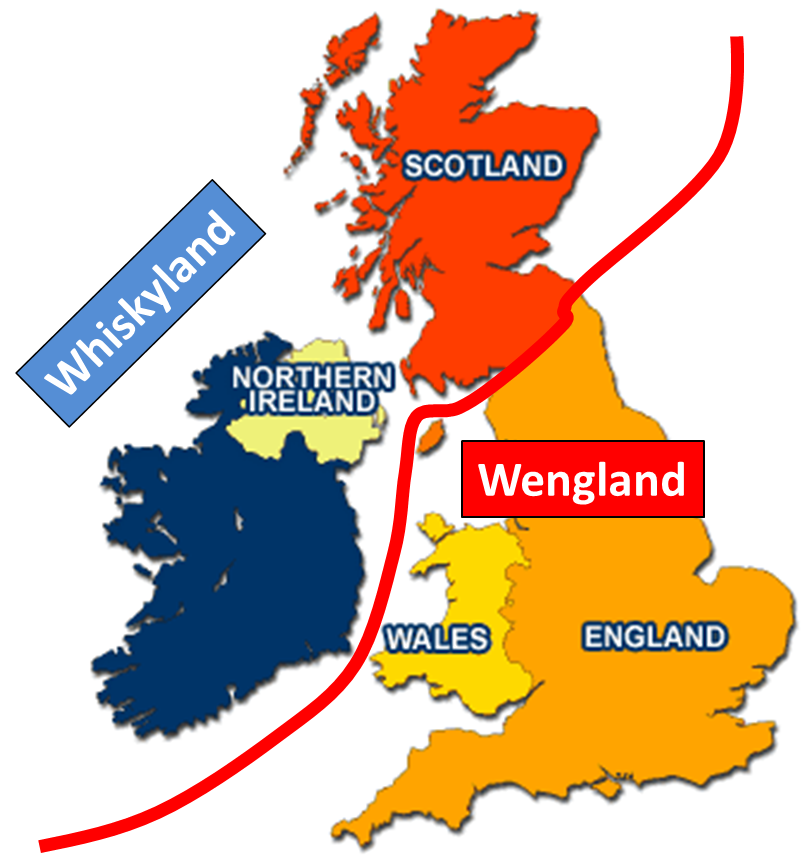
Whiskyland after Brexit
June 25, 2016Whiskyland within the EU and Wengland out.
It could get really painful if whisky is going to cost as much in Wengland as in – say – Sweden!
More Scotch whiskey is consumed in a month than cognac in a year.
Scotch Whisky adds £3.3 billion directly and its total impact is to add nearly £5bn overall to UK GDP. Every £1 of value added in the industry produces another £0.52 of value in the broader economy. The industry is the UK’s largest single food and drink sector. It accounts for 25% of the UK’s food and drink exports.
In value added Scotch Whisky is bigger than the UK’s iron/steel, textiles, shipbuilding, or computer industries; about half the size of the UK’s pharmaceuticals or aerospace industries; and one third the size of the entire UK car industry.
Obama’s support could be toxic
June 25, 2016
EU bureaucrats, but not the elected politicians, are in denial
June 24, 2016Listening to the European bureaucrats reacting to Brexit today, it was very quickly obvious as to why euroscepticism has never been as high and as widespread in Europe as today. Every bureaucrat, who by definition is part of the EU gravy train, was angry and wanted the UK out as soon as possible. Not one, not Jean-Claude Juncker, not Martin Schulz, not Donald Tusk did not but want to punish the UK for the poll result. Juncker would not even address the question of euroscepticism within member countries. What he does not want to see, it seems, does not exist. He does not see that it is the form and manner of the EU itself which fuels the desire of many to leave.

They are the non-elected, spoiled and pampered bureaucrats of Europe who have gotten used to the idea of issuing European Directives, for all EU members to follow and overruling any objections from national parliaments. The elected politicians from Germany and France were a little more circumspect in their statements. The arrogance and self-righteousness on display today was as clear a symptom of the European malaise as could be imagined. They had no conception of the contempt in which they are held by so many in Europe.
I have no doubt that the UK can manage without being a member of the inner circle of the EU. Of course the UK will need to negotiate a good trade agreement with the EU but there is no reason why this should not be possible – in spite of the EU bureaucrats. Angela Merkel indicated today that some form of EU association with the UK would not be unthinkable. The bureaucrats, of course, dislike this because it may give heretical ideas to the eurosceptics in other countries. It is a myth to think that trade with the US or China or Latin America is enhanced greatly by being a member of the EU. I have no doubt, for example and from my own experience, that the UK can do more business in Africa or in India from outside the EU. There are trading opportunities in a Brexit – but it will need some skill to seize them.
But the one thing that struck me today was that for the survival of the EU in some sustainable form, the EU bureaucrats need to be reigned in by their own politicians from the member countries. Here I mean by the politicians in their own governments and parliaments and not the utterly useless MEPs in the even more pointless European Parliament. The EU bureaucracy has become parasitical. The self-serving and blinkered behaviour of the bureaucrats keeps them completely out of touch with how deep euroscepticism actually runs. Their denial of reality is the single factor which is most likely to lead to the break-up of the EU.
And then came Brexit
June 24, 2016First came Grexit, which threatened, but never came to pass,
Then came Brexit which took a goodly bit of brass,
Next, of course, was Nexit as the Dutch showed their class,
Followed closely by Swexit which showed the EU to be an ass.
Le Pen was shrill in calling for a Fraxit,
Even the Lega Nord saw benefit in an Ixit,
Latin solidarity raised the spectre of a Poxit and a Spaxit,
And the Germans desperately resisted any Gexit.
The Danes couldn’t wait to implement a Dexit,
Which stirred the Greeks enough to go through with their Grexit,
Agitated Finns were not too slow to go ahead with Fixit,
And Brussels couldn’t survive the final straw of a Bexit.
Homo inferieur
June 24, 2016Homo sapiens include Homo denisova, Homo neanderthalensis, another unknown race now extinct and Anatomically Modern Humans (Homo sapiens sapiens).
Future evolution will probably show up as a Homo superieur in about 10,000 generations. Along the way we will also see a degeneration of some to be Homo inferieur.
High on my list of of those making up Homo inferieur will be the participants of some of the “reality TV shows” which make me cringe.
This picture is from the Daily Mail.
Humans rutting in a zoo for the viewing entertainment of others.
All it needs is a hushed David Attenborough commenting on the behaviour of these degenerate samples of Homo inferieur.

BREXIT
June 24, 2016
A leave could take around 3 years.
A new dawn? for the EU?
Clear win for BREXIT (but a win for remain in Scotland).
Cameron thought he knew how to use referenda as a tool of government. But he got virtually no concessions from the EU and his strategy has backfired. Now we will see whether David Cameron is a leader or just another follower. I think his position is untenable — except if he can get real concessions and call yet another referendum.
It is time to dismantle the Brussels machine and the first step shoud be to abolish the European parliament.
Zika fears lead to spike in DIY abortions in Latin America
June 23, 2016Abortion is still illegal in most of Catholic Latin America and the governments have responded to the Zika virus by suggesting that women not get pregnant. They seem to have the support of the Pope for that approach. As The Guardian reports, “Pope Francis has indicated that women exposed to the Zika virus may be permitted to use contraception to avoid pregnancy, in a departure from Catholic teaching. However he reiterated the church’s staunch opposition to abortion, saying it was a crime and “absolute evil”.
But the reality is that DIY abortions are spiking and interestingly the countries advising women not to get pregnant are seeing the largest increases in abortion. Effectively The Pope’s dispensation on contraception is being taken, it would seem, as a dispensation also for abortion.
BBC: Fears over the Zika virus have contributed to a “huge” increase in the number of women in Latin America wanting abortions, researchers say. Estimates suggest there has been at least a doubling in requests in Brazil and an increase of a third in other countries. Many governments have advised women not to get pregnant due to the risk of babies being born with tiny brains.
The findings were published in the New England Journal of Medicine.
A termination remains illegal in many parts of Latin America, but women simply turn to unofficial providers. Women on Web, which advises women online and then delivers pills to end a pregnancy, is one of the largest. The researchers analysed the thousands of requests received by Women on Web in the five years before the Pan American Health Organization issued its warning on Zika on 17 November 2015. It used this to predict how many abortion requests would have been expected between 17 November 2015 and 1 March 2016.
The analysis of countries that advised against getting pregnant suggested Brazil and Ecuador had had more than twice the expected demand for abortions.
Country Expected Actual Increase Brazil 582 1210 +108% Colombia 102 141 +39% Costa Rica 49 67 +36% El Salvador 18 24 +36% Ecuador 34 71 +108% Honduras 21 36 +76% Venezuela 45 86 +93% Analysis from other countries, which did not advise against pregnancy, suggested smaller increases in abortion demand.

 The k2p blog