Posts Tagged ‘Antarctic’

Ironies multiply as rescue ice-breaker is also stuck in Antarctic ice

December 28, 2013

I posted earlier about the irony of the Guardian having to report this story about the lack of the expected melting of ice during the Antarctic summer.

The ironies multiply.

The objective of the tourists, the journalists and the ostensibly “scientific” team was to recreate the journey of Douglas Mawson 100 years ago. They got stuck in 3m thick ice and three ice-breakers have gone to their rescue. The first, a Chinese ice-breaker is now also stuck in the ice. The “scientific” team is led by – wait for it – Chris Turney, a “professor of climate change” at the University of New South Wales in Australia!!

Some immediate questions arise:

  1. Who pays for the rescue ships? (I do hope the Guardian and the BBC and the University of NSW pay their fair share).
  2. If the journey of 100 years ago cannot be retraced because there is more ice now – what does that say about global warming theory and melting polar ice?
  3. What does a professor of climate change do – apart from profess his faith in climate change?
  4. When does “climate change” change from being global warming to global cooling?

CNN reports:

Only at the South Pole: Icebreaker also stuck — in ice — heading for stranded ship

South Pole weather has stymied a rescue by a Chinese icebreaker trying to reach an expedition vessel trapped for the past four days in frozen seas, a ship officer told CNN Friday.

The Chinese icebreaker Xue Long, or Snow Dragon, was just six nautical miles away from the rescue, but now it’s stuck in an Antarctica ice floe, too.

The Chinese crew is hoping a French icebreaker 14 nautical miles away will arrive and offer relief, said Zhu Li, chief officer of the Chinese ship.

But it’s likely the French vessel Astrolabe will also be slowed by the polar cap’s extreme frigidity, Zhu said.

Those two icebreakers — plus a third, from Australia — were battling the planet’s coldest environment in trying to reach the stranded Russian ship MV Akademik Shokalskiy, whose 74 researchers, crew and tourists remained in good condition despite being at a frozen standstill since Monday. …..

Antarctic sea ice is currently at record levels and global sea ice extent is greater than it has been for two decades. It should be noted that few proponents of climate change yet have the courage to state what is really happening but which is politically incorrect. That global warming has stopped and global cooling has begun and that carbon dioxide emissions are largely irrelevant to climate.
Global Warming gone missing: Arctic ice back to “normal” and Antarctic ice at highest ever recorded levels

October 20, 2013

IF THE GLOBE IS WARMING, WHERE’S THE HEAT?

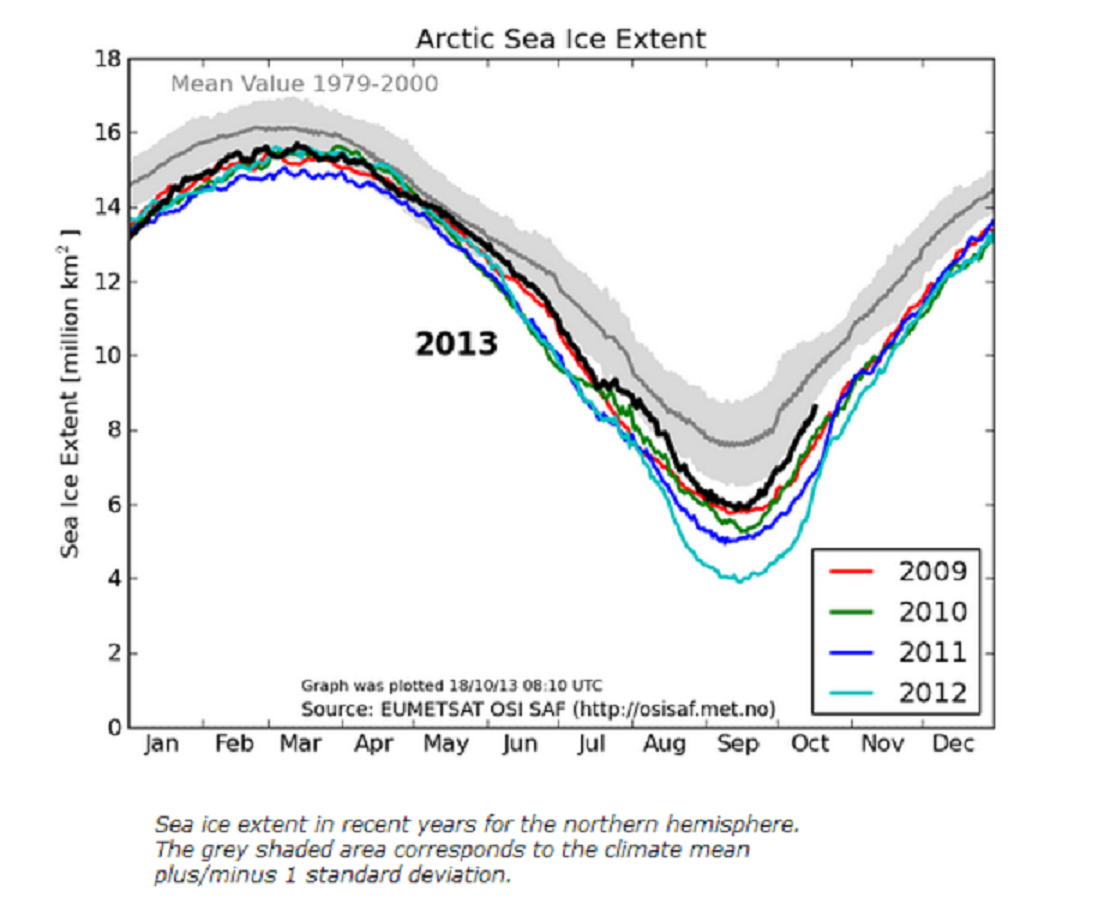
Arctic Ice levels are increasing fast and are within 1 standard deviation of the 1979-2000 mean.

Arctic Ice Extent 20131018 DMI Centre for Ocean and Ice

Arctic Ice Extent 20131018 DMI Centre for Ocean and Ice

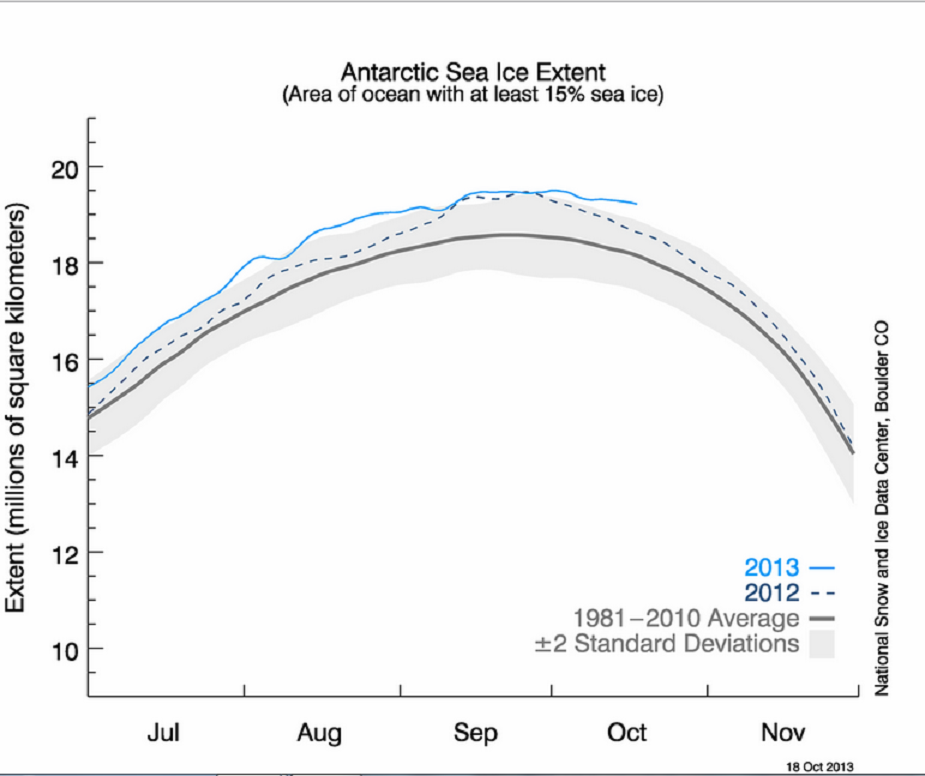
In the Anatrctic ice extent should normally have started reducing by 22nd Sepptember but kept increasing till about 1st October. At maximum it reached levels never recorded before. It is currently at a level more than 2 standard deviations higher than the long term 1981 – 2010 average.

Antarctic Ice Extent 20131018 NSIDC Boulder

Antarctic Ice Extent 20131018 NSIDC Boulder

This leads to obvious but simple conclusions:

  1. Over the last 34 years therefore, Arctic ice extent has shown great variability but is currently at values within one standard deviation of the 30 year average.
  2. Global warming – if it is taking place – has not left any significant signature in the extent of Arctic Ice which is larger than “natural variability”.
  3. Over the last 32 years Antarctic ice extent has consistently shown a small but steady increase.
  4. Global warming – if it is taking place – is completely absent in the record of the ice extent.

It could be argued – but it would stretch credulity – that heat is being stored in the deep ocean (having bypassed the surface waters by a hitherto unknown form of “deep sea radiation”)  and that this will all be released in a coming catastrophic event (to be known as the Ehrlich Rapture) in 2047.

Or, it could be argued – again with little credibility – that man-made particulate emissions from China in the Northern Hemisphere and from Indonesian forest fires in the Southern Hemisphere have reflected away the Sun’s radiation and prevented the warming that should have taken place. This argument then fails since it would appear to describe a very successful  application – if inadvertent – of geo-engineering.

Or we could choose the parsimonious explanation. There has been no global warming for the last 2 decades or so.

Any discussion about whether or how much warming is caused by carbon dioxide emissions becomes moot if there is no warming.

WHERE’S THE HEAT?

2013 was a “good” year for the cryosphere – but could it be the beginning of the end of this interglacial?

October 8, 2013

According to the NSIDC – which is an important part of orthodox officialdom – 2013 was a better year for the cryosphere since:

“This summer, Arctic sea ice loss was held in check by relatively cool and stormy conditions. As a result, 2013 saw substantially more ice at summer’s end, compared to last year’s record low extent. The Greenland Ice Sheet also showed less extensive surface melt than in 2012. Meanwhile, in the Antarctic, sea ice reached the highest extent recorded in the satellite record”.

What makes for “good” or “bad” depends upon what the fears are. If global warming is the fear then – as the NSIDC states – it was a good year. But if a cooling cycle or even a coming ice age is the fear then the increasing ice extent, the short summer, the extended winter last year and the increased snow cover in the Northern Hemisphere are all just early warning signs of what is to come.

We don’t know if we are in:

  1. a run-away global warming period (as the global warming orthodoxy will have us believe), or
  2. a series of global warming and cooling cycles, each about 20 – 30 years long and responding to the decadal ocean cycles, or
  3. the beginning of the end of this interglacial (which is overdue).

The global warming pause of the last 17 – 18 years suggests that “run-away” global warming is unlikely. The slight decrease in global temperatures over the last 7 – 8 years is not conclusive but is also evidence that the effect of increasing carbon dioxide on global temperature is far from certain. Even if it exists it is very small  and is clearly not yet properly understood. Catastrophe scenarios may attract funding but reduce the credibility of the doom-sayers.

If we are just in a regular cooling cycle then the increasing ice level is nothing to be afraid of. Even if 2 or 3 decades of cooling give us another Little Ice Age, it will be followed by a warming cycle. It will not necessarily mean the start of the end of the current interglacial. But it will mean 20 – 30 years of cooling and the increased use of fossil fuels will be required. Fracking and methane hydrate recovery from the deep sea will be needed along with the continued – and increased – mining of coal. Wind and solar energy can play their little part in the niches that they are suitable for. Nuclear energy will have to make a come-back.

But if the Earth is now responding – by mechanisms unknown – to the Milankovitch cycles – and has started its many thousands year journey into glacial conditions, then we would be well served by developing the strategies and technologies for prospering in such times. We will gradually lose habitat in the North to growing ice sheets but we will gain new habitat as the sea level sinks. But these changes will take place over many generations (50 – 100) and we will have time to adapt. One lost generation – as the last 20 years of global warming hysteria will be – will be of little consequence. Humans have lived and prospered through glacial conditions before and will again. One big difference will be the availability of affordable and abundant energy which gives us the ability – not to stop the advance of the ice sheets – but to be able to continue to access resources and minerals under the ice sheets. We may even have colonies living on top of the shallower ice sheets. But there will also be new opportunities. The increase of habitat as the sea levels drop (by upto 150m) will be in exceptionally fertile areas for food production. Mineral and energy resources currently under the sea will become even more accessible. As with the last glacial period it will probably be a period in which human ingenuity is challenged and innovation will flourish.

The coming of a new glacial period will be no catastrophic change. We will have plenty of time to adapt. And in the 1,000 or 2,000 years it will take to establish glacial conditions, humans will probably have found new frontiers and established new colonies in space. And in 50 or 100 generation humans will continue to evolve. The humans coming out of the next glacial will not be quite like us.

Arctic ice past minimum and growing fast and Antarctic ice reaching maximum at record level

October 5, 2013

Arctic ice extent reached its minimum about 2 weeks ago and is now growing fast.

Arctic Ice extent 20131005

Arctic Ice extent 20131005 source: COI

At the Antarctic however, the sea ice extent is just about reaching its maximum level which is at a record level.

Antarctic sea ice extent 20131004

Antarctic sea ice extent 20131004 source: cryosphere


Arctic sea ice reaches minimum for 2013 – about a week early

September 6, 2013

A late spring and a short summer has led to Arctic ice melting much slower than for many years: IS ARCTIC SEA ICE REBOUNDING? 

It would seem that the minimum ice extent in the Arctic which usually happens around the middle of September has already been reached – about a week early.

From DMI – Centre for Ocean and Ice (coastal zones masked)

Arctic Sea Ice Extent 2013 minimum

Arctic Sea Ice Extent 2013 minimum

A real rebound in the ice extent and almost back to the level of 2005.

And of course the Antarctic which is reaching its maximum ice extent seems to be at a level significantly higher than the average for 1981 -2010. (NSIDC, Boulder).

Antarctic sea ice extent 20130904

Antarctic sea ice extent 20130904

These levels of ice extent correspond to the lack of significant increase in sea levels.

There does not seem to be very much to be alarmed about.


Increasing Antarctic sea ice correlates with global cooling

August 18, 2013

A new paper shows that for the last 30 years Antarctic ice is increasing and correlates best with a cooling global temperature.

Qi Shu, Fangli Qiao, Zhenya Song and Chunzai Wang, Sea ice trends in the Antarctic and their relationship to surface air temperature during 1979–2009, Clim Dyn (2012) 38:2355–2363, DOI 10.1007/s00382-011-1143-9

Abstract: Surface air temperature (SAT) from four reanalysis/analysis datasets are analyzed and compared with the observed SAT from 11 stations in the Antarctic. It is found that the SAT variation from Goddard Institute for Space Studies (GISS) is the best to represent the observed SAT. Then we use the sea ice concentration (SIC) data from satellite measurements, the SAT data from the GISS dataset and station observations to examine the trends and variations of sea ice and SAT in the Antarctic during 1979–2009. The Antarctic sea ice extent (SIE) shows an increased trend during 1979–2009, with a trend rate of 1.36 ± 0.43% per decade. Ensemble empirical mode decomposition analysis shows that the rate of the increased trend has been accelerating in the past decade. Antarctic SIE trend depends on the season, with the maximum increase occurring in autumn. If the relationship between SIC and GISS SAT trends is examined regionally, Antarctic SIC trends agree well with the local SAT trends in the most Antarctic regions. That is, Antarctic SIC and SAT show an inverse relationship: a cooling (warming) SAT trend is associated with an upward (downward) SIC trend.

The variations of local  SIC and SAT anomalies in autumn during the past 30 years

The variations of local
SIC and SAT anomalies in
autumn during the past 30 years

Summary: ….

The SAT and SIC trends illustrate an inverse relationship in most of the Antarctic regions, especially in summer and autumn. This indicates that a cooling (warming) SAT trend is associated with an upward (downward) SIC trend in the Antarctic. The station observations also confirm the inverse relationship between SAT and SIC. In most of the Antarctic regions, a cooling trend of SAT in summer and autumn is associated with an increased trend of SIC. …

Our analyses show that the relationship between sea ice and SAT trends should be examined regionally rather than integrally.

Antarctic sea ice extent almost 3 SD’s higher than “average”

November 25, 2010

Source:

http://nsidc.org/data/seaice_index/images/daily_images/S_stddev_timeseries.png

The Southern Hemisphere is coming into summer but seems significantly cooler (and wetter in Australia) than usual.

The ice extent in the Antarctic is reducing much slower than normally and currently the sea ice extent is about 1.3 million sq. km or 9%  or 3 Standard Deviations higher than the 1979 – 2000 average.

The Pacific Oscillation – or La Nina – is probably responsible.

Increased snowfall in the Antarctic over the past 30 years: Must be global warming

October 26, 2010

When Good Measurements become Bad Science

Analysis of ice cores, drilled at Law Dome just inland from Australia’s Casey Station in the Antarctic shows increased snowfall in the Antarctic over the past 30 years.

http://news.curtin.edu.au/news/wa-drought-linked-to-greater-snowfall-in-the-antarctic/

Dr Tas van Ommen, Principal Research Scientist with the Australian Antarctic Division in Hobart will be presenting his research results from the analysis of ice cores during a seminar ‘Antarctic Ice Cores and Australian Climate’ at Curtin University on Monday 25 October.

But inevitably global warming is then invoked on the basis of speculation and correlations.

Analysis of ice cores drilled at Law Dome, a site just inland from the Antarctic Casey station, has revealed that snowfall variability may be linked to climate in the Australian sector of the Southern Ocean and southwest Western Australia.

Dr van Ommen said the ice cores provide a record of annual variations in snowfall and provide a record that stretches back over 750 years.

“Over the past 30 years, the cores indicate that there has been a significant increase in snowfall in that area,” he said.

“This inversely correlates to the occurrence of a significantly lower rainfall and subsequent drought that has been experienced in the southwest of Western Australia. “So when there’s extra moisture at Law Dome, the same circulation pattern is starving Western Australia of moisture.”

Further work is underway to explore these connections and understand the reasons behind them. However, these events of greater snowfall in the Antarctic and drought in WA also coincide with human induced changes in the atmosphere that may be contributing to global warming.

“The snowfall increase we see in the last 30 years lies well outside the natural range recorded over the past 750 years,” Dr van Ommen said.

The item only becomes newsworthy because of this “coincidence” and the speculation that this increased snowfall may be linked to the drought with reduced precipitation in Western Australia which may be linked to “global warming” !!

Coincidences and inverse correlations do not a science make!

But the tag “global warming”  brings in the funding.

Summer delayed in the Southern Hemisphere?

October 15, 2010

The Northern Hemisphre is anticipating a long cold winter which might even be a little early, but summer is a little late in the Southern Hemisphere.

Usually Antacrtic ice starts decreasing around 15th September but this year it seems to be still quite high and delayed by about a month.

http://nsidc.org/data/seaice_index/images/daily_images/S_stddev_timeseries.png

Meanwhile in Australia,

WARM weather may have teased the state into believing summer was on its way, but the wild weather predicted for the weekend could be winter’s last hurrah.

Meteorologists are warning of a wet and windy weekend with widespread rain, potential flash-flooding, and wind gusts of up to 110km/h. Snow is likely to fall on the alps and southern ranges, and even Orange could get a light dusting. The shift is being caused by a broad trough moving over NSW, which is expected to deepen into a low pressure system today, causing heavy rain and strong winds across central NSW.

Antarctic sea ice growing fast

August 10, 2010

The sea ice extent in the Antarctic continues to be well above the 2009 level and more than 2 SD’s higher than the 1979-2000 average. Sea ice extent peaks at the end of September and, if anything, the growth is accelerating rather than slowing down when we are now in the middle of August.

http://nsidc.org/data/seaice_index/images/daily_images/S_stddev_timeseries.png

In the Northern Hemisphere, temperatures above the 80th parallel have dipped below freezing and are also clearly lower than the 1958 -2002 average.

http://ocean.dmi.dk/arctic/meant80n.uk.php

Looks like we are in for another long and cold winter.