Posts Tagged ‘Arctic’

Greenland votes today on whether to let the Chinese in

March 12, 2013

Greenland flag

UPDATE!

Greenland’s main opposition leader, who campaigned on a platform of greater control and higher taxes of foreign miners, gained the biggest number of votes in a national parliamentary election, underscoring a backlash against the island’s fast globalisation.

Aleqa Hammond’s Siumut party won around 42 percent of votes, or around 14 seats in the 31-seat parliament, meaning she will need to form a coalition. Prime Minister Kuupik Kleist won around 34 percent of votes, according to official results published by Greenland’s national KNR broadcaster.

=====================================================

Not that it is very relevant to the “general” election being held in Greenland today, but I had not really appreciated that Greenland (and half of Iceland and a large chunk of Siberia and part of Japan) are part of the North American Continental plate.  Greenland has been inhabited – off and on – for some 5000 years (from c. 2500 – 3000 BCE) and initially by the ancestors of the Arctic peoples (paleo-Eskimos). The Scandinavian link goes back to around 1200 years ago (900 CE).

 Norsemen settled on the uninhabited southern part of Greenland beginning in the 10th century. Inuit peoples arrived in the 13th century. The Norse colonies disappeared in the late 15th century. In the early 18th century, Scandinavia and Greenland came back into contact with each other, and Denmark established sovereignty over the island. Having been ruled by Denmark-Norway for centuries, Greenland became a Danish colony in 1814, and a part of the Danish Realm in 1953 under the Constitution of Denmark. In 1979, Denmark granted home rule to Greenland, and in 2008, Greenlanders voted to transfer more power from the Danish royal government to the local Greenlandic government. Under the new structure, in effect since June 21, 2009, the Danish government retains control of foreign affairs, national defence, the police force, and the justice system. …

Following World War II, the United States developed a geopolitical interest in Greenland, and in 1946 the United States offered to buy Greenland from Denmark for $100,000,000, but Denmark refused to sell.

Kuupik Kleist, prime minister of Greenland Рус...

Kuupik Kleist, prime minister of Greenland (wikipedia)

The Inuit Ataqatigiit Party which is currently in power in the “Home Rule” Government is a curious mixture of being both left-leaning and somewhat nationalistic. Their target is for an economic and politically independent Greenland and want to reduce the financial support from the Danish government by increasing the rate at which Greenland’s mineral resources are exploited. But to do that they will need labour and it seems that this could come from China. If they win the election today it could open the door for 2,000 – 3,000 Chinese engineers and miners. The opposition Siumut Party seems to have very similar goals but they don’t agree with bringing the Chinese in.

Aleqa Hammond Siumut leader

The BBC reports:

Voters go to the polls in Greenland on Tuesday, in an election dominated by the question of how the territory should exploit its mineral riches. Nearly 70% of 57,000 inhabitants are eligible to vote in Greenland, a Danish territory with partial autonomy.

Many are keen to reduce reliance on Denmark’s annual subsidy of $576m (£387m).

Iron, uranium and rare earths lie underground, but opinions differ over how to extract them. The latest poll predicts a tight race between the governing left-leaning Inuit Ataqatigiit party (IA) and the opposition Siumut party, reports the BBC’s Malcolm Brabant from the Danish capital, Copenhagen.

They will be fighting for 31 seats in a home rule government. There is only one polling station in the capital, Nuuk – a town of 15,000 with only two traffic lights.

The IA – headed by Prime Minister Kuupik Kleist – is in favour of importing cheap, foreign, mainly Chinese labour to mine iron ore. Siumut – led by Aleqa Hammond – is opposed to the plan, which could see Greenland’s population increase by 5%.

The election will be monitored in China, which wants Greenland’s iron for its expanding economy, and in turn by European Union officials who have expressed concern about China’s influence in the territory. ..
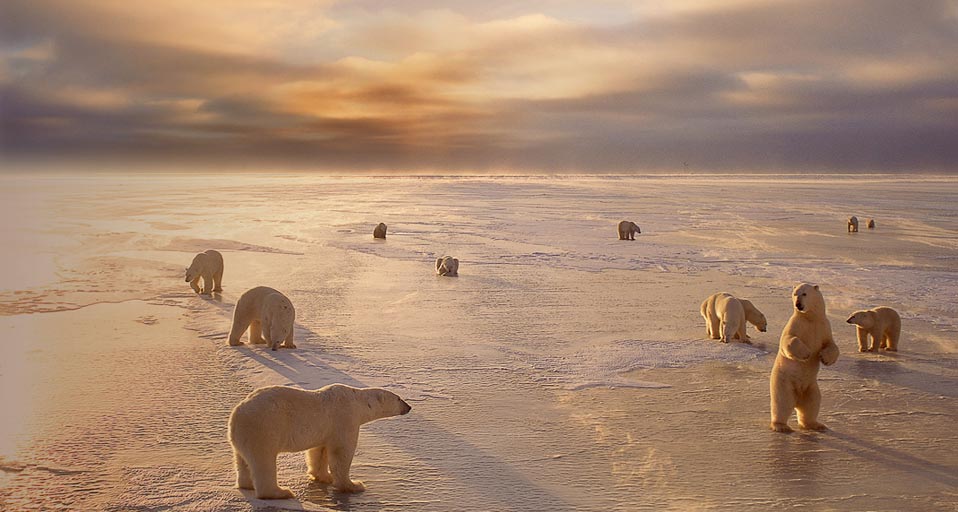
Polar bears heading out onto rapidly forming Arctic sea ice

November 17, 2012

In spite of all the headlines about the dearth of Arctic ice it seems that polar bears are not too worried. They are heading out onto the rapidly growing ice in a “mass exodus” to hunt for their seals about a week ahead of  schedule. 

Polar Bear Science reports that:

It appears from the ice maps that most of the polar bears throughout the world that have chosen to remain on land during the late summer and fall (about July/August through October/November) can now return to the ice. …

… polar bear watchers in and around Churchill Manitoba (in Western Hudson Bay) are reporting an exodus of polar bears to the sea ice that is rapidly forming offshore. While it appears from the ice map …. that only a narrow strip of sea ice has formed close to shore, this is apparently quite enough for the bears to move off the land and out to sea. Once on the ice, polar bears will start hunting for seals.

The same phenomenon is likely true all over the Arctic – ice forming near shore may not be showing up on the satellite images (e.g. western Russia, Svalbard) but it will be enough to get polar bears off land and back out to sea where they can hunt. ….

…. Kelsey says that the “bay froze about a week earlier than last year” [earlier is good] and reports that polar bears are eagerly moving offshore onto the newly-formed ice.  Sounds like the folks there to promote “Polar Bear Week” won’t find many bears to point cameras at.

Polar Bear Alley also reports:

This whole season has been about a week ahead of last year so it is not a real surprise that the bay froze about a week earlier than last year. Yesterday, we watched the mass exodus of polar bears out onto the sea ice. Most of the day consisted of yellow bear butts wobbling and weaving out towards the floe edge.

Over the past week, there have been daily highs around minus 10-15C and some fairly consistent north winds. This combination is all we need for the ice to freeze along Cape Churchill. From wind and greasy waves last Thursday to a thin band of ice along the shore by Saturday, you could see the end was near.

Most years though a late season south wind ‘saves’ bear season but this wind arrived about a day or two late this year, the ice is now locked in from what I can see. By Monday, ice floes clung to the shore and the smaller bays near Churchill were almost locked in. A north wind that night and the next day then sealed the deal.

Yesterday, there was a constant stream of polar bears crossing Cape Merry, the point between town and the Churchill River. Polar Bear Alert officers hazed some of them to speed their departure but really, once the ice is here, there is not much incentive to stay around. By 3pm, you could see twelve bears out on the ice between Eskimo Point to the west and Miss Piggy beach. ……

Polar bear numbers in Canada “likely the highest there has ever been”

April 6, 2012

Polar bears near Churchill, Manitoba: Ward Kennan photolibrary

DNA studies have shown that polar bears and brown bears have a common ancestry. The genetic split occurred about 150,000 years ago in the late Pleistocene just before the end of the Pleistocene glaciation known as the Ice Age. They evolved to meet the conditions of the Ice Age and they continue to adapt. In their present form as polar bears they have survived previous interglacials with temperatures greater than we have at present. And far from being endangered and under threat of extinction they continue to adapt their behaviour and to prosper.

New surveys have shown that 

(more…)

Self-correcting feedback mechanisms? When warming leads to cooling

February 28, 2012

An interesting paper from Curry et al. providing further evidence of a relationship between melting ice in the Arctic regions and widespread cold outbreaks in the Northern Hemisphere. Forcing mechanisms are all the rage where feedback loops lead to runaway effects. In general – in my experience with things technical – natural feedback loops are most often self-correcting. Sometimes they may appear in the short-term to amplify effects but in the long-term they drive back to an equilibrium condition. If feedback mechanisms are not known or if the true cycle-time of the feedback is unknown then short-term effects can be misleading.

Jiping Liu, Judith A. Curry, Huijun Wang, Mirong Song, and Radley M. Horton. Impact of declining Arctic sea ice on winter snowfallProceedings of the National Academy of Sciences, February 27, 2012 DOI:10.1073/pnas.1114910109

Newswise: 

Since the level of Arctic sea ice set a new record low in 2007, significantly above-normal winter snow cover has been seen in large parts of the northern United States, northwestern and central Europe, and northern and central China. During the winters of 2009-2010 and 2010-2011, the Northern Hemisphere measured its second and third largest snow cover levels on record.

“Our study demonstrates that the decrease in Arctic sea ice area is linked to changes in the winter Northern Hemisphere atmospheric circulation,” said Judith Curry, chair of the School of Earth and Atmospheric Sciences at Georgia Tech. “The circulation changes result in more frequent episodes of atmospheric blocking patterns, which lead to increased cold surges and snow over large parts of the northern continents.”

Arctic Ice: “Rapture” of an ice free Arctic now postponed till 2030

August 9, 2011

The ice free Arctic which was to have happened in 2008 according to Mark Serreze of the doomsday crowd has now been postponed till 2030 while scientists find that current concerns over a tipping point in the disappearance of Arctic sea ice may be misplaced.

From WUWT’s Quote of the week:

WUWT

We all cringed, then laughed when Dr. Mark Serreze of NSIDC first said it, then marveled about it as it got a life of its own, being the buzzphrase for every alarmist who wanted to shriek about declining Arctic sea ice.

In 2007 we heard him say:

“The Arctic is screaming,” said Mark Serreze, senior scientist at the government’s snow and ice data center in Boulder, Colorado.

So far, the “screaming” hasn’t kept anyone awake at night, and we have not returned to the low of 2007 in the last three melt seasons.

In 2008 Serreze made the  bold claim:

The ice is in a “death spiral” and may disappear in the summers within a couple of decades, according to Mark Serreze, an Arctic climate expert at the National Snow and Ice Data Center in Boulder, Colorado.

And in 2008 we had the forecast from NSIDC’s Dr. Mark Serreze of an “ice free north pole”.  As we know, that didn’t even come close to being true. Summer 2008 had more arctic ice than summer 2007, and summer 2007 was not “ice free” by any measure.

With those failed predictions behind him,  in an interview in The Age just a few weeks ago, Serreze pulled a Harold Camping, and changed his prediction date. Now he’s saying the new date for an ice free summer is 2030.

”There will be ups and downs, but we are on track to see an ice-free summer by 2030. It is an overall downward spiral.”

And in the meantime research reveals that ice levels in the Arctic were about half the present levels some 5000 years ago and had no problems in recovering.

Scientists say current concerns over a tipping point in the disappearance of Arctic sea ice may be misplaced. 


Reindeer grazing not global warming is shifting the tree line in Torneträsk

November 29, 2010
Strolling reindeer (Rangifer tarandus) in the ...

Strolling reindeer: iImage via Wikipedia

New research shows that the advance of the tree line upwards in the Swedish mountains was due to reduced reindeer grazing and not due to any global warming.

Swedish Radio P1 reports today: (freely translated)

It is not primarily a warmer climate which causes the tree line to crawl
up in many places in the Swedish mountains. A new study from the Torneträsk area shows that there are several other factors that affect tree spread rather than just higher temperatures. Climate change plays a very minor role. It is mainly grazing reindeer, insect infestation, and several other factors that affect mountain forest coverage, rather than changing temperature conditions.
“That the tree line can go up or down or remain stationary within the same climate period has not been shown before “, says Professor Terry Callaghan, one of the researchers who carried out the study.

The tree line advanced up the mountains most during the cold period at the end of the 1960s and 1970s. It was primarily because it was a time with fewer reindeer. A warmer climate may actually have an indirect effect (to reduce the advance northwards) by adding to the number of  insects and insect infestations that can damage trees.

Many climate models expect that the forest in the tundra and other Arctic areas will expand considerably northwards in the next one hundred years because of higher temperatures. But the new research suggests that these simple assumptions can be grossly inaccurate. One must reckon with how to account for the impact of insects and grazing reindeer and moose. “It now requires that much more detailed information be added into the models”, says Professor Terry Callaghan, director of the Abisko research station.

The article is published in the Journal of Biogeography

Riding piggy-back can save the polar bears from melting ice!!

September 16, 2010

Well now….

Swedish Radio reports that a previously unknown behaviour of polar bears has been observed. A cub can travel on its mother’s back while she swims in search of food. “It could be a way for polar bears to cope better than we thought” said Tom Arnbom of WWF. “I think it’s positive” he says. “It proves that the polar bears can adapt if climate changes in the Arctic”

image: Isbjörnar. Foto: Angela Plumb/WWF.

Polar bear with cub

Update: Story also on the BBC http://news.bbc.co.uk/earth/hi/earth_news/newsid_8284000/8284906.stm

Dr Jon Aars from the Norwegian Polar Institute in Tromso describes what happened in the journal Polar Biology. On the 21 July 2006, Mrs Angela Plumb, a tourist from the UK, was aboard a ship in the mouth of a fjord in the Svalbard archipelago.

“The cub was on the back of the polar bear when it was in the water, then it got out of the water and stayed on its mother’s back a little, then she shook it off,” Mrs Plumb explains.

For large parts of the year, polar bears (Ursus maritimus) live among the sea ice, feeding mainly on seals. The challenge for the bears is to navigate the many areas of open water between the islands of floating ice. Seeing the bear had a radio collar, Mrs Plumb got in touch with Dr Aars to report her sighting and asked if this was a common behaviour.

“I hadn’t seen this behaviour before or heard about it so I asked other researchers and found out it is something that has been observed but not frequently at all,” Dr Aars says.

Dr Aars was especially interested if this behaviour might have some adaptive value for the bears. “This could be potentially important because it means that the cubs get exposed to less water. If they are in the water they would have to swim and very small cubs are very badly insulated in water,” he says.

Antarctic sea ice growing fast

August 10, 2010

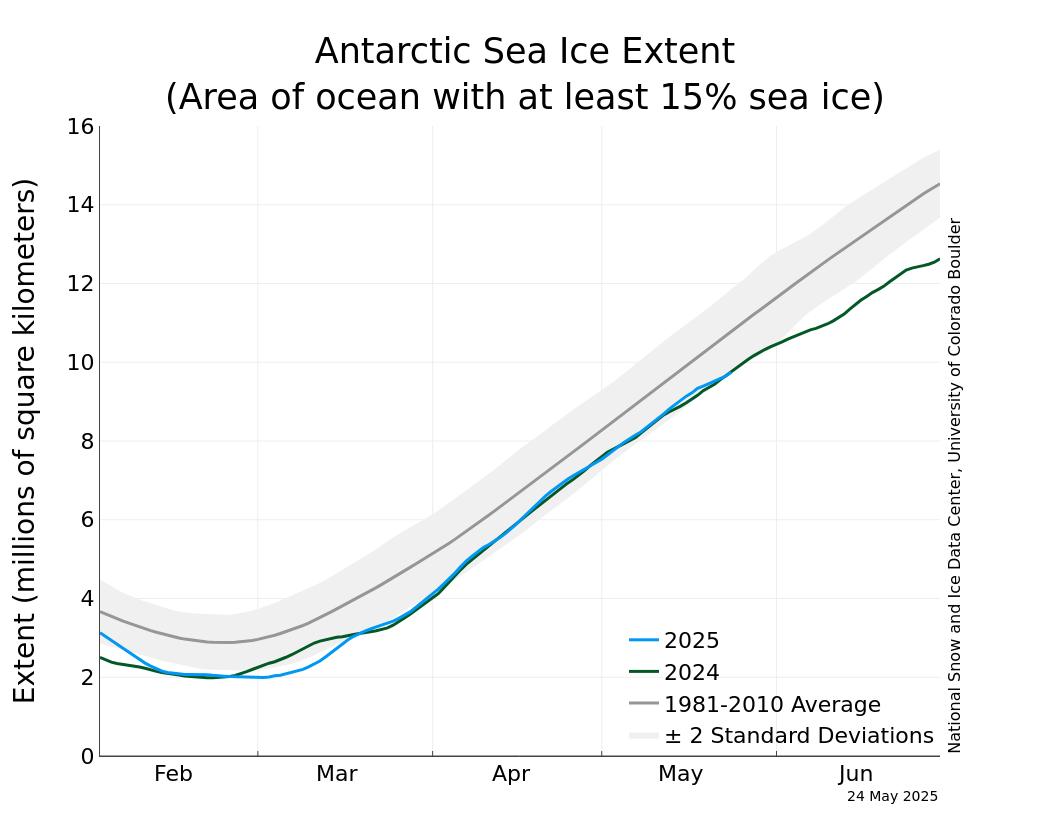
The sea ice extent in the Antarctic continues to be well above the 2009 level and more than 2 SD’s higher than the 1979-2000 average. Sea ice extent peaks at the end of September and, if anything, the growth is accelerating rather than slowing down when we are now in the middle of August.

http://nsidc.org/data/seaice_index/images/daily_images/S_stddev_timeseries.png

In the Northern Hemisphere, temperatures above the 80th parallel have dipped below freezing and are also clearly lower than the 1958 -2002 average.

http://ocean.dmi.dk/arctic/meant80n.uk.php

Looks like we are in for another long and cold winter.