Posts Tagged ‘Atlantic Ocean’

Norway: “25–56% of the temperature increase the last 150 years may be attributed to the Sun”

March 8, 2012

The evidence for the obvious mounts. The sun comes first and dominates and then come the oceans which provide the vehicle for distributing solar effects around the globe. The mythical effect of anthropogenic carbon dioxide on climate has yet to be supported by any direct evidence. Instead, the direct evidence observations of the last 12 years is that increasing carbon dioxide concentration in the atmosphere has been accompanied by a decline of “global” temperature.

A new paper by Jan-Erik Solheim (Department of Physics and Technology, University of Tromsø), Kjell Stordahl (Telenor Norway, Fornebu), Ole Humlum (Department of Geosciences, University of Oslo; Department of Geology, University Centre in Svalbard).

The long sunspot cycle 23 predicts a significant temperature decrease in cycle 24

Preprint: Accepted for publication in Journal of Atmospheric and Solar-Terrestrial Physics February 9, 2012

Abstract. Relations between the length of a sunspot cycle and the average temperature in the same and the next cycle are calculated for a number of meteorological stations in Norway and in the North Atlantic region. No significant trend is found between the length of a cycle and the average temperature in the same cycle, but a significant negative trend is found between the length of a cycle and the temperature in the next cycle. This provides a tool to predict an average temperature decrease of at least 1.0 “C from solar cycle 23 to 24 for the stations and areas analyzed. We find for the Norwegian local stations investigated that 25-56% of the temperature increase the last 150 years may be attributed to the Sun. For 3 North Atlantic stations we get 63-72% solar contribution. This points to the Atlantic currents as reinforcing a solar signal.
Since last ice age, warming and cooling have been caused by ocean currents

January 16, 2011

A new paper in Science giving ocean currents in the Atlantic their due (and without finding it necessary to appeal to tales of carbon dioxide). Perhaps the science is not so settled after all!

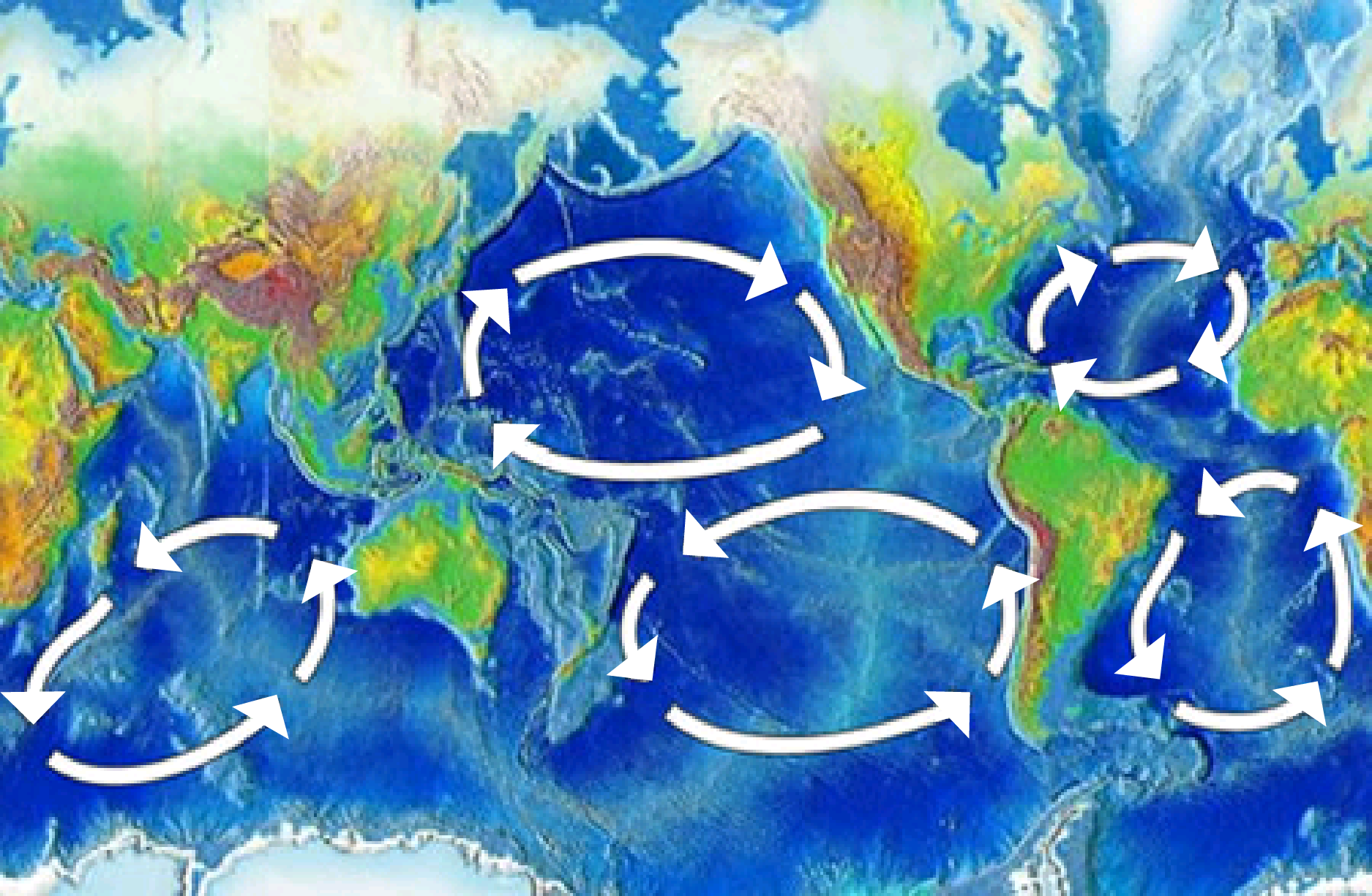
File:Oceanic gyres.png

The five major ocean-wide gyres — the North Atlantic, South Atlantic, North Pacific, South Pacific, and Indian Ocean gyres. Each is flanked by a strong and narrow “western boundary current,” and a weak and broad “eastern boundary current”: Wikimedia

The Deglacial Evolution of North Atlantic Deep Convection. by D. J. R. Thornalley, S. Barker, W. S. Broecker, H. Elderfield, I. N. McCave.  Science, 2011; 331 (6014): 202 DOI: 10.1126/science.1196812

Science Daily reports:

… Scientists have long suspected that far more severe and longer-lasting cold intervals have been caused by changes to the circulation of the warm Atlantic ocean currents themselves.

Now new research led by Cardiff University, with scientists in the UK and US, reveals that these ocean circulation changes may have been more dramatic than previously thought. The findings, published January 14, 2011 in the journal Science, show that as the last Ice Age came to an end (10,000 — 20,000 years ago) the formation of deep water in the North-East Atlantic repeatedly switched on and off. This caused the climate to warm and cool for centuries at a time.

The circulation of the world’s ocean helps to regulate the global climate. One way it does this is through the transport of heat carried by vast ocean currents, which together form the ‘Great ocean conveyor’. Key to this conveyor is the sinking of water in the North-East Atlantic, a process that causes warm tropical waters to flow northwards in order to replace the sinking water. Europe is kept warmer by this circulation, so that a strong reduction in the rate at which deep water forms can cause widespread cooling of up to 10 degrees Celsius. ….. The new results suggest that the Atlantic ocean is capable of radical changes in how it circulates on time scales as short as a few decades.

Dr Thornalley said: “These insights highlight just how dynamic and sensitive ocean circulation can be. Whilst the circulation of the modern ocean is probably much more stable than it was at the end of the last Ice Age, and therefore much less likely to undergo such dramatic changes, it is important that we keep developing our understanding of the climate system and how it responds when given a push.”

Paper Abstract:

Deepwater formation in the North Atlantic by open-ocean convection is an essential component of the overturning circulation of the Atlantic Ocean, which helps regulate global climate. We use water-column radiocarbon reconstructions to examine changes in northeast Atlantic convection since the Last Glacial Maximum. During cold intervals, we infer a reduction in open-ocean convection and an associated incursion of an extremely radiocarbon (14C)–depleted water mass, interpreted to be Antarctic Intermediate Water. Comparing the timing of deep convection changes in the northeast and northwest Atlantic, we suggest that, despite a strong control on Greenland temperature by northeast Atlantic convection, reduced open-ocean convection in both the northwest and northeast Atlantic is necessary to account for contemporaneous perturbations in atmospheric circulation.