Posts Tagged ‘China’

Goldman Sachs cools on China and India

January 18, 2011

The growing inflation in India and China is a clear signal of overheating in their economies and Goldman Sachs (who are credited with inventing the term “BRIC”) are reducing their exposure to the BRIC countries.

The BRIC countries (Brazil, Russia, India, China)

The Telegraph reports:

Goldman Sachs has issued a short-term alert on China and India as inflation rears its ugly head, advising clients to rotate into Wall Street and Old World bourses as a safer bet over coming months.

“We’re not as tactically positive on the BRICs as we have been,” said Tim Moe, the bank’s chief Asia-Pacific strategist, referring to the quartet of Brazil, Russia, India, and China.

“To be frank, we may have held on too long to our overweight position in China last year. We have decided that discretion is the better part of valour and have tactically reduced our weight. Asia is not in the sweet part of the cycle. The longer-term picture of Asia outperforming the US is taking a breather,” he said, speaking at a Goldman conference in London.

The cooling ardour for China is significant shift for the bank that invented the term BRICs and has been the cheerleader of the emerging market story over the past decade.

India is an even bigger worry, with yawning twin deficits, and overheating visible on all fronts. The nation’s central bank warned this week of “surging inflation”.

“India’s current account deficit is running at a record pace of 4.1pc of GDP and it is 100pc funded by short-term portfolio flows, which cannot be relied on indefinitely,” said Mr Moe, describing Mumbai’s bourse as “crowded”.

Read more….

Development of stealth fighter aircraft moves East

January 10, 2011

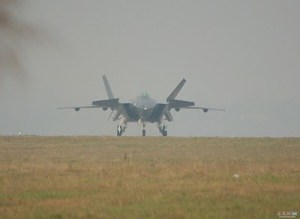
Both China and India are developing 5th Generation stealth fighters; China on its own and India as part of a joint development programme together with Russia.

From http://china-defense.blogspot.com/2010/12/latest-batch-of-j-20-photos.html

Chinese Chengdu J20 - 5th generation stealth fighter: image http://china-defense.blogspot.com

Rumours from China’s Chengdu Aerospace Corporation (CAC) and the adjoining Aircraft Plant No 132 suggest that a flight of a Chinese-developed fifth-generation fighter prototype would take place by the end of the year. Reportedly, two airframes (numbered 2001 and 2002) have been assembled at the 132 plant.

In August 2008 it was reported that 611 Institute was selected to be the main contractor for the development of the fifth-generation stealthy J-20, and that 601 Institute was the sub-contractor. It was rumored that 611 Institute has started to issue manufacturing drawings for constructing the first prototype, which is expected to fly by 2012, even though the full configuration one won’t fly until a few years later. The latest rumor suggested that a full-scale mock-up had been built at CAC.

From http://www.globalsecurity.org/military/world/china/j-xx.htm

File:Pak fa.jpg

Sukhoi PAK FA T50: image wikipedia

Russia and India are jointly developing the Sukhoi PAK FA / T-50 , which first flew in January 2010. In June 2001, India was offered ‘joint development and production’ of this new 5th generation fighter by Russia. Russia had been trying to sell this concept both to China and India for some time. It seems probable that China declined to participate in this project given a belief that Russia stood to gain more from Chinese participation than did China. That is, it would seem that China had determined that it could produce a superior product without Russian help. With the first flight of the Russian stealth fighter in 2010, an arguably superior Chinese steath fighter might be expected to take to the skies not too long thereafter.

Chinese combat aviation has made remarkable strides in recent years, moving from a collection of obsolete aircraft that would have provided a target-rich environment to potential adversaries. Today China flies hundreds of first rate aircraft, and even flies more Sukhoi Flankers [the aircraft the American F-22 was designed to counter] than does Russia. The Chinese stealth fighter has arrived right on schedule. Chinese military technology is generally rated about two decades behind that of the United States. while the advent of a Chinese counterpart to the F-22 fighter might be disconcerting, the first flight of the prototype American F-22 stealth fighter came on September 29, 1990.

From the Hindustan Times:
New Delhi, December 21, 2010: India and Russia on Tuesday finalised a contract for the biggest defence programme in the country’s history — a $30-billion (Rs 1,35,000-crore) project involving the joint production of 200-250 fifth generation fighter aircraft (FGFA). The aircraft, being called the perspective multi-role fighter (PMF), will exploit the basic design of the Russian Sukhoi T-50 PAK-FA prototype, with modifications thrown in to meet the Indian Air Force’s “more stringent specifications”. The 30-tonne aircraft will be a swing-role fighter with stealth features for increased survivability, advanced avionics, smart weapons, top-end mission computers and 360-degree situational awareness. What will put the co-produced fighter in a different league is its ability to supercruise, i.e. sustain supersonic speeds in combat configuration without kicking in fuel-guzzling afterburners. Currently, the US Air Force’s F-22 Raptor is the only fighter in the world that can supercruise.
The contract for the joint design and development of the FGFA was signed between Hindustan Aeronautics Limited and two Russian firms, Sukhoi Design Bureau and Rosoboronexport. The fighter will be jointly marketed to international air forces. The first prototype flew its maiden sortie in January 2010 and has conducted more than 40 flights. The IAF hopes to induct it by 2018.
A joint statement issued by the ministry of external affairs said Prime Minister Manmohan Singh and Russian President Dmitry Medvedev agreed that the December 2009 pact covering bilateral military cooperation during the next decade would lead to a more substantive engagement cutting across joint research and development, manufacturing and marketing activities.
In the meantime DNA reports:
 

HAL Tejas at Aero India 2009

HAL Tejas: Image via Wikipedia

India today joined a select group of nations manufacturing warplanes with the home-grown Light Combat Aircraft ‘Tejas’ moving a step closer to its induction into the Indian Air Force after getting its Initial Operational Clearance (IOC) here. 

27 years after the project was initiated, defence minister AK Antony handed over the IOC certificate to Air Chief Marshal PV Naik at the HAL airport in Bangalore.

“This is only the semi-finals”, Antony said, adding the LCA would enhance national security and build the country’s own fighter aircraft capabilities.

The aircraft, with an investment of over Rs 14,500 crore ($3.2 billion), has been developed by DRDO’s Aeronautical Development Agency after battling technology denial regimes and sanctions for nearly three decades. “After crossing a number of challenges and accomplishing a significant series of milestones including weapon delivery, in over 1500 sorties, the country is poised for a major turning point with the declaration of the IOC,” Antony said.

The IAF has plans to induct a total of around 200 planes of which orders for the initial 40 have already been placed by the IAF.

The aircraft, which costs between Rs 180 to 200  crore ($45 million)  per piece, is presently powered by American GE-F 404 engine and the advanced GE-414 engines have been chosen for powering the LCA Mk II aircraft, which are likely to be developed by 2014.

 

Russian oil pipeline to China in operation

January 2, 2011

Xinhua News:

MOHE, Heilongjiang, Jan. 2 (Xinhua) — Some 42,000 tonnes of crude oil had as of 5:48 a.m. Sunday flowed through an oil pipeline linking Russia’s far east and northeast China, 24 hours after the pipeline began operating, a spokesman for the Chinese operator of the pipeline said.

Pipelines and oil storage tanks of China and Russia crude oil pipeline in Mohe, northeast China's Heilongjiang Province, Jan. 1, 2011: (Xinhua/Wang Jianwei)

The pipeline, which originates in the Russian town of Skovorodino in the far-eastern Amur region, enters China at Mohe and terminates at northeast China’s Daqing City. A total of 1.32 million tonnes of oil is scheduled to be transported to China through the pipeline in January, said a spokesman for Pipeline Branch of Petro China Co., Ltd. (PBPC), the operator of the Chinese section of the pipeline.

The 1,000-km-long pipeline will transport 15 million tonnes of crude oil from Russia to China per year from 2011 until 2030, according to an agreement signed between the two countries. Some 72 kilometers of the pipeline is in Russia while 927 km of it is in China.


Yellow River freezes early

December 29, 2010

China’s Yellow River has frozen up to 677 kilometers in Inner Mongolia so far. The freezing is more typical of mid-to-late January. Preventive work has been organised for possible ice damage.

http://news.xinhuanet.com/english2010/photo/2010-12/29/c_13669452.htm

Dec. 29, 2010 Frozen Yellow River at Sanshenggong Water Project. (Xinhua/Li Yunping)

Recent strong cold air made Yellow River freeze up quickly in Shandong as the flow decreased in lower Yellow River.

December 29th 2010. Floating ice on Yellow River in Jinan, capital of east China's Shandong Province. (Xinhua/Guo Xulei)

Heavy November snowfall in China as well

November 27, 2010

Scandinavia and the UK are not alone in seeing November snowfall and bitterly cold temperatures – the coldest November in 15 years.

China issued a “blue” alert as heavy snowfall battered most of the north east of the country for a second day.

People walk against strong wind in Jilin City, northeast China's Jilin Province, Nov. 27, 2010. Snowfall hit most parts of the province from Friday night. Local meteorologic authority has issued a blue alarm against cold wave Saturday morning. (Xinhua/Zhu Wanchang)

The National Meteorological Center issued the blue alert for snowstorms on a second consecutive day as heavy snowfalls hit southern and eastern Heilongjiang and neighboring Jilin Province in the east on Saturday reports Xinhua. China has a four-color snow warning system: red, orange, yellow and blue. Blue is the least serious level.

But of course this is weather – not climate.


Former head of Chinese Nuclear corporation sentenced to life for corruption

November 19, 2010

Kang Rixin: photo china-defense-mashup.com

In August 2009 China National Nuclear Corporation’s head Kang Rixin (born 1953), was suspended and put under investigation for misusing $260 million that was earmarked for the construction of three nuclear plants and allegedly used for playing the stock market sustaining heavy losses. Kang Rixin was also accused of accepting bribes of several million dollars of corrupt payments from Areva, a leading French nuclear engineering company.

Sun Qin was appointed President to replace the suspended Kang Rixin.

Today Xinhua reports

that a Chinese court sentenced Kang Rixin, a former head of Chinese nuclear giant China National Nuclear Corporation (CNNC), to life imprisonment Friday for corruption and accepting almost one million U.S. dollars in bribes. Kang, CNNC’s former general manager, was also deprived of his political rights for life and had his personal assets confiscated, a statement from the Beijing No.1 intermediary court said.

Kang, 57, was convicted of having abused his power to enable others to profit. He accepted bribes totaling 6.6 million yuan (970,000 U.S. dollars) between 2004 and 2009. The sentence was lighter because Kang cooperated with investigators and returned all his ill-gotten gains.

Kang became a member of the Communist Party of China (CPC) Central Committee in October 2007. He was stripped of his post in and membership of the CPC for “serious violations of the law and discipline breaches” in December 2009.

China enters the cricket arena, beat Malaysia by 55 runs

November 14, 2010
Pictograms of Olympic sports - Cricket. This i...

Cricket debut at Asian Games :Image via Wikipedia

I am looking forward to the first time China plays a Test Match at Lords!

Now China has entered the cricket arena.

After Chinese spectators sat through a short video explaining the basics of the game, cricket made its Asian Games debut on Saturday. The crowd swiftly caught on and cheered every run on a slightly parched pitch as China’s women beat Malaysia on a sunny afternoon. “They were the best. In terms of their fielding they were very well drilled,” said Roger Golding, an English spectator in the crowd. “They didn’t miss a trick.”

China has underscored the state’s vast commitment to sports as a symbol of national pride by hiring top coaches and pumping money into less popular sports — and getting very good at them. “It was very strange at first but we’re slowly getting the hang of it,” said 19-year-old Chinese fan Li Zibo of cricket, hugely popular in Commonwealth nations but little-known in China. “It’s very fresh and we’ve never seen it before,” added Deng Xiaozhu, another young spectator who said he had been given a free ticket for the match.

A rapid-fire North American-style commentator was employed to liven up proceedings for the Chinese fans but stands were half-empty even though organisers had said that tickets for all weekend cricket had sold out.

Times of India:

Cricket was last seen at a major multi-sport event at the 1998 Commonwealth Games in Kuala Lumpur, but was dropped for the next three editions in England, Australia and India. Its Asian Games debut has already been marred by India’s refusal to field men’s or women’s teams due to international and domestic commitments.
India, whose huge cricket-mad television audiences make them an attractive proposition for any organiser, are currently hosting New Zealand for a Test and one-day series.
Asia’s other big three – Pakistan, Sri Lanka and Bangladesh – sent second-string teams for the Twenty20 tournament in Guangzhou, robbing the event of its star appeal.
The International Cricket Council, the sport’s ruling body, has identified China as one of the major new markets along with the United States for the development of the sport.

China downgrades US bonds as trade surplus expands

November 10, 2010

The Telegraph:

One of China’s leading credit rating agencies has downgraded United States of America government debt in response to what it sees as deliberate devaluation of the dollar by quantitative easing and other means.

If China, now the second biggest economy in the world, stops buying US government bonds this could have a very negative effect on the global recovery. The Dagong Global Credit Rating Company analysis is highly critical of American attempts to borrow their way out of debt. It criticises competitive currency devaluation and predicts a “long-term recession”.

Dagong Global Credit says: “In order to rescue the national crisis, the US government resorted to the extreme economic policy of depreciating the U.S. dollar at all costs and this fully exposes the deep-rooted problem in the development and the management model of national economy.

The analysis concludes:  “The potential overall crisis in the  world resulting from the US dollar depreciation will increase the uncertainty of the U.S.  economic recovery. Under the circumstances that none of the economic factors  influencing the U.S. economy has turned better explicitly it is possible that the US will continue to expand the use of its loose monetary policy, damaging the interests the creditors.

“Therefore, given the current situation, the United States may face much unpredictable risks in solvency in the coming one to two years. Accordingly, Dagong assigns negative outlook on both local and foreign currency sovereign credit ratings of the United States.”

Max King, global investment strategist at Investec Asset Management, said: “Dagong is well respected as an independent credit rating agency which takes a more conservative view than better-known American credit rating agencies.

“It is interesting to see what people with money outside the American sphere of influence think.  Until recently, the US had been regarded as beyond reproach but now independent analysts say the position is deteriorating and likely to deteriorate further.

Meanwhile Xinhua reports the trade figures for October:

China’s exports rose 22.9 percent in October from a year earlier to 135.98 billion U.S. dollars, while imports increased 25.3 percent to 108.83 billion U.S. dollars, the General Administration of Customs (GAC) said Wednesday.

China’s trade surplus expanded sharply to 27.15 billion U.S. dollars last month from 16.88 billion U.S. dollars in September, making the October figure the second highest this year after July’s 28.73 billion U.S. dollars.

The higher-than-expected trade surplus would add pressure for the yuan’s appreciation and exacerbate the already grave inflation problem in China, said ANZ Bank economist Liu Ligang.

In the first 10 months, China’s trade surplus totaled 147.77 billion U.S. dollars, down 6.7 percent compared with the same period last year.

Foreign trade with the European Union, China’s largest trade partner, grew 32.9 percent year on year to 388.42 billion U.S. dollars in the first 10 months.

Trade with the United States climbed 29.8 percent to 310.71 billion U.S. dollars during the January-October period. China-Japan trade totaled 239.28 billion U.S. dollars, up 31.3 percent year on year.


Chinese Premier Wen Jiabao unveils Chang’e-2 pictures

November 8, 2010

Xinhua reports the success of the Chang’e-2 mission.

Chinese Premier Wen Jiabao Monday unveiled the first pictures of the moon’s Sinus Iridum, or Bay of Rainbows, marking the success of China’s Chang’e-2 lunar probe mission.

Chinese Premier Wen Jiabao attends an unveiling ceremony for pictures of the moon's Sinus Iridum, or Bay of Rainbows, taken and sent back by the Chang'e-2, China's second lunar probe, in Beijing, capital of China, Nov. 8, 2010. (Xinhua/Huang Jingwen)

The pictures were taken and sent back by the Chang’e-2, China’s second lunar probe, which was launched on October 1.

Chang’e-2 entered into its final 118 min orbit and formally started its mission of mapping the moon and preparing the way for Chang’e-3 on October 9th.

China: Cutting power generation to cut emissions makes things worse

November 7, 2010


The Skyline of the City

Guiyang-skyline: Image via Wikipedia


Xinhua reports on a diesel shortage because electricity consumers are forced to use diesel generators as authorities shut down power generation to reach “emissions targets”. Needless to say the emissions from the diesel generators are a lot worse than the forced power shut-downs they replace!

An unprecedented diesel shortage is sweeping through Chinese cities, as numerous enterprises have to resort to diesel fuel to generate electricity to continue operation during periods of forced power outages. Local governments are rushing to switch off electricity as part of their commitment to the central government on energy conservation and emissions reductions.

However, the blackouts have apparently led to the linking effect of the diesel shortage. Long queues of cars and even “Sold-out” signs at gas stations are increasingly common scenes in many cities. Additionally, the market monitoring of the China Chamber of Commerce for the Petroleum Industry has acknowledged that more than 2,000 privately-owned gas stations in southern China had shut down due to their not having diesel fuel to sell.

During the period of the 11th Five-Year Plan (2006-2010), China sought to reduce energy consumption per GDP unit by 20 percent. In the first four years of the 11th five-year plan, a 15.6 percent reduction (compared to between year 2005 and year 2009) was reached. But energy consumption per unit of GDP increased 0.09 percent in the first half of 2010, year on year. In a hurry to meet their regional targets assigned by the central government, many local governments chose the blackout method for enterprises in the remaining two months. This method quickly spread to many provinces around China.

In Wenzhou city of Zhejiang Province, with China’s most prosperous private economy, power supplies for some enterprises will be cut for two to four days following one day with electricity. “My company’s electricity consumption is about 150,000 kw-hr, but the local government’s allotment is only 60,000 kw-hr.” said the owner of an export-oriented farm products deep-processing company, who only gave his surname, Ye. Just as is being done by many of his peers, Ye had to purchase a diesel generator with 200,000 yuan (about 30,000 U.S. dollars). It will cost him an additional 10,000 yuan (about 1,500 U.S. dollars) to generate electricity, twice the normal cost for electricity.

“The irrational blackout policy by some local governments is contrary to the energy conservation and emissions reduction target as was set by China’s 11th Five-Year Plan,” said Dr.Zhang Jianyu, China Program manager of the U.S. Environmental Defense Fund. Also, more emissions and fuel consumption might be produced by the diesel generators. “The blackout is not a wise choice. What the local governments need to do now is to pay attention to change the mode of economic growth with high efficiency and low energy consumption,” said Zhong Yongsheng, deputy director of the Center for China’s Urban-Rural Development Studies.

Environmentalism gone mad.