Posts Tagged ‘climate change’

Climate models stretch credulity

June 6, 2013

What is perplexing is the blind faith in the climate models and reluctance to revisit the assumptions on which the clearly fallacious models are based.

UPDATE!!

Dr. Spencer has also provided the “un-linearised” data  and writes:

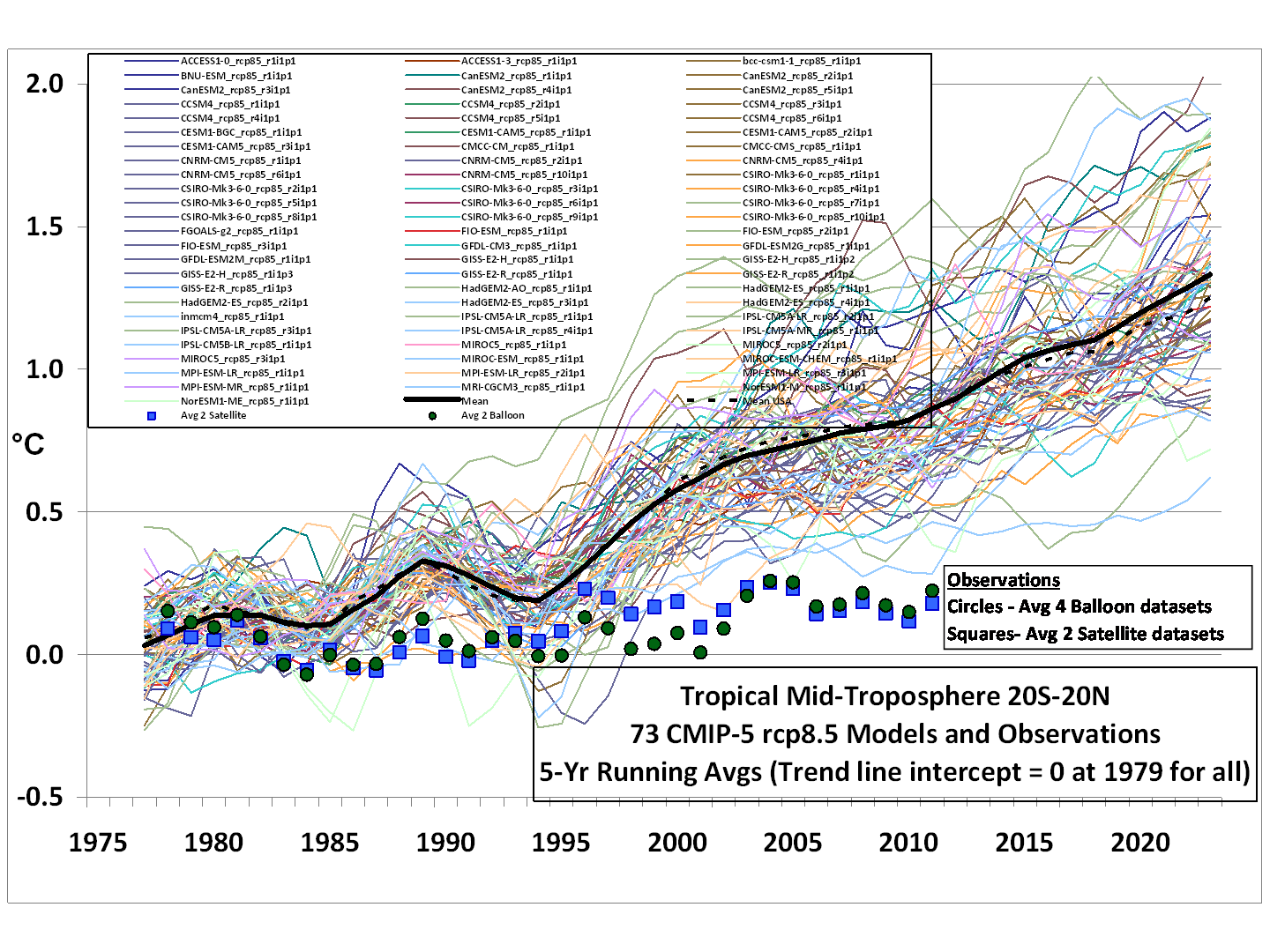
In response to those who complained in my recent post that linear trends are not a good way to compare the models to observations (even though the modelers have claimed that it’s the long-term behavior of the models we should focus on, not individual years), here are running 5-year averages for the tropical tropospheric temperature, models versus observations (click for full size):
CMIP5-73-models-vs-obs-20N-20S-MT-5-yr-means
In this case, the models and observations have been plotted so that their respective 1979-2012 trend lines all intersect in 1979, which we believe is the most meaningful way to simultaneously plot the models’ results for comparison to the observations.

In my opinion, the day of reckoning has arrived. The modellers and the IPCC have willingly ignored the evidence for low climate sensitivity for many years, despite the fact that some of us have shown that simply confusing cause and effect when examining cloud and temperature variations can totally mislead you on cloud feedbacks (e.g. Spencer & Braswell, 2010). The discrepancy between models and observations is not a new issue…just one that is becoming more glaring over time. ….

….
Reblogged from Dr. Roy Spencer

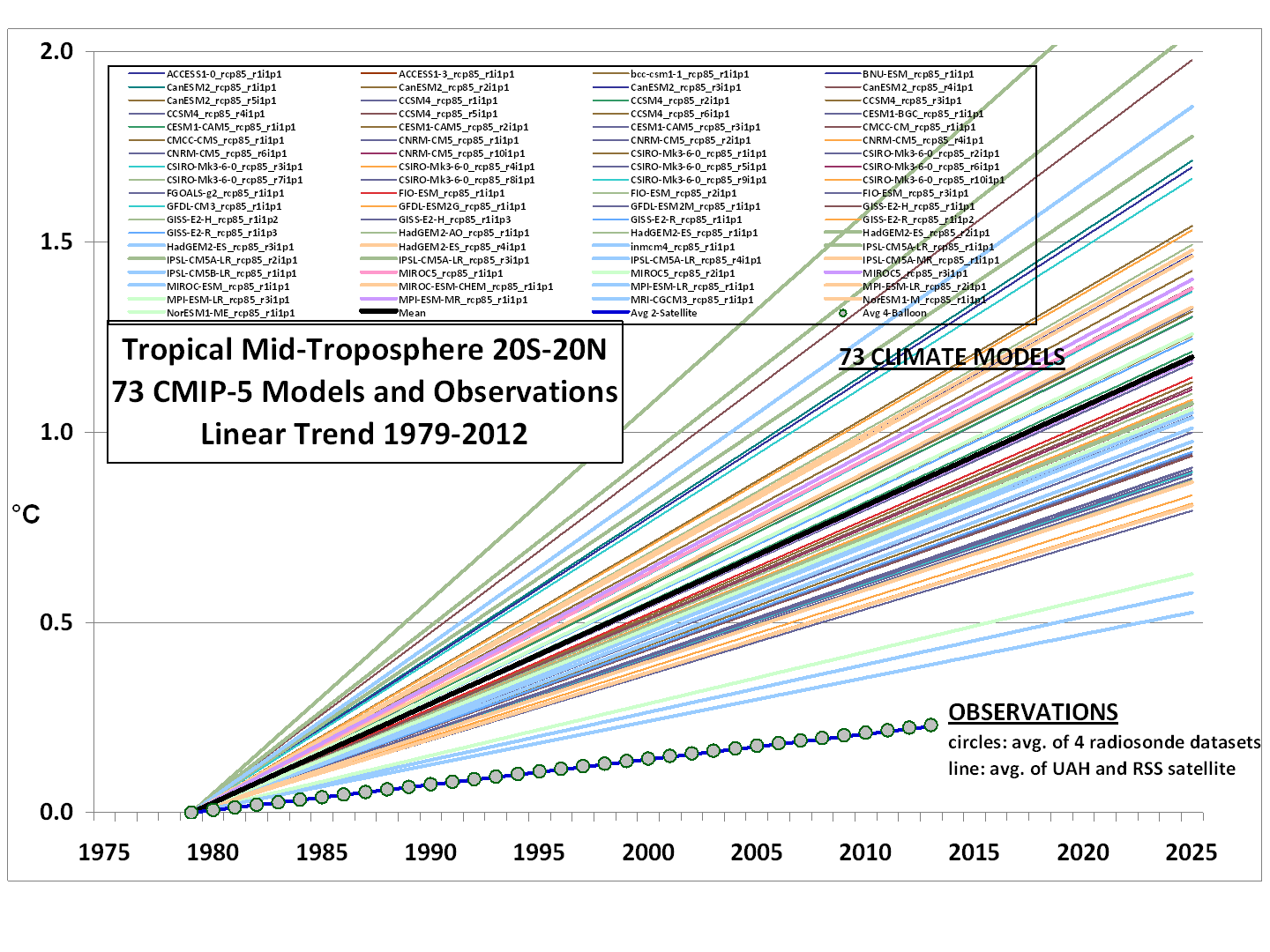
Courtesy of John Christy, a comparison between 73 CMIP5 models (archived at the KNMI Climate Explorer website) and observations for the tropical bulk tropospheric temperature (aka “MT”) since 1979 (click for large version):
CMIP5-73-models-vs-obs-20N-20S-MT
Rather than a spaghetti plot of the models’ individual years, we just plotted the linear temperature trend from each model and the observations for the period 1979-2012.

Note that the observations (which coincidentally give virtually identical trends) come from two very different observational systems: 4 radiosonde datasets, and 2 satellite datasets (UAH and RSS).

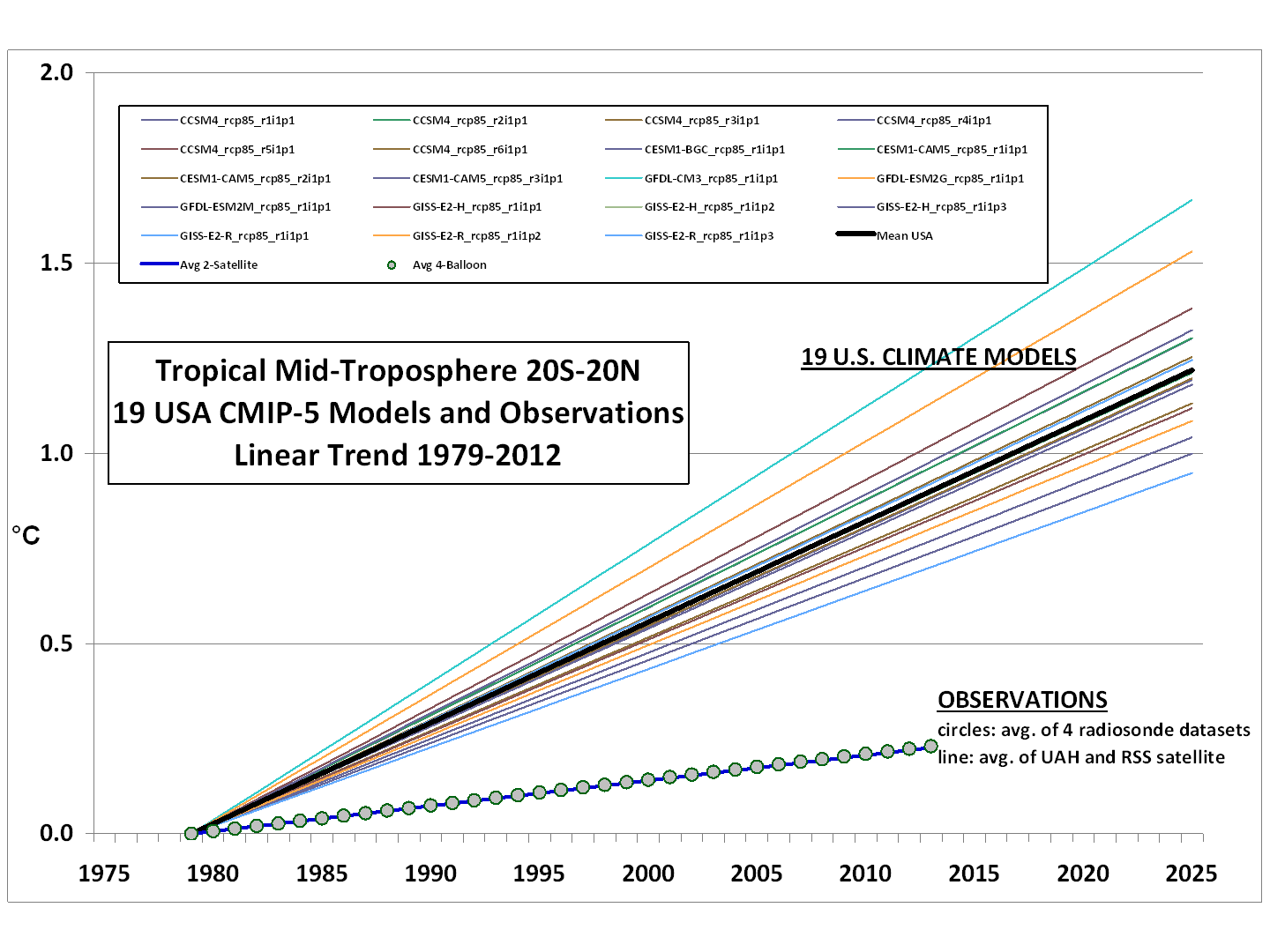
If we restrict the comparison to the 19 models produced by only U.S. research centers, the models are more tightly clustered:
CMIP5-19-USA-models-vs-obs-20N-20S-MT

Now, in what universe do the above results not represent an epic failure for the models?

I continue to suspect that the main source of disagreement is that the models’ positive feedbacks are too strong…and possibly of even the wrong sign.

The lack of a tropical upper tropospheric hotspot in the observations is the main reason for the disconnect in the above plots, and as I have been pointing out this is probably rooted in differences in water vapor feedback. The models exhibit strongly positive water vapor feedback, which ends up causing a strong upper tropospheric warming response (the “hot spot”), while the observation’s lack of a hot spot would be consistent with little water vapor feedback.

Three decades of needless “green” energy has cost some 15 million jobs in Europe

June 2, 2013

It has been a pointless waste. Just to pander to the superstition that controlling carbon dioxide emissions can control global temperature.

Temperatures have been flat since 1997 while human emissions of carbon dioxide have risen around 30%. Carbon dioxide concentrations in the atmosphere have also increased but have had little impact on global temperature – if any at all.

graphic Bert Rutan via WUWT

graphic Bert Rutan via WUWT

graphic source: WUWT

The last three decades have seen the vilification of carbon dioxide and the combustion of fossil fuels but it has been a pointless and expensive exercise. The profligate subsidies in favour of renewable energy and the shameless taxation of fossil fuel use and the consequent increase of energy prices have made their contributions to the economic slowdown and loss of jobs – particularly in Europe. The cowardly adoption of political correctness and of “green” energy is proving expensive – and has been quite needless.

Today electricity prices in Europe are at least 50% higher and perhaps twice as high as they need to be. The curbing of fossil fuel use and the hysteria about nuclear power together with the renewable profligacy are responsible for that. The cost of electricity is a fundamental parameter in our economies which feeds its way into every aspect of economic activity. It is the availability of affordable electricity which has been the driver of growth for over 100 years. A simple estimate of the growth that has been prevented by having unnecessarily high electricity prices gives the cost as being about 15 million jobs within the European Union.

Gerald Warner writes in The Scotsman: (my emphasis)

…. As the bottom falls out of the man-made climate change industry, those who were among its most bullish investors at the height of the scam are now covering their positions in a bear market.

Great damage was done to this much-hyped imposture by Climategate (“Hide the decline!”), by the discredited “hockey stick”, by the farce over “melting” Himalayan glaciers and the “decrease” in the polar bear population from 5,000 in 1970 to 25,000 today. Yet what has chiefly discredited the climate change superstition is the basic, inescapable fact that there has been no global warming since 1997.

The official face-saving response is that this is a “pause” in an otherwise menacing trend – a pause of a decade and a half. The warmist fanatics will freeze to death in their solar bunkers before they will admit defeat; but the more worldly wise, especially scientists anxious to preserve a vestige of academic credibility, are now striving to effect a withdrawal in good order.

Even the Intergovernmental Panel on Climate Change began to ratchet down its more extravagant predictions as early as 2007. In 2010 the Royal Society reviewed its stance on the Anthropogenic Global Warming theory and assumed a more neutral position. Since then, it has been like the retreat from Moscow: last month Oxford scientists, albeit in Delphic language, moderated forecasts of climate disaster. …..

….. The global warming hysteria began in the 1880s but was discredited when its prediction that CO2 would increase the mean global temperature by more than 1C by 1940 was not borne out. What gave it fresh life over the past two decades was the realisation by governments that it could provide a pretext for taxing citizens to unprecedented levels and by private entrepreneurs that government subsidies could supply a dripping roast. Of all the damage that politicians have inflicted on the public, the “green” scam has been among the most extreme.

The Renewables Obligation, introduced in Scotland in 2002, was scheduled to end in 2027, by which time UK energy customers will have been robbed of £32 billion. It has now been extended to 2037 for new projects. By 2011 Ofgem confirmed that 10 per cent of every electricity bill went towards “renewables”. Proliferating wind turbines are blighting the landscape despite being a wholly inefficient source of energy. Turbines operate at just 24 per cent of capacity – for more than a third of the time at only 10 per cent – and conventional power stations have to remain in service as backup: two energy systems pointlessly working in tandem. ……

…… South of the Border a modicum of sanity has entered government thinking since UK energy minister John Hayes’ “Enough is enough” remarks. In England and Wales turbines are falling out of favour. 

Not so in Scotland. ……. 

Local objections to wind farms are routinely overruled by central government (that would be the listening, accountable Scottish Nationalist government). At the end of last year only ten out of Scotland’s 32 local authorities admitted to knowing how many wind turbines were sited in their areas.

They could cover every inch of Scottish soil with Martian whirligigs and the lights will still go out, due to the SNP’s refusal to replace Hunterston B, due to close in 2016, and Torness, closing in 2023. All this to satisfy a superstition: if all mankind stopped producing CO2 (try selling that idea in China and India), 96.5 per cent would remain. The climate Anabaptists will never recant, but their mad creed is doomed all the same.

Wind turbines and solar energy have their place in the energy mix we should use.  But not at the expense of fossil fuel and nuclear use.

Carbon dioxide concentration was at 500+ ppm already in 1860

May 13, 2013

This has been around for some time, but I have only just come across it.

It could be that GS Callendar’s 1957 paper about Global warming  cherry picked supportive data points and ignored inconvenient data.

Reblogged from JunkScience

Did one of the fathers of manmade global warming cherry-pick his data for a 1957 study?

Here’s the original data.

Source: Slocum, G., Has the amount of carbon dioxide in the atmosphere changed significantly since the beginning of the twentieth century? Month. Weather Rev., 1955(October): p. 225-231.

Source: Slocum, G., Has the amount of carbon dioxide in the atmosphere changed significantly since the beginning of the twentieth century? Month. Weather Rev., 1955(October): p. 225-231. 

Here’s the cherry-picked version.

Callendar graph

Read the full story at Tallbloke’s blog.

Related:

slocum 1955 carbon dioxide Slocum, G., Has the amount of carbon dioxide in the atmosphere changed significantly since the beginning of the twentieth century? Month. Weather Rev., 1955(October): p. 225-231. 

Climate Change: Incorrect information on pre-industrial CO2

CO2: The Greatest Scientific Scandal of Our Time


Climate “science” reduced to “Retrospective Predictions”

May 13, 2013

Hindsight science

Wow!

Nature and Climate Science are now reduced to publishing “Retrospective Predictions”.  And Predicting the Past is apparently good enough to get published! At least you can never make a prediction which is wrong!

It used to be called  hindsight!


Retrospective prediction of the global warming slowdown in the past decade

by Virginie Guemas, Francisco J. Doblas-Reyes, Isabel Andreu-Burillo & Muhammad Asif

Nature Climate Change (2013) doi:10.1038/nclimate1863

Despite a sustained production of anthropogenic greenhouse gases, the Earth’s mean near-surface temperature paused its rise during the 2000–2010 period. To explain such a pause, an increase in ocean heat uptake below the superficial ocean layer has been proposed to overcompensate for the Earth’s heat storage. Contributions have also been suggested from the deep prolonged solar minimum, the stratospheric water vapour, the stratospheric and tropospheric aerosols. However, a robust attribution of this warming slowdown has not been achievable up to now. Here we show successful retrospective predictions of this warming slowdown up to 5 years ahead, the analysis of which allows us to attribute the onset of this slowdown to an increase in ocean heat uptake. Sensitivity experiments accounting only for the external radiative forcings do not reproduce the slowdown. The top-of-atmosphere net energy input remained in the [0.5–1] W m−2 interval during the past decade, which is successfully captured by our predictions. Most of this excess energy was absorbed in the top 700 m of the ocean at the onset of the warming pause, 65% of it in the tropical Pacific and Atlantic oceans. Our results hence point at the key role of the ocean heat uptake in the recent warming slowdown. The ability to predict retrospectively this slowdown not only strengthens our confidence in the robustness of our climate models, but also enhances the socio-economic relevance of operational decadal climate predictions.

And how many reviewers saw nothing wrong with “Retrospective Predictions”?

“Consensus science” – by definition – is not “science” and is a dangerous thing

April 30, 2013

The internet is full of polls that I generally find irritating. How many believe that “A” will happen? or that “B will win? or that “C” is better than “D”? Whatever the result of the poll may be, they show nothing more than where the preponderance of belief  lies. The polls are evidence only of what people believe; they are not evidence of the subject being voted upon.

Either something is or it is not.

If we don’t know whether it is or is not, we can formulate it as a hypothesis and address it by the scientific method. The formulation is then as a falsifiable hypothesis and we then predict what data might be collectable if the hypothesis was false. We then collect data and where data is not available we design and carry out experiments to provide such data. These data and their analysis should be tested – for the classical scientific method – to see if the hypothesis is false (not – it should be noted – to show that the hypothesis is true). Where the data cannot show the hypothesis to be false it means only that the hypothesis is still unproven but the data set adds to the body of evidence in favour of the hypothesis in the particular circumstances in which that data-set was collected.

When we don’t know we can still suppose the hypothesis to be true or false. But that is just a supposition and lies in the realms of belief and religion. We can take a vote within some group and see how many believe it to be true or to be false. Commercial and other interests may be vested in the supposition. Lobbying and persuasion can be applied in favour of or against the supposition. Voters can be influenced and cajoled and persuaded to vote for or against. A completely democratic and transparent system of voting may be applied. And  the result may be overwhelmingly in favour or against the supposition. But even where a majority – even an overwhelming majority of say 97% – of some group believes the proposed hypothesis to be true, the vote adds not one iota of evidence in favour of or against the hypothesis. An overwhelming vote that a hypothesis is true when it is actually false makes it no less false. All the vote can show is the preponderance of belief (and belief – by definition – comes into play when and because evidence is lacking).

And all that democratic process to establish what people believe brings us no closer to answering the question of whether the supposition is true.

But it gets worse.

Once a “democratic” majority has confirmed its belief in a supposed “truth” of a supposition, then there is a immense societal pressure against proving the supposition to be false. Falsifiable hypotheses are reformulated to be no longer falsifiable. The scientific method is perverted – for reasons of the vested interests – to now produce anecdotal evidence trying to “prove the hypothesis” rather than trying to collect data to try and show the hypothesis to be false. Evidence against the majority belief is not collected because it is no longer expedient to do so. Not only is it not collected, it is ignored even when it is plain and obvious. The moment a scientific hypothesis invokes or has to invoke a majority vote or a consensus in its support it leaves the scientific arena and enters the  political universe. Truth becomes whatever the majority believes. Proper scientific effort directed to falsifying the supposition is not just discouraged, it is penalised and attracts sanctions in the form of reduced funding and rejection of publications. It becomes heresy. Even where the believed supposition is actually true, the supposition remains as belief and cannot easily be brought back into the rational world.

As Judith Curry wrote recently:

With genuinely well-established scientific theories, ‘consensus’ is not discussed and the concept of consensus is arguably irrelevant.  For example, there is no point to discussing a consensus that the Earth orbits the sun, or that the hydrogen molecule has less mass than the nitrogen molecule.  While a consensus may arise surrounding a specific scientific hypothesis or theory, the existence of a consensus is not itself the evidence. ……. 

Given the complexity of the climate problem, ‘expert judgments’ about uncertainty and confidence levels are made by the IPCC on issues that are dominated by unquantifiable uncertainties. It is difficult to avoid concluding that the IPCC consensus is manufactured and that the existence of this consensus does not lend intellectual substance to their conclusions.

“Consensus science” has no option but to become science by majority vote. Polls replace evidence. And where the belief is false, the belief itself prevents a return to the truth. “Consensus science” as belief cannot be “science”. The simple fact is that whenever a “scientific hypothesis” invokes a consensus in its support it is – per force – just a belief. It becomes religion and not science. And that is a dangerous thing.

Related: Climate change: no consensus on consensus

Disconnect between man-made CO2 and atmospheric levels of CO2

April 28, 2013

The evidence grows that

  1. Temperature drives carbon dioxide, and 
  2. man made carbon dioxide is a minor contributor to carbon dioxide concentration in the atmosphere

Atmospheric verification of anthropogenic CO2emission trendsRoger J. Francey et al, Nature Climate Change 3, 520–524 (2013) doi:10.1038/nclimate1817

The Hockey Schtick reports:

A recent paper published in Nature Climate Change finds a disconnect between man-made CO2 and atmospheric levels of CO2, demonstrating that despite a sharp 25% increase in man-made CO2 emissions since 2003, the growth rate in atmospheric CO2 has slowed sharply since 2002/2003. The data shows that while the growth rate of man-made emissions was relatively stable from 1990-2003, the growth rate of atmospheric CO2 surged up to the record El Nino of 1997-1998. Conversely, growth in man-made emissions surged ~25% from 2003-2011, but the growth rate of atmospheric CO2 has flatlined since 1999 along with global temperatures. The data demonstrates temperature drives CO2 levels due to ocean outgassing, man-made CO2 does not drive temperature, and that man is not the primary cause of the rise in CO2 levels.

The climate is a-changin

April 20, 2013

The winds of climate are changing direction – again.

Forty years ago “climate scientists” were sure we were entering a new ice age and even that we could have triggered the end of the current inter-glacial.

For forty years we have seen the growth of the global warming meme and the demonisation of carbon dioxide and of all things “fossil”.

A new economy based on the expensive and premature cessation of the use of fossil fuels took shape. All alternatives to fossil fuel – no matter how expensive or impractical – were worthy of subsidy. By invoking a connection to global warming any science project could attract funds. A fascist and authoritarian “environmental” politics gained ground.  The politicians had a new “label” for introducing taxation in the name of controlling climate (!). Vast new revenue streams of taxes and subsidies and carbon credits were created in the name of protecting the planet. In fact the penalty for not being “politically correct” on climate was seen as being so disadvantageous that every product – from toothpaste to children’s toys to aircraft and weapons – had to show that it was “climate-smart”. Meaningless new parameters like “carbon footprint” entered the vocabulary. No self-respecting newspaper or scientist or politician or business could afford to be heretical with respect to the new religion of the day.

But the Earth and the Sun and the resulting climate pay little attention to the puny efforts of man and dance to their own music. When an ice age is to come it will come and when the ice sheets are to retreat the earth will warm and humanity’s best option is to adapt to the changes as they come. If we understand anything about the Sun and its cycles, an ice age will surely come – whether in 10 or 10,000 years.  And we should concentrate on having the wherewithal to cope when it does. To attempt to control the climate has more than a hint of arrogance. We might as well try to ask the Sun to shine a little less brightly or for a little longer!

But for the last 17 years (or 12 or 18 depending upon how religious one is) global warming has stalled. Now vast amounts of a “new” fossil fuel – shale gas –  have been discovered and its utilisation is changing the economic landscape. “Global warming” was renamed to be “climate change”. The money making (for some) revenue schemes and subsidy-milking for unnecessary and expensive renewable energy have been revealed for the scams they are. Heretical views are being expressed again.

The climate winds are changing:

  1. The Great Green Con no. 1: The hard proof that finally shows global warming forecasts that are costing you billions were WRONG all along   
  2. A sensitive matter
  3. Spiegel Stops Believing…”Hot Debate Over Climate: How Reliable Are The Prognoses?” Growing Doubts Over Models! 

  4. Global warming: time to rein back on doom and gloom?
  5. Climate scientists struggle to explain warming slowdown 

  6. Mother Of German Green Weeklies, Die Zeit, Shocks Readers…Now Casts Doubt On Global Warming!

Climate forcing: Missing water must be hiding in the deep ocean

April 19, 2013

Clive Best points out that NASA data shows quite clearly that water vapour in the atmosphere has been decreasing quite significantly especially since about 1998 while carbon dioxide has continued rising. All the wonderful climate models (settled science after all) take it for granted that increased water vapour in the atmosphere is a key forcing caused by increasing carbon dioxode.

I wonder where the water went?

Presumably hiding along with all the missing heat in the deep oceans!

And causing the sea level to increase no doubt.

The fact is that we can’t account for the lack of water in the atmosphere and it is a travesty that we can’t.

H2O decreasing while CO2 rises !

Posted on April 18, 2013 by Clive Best

Dire predictions of global warming all  rely on positive feedback from  water vapor. The argument goes that as surface temperatures rise so  more water will evaporate from the oceans thereby amplifying temperatures because H2O itself is a strong GHG.  Climate models all assume net amplification factors of between 1.5 and 6. But in the real world has the water content of the atmosphere actually been increasing as predicted?

NASA have just released their latest NVAP-M  survey of global  water content derived from satellite data and radio-sondes over the period from 1988 to 2009. This new data is explicitly intended for climate studies . So lets take a look at the comparison between actual NVAP-M atmospheric H2O levels and those of CO2 as measured at Mauna Loa. I have extracted all the daily measurement NVAP-M data and then calculated the global average. Figure 1 shows the running 30 day average of all the daily data recorde between 1988 and 2009 inclusive. The 365 day (yearly) running average is also shown. Plotted on the right hand scale are the Mauna Loa CO2 concentration data in red over the same period.

Fig1: Total precipitative H2O (running 30 day average) compared to Mauna Loa CO2 data in red. The central black curve is a running 365 day average.

Fig1: Total precipitative H2O (running 30 day average) compared to Mauna Loa CO2 data in red. The central black curve is a running 365 day average.

There is indeed some correlation in the data from 1988 until 1998, but thereafter the two trends diverge dramatically. Total atmospheric water content actually falls despite a relentless slow rise in CO2. This fall in atmospheric H2O also coincides with the observed and now widely accepted stalling of global temperatures over the last 16 years. All climate models (that I am aware of) predict exactly the opposite, so something is clearly amiss with theory. Is it not now time for “consensus” climate scientists perhaps to have a rethink ?

more to follow…

  1. My thanks to Ken Gregory for help with the  data. The conversion from NetCDF was a bit of a nightmare !
  2. NASA NVAP-M data is available here. Thanks to NASA Water Vapor Project-Measures (NVAP-M) team.

Anthony Watts in a comment does point out that sensor degradation or failure would need to be eliminated. (But I wonder why sensor integrity would not have been checked by NASA before the data was published as data)

Chaos of climate models only shows that “we don’t know what we don’t know”

April 17, 2013

I spent a large part of my early career in mathematical modelling (of combustion systems and of heat flow) and have a very clear idea of what models can do and what they can’t. Models after all are used primarily to simplify complex systems which are otherwise intractable. They are – always – severely limited by the assumptions and simplifying approximations that have to be introduced. Models are a powerful tool for investigation but are only as good as their most inaccurate assumption. But they are a tool primarily for investigation — and can be dangerous when used for decision making based on their imperfect predictions. The spectacular failures of mathematical models of the global economy are a case in point. It is worth noting that in spite of the great strides made in weather forecasting  for example – much of which is empirical – the simple statement that “tomorrows weather will be like today’s”  is as correct – statistically – as the most complex model running on some super-computer somewhere.

It has therefore always amazed me that so-called “scientists” would be so certain about their approximate models of climate systems – which are perhaps as complex, chaotic and “unknown” systems as any one could study. It has been a boon for politicians looking for new ways of raising revenue. It has been exploited by the alarmists since the alarmist predictions cannot be tested. The wide spread of results from climate models is rarely mentioned.

When reality does not match model forecasts it is time to back off and rethink the models and hopefully they will be better next time. And it is time to back track from all the political decisions made on the basis of patently incomplete and inaccurate models.

The simple reality about climate is that rather than being a “settled science”

  • we don’t know the impact of solar effects on climate
  • we don’t know the impact of clouds or even if they are net “warmers” or net “coolers”
  • we don’t know how much of the earth’s radiative energy balance is dependent upon carbon dioxide
  • we don’t know how much carbon dioxide is absorbed  by the oceans and living things
  • we don’t know the impact of aerosols and particles in the atmosphere
  • we don’t know the role of the oceans in transporting heat around the globe
  • we don’t know how much heat is stored in the oceans and how it varies
  • we don’t know the impact of solar effects on cloud formation
  • we don’t know what triggers ice ages, and
  • we don’t know what we don’t know.

This from Dr. Roy Spencer and the ridiculously wide spread of the model results and the obvious deviation of reality from model results are particularly striking:

Global Warming Slowdown: The View from Space

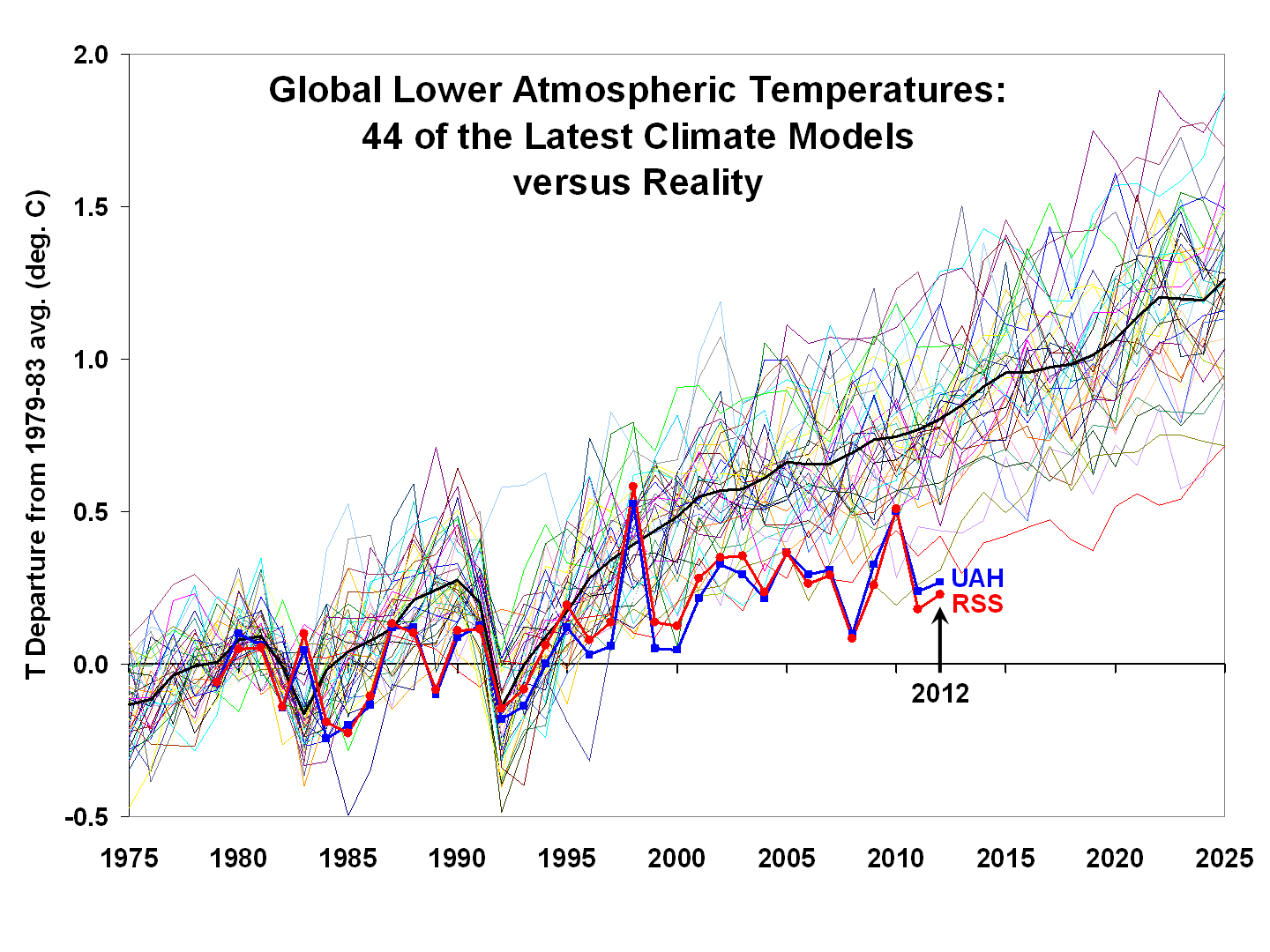
Since the slowdown in surface warming over the last 15 years has been a popular topic recently, I thought I would show results for the lower tropospheric temperature (LT) compared to climate models calculated over the same atmospheric layers the satellites sense.

Courtesy of John Christy, and based upon data from the KNMI Climate Explorer, below is a comparison of 44 climate models versus the UAH and RSS satellite observations for global lower tropospheric temperature variations, for the period 1979-2012 from the satellites, and for 1975 – 2025 for the models:

CMIP5-global-LT-vs-UAH-and-RSS

CMIP5-global-LT-vs-UAH-and-RSS

Clearly, there is increasing divergence over the years between the satellite observations (UAH, RSS) and the models. The reasons for the disagreement are not obvious, since there are at least a few possibilities:

……… 

The dark line in the above plot is the 44-model average, and it approximately represents what the IPCC uses for its official best estimate of projected warming. Obviously, there is a substantial disconnect between the models and observations for this statistic.

I find it disingenuous for those who claim that, because not ALL of individual the models disagree with the observations, the models are somehow vindicated. What those pundits fail to mention is that the few models which support weaker warming through 2012 are usually those with lower climate sensitivity.

So, if you are going to claim that the observations support some of the models, and least be honest and admit they support the models that are NOT consistent with the IPCC best estimates of warming.

Questioning global warming dogma is taboo in Belgium

April 15, 2013

Reproduced from The GWPF  because “questioning the impact of mankind on climate change is evidently still a taboo in the French-speaking world”. 

The authors of this paper recently presented their views on climate science at the Royal Academy of Belgium. No French or Belgian newspaper was willing to publish their assessment. Questioning the impact of mankind on climate change is evidently still a taboo in the French-speaking world.

Double Standards in Climate Change

István E. Markó a), Alain Préat b), Henri Masson c) and Samuel Furfari d)

a) Professor at the Université catholique de Louvain (UCL)

b) Professor at the Université libre de Bruxelles (ULB)

c) Professor at Maastricht University

d) Lecturer at the Université libre de Bruxelles (ULB)

The conference on climate change held in Doha (Qatar) last December ended in failure once again. However, the news reported in the media about this 18th conference on climate change were fully in line with the well-rehearsed mantra: the Earth is warming up, human emissions of greenhouse gases are mainly to blame for this warming up, and we are approaching disaster. We have only one climate, but communication about it seems to be plagued by double standards.

For a few years now British, American, Italian or German media have given sceptical scientists the opportunity to express their opinions on the validity of the statements released by the Intergovernmental Panel on Climate Change (IPCC), the organisation responsible for the official line of thought on climate matters. Nothing like that has been seen in the French or Belgian media which persist in portraying scientific sceptics, at best as sold out to the oil lobbies, at worst as troubled individuals, greedy for public recognition and fame and as such not worthy to be proponents in a serious debate.

The authors of this contribution were recently been granted the honour of presenting their point of view as climate sceptics at the Royal Academy of Belgium. During a series of six well-attended lectures we showed, among other things, that:

  1. The climate has always changed. This was true during ancient times and it has also been true since the beginning of the modern era. These climate changes have always been, and still are, independent of the concentration of CO2 in the atmosphere;
  2. During Roman times and the Middle Ages temperatures were observed well in excess of those currently experienced. From the 16th till the 19th century a cold period referred to as the “Little Ice Age” predominated. All these changes took place without mankind being held responsible. We believe that the increase in temperatures that occurred during a certain part of the 20th century is the result of a recovery from this cold period. These various events can be explained by a combination of warm and cold cycles of different magnitudes and duration. Why and how this happens is not yet fully understood, but some plausible explanations can be put forward;
  3. The so-called “abnormally rapid” increase in global temperatures between 1980 and 2000 is not unusual at all. There have in fact been several such periods in the past, during which temperatures rose in a similar manner and at comparable rates, even though fossil fuels were not yet in use;
  4. Temperature measurements do not necessarily correlate with a building up or a decrease in heat since heat variations are energy changes subject to thermal inertia. Apart from heat many other parameters have an influence on temperature. Moreover the measurement of temperatures is subject to numerous large errors. When the magnitude and plurality of these measurement errors are taken into account, the reported increase in temperatures is no longer statistically significant;
  5. The famous “Hockey-stick” curve, known as the Mann’s curve and presented six times by the IPCC in its penultimate report, is the result among other things of a mistake in the statistical calculations and an incorrect choice of temperature indicators, i.e. proxies. This lack of scientific rigour has totally discredited the curve and it was withdrawn, without any explanation, from subsequent IPCC reports;
  6. Even though they look formidably complex, the theoretical models employed by the climate modellers are simplified to the extreme. In fact there are far too many (known and unknown) parameters that influence climate change. At the moment it is impossible to take them all into account. The climate system is extremely complex, containing not only chaotic components but also numerous positive and negative feedback loops operating according to various different time scales. Which is why the IPCC wrote in its reports that: “…long-term prediction of future climate states is not possible” (page 774, Third report). This is very true. To this day all the climate predictions based upon these models have turned out to be totally incorrect. Strangely, nobody seems to care;
  7. The relationship between CO2 and temperature, obtained from the Vostok ice cores, shows that a building up of CO2 occurs 800 to 1000 years after an increase in temperature is observed. Hence the increase in the concentration of CO2 is a consequence of the warming of the climate, not its cause;
  8. But the coup de grâce to the “warmists’ theory” – certainly not yet visible in the French and Belgian media – comes from the observation that for the past fifteen years or so the global temperature of the Earth has remained constant. During the same period CO2 emissions have increased by far more than in the past, reaching an unparalleled record this year. Honest climate scientists admit that this observation is an embarrassing inconvenience for their theory. However, attempts to make us believe that the Earth is continuing to warm up persist. Will we have to wait for another twenty, twenty-five or thirty years for the global warming advocates to finally admit that there is no unambiguous correlation between the global temperature of the Earth and human-generated CO2 emissions?
  9. The claim that Hurricane Sandy is due to human CO2 emissions is totally unfounded and has been vigorously contested by numerous meteorologists. This regrettable distortion of the facts has been denounced in an open letter, addressed to the General Secretary of the UN and signed by more than 130 world-renowned scientists, including one of the present authors;
  10. Finally the “abnormal” melting of the Arctic Sea ice, that made the headlines of numerous journals during this summer, was also observed during previous decades. Amazingly the record high increase in Antarctic Sea ice that occurred at exactly the same time has been completely ignored by the very same media. Moreover, no mention has been made of the current, particularly rapid, regeneration of the Arctic Sea ice.

These ten statements are facts. We would be ready to accept that they could be wrong, if evidence were presented to scientifically disprove them. In the meantime, and in view of the lack of coherence and unreliability associated with the numerous predictions made by the IPCC, it is time to set the record straight. The public and politicians must be informed about the hypothetical character of the predominant ‘consensus’ on climate change, which has been uncritically disseminated in the media for more than ten years. If it ever existed, this so-called “climate change consensus” has now been totally undermined by the facts.

Despite the opportunity that we were given by the Royal Academy to raise this issue, we were unable to find any French or Belgian newspaper willing to publish this text. Questioning the impact of mankind on climate change is evidently still a taboo over here.

This article reflects solely the opinions of the Authors.