Posts Tagged ‘global cooling’

Satellite data clearly shows global cooling from 1984 – 2006

August 4, 2013

Brightness temperatures derived from the Meteosat data show a planetary trend of global cooling of upto  2K/decade since 1984.

One wonders why this data has not been publicised earlier.

In general, the Atlantic Ocean, Africa and Europe show a negative temperature trend, varying between zero and -2 K/decade.

Andries Rosema, Steven Foppes and Joost van der Woerd, Meteosat Derived Planetary Temperature Trend 1982-2006Energy & Environment, Volume 24, Number 3 – 4 / June 2013, 381-396, doi:10.1260/0958-305X.24.3-4.381

The paper is behind a paywall at the Journal but a pdf version is available (via climategate.nl): Rosema et al Meteosat data 1984-2006

From the author’s conclusions:

The amazing finding of the present study is that we do not observe global warming in the period 1982-2006, but significant cooling. …

The satellite data are from a reliable origin supported by the European meteorological community. Their accurate calibration has received due attention and efforts from Eumetsat. Our processing of these data has been simple and straight forward, involving only noon and midnight image composition, averaging and a filter to eliminate cloud effects. We have created similar planetary temperature change images for the unfiltered, 10, 20 and 30 day filtered data, clearly showing convergence towards the longer filters, indicating that cloud influences were effectively removed. 

Moreover, we do observe significant temperature increase at some locations which are due to human interventions, and which are quantitatively in line with the theoretically expected effects of these interventions. Therefore we believe the observed planetary temperature decrease for most of the hemisphere to be real.

The cloud filtered temperature change patterns, in figure 2c, indicate that the largest decrease occurs in the more cloudy regions of the hemisphere: the tropics and the temperate zones, while in the desert belt the temperature decrease is much smaller. This suggests that cloudiness changes could be the mechanism behind the observed global cooling since 1982: an increase in cloudiness would decrease global radiation and increase rainfall and evapotranspiration. Both effects tend to decrease the surface temperature.

While their conclusions about cloud cover as the determining mechanism are plausible – but as yet unproven – their general observations are quite significant:

In general, the Atlantic Ocean, Africa and Europe show a negative temperature trend, varying between zero and -2 K/decade. Remarkable, is a large area in southern Africa, mainly Zimbabwe and Mozambique, where the temperature decrease is even larger and in the range of -2 to -3 K. Also note the temperature decrease of Lake Chad and Lake Nasser, probably due to an increase in their surface areas. There are also some spots that show a substantial temperature increase, in particular in SE Iraq (figure 3a) and NW Tanzania (figure 3b).

They see a general reduction of temperature everywhere except in two small areas of Iraq and Tanzania:

  1. SE Iraq- An exceptional location which shows a strong temperature increase of some 5K in the period of 20 year. This increase took mainly place in the period 1993-1995 and reflects the draining of the marshes at the confluence of the Ephrata and Tigris under the regime of Sadam Hussein.
  2. NW Tanzania, south of Lake Victoria. There is a temperature increase of 1.3 K in 20 year. This location is in a strongly developing mining area. Decrease in vegetation cover and reduced  evapotranspiration may have caused this temperature increase.

ABSTRACT
24 year of Meteosat hourly thermal infrared data have been used to study planetary surface temperature change. Thermal infrared radiation in the 10.5-12.5mm spectral window is not affected by CO2 and only slightly by atmospheric water vapor. Satellite thermal infrared data have been converted to brightness temperatures as prescribed by Eumetsat. Hourly brightness temperature images were then composed to corresponding noon and midnight temperature data fields. The resulting data fields were cloud filtered using 10, 20 and 30 day maximum temperature substitution. Filtered data were subsequently averaged for two 10 yearly periods: 1986-1995 and 1996-2005. Finally the change in brightness temperature was determined by subtraction. In addition nine locations were selected and data series were extracted and studied for the period 1982-2006. Our observations point to a decrease in planetary temperature over almost the entire hemisphere, most likely due to an increase of cloudiness. Two small areas are found where a considerable temperature increase has occurred. They are explained in terms of major human interventions in the hydrological balance at the earth surface.

Idiot Science! Human conflict caused by cooler climate and/or by hotter climate

August 2, 2013

Silly science can sometimes just be idiot “science” and no science at all.

One says warmer temperatures cause human conflict, another that colder climate does so.

The idiocy lies first in assuming that climate is the determining factor for the political, economic, social and behavioural stresses that cause conflict among humans and second in the classic idiocy that correlation is equal to causation.

1. Solomon M. Hsiang, Marshall Burke and Edward Miguel, Quantifying the Influence of Climate on Human ConflictPublished Online August 1 2013, Science DOI: 10.1126/science.1235367

Abstract: A rapidly growing body of research examines whether human conflict can be affected by climatic changes. Drawing from archaeology, criminology, economics, geography, history, political science, and psychology, we assemble and analyze the 60 most rigorous quantitative studies and document, for the first time, a remarkable convergence of results. We find strong causal evidence linking climatic events to human conflict across a range of spatial and temporal scales and across all major regions of the world. The magnitude of climate’s influence is substantial: for each 1 standard deviation (1σ) change in climate toward warmer temperatures or more extreme rainfall, median estimates indicate that the frequency of interpersonal violence rises 4% and the frequency of intergroup conflict rises 14%. Because locations throughout the inhabited world are expected to warm 2 to 4σ by 2050, amplified rates of human conflict could represent a large and critical impact of anthropogenic climate change.

2. Ulf Büntgena, Tomáš Kyncld, Christian Ginzlera, David S. Jackse, Jan Esperf, Willy Tegelg, Karl-Uwe Heussnerh, and Josef Kyncld, Filling the Eastern European gap in millennium-long temperature reconstructions. Published online January 14, 2013, Proceedings of the National Academy of Sciences. doi:10.1073/pnas.1211485110.

Abstract: Tree ring–based temperature reconstructions form the scientific backbone of the current global change debate. Although some European records extend into medieval times, high-resolution, long-term, regional-scale paleoclimatic evidence is missing for the eastern part of the continent. Here we compile 545 samples of living trees and historical timbers from the greater Tatra region to reconstruct interannual to centennial-long variations in Eastern European May–June temperature back to 1040 AD. Recent anthropogenic warming exceeds the range of past natural climate variability. Increased plague outbreaks and political conflicts, as well as decreased settlement activities, coincided with temperature depressions. The Black Death in the mid-14th century, the Thirty Years War in the early 17th century, and the French Invasion of Russia in the early 19th century all occurred during the coldest episodes of the last millennium. A comparison with summer temperature reconstructions from Scandinavia, the Alps, and the Pyrenees emphasizes the seasonal and spatial specificity of our results, questioning those large-scale reconstructions that simply average individual sites.

Beware Global Cooling

July 1, 2013
File:Hendrick Avercamp - Frozen River with Skaters - Google Art Project.jpg

Hendrick Avercamp – Frozen River with Skaters

Andrew McKillop has a new article posted at The Market Oracle.

Global cooling began at the end of the so-called Medieval Warm Period, by or before the year 1300, and was preceded by at least 200 years, and as long as 350 years, of warming on the same variable and unpredictable basis. Measurement problems include the type of proxies used – ice cores, tree rings, corals and shells, others – but at least as important, the ideological bias of climate science leads to extreme variations in reconstructed climate data for the same region, same period. One flagrant example is IPCC treatment of Medieval Warming Period data – as published by the IPCC in different editions of its reports and studies. Before year 2000, IPCC studies include papers showing Warm Period temperatures in certain high latitude locations at certain dates around 950-1200 as several full degrees celsius above present day temperatures.

That is, despite 213 years of anthropogenic global warming if with the IPCC we use a start date of 1800 for human “carbon pollution of the atmosphere”, we have in no way matched this natural warming. Which needed zero assistance from human-source CO2.

This is the global cooling fear

Flooding in the low countries in Europe was a common feature which accompanied the global cooling which succeeded the Medieval Warm Period. The cooling period he writes, lasted 450 years.

(more…)

Global cooling is killing off the birds and the bees

June 28, 2013

Humans have always looked to the birds and the bees for figuring out how to do it. But now we are doomed!

Whole populations of plants, bees, insects and even birds are already dying of cold. 

Those who deny that global cooling has set in and have their heads buried in the sand are still lost in the fantasy world of trying to “stop global warming” by cutting carbon dioxide emissions.  That horse has bolted and to make it worse they are trying to close the wrong stable door! In the meantime, the sun and the earth and the climate have moved on. Global warming is no longer fashionable. Global cooling is here – at least for the next 2 or 3 decades.

BBC: Winged insects including bees, moths and butterflies are suffering this year following the UK’s late, cold spring, a National Trust report has revealed.

The charity warns the drop in numbers of winged insects could lead to food shortages for birds and bats. The six-month review assessed the state of plants and animals in England, Wales and Northern Ireland and came up with a “winners and losers” list. 

Snowdrops, bluebells and daffodils are all on the winners’ list

Among the “losers”, butterflies have been “very scarce” this year, due to a combination of an unsettled spring and the last year’s extremely wet summer. Likewise, moth numbers have been driven down by cool, wet or windy nights over the past few months. Mason bees and mining bees also struggled to survive in poor weather in May, which may have a knock-on effect for plant pollination. “Insect populations have been really very low. Then when they have got going, they’ve been hit by a spell of cool, windy weather… so our environment is just not bouncing with butterflies or anything else,” said Mathew Oates, a naturalist at the National Trust, who worked on the report. …  

Birds on the “losers” list include martins, swifts, swallows and warblers, all of which rely on airborne insects to feed and may struggle to survive in the coming months.

Some seabird populations have been hard hit too. In March, windy weather along the coast of Scotland and northern England led to the apparent starvation of thousands of puffins along with guillemots, razorbills, kittiwakes and shags.

However, a number of animals and plants have enjoyed a more fruitful year, earning a place on the list of “winners” of the first half of 2013. Snowdrops and daffodils had “amazingly long flowering seasons”, according to the charity, with daffodils flowering well into May and snowdrops appearing from January through to mid-April. ….

But the UK Government has been moved to urgent action. They have decided that the bee decline is not due to pesticides – which leaves only global cooling which can be blamed. The government has called an urgent  “bee summit to “carry out an “urgent and comprehensive” review of the decline of bees. The majority of the participants will not have any experience of keeping bees!

The bees themselves are not invited:

BBC againThe government is to announce it will carry out an “urgent and comprehensive” review of the decline of bees.

Minister Lord de Mauley will tell a bee summit, organised by Friends of the Earth, that the review will lead to a “national pollinator strategy”.

There is great concern across Europe about the collapse of bee populations and the European Commission wants to ban pesticides linked to bee deaths.

But the UK has opposed the move, saying that the science is inconclusive.


Global cooling in the cretaceous shifted the global carbon cycle

June 17, 2013

A new paper in Nature Geoscience showing that global cooling is as significant as global warming.

‘Atlantic cooling associated with a marine biotic crisis during the mid-Cretaceous period’. A McAnena, S Flogel, P Hofmann, JO Herrle, A Griesand, J Pross, HM Talbot, J Rethemeyer, K Wallmann and T WagnerNature Geoscience, DOI: 10.1038/NGEO1850, published on: 16th June 2013

From Newcastle Univeristy’s press release:

Global cooling as significant as global warming

A “cold snap” 116 million years ago triggered a similar marine ecosystem crisis to the ones witnessed in the past as a result of global warming, according to research published in Nature Geoscience.

The international study involving experts from the universities of Newcastle, UK, Cologne, Frankfurt and GEOMAR-Kiel, confirms the link between global cooling and a crash in the marine ecosystem during the mid-Cretaceous greenhouse period.

It also quantifies for the first time the amplitude and duration of the temperature change.  Analysing the geochemistry and micropaleontology of a marine sediment core taken from the North Atlantic Ocean, the team show that a global temperature drop of up to 5oC resulted in a major shift in the global carbon cycle over a period of 2.5 million years.

Occurring during a time of high tectonic activity that drove the breaking up of the super-continent Pangaea, the research explains how the opening and widening of new ocean basins around Africa, South America and Europe created additional space where large amounts of atmospheric CO2 was fixed by photosynthetic organisms like marine algae. The dead organisms were then buried in the sediments on the sea bed, producing organic, carbon rich shale in these new basins, locking away the carbon that was previously in the atmosphere.

The result of this massive carbon fixing mechanism was a drop in the levels of atmospheric CO2, reducing the greenhouse effect and lowering global temperature.

This period of global cooling came to an end after about 2 million years following the onset of a period of intense local volcanic activity in the Indian Ocean.  Producing huge volumes of volcanic gas, carbon that had been removed from the atmosphere when it was locked away in the shale was replaced with CO2 from the Earth’s interior, re-instating a greenhouse effect which led to warmer climate and an end to the “cold snap”.

The research team highlight in this study how global climate is intrinsically linked to processes taking place in the earth’s interior at million year time scales. These processes can modify ecospace for marine life, driving evolution.

Current research efforts tend to concentrate on global warming and the impact that a rise of a few degrees might have on past and present day ecosystems.  This study shows that if global temperatures swing the other way by a similar amount, the result can be just as severe, at least for marine life.


Criegee intermediates further unsettle climate science

April 26, 2013

Far from being a “settled” science, global warming in particular and “climate science” in general are looking decidedly shaky these days!

What is not in doubt is that clouds and their formation are of critical importance for our climate. But clouds can both “warm” and “cool”. They can attenuate the sun’s radiation that reaches the earth during the day and they can prevent the radiation of heat  from the earth into space during the night. They can absorb some of the sun’s radiation and transfer that heat into the atmosphere and radiate some of it back into space as well. The net effect of clouds is uncertain. Solar effects themselves can affect the formation of clouds (Svensmark’s theory) as has been confirmed recently by experiments at CERN. Current climate models speculate that carbon dioxide can affect the moisture levels and therefore increase clouds in the atmosphere. But no mechanisms are known and these assumptions are more fanciful than based on any evidence. Moreover the assumed enhanced warming due to the increased moisture (positive forcing) is even more fanciful since it is also not known as to whether any such extra moisture results and whether any exists as clouds. Computer models – in the absence of any known mechanisms for such forcing – merely assume some “net, resultant” level of the forcing which (of course) causes warming and can be attributed to carbon dioxide. These assumptions about the forcing due to carbon dioxide effectively presuppose the forcing and are little more than “fudge factors”.

But even the chemistry of and the chemical reactions in the upper atmosphere are uncertain. A new paper  provides new evidence of how Criegee intermediate molecules in the atmosphere could help in aerosol and cloud formation and contribute to cooling in the atmosphere.

A  Criegee intermediate is a carbonyl oxide with two free radical centres which act independently of each other. These molecules could help to break down sulfur dioxide and nitrogen dioxide in the atmosphere and their existence formation of Criegee biradicals was first postulated in the 1950s by Rudolf Criegee. 

Rudolf Criegee (1902-1975) was a German chemist. He studied in Tübingen, Greifswald, and Würzburg and received his doctorate at Würzburg in 1925. He proposed a reaction mechanism for ozonolysis in 1953. The Criegee intermediate and the Criegee rearrangement are named after him. In this context, his research on cyclic reactions and cyclic rearrangement-mechanisms led him, independently of the Nobel-Prize winning work of R.B.Woodward and R.Hoffmann (Woodward-Hoffmann rules), to the same conclusions as theirs, but he failed to publish his findings in time.

File:Carbonyl oxide (Criegee zwitterion).svg

Carbonyl oxide (Criegee zwitterion): wikipedia

The new paper is published in Science:

Direct Measurements of Conformer-Dependent Reactivity of the Criegee Intermediate CH3CHOOCraig A Taatjes et al, Science 12 April 2013: Vol. 340 no. 6129 pp. 177-180 DOI: 10.1126/science.1234689

Abstract: Although carbonyl oxides, “Criegee intermediates,” have long been implicated in tropospheric oxidation, there have been few direct measurements of their kinetics, and only for the simplest compound in the class, CH2OO. Here, we report production and reaction kinetics of the next larger Criegee intermediate, CH3CHOO. Moreover, we independently probed the two distinct CH3CHOO conformers, syn- and anti-, both of which react readily with SO2 and with NO2. We demonstrate that anti-CH3CHOO is substantially more reactive toward water and SO2 than is syn-CH3CHOO. Reaction with water may dominate tropospheric removal of Criegee intermediates and determine their atmospheric concentration. An upper limit is obtained for the reaction of syn-CH3CHOO with water, and the rate constant for reaction of anti-CH3CHOO with water is measured as 1.0 × 10⁻¹⁴ ± 0.4 × 10⁻¹⁴ centimeter3 second−1.

From the Manchester University Press Release:

Scientists have discovered further evidence for the existence of new molecules in the atmosphere that have the potential to off-set global warming by reacting with airborne pollutants.

Researchers from The University of Manchester, Bristol University, Southampton University and Sandia National Laboratories in California have detected the second simplest Criegee intermediate molecule – acetaldehyde oxide – and measured its reactivity.

Intermediates are molecules that are formed during a chemical reaction and react further to produce the final chemicals of the reaction. Criegee intermediates – carbonyl oxides – were first identifies by the team in January last year and shown to be powerful oxidisers, reacting with pollutants such as nitrogen dioxide and sulphur dioxide.

The authors, whose latest study is again published in the journal Science, believe Criegee intermediates have the potential to cool the planet by converting these pollutants into sulphate and nitrate compounds that will lead to aerosol and cloud formation.

Professor Carl Percival, who led the Manchester team in the University’s School of Earth, Atmospheric and Environmental Sciences, said: “We have carried out the first ever studies on the second simplest Criegee intermediate and were able to show that it also reacts extremely quickly with sulphur dioxide to produce sulphates under experimental conditions.

“We can therefore say that the reaction of these intermediates with sulphur dioxide will have a significant impact on sulphuric acid production in the atmosphere if they follow the pattern established by these two studies.

He continued: “One of the main questions from our first study was if this increased reactivity would be observed for other Criegee intermediates, so with these findings we now have additional evidence that Criegee intermediates are indeed powerful oxidisers of pollutants such as nitrogen dioxide and sulphur dioxide.

“What this study suggests is that the biosphere could have a significant impact on aerosol production and thus potentially climate cooling via the formation of Criegee intermediates. The next steps will be to carry out modelling studies to quantify the impact of Criegee intermediates on climate and to quantify the level of alkene present in various environments.”

The formation of Criegee intermediates or biradicals was first postulated by the German chemist Rudolf Criegee in the 1950s but, despite their importance, it had not been possible to study the chemicals in the laboratory. The detection of the molecules was made possible through a unique apparatus that uses light from a third-generation synchrotron facility at the Lawrence Berkeley National Laboratory.

The latest study has also revealed which of the two isomers of acetaldehyde oxide is the most reactive. Isomers are molecules that contain the same atoms but arranged in different combinations, while conformational isomerism refers to the way the atoms of a molecule are rotated around a single chemical bond.

“In this new paper we have been able to show that the reactivity depends on the conformer of acetaldehyde oxide in a dramatic way,” said Professor Percival. “The ‘anti’ conformer is much more reactive than the ‘syn’ conformer, which we believe more likely to be formed in the atmosphere. This enabled us to measure the rate coefficient for reaction with water for the first time; the removal, via reaction with water, is of vital importance if we want to understand the role of Criegee intermediates in the atmosphere.”

Sandia combustion chemist Craig Taatjes, the lead author on the paper, added: “Observing conformer-dependent reactivity represents the first direct experimental test of theoretical predictions. The work will be of tremendous importance in validating the theoretical methods that are needed to accurately predict the kinetics for reactions of Criegee intermediates that still cannot be measured directly.”

Related: 

Criegee Intermediates Found to Have Big Impact On Troposphere

Offsetting Global Warming: Molecule in Earth’s Atmosphere Could ‘Cool the Planet’


Carbon dioxide warming effect is just a “marketing trick”

April 11, 2013

P Gosselin of NoTricksZone reports on this Article in the Voice of Russia a month ago – but which got little attention from the global warming orthodoxy and the politically correct media. Not that everything from Russia makes sense but in this case I think they are far closer to reality than most others. I think they pay sufficient attention to solar effects and the oceans and are not easily diverted by the fanciful demonisation of carbon dioxide:

The world facing an ice age (in German)

Gosselin writes: The article writes that Russian scientists are predicting that “a little ice age will begin in 2014“. The article adds:

“They reject the claim of global warming and call it a marketing trick.”

When it comes to warming and the man-made CO2 greenhouse gas effect, the Voice of Russia writes that “Russian scientist Vladimir Bashkin is categorically in disagreement. He claims that the climatic changes are characterized by cycles and have nothing to do in any way with the activities of man.”

Together with his colleague Rauf Galiullin from the Institute for Fundamental Problems of Biology of the Russian Academy Of Science, he demonstrates that the current warming is a reverberation of the planet coming out of the ‘Little Ice Age’ and that in the near future, of course measured on geological timescales, we are at the threshold of an ice age.”

The Voice of Russia quotes Bashkin:

“The periods of a cooling and a warming follow each other at 30-40 year intervals. In Russia for example there was a warming in the 1930s, a time when seafaring at the Northern Sea Route was possible, then a cooling followed during the wartime years, and then warming followed in the 1970s, etc.. The current warming period ended at the end of the millennium.“

Note here that the Russian scientists confirm that the Arctic sea ice extent was also low in the 1930s. This tells us that nothing is really so unusual in the Arctic today.

The Voice of Russia then explains that the cooling is related to ”a change in solar activity” and that this “also has an impact on our climate“. Bashkin adds:

“The scientific research of the climate of the past geological epoch causes us to doubt the motives behind the demands of the IPCC. […] The greenhouse effect that is connected with the anthropogenic factor is about 4 or 5 percent of that from natural emissions. The eruption of a volcano produces more. A real contribution to the greenhouse effect is made by normal water vapor. Thank God nobody has gotten the idea that this too needs to be regulated.“

The Voice of Russia continues: “The world’s oceans contain 60 times more carbon dioxide than the atmosphere. When the temperature of the planet rises, it begins to be quickly released. This leads to an increase in atmospheric CO2 concentration, and not vice versa. A global warming that so many are talking about is not so much a scientific problem, rather it is much more a marketing trick. […] We do not have global warming ahead of us, rather we have global cooling, the Russian scientist claims. However, we do not need to fear the cooling because it will take place gradually and won’t be noticeable until the middle of the 21st century.”

The scientists add that part of the motive behind the “marketing trick” is to manipulate the market for fossil fuels.

“Global warming is the opiate of the upper middle class”

April 9, 2013

That “global warming” is a religion I have no doubt. But we could be going through a Martin Luther or perhaps a Galileo Galilei  moment for this religion as its foundations crumble. “Heretics” are gaining ground steadily as the high priests of the global warming religion continue to roar and bluster and threaten hell-fire and damnation.

The “religion” theme is succinctly put by Henry Payne in The Detroit News. Considering the soporific and addictive nature of the religion and its ability to induce a feeling of being superior I thought that being “an opiate of the upper middle class” was particularly apt.

Paris, France – From Anglicanism to Catholicism, Europe’s history is full of state-based religion. In secular 21st century Europe, the unofficial state religion is the GreenChurch. Environmentalism inspires a devout, pro-Kyoto devotion here quite different than the more skeptical American outlook.

But France’s strident green political and media voices are curiously silent this year. Perhaps it’s the bone-chilling spring.

Parisians used to leafy April vistas shiver past leafless trees on Paris’s beautiful, tree-lined parks. Temperatures are in the mid-40s, well below the 60s-normal. Average temperatures across the continent are, on average, 4-8 degrees below normal with March registering colder average temperatures than January. Snow fell in England, France, and Germany this spring- an unusual occurrence. The cold snap follows the frigid London Olympics last summer and over a decade of flat temperatures worldwide. Hardly the stuff of global warming. But the GreenChurch is firm in its doctrine – and the global warming high priests must be obeyed.

If Christianity was the opiate of the masses in centuries gone by, then global warming is the opiate of the upper middle class.

As such, politicians here have imposed draconian laws on their masses, from high gas taxes to high utility costs – a situation so extreme in Germany that the term “electric poverty” has become a common term. Unable to afford high energy costs imposed by government censor of sinful coal power, thousands have had their power shut off.

Here in Paris, French citizens suffer under $7.50 a gallon gas even as hey huddle at the pumps in winter overcoats. They pay their sin taxes, but, they may ask, to what end?

Piers Corbyn: Mini Ice Age is upon us and the CO2 story is over

March 15, 2013

Piers Corbyn is not the most popular figure in “scientific” circles and is probably detested among “main-stream” weather pundits.  He just seems to get his forecasts right more often than conventional weather-men do, but he does not reveal his methods and this causes many to dismiss him as a lucky charlatan. They prefer to consider him an astrologer rather than a colourful but serious astrophysicist who might actually be considering the correct parameters. That he might also be making some money from his commercial weather forecasts is even more galling to some.

Weather Action: Our forecasts, which have independently proven peer-reviewed significant skill – unlike all others in the field – are based on our revolutionary Solar-Lunar-Action-Technique (SLAT) which is increasing in scope and skill as our researches advance.

But I like that he gives due importance to solar effects. And his track record in forecasting cannot be denied and I am inclined to take him rather seriously in spite of his  use of horribly garish colours in his presentations. His results if not his methods are getting some attention in Parliament.

Climate Realists have his article claiming that the Mini Ice Age is already here (pdf).

The new Mini Ice Age is upon us!

“MIA fingerprint now overwhelming” – astrophysicist

“March 10th 1947** was the day of the thaw ending the late snowy cold winter of 1947 in Britain & Europe and there was a giant sunspot group at the centre of the solar disc. This year, three magnetic (22yr) solar cycles later, solar activity has been generally very low and this day marked deep cold” – heralding more snow, on 12th , when snow-blizzards hit S/E England (Pic Folkstone) as WeatherAction forecasted in detail 25 days ahead (see map). “This is further evidence of the inevitable plunge – from now – into the new Mini-Ice Age we warned of some years ago”, said Piers Corbyn, astrophysicist of  WeatherAction.com, March 10th. “The CO2 story is over. It has been pointing the world in the wrong direction for too long. The serious implications of the developing MIA to agriculture and the world economy through the next 25 to 35 years must be addressed.”

(** Piers’ birthday!)

● The CO2 story is over

● World cooling is now ‘locked-in’

● Average solar activity way down

● Jet stream often way south

●Jet Stream develops wild waves giving very extreme weather events – hail, thunder, floods etc

Solar Cycle 24 will be the smallest sunspot cycle since 1906 (SC 14)

January 5, 2013

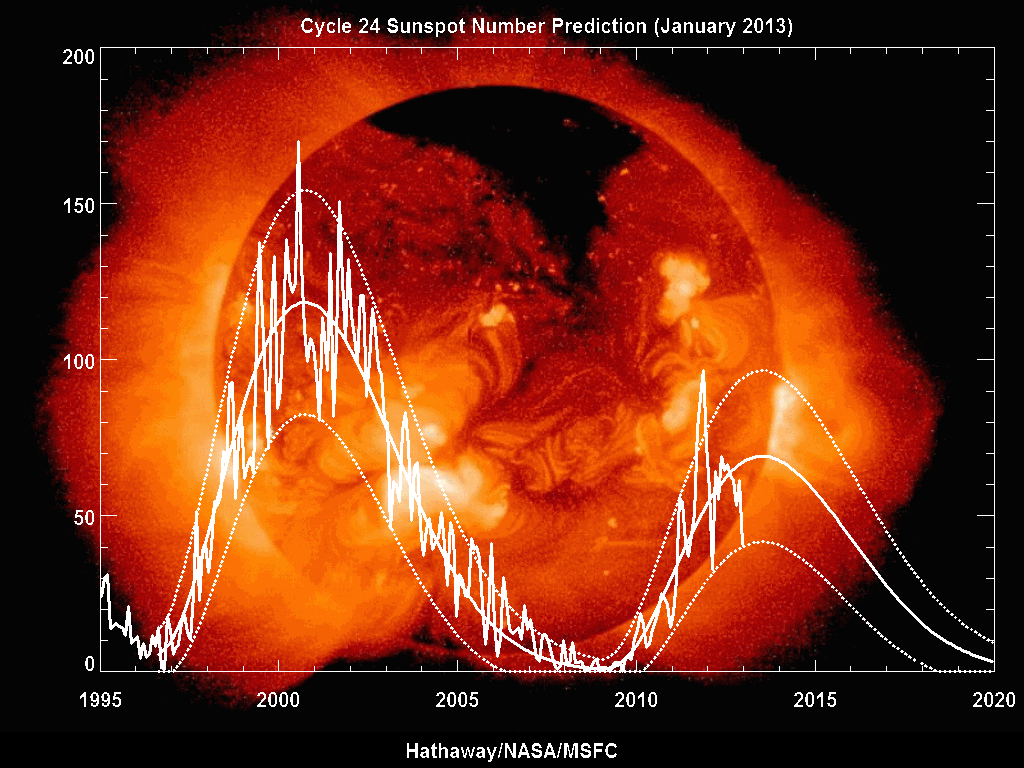
The January 2013 NASA forecast for the development of Solar Cycle 24 is out.

sc 24 prediction January 2013

SC 24 prediction Jan 2013 – Hathaway -NASA

The current prediction for Sunspot Cycle 24 gives a smoothed sunspot number maximum of about 69 in the Fall of 2013. The smoothed sunspot number has already reached 67 (in February 2012)due to the strong peak in late 2011 so the official maximum will be at least this high and this late. We are currently over four years into Cycle 24. The current predicted and observed size makes this the smallest sunspot cycle since Cycle 14 which had a maximum of 64.2 in February of 1906.

With sunspot activity at this low level the planet will cool. It remains to be seen whether this is the start of something like a Dalton Minimum (SC5 and 6) or even a Maunder Minimum. This cooling has begun and global temperatures peaked about 16 years ago and are now declining slightly while carbon dioxide concentration continues to increase. It is only a matter of time before the belief that carbon dioxide concentration (whether man-made or not) causes global warming will have to be completely discarded. But there is so much money now riding on this belief (and even though there is only conjecture and no direct evidence for this belief), that we will likely see a decade or more of rationalisation of reality before the belief is abandoned.

SC24 compared to SC5 in 2011 is shown below:

SC24 compared to SC5