Posts Tagged ‘global warming’

No sign of global warming in Great Lakes ice cover

April 25, 2014

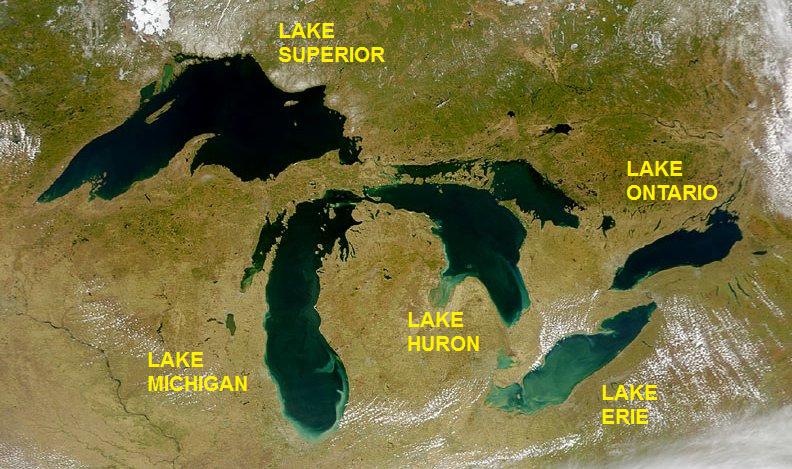
Great lakes (Wikipedia)

An exceptionally cold winter has seen the ice coverage over the Great Lakes being extremely high. Lake Superior has experienced the latest ever recorded start to shipping.

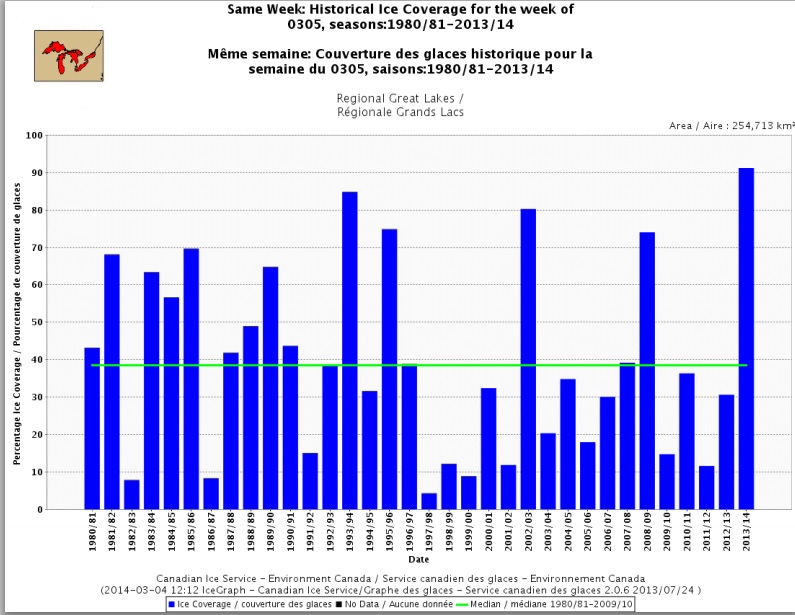
The total accumulated ice cover since 1980/81 and till 2013/14 shows no sign of any global warming. The season 2011/12 with its low ice cover was often “produced” as proof of global warming. By that standard of proof, 2013/14 clearly demonstrates that global cooling is upon us and a new ice age is on the way.

From Canadian Ice Service:

Historical Great Lakes Ice Cover 1980 - 2014

IPCC is still living in its world of “IF” and is stuck in denial

March 31, 2014

Institutionalised alarmism is difficult to stop. It has a momentum of its own.

There has been no global warming for almost 20 years.

The link between carbon dioxide as a significant cause of the non existent global warming is broken.

Yet, the IPCC has come out with part 2 of its wildly alarmist report.

Everything is based on IF.

Lead authors have resigned because the report is too alarmist.

The wolf is dead and they are still crying “Wolf”.

IF global warming continues we COULD be in trouble sometime after 2050.

BUT Global Warming has stalled and the IPCC is in denial

I just have to keep my head when others are losing theirs and dealing in lies-

If you can keep your head when all about you   
    Are losing theirs and blaming it on you,   
If you can trust yourself when all men doubt you,
    But make allowance for their doubting too;   
If you can wait and not be tired by waiting,
    Or being lied about, don’t deal in lies,
Or being hated, don’t give way to hating,
    And yet don’t look too good, nor talk too wise:
(Rudyard Kipling – IF)

Ice cover on the Great Lakes at an unprecedented (since 1980) high

March 4, 2014

Ice cover on the Great lakes typically reaches maximum in the second week of March and the median since 1980 is at about 40%.

This week ice cover reached over 90%. Maximum in a “normal” year would be reached in the second week of March.

Both the diagrams below are from the Canadian Ice Service with the first showing ice cover historically for this week (since 1980) and the second showing the ice cover for this season (2013/2014) with the median for 1980-2010. This season ice cover is running at more than twice the median values.

Historical Great lakes Ice Cover  week of 0304 Canadian Ice Service

Historical Great lakes Ice Cover week of 0304
Canadian Ice Service

Great Lakes Ice Cover Season 2013 - 2014 Canadian Ice Service

Great Lakes Ice Cover Season 2013 – 2014 Canadian Ice Service

Global warming contortionists will no doubt find strange and convoluted explanations to show that this massive increase of ice cover is not inconsistent with global warming. The missing heat could be hiding in the deep waters around the world and Nessie is probably running a fever.

Of course this massive increase of ice cover is also not inconsistent with the start of another Little Ice Age.

The most parsimonious explanation is that the climate and weather are going through their “natural variations” (due directly or indirectly to the Sun) and that there is no missing heat. Which leads to the obvious – but politically incorrect – conclusion that man-made global warming is – at most – insignificant.

Where is the evidence that man-made CO2 is the dominant cause of global warming?

March 1, 2014

Political correctness is fond of stating that there is “overwhelming” evidence of man-made global warming. They have repeated it so often that many actually believe it. The reality however is that there is no evidence beyond assumptions in models that

  1. Carbon dioxide concentration in the atmosphere has a significant impact on global warming
  2. man-made carbon dioxide emissions (which accounts for about 5% of all carbon dioxide emissions) is incontrovertibly the cause of the observed increase in atmospheric carbon dioxide concentration

Assumptions of the impact of carbon dioxide in models tend to show the assumed impact, but assumptions do not evidence provide.

Patrick Moore (a co-founder of Greenpeace) has been testifying to a Senate Sub-Committee.

Full Statement of Patrick Moore, Ph.D.

Before the Senate Environment and Public Works Committee, Subcommittee on Oversight – “Natural Resource Adaptation: Protecting ecosystems and economies”

February 25, 2014

Chairman Whitehouse, Ranking Member Inhofe, and members of the Committee. Thank you for the opportunity to testify at today’s hearing.

In 1971, as a PhD student in ecology I joined an activist group in a church basement in Vancouver Canada and sailed on a small boat across the Pacific to protest US Hydrogen bomb testing in Alaska. We became Greenpeace.

After 15 years in the top committee I had to leave as Greenpeace took a sharp turn to the political left, and began to adopt policies that I could not accept from my scientific perspective. Climate change was not an issue when I abandoned Greenpeace, but it certainly is now.

There is no scientific proof that human emissions of carbon dioxide (CO2) are the dominant cause of the minor warming of the Earth’s atmosphere over the past 100 years. If there were such a proof it would be written down for all to see. No actual proof, as it is understood in science, exists.

The Intergovernmental Panel on Climate Change (IPCC) states: “It is extremely likely that human influence has been the dominant cause of the observed warming since the mid-20th century.” (My emphasis)

“Extremely likely” is not a scientific term but rather a judgment, as in a court of law. The IPCC defines “extremely likely” as a “95-100% probability”. But upon further examination it is clear that these numbers are not the result of any mathematical calculation or statistical analysis. They have been “invented” as a construct within the IPCC report to express “expert judgment”, as determined by the IPCC contributors.

These judgments are based, almost entirely, on the results of sophisticated computer models designed to predict the future of global climate. As noted by many observers, including Dr. Freeman Dyson of the Princeton Institute for Advanced Studies, a computer model is not a crystal ball. We may think it sophisticated, but we cannot predict the future with a computer model any more than we can make predictions with crystal balls, throwing bones, or by appealing to the Gods.

Perhaps the simplest way to expose the fallacy of “extreme certainty” is to look at the historical record. With the historical record, we do have some degree of certainty compared to predictions of the future. When modern life evolved over 500 million years ago, CO2 was more than 10 times higher than today, yet life flourished at this time. Then an Ice Age occurred 450 million years ago when CO2 was 10 times higher than today.

There is some correlation, but little evidence, to support a direct causal relationship between CO2 and global temperature through the millennia. The fact that we had both higher temperatures and an ice age at a time when CO2 emissions were 10 times higher than they are today fundamentally contradicts the certainty that human-caused CO2 emissions are the main cause of global warming.

Today we remain locked in what is essentially still the Pleistocene Ice Age, with an average global temperature of 14.5°C. This compares with a low of about 12°C during the periods of maximum glaciation in this Ice Age to an average of 22°C during the Greenhouse Ages, which occurred over longer time periods prior to the most recent Ice Age. During the Greenhouse Ages, there was no ice on either pole and all the land was tropical and sub-tropical, from pole to pole. As recently as 5 million years ago the Canadian Arctic islands were completely forested.

Today, we live in an unusually cold period in the history of life on earth and there is no reason to believe that a warmer climate would be anything but beneficial for humans and the majority of other species. There is ample reason to believe that a sharp cooling of the climate would bring disastrous results for human civilization.
Moving closer to the present day, it is instructive to study the record of average global temperature during the past 130 years. The IPCC states that humans are the dominant cause of warming “since the mid-20th century”, which is 1950.

From 1910 to 1940 there was an increase in global average temperature of 0.5°C over that 30-year period. Then there was a 30-year “pause” until 1970. This was followed by an increase of 0.57°C during the 30-year period from 1970 to 2000. Since then there has been no increase, perhaps a slight decrease, in average global temperature. This in itself tends to negate the validity of the computer models, as CO2 emissions have continued to accelerate during this time.

The increase in temperature between 1910-1940 was virtually identical to the increase between 1970-2000. Yet the IPCC does not attribute the increase from 1910-1940 to “human influence.” They are clear in their belief that human emissions impact only the increase “since the mid-20th century”. Why does the IPCC believe that a virtually identical increase in temperature after 1950 is caused mainly by “human influence”, when it has no explanation for the nearly identical increase from 1910-1940?

It is important to recognize, in the face of dire predictions about a 2°C rise in global average temperature, that humans are a tropical species. We evolved at the equator in a climate where freezing weather did not exist. The only reasons we can survive these cold climates are fire, clothing, and housing. It could be said that frost and ice are the enemies of life, except for those relatively few species that have evolved to adapt to freezing temperatures during this Pleistocene Ice Age. It is “extremely likely” that a warmer temperature than today’s would be far better than a cooler one.

I realize that my comments are contrary to much of the speculation about our climate that is bandied about today. However, I am confident that history will bear me out, both in terms of the futility of relying on computer models to predict the future, and the fact that warmer temperatures are better than colder temperatures for most species.

If we wish to preserve natural biodiversity, wildlife, and human well being, we should simultaneously plan for both warming and cooling, recognizing that cooling would be the most damaging of the two trends. We do not know whether the present pause in temperature will remain for some time, or whether it will go up or down at some time in the near future. What we do know with “extreme certainty” is that the climate is always changing, between pauses, and that we are not capable, with our limited knowledge, of predicting which way it will go next.

Thank you for the opportunity to present my views on this important subject.

Attached please find the chapter on climate change from my book, “Confessions of a Greenpeace Dropout: The Making of a Sensible Environmentalist”. I would request it be made part of the record.

Click here for Moore’s full chapter excerpt. (pdf)
Great Lakes ice cover approaching highest levels for twenty years

February 8, 2014

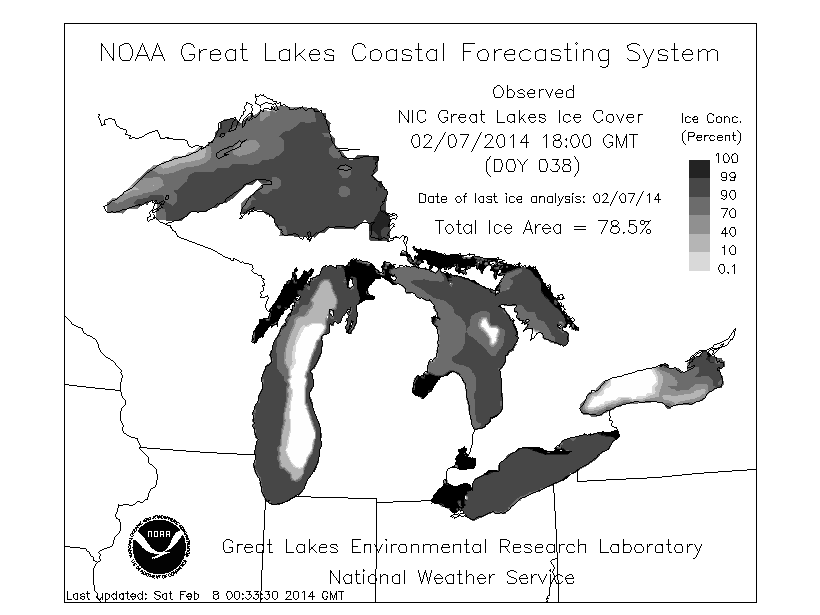
The Great Lakes ice cover on 7th February had reached 78% and will continue increasing in the coming days – at least until the 3rd week of February (Source: NOAA).

Gl Ice 7th February 2014 NOAA

Gl Ice 7th February 2014 NOAA

Having a high ice cover is apparently a “good thing” . Jeff Masters writes:

The increased ice coverage on the Great Lakes this winter is good news for water levels on the lakes, which are still struggling to recover from some record lows recorded at this time last year. During January 2013, water levels on Lake Michigan and Lake Huron fell to their all-time lowest values since record keeping began in 1918, 29 inches below the long-term average. While the water levels recovered substantially during 2013, which was one of the wettest years in Michigan’s history, water levels were still a foot below average at the beginning of 2014. The above average ice cover this winter will reduce evaporation from the Great Lakes, keeping water loss lower than in recent winters. 

I suppose one can have too much of a good thing and that being completely frozen for too long a time is not a “good thing”.

Historically the ice cover is approaching the highest levels seen for over 20 years. (From Canadian Ice Service)

Great Lakes Ice february 4th 2014 - Canadian Ice Service

Great Lakes Ice february 4th 2014 – Canadian Ice Service

If there is a global warming (or global cooling) signal in this chart – I can’t see it. The natural variations are of an amplitude which hides any such signal – if it exists. Whenever weather observations – however extreme – are still within the envelope of what has been observed before it only shows that such observations are not unprecedented and must be taken as to be within natural variations. And if what is observed has also been observed before the industrial revolution – say 200 years ago – then industrialisation cannot be blamed.

Meteorologist Mark Torregrossa writes:

Ice continued to build this past week on the Great Lakes due to the cold air and temperatures staying below freezing, and Lake Superior’s new record shows it.

The lake is 92 percent frozen, toppling a 20-year-old record of 91 percent set on Feb. 5, 1994. That statistic helped total Great Lakes ice cover soar, and we can expect to see more form in coming days.

The air temperatures this past week averaged around five degrees below normal for the Great Lakes area. This amount of deviation from normal means it was a fairly cold week.

….. 

Lake Superior

Lake Superior is almost frozen over as of yesterday February 5, 2014. Lake Superior is 92 percent covered with ice now. The ice has increased rapidly in the past week, from 76 percent ice cover on January 30, 2014. The high resolution satellite picture from February 3, 2014 shows all of the ice cover on Lake Superior. The current ice cover on Lake Superior is the highest amount ever for February 5. In 1994, Lake Superior was reportedly 91 percent covered in ice.

Lake Michigan

Lake Michigan is now 51 percent covered with ice, as opposed to 42 percent at this time last week. Coyotes were seen walking on the ice just offshore of Chicago this week. This makes us wonder if the lakes freeze over totally, will animals from Canada be able to cross over Lake Huron or Lake Superior, and enter Michigan. It is thought that this is how the last wolverine spotted in Michigan made it into Michigan. Lake Michigan has been covered with more ice on this date in the past. In 1977 and 1996, Lake Michigan was up to 74 percent ice covered.

Lake Huron

Ice cover on Lake Huron rocketed up an additional 14 percent this week, climbing to a total ice cover of 86 percent. If the ice continues to build at that rate in this next week, Lake Huron could be almost frozen over, or frozen over by the end of next week. People ice fishing are reporting 24 inches of ice on Saginaw Bay near Bay City. Lake Huron has been as much at 95 percent covered in ice on this date back in 1981 and 1994.

Lake Erie

Lake Erie is the shallowest of the Great Lakes, with an average depth of 62 feet and a maximum depth of 210 feet. It also has the least volume of any Great Lake, with 116 cubic miles of water. So it should come as no surprise that Lake Erie currently has the highest percentage of ice cover. Lake Erie is 96 percent covered with ice. Last week at this time Lake Erie had 94 percent ice cover. Erie was entirely ice covered on February 5, 1996.

Lake Ontario

Lake Ontario is an interesting lake. It is the smallest Great Lake when it comes to surface area, but actually holds more than three times the amount of water when compared to Lake Erie. The average depth of Lake Ontario is 283 feet, making it the second deepest Great Lake behind Lake Superior. The deepest spot in Lake Ontario is 802 feet. The ice cover on Lake Ontario is the lowest of any of the Great Lakes, with only 32 percent covered in ice. Last week at this time, Lake Ontario had 27 percent ice cover. Lake Ontario has been covered with as much as 79 percent ice up to this point in the winter in 1994.


Climate warming due to humans is highly uncertain says new paper in Science

February 2, 2014

The level of uncertainty in this supposedly “settled” science never fails to amaze. But I observe that it is beginning to be politically acceptable to talk about the uncertainties and even – as in this paper – to begin to question the significance of human activities on climate.

“Climate Effects of Aerosols-Cloud Interactions. Daniel Rosenfeld, Steven Sherwood, Robert Wood, Leo Donner. Science VOL 343, 24 JANUARY 2014

Abstract: Aerosols counteract part of the warming effects of greenhouse gases, mostly by increasing the amount of sunlight reflected back to space. However, the ways in which aerosols affect climate through their interaction with clouds are complex and incompletely captured by climate models. As a result, the radiative forcing (that is, the perturbation to Earth’s energy budget) caused by human activities is highly uncertain, making it difficult to predict the extent of global warming (12). Recent advances have led to a more detailed understanding of aerosol-cloud interactions and their effects on climate, but further progress is hampered by limited observational capabilities and coarse-resolution climate models.

The paper is behind a pay-wall but the accompanying press release begins “The warming effect of human-induced greenhouse gases is a given, but to what extent can we predict its future influence?”. I have no doubt that “greenhouse gases” in the atmosphere have a small warming effect but evidence is still lacking even for this simple statement because the carbon balance of the earth is still far from certain and the extent to which fossil fuel combustion contributes to the carbon dioxide concentration is still not certain. So while the warming effect of  greenhouse gases is established, its magnitude is not and the impact of humans on the concentration is also not yet certainly established. In fact, the primary contributors to the “greenhouse effect” are still water vapour and clouds but clouds also cause significant cooling by blocking insolation. Carbon dioxide by itself is almost of minor consequence and the weakness of climate models has always been that they make unjustified assumptions for the forcing effects of carbon dioxide. The pause in warming over the last 17-18 years and the slight decline in global temperatures for the last decade – while carbon dioxide concentrations have been steadily increasing – is a further indicator that the warming effect of carbon dioxide has been grossly exaggerated.

The Press Release goes on:

…… Indeed, one could say that the picture is a “cloudy” one, since the determination of the greenhouse gas effect involves multifaceted interactions with cloud cover.

To some extent, aerosols –- particles that float in the air caused by dust or pollution, including greenhouse gases – counteract part of the harming effects of climate warming by increasing the amount of sunlight reflected from clouds back into space. However, the ways in which these aerosols affect climate through their interaction with clouds are complex and incompletely captured by climate models, say the researchers. As a result, the radiative forcing (that is, the disturbance to the earth’s “energy budget” from the sun) caused by human activities is highly uncertain, making it difficult to predict the extent of global warming.

And while advances have led to a more detailed understanding of aerosol-cloud interactions and their effects on climate, further progress is hampered by limited observational capabilities and coarse climate models, says Prof. Daniel Rosenfeld of  the Fredy and Nadine Herrmann Institute of Earth Sciences at the Hebrew University of Jerusalem, author of the article in Science. ….. 

Their recent studies have revealed a much more complicated picture of aerosol-cloud interactions than considered previously. Depending on the meteorological circumstances, aerosols can have dramatic effects of either increasing or decreasing the cloud sun-deflecting effect, the researchers say. Furthermore, little is known about the unperturbed aerosol level that existed in the preindustrial era. This reference level is very important for estimating the radiative forcing from aerosols.

Also needing further clarification is the response of the cloud cover and organization to the loss of water by rainfall. Understanding of the formation of ice and its interactions with liquid droplets is even more limited, mainly due to poor ability to measure the ice-nucleating activity of aerosols and the subsequent ice-forming processes in clouds.

Needless to say they end up asking for more funds:

While it is unfortunate that further progress on understanding aerosol-cloud interactions and their effects on climate is limited by inadequate observational tools and models, achieving the required improvement in observations and simulations is within technological reach, the researchers emphasize, provided that the financial resources are invested. 

Thank goodness for Prince Charles

January 31, 2014

I am a fairly sceptical sort – on most things and not just about global warming. I am not impressed by ungrounded statements and I tend to dislike appeals to authority.

He is generally quite harmless and now getting frustrated with his mother’s refusal to abdicate. But I also rely on Prince Charles as the ultimate non-authority on everything he cares to open his mouth about. Among other things he believes in Kabbalistic teachings, herbal medicine and homeopathy. He was an avid fox hunter (now banned and he is therefore against it) and seems to approve of Robert Mugabe!

So I do not mind being called a headless chicken, and since it is from Prince Charles, I can take it as an accolade.

The Guardian (where else):

Climate change sceptics are ‘headless chickens’, says Prince Charles

“It is baffling, I must say, that in our modern world we have such blind trust in science and technology that we all accept what science tells us about everything – until, that is, it comes to climate science,” 

It does not take much to baffle him, and in any case it is best as a future King of England that he not think too much for himself.

Heavyweights in Europe backing away from “green” follies

January 27, 2014

The beginning of the end of “green” profligacy? Perhaps – but the EU is still dominated by earnest, self-righteous, politically correct, fanatical, “green” fantasists.

Nevertheless it is a change of political climate in the right direction – from angry, hot alarmism  to a healthy, cold scepticism.

Lobby groups such as Greenpeace and Friends of the Earth are not pleased. And that itself is a good sign. After all – as the great sage John Gummer has pointed out – such groups have been infiltrated and taken over by the Trotskyites.

The inanity of those who would connect weather with global warming is stupefying. I don’t call it “climate change” since if change could include “global cooling” all the warmists would be left without any faith and be out of a job. 

  1. ‘We must not demonise coal’ – German environment minister
  2. UK: Climate scepticism blamed as Owen Paterson slashes spending on global warming
  3. UK: David Cameron pledges to rip up green regulations

Germany:

Germany’s environment minister, Barbara Hendricks, says coal-fired power is important to the country’s economic security and should not be subject to extreme negativity.

In a separate development, Ms Hendricks told Power Engineering International that a court decision, which found the forced shutdown of the Biblis nuclear power plant to be illegal, would not have any impact on Germany’s plans to wind down its nuclear power industry. Speaking to Frankfurter Rundschau, Ms Hendricks said that while the energy transition’s dependence on coal power was ‘undesirable’, it was necessary for the country’s stability, particularly as “we can no longer expect gas to flexibly complement eco-energy.”

“Gas is unprofitable while coal is booming. We must not demonize coal. We still need to transition to a guarantee security of supply.”

She added that ‘rectivating’ the energiewende meant tacking the undesirable development of coal’s eminence. However this, she said, is to be a long term goal governed by market mechanisms/ETS. ETS, which would have to be reactivated. 

In her view backloading of 900 million ETS-certificates is to be a first step even if it is not enough. “The two billion CO2 allowances, which are too much on the European market, must be permanently removed. The 900 million ETS certificates, for which the EU has recently decided on an interim basis, are not enough. We will aggressively fight in the EU for a functioning CO2 trading system.”

UK:

The Department for Environment, Food & Rural Affairs (Defra) will spend just £17.2m on domestic “climate change initiatives” this financial year, a 41 per cent decline on the previous 12 months, according to its response to a freedom of information request. …. 

The dramatic cut in domestic climate change spending comes in Mr Paterson’s first full-year as Environment Secretary – he took up the post in September 2012 . The spending now represents just 0.7 per cent of the department’s total budget for the year, down from 1.2 per cent last year.

Defra is in charge of preparing, or adapting, Britain for global warming, while the Department for Energy and Climate Change is responsible for mitigating the risks. ….  One source who worked with the Environment Secretary said: “Adapting to climate change in itself is not a priority for Owen Paterson. He doesn’t believe that floods have anything to do with climate change, so he calls the biggest aspect of adaptation ‘flood management’. When you talk to him, you don’t use words like ‘adaptation’ – instead you talk about the economic impacts and opportunities and present it as a market solution.”

UK:

David Cameron will on Monday boast of tearing up 80,000 pages of environmental protections and building guidelines as part of a new push to build more houses and cut costs for businesses.

In a speech to small firms, the prime minister will claim that he is leading the first government in decades to have slashed more needless regulation than it introduced.

Climate “scientists” begin to acknowledge the obvious

January 16, 2014

It is obvious that the source of all heat is the Sun and that nuclear reactions in the earth’s interiror producing heat – if any – are negligible in comparison.

It seems equally obvious, considering the relative heat capacities of air with that of water, that the primary vehicle for the storage and distribution of the heat emanating from the sun, around the earth, is first by the oceans and only second via the atmosphere. The heat absorbed is attenuated by clouds. The heat lost from the earth is also primarily attenuated by clouds and only marginally by other constituents of the atmosphere.

But climate models have generally minimised solar insolation effects and largely ignored the oceans. Heat losses have been predicated primarily on carbon dioxide and other trace constituents of the atmosphere and have ended up treating the net effects of clouds as causing warming rather than cooling. Whither common sense!!

But the current “hiatus” in global warming – which may well become 2 or 3 decades of cooling  – is beginning to bring a whiff of reality into the “science”. They don’t acknowledge the possibility of cooling, of course, and don’t give up on their carbon dioxide fantasies but they are beginning to pay some attention to the oceans and the Sun.

But now they reckon models must be judged on a timescale of 50 – 100 years!

But note the phrase “sceptics and some scientists”! I thought scientists were supposed to be sceptical. Science based on belief leaves a little to be desired.

The heat is actually non-existent but the euphemism for that is “missing heat”.

Climate change: The case of the missing heat

Nature 505, 276–278 (16 January 2014),  doi:10.1038/505276a

… Average global temperatures hit a record high in 1998 — and then the warming stalled.

For several years, scientists wrote off the stall as noise in the climate system: the natural variations in the atmosphere, oceans and biosphere that drive warm or cool spells around the globe. But the pause has persisted, sparking a minor crisis of confidence in the field. Although there have been jumps and dips, average atmospheric temperatures have risen little since 1998, in seeming defiance of projections of climate models and the ever-increasing emissions of greenhouse gases. Climate sceptics have seized on the temperature trends as evidence that global warming has ground to a halt. Climate scientists, meanwhile, know that heat must still be building up somewhere in the climate system, but they have struggled to explain where it is going, if not into the atmosphere. Some have begun to wonder whether there is something amiss in their models.

Now, as the global-warming hiatus enters its sixteenth year, scientists are at last making headway in the case of the missing heat. Some have pointed to the Sun, volcanoes and even pollution from China as potential culprits, but recent studies suggest that the oceans are key to explaining the anomaly. The latest suspect is the El Niño of 1997–98, which pumped prodigious quantities of heat out of the oceans and into the atmosphere — perhaps enough to tip the equatorial Pacific into a prolonged cold state that has suppressed global temperatures ever since. …… 

….. But none of the climate simulations carried out for the IPCC produced this particular hiatus at this particular time. That has led sceptics — and some scientists — to the controversial conclusion that the models might be overestimating the effect of greenhouse gases, and that future warming might not be as strong as is feared. Others say that this conclusion goes against the long-term temperature trends, as well as palaeoclimate data that are used to extend the temperature record far into the past. And many researchers caution against evaluating models on the basis of a relatively short-term blip in the climate. “If you are interested in global climate change, your main focus ought to be on timescales of 50 to 100 years,” says Susan Solomon, a climate scientist at the Massachusetts Institute of Technology in Cambridge. …….

….

Climate – the second derivative

January 14, 2014

Change changes.

We take global temperature (which exists nowhere and is merely a numerical construct) as climate. When global temperature is not constant we call it climate change. When “climate change” starts to change (as now from warming to cooling) we are into the second derivative. The turbulence at the time of the change of climate change we call “extreme events”.

Changing climate change

Changing climate change

These articles do not say very much new but they are quite extraordinary in that they are carried by the Sydney Morning Herald and Real Clear Politics, who have been staunch supporters of global warming orthodoxy.

The Ship of Fools in the Antarctic seems to have been a “tipping point” – not for climate or for climate change or for the change in climate change – but maybe for bringing some reality back into how climate is reported. (Incidentally, the Akademik Shokalskiy managed to get free of the ice and reached New Zealand but Turney’s tourists who were so dramatically rescued are still stuck at Casey station in the Antarctic and are not due back home for another 10 days!!!!!)

Sydney Morning HeraldGame finally up for carboncrats

It was promoted as the voyage to study the melting of ice sheets in the South Pole as well as to retrace Douglas Mawson’s perilous expedition a century ago. Yet the Australasian Antarctic Expedition, led by UNSW climatologist Chris Turney, has become a comedy goldmine. …..

Real Clear PoliticsShip of Fools in the Antarctic

In the mega-bestseller of the 15th century, “Das Narrenschiff,” Swiss lawyer Sebastian Brant satirized the pretensions, delusions and follies of his day through descriptions of passengers on a ship bound for “Narragonia.” Brant’s depiction of humanity as a ship of fools sailing without rudder or compass captured the imagination, inspiring a painting by Hieronymous Bosch, a song by the Grateful Dead.

So when the research ship Akademik Shokalskiy got stuck in the ice about 40 miles from Antarctica, some who knew the purpose of its voyage dubbed it the “Ship of Fools.” ……

Real Clear PoliticsFreezing Is the New Warming

This is looking like another bad year for global warming.

The year began with the news that an Australian “climate researcher” leading a tourist expedition to Antarctica got his ship trapped in the sea ice. Which is embarrassing, because the purpose of his expedition was to study the melting of sea ice supposedly caused by 20th-century global warming. The current expedition was meant to retrace the route Douglas Mawson took in 1912—but they were stopped 70 kilometers short of where Mawson landed. So they needed to have an icebreaker ship sent to rescue them. Then the icebreaker got caught in the ice, and someone had to rescue the rescuers. You can’t make this stuff up. …… 

The New York Times and Der Spiegel have started backing away from the orthodoxy towards reality – but very slowly. The Guardian, Washington Post and the BBC are among those who are still stuck in a fantasy world.