Posts Tagged ‘IPCC’

IPCC: the best headlines

September 28, 2013

I particularly liked the headline in Andrew Orlowski’s article in The Register!

IPCC: Yes, humans are definitely behind all this global warming we aren’t having

Some other winners:

IPCC report: Britain could cool if Gulf Stream slows 

THE DISCLAIMER THAT SHOULD BE ADDED AT THE TOP OF EACH IPCC REPORT

Band-aids Can’t Fix the New IPCC Report

IPCC AR5 Press Release: Oceans Ate “More Than 90% Of The Energy Accumulated Between 1971 And 2010″! 

and of course my own:

IPCC = International Promotion of Global Warming

IPCC = International Promotion of Global Warming

September 28, 2013

It is quite wrong to think of the IPCC as some august body looking objectively at Climate Change and what causes climate to change. They only operate as a PR agent – under the cloak of consensus science – for the Global warming hypothesis. Global cooling hypotheses or – in fact – any hypotheses other than carbon dioxide being the controller of global temperature are given short shrift. Even real observations and all global cooling trends are ignored. Global warming models take precedence over real data. The Sun is ignored. Climate sensitivities is apparently too new a topic to be considered.

They do not just cherry pick data; they just ignore it when they represent inconvenient truths. The last 17 years with no global warming are merely dismissed as being for too short a period. But then the IPCC has only been in operation for 25 years. The IPCC has not looked up from its computer models to realise that for most of its life it has seen no global warming.

If the IPCC was really looking at climate change and not just promoting the idea of global warming they might have shown some interest in the climate trend-break which seems to have occurred about 15 years ago. But a trend-break would be heretical. Their dismissal yesterday of the last 15 – 18 years was disgraceful. How, after such real observations, they are more certain than ever that global warming continues and that carbon dioxide is the culprit, is not rational and can only be “wishful thinking” (to put the best interpretation on it).

(data below generated using woodfortrees interactive database)

Global temperatures since 1850

Global temperatures since 1850

And how their certainty about carbon dioxide being the prime culprit can be increased with the reality of temperatures declining in the last 15 or so years  boggles rationality. Except of course that their certainty is based on climate models and cannot be bothered by real observations.

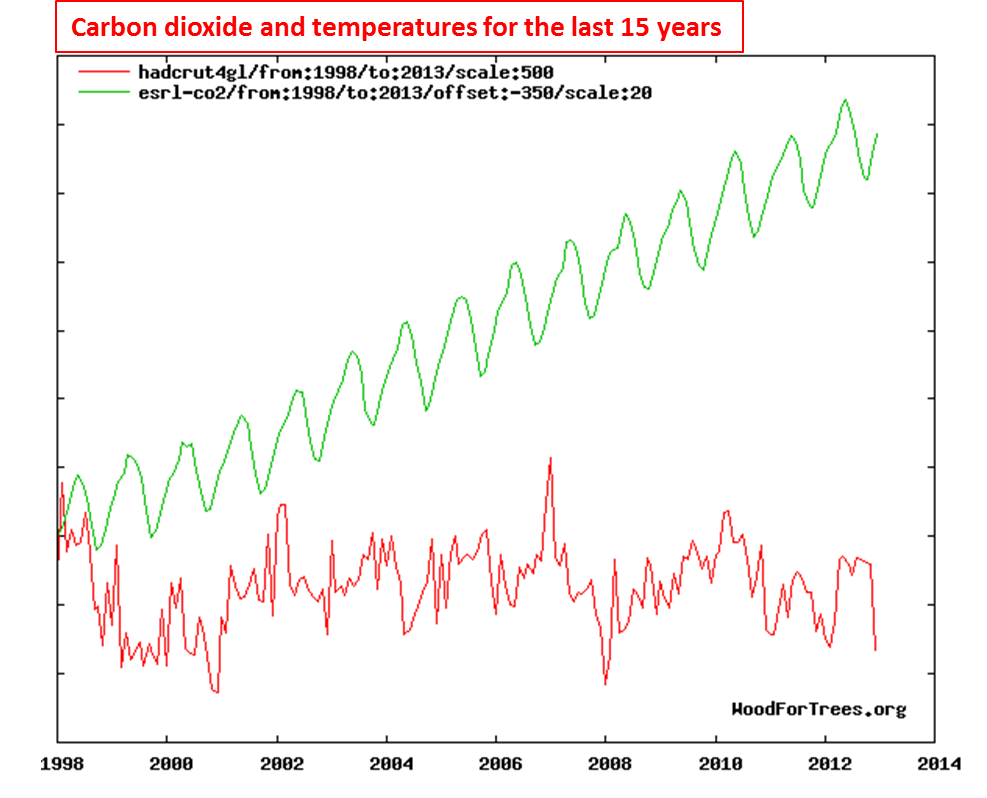
CO2 and global temperatures 1998-2013

CO2 and global temperatures 1998-2013

IPCC will ignore hiatus in global warming until it has gone on for 30 years!

September 27, 2013

I have been watching the IPCC press conference and it seems to me that they were very much on the defensive:

  1. they felt that had no option but to mention the hiatus in global warming,
  2. they decided to underplay its significance along a number of fronts
    • the period was too short
    • hiatus was not significant untill it had existed for 30 years
    • 1998 was a very special El Nino year
    • the intervening period had other factors (volcanic activity for example) which could have contributed to cooling
  3. they have rejected the very high sea level rise scenarios but assign no probability because there is no consensus
  4. they are following the line that “it is not important to know where we are now because we are certain about where we will end up in 20 or 30 years”
  5. sensitivities is an emerging subject and there is no consensus
  6. it is still correct to follow the one dimensional greenhouse gas view of global warming.

All in all a rather predictable performance  with a clear task of “protecting the models”.

IPCC still cooking it’s books to cover-up the inconvenient truths

September 27, 2013

The 95% probability/certainty of global warming being due to human activity is based on a show of hands and not on any evidence or statistical analysis of data. What it actually says is that 95% of all global warming believers, believe.

Late last night the IPCC delegates in Stockholm were still messing around preparing their 30 page political summary of their AR5 report to be released today.

The political summary of AR5 is primarily a CYA effort to protect the posteriors of the policy makers (mainly political figures, bureaucrats and activists) in the face of a long row of broken models and broken hypotheses. The IPCC has forgotten that natural variability is a euphemism for unknown mechanisms which cannot be calculated or predicted. It is going to be interesting to see just how the summary report will cover-up, deny or ignore the long string of inconvenient facts:

  • Global temperatures have not risen for 17-18 years while CO2 has kept on increasing. 
  • Global temperatures have been declining for the last 11 years. 
  • None of the IPCC’s computer models have predicted the warming hiatus or the cooling over the last decade.
  • Global wildfires are lower than normal. 
  • Rainfall patterns (and the Indian monsoon) continue within the bounds of known natural variability. 
  • Food and grain production is at an all-time high. 
  • Flood frequency and flood levels have not been at unprecedented levels. Just more people live in flood-plains today than before. 
  • CO2 in the atmosphere reached the magic level of 400 ppm (albeit for just a few hours) and nothing happened.
  • How much of the CO2 concentration increase is due to carbon dioxide from fossil fuel. combustion is unclear but fossil fuel emissions are only 5% of global carbon dioxide emissions. 
  • The absorption and release of carbon dioxide by the oceans is unknown and the error margin is greater than the total amount released by fossil fuels.
  • CO2 absorption mechanisms do not care where the CO2 being absorbed came from.
  • The sensitivity of global temperature to CO2 concentration has been grossly exaggerated by the computer models.
  • Carbon dioxide concentration is more likely to follow global temperature (due to subsequent changes in emission and absorption rates) than to lead it.
  • Sea ice levels are increasing at both poles with the Antarctic at record high levels.
  • Polar bear populations are thriving and increasing.
  • Sea levels are continuing to rise at just the historical levels due to the recovery from the last glacial and are not accelerating due to industrialisation or the use of fossil fuels.
  • Oceans are still strongly alkaline and any increase in acidity is within known natural variability.
  • Coral reefs have shown themselves to be self-healing when damaged and are not showing any signs of ocean acidification.
  • Climate models have grossly underestimated solar effects because the mechanisms are unknown.
  • Sunspot activity in SC24 is well down from SC 23 and is not unlike the period of the dalton minimum during SC5 and SC6.
  • Clouds and moisture in the atmosphere have a much bigger impact on global warming and cooling than CO2 in the atmosphere.
  • Cloud formation is linked to sunspot activity and cosmic rays.
  • Global warming and cooling follow solar effects via the oceans in long decadal cycles.
  • The number of hurricanes and tornadoes are at historically low levels.
  • Heat released from the earth’s interior by tectonic and volcanic activity is not known.
  • A Little Ice Age is more likely than further Global Warming and a global cooling cycle lasting 20-30 years may have begun.
  • This interglacial is due (within c. 1000 years) to come to an end.

There is more we don’t know that we don’t know about the climate than the IPCC would like to admit. And for policy makers, activists and bureaucrats who have followed misguided policies for the last 25 years it is no longer possible to admit that they have been making “certain” predictions in an ocean of uncertainty. They have replaced scientific objectivity by “consensus science” where the validity of a hypothesis is based on how many believe and not on evidence. The 95% probability/certainty of global warming being due to human activity being touted by the IPCC is based on a show of hands of believers, and not on any evidence or statistical analysis of data.

Nature hypes the IPCC

September 24, 2013

It could not have escaped anybody’s notice that the summary of the IPCC’s 5th Assessment Report (AR5) is due out at the end of this week in Stockholm on 27th September. The hype around this release is building up and by all the usual suspects. And the prime suspect is Nature. It has released a special issue on the 25 years of the IPCC. But nearly all these usual outlets are all in a state of denial or cover-up or both.

The IPCC faces a dilemma. Should they mention that while carbon dioxide keeps increasing global temperatures have been at a standstill and their fantasised link between fossil fuel combustion and global temperature seems to be broken. Not likely since the usual suspects have far too much invested in this hypothesis. Should they just ignore that global warming has stalled for the last 17 years and lose even more of their fast evaporating credibility. Or should they mention it and then enter into an orgy of contortion to show that their models are still valid because the missing heat has been swallowed by the Monsters of the Deep. It looks like they will choose the latter since the contortions have already begun.

The simple but inconvenient truth is that the IPCC has misled and wasted the world’s resources for  25 years.

Nature Special Issue

OUTLOOK FOR EARTH: A NATURE SPECIAL ISSUE ON THE IPCC
This Nature special issue explores the Intergovernmental Panel on Climate Change (IPCC) – an international body of hundreds of scientists and policy experts that regularly assesses the state of knowledge about how climate is changing, what impacts that will have, and how nations can mitigate the problem. A graphical introduction chronicles the history of the IPCC and how climate science has evolved over the past 25 years. One news feature examines the latest research on rising sea levels and another profiles Ottmar Edenhofer, a leader of the IPCC’s upcoming report on mitigation. In a Commentary, Elliot Diringer proposes that individual actions by nations to tackle the causes of climate change can set the stage for international action. And K. John Holmes looks at the history of large-scale environmental assessments.
Image credit: Carl De Torres


FEATURES

Outlook for Earth

As the IPCC finalizes its next big climate-science assessment, Nature looks at the past and future of the planet’s watchdog.

25 years of the IPCC

A graphical tour through the history of the Intergovernmental Panel on Climate Change and the science that underlies it.

Rising tide

Researchers struggle to project how fast, how high and how far the oceans will rise.

The climate chairman

Getting hundreds of experts to agree is never easy. Ottmar Edenhofer takes a firm, philosophical approach to the task.

COMMENT

A patchwork of emissions cuts

Home-made national approaches can be effective for climate-change mitigation if countries agree on rules and build trust, says Elliot Diringer.

Pushing the climate frontier

The first large-scale environmental surveys, carried out on the US arid lands, hold scientific lessons for policy-making still relevant today, explains K. John Holmes.


Move over Nessie! Make way for the Heat Monster in the deep oceans

September 23, 2013
Heat Monster of the Deep

Heat Monster of the Deep (Artist’s impression because it has never been seen)

Global warming has stalled. Global temperatures have been static and may have declined slightly over the last 17-18 years.

Antarctic ice extent is higher than it has been for many years.

Arctic ice extent has just reached its annual minimum and has grown by about 70% from last year’s low.

Polar bears are thriving. Sea levels are increasing ever so slightly and are matching the expected levels for the recovery from the last ice age. The oceans are not getting very acidic (and remain alkaline). Harvests are higher than they have ever been before. The world is feeding more people than ever before. The developing world is crying out for available and affordable energy.

Global warming has gone negative.

But Global Warmists, the IPCC and the policy makers who have been duped for the last 2 decades are in a state of complete denial.

The Guardian (who else?):

“The heat is still coming in, but it appears to have gone into the deep ocean and, frustratingly, we do not have the instruments to measure there,” said Professor Ted Shepherd of Reading University. “Global warming has certainly not gone away.”

How very scientific!

We know the warming is there because our models must be correct. We can’t see it, we can’t measure it and we don’t know how it got to the deep ocean from the surface but we are sure it’s there!!!!!! The Heat Monster of the Deep ate it.

We seem to have entered a cooling cycle – courtesy of the Sun – and settled climate science is reducing to inventing new monsters of the deep. We may even be entering a new Little Ice Age but the policy makers are continuing with useless measures to restrict carbon dioxide emissions which seem to have little impact – if any – on our climate cycles.

Move over Nessie!

The Heat Monster of the Deep is here. It comes to the surface every so often and swallows the heat and dives straight down to to the deep ocean.

Simple truths are becoming highly inconvenient for the IPCC

September 21, 2013

The simple truths are

  1. Global temperatures exhibit no warming for the last 17-18 years, and
  2. Carbon dioxide concentrations in the atmosphere have increased continuously during the same period  noting that man made carbon dioxide emissions constitute about (at most) 5% of all carbon dioxide emissions.

The tag of “Denier” is now shifting to the Global Warmists who are denying that there is a hiatus in “global warming”. And to those who deny that the causal link between carbon dioxide concentration and global warming – which itself is highly speculative – is now clearly broken.

The Global Warming brigade are now putting pressure on the IPCC and “learned” journals to conceal, cover up, explain away and generally deny these two simple truths for the upcoming release (in parts) of the AR5 report. It is a full-court denialist press to try and ensure that AR5 is not treated as scrap even before it is released.

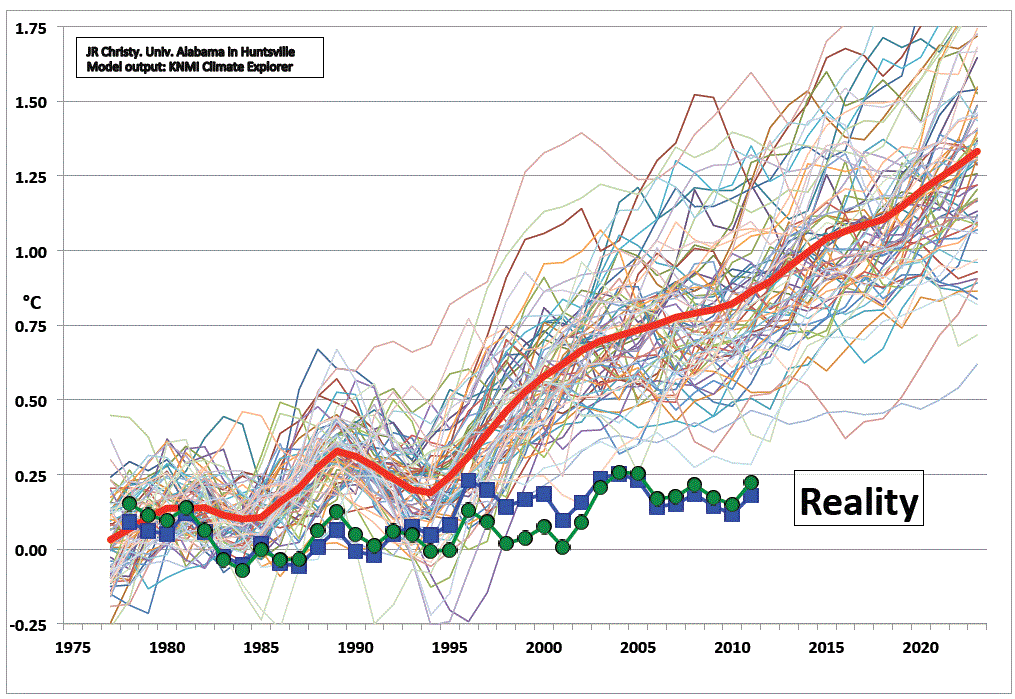
The reality of global temperatures is increasingly diverging from increasingly discredited climate models. In fact the reality of global temperature measurements since about 1978 would not provide any convincing evidence that any concern regarding “global warming” was justified.

Climate Models versus Reality

Not only are temperatures not increasing as the models  – and their religious adherents – would like but atmospheric concentrations of carbon dioxide have continued to increase unabated.

Global temparature and carbon dioxide – last 17 years

The two simple truths lead to two simple – but inescapable – conclusions

  1. There is no evidence that “global warming” is an irreversible phenomenon. There is no evidence either that global warming or global cooling are anything other than “natural” variations of climate.
  2. Carbon dioxide concentration in the atmosphere is not strongly indicated – if at all – as anything but a very small component of the very many which affect global temperature. The man made contribution to global carbon dioxide emissions itself  is about 5% of all carbon dioxide emissions.

The irony of global warmists now becoming the “hiatus deniers”

September 1, 2013

Denying the hiatus without being seen to deny it is now becoming the most important task facing the IPCC global warmists, That the “missing heat” cannot be found is a “travesty”! It could be hiding in the deep oceans or maybe it is in the deep mantle. It can’t be in the upper atmosphere because there we have measurements.

Perhaps it is just not there but that would be too simple!

The high priests of global warming are all joining the cult of the “hiatus deniers”.

Reblogged from P. Gosselin at NoTricksZone:

Die Welt Veteran Journalist: “Ignoring Warming Stop Would Be Ridiculous”, Missing Heat “Perhaps Just Doesn’t Exist”

Veteran journalist Ulli Kulke at German national daily Die Welt has a commentary at his Die Welt blog about the upcoming IPCC report. IPCC: Discuss or Ignore Warming Stop. He starts:

According to News Service Bloomberg it is currently being discussed whether to mention the ongoing 15-year pause in global in the 5th Assessment Report“ (AR 5) to be released in late September, or if perhaps it would be better to simply ignore it in order not to unnecessarily supply so-called ‘climate skeptics’ with ammunition.”

Alarmist scientists find themselves in a dilemma and aren’t sure what to do. They are eager to argue back against skeptics’s claims that the warming has stopped, yet are petrified of bringing it up. Some are saying it is simply best to ignore the pause in warming. But Kulke writes:

The attempt to keep the warming pause out of the ongoing discussion surrounding the upcoming AR 5 would be ridiculous. Semantic and formal splitting of hairs would not stick because it cannot be denied that also the In-group of the IPCC scientists have acknowledged the stop in warming – at least internally – and view this as the biggest problem. It is “a travesty” they cannot explain. That quote comes from Kevin Trenberth, a lead author of the 2001 and 2007 IPCC reports. […] In the meantime Trenberth suspects, according to his models, that the missing heat is somewhere in the depths of the oceans. But this is not certain in any way; perhaps it just doesn’t exist.”

Kulke then adds that the IPCC also will not be able to downgrade the warming pause to a mere weather event and claim that it has nothing to do with overall climate:

Just because it is still in the range of weather and has not yet reached the time span that one uses to discuss climate, ignoring the warming stop would also be outrageous because it would mean you couldn’t mention any weather event that is not at least 30 years long.”

If increasing frequency is the test that alarmists like to use, then it’s tough to get more frequent than every year over the last 15. You can’t claim a team is in a slump-trend after it has just won 15 games in a row.

For the alarmist IPCC scientists, it’s a damned-if-you-do, damned-if-you-don’t situation. Bringing up the warming stop surely will be ammo for the skeptics, but so would ignoring it. Should we feel sorry for them? I don’t think so. It was they themselves who maneuvered their own jewels between the jaws of the vise. Last chance to pull them out!

Global warming has “gone missing” and the IPCC is aked to explain

August 30, 2013

Heat does not hide. It always flows towards lower temperatures.

Global warmists are now scrambling to explain why global temperatures have not been rising for the best part of two decades even though carbon dioxide concentrations keep increasing. That man-made carbon dioxide emissions may not be as important as they have fantasised is heretical and not an acceptable explanation. Instead they claim that the warming has been going on all along but the “heat is hiding” probably in the deep oceans!  How on earth it got there remains a mystery. Has it never “hidden” there before? Why just the deep oceans? Why not in the Earth’s mantle?

In any event, the hiatus in global warming can no longer be denied. So much so that the IPCC is now being asked to explain. Even Bloomberg – a well established proponent of the orthodox global warming doctrine which has been among the hiatus deniers – can no longer maintain that position. The IPCC will make a convenient scapegoat. Bloomberg  now writes (though with many caveats):

U.S. and European Union envoys are seeking more clarity from the United Nations on a slowdown in global warming that climate skeptics have cited as a reason not to “panic” about environmental changes, leaked documents show.

They’re requesting that more details on the so-called “hiatus” be included in a key document set to be debated at a UN conference next month that will summarize the latest scientific conclusions on climate change. … ..

A draft of the summary and the underlying 2,200-page report from the UN Intergovernmental Panel on Climate Change were obtained by Bloomberg from a person with official access to the documents who declined to be further identified because it hasn’t been published.

Government envoys from around the world will debate the final wording of the summary at an IPCC meeting that starts in Stockholm on Sept. 23. That document, formally the Summary for Policymakers, is designed to be used by ministers working to devise by 2015 a global treaty to curb climate change. ….

… The current version of the summary needs more information about the hiatus, according to the EU and the U.S.

“The recent slowing of the temperature trend is currently a key issue, yet it has not been adequately addressed in the SPM,” the EU said, according to an official paper that includes all governmental comments on the draft report. The U.S. comment suggested “adding information on recent hiatus in global mean air temperature trend.”

Addressing the hiatus is important because skeptics of man’s influence on warming the planet have seized on the slowing pace temperature increase as evidence that scientists have exaggerated the impact of manmade greenhouse gases. That supports their assertion that there’s less need for expensive policies to curb carbon emissions from factories, vehicles and deforestation. …

The summary document notes that the rate of warming over the past 15 years “is smaller than the trend since 1951,” citing a rate of about 0.05 degrees Celsius per decade in the years 1998 through 2012. The rate was about 0.12 degrees per decade from 1951 through 2012. …

….. The slowdown came as emissions grew, with the concentration of carbon dioxide in the atmosphere this year exceeding 400 parts per million for the first time on record.

The draft report includes possible reasons for the slowing rate, including natural variability, volcanic eruptions and a drop in solar energy reaching the Earth.

“Much of the information is present but it requires a lot of effort on the part of the reader to piece it all together,” the 28-nation EU said in the comments document.

The U.S. requested clarity on the implications of the data, commenting “this is an example of providing a bunch of numbers, then leave them up in the air without a concrete conclusion.”

Norway, Denmark and China requested information on the role oceans have played in the slowdown.

Nature Editorial – All change but no change (because the heat is hidden)

August 29, 2013

A very peculiar Nature Editorial.

First they confirm that there has been a hiatus in global temperature.Then they report on recent papers trying to invoke ocean cycles and their impact on global temperatures. This is followed by a claim that this does not explain the “missing heat” but fail to say that there may be no “missing heat” at all if global warming has slowed-down or ceased. By assuming that there must be “missing heat” they then claim that the underlying science has not changed. The key point of course is that if ocean cycles can cause global cooling they can also cause global warming. Natural processes can then well explain all the temperature observations of the last 150 years. Carbon dioxide concentration in the atmosphere and the 5% of global emission that is man-made emissions of carbon dioxide become irrelevant and unnecessary to the explanations for changes to climate.

“Hidden heat” that cannot be found is just a convenient excuse to avoid having to scrap most of the existing climate models. And what Nature fails to mention is that if there is no “missing heat” then the entire edifice that is the man-made global warming hypothesis comes crashing down.

Nature: Hidden heat

Nature 500, 501 (29 August 2013), doi:10.1038/500501a

This week, Nature publishes a study online suggesting that a recent cooling trend in the tropical Pacific Ocean can explain the current hiatus in global warming. Authored by a pair of scientists at the Scripps Institution of Oceanography in La Jolla, California, the paper does not say why the Pacific seems to have entered a prolonged ‘La Niña’ phase, in which cooler surface waters gather in the eastern equatorial Pacific. It is also silent on where the missing heat is going. But it does suggest that this phenomenon — affecting as little as 8% of Earth’s surface — could temporarily counteract the temperature increase expected from rising greenhouse-gas emissions

(Y. Kosaka and S.-P. Xie  Nature, http://dx.doi.org/10.1038/nature12534; 2013).

Previous modelling studies have linked the pause to La-Niña-like conditions that have prevailed since 1999, suggesting that heat that would otherwise go into the atmosphere is getting buried deeper in the ocean. And scientists at the National Center for Atmospheric Research in Boulder, Colorado, have a study in the press indicating that decades in which global air temperature rises rapidly — including the 1980s and 1990s — are associated with warmer temperatures in the tropical Pacific, as exemplified by La Niña’s opposite effect, El Niño (G. A. Meehl et al. J. Climate http://doi.org/nkw; 2013). The Scripps researchers also confirmed that El-Niño-like conditions can boost global temperatures.

Scientists seem to be homing in on an important lever in the climate system. And none too soon. Although a prolonged hiatus in warming does not necessarily contradict prevailing theory, this one came as a surprise and has been used to discredit the climate-science community. The story will probably not end there. Scientists know that the Sun has been in a prolonged solar minimum for several years, which means less incoming energy, and there may yet be a role for sunlight-blocking aerosols — human pollution and volcanic ash — and other factors in the hiatus. But at least a better explanation of the climate system is beginning to take shape.

All of this comes as the Intergovernmental Panel on Climate Change (IPCC) prepares to release the first instalment of its fifth assessment report. The hiatus in warming is at the centre of an ongoing debate about ‘equilibrium climate sensitivity’, which is the amount of warming that would be expected over the long term owing to a doubling of atmospheric carbon dioxide levels. Several papers have assessed the most recent data and conclude that the climate may not be as sensitive to greenhouse gases as was previously thought. The latest draft of the IPCC summary for policy-makers accounts for this — just. It suggests a likely climate sensitivity of 1.5–4.5 °C, compared with a range of 2–4.5 °C in the IPCC’s last assessment report.

Some argue that recent temperature trends show that the climate problem is less urgent. One can only hope that this is so, and scientists will continue to probe the matter. But policy-makers would be foolhardy to think that the danger has receded. Although scientists understand the basic physics, nobody can know how the numbers will turn out, as shown by the various temperature projections. Plenty of other lines of evidence, including palaeoclimate data and modern modelling experiments, support the higher end of these.

Ultimately, the decision over how to characterize climate sensitivity will fall to government officials who will approve — under the watchful eye of scientists — the latest IPCC documents in Stockholm next month. Whatever their decision, the underlying science has not changed.

This 2007 ClimateGate quote seems timely:

“What if climate change appears to be just mainly a multidecadal natural fluctuation? They’ll kill us probably…”

[Via Barry Woods; Tommy Wills, Swansea University to the mailing list for tree-ring data forum ITRDB, 28 Mar 2007]