Posts Tagged ‘La Nina’

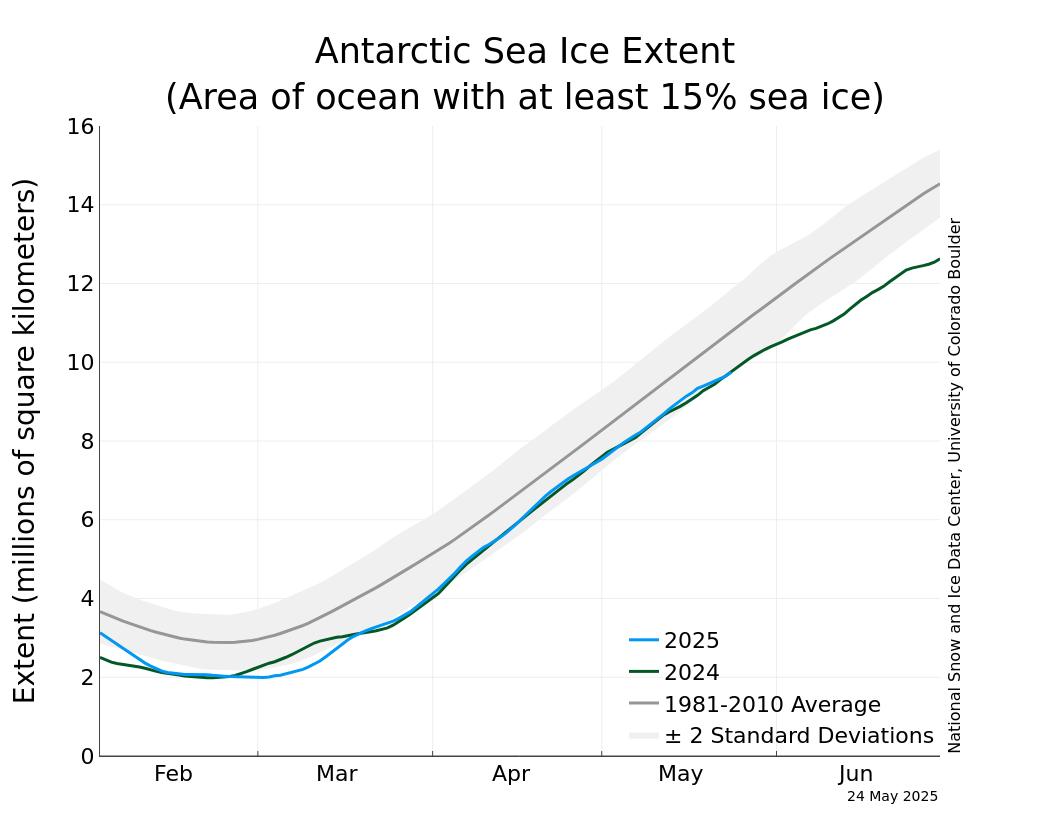
Antarctic sea ice extent almost 3 SD’s higher than “average”

November 25, 2010

Source:

http://nsidc.org/data/seaice_index/images/daily_images/S_stddev_timeseries.png

The Southern Hemisphere is coming into summer but seems significantly cooler (and wetter in Australia) than usual.

The ice extent in the Antarctic is reducing much slower than normally and currently the sea ice extent is about 1.3 million sq. km or 9%  or 3 Standard Deviations higher than the 1979 – 2000 average.

The Pacific Oscillation – or La Nina – is probably responsible.

La Niña Strengthens further

October 25, 2010

The NOAA has released its annual winter outlook.

The Pacific Northwest should brace for a colder and wetter than average winter, while most of the South and Southeast will be warmer and drier than average through February 2011. A moderate to strong La Niña will be the dominant climate factor influencing weather across most of the U.S. this winter.

“La Niña is in place and will strengthen and persist through the winter months, giving us a better understanding of what to expect between December and February,” said Mike Halpert, deputy director of the Climate Prediction Center – a division of the National Weather Service. “This is a good time for people to review the outlook and begin preparing for what winter may have in store.”

“Other climate factors will play a role in the winter weather at times across the country,” added Halpert. “Some of these factors, such as the North Atlantic Oscillation, are difficult to predict more than one to two weeks in advance. The NAO adds uncertainty to the forecast in the Northeast and Mid-Atlantic portions of the country.”

This seasonal outlook does not project where and when snowstorms may hit or total seasonal snowfall accumulations. Snow forecasts are dependent upon winter storms, which are generally not predictable more than several days in advance.


Winter Outlook - Precipitation

NOAA Winter Outlook: Graphic NOAA


The beneficial effects of La Niña on the Indian monsoon have already been seen this year. But after the very cold winter in the Southern Hemisphere it remains to be seen if warm and dry conditions  are established in the South American summer now approaching.

From The Canadian Encyclopedia:

La Niña normally exerts much less of a global impact than El Niño, enhancing conditions that are more or less normal. Thus, under La Niña’s grip, normally wet Indonesia becomes wetter, and winters in Canada are often colder and snowier than normal. However, the weather associated with La Niña tends to be quite variable depending on such factors as its strength, the depth and geographic extent of the cool waters and the pre-existing atmospheric circulation. Among the normal weather effects of La Niña are wetter monsoons and flooding on the Indian subcontinent; torrential rains and floods in southeast Asia and northern and eastern Australia; cool and wet winters in southeastern Africa; and warm and dry conditions along the coast of Peru and Ecuador.

La Niña favours the formation of more and intense hurricanes in the North Atlantic Ocean. Three recent La Niña periods – 1988-89, 1995-96 and 1997-98 – were among the most active periods this century for Atlantic hurricanes.

North America typically feels the effects of La Niña during the winter and early spring. Wetter-than-normal conditions occur across the Pacific Northwest, British Columbia and Alaska. On the other hand, it delivers drier, warmer and sunnier weather along the southern tier of the United States from California through Texas to Florida. Northern states west of the Great Lakes generally experience colder and snowier winters. During La Niña episodes, there is also a greater risk of wildfires in Florida and dryness in the North American plains. The great dust bowl drought of the 1930s is thought to have been caused by a decade of La Niña-like conditions and was likely responsible, in part, for the severe drought in the American midwest in 1988.

During La Niña winters in Canada, the jet stream assumes its more normal mid-continental location. Because the mild air and cold air are never too far away, winters usually comprise alternating bouts of freezing and thawing. Overall, in Western and Central Canada, most La Niña winters tend to be colder than normal by 1 to 2°C, and snowfall amounts are greater than normal from the interior of BC to the St Lawrence Valley. During 8 La Niña episodes since 1950, 6 of the winters across Canada were colder than normal (2 were near-normal) and 7 were snowier than normal.


Global La Niña effects: graphic nbc33tv.com


With a “good” monsoon in the bag Indian GDP should exceed 11%

October 11, 2010

The 4 month monsoon season in India ended on 30th September and total rainfall was 2% over the long term average, about 25% higher than last year and about 5% above the long range forecast made in the spring.


Total rainfall 2010 Monsoon: IMD


Expectations that a good monsoon could lead to double digit growth are stronger with the IMF now predicting a 9.7% growth rate for the calendar year 2010.

“India’s macroeconomic performance has been vigorous, with industrial production at a two-year high. Leading indicators — the production manufacturing index and measures of business and consumer confidence — continue to point up,” the IMF said.

“Growth is projected at 9.7 per cent in 2010 and 8.4 per cent in 2011, led increasingly by domestic demand. Robust corporate profits and favorable external financing will encourage investment,” it said.

“Recent activity (10 per cent year-over year growth in real GDP at market prices in the second quarter) was driven largely by investment and the contribution from net exports is projected to turn negative in 2011 as the strength in investment further boosts imports,” the IMF said.

But in spite of the IMF’s caveat on net exports turning down, I think the trickle-down effects of a good monsoon may have been under-estimated. Agricultural growth which was low should pick up and domestic demand will ensure the industrial growth continues. For the Fiscal Year 2010/11 (till 31st March 2011) I fully expect that the GDP will grow by just over 11%.

The establishing La Niña probably helped the monsoon somewhat.

A “moderate to strong” La Niña, which appeared in July, was now well estabished according to the WMO, and forecasts showed “rather a strengthening of this La Niña episode for the next four to six months.” La Niña is characterised by unusually cool ocean temperatures in the eastern equatorial Pacific and has been associated with strong rainfall in Asia and Australia, bitter cold snaps in North America, as well as drought in South America.


La Niña chills out the Pacific – could cause drought

October 4, 2010

“The tropical Pacific Ocean has transitioned from last winter’s El Niño conditions to a cool La Niña, as shown by new data about sea surface heights, collected by the U.S-French Ocean Surface Topography Mission (OSTM)/Jason-2 oceanography satellite” writes Science Daily.

La Niña continues to strengthen in the Pacific Ocean, as shown in the latest satellite data of sea surface heights from the NASA/European Ocean Surface Topography Mission/Jason-2 satellite. The image is based on the average of 10 days of data centered on Sept. 3, 2010. Higher (warmer) than normal sea surface heights are indicated by yellows and reds, while lower (cooler) than normal sea surface heights are depicted in blues and purples. Green indicates near-normal conditions. (Credit: NASA/JPL Ocean Surface Topography Team)

“This La Niña has strengthened for the past four months, is strong now and is still building,” said Climatologist Bill Patzert of NASA’s Jet Propulsion Laboratory, Pasadena, Calif. “It will surely impact this coming winter’s weather and climate.

“After more than a decade of mostly dry years on the Colorado River watershed and in the American Southwest, and only one normal rain year in the past five years in Southern California, water supplies are dangerously low,” Patzert added. “This La Niña could deepen the drought in the already parched Southwest and could also worsen conditions that have fueled Southern California’s recent deadly wildfires.” NASA will continue to track this change in Pacific climate.

Sydney shivers! Can’t be climate must be weather.

September 30, 2010

Temperatures in Los Angeles must be due to climate but the cold in Sydney is probably only weather !!!

From the Sydney Morning Herald:

After their coldest winter in 13 years Sydney residents have just experienced their coldest September in five years. “September was an unusual month in terms of the lack of warm days across much of south-eastern Australia,” weatherzone meteorologist Brett Dutschke said.

When both daytime and overnight temperatures were combined, Sydney’s average temperature this month came in at just under 17 degrees. This made it the coldest September in five years, despite being one degree above the long-term norm. It was also the coldest September in terms of daytime temperatures in three years.

Sydney Winter Festival 2010

As far as rainfall goes, Sydney failed to receive the long-term monthly average of 69mm, despite having the normal number of rain days, 10. The city gained only 42mm, the lowest for September since 2007.

“With La Nina likely to peak in the next few months, we are expecting rainfall to increase, trending to near or above average into summer,” Mr Dutschke said. “During this period, daytime temperatures should be near or below average. Overnight temperatures are likely to be close to normal.”

Residents of Melbourne have just experienced their coldest September days in 16 years, Mr Dutschke said. Warmer days ahead will provide Adelaide residents with a good thawing out after enduring their coldest September in 18 years, Mr Dutschke said.

Indian monsoon has been “good”: 10%+ growth possible

September 12, 2010

The Indian monsoon season officially lasts from June to September. When average rainfall over these 4 months is close to or slightly above the long term average ( from about -5% to about +10%), the monsoon can be termed to be “good”.

With 3 weeks to go rainfall is running at 1% above the long term average and has been reasonably uniform over the whole country.

http://www.imd.gov.in/section/nhac/dynamic/Monsoon_frame.htm

Despite a steady decline in the share of agriculture and allied activities in GDP to about 14.6 percent, it continues to be the mainstay of majority of the population, of about 52 percent of the work force, and remains critical from the point of view of achieving the objectives of food security and price stability.

In 2009-10, there was a poor monsoon with rainfall being about 22% less than the long term average. Consequently the Agricultural growth rate was less than 2% (1.86%). The total GDP growth was held back to around 6%. The difference between a good monsoon year and a poor year is thought to be around 2% points for GDP:

For this year the pre-monsoon forecast was for 98% rainfall but with the La Niña conditions now prevailing, this has increased. Currently Agricultural growth (April – June  2010) is at 2.78% and the “good” monsoon is likely to see this increase sharply through the rest of the year.

Currently GDP is running at over 9% with industry and manufacturing each showing growth rates of close to 12%.

Inflation in food prices should now reduce sharply and if industry and manufacturing maintain their spurt, a total 10%+  GDP growth for 2010 -11 becomes probable.

Spring will be warmer than winter — official

September 1, 2010

The cold wave sweeping through S. America is also evident in Australia.

New South Wales has experienced its coldest winter in 12 years and daytime temperatures in August were the coldest since 1990. La Niña is now established and may be deepening and this has also given the wettest winter since 2005.

http://www.australianclimatemadness.com/wp-content/uploads/2010/08/nsw-300×255.gif

The Australian reports:

http://www.news.com.au/breaking-news/nsw-experiences-coldest-winter-in-12-years/story-e6frfku0-1225912300531#ixzz0yFdVn6Ge

Climatologist at the Bureau of Meteorology (BoM), Shannon Symons says widespread rainfall also resulted in the wettest winter since 2005. “Northern inland regions received above, to very much above average rainfall and that was mainly in July and August, and that’s pretty much the case (across) NSW as well,” Ms Symons told AAP today.

Ms Symons said in the coming months, temperatures should rise as NSW settles into spring !!!

It is not clear whether the coming temperature rise is a warning or a promise.

Bitter cold wave in S. America — blamed on global warming!!

August 29, 2010

The bitter cold wave being experienced in S. America does not conform to the Global Warming Religion’s creeds. Facts cannot be suppressed forever and Nature has finally acknowledged one cold event in Bolivia but even here finds a way to contort itself to claim this ” as an example of a sudden climatic change wreaking havoc on wildlife”.

Antarctic cold snap kills millions of aquatic animals in the Amazon. Cold empties Bolivian rivers of fish

dead fish

With high Andean peaks and a humid tropical forest, Bolivia is a country of ecological extremes. But during the Southern Hemisphere’s recent winter, unusually low temperatures in part of the country’s tropical region hit freshwater species hard, killing an estimated 6 million fish and thousands of alligators, turtles and river dolphins.

But the cold wave is not an isolated incident and appears to be widespread over a large part of the southern hemisphere. Der Spiegel (translation in Politically Incorrect) reports today that:

Cold wave in South America: The continent is experiencing one of the harshest winters in many years. Altogether 175 people have died as a result of the bitter cold, according to official statements. Especially affected are the more impoverished population groups who are often poorly protected from the cold by precarious housing that has no heating and are poorly cared for.

In Argentina, such low temperatures haven’t been recorded for ten years. There, 16 people froze to death, another eleven died from Carbon Monoxide poisoning because of faulty stoves. It was also unusually cold in the bordering countries: In Bolivia, 18 people fell victim to the cold, in Paraguay it was five, in Chile and Uruguay there were two each, and in southern Brazil nine people.

In addition, thousands of cattle froze to death in the pastures of Paraguay and Brazil. There aren’t stalls because normally it doesn’t get very cold, even in the winter.

In some regions of Bolivia and Peru, children had school-free days until the end of the week. In the larger cities of the region emergency shelters were opened for people who live on the street. The system for supplying electricity and natural gas were working to capacity in many communties. In Argentina there were even shortages in some provinces.

With La Niña already established the Northern Hemisphere may also be in for another harsh winter.

Further contortions are likely by the religious fanatics to show that it is just further evidence of  global warming !

La Niña conditions now established?

August 9, 2010

It would seem that La Niña conditions are no longer just a probability.  La Niña conditions are expected to strengthen towards the end of the year and through the first quarter of 2011.

In the latest bulletin issued by the NOAA (Update prepared by Climate Prediction Center / NCEP 9 August 2010) we see that

  • La Niña conditions are present across the equatorial Pacific. Negative sea surface temperature anomalies continue to strengthen across much of the Pacific Ocean.  La Niña conditions are likely to continue through early 2011
  • Since March 2010, positive SST anomalies have decreased across much of the equatorial Pacific. Since the beginning of May 2010, SST anomalies have become increasingly negative in the eastern half of the Pacific.
  • During the last four weeks, equatorial SST anomalies have been negative in the eastern half of the Pacific. During the last 30 days, negative SST anomalies increased in magnitude in the central equatorial Pacific
  • Since mid-June 2010, negative subsurface temperature anomalies have dominated the central and eastern equatorial Pacific, with only slight variations in the magnitude of the anomalies.

The formal designation of a La Niña is keyed to a 3 month mean of the Oceanic Niño Index (ONI) in Region 3.4 and is likely to happen in the first two weeks of September.


High probability of La Nina: Good news for the Indian monsoon

June 26, 2010

Good news for the Indian monsoon

The Indian Meteorological Department has increased their rainfall forecast from being 98% of normal to being 102% of normal because of the La Nina conditions developing from the cooling of  the Central Pacific. The monsoon is expected to be “on time” and Northern India will get some relief from the sweltering temperatures they have been suffering.

Development of La Nina will also lead to global temperatures continuing to show the decline which has been apparent for the last decade.

The monsoon is formally defined to last for the 4 months of June to September every year and the onset and progress of the northern front of the monsoon is closely watched and can have a major impact. Even though the Indian economy is not as vulnerable to bad monsoons as it used to be, the importance of the monsoon to agriculture (and therefore also to related industries such as fertilisers, pesticides,pumps and even tractors) means that the difference between a “good” monsoon and a “bad” monsoon can be as much as 2% of annual GDP.

‘‘The latest forecasts from a majority of the dynamical and statistical models indicate continued and rapid cooling of the equatorial Pacific to below La Nina threshholds. There is a very high probablity (about 60%) for the La Nina conditions to develop during the monsoon season, which favours stronger than normal monsoon,’’ said IMD Director General Ajit Tyagi.

(photo credit: worldslatestnews.com/…/)

La Nina is also expected to bring more rain to Australia.

While La Nina will be welcomed in India and may disrupt the Ashes Tests in Australia it is not good news for the soya bean crops in Brazil.