Posts Tagged ‘Landscheidt Minimum’

Is the Landscheidt minimum a precursor for a grand minimum?

December 23, 2010

It took 500 years with reducing solar activity to get from the Medieval maximum to the the grand Maunder minimum. The Dalton minimum came a little over a 100 years later as solar activity was increasing to its modern maximum in the years preceding Solar Cycle 22 (c. 1890 – 1990). Now with the Landscheidt minimum seemingly well established, SC 23 and the current SC 24 show a clear trend of declining solar activity. SC’s 22, 23 and 24 are remarkably similar to SC’s 3, 4 and 5. The Dalton minimum coincided with SC’s 5 and 6.

It is reasonable to assume that climatic conditions over the next 20 – 30 years will resemble those prevailing between 1790 and 1820. But SC24 has a way to go yet and it could be that solar activity for SC24 and 25 will be even lower than during the Dalton minimum and perhaps closer to the Spörer minimum but perhaps not as deep as the Maunder minimum.

But in either case the solar activity to come following the Modern maximum may well resemble the 500 years of decline in solar activity which followed the Medieval maximum.

http://en.wikipedia.org/wiki/Dalton_Minimum
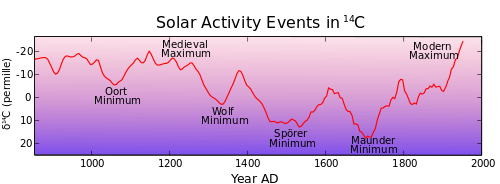
Solar activity events recorded in radiocarbon. Present period is on left. Values since 1950 not shown: Wikipedia

http://en.wikipedia.org/wiki/Maunder_Minimum
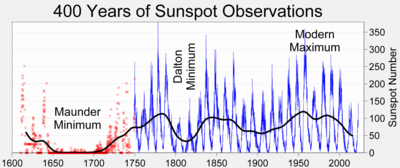
The Maunder minimum in a 400 year history of sunspot numbers: Wikipedia

http://sc25.com/index.php?id=268&linkbox=true&position=10

Image Attachment

The excellent historical weather chronology covering 1800 years put together by James A Marusek shows that the period between 1790 and 1820 was characterised not only by colder weather but also by violent fluctuations of seasonal weather. An extract of the chronology during the Dalton minimum is here: (weather chronology Dalton).

I give little credence to AGW Alarmism and the doom-saying regarding the effects of carbon dioxide. Environmentalism which was (and still is) highly admirable when concerned with the improvement of local conditions went off the rails when it went “global” and came to be dominated by the overweening arrogance of ignoring the sun and the presumption of super-computers and inadequate computer models.  Rather I am persuaded about the dominance of solar influences on the chaotic system which is our climate.

Whether or not a grand solar minimum is on its way, we are in for a decade of two of reduced activity and a cooling trend during this Landscheidt minimum.

Landscheidt minimum is here — a new Dalton is indicated

December 21, 2010
SDO Sunspot

Spotless Sun

All the indicators are that the Landscheidt minimum is here and that this is going to be close to a Dalton minimum.

2010/12/20 8:00  Five Days in a row spotless is achieved 12 months after solar cycle 24 began it’s ramp up.

A Dalton Minimum Repeat is Shaping Up

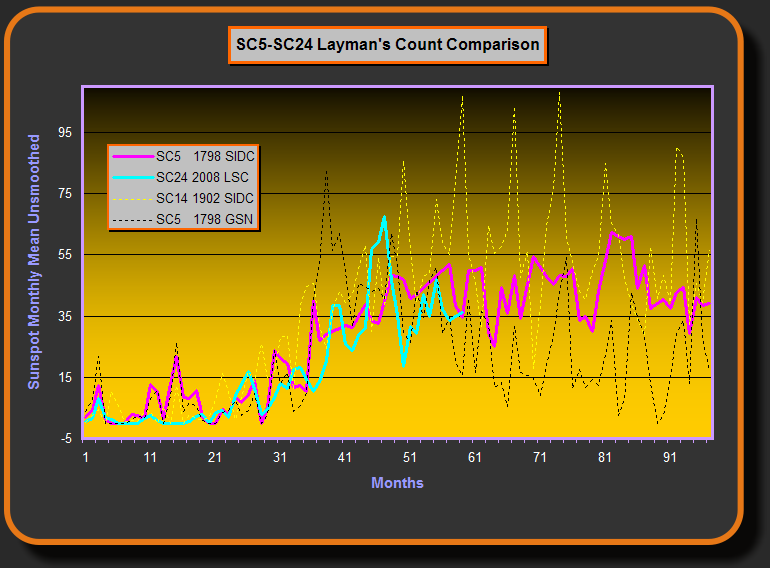
The Dalton Minimum was a period of low solar activity, named after the English meteorologist John Dalton, lasting from about 1790 to 1830. Like the Maunder Minimum and Spörer Minimum, the Dalton Minimum coincided with a period of lower-than-average global temperatures. The Oberlach Station in Germany, for example, experienced a 2.0°C decline over 20 years. The Year Without a Summer, in 1816, also occurred during the Dalton Minimum. Solar cycles 5 and 6, as shown below, were greatly reduced in amplitude.

http://solarcycle24.com/sunspots.htm

Sunspot number till December 7th


http://www.landscheidt.info/images/sc5_sc24.png

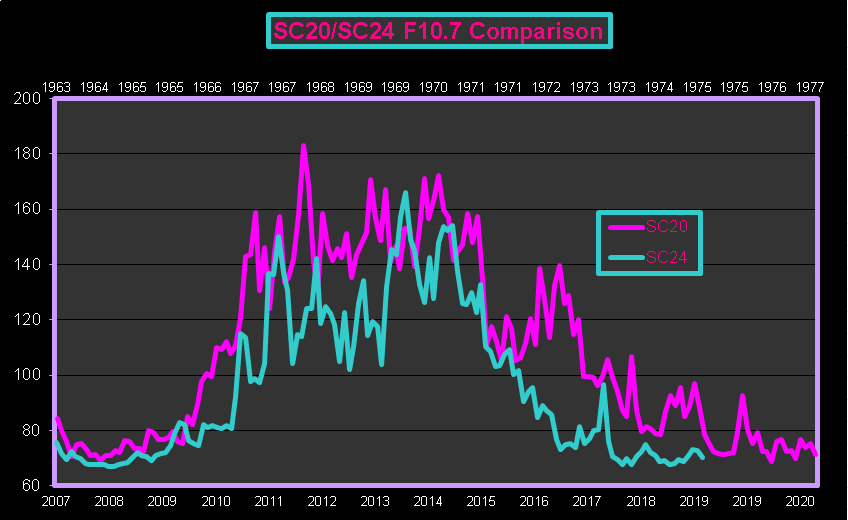
To compare solar cycles we can also use the F10.7 radio flux values that have been recorded since 1947 in Canada. Solar cycle 20 was a weak cycle which is currently looking strong against solar cycle 24. Data is taken from the AU adjusted monthly average values.

The Sun moves to its own music

October 6, 2010

Totally impervious to vulgar 10:10 videos, biodiversity 10.10 campaigns, 0% interest rates and other goings-on on Earth, the Sun moves to its own music.

It was spotless again.

Spotless Sun 5th October 2010: NASA image

Sunspot numbers and 10.7 flux continue to be significantly lower than forecast (and the forecast for Cycle 24 were pretty low to begin with).

2010/10/05 08:00 Today was spotless although Locarno managed to see two groups. The specks were tiny and would be on the fringe of visibility on the original Wolf 64x telescope on a perfect day. What could be old area 1106 may be returning in the next two days.

Yesterday’s adjusted F10.7 flux figures recorded a high of 76.6 (81.4) and a low of 74.7 (78.8), unbelievably low.

F10.7 Radio Flux (including September 2010)

That we are in a solar minimum (the Landscheidt minimum) seems clear but whether it will be a grand minimum remains to be seen.

sc5 sc24 comparison

sc5,sc14 comparison with sc24

And the sun will surely impact our climate — but how?

And in any case the sun gets no feedback and it does not much care.


How can we – if we should – prepare for a new Little Ice Age?

August 22, 2010

It seems that we are in a Solar Cycle Minimum – a Landscheidt Minimum which will perhaps be comparable to the Maunder Minimum.

The last decade has seen flat or declining global temperatures.

The Ocean temperature oscillations could indicate 20 or 30 years cooling ahead of us.

If these are all indicators of a coming Little Ice Age, then it may be time to take some preparatory actions to help humans adapt. I think adaptation to Climate Change when it happens is the key not some mis-guided and futile attempt to prevent the Climate Change from happening (as being proposed by the IPCC and other global warming fanatics).

image: http://t2.gstatic.com/images?q=tbn:TtpOoja-ueuOLM:http://www.wilsonsalmanac.com/images3/frost_fair_C18.jpg

The question which is more for engineers rather than for scientists is “What are the actions that could be taken to prepare and help for such an adaptation?”