Posts Tagged ‘SC5’

Double peak in Solar Cycle 24? as in SC14 and in SC5?

March 4, 2013

The NOAA/NASA Solar Cycle Prediction Panel is puzzled. They don’t know if we are reaching solar maximum or whether another little peak could be on its way which would shift solar maximum for SC24 to 2014 from 2013.

And should we compare SC24 with SC14 or should it be SC5?

But SC24 will still show the lowest sunspot activity for 100 years. I note that not only SC14 but even SC5 had a double peak – so my expectation remains that this Landscheidt Minimum may be comparable to the Dalton Minimum – though not perhaps to the Maunder Minimum.
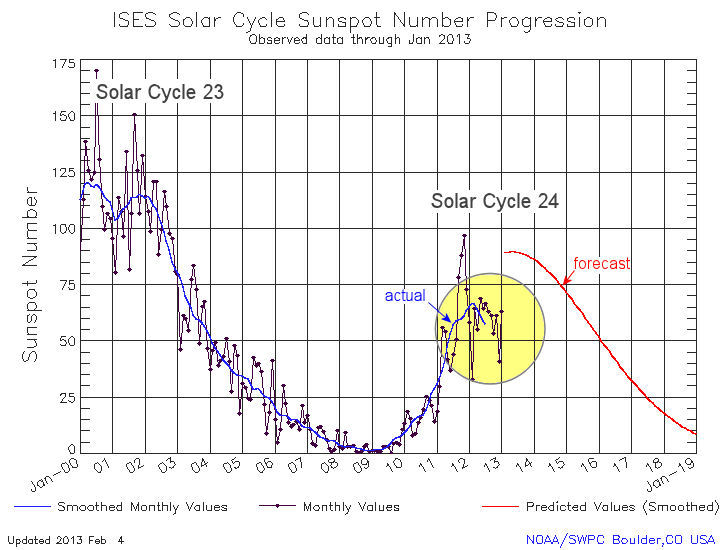
credit Dr. Tony Phillips

credit Dr. Tony Phillips

This Sciencecast video is a good summary of what we don’t know:

Landscheidt’s prediction is that this Minimum will last till 2060 so we can expect low sunspot activity for the next 4 sunspot cycles (till SC28).

Landscheidt’s predicted solar minima

The Sc24 –  SC5 comparison looks like a repeating pattern but it would be wrong to assume that the Sun cares about this and it will surely continue to keep us perplexed as it does its own thing.

SC24 compared to SC5

The Big Picture is persuasive – even if we don’t really know what the sun is upto and even less about how the Earth dances to the Sun’s music.

Recent solar activity (Wikipedia) showing the Maunder and Dalton minima

Related:
Solar cycles and the Landscheidt minimum

Theodor landscheidt: Sun-Earth-Man and the Kepler ratios

Solar Cycle 24 will be the smallest sunspot cycle since 1906 (SC 14)

January 5, 2013

The January 2013 NASA forecast for the development of Solar Cycle 24 is out.

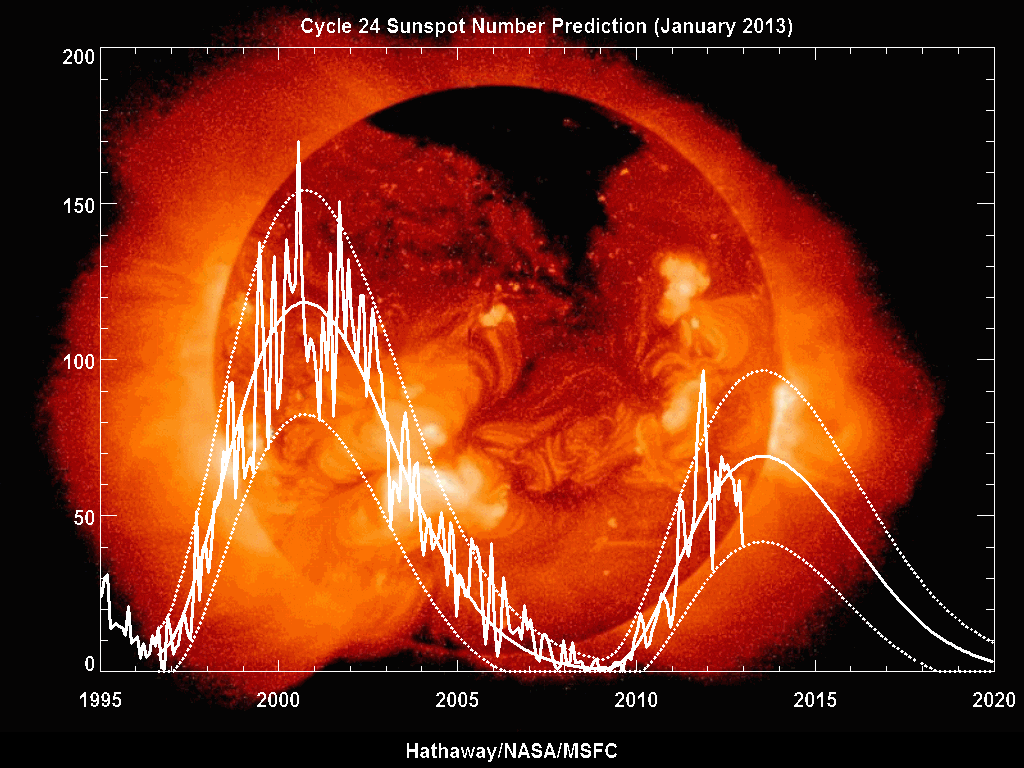
sc 24 prediction January 2013

SC 24 prediction Jan 2013 – Hathaway -NASA

The current prediction for Sunspot Cycle 24 gives a smoothed sunspot number maximum of about 69 in the Fall of 2013. The smoothed sunspot number has already reached 67 (in February 2012)due to the strong peak in late 2011 so the official maximum will be at least this high and this late. We are currently over four years into Cycle 24. The current predicted and observed size makes this the smallest sunspot cycle since Cycle 14 which had a maximum of 64.2 in February of 1906.

With sunspot activity at this low level the planet will cool. It remains to be seen whether this is the start of something like a Dalton Minimum (SC5 and 6) or even a Maunder Minimum. This cooling has begun and global temperatures peaked about 16 years ago and are now declining slightly while carbon dioxide concentration continues to increase. It is only a matter of time before the belief that carbon dioxide concentration (whether man-made or not) causes global warming will have to be completely discarded. But there is so much money now riding on this belief (and even though there is only conjecture and no direct evidence for this belief), that we will likely see a decade or more of rationalisation of reality before the belief is abandoned.

SC24 compared to SC5 in 2011 is shown below:

SC24 compared to SC5

NASA reduces forecast for Solar Cycle 24 again

January 19, 2011

In December NASA had reduced its forecasts for SC24 to a peak sunspot number of 64 being reached in June 2013. Now less than two months later, the latest forecast has been reduced again to a peak sunspot number of 59 to be reached in June / July 2013.

We find a starting time of May 2008 with minimum occurring in December 2008 and maximum of about 59 in June/July of 2013.

NASA SC24 forecast - January 2011: image NASA

At these levels the current Landscheidt minimum is comparable to SC5 and SC6 – the Dalton Minimum of 1790 to 1830 – where peak sunspot numbers were just over 50. (The earlier Maunder Minimum – 1645 to 1715- was before the modern period of sunspot number measurement and nominally was a period with no significant sunspots – presumably at sunspot numbers of less than 20 in today’s measurement values).

From my previous post:

It is not inconceivable that the SC24 will not peak till early 2014 and will only achieve peak sunspot numbers around 55. Solar cycle 24 could well have a length of 150+ months instead of the nominal 132 months.

The development of the NASA predictions are in the table below:

NASA Forecasts for SC24

Date of

forecast

Expected date

of peak

Expected peak

sunspot number

March 2006 June 2010 168
October 2008 March 2012 137
January 2009 June 2012 104
January 2010 June 2013 90
December 2010 June 2013 64
January 2011 June / July 2013 59


Related:

https://ktwop.wordpress.com/2010/12/23/is-the-landscheidt-minimum-a-precursor-for-a-grand-minimum/