Here in Sweden we have not yet changed to winter time but we had minus 6 C yesterday and our first snow last night. I changed to winter tyres yesterday.

Finspång: October Snow
It is only weather but the long, cold winter may be starting.
Here in Sweden we have not yet changed to winter time but we had minus 6 C yesterday and our first snow last night. I changed to winter tyres yesterday.
Finspång: October Snow
It is only weather but the long, cold winter may be starting.
The Northern Hemisphre is anticipating a long cold winter which might even be a little early, but summer is a little late in the Southern Hemisphere.
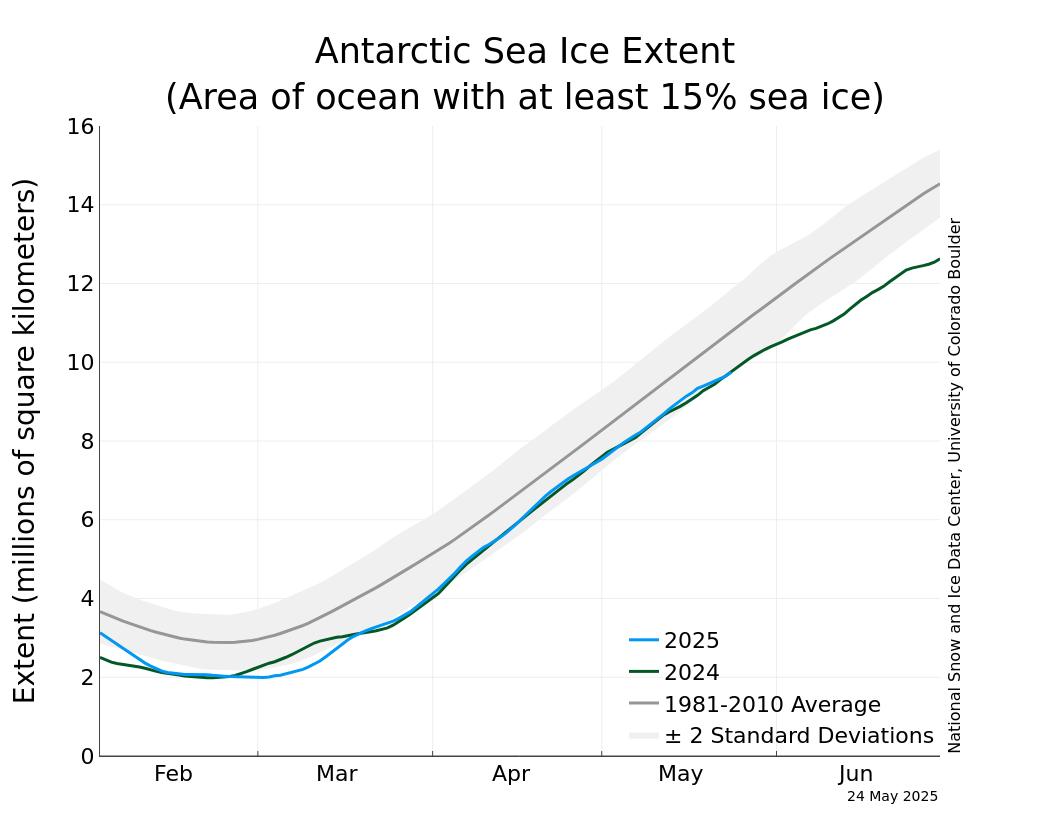
Usually Antacrtic ice starts decreasing around 15th September but this year it seems to be still quite high and delayed by about a month.
http://nsidc.org/data/seaice_index/images/daily_images/S_stddev_timeseries.png
WARM weather may have teased the state into believing summer was on its way, but the wild weather predicted for the weekend could be winter’s last hurrah.
Meteorologists are warning of a wet and windy weekend with widespread rain, potential flash-flooding, and wind gusts of up to 110km/h. Snow is likely to fall on the alps and southern ranges, and even Orange could get a light dusting. The shift is being caused by a broad trough moving over NSW, which is expected to deepen into a low pressure system today, causing heavy rain and strong winds across central NSW.
The Southern Hemisphere is still facing bitterly cold weather.

Southland, New Zealand
The 1st of September is usually designated as the start of spring in New Zealand. Lambing is in full swing but six days of blizzards are being called the worst spring storm in living memory. Cars, lambs, and buildings have all fallen victim to the unusually heavy, wet snow that has fallen in Southland. Seven trampers were rescued by helicopterafter being caught in the snowstorm that has swept South Island national parks. A roof of a stadium collapsed in Southland under the weight of wet snow. A sixth day of snow, rain, wind, hail and sleet was forecast for the already battered coastal belt from Colac Bay in Southland, parts of Central Southland, the Catlins, Owaka and Clinton. Three snowfalls of up to 15cm since Saturday had left ground conditions so wet and muddy that newborn lambs had nowhere dry to go.

BARRY HARCOURT/The Southland Times
Exactly how many lambs have been killed will not be known until tailing but at an expected average price of $80 for each lamb, the cost to farmers could be measured in millions of dollars. In recent days, the Owaka Lions Club has collected up to 400 dead lambs a day from the 19km Owaka Valley Rd, for which farmers receive 50c each.
Federated Farmers adverse events spokesman David Rose said he estimated half the farms in Southland were affected. “The spring storm of 2010 is, frankly, the worst in a generation, with farmers going back over 50 years for anything this bad.”
MetService warned that temperatures would plunge in the Southland tonight as a cold front crosses the region. It said significant snowfalls were expected overnight, mainly above 200m, where 10-15cm is possible, especially in the Catlins and hilly areas exposed to strong southwesterlies. Localised blizzards and snow drifts are possible. The Fire Service in Invercargill said it had been flat out working three pumps to drain properties around the city swamped by melting snow.
The North Island has also received its share of the snow fall.
The Rimutaka Hill Road was closed following 2-6cm of snow accumulating on the hill above 400m from 3am to 7am this morning. It has since reopened with cars only allowed across in escorted convoys, one way at a time. The Manawatu Gorge road has reopened following a slip which closed it yesterday. Snow is also falling on the Central Plateau this morning, with 4-12cm accumulating on the Desert Road between 3am and 12am this morning. Another 3-6cm are expected over the next couple of hours. Drivers are warned the road may close.
Sources: http://www.nzherald.co.nz/nz/news/article.cfm?c_id=1&objectid=10675265
http://www.nzherald.co.nz/nz/news/article.cfm?c_id=1&objectid=10675510

View from Rohtang Pass
Snow has been falling across the world’s mountain ranges almost a month early. It could portend another long hard winter in the Northern Hemisphere.
The cold wave sweeping through S. America is also evident in Australia.
New South Wales has experienced its coldest winter in 12 years and daytime temperatures in August were the coldest since 1990. La Niña is now established and may be deepening and this has also given the wettest winter since 2005.

The Australian reports:
Climatologist at the Bureau of Meteorology (BoM), Shannon Symons says widespread rainfall also resulted in the wettest winter since 2005. “Northern inland regions received above, to very much above average rainfall and that was mainly in July and August, and that’s pretty much the case (across) NSW as well,” Ms Symons told AAP today.
Ms Symons said in the coming months, temperatures should rise as NSW settles into spring !!!
It is not clear whether the coming temperature rise is a warning or a promise.
The sea ice extent in the Antarctic continues to be well above the 2009 level and more than 2 SD’s higher than the 1979-2000 average. Sea ice extent peaks at the end of September and, if anything, the growth is accelerating rather than slowing down when we are now in the middle of August.
http://nsidc.org/data/seaice_index/images/daily_images/S_stddev_timeseries.png

In the Northern Hemisphere, temperatures above the 80th parallel have dipped below freezing and are also clearly lower than the 1958 -2002 average.
http://ocean.dmi.dk/arctic/meant80n.uk.php

Looks like we are in for another long and cold winter.
Do volcanoes cause climate change or it the other way around?
Freysteinn Sigmundsson, a vulcanologist at the University of Iceland believes that climate change can impact eruptions. “Global warming melts ice and this can influence magmatic systems,” he told Reuters. The end of the Ice Age 10,000 years ago coincided with a surge in volcanic activity in Iceland, apparently because huge ice caps thinned and the land rose. “We believe the reduction of ice has not been important in triggering this latest eruption,” he said of Eyjafjallajokull. “The eruption is happening under a relatively small ice cap.”
http://www.scientificamerican.com/article.cfm?id=ice-cap-thaw-iceland-volcanoes
But Steven Goddard writing in What’s Up with That suggests it is the other way around.
http://wattsupwiththat.com/2010/04/17/volcanoes-cause-climate-change/#more-18609
Not climate, but perhaps solar effects can impact geological changes in the earth’s crust and influence eruptions. It seems unlikely that a feedback loop from surface air conditions could work to change the earth’s crust.
Clouds and dust from volcanoes can surely affect weather and maybe even weather for a few years. Perhaps volcanoes can even change climate but I think the jury is out on that.
A lovely picture of cherry blossoms in full bloom, people in kimonos, umbrellas unfurled and snow on the ground in Tokyo — from The Japan Times.


 The k2p blog
