Archive for March, 2012
March 16, 2012
I like this flash animation from NASA which is a modern version of the classic video Powers of Ten and travels from billionths of a yoctometre (10 -24 metres) up to tens of Gigaparsecs (about 3.1 x 10 25 metres). A journey of 60 powers of 10 from the Planck length of 1.616199(97)×10 -35 metres to the size of the observable universe at 10 27 metres.
“From where neutrinos are like suns to where galaxies are like dust”
It takes a few seconds to load.
http://apod.nasa.gov/apod/ap120312.html
Tags:Education, Images and Movies, NASA
Posted in Trivia | Comments Off on The scale of the Universe: from yoctometres to Gigaparsecs
March 15, 2012
It was high time and even though they have tried before, the new measures just announced by the Chinese Education Ministry will hopefully begin to curb the widespread plagiarism, data manipulation and even data fakery that allegedly goes on.
India needs to institutionalise something similar. The Society of Scientific Values in India is an independent body and tries valiantly to act as a watch-dog but it has no teeth and no official standing. Of course in India the danger with creating institutions under a Ministry – and therefore under a Minister – is that the institution will very quickly become politicised. And Indian politicians are perhaps not the best choice when it comes to monitoring and establishing ethical standards. Nevertheless a start has to be made and the Ministry of Science and Technology in India is the natural home of an institution to promote ethical standards in scientific research and at institutes of higher education. The key will be to provide the backing of the Ministry to give it sufficient weight but to maintain its independence from party political influences. Giving such an institution semi-judicial status is one way but could be very heavy handed.
China Daily reports:
China’s Ministry of Education on Wednesday issued new rules to supervise universities’ scientific research and academic activities in order to “effectively prevent and curb academic misconduct.”
(more…)
Tags:China, China Education Ministry, ethics, India, Scientific misconduct, Society for Scientific Values
Posted in Academic misconduct, China, Ethics, India, Science, scientific misconduct, Technology | Comments Off on Chinese Government tries to get to grips with science misconduct. When will India follow?
March 14, 2012

Professor Akihisa Inoue
Professor Akihisa Inoue is the President of Tohoku University, is a leading materials scientist and the author of over 2,500 publications. But criticism from other Japanese scientists (as on this Japanese website) has now led to at least 7 retractions for plagiarism. Three investigations have been conducted so far with rather wishy-washy conclusions. The investigations are in uncharted territory since Japan has no established processes for handling cases of scientific wrong-doing. There is no institution or body for supervising ethics or misconduct in research. And now yet another investigation committee is proposed. Without the guidance of precedent Tohoku University and even the Japanese Science and Technology Agency are not really sure how to proceed – especially when the allegations are against as prominent a person as the President of a University. Almost a classic case of what in industry would be called “paralysis by analysis” where every analysis shirks the task of coming to conclusions, declines to make judgements and merely proposes further analysis.
Nature reports:
Japan fails to settle university dispute
It has been a rough year for materials scientist Akihisa Inoue, the president of Tohoku University in Japan.
(more…)
Tags:Akihisa Inoue, Japan, Nature, paper retraction, Paralysis by analysis, Scientific misconduct, Tohoku University
Posted in Academic misconduct, Ethics, Japan, Science, scientific misconduct | Comments Off on Tohoku University struggles to handle transgressions by its President Akihisa Inoue
March 14, 2012
The Indian 2011 Census has some fascinating – and sometimes surprising – information on the trends and manner in which development is taking place. In 2011 the population had reached 1,201 million people. Population growth rate continues to decline with the sharpest decline during 2001-2011. The percentage increase during the decade 2001-2011 was the lowest since Indian Independence in 1947. The urban-rural divide is still very strong. Mobile phone connectivity is penetrating the rural heartland faster than toilets. While almost half of all rural households had access to mobile phones less than 1% had access to the internet. Radio is not going anywhere fast but TV continues to penetrate. The joint family system with multiple couples in a household is giving way to nuclear families. Two-thirds of all households now have access to electricity but two-thirds still use “smoky fuels” ( firewood, crop residue, cow dung cakes or coal) for cooking. But only a third of all households (and less than 20% of rural households) have access to treated drinking water. The bicycle is still the primary mode of travel.
(more…)
Tags:Census 2011, India
Posted in Demographics, India | Comments Off on Indian Census: Access to electricity progresses but toilets lag mobile phones
March 13, 2012
In December I posted about the suspicious goings on at Kyoto Prefectural University:
A Japanese investigative website (http://blog.m3.com/Retraction/) has found 12 published articles where manipulation of images is very likely. The suspicious images in the papers published by the Matsubara lab are carefully deconstructed by Abnormal Science in an ongoing series of posts: here, here and here.
Today Retraction Watch reports that the efforts of M3 (now discontinued) and Abnormal Science have not gone unnoticed:
The American Heart Association, which publishes a number of journals, has issued an Expression of Concern about five papers in three of their publications, following allegations of image manipulation. All of the papers include Hiroaki Matsubara, of Kyoto Prefectural University, as a co-author.
The notice begins:
It has come to the attention of the American Heart Association (AHA), in a public manner, that there are questions concerning a number of figures in several AHA journals’ articles…
The “public manner” was three posts last year on the Abnormal Science blog… alleging that images were manipulated in the manuscripts, and that histology slides were reused.
The notice continues:
After reviewing these concerns, we have asked the institution, Kyoto Prefectural University of Medicine, to investigate the allegations. Until we learn the outcome, we feel it is best to post this Expression of Concern to alert our readers that concerns about these articles have been raised.
Tags:Abnormal Science, American Heart Association, Blog-M3, Hiroaki Matsubara, image manipulation, Kyoto Prefectural University, Retraction Watch
Posted in Academic misconduct, Japan, Medicine, scientific misconduct | Comments Off on Update on Matsubara
March 13, 2012
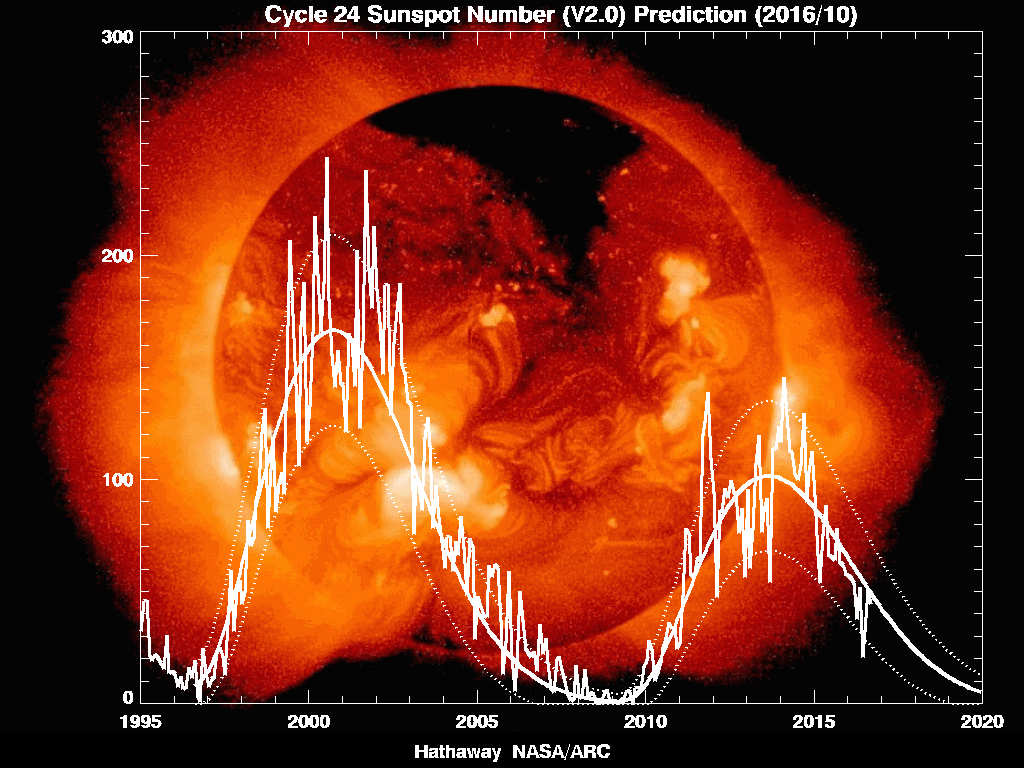
David Hathaway has a new forecast for solar cycle 24:
The current prediction for Sunspot Cycle 24 gives a smoothed sunspot number maximum of about 59 in early 2013. We are currently over three years into Cycle 24. The current predicted size makes this the smallest sunspot cycle in about 100 years.

SC24 forecast: updated 2nd March 2012
SC25 will likely be even smaller and it now remains to be seen if this Landscheidt Minimum is closer to a Dalton Minimum or a Maunder Minimum.
(more…)
Tags:David Hathaway, Landscheidt Minimum, Prediction, SC 24, SC25, solar cycle, Solar Cycle 24
Posted in Climate, Solar science | Comments Off on Solar Cycle 24 NASA forecast update
March 13, 2012
Another idiot paper from a supposed Professor of Philosophy at New York University who claims that “human engineering deserves further consideration in the debate about climate change”.
He gets paid for producing this drivel.
Human Engineering and Climate Change by S. MATTHEW LIAO (NEW YORK UNIVERSITY), ANDERS SANDBERG (OXFORD), and REBECCA ROACHE (OXFORD)
The Atlantic carries a long interview with the idiot philosopher (whose ego is revelling in the publicity):
… the paper suggests that parents could make use of genetic engineering or hormone therapy in order to birth smaller, less resource-intensive children.
In your paper you suggest that some human engineering solutions may actually be liberty enhancing. How so?
Liao: That’s right. It’s been suggested that, given the seriousness of climate change, we ought to adopt something like China’s one child policy. There was a group of doctors in Britain who recently advocated a two-child maximum. But at the end of the day those are crude prescriptions—what we really care about is some kind of fixed allocation of greenhouse gas emissions per family. If that’s the case, given certain fixed allocations of greenhouse gas emissions, human engineering could give families the choice between two medium sized children, or three small sized children. From our perspective that would be more liberty enhancing than a policy that says “you can only have one or two children.” A family might want a really good basketball player, and so they could use human engineering to have one really large child.
Indeed! A family may wish to ensure that they don’t produce idiot children – large or small. Human engineering to breed out the possibility of producing idiot professors of philosophy could be more productive for the human race.
Tags:climate change, Climate eugenics, idiot philosopher, MATTHEW LIAO, New York University
Posted in Academic misconduct, Alarmism, Philosophy | 1 Comment »
March 13, 2012
Type in your street address with city & state or somewhere you used to live. Then you click on “shake”. A photo of the house appears!
I tried it 6 times with addresses of people I know & it worked every time.
( So far I have tried addresses in 4 countries- UK, US, Germany and Sweden – and I get the Google Maps or Google Street View – but faster than I could zoom in on it. Just address and town seems to be sufficient.)

Address Magic
(h/t – Nessan)
Tags:Address magic, Google Maps, Google Street View
Posted in Trivia | Comments Off on Address Magic
March 11, 2012
When can “ends” no longer justify the “means”?
At what level does “collateral damage” become unacceptable?
And even after all the blood-letting in Iraq and Afghanistan there are still those who would like to see the US and Israel launch attacks on Iran. Iran dossiers are no doubt being “sexed-up” by those who are worried that not being at war with someone is not sustainable for business.
BBC News:
‘Rogue’ US soldier kills Afghan civilians
A US soldier in Afghanistan has killed at least 16 civilians and wounded five after entering their homes in Kandahar province, senior local officials say. He left his military base in the early hours of the morning and opened fire in at least two homes; women and children were among the dead.
Nato said it was investigating the “deeply regrettable incident”.
The New York Times does cover this as its top story, but Fox News only reports – as its third story – that a US soldier has been detained for the alleged killing of civilians! It is Sunday and Huff Post and the Drudge Report – as of 1300 CET – have not even managed to report this “regrettable incident”.
UPDATE! And now Reuters reports that it wasn’t one, lone, disturbed, “rogue” soldier but “a rampage that witnesses said was carried out by American soldiers who were laughing and appeared drunk”.
Tags:Afghanistan, Iran, Iraq, massacre of the innocents, rogue soldier, war
Posted in Business, Ethics, Politics, War | Comments Off on A “regrettable incident”
March 11, 2012
One year on and young hopes bloom eternal.

Young hopes bloom eternal: Illustration by Yuko Shimizu: From The Japan Times
I was in Japan during the Great Hanshin Earthquake in 1995 when over 6,000 perished in Kobe and – inevitably – I try to relate events to my own experience. But the Graeat Tohuku earthquake and tsunami were something quite different and have claimed more than 20,000 lives.
The death toll was much greater after the Aceh earthquake and tsunami but was spread over many more countries and in that sense is more “diffuse”. Perceptions sometimes get diluted compared to the intensity of the reactions one year ago. The 2004 Indian Ocean earthquake and tsunami claimed over 230,000 lives in 14 countries.
The meltdowns at the Fukushima nuclear plant following the Tohoku earthquake and tsunami were pretty scary but sometimes the coverage (especially in Europe) becomes alarmist and tends to take away from the earthquake and tsunami. But it is worth remembering also that the incidents at Fukushima – without trying to trivialise them – have caused no radiation related deaths.
Tags:2004 Indian Ocean earthquake and tsunami, 2011 Tōhoku earthquake and tsunami, Earthquake, Fukushima Nuclear plant, Great Hanshin earthquake, Japan, Kobe, Tsunami
Posted in Japan, Natural Disasters | Comments Off on One year on from the Great Tohoku earthquake and tsunami



 The k2p blog