Archive for November, 2013

Heigh-ho, ISRO, it’s off to Mars we go

November 30, 2013

UPDATE!!

Trans-Mars injection has been completed successfully.

  • Trans Mars Injection (TMI) operations completed successfully. The liquid engine burn time was 1328.89 sec and the imparted incremental velocity was 647.96 m/sec.
  • Trans Mars Injection (TMI) operation began at 00:49 hrs (IST) on Sunday Dec 01, 2013.
  • Forward rotation of spacecraft, to put it into the right orientation to perform Trans Mars Injection (TMI) operation has been completed successfully at 00:30 hrs IST on Dec 1, 2013

=================

A big night for ISRO and congratulations are due! And not least for ISRO’s coverage of the event – almost live – on their Facebook page. (I have not been too enamoured of the ISRO website but somebody did a great job on the live updates).

The Indian Mars Orbiter (Mangalyaansuccessfully completed its final burn in earth orbit and has been inserted into a Trans Mars Trajectory (to be confirmed). It may just be one small step in Man’s exploration of space but it is a giant leap for ISRO. After spending a month in 6-ever increasing orbits around Earth the craft now has a 300 day journey to get to Mars with the possibility of 3 mid-course corrections before the liquid engine has to be fired up again to enter into orbit around Mars.

So far, so good!

A number of “firsts” for the Indian Space Research Organisation (ISRO) and, no matter what may now happen, a great many accomplishments already in the bag. The lack of a sufficiently powerful rocket necessitated that the craft first enter earth orbit and then the month-long, laborious compared to NASA, procedures where the space craft engine had to be used  to first to increase the earth orbits and then – tonight – be fired for an extended time (23 minutes) to be inserted into a heliocentric Trans Mars Trajectory.

Mission Operations Complex ISTRAC  Bangalore.

Mission Operations Complex ISTRAC Bangalore.

Photo

One hour before the final engine firing the craft was put under the control of its on-board computer which was to carry out the final burn. Forward rotation of the spacecraft to put it into the right orientation for the burn was carried out and completed about 20 minutes before firing. Engine firing started on schedule just before the craft reached perigee. The actual burn of the 440 N Liquid Engine lasted its planned 23 minute long firing entirely under local on-board computer control. The objective was to impart an incremental velocity of 648 m/s and the indications are that that was achieved. The engine firing manoeuver seems to have gone exactly to plan. The orbit determination team have now to confirm now confirmed the trajectory actually achieved.

The new heliocentric orbit is yet to be confirmed. confirmed

The ISRO chorus (with apologies to Walt Disney)

Heigh-ho, ISRO

It’s off to Mars we go

We keep on working all day long

Heigh-ho, ISRO 

Photo: Liquid Engine propels MOM into Mars Transfer Trajectory and India into interplanetary space !Trans-Mars injection has been completed successfully.

Liquid Engine propels MOM into Mars Transfer Trajectory and India into interplanetary space !Trans-Mars injection has been completed successfully. ISRO

 

Will buying “likes” on Facebook and Twitter translate into votes?

November 29, 2013

Perception can be reality. And fake “likes” are being used to generate fake perceptions of popularity and goodness. Whether humans are dumb enough to be taken in by fake perceptions and whether perceptions can be converted into real voters and customers remains to be seen.

The assumption within the public relations and advertising industry is that  buying “likes” on social media actually leads to some advantage for the person/thing/company being liked. Clearly some companies perceive “likes” as being an effective – if unproven -advertising form. There seems to be no shortage of people offering ways of buying and boosting “likes”. Offers are readily available to arrange “2000 Facebook likes for only $17, or 5000 for $35 or 100,000 for $500”. Carlo De Micheli and Andrea Stroppa have been looking at Twitter and the underground market

De Micheli and Stroppa

De Micheli and Stroppa


We estimated fake accounts make up for 4% of Twitter’s user base

Does this make sense?

  • Facebook makes it harder to create fake accounts yet openly declares: “As of June 30, 2012, we estimate user-misclassified accounts may have represented approximately 2.4% of our worldwide MAUs and undesirable accounts may have represented approximately 1.5% of our worldwide MAUs. 
  • Every account can follow up to 2000 people. 
  • By statistically excluding overlapping fake accounts, just on the 12 main marketplaces (Fiverr, SeoClerks, InterTwitter, FanMeNow, LikedSocial, SocialPresence, SocializeUk,  ViralMediaBoost), it turns out there are around 20M fake followers on sale right now. 
  • Followers are sold at an average price of $18/1000 followers (barracudalabs). 
  • Sellers can make between $2 and $36 per fake account 
  • Multiplying it out definitely shows a multi-million-dollar market

Apart from entertainment figures wanting to boost their apparent popularity, the buying of “likes” has now become a routine matter for politicians facing elections. They are relying on the herd mentality to lead  to an increase of votes in their favour. The risk they take is that humans – when acting as a mob or a herd – don’t like acknowledging or being accused of acting like dumb animals. But the risk of this backlash is being taken as being small. Politicians in India are now all rushing to buy “likes” – as just another legitimate advertising ploy. They have been paying for favourable articles about themselves and negative articles about their opponents in the print media for many years. But even the most socially illiterate politicians – who wouldn’t know a tweet from a twit – are spending a great deal of money to be able to show huge numbers of “likes”!

What part fake likes and dislikes are going to have in the Delhi elections next week and the national elections next year, remains to be seen. It could be quite effective in a city like Delhi where the penetration of social media among the new urban population is high  but among whom political awareness is still relatively new.

FirstPostIn a new sting operation, Cobrapost has revealed how certain IT companies in India are working to manipulate social media campaigns by buying fake FB likes and followers on Twitter, and running negative campaigns against rivals of their clients and also engaging in creating panic among minority groups. The report states that the most of these companies are working on the behest of BJP and Modi, but also work for Congress sometimes, and in addition manage campaigns for multinational firms, corporations etc as well. …….  In a statement to Firstpost, Facebook said that where fake likes and profiles are concerned, “It’s a violation of our policies to use a fake name or operate under a false identity, and we encourage people to report anyone they think is doing this.

CobrapostOperation Blue Virus also makes certain stunning revelations. If the claims of the companies exposed are to be believed, among political parties, BJP is at the forefront in social media campaign, so is its Prime Ministerial candidate Narendra Modi, with scores of companies working overtime for him. This puts a question mark on the claims of the BJP leadership that there is a wind blowing in favour of their party and Narendra Modi. The larger-than-life-image that Team Modi has assiduously carved out for Modi over the past one decade may not be that real, rather invented, and is reminiscent of the Goebbellian propaganda, to sway the opinion of gullible public. It is no surprise then that even a milder criticism of the BJP’s star campaigner invites scathing attacks from his followers on social media, claimed to be in millions in count. 

Paul Joseph Goebbels would have been in his element.


Economic model predicts Olympic medals at 2014 Sochi winter games

November 29, 2013

Update! See post of 7th February 2014 about PwC’s predictions.

==============================================

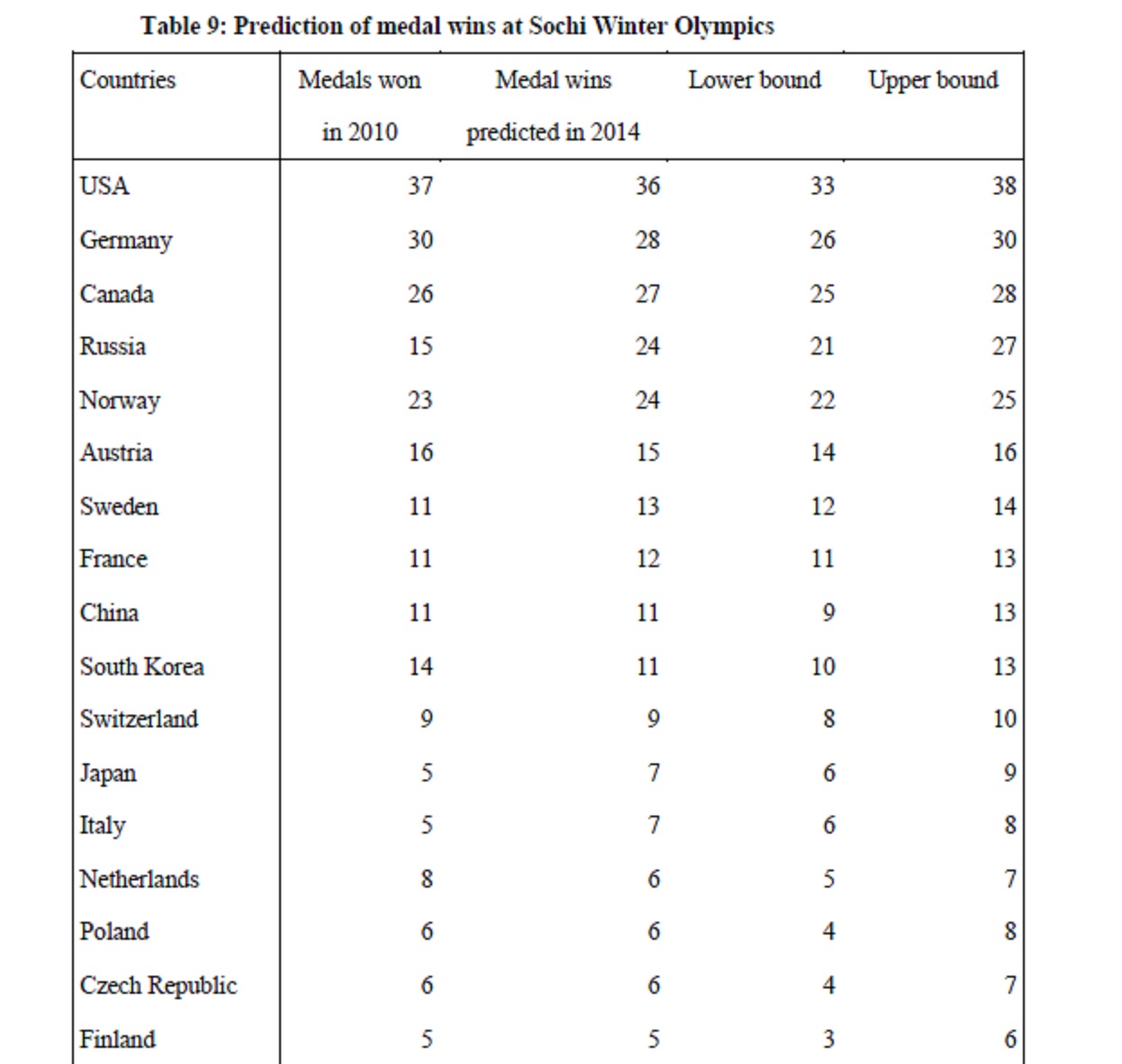
Two economists believe that the number of medals that will be won by any country at the 2014 Winter Olympic games in Sochi will be determined primarily by GDP. They have developed an economic model, tested it against previous Olympic results from 1964 to 2010 and have found that other factors have only a minor effect. They have used their model to make predictions for the 2014,  XXII Olympic Winter Games at Sochi in Russia!

Medal predictions Sochi 2014 - M Andreff

Medal predictions Sochi 2014 – M Andreff

Economic Prediction of Medal Wins at the 2014 Winter Olympics, Madeleine Andreff and  Wladimir Andreff  (pdf: Andreff Sochi)

There is also a published version of the paper: W Andreff, Economic development as major determinant of Olympic medal wins: predicting performances of Russian and Chinese teams at Sochi Games, in Int. J. Economic Policy in Emerging Economies, 2013, 6, 314-340.

Abstract: Starting from an econometric model successfully used to explain and then predict the distribution of medal wins across nations at the Beijing Summer Olympics, a similar model is elaborated on with some different explanatory variables for estimating the determinants of medals won per nation at Winter Games. A Tobit estimation of the model based on data from 1964 to 2010 shows that GDP per capita, population, the endowment in ski and winter sports resorts, and a host country dummy are significant determinants of medal wins at Winter Olympics. Then the estimated model is used for predicting the sporting outcomes at the 2014 Sochi Games with a focus on Russia and China. The Russian team is expected to perform better than in Vancouver 2010 and to be ranked fourth behind the USA, Germany and Canada while the Chinese team would be ranked ninth, a performance doomed to improve in the future given China’s swift economic development.

In their base study the authors do warn that a pinch of salt would be called for and conclude:

Conclusion
All the above predictions must be taken with a pinch of salt. This is namely due to a number of surprising sporting outcomes. Indeed, there are many unexpected sporting outcomes observed ex post ( i.e. achieved outcomes markedly different from the forecast – even though it happens more with the FIFA World Cup than with Summer Olympics (M. & W. Andreff, 2010). Unexpected or surprising outcomes of a sport game or contest have not really been analysed so far. This happens when opponents in a game (contest) have clearly uneven sporting forces, and the underdog wins the favourite. Elaborating on a metrics to quantify surprising sporting outcomes should be a promising avenue for further research. It will be possible to check after Sochi 2014 whether Winter Olympics are characterised with many or few surprising sport outcomes.
For the time being our recommendation is: do not bet that Russia will win 24 medals at Sochi Winter Olympics! But, if Russia makes it with more than 27 medals you would be allowed to conclude that she performed very well, better than expected with an economic model, and that this must be due to exceptional efforts of Russian athletes and coaches before and during Sochi Games. If Russia would win less than 21 medals, you could join Prime Minister Putin and President Medvedev in complaining that the Russian winter sports squad should really have done better – or that it was unexpectedly bad lucky.

The Russians are expecting to be the leading nation on the total medals table and they will not be pleased if they win less than 21 medals. Heads will roll!

If GDP really is the determining factor it should not be too difficult to devise a handicapping system to level the field of competition.

I am inclined to take this with a bucket rather than a pinch of salt.

Moment of truth approaches for India’s Mars Orbiter Mission

November 28, 2013

When everything is for the first time,achievements are incremental and there are very many critical “moments of truth” to meet and overcome. But now comes a very large “moment of truth” as ISRO prepares to inject the Mars Orbiter spacecraft into its Trans Mars Trajectory.

India’s Mars Orbiter (Mangalyaan) is currently in its final orbit around the earth and is scheduled to fire its 440 Newton liquid engine at 0049 hours IST on Sunday morning ( 1919 GMT Saturday 30th November).  It entered its final Earth orbit yesterday which has an orbital period of 5575 minutes (just under 4 days) and it should be approaching apogee later tonight (early hours of Friday morning) and the next engine burn will take place at perigee. Currently apogee is about 193,000 km from earth and perigee is around 350km.

The spacecraft must first be manoeuvred into the right attitude using its thrusters for the firing of its main engine which must then be fired to impart the correct change of velocity (delta-vee). Both, an incorrect attitude and/or an incorrect delta-vee are potential sources of error. Three mid-course corrections are planned  (the first on December 11th) but the margin of error allowable is still extremely small. Too low a velocity change could leave the craft in earth orbit or put it into a heliocentric orbit which does not get close enough to Mars. Too high a delta-vee would also put the craft into a heliocentric orbit which would eventually decay into the sun. I believe there is no chance of achieving a velocity high enough to escape the sun. And even if the velocity change is correct but the direction is too far in error then just another orbital path around the sun would result.

NDTV:“The trans-Mars injection- we are planning to depart on December 1, 2013 early hours of 00:49 hours IST and we are going to burn a liquid engine for duration of roughly 23 minutes which will impart an incremental velocity of 648 metres per second consuming a fuel of 198 kgs,” ISRO Scientific Secretary V Koteswara Rao told reporters in Bangalore.

K. Radhakrishnan, ISRO Chairman. (For the) trans-Mars injection and its insertion into the Martian orbit, the firing of the liquid engine is done in a closed loop mode. Here, a precision accelerometer is used to estimate the incremental velocity added as the liquid engine burns and when the accelerometer gives a feedback that the required incremental velocity added to the spacecraft has been achieved, the burning of the liquid engine is automatically terminated. So, minor variations in the performance of the liquid engine will not matter because we are cutting off its burning based on the delta-v that is achieved. That is why we call it closed loop of firing. … The spacecraft’s propulsion system, i.e., the 440 Newton liquid engine, will complete its first phase of operations on December 1. It has to be re-started for its operation on September 24 (2014).

MOM Trans Mars Injection ISRO

MOM Trans Mars Injection ISRO

ISRO: This voyage is achieved by a combination of navigation and propulsion technologies, governed by the gravity of Sun and Mars, and assisted by the 440 N Liquid engine. Further fine tuning of the trajectory is achieved using the Attitude and Orbit Control Thrusters during the Trajectory Correction maneuvers planned en route.

… on December 11, we plan to have one small firing for mid-course correction of the spacecraft. There may be one more mid-course correction during the helio-centric phase, and subsequently, a fortnight before the spacecraft’s arrival near Mars, there will be one more mid-course correction. So there will be three mid-course corrections between December 1, 2013 and September 24, 2014. 

Mangalyaan is eventually to be placed into a Martian orbit, with a periapsis height of 365 km, apoapsis height of 80,000 km and an orbital period of about 77 hours.

So on Saturday I shall have as many of my fingers crossed as I can manage. I suspect there will be many others doing the same across India.

The Winner

November 28, 2013
The winner spermatazoon - Gabriel Sancho

The winner spermatozoon – Gabriel Sancho

Gabriel Sancho –  Flores

A liking for alcohol is genetic

November 28, 2013

Yet another paper which purports to show that bad behaviour is due to genetic compulsions. In this case a faulty gene is supposed to cause compulsive consumption of alcohol. If all bad behaviour can be shown to be due to genetic compulsions, it follows that nobody can be held accountable for their behaviour.

The press release is from Newcastle University but the researchers come from five universities. It is a 10 year project funded by the Medical Research Council to study genetic effects on alcohol dependence. “.. we don’t understand about how and why consumption progresses into addiction, but the results of this long-running project suggest that, in some individuals, there may be a genetic component”  says Professor Hugh Perry (MRC), “…. it could help us to identify those most at risk of developing an addiction and ensure they receive the most effective treatment.”

Genetic screening of the foetus and abortion of the alcoholicly inclined perhaps! Prevention being better than an impossible cure.

Quentin M. Anstee, Susanne Knapp, Edward P. Maguire, Alastair M. Hosie, Philip Thomas, Martin Mortensen, Rohan Bhome, Alonso Martinez, Sophie E. Walker, Claire I. Dixon, Kush Ruparelia, Sara Montagnese, Yu-Ting Kuo, Amy Herlihy, Jimmy D. Bell, Iain Robinson, Irene Guerrini, Andrew McQuillin, Elizabeth M.C. Fisher, Mark A. Ungless, Hugh M.D. Gurling, Marsha Y. Morgan, Steve D.M. Brown, David N. Stephens, Delia Belelli, Jeremy J. Lambert, Trevor G. Smart, Howard C. ThomasMutations in the Gabrb1 gene promote alcohol consumption through increased tonic inhibitionNature Communications, 2013; 4 DOI:10.1038/ncomms3816

Newcastle University Press Release

Researchers have discovered a gene that regulates alcohol consumption and when faulty can cause excessive drinking. They have also identified the mechanism underlying this phenomenon.

The study showed that normal mice show no interest in alcohol and drink little or no alcohol when offered a free choice between a bottle of water and a bottle of diluted alcohol.

However, mice with a genetic mutation to the gene Gabrb1 overwhelmingly preferred drinking alcohol over water, choosing to consume almost 85% of their daily fluid as drinks containing alcohol – about the strength of wine.

The consortium of researchers from five UK universities – Newcastle University, Imperial College London,  Sussex University, University College London and University of Dundee – and the MRC Mammalian Genetics Unit at Harwell, funded by the Medical Research Council (MRC), Wellcome Trust and ERAB, publish their findings today in Nature Communications.

Dr Quentin Anstee, Consultant Hepatologist at Newcastle University, joint lead author said: “It’s amazing to think that a small change in the code for just one gene can have such profound effects on complex behaviours like alcohol consumption.

“We are continuing our work to establish whether the gene has a similar influence in humans, though we know that in people alcoholism is much more complicated as environmental factors come into play. But there is the real potential for this to guide development of better treatments for alcoholism in the future.”

…. a team led by Professor Howard Thomas from Imperial College London introduced subtle mutations into the genetic code at random throughout the genome and tested mice for alcohol preference. This led the researchers to identify the gene Gabrb1 which changes alcohol preference so strongly that mice carrying either of two single base-pair point mutations in this gene preferred drinking alcohol (10% ethanol v/v – about the strength of wine), over water.

The group showed that mice carrying this mutation were willing to work to obtain the alcohol-containing drink by pushing a lever and, unlike normal mice, continued to do so even over long periods. They would voluntarily consume sufficient alcohol in an hour to become intoxicated and even have difficulty in coordinating their movements.

So my preference for scotch rather than Newcastle Brown Ale is probably also genetic!.

The next VEI 5+ volcanic eruption is overdue

November 26, 2013

As Indonesia raised the warning level for the Mount Sinabung eruption it is worth noting that the last volcanic eruptions of  5 or greater on the Volcanic Explosivity Index (VEI) scale were the 1991 eruptions of Mount Pinatubo (VEI of 6) and Mount Hudson (VEI of 5).

The currently ongoing Mount Sinabung eruption (pictures here) gives cause for concern, as all Indonesian volcanoes do, but there is no certainty as to what intensity it may finally reach:

Jakarta Post: The volcanic ash spewed by Mount Sinabung in Karo regency, North Sumatra, disrupted a number of flights from Kuala Namu International Airport in Deli Serdang regency on Sunday.
In Bandung, the Center for Volcanology and Geological Hazard Mitigation (PVMBG) increased the volcano’s status to “awas” (beware), the highest level of the four-level alert system.

During the 19th century VEI eruptions of 5 or greater ocurred every 11 years on average with the Krakatoa eruption being the greatest at VEI 6 in 1883. Through the 20th century, an eruption of intensity 5 or greater came at intervals varying from 1 year upto 23 years with an average interval of just under 7 years. The Novarupta (1912) and Mount Pinatubo (1991) eruptions were the two classified at VEI6. 

  • 1902 Santa Maria
  • 1907 Kudach
  • 1912 Novarupta
  • 1913 Colima
  • 1918 Katla
  • 1932 Cerro Azul
  • 1933 Kharimkotan
  • 1956 Bezymianny
  • 1963 Mount Agung
  • 1980 Mount St. Helens
  • 1982 El Chichón
  • 1991 Mount Pinatubo
  • 1991 Mount Hudson

So far in this century the 2010 Eyjafjallajökull eruption in Iceland “only” reached a VEI intensity of 4. The 2012 Mt. Etna eruption was rated a 3+. 

The last VEI 5 level eruption was in 1991 and a major eruption of intensity 5 or greater is now  overdue. The interval of 22 years is almost as long as the longest interval between major eruptions in the 20th century. Of course even VEI 6 is still a great deal less than the VEI 8 of Toba or Yellowstone.

The VEI is an index taking both the volume of tephra ejected as well as the height to which it is ejected into account. While there is no evidence that the impact of volcanic eruptions is more than a temporary perturbation of the underlying climate cycle, these perturbations may well last a year or two. The effect on climate is usually that of cooling.

The most significant climate impacts from volcanic injections into the stratosphere come from the conversion of sulfur dioxide to sulfuric acid, which condenses rapidly in the stratosphere to form fine sulfate aerosols. The aerosols increase the reflection of radiation from the Sun back into space, cooling the Earth’s lower atmosphere or troposphere. Several eruptions during the past century have caused a decline in the average temperature at the Earth’s surface of up to half a degree (Fahrenheit scale) for periods of one to three years. The climactic eruption of Mount Pinatubo on June 15, 1991, was one of the largest eruptions of the twentieth century and injected a 20-million ton (metric scale) sulfur dioxide cloud into the stratosphere at an altitude of more than 20 miles. The Pinatubo cloud was the largest sulfur dioxide cloud ever observed in the stratosphere since the beginning of such observations by satellites in 1978. It caused what is believed to be the largest aerosol disturbance of the stratosphere in the twentieth century, though probably smaller than the disturbances from eruptions of Krakatau in 1883 and Tambora in 1815. 

But an eruption of VEI 5 or greater within the next year or two could well accelerate the underlying global cooling cycle that may be underway (and caused primarily by solar effects – direct and indirect).

The diagram below comes from a guest post by Dan Pangburn at The Hockey Schtick.

Global temperature anomaly and major volcanic eruptions

Psycho the rapist

November 26, 2013
  • Sigmund Freuds ‘Oedipus complex’. Not so much a theory as a confession.
  • Two psychotherapists meet. “Hi,” says one, “How am I feeling today?
  • They have sex and the other one says, “That was great for you. How was it for me?”
  • A Freudian slip is when you say one thing, but you mean your mother
  • How many psychiatrists does it take to change a light bulb?

 None. The light bulb will change itself when it’s ready.
Just one, but it takes nine visits.
One tablet a day, if it’s included in DSM5.

  • I told my psychiatrist that everyone hates me. He said I was being ridiculous – everyone hasn’t met me yet.
  • If you think you are walking out of here cured after only three sessions, you are crazy.
  • A neurotic is the person who builds a castle in the air. A psychotic is the person who lives in it. And a psychiatrist is the person who collects the rent.
  • I asked my therapist never to tell anyone about my Oedipus complex. He said ‘sure, mum’s the word’.
  • When Sigmund’s mirror broke, Jung took pleasure in seeing a shard in Freud.
  • Therapy helps but screaming obscenities is more satisfying – and cheaper.
  • Freud quotes:

The great question that has never been answered, and which I have not yet been able to answer, despite my thirty years of research into the feminine soul, is ‘What does a woman want?’
Time spent with cats is never wasted.
America is the most grandiose experiment the world has seen, but, I am afraid, it is not going to be a success.
A man who has been the indisputable favorite of his mother keeps for life the feeling of a conqueror.
A certain degree of neurosis is of inestimable value as a drive, especially to a psychologist.

Class war in France as Hollande takes on the cavaliers

November 25, 2013

1. In France equestrian centres enjoy the relatively low VAT rate of  5.5% or 7%.

2. The EU naturally feels it necessary to poke its nose into anything it pleases

In a judgement handed down on 8 March (1), the EU Court of Justice ruled that France incorrectly applied the directive on the common system of value added tax (VAT) (2) by applying a reduced rate to certain transactions related to equidae.

The court upheld the European Commission’s first grievance whereby France may not apply a reduced rate (5.5%) to transactions related to horses when these animals are not intended for use in the preparation of foodstuffs or in agricultural production. It maintained that the directive authorises a reduced VAT rate for live animals “normally” intended for use in the preparation of foodstuffs and for transactions related to equidae, particularly horses, for agricultural, forestry or fishery activities, to the extent that they constitute deliveries or services intended for use in agricultural production.

3. The equestrian brigade (the cavaliers) are seen to be part of the privileged classes and as such a clear target for Francois Hollande and his old-fashioned class warfare objectives. The EU directive gives Hollande a wonderful excuse to triple VAT on the cavaliers. But for the cavaliers Hollande is not the right horse to bet on.

Paris equestrial protest

French cavaliers take to the street – image The Guardian

The Guardian: François Hollande’s plan to treble VAT on equestrian centres will ‘send 80,000 horses to the abattoir’, warns industry. 

A French mood of mutiny that has rippled through Brittany and infected teachers, farmers and shopkeepers, skipped species on Sunday when horses took to the streets of Paris to complain about tax rises. Thousands of disgruntled horse and pony riders rode through the French capital to complain about tax increases they say will put many of them out of business and send 80,000 animals to the abattoir.

The “cavaliers” blocked roads from the symbolic Paris squares, Place d’Italie, Place de la Bastille and Place de la Nation, in protest at government plans to almost treble VAT on equestrian centres. It was the latest manifestation of the growing revolt over President François Hollande’s tax reforms, many of them aimed at reducing the country’s public deficit to meet European Union demands.

The EU bureaucracy is essentially “socialist” in  that they are all paid for by taxes and they will do anything to make work for themselves and to expand their areas of work to ensure their own continuance. Support for all forms of publicly funded bureaucracy seems to be the core value of all socialist parties in Europe. If there was any group which needed to be disenfranchised it must be those who live off public funding – and not only in the EU but also within the member countries of the EU. Of course that line of thought leads to all politicians being banned from voting. And maybe that would not be so bad either.

Political statues in India cost more than the Mars Orbiter Mission

November 24, 2013

A very critical moment for the Indian Mars Orbiter Mission (Mangalyaan) comes a week from today when the spacecraft’s engine has to be fired as it reaches perigee in its Earth orbit, to insert  it into  a trajectory to reach Mars some 10 months later.

The Mission has been criticised both in the West and in India (here and here for example) as being too expensive, too elitist and the wrong priority for a developing country like India. I think such criticism misses the point. The Indian Mars Orbiter Mission is primarily a test of technology and capability and self-confidence and self-belief”. The cost pales in comparison with the spend on religious festivities and what other much less productive projects can cost. As an example of what frugal engineering can achieve, the inspiration and ingenuity it can foster is immeasurable.

Manoj KumarPatairiya writes in the New York Times:

If the Mars Orbiter successfully reaches the vicinity of the planet in September 2014, after 300 days’ journey into deep space, it will make India the first Asian country and the fourth in the world to reach the red planet. …. The mission has, however, started an intense debate. While its supporters trumpet its incredibly low cost of around $75 million (a fraction of the cost of a similar American expedition), critics question the logic behind spending any amount when India is dealing with such deep-rooted problems as widespread hunger, poverty and corruption. ……. 

But U. R. Rao, a former chairman of the Indian Space Research Organization, compared the $75 million spent on the mission to the amount Indians spend on Diwali crackers for one day: “For going all the way to Mars, just one-tenth of the money is being spent. So, why are they shouting?”

Part of the reason the mission is so much less expensive is that it is able to take advantage of existing deep space communications systems and navigation support from NASA. But India is becoming known for its low-cost innovations in many diverse fields, including health care, renewable energy, sanitation, mobile technology and tablet computers. Indian scientists like to share this anecdote: “Americans spent millions to develop a pen that will not leak in space, whereas Russians used a pencil!”

The cost of the Indian Mars mission is about $75 million and just to put it into perspective:

  • Mayawati’s park in Noida was constructed at the cost of $130 million, and has 24 huge statues of elephants, and one of herself.
  • the total cost to build the Narendra Modi sponsored “Statue of Unity” is estimated to be about $340 million

Politicians will of course argue that the “feel-good” effects generated by such monuments to themselves or their heroes are well worth the cost!

If the MOM succeeds in its main objectives, there is even a case for using the window that is coming in 2018 to attempt a manned trip around Mars and back in 501 days.