Archive for the ‘Alarmism’ Category

Chaos of climate models only shows that “we don’t know what we don’t know”

April 17, 2013

I spent a large part of my early career in mathematical modelling (of combustion systems and of heat flow) and have a very clear idea of what models can do and what they can’t. Models after all are used primarily to simplify complex systems which are otherwise intractable. They are – always – severely limited by the assumptions and simplifying approximations that have to be introduced. Models are a powerful tool for investigation but are only as good as their most inaccurate assumption. But they are a tool primarily for investigation — and can be dangerous when used for decision making based on their imperfect predictions. The spectacular failures of mathematical models of the global economy are a case in point. It is worth noting that in spite of the great strides made in weather forecasting  for example – much of which is empirical – the simple statement that “tomorrows weather will be like today’s”  is as correct – statistically – as the most complex model running on some super-computer somewhere.

It has therefore always amazed me that so-called “scientists” would be so certain about their approximate models of climate systems – which are perhaps as complex, chaotic and “unknown” systems as any one could study. It has been a boon for politicians looking for new ways of raising revenue. It has been exploited by the alarmists since the alarmist predictions cannot be tested. The wide spread of results from climate models is rarely mentioned.

When reality does not match model forecasts it is time to back off and rethink the models and hopefully they will be better next time. And it is time to back track from all the political decisions made on the basis of patently incomplete and inaccurate models.

The simple reality about climate is that rather than being a “settled science”

  • we don’t know the impact of solar effects on climate
  • we don’t know the impact of clouds or even if they are net “warmers” or net “coolers”
  • we don’t know how much of the earth’s radiative energy balance is dependent upon carbon dioxide
  • we don’t know how much carbon dioxide is absorbed  by the oceans and living things
  • we don’t know the impact of aerosols and particles in the atmosphere
  • we don’t know the role of the oceans in transporting heat around the globe
  • we don’t know how much heat is stored in the oceans and how it varies
  • we don’t know the impact of solar effects on cloud formation
  • we don’t know what triggers ice ages, and
  • we don’t know what we don’t know.

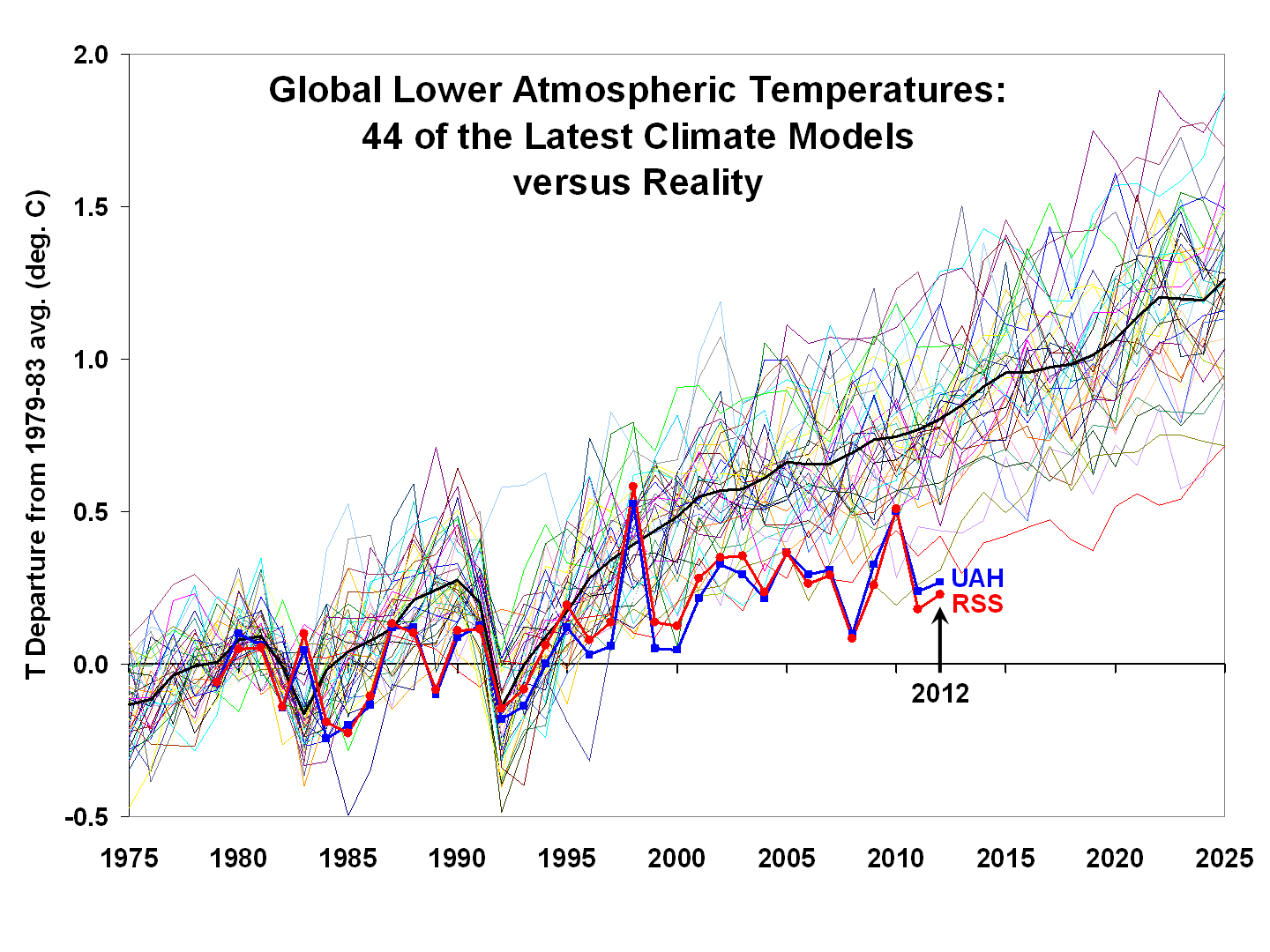
This from Dr. Roy Spencer and the ridiculously wide spread of the model results and the obvious deviation of reality from model results are particularly striking:

Global Warming Slowdown: The View from Space

Since the slowdown in surface warming over the last 15 years has been a popular topic recently, I thought I would show results for the lower tropospheric temperature (LT) compared to climate models calculated over the same atmospheric layers the satellites sense.

Courtesy of John Christy, and based upon data from the KNMI Climate Explorer, below is a comparison of 44 climate models versus the UAH and RSS satellite observations for global lower tropospheric temperature variations, for the period 1979-2012 from the satellites, and for 1975 – 2025 for the models:

CMIP5-global-LT-vs-UAH-and-RSS

CMIP5-global-LT-vs-UAH-and-RSS

Clearly, there is increasing divergence over the years between the satellite observations (UAH, RSS) and the models. The reasons for the disagreement are not obvious, since there are at least a few possibilities:

……… 

The dark line in the above plot is the 44-model average, and it approximately represents what the IPCC uses for its official best estimate of projected warming. Obviously, there is a substantial disconnect between the models and observations for this statistic.

I find it disingenuous for those who claim that, because not ALL of individual the models disagree with the observations, the models are somehow vindicated. What those pundits fail to mention is that the few models which support weaker warming through 2012 are usually those with lower climate sensitivity.

So, if you are going to claim that the observations support some of the models, and least be honest and admit they support the models that are NOT consistent with the IPCC best estimates of warming.
EU begins “repatriation of climate policy”?

April 16, 2013

It is probably the best thing that has happened for German electricity consumers for some time as German power prices fell by 3% as a reaction to the vote in the European Parliament. Even the EU Parliament – which has long been known as a “politically correct” follower of global warming orthodoxy – today balked at the  prospect of “backloading” and postponing the introduction of 900 million “carbon allowances”. This had been proposed by the climate fanatics in an effort to increase the declining price of these allowances and the possible collapse of the entire carbon trading market.

It is to be hoped that it really is the “beginning of the “repatriation of EU climate policy” which has been so wrong and so stubborn and so stupid for so long. But the religious environmentalism is still pretty fanatic and they will not give up their cherished dogma and their entrenched positions and their carbon scams so easily.

The Parliament:

Controversial ‘backloading’ proposal rejected by MEPs

The European parliament has rejected proposals for ‘backloading’ to postpone the auctioning of 900 million carbon allowances for 2013-2015, in a bid to help boost the price of ‘polluters permits’.

The proposals have been much debated, with some believing that any interference in the EU’s carbon market – the biggest in the world – could undermine confidence in the emissions trading scheme (ETS).

However, others feel that the temporary backloading solution would give the ETS, which is considered to be a flagship policy in the EU’s climate change agenda, a much needed boost, increasing carbon prices and in turn stimulating investment and innovation.

On Tuesday, parliament rejected the proposals by a narrow margin, 334 MEPs voted in favour, 315 against, and 63 abstained. Carbon prices immediately fell by 44 per cent to a record low of €2.63 following the vote.

Matthias Groote, parliament’s rapporteur on the timing of auctions, said “I deeply regret today’s vote. It is the beginning of the repatriation of climate policy.”

Reuters reports: 

Traders took the lack of political support as a signal to sell, driving the market down to its lowest yet. Immediately after the vote, carbon prices dropped by around 40 percent to 2.63 euros a tonne. They were trading at 3.15 euros, down 33.4 percent, by 1423 GMT.

“The carbon market is now in a coma, until a clear intervention takes place,” an emissions trader said. 

The Commission’s backloading proposal was meant to be a quick fix that could be agreed by the end of last year.

But it exposed deep divisions, with interest groups intensively lobbying members of the European Parliament.

Hedegaard, together with analysts and some in the energy sector have warned that failure to agree on EU steps would spur fragmentation in environmental policy as member nations move to safeguard their own green targets. Britain, for instance, already has a carbon price floor.

Of course the “loony left” were appalled:

“This kind of politics plays into the hands of climate sceptics. The rejection of the backloading proposal weakens the EU emissions trading system and puts our climate goals at risk.”

S&D deputy Linda McAvan said that the UK Tory party played an instrumental part in rejecting support for the EU’s carbon market. 
She said, “In a tight vote in the full session of the parliament in Strasbourg, most Tory MEPs chose to side with climate sceptics once again and undermine their own government’s climate strategy.” 
She continued, “They put their fanatic euro-scepticism ahead of British jobs and our environment,” adding, “This vote is a catastrophe for the environment.”
Greens MEP Keith Taylor also condemned the UK’s Tory party, as well as UKIP, saying, “Some MEPs want to leave the EU carbon market to sort itself out, but this simply won’t work.
“The ETS is flawed and leaving it alone won’t get us anywhere towards improving it. By opposing necessary steps to fix these problems Tory and UKIP MEPs are effectively signalling their desire to destroy the EU’s flagship climate change policy.”
Climate action commissioner Connie Hedegaard also expressed “regret” about the decision by parliament, and said that the proposal will now go back to the environment committee for “further consideration”. 
She added, “The commission remains convinced that backloading would help restore confidence in the EU ETS in the short term until we decide on more structural measures.
“We will now reflect on the next steps to ensure that Europe has a strong EU ETS.”
Josche Muth, secretary general of the European renewable energy council, said that the decision “renders the ETS impotent as a tool for shifting investments into less polluting generation technologies”.

But at least some sanity is returning

However, it wasn’t just the 315 MEPs who voted against the proposals that disagree with the proposals. 
BusinessEurope also welcomed the decision, with the director general Markus J. Beyrer saying that, “The European parliament expressed its support for a market-based instrument and rejected political interference. 
“It is time to move past the divisive and unhelpful debate around backloading and focus on the real priorities for the EU: how to secure a cost-competitive, secure and climate-friendly energy policy for 2030.”

Questioning global warming dogma is taboo in Belgium

April 15, 2013

Reproduced from The GWPF  because “questioning the impact of mankind on climate change is evidently still a taboo in the French-speaking world”. 

The authors of this paper recently presented their views on climate science at the Royal Academy of Belgium. No French or Belgian newspaper was willing to publish their assessment. Questioning the impact of mankind on climate change is evidently still a taboo in the French-speaking world.

Double Standards in Climate Change

István E. Markó a), Alain Préat b), Henri Masson c) and Samuel Furfari d)

a) Professor at the Université catholique de Louvain (UCL)

b) Professor at the Université libre de Bruxelles (ULB)

c) Professor at Maastricht University

d) Lecturer at the Université libre de Bruxelles (ULB)

The conference on climate change held in Doha (Qatar) last December ended in failure once again. However, the news reported in the media about this 18th conference on climate change were fully in line with the well-rehearsed mantra: the Earth is warming up, human emissions of greenhouse gases are mainly to blame for this warming up, and we are approaching disaster. We have only one climate, but communication about it seems to be plagued by double standards.

For a few years now British, American, Italian or German media have given sceptical scientists the opportunity to express their opinions on the validity of the statements released by the Intergovernmental Panel on Climate Change (IPCC), the organisation responsible for the official line of thought on climate matters. Nothing like that has been seen in the French or Belgian media which persist in portraying scientific sceptics, at best as sold out to the oil lobbies, at worst as troubled individuals, greedy for public recognition and fame and as such not worthy to be proponents in a serious debate.

The authors of this contribution were recently been granted the honour of presenting their point of view as climate sceptics at the Royal Academy of Belgium. During a series of six well-attended lectures we showed, among other things, that:

  1. The climate has always changed. This was true during ancient times and it has also been true since the beginning of the modern era. These climate changes have always been, and still are, independent of the concentration of CO2 in the atmosphere;
  2. During Roman times and the Middle Ages temperatures were observed well in excess of those currently experienced. From the 16th till the 19th century a cold period referred to as the “Little Ice Age” predominated. All these changes took place without mankind being held responsible. We believe that the increase in temperatures that occurred during a certain part of the 20th century is the result of a recovery from this cold period. These various events can be explained by a combination of warm and cold cycles of different magnitudes and duration. Why and how this happens is not yet fully understood, but some plausible explanations can be put forward;
  3. The so-called “abnormally rapid” increase in global temperatures between 1980 and 2000 is not unusual at all. There have in fact been several such periods in the past, during which temperatures rose in a similar manner and at comparable rates, even though fossil fuels were not yet in use;
  4. Temperature measurements do not necessarily correlate with a building up or a decrease in heat since heat variations are energy changes subject to thermal inertia. Apart from heat many other parameters have an influence on temperature. Moreover the measurement of temperatures is subject to numerous large errors. When the magnitude and plurality of these measurement errors are taken into account, the reported increase in temperatures is no longer statistically significant;
  5. The famous “Hockey-stick” curve, known as the Mann’s curve and presented six times by the IPCC in its penultimate report, is the result among other things of a mistake in the statistical calculations and an incorrect choice of temperature indicators, i.e. proxies. This lack of scientific rigour has totally discredited the curve and it was withdrawn, without any explanation, from subsequent IPCC reports;
  6. Even though they look formidably complex, the theoretical models employed by the climate modellers are simplified to the extreme. In fact there are far too many (known and unknown) parameters that influence climate change. At the moment it is impossible to take them all into account. The climate system is extremely complex, containing not only chaotic components but also numerous positive and negative feedback loops operating according to various different time scales. Which is why the IPCC wrote in its reports that: “…long-term prediction of future climate states is not possible” (page 774, Third report). This is very true. To this day all the climate predictions based upon these models have turned out to be totally incorrect. Strangely, nobody seems to care;
  7. The relationship between CO2 and temperature, obtained from the Vostok ice cores, shows that a building up of CO2 occurs 800 to 1000 years after an increase in temperature is observed. Hence the increase in the concentration of CO2 is a consequence of the warming of the climate, not its cause;
  8. But the coup de grâce to the “warmists’ theory” – certainly not yet visible in the French and Belgian media – comes from the observation that for the past fifteen years or so the global temperature of the Earth has remained constant. During the same period CO2 emissions have increased by far more than in the past, reaching an unparalleled record this year. Honest climate scientists admit that this observation is an embarrassing inconvenience for their theory. However, attempts to make us believe that the Earth is continuing to warm up persist. Will we have to wait for another twenty, twenty-five or thirty years for the global warming advocates to finally admit that there is no unambiguous correlation between the global temperature of the Earth and human-generated CO2 emissions?
  9. The claim that Hurricane Sandy is due to human CO2 emissions is totally unfounded and has been vigorously contested by numerous meteorologists. This regrettable distortion of the facts has been denounced in an open letter, addressed to the General Secretary of the UN and signed by more than 130 world-renowned scientists, including one of the present authors;
  10. Finally the “abnormal” melting of the Arctic Sea ice, that made the headlines of numerous journals during this summer, was also observed during previous decades. Amazingly the record high increase in Antarctic Sea ice that occurred at exactly the same time has been completely ignored by the very same media. Moreover, no mention has been made of the current, particularly rapid, regeneration of the Arctic Sea ice.

These ten statements are facts. We would be ready to accept that they could be wrong, if evidence were presented to scientifically disprove them. In the meantime, and in view of the lack of coherence and unreliability associated with the numerous predictions made by the IPCC, it is time to set the record straight. The public and politicians must be informed about the hypothetical character of the predominant ‘consensus’ on climate change, which has been uncritically disseminated in the media for more than ten years. If it ever existed, this so-called “climate change consensus” has now been totally undermined by the facts.

Despite the opportunity that we were given by the Royal Academy to raise this issue, we were unable to find any French or Belgian newspaper willing to publish this text. Questioning the impact of mankind on climate change is evidently still a taboo over here.

This article reflects solely the opinions of the Authors.

Carbon dioxide warming effect is just a “marketing trick”

April 11, 2013

P Gosselin of NoTricksZone reports on this Article in the Voice of Russia a month ago – but which got little attention from the global warming orthodoxy and the politically correct media. Not that everything from Russia makes sense but in this case I think they are far closer to reality than most others. I think they pay sufficient attention to solar effects and the oceans and are not easily diverted by the fanciful demonisation of carbon dioxide:

The world facing an ice age (in German)

Gosselin writes: The article writes that Russian scientists are predicting that “a little ice age will begin in 2014“. The article adds:

“They reject the claim of global warming and call it a marketing trick.”

When it comes to warming and the man-made CO2 greenhouse gas effect, the Voice of Russia writes that “Russian scientist Vladimir Bashkin is categorically in disagreement. He claims that the climatic changes are characterized by cycles and have nothing to do in any way with the activities of man.”

Together with his colleague Rauf Galiullin from the Institute for Fundamental Problems of Biology of the Russian Academy Of Science, he demonstrates that the current warming is a reverberation of the planet coming out of the ‘Little Ice Age’ and that in the near future, of course measured on geological timescales, we are at the threshold of an ice age.”

The Voice of Russia quotes Bashkin:

“The periods of a cooling and a warming follow each other at 30-40 year intervals. In Russia for example there was a warming in the 1930s, a time when seafaring at the Northern Sea Route was possible, then a cooling followed during the wartime years, and then warming followed in the 1970s, etc.. The current warming period ended at the end of the millennium.“

Note here that the Russian scientists confirm that the Arctic sea ice extent was also low in the 1930s. This tells us that nothing is really so unusual in the Arctic today.

The Voice of Russia then explains that the cooling is related to ”a change in solar activity” and that this “also has an impact on our climate“. Bashkin adds:

“The scientific research of the climate of the past geological epoch causes us to doubt the motives behind the demands of the IPCC. […] The greenhouse effect that is connected with the anthropogenic factor is about 4 or 5 percent of that from natural emissions. The eruption of a volcano produces more. A real contribution to the greenhouse effect is made by normal water vapor. Thank God nobody has gotten the idea that this too needs to be regulated.“

The Voice of Russia continues: “The world’s oceans contain 60 times more carbon dioxide than the atmosphere. When the temperature of the planet rises, it begins to be quickly released. This leads to an increase in atmospheric CO2 concentration, and not vice versa. A global warming that so many are talking about is not so much a scientific problem, rather it is much more a marketing trick. […] We do not have global warming ahead of us, rather we have global cooling, the Russian scientist claims. However, we do not need to fear the cooling because it will take place gradually and won’t be noticeable until the middle of the 21st century.”

The scientists add that part of the motive behind the “marketing trick” is to manipulate the market for fossil fuels.

Doomsayers confounded as Gulf of Mexico heals itself

April 10, 2013

It was touted as the greatest environmental disaster of all time when Deepwater Horizon exploded in the Gulf of Mexico killing 11 and spilling vast quantities of crude oil. But two years later in April 2012 it was clear that the Gulf was recovering much faster than expected. It was soon clear that the effect of oil eating microbes had been grossly underestimated. And now 3 years after the accident an expert in bioremediation reported  at the 245th National Meeting & Exposition of the American Chemical Society (ACS)  that “the Gulf of Mexico may have a much greater natural ability to self-clean oil spills than previously believed”.

“It shows that we may not need the kinds of heroic measures proposed after the Deepwater Horizon spill, like adding nutrients to speed up the growth of bacteria that breakdown oil, or using genetically engineered bacteria. The Gulf has a broad base of natural bacteria, and they respond to the presence of oil by multiplying quite rapidly.”

From ACS: Terry C. Hazen, Ph.D., said that conclusion has emerged from research following the 2010 Deepwater Horizon disaster, which by some estimates spilled 4.9 million barrels (210 million gallons) of oil into the Gulf of Mexico. His research team used a powerful new approach for identifying microbes in the environment to discover previously unknown bacteria, naturally present in the Gulf water, that consume and break down crude oil.

“The Deepwater Horizon oil provided a new source of nutrients in the deepest waters,” explained Hazen, who is with the University of Tennessee in Knoxville. “With more food present in the water, there was a population explosion among those bacteria already adapted to using oil as a food source. It was surprising how fast they consumed the oil. In some locations, it took only one day for them to reduce a gallon of oil to a half gallon. In others, the half-life for a given quantity of spilled oil was 6 days. This data suggests that a great potential for intrinsic bioremediation of oil plumes exists in the deep sea and other environs in the Gulf of Mexico.” 

Hazen spoke at a symposium, “Environmental Fate of Petroleum Oils and Dispersants in the Marine Environment,” that included other reports relating to the Deepwater Horizon spill. They were among 12,000 reports being presented at the ACS meeting, which continues through Thursday. Abstracts of the oil spill symposium appear at the end of this press release.

Oil-eating bacteria are natural inhabitants of the Gulf because of the constant supply of food. Scientists know that there are more than 600 different areas where oil oozes from rocks underlying the Gulf of Mexico. These oil seeps, much like underwater springs, release 560,000-1.4 million barrels of oil annually, according to the National Research Council.

Hazen’s team used a powerful new approach for identifying previously recognized kinds of oil-eating bacteria that contributed to the natural clean-up of the Deepwater Horizon spill. In the past, scientists identified microbes by putting samples of water into laboratory culture dishes, waiting for microbes to grow and then using a microscope to identify the microbes. The new approach, called “ecogenomics,” uses genetic and other analyses of the DNA, proteins and other footprints of bacteria to provide a more detailed picture of microbial life in the water.

“The bottom line from this research may be that the Gulf of Mexico is more resilient and better able to recover from oil spills than anyone thought,” Hazen said. “It shows that we may not need the kinds of heroic measures proposed after the Deepwater Horizon spill, like adding nutrients to speed up the growth of bacteria that breakdown oil, or using genetically engineered bacteria. The Gulf has a broad base of natural bacteria, and they respond to the presence of oil by multiplying quite rapidly.”


“Global warming is the opiate of the upper middle class”

April 9, 2013

That “global warming” is a religion I have no doubt. But we could be going through a Martin Luther or perhaps a Galileo Galilei  moment for this religion as its foundations crumble. “Heretics” are gaining ground steadily as the high priests of the global warming religion continue to roar and bluster and threaten hell-fire and damnation.

The “religion” theme is succinctly put by Henry Payne in The Detroit News. Considering the soporific and addictive nature of the religion and its ability to induce a feeling of being superior I thought that being “an opiate of the upper middle class” was particularly apt.

Paris, France – From Anglicanism to Catholicism, Europe’s history is full of state-based religion. In secular 21st century Europe, the unofficial state religion is the GreenChurch. Environmentalism inspires a devout, pro-Kyoto devotion here quite different than the more skeptical American outlook.

But France’s strident green political and media voices are curiously silent this year. Perhaps it’s the bone-chilling spring.

Parisians used to leafy April vistas shiver past leafless trees on Paris’s beautiful, tree-lined parks. Temperatures are in the mid-40s, well below the 60s-normal. Average temperatures across the continent are, on average, 4-8 degrees below normal with March registering colder average temperatures than January. Snow fell in England, France, and Germany this spring- an unusual occurrence. The cold snap follows the frigid London Olympics last summer and over a decade of flat temperatures worldwide. Hardly the stuff of global warming. But the GreenChurch is firm in its doctrine – and the global warming high priests must be obeyed.

If Christianity was the opiate of the masses in centuries gone by, then global warming is the opiate of the upper middle class.

As such, politicians here have imposed draconian laws on their masses, from high gas taxes to high utility costs – a situation so extreme in Germany that the term “electric poverty” has become a common term. Unable to afford high energy costs imposed by government censor of sinful coal power, thousands have had their power shut off.

Here in Paris, French citizens suffer under $7.50 a gallon gas even as hey huddle at the pumps in winter overcoats. They pay their sin taxes, but, they may ask, to what end?

Population decline is looming

April 6, 2013

I have posted earlier regarding the population decline that is inevitable if the fertility rates around the world continue to decline as they are doing. The declining fertility combined with the increase in longevity and the problems of aging pose new challenges of maintaining the growth and maintenance of the infrastructure that we would have become used to. In a hundred years from now the challenge could be a real shortage of labour.

The challenge in 2100 will be to maintain the balance between those “producing” to those “supported” in a declining and aging population. Perhaps immigration or population migrations or  productivity increases by the use of robots and an increase in the age one joins the “supported” population will be parts of the solution. I have no doubt that solutions will be found, but the “overpopulation problem” would have left the stage. ….

The majority of children being born today in the developed world will live to be over 100 years old.

Now as Science 2.0 reports another model simulation shows that  The Looming Population Implosion is inevitable and just a mathematical consequence of falling fertility rates.

Total fertility by major regions, 1950-2100 (children per woman) (UN)

A model based on global population data spanning the years from 1900 to 2010 has caused a research team to predict the opposite of what Doomsday Prophets of the 1960s and beyond insisted would happen –  the number of people on Earth will stabilize around the middle of the century and perhaps even start to decline. 

The results coincide with the United Nation’s downward estimates, which claim that by 2100 Earth’s population will be 6.2 billion, if low fertility and birth rate continues on its current path, below the 7 billion we are at now. 

The numerical model developed by a team from the Autonomous University of Madrid (UAM) and the CEU-San Pablo University seems to confirm the lower estimate, in addition to a standstill and even a slight drop in the number of people on Earth by the mid-21st century. The population prospects between 1950 and 2100 provided by the UN were used to conduct the analysis published in the journal Simulation. 

“This is a model that describes the evolution of a two-level system in which there is a probability of passing from one level to another,” as explained to SINC by Félix F. Muñoz, UAM researcher and co-author of the project. …… 

……. The team considered the Earth as a closed and finite system where the migration of people within the system has no impact and where the fundamental principle of the conservation of mass –biomass in this case– and energy is fulfilled.

“Within this general principle, the variables that limit the upper and lower zone of the system’s two levels are the birth and mortality rates,” Muñoz pointed out and recalled the change that occurred in the ratio between the two variables throughout the last century.

“We started with a general situation where both the birth rate and mortality rate were high, with slow growth favouring the former,” he added, “but the mortality rate fell sharply in the second half of the 20th century as a result of advances in healthcare and increased life expectancy and it seemed that the population would grow a lot.

However, the past three decades have also seen a steep drop-off in the number of children being born worldwide.”

Climate sensitivity – 10 years on and Pat Michaels et al get their due

April 5, 2013

Back in 2002 a paper in Climate Research by Pat Michaels and his colleagues seriously questioned the sensitivities assumed in the exaggerated IPCC projections for global temperature but the paper was considered heretical and its authors were castigated by the global warming orthodoxy. So Pat Michaels and his colleagues would be more than entitled to an “I told you so” and even some more derisory nose-thumbing at the IPCC.

As Michaels and Knappenberger write at Cato:

Getting Our Due

In the Diary feature of this week’s The Spectatorrational optimist Matt Ridley has a collection of rather random observations from his daily life that have him thinking about (or maybe wishing for since Old Man Winter has been slow to loose his grip in the U.K. and Western Europe, much like he has across the Eastern U.S.) anthropogenic global warming.

What has his attention is that global warming just doesn’t seem to be going according to plan. And for those who have bought into that plan, their plan-driven actions are starting to make them look foolish.

But it’s not as if we haven’t “told you so”—a fact that Ridley draws attention to in the closing segment of his article. ……. 

What we determined in our 2002 study was that the amount of global warming projected by the end of this century was most likely being overestimated.  When we adjusted the climate model projections to take into account and better match the actual observations, our best estimate of the amount of warming we expected from 1990 to 2100 was about 1.8°C (3.2°F), which was in the lower end of the IPCC projected range, and which Ridley correctly noted, we termed as “modest.”

Further, we anticipated the slowdown in the warming rate. ….. 

…… Now, more than 10 years later, more and more evidence is piling in that we were right, including several recent papers that apply a technique not all that dissimilar in theory than our own (e.g. Gillett et al., 2012; Stott et al., 2013).

So even though we still are largely ostracized, at least we rest assured that we were pretty much on target—and some people are starting to take notice.

Revised 21st century temperature projectionsPatrick J. Michaels, Paul C. Knappenberger, Oliver W. Frauenfeld and Robert E. Davis, Climate Research, Vol. 23: 1–9, 2002

Abstract: Temperature projections for the 21st century made in the Third Assessment Report (TAR) of the United Nations Intergovernmental Panel on Climate Change (IPCC) indicate a rise of 1.4 to 5.8°C for 1990–2100. However, several independent lines of evidence suggest that the projections at the upper end of this range are not well supported. Since the publication of the TAR, several findings have appeared in the scientific literature that challenge many of the assumptions that generated the TAR temperature range. Incorporating new findings on the radiative forcing of black carbon (BC) aerosols, the magnitude of the climate sensitivity, and the strength of the climate/carbon cycle feedbacks into a simple upwelling diffusion/energy balance model similar to the one that was used in the TAR, we find that the range of projected warming for the 1990–2100 period is reduced to 1.1–2.8°C. When we adjust the TAR emissions scenarios to include an atmospheric CO2 pathway that is based upon observed CO2 increases during the past 25 yr, we find a warming range of 1.5–2.6°C prior to the adjustments for the new findings. Factoring in these findings along with the adjusted CO2 pathway reduces the range to 1.0–1.6°C. And thirdly, a simple empirical adjustment to the average of a large family of models, based upon observed changes in temperature, yields a warming range of 1.3–3.0°C, with a central value of 1.9°C. The constancy of these somewhat independent results encourages us to conclude that 21st century warming will be modest and near the low and of the IPCC TAR projections.

Coral reef not so sensitive to global warming after all (if it ever was)

April 5, 2013

Another “climate sensitivity” to join the long list of global warming exaggerations. A coral reef has recovered from a severe “bleaching” event in just 12 years to a level that was thought to require many decades. In fact the assumption that the cause of the severe disturbance in in 1998 was due to global warming is itself looking very shaky. After all, if it was due to global warming (rather than some local temperature or other event) then why on earth did it reverse in 1998? Or is it just a coincidence that no global warming has been observed since that time?

Polar bear numbers are increasing, clouds may “cool” more than they “heat”, the earth’s green cover is increasing, the Antarctic has more ice than it ever had and the Arctic ice variability is not unprecedented and glaciers are not melting at any greater rate than the pre-industrial rate. It is becoming increasingly clear that the “sensitivity” of the global climate to carbon dioxide has been grossly exaggerated.

Location of Reef building corals

Location of Reef building corals (Photo credit: Wikipedia)

“Recovery of an isolated coral reef system following severe disturbance”, by J. P. Gilmour, L. D. Smith, A. J. Heyward, A. H. Baird and M. S. Pratchett  published online at Science on Friday, 5th April, 2013.

Abstract: Coral reef recovery from major disturbance is hypothesized to depend on the arrival of propagules from nearby undisturbed reefs. Therefore, reefs isolated by distance or current patterns are thought to be highly vulnerable to catastrophic disturbance. We found that on an isolated reef system in north Western Australia, coral cover increased from 9% to 44% within 12 years of a coral bleaching event, despite a 94% reduction in larval supply for 6 years after the bleaching. The initial increase in coral cover was the result of high rates of growth and survival of remnant colonies, followed by a rapid increase in juvenile recruitment as colonies matured. We show that isolated reefs can recover from major disturbance, and that the benefits of their isolation from chronic anthropogenic pressures can outweigh the costs of limited connectivity.

PhysOrg writes: Scott Reef, a remote coral system in the Indian Ocean, has largely recovered from a catastrophic mass bleaching event in 1998, according to the study published in Science today. The study challenges conventional wisdom that suggested isolated reefs were more vulnerable to disturbance, because they were thought to depend on recolonisation from other reefs. Instead, the scientists found that the isolation of reefs allowed surviving corals to rapidly grow and propagate in the absence of human interference. Australia’s largest oceanic reef system, Scott Reef, is relatively isolated, sitting out in the Indian Ocean some 250 km from the remote coastline of north Western Australia (WA). Prospects for the reef looked gloomy when in 1998 it suffered catastrophic mass bleaching, losing around 80% of its coral cover. The study shows that it took just 12 years to recover. Spanning 15 years, data collected and analysed by the researchers shows how after the 1998 mass bleaching the few remaining corals provided low numbers of recruits (new corals) for Scott Reef. On that basis recovery was projected to take decades, yet within 12 years the cover and diversity of corals had recovered to levels similar to those seen pre-bleaching.

Climate studies a “science” is not

April 4, 2013

That climate is a subject for study is obvious. That it can be called a “discipline” is questionable but allowable. But any claim that it is settled and understood, let alone fanciful claims that we can control it, are just arrogant nonsense. When the study of climate might  get to be a “science” lies some few centuries in the future – if ever. Climate studies may be a discipline but a “science” it is not.

As with many articles in RealClearPolitics this by Robert Tracinski is trenchant, concise, precise and extremely well written. But RCP has not often been known to break with the global warming orthodoxy and I was surprised to find this there.

Very well worth reading.

The End of an Illusion

Many years ago, I remember thinking that it would take many years to refute the panicked claims about global warming. Unlike most political movements, which content themselves with making promises about, say, what the unemployment rate will be in two years if we pass a giant stimulus bill—claims that are proven wrong (and how!) relatively quickly—the environmentalists had successfully managed to put their claims so far off into the future that it would take decades to test them against reality.

But guess what? The decades are finally here.

…….. So basically, all that the global warming advocates really have, as the evidentiary basis for their theory, is that global temperatures were a little higher than usual in the late 1990s. That’s it. Which proves nothing. The climate varies, just as weather varies, and as far as we can tell, this is all well within the normal range. …..

……

So here’s the state of play of climate science a third of a century into the global warming hysteria. They don’t have a reliable baseline of global temperature measurements that would allow them to say what is normal and natural and what isn’t. Their projections about future warming are demonstrably failing to predict the actual data. And now they have been caught, yet again, fudging the numbers and manipulating the graphs to show a rapid 20th-century warming that they want to be true but which they can’t back up with actual evidence.

A theory with this many holes in it would be have been thrown out long ago, if not for the fact that it conveniently serves the political function of indicting fossil fuels as a planet-destroying evil and allowing radical environmentalists to put a modern, scientific face on their primitivist crusade to shut down industrial civilization.

But can’t we all just stop calling this “science” now? 

Full article here